Tawney
By tortoise, hills, and king of snakes
Upheld and poised, earth's centre shakes;
Men of firm faith and constant soul
Swerve not, while endless ages roll.
Telang
all

Notes
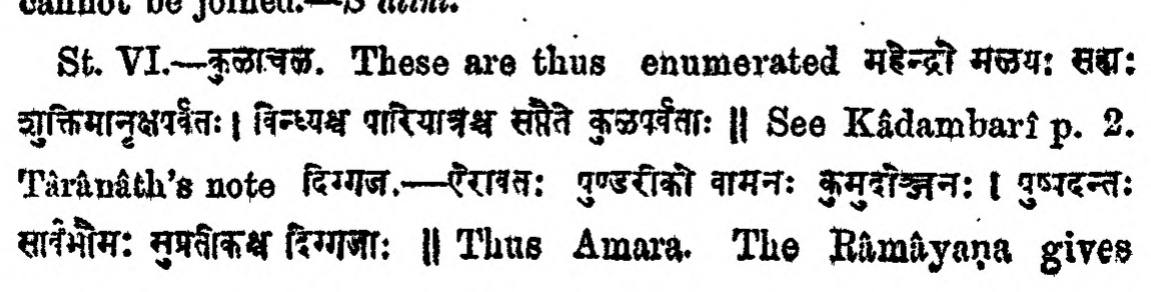
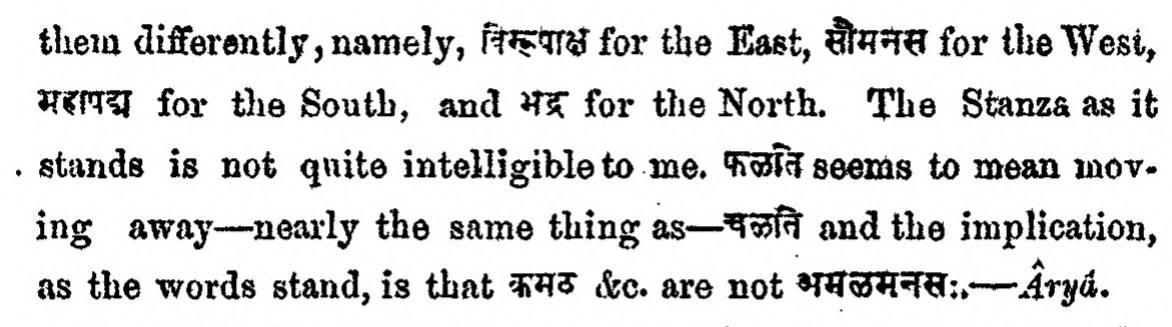
St. VI.—कुलाचल. These are thus enumerated महेन्द्रो मलयः सह्यः शुक्तिमानृक्षपर्वतः । विन्ध्यश्च पारियात्रश्च सप्तैते कुलपर्वताः ॥ See Kâdambarî p. 2. Târânâth's note दिग्गज.—ऐरावतः पुण्डरीको वामनः कुमुदोऽञ्जनः । पुष्पदन्तः सार्वभौमः सुप्रतीकश्च दिग्गजाः ॥ Thus Amara. The Râmâyaṇa gives them differently, namely, विरूपाक्ष for the East, सौमनस for the West, महापद्म for the South, and भद्र for the North. The Stanza as it stands is not quite intelligible to me. फलति seems to mean moving away—nearly the same thing as—चलति and the implication, as the words stand, is that कमठ &c. are not अमलमनसः.—Âryâ.
Kale
all

Translation
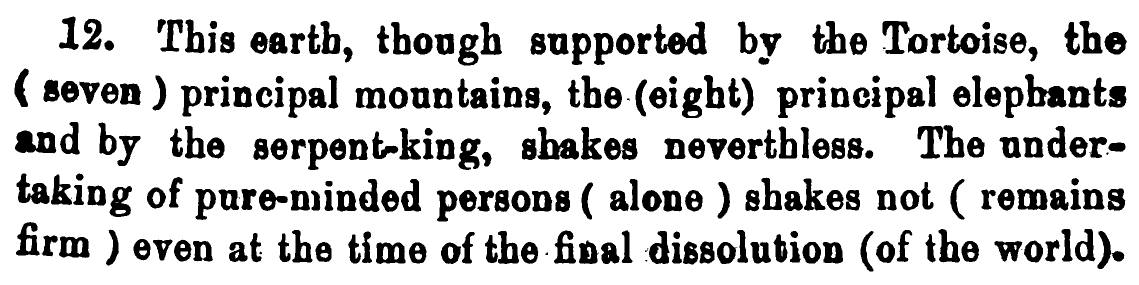
12. This earth, though supported by the Tortoise, the ( seven ) principal mountains, the (eight) principal elephants and by the serpent-king, shakes neverthless. The undertaking of pure-minded persons ( alone ) shakes not ( remains firm ) even at the time of the final dissolution (of the world).
Notes
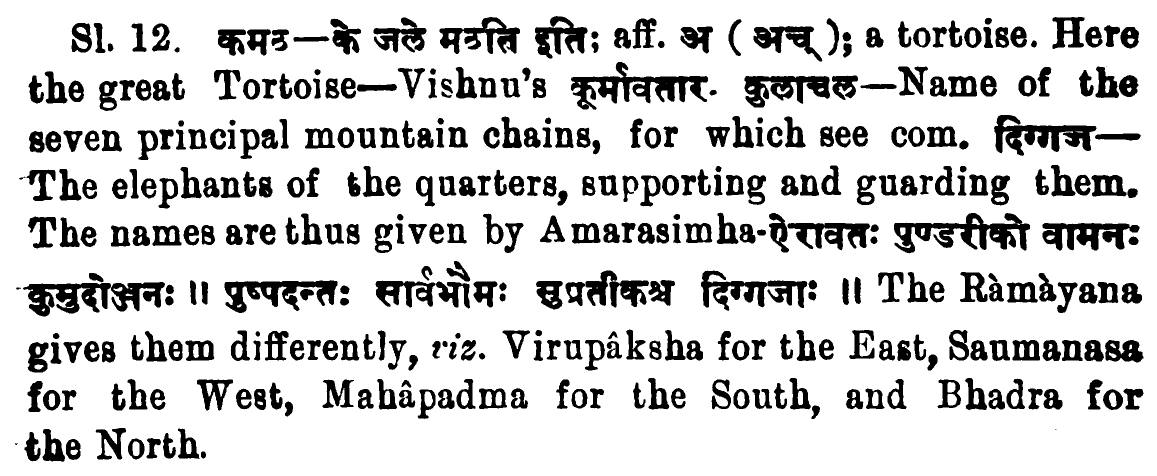
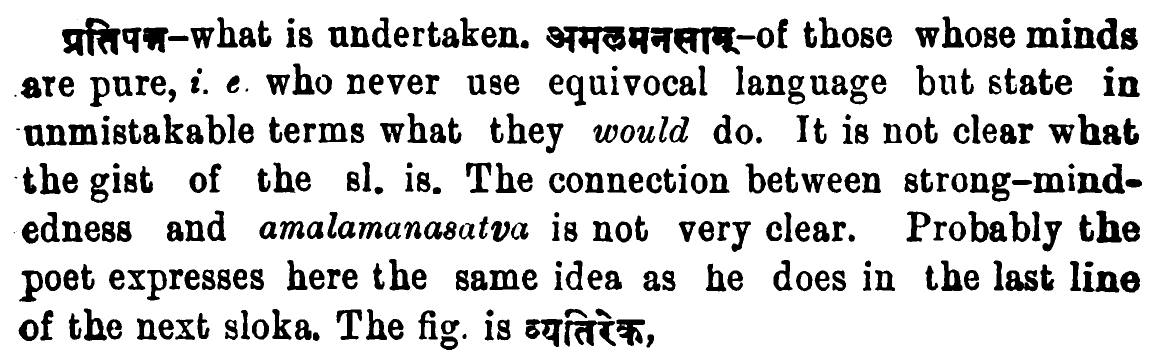
Sl. 12. कमठ—के जले मठति इति; aff. अ ( अच् ); a tortoise. Here the great Tortoise—Vishnu’s कूर्मावतार. कुलाचल—Name of the seven principal mountain chains, for which see com. दिग्गज— The elephants of the quarters, supporting and guarding them. The names are thus given by Amarasimha-ऐरावतः पुण्डरीको वामनः कुमुदोञ्जनः ॥ पुष्पदन्तः सार्वभौमः सुप्रतीकश्च दिग्गजाः ॥ The Ràmàyana gives them differently, viz. Virupâksha for the East, Saumanasa for the West, Mahâpadma for the South, and Bhadra for the North. प्रतिपन्न-what is undertaken. अमलमनसाम्-of those whose minds are pure, i. e. who never use equivocal language but state in unmistakable terms what they would do. It is not clear what the gist of the sl. is. The connection between strong-mindedness and amalamanasatva is not very clear. Probably the poet expresses here the same idea as he does in the last line of the next sloka. The fig. is व्यतिरेक,
Commentary