Tawney
Alms are not difficult to gain, great Rama showed the way;
The earth yields roots, the deer skin keeps the winter's cold away;
Whether we joy or grieve we're still of destiny the slaves;
Why should I leave the three-eyed god to court blind purse-proud knaves?
Telang
all
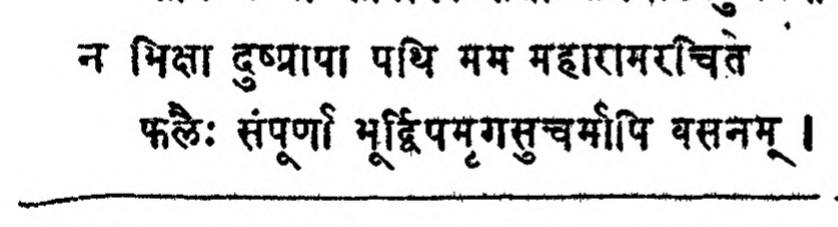
न भिक्षा दुष्प्रापा पथि मम महारामरचिते
फलैः संपूर्णा भूर्द्विपमृगसुचर्मापि वसनम् ।
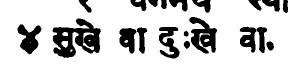
सुखैर्वा दुःखैर्वा सदृशपरिपाकः खलु तदा
त्रिनेत्रं कस्त्यक्त्वा धनलवमदान्धं प्रणमति ॥ २२ ॥

Notes
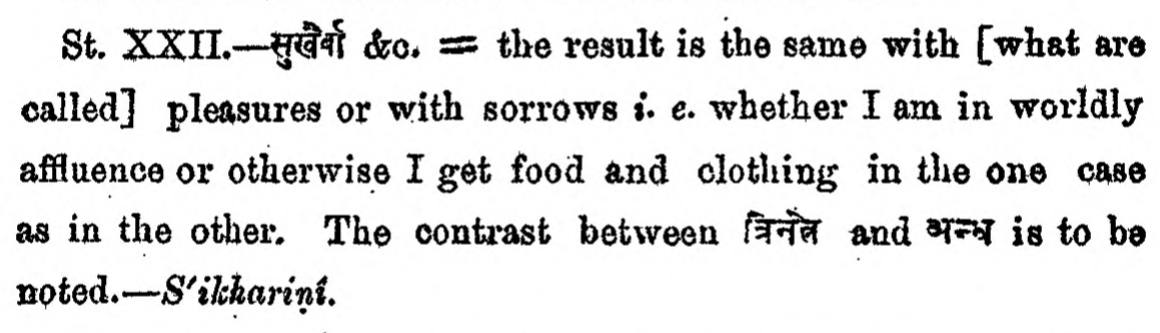
St. XXII.—सुखैर्वा &c. = the result is the same with [what are called] pleasures or with sorrows i. e. whether I am in worldly affluence or otherwise I get food and clothing in the one case as in the other. The contrast between त्रिनेत्र and अन्ध is to be noted.—S'ikhariṇî.


Kale
all
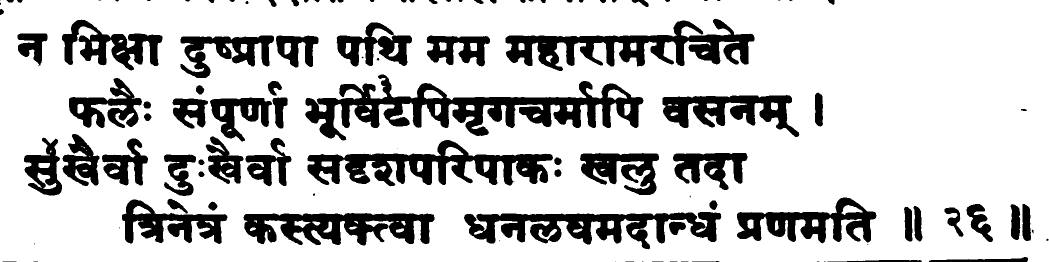
न भिक्षा दुष्प्रापा पथि मम महारामरचिते
फलैः संपूर्णा भूर्विटपिमृगचर्मापि वसनम् ।
सुखैर्वा दुःखैर्वा सदृशपरिपाकः खलु तदा
त्रिनेत्रं कस्त्यक्त्वा धनलवमदान्धं प्रणमति ॥ २६ ॥
Translation
26. Alms are not unattainable to me in my path lined by rich gardens; the earth is full of fruits, and the skins of deer and the barks of trees ( serve as ) raiment; with joys or with sorrows, there is in fact the same result. Who will then give up the Three-eyed God, and bow to the man blinded by pride for a particle of wealth ?

Notes
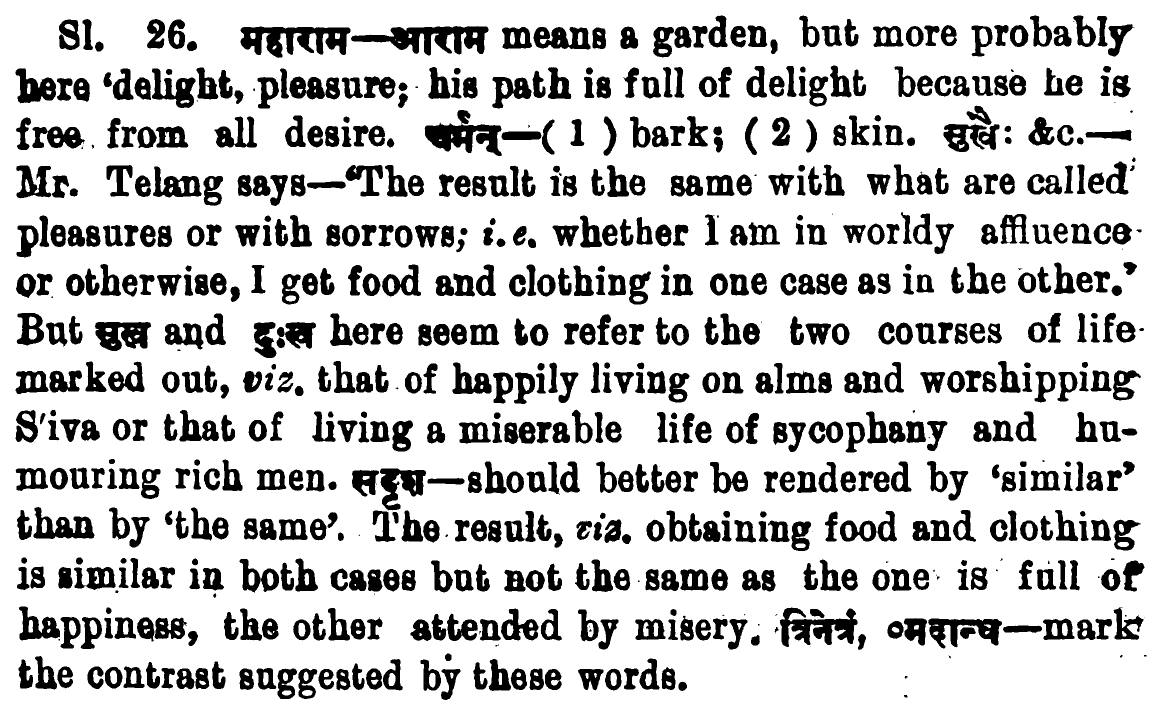
Sl. 26. महाराम—आराम means a garden, but more probably here ‘delight, pleasure; his path is full of delight because he is free from all desire. चर्मन्—( 1 ) bark; ( 2 ) skin. सुखैः &c.— Mr. Telang says—“The result is the same with what are called pleasures or with sorrows; i. e. whether I am in worldy affluence or otherwise, I get food and clothing in one case as in the other.’ But सुख and दुःख here seem to refer to the two courses of life marked out, viz. that of happily living on alms and worshipping S'iva or that of living a miserable life of sycophany and humouring rich men. सदृश—should better be rendered by ‘similar’ than by ‘the same’. The result, viz. obtaining food and clothing is similar in both cases but not the same as the one is full of happiness, the other attended by misery. त्रिनेत्रं, ०मदान्ध—mark the contrast suggested by these words.

Commentary