Tawney
God satisfies the snake with air,
Grass to the cows is food and bed,
Man's nobler soul is clogged with care,
Struggling to gain his daily bread.
Mādhavānanda
हिंसाशून्यमयत्नलभ्यमशनं धात्रा मरुत्कल्पितं
व्यालानां पशवस्तृणाङ्कुरभुजस्तुष्टा: स्थलीशायिन: ।
संसारार्णवलङ्घनक्षमधियां वृत्ति: कृता सा नृणां
तामन्वेषयतां प्रयान्ति सततं सर्वे समाप्तिं गुणा: ।।९७।।
97. (If) for serpents (even) air has been provided by the Creator as food obtainable without killing or toiling; (if) beasts are contented with feeding on grass-sprouts and lying on ground; for men (also) with intelligence strong enough to lead across the ocean of transmigratory existence, some such livelihood has been created; and those who seek this have all their guṇas invariably brought to their final dissolution.
[When the guṇas—sattva, rajas, and tamas—are finally reduced to the inactivity of equipoise, the yogī reaches beyond māyā.
The last line may also be interpreted differently—‘But in rummaging for it all one’s virtues are apt to come to an end.’]
Telang
all
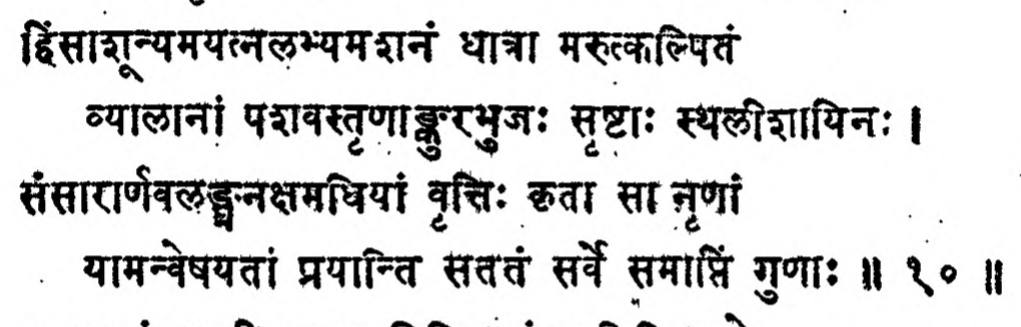
हिंसाशून्यमयत्नलभ्यमशनं धात्रा मरुत्कल्पितं
व्यालानां पशवस्तृणाङ्कुरभुजः सृष्टाः स्थलीशायिनः ।
संसारार्णवलङ्घनक्षमधियां वृत्तिः कृता सा नृणां
यामन्वेषयतां प्रयान्ति सततं सर्वे समाप्तिं गुणाः ॥ १० ॥
Notes
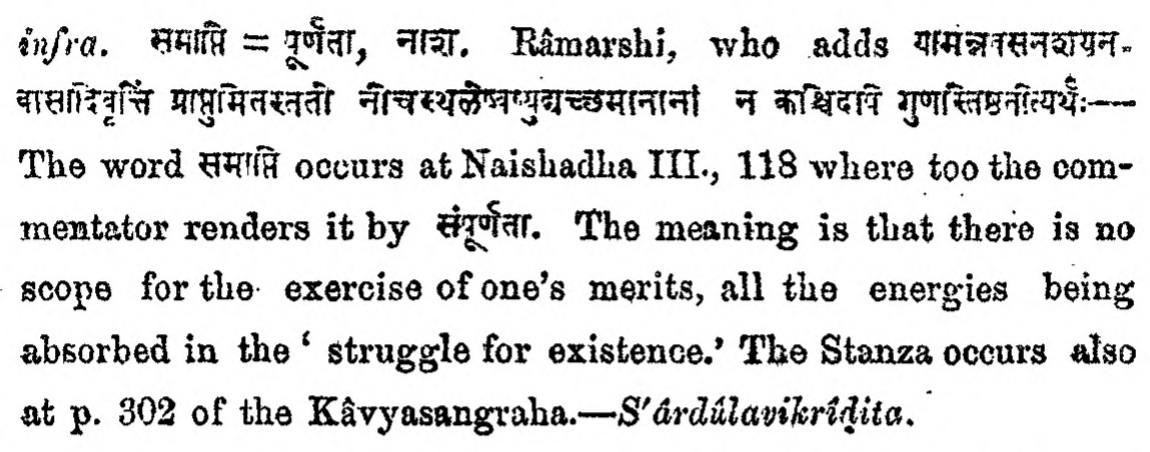
St. X.—व्यालानां मरुदशनं कल्पितम् — one of the synonymes given by Amara of सर्प is पवनाशनः. वृत्तिः = mode of living. Comp. St. 59 infra. समाप्ति = पूर्णता, नाश. Râmarshi, who adds यामन्नवसनशयनवासादिवृत्तिं प्राप्तुमितस्ततो नीचस्थलेष्वप्युद्यच्छमानानां न कश्चिदपि गुणस्तिष्ठतीत्यर्थः— The word समाप्ति occurs at Naishadha III., 118 where too the commentator renders it by संपूर्णता. The meaning is that there is no scope for the exercise of one's merits, all the energies being absorbed in the ‘ struggle for existence.’ The Stanza occurs also at p. 302 of the Kâvyasangraha.—S'ârdûlavikrîḍita.


Kale
all

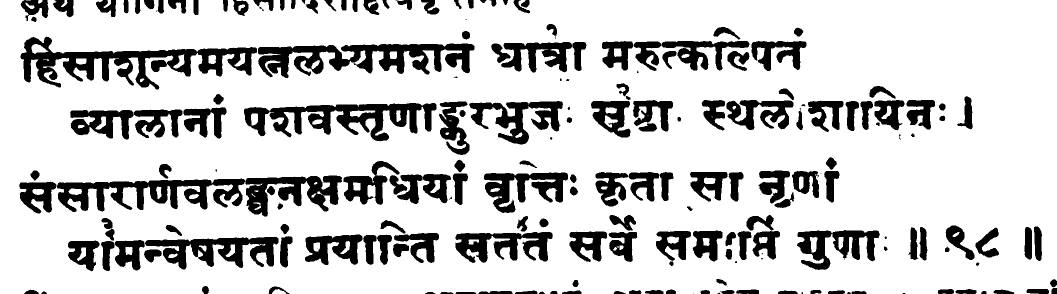
हिंसाशून्यमयत्नलभ्यमशनं धात्रा मरुत्कल्पितं
व्यालानां पशवस्तृणाङ्कुरभुजः सृष्टाः स्थलीशायिनः ।
संसारार्णवलङ्घनक्षमधियां वृत्तिः कृता सा नृणां
यामन्वेषयतां प्रयान्ति सततं सर्वे समाप्तिं गुणाः ॥ ९८ ॥
Translation
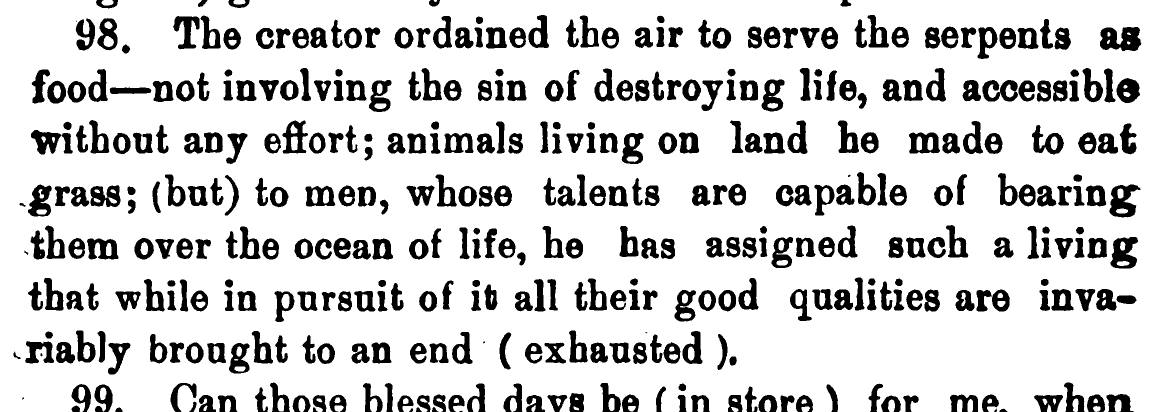
98. The creator ordained the air to serve the serpents as food—not involving the sin of destroying life, and accessible without any effort; animals living on land he made to eat grass; (but) to men, whose talents are capable of bearing them over the ocean of life, he has assigned such a living that while in pursuit of it all their good qualities are invariably brought to an end ( exhausted ).
Notes
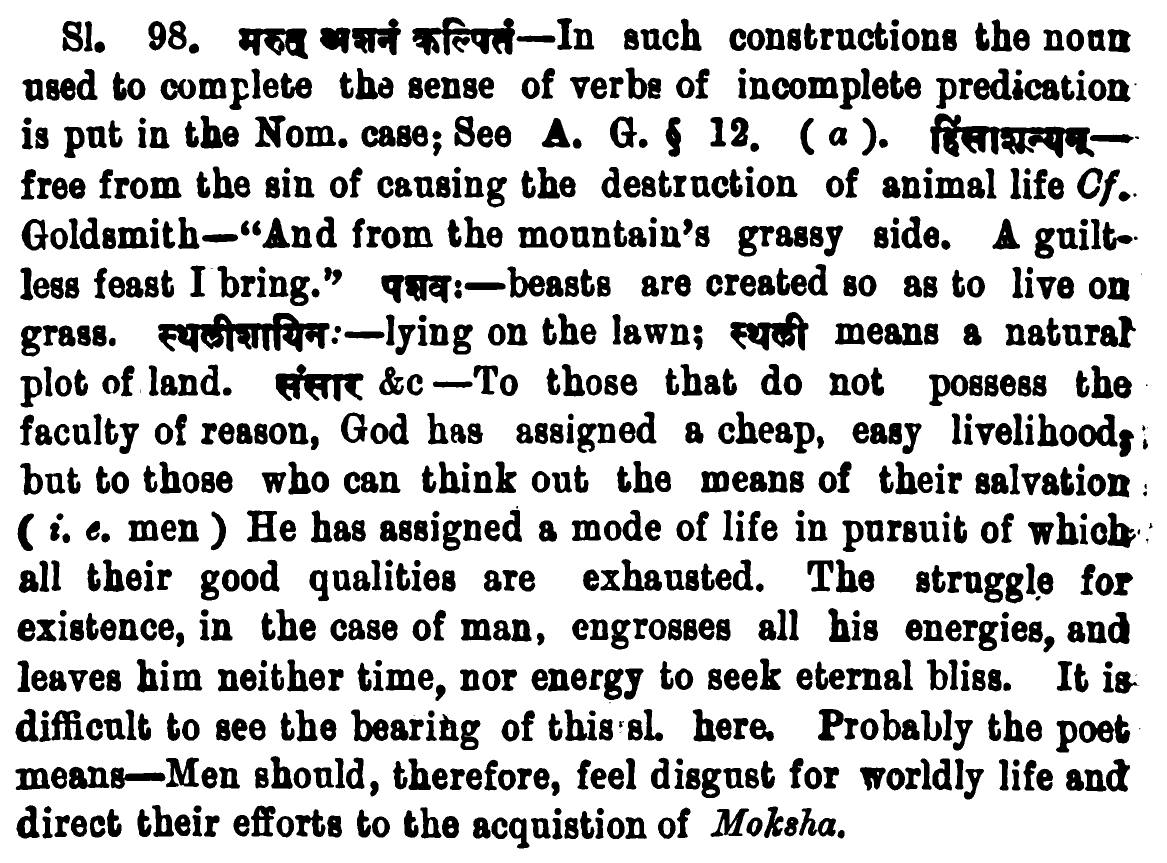
Sl. 98. मरुत् अशनं कल्पितं—In such constructions the noun used to complete the sense of verbs of incomplete predication is put in the Nom. case; See A. G. § 12. ( a ). हिंसाशून्यम्— free from the sin of causing the destruction of animal life Cf. Goldsmith—“And from the mountain’s grassy side. A guiltless feast I bring.” पशवः—beasts are created so as to live on grass. स्थलीशायिनः—lying on the lawn; स्थली means a natural plot of land. संसार &c —To those that do not possess the faculty of reason, God has assigned a cheap, easy livelihood; but to those who can think out the means of their salvation ( i. e. men ) He has assigned a mode of life in pursuit of which all their good qualities are exhausted. The struggle for existence, in the case of man, engrosses all his energies, and leaves him neither time, nor energy to seek eternal bliss. It is difficult to see the bearing of this sl. here. Probably the poet means—Men should, therefore, feel disgust for worldly life and direct their efforts to the acquistion of Moksha.




Gopinath1914
all
हिंसाशून्यमयत्न लभ्यमशनं धात्रा मरुत्कल्पि-
तं व्यालानां पशवस्तृणाङ्करभुजः सृष्टाः
स्थलीशायिनः ॥ संसारार्णवलनक्षमधियां
वृत्तिः कृता सा नृणां यामन्वेषयतां प्रयान्ति
सततं सर्वे समाप्तिं गुणाः ॥ १० ॥
विधाताने सर्पोंके लिए पवनका भक्षण कैसा नियत किया है कि जिसे हिंसा करनेके बिना वह सहजहीमें लाभ कर सकते हैं, और इसही प्रकार पशुओंको भी तृणका भक्षण करनेवाले और ज़मीनपर शयन करनेवाले बनाए हैं कि जिससे उनको किसी तरहका कष्ट नहीं होता, परंतु संसारसमुद्रकातरण करनेकी सामर्थ्य रखनेवाले मनुष्यों की वृत्ति विधाताने ऐसी दुर्लभ बनाई है कि जिसके संपादन करनेमें इनके सारे गुण समाप्त हो जाते हैं ॥ १० ॥
Snakes are made to live on air which is obtained very easily, and without causing the least harm to other creatures; cattle are made to live on grass and lie down on bare earth; but the food of man whose intellect can enable him to cross over the worldly ocean is made so difficult of attainment that all his abilities are generally of little avail to find it out.



Gopinath1896
all
हिंसाशून्यमयत्न लभ्यमशनं धात्रामरुत्कल्पि
तं, व्यालानां पशवस्तृणाङ्करभुजः सृष्टाः
स्थलीशायिनः । संसारार्णवलङ्घनक्षमधियां
वृत्तिः कृता सा नृणां या मन्वेषयतां प्रयान्ति
सततं सर्वे समाप्ति गुणाः ॥ १० ॥
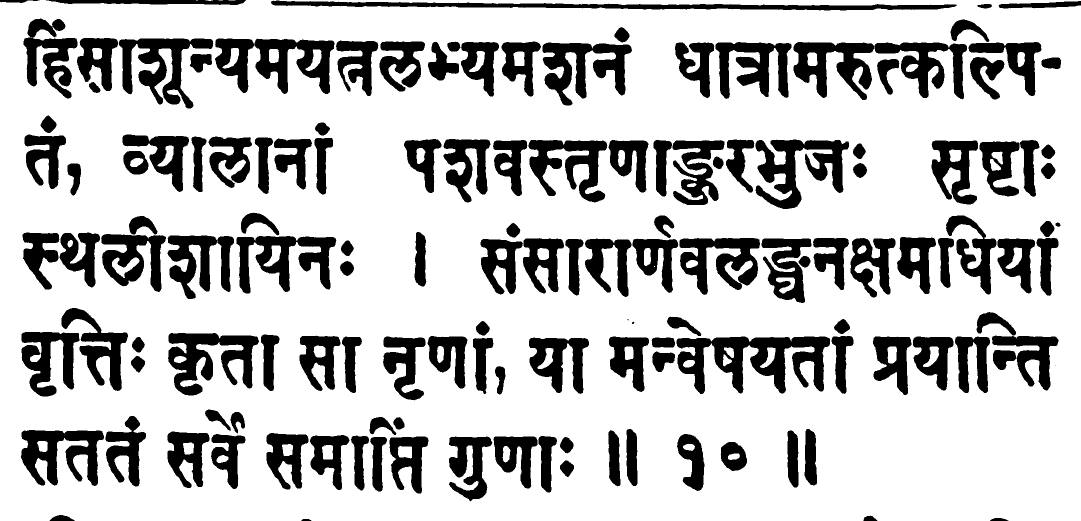
विधाताने सर्पों के लिए पवन का भक्षण कैसा नियत किया है कि जिसे हिंसा करने के बिना वह सहनही में लाभ कर सकते हैं, और इसही प्रकार पशुओं को भी तृणका भक्षण करनेवाले और ज़मीनपर शयन करनेवाले बनाए हैं कि जिससे उनको किसी तरहका कष्ट नहीं होता, परंतु संसार समुद्र का तरण करने की सामर्थ्य रखनेवाले मनुष्यों की वृत्ति विधाताने ऐसी दुर्लभ बनाई है कि जिसके संपादन करने में इनके सारेगुण समाप्त होजाते हैं ॥ १० ॥
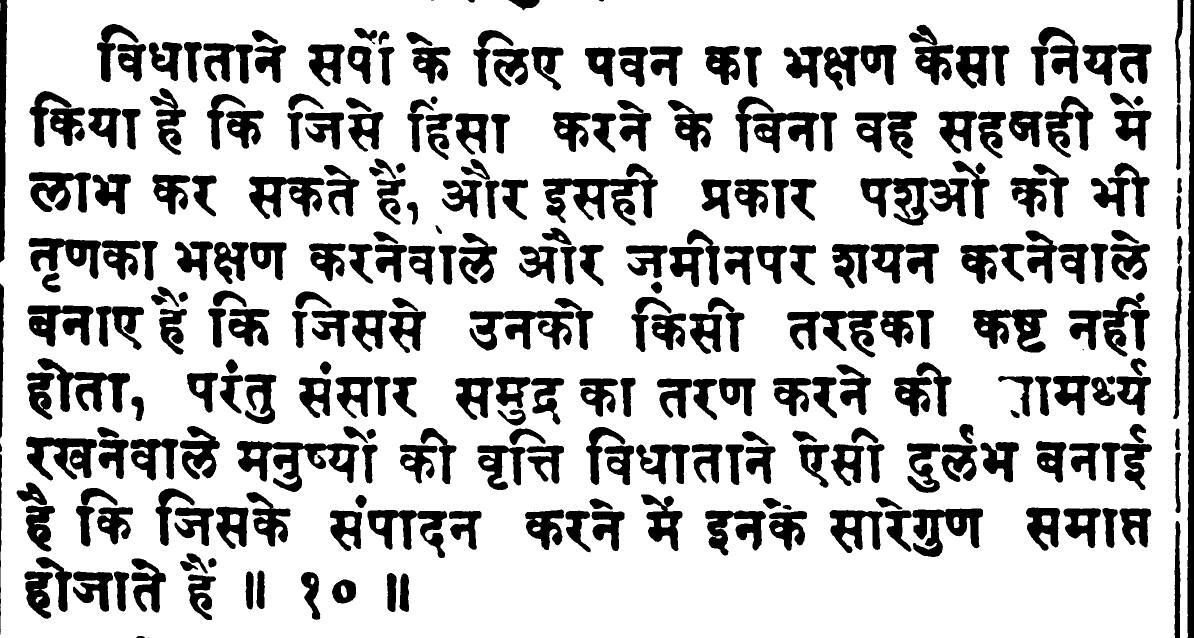
Snakes are made to live on air which is obtained very easily, and without causing the least harm to other creatures; cattle are made to live on grass and lie down on bare earth; but the food of man whose intellect can enable him to cross over the worldly ocean is made so difficult of attainment that all his abilities are generally of little avail to find it out.

Kosambi
all
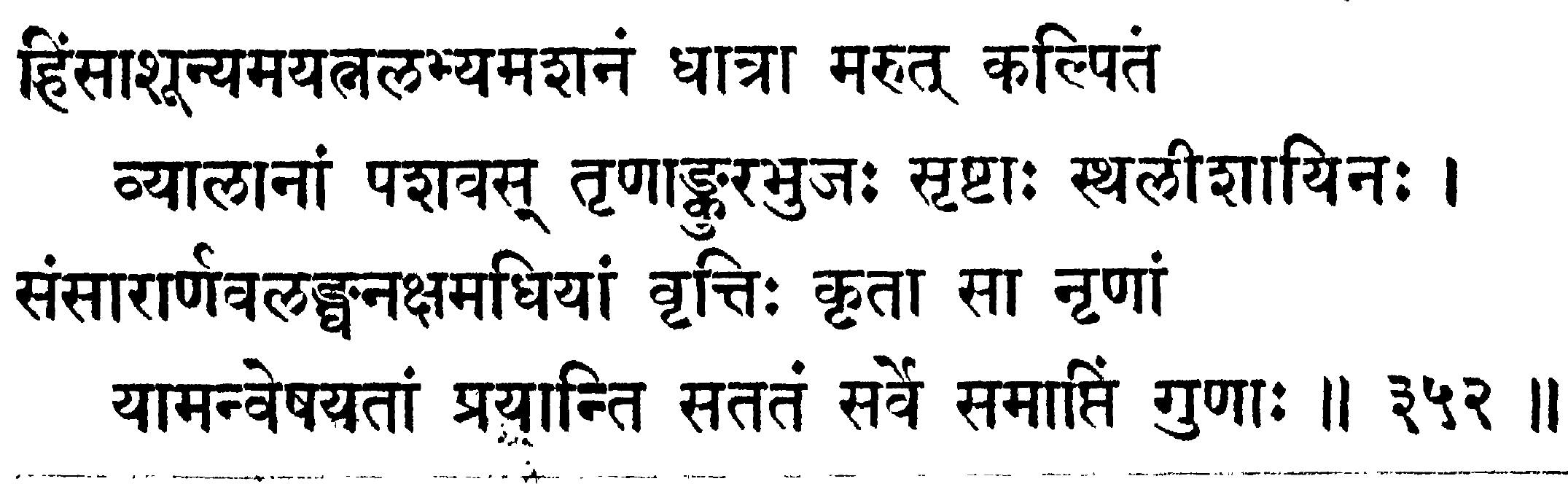
हिंसाशून्यमयत्नलभ्यमशनं धात्रा मरुत् कल्पितं
व्यालानां पशवस् तृणाङ्कुरभुजः सृष्टाः स्थलीशायिनः ।
संसारार्णवलङ्घनक्षमधियां वृत्तिः कृता सा नृणां
यामन्वेषयतां प्रयान्ति सततं सर्वे समाप्ति गुणाः ॥ ३५२ ॥
Footnote
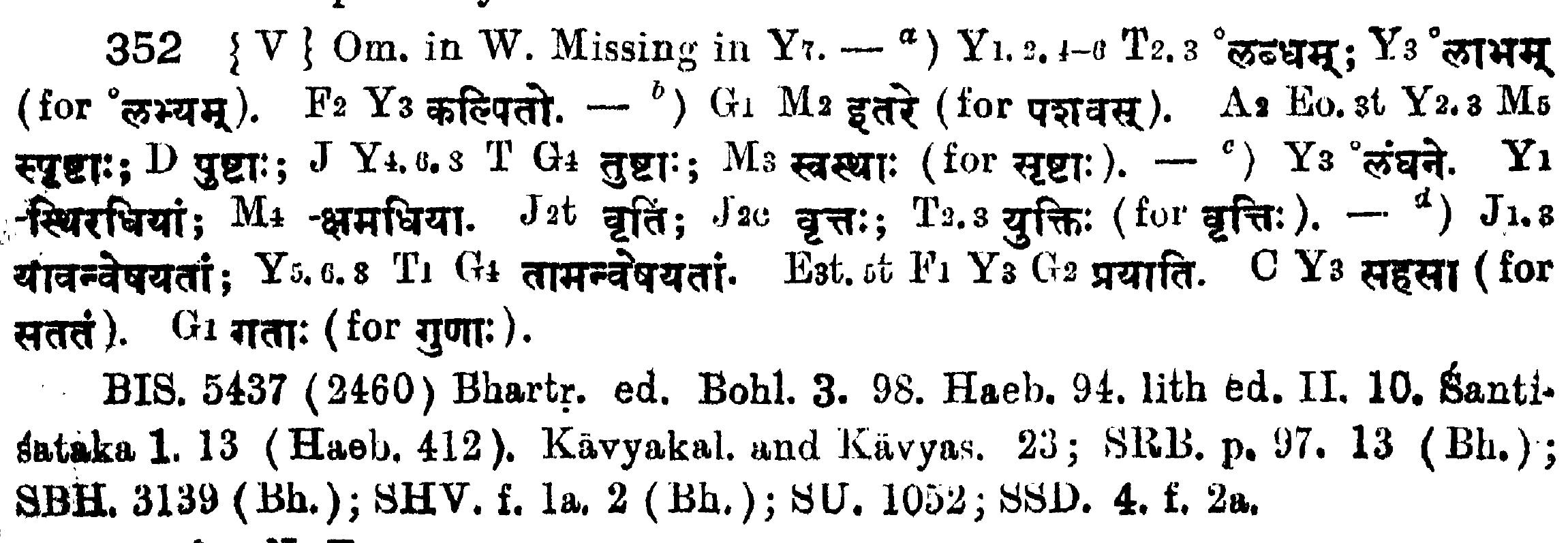
352 { V } Om . in W. Missing in Yr . “ ) Y1 . 2. 1–5 T2 . 3 ° लब्धम् ; Y3 लाभम्
( for ' लभ्यम् ) . F2 Y3 कल्पितो . 6 ) G 1 M 3 इतरे ( for पशवस् ) . Aa Eo . st Y2.3 Ms
स्पृष्टाः ; D पुष्टाः ; J Y 4 , 6.3 T G + तुष्टाः ; Ms स्वस्था : ( for सृष्टाः ) . " ) Y3 लंघने . Y1
स्थिरधियां ; M1 - क्षमधिया . Jat वृतिं ; J20 वृत्तः ; T2.3 युक्तिः ( for वृत्तिः ) . – 4 ) J1.8
यावन्वेषयतां ; Y.6.8 T1 G1 तामन्वेषयतां • Est at F1 Y3 G2 प्रयाति . CY3 सहसा ( for
सततं ) . G1 गताः ( for गुणाः ) .
BIS . 5437 ( 2460 ) Bhartr . ed . Bohl . 3. 98. Haeb , 94 lith ed . II . 10. Santi .
śataka 1. 13 ( Haeb . 412 ) . Kävyakal . and Kävyas . 23 ; SRB . p . 97. 13 ( Bh . ) ;
SBH . 3139 ( Bh . ) ; SHVf la , 2 ( Bh . ) ; SU . 1052 ; SSD . 4 , f , 2
Commentary