Tawney
When shall I bathe in Ganga's stream and please Thee, Lord, with fruits and flowers,
Thinking of that one worthy theme, on beds of stone through midnight hours,
Honouring my Father in the faith, striving to lift my heart above?
When shall I fling my woes aside? Help me, thou enemy of Love.
Mādhavānanda
स्नात्वा गाङ्गै: पयोभि: शुचिकुसुमफलैरर्चयित्वा विभो त्वां
ध्येये ध्यानं निवेश्य क्षितिधरकुहरग्रावपर्यङ्कमूले ।
आत्माराम: फलाशी गुरुवचनरतस्त्वत्प्रसादात्स्मरारे
दु:खं मोक्ष्ये कदाहं समकरचरणे पुंसि सेवासमुत्थम् ।।८८।।
88. Having bathed in the waters of the Gaṅgā and worshipped Thee, O Lord, with unblemished fruits and flowers and having concentrated my mind, by my stony bed within the mountain cave, on the object of my meditation—blissful in the Self alone, living on fruits, and devoted to the guru’s words—when shall I, O Thou Enemy of Cupid, through Thy grace become released from the grief which has arisen from my serving the man of prosperity?
[समकरचरणे—‘With the sign of a shark in the feet’, said to be a sign of uncommon prosperity according to the science of divination by bodily signs.]
Telang
all
स्नात्वा गाङ्गैः पयोभिः शुचिकुसुमफलैरर्चयित्वा विभो त्वां
ध्येये ध्यानं नियोज्य क्षितिधरकुहरग्रावपर्यङ्कमूले ।
आत्मारामः फलाशी गुरुवचनरतस्त्वत्प्रसादात्स्मरारे
दुःखान्मोक्ष्ये कदाहं तव चरणरतो ध्यानमार्गैकप्रश्नः ॥ ९३ ॥


Notes
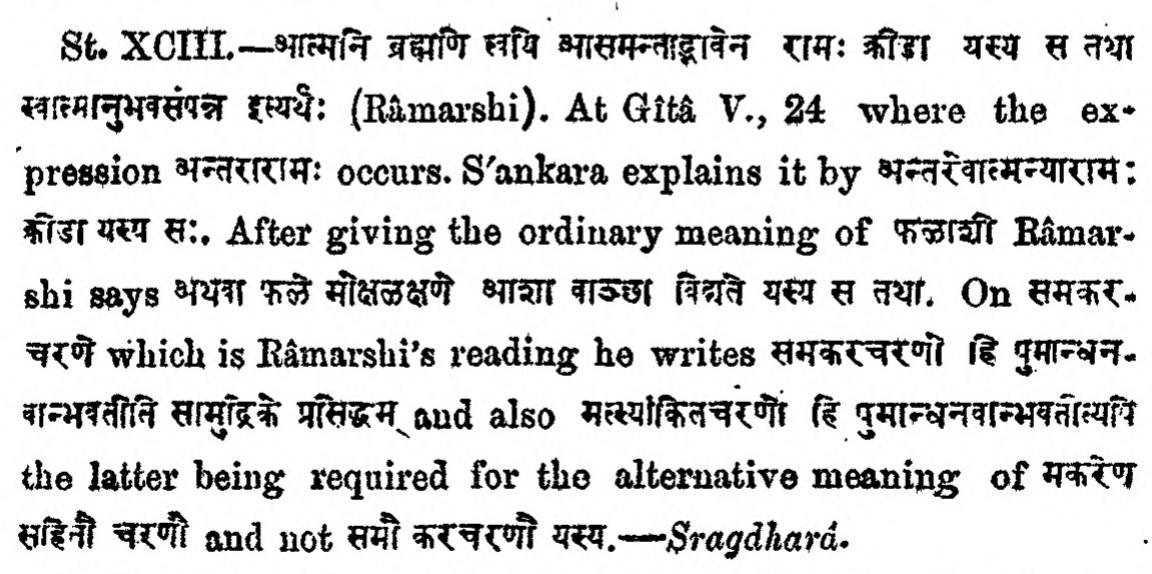
St. XCIII.—आत्मनि ब्रह्मणि त्वयि आसमन्ताद्भावेन रामः क्रीडा यस्य स तथा स्वात्मानुभवसंपन्न इत्यर्थः (Râmarshi). At Gîtâ V., 24 where the expression अन्तरारामः occurs. S'ankara explains it by अन्तरेवात्मन्यारामः क्रीडा यस्य सः. After giving the ordinary meaning of फलाशी Râmarshi says अथवा फले मोक्षलक्षणे आशा वाञ्छा विद्यते यस्य स तथा. On समकरचरणे which is Râmarshi's reading he writes समकरचरणो हि पुमान्धनवान्भवतीति सामुद्रिके प्रसिद्धम् and also मत्स्यांकितचरणो हि पुमान्धनवान्भवतीत्यपि the latter being required for the alternative meaning of मकरेण सहितौ चरणौ and not समौ करचरणौ यस्य.—Sragdharâ.


Kale
all
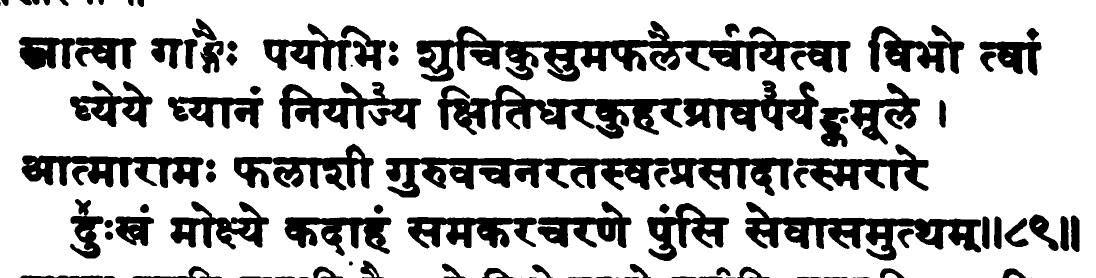
स्नात्वा गाङ्गैः पयोभिः शुचिकुसुमफलैरर्चयित्वा विभो त्वां
ध्येये ध्यानं नियोज्य क्षितिधरकुहरग्रावपर्यङ्कमूले ।
आत्मारामः फलाशी गुरुवचनरतस्त्वत्प्रसादात्स्मरारे
दुःखं मोक्ष्ये कदाहं समकरचरणे पुंसि सेवासमुत्थम्॥८९॥
Translation
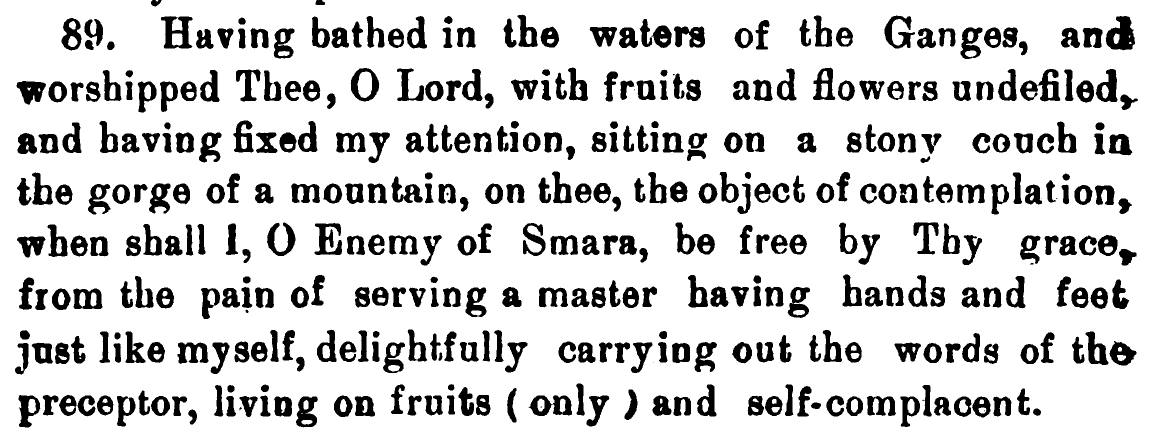
89. Having bathed in the waters of the Ganges, and worshipped Thee, O Lord, with fruits and flowers undefiled, and having fixed my attention, sitting on a stony couch in the gorge of a mountain, on thee, the object of contemplation, when shall I, O Enemy of Smara, be free by Thy grace, from the pain of serving a master having hands and feet just like myself, delightfully carrying out the words of the preceptor, living on fruits ( only ) and self-complacent.
Notes
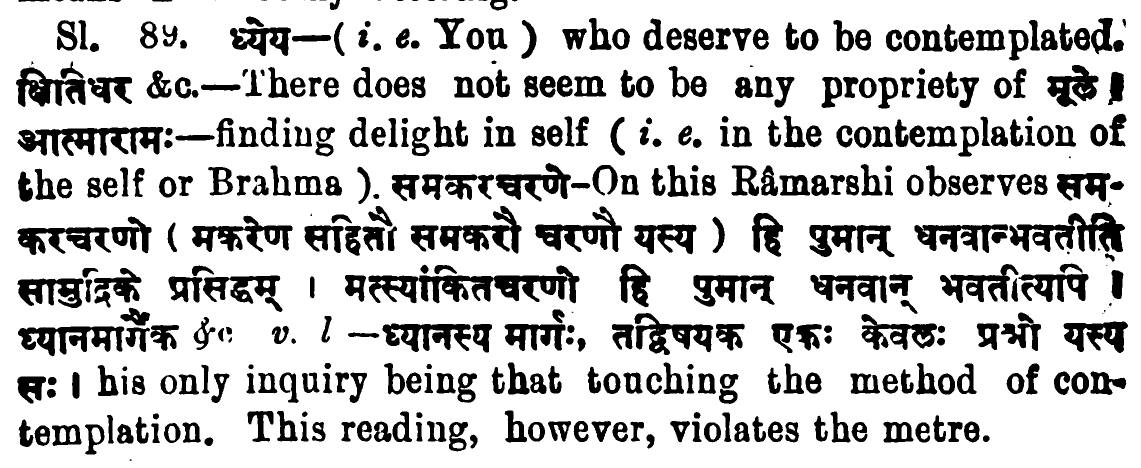
Sl. 89. ध्येय—( i. e. You ) who deserve to be contemplated. क्षितिधर &c.—There does not seem to be any propriety of मूले । आत्मारामः—finding delight in self ( i. e. in the contemplation of the self or Brahma ). समकरचरणो–On this Râmarshi observes समकरचरणो ( मकरेण सहितौ समकरौ चरणौ यस्य ) हि पुमान् धनवान्भवतीति सामुद्रिके प्रसिद्धम् । मत्स्यांकितचरणो हि पुमान् धनवान् भवतीत्यपि । ध्यानमार्गैक &c v. l —ध्यानस्य मार्गः, तद्विषयक एकः केवलः प्रश्नो यस्य सः । his only inquiry being that touching the method of contemplation. This reading, however, violates the metre.


Gopinath1914
all
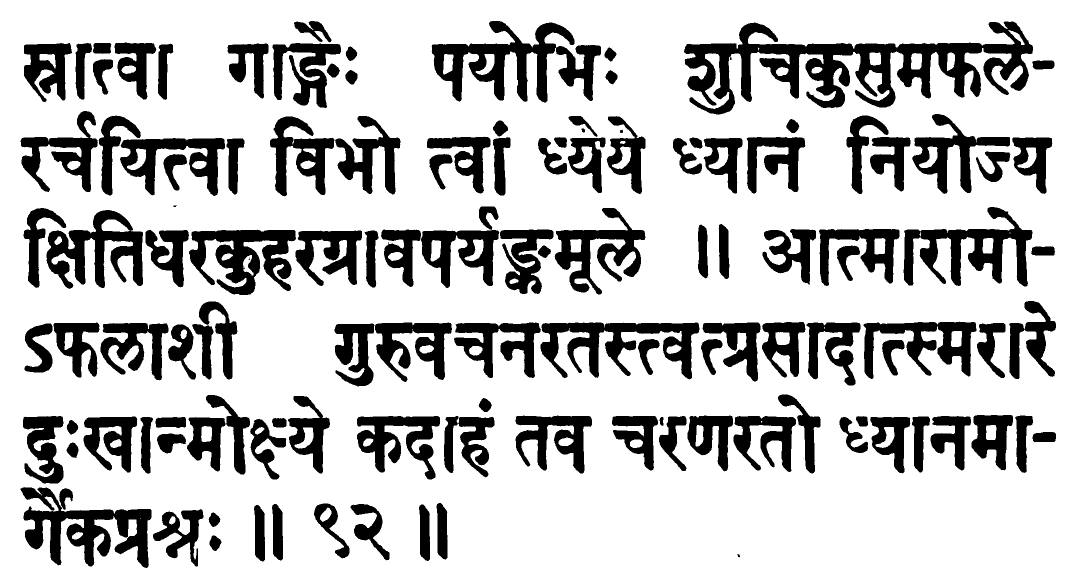
स्नात्वा गाङ्गैः पयोभिः
रर्चयित्वा विभो त्वां ध्येये शुचिकुसुमफलै- ध्यानं नियोज्य
क्षितिधरकुहरयावपर्यङ्कमूले ॥ आत्मारामो-
sफलाशी गुरुवचनरतस्त्वत्प्रसादात्स्मरारे
दुःखान्मोक्ष्ये कदाहं तव चरणरतो ध्यानमा-
कप्रश्नः ॥ ९२ ॥
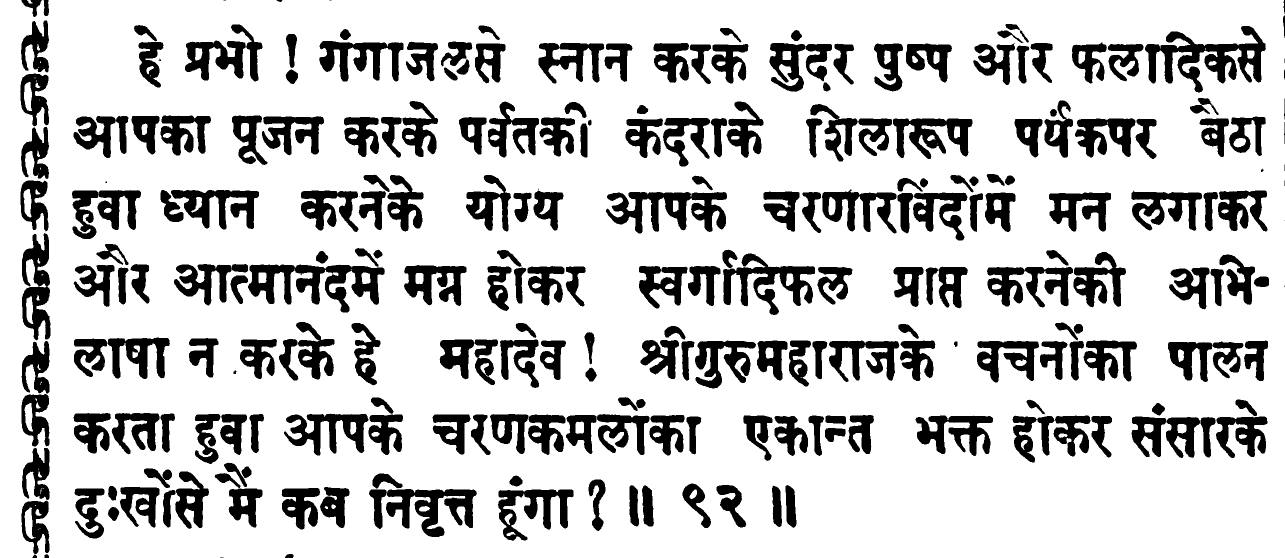
हे प्रभो ! गंगाजल से स्नान करके सुंदर पुष्प और फलादिकसे आपका पूजन करके पर्वतकी कंदराके शिलारूप पर्यकपर बैठा हुवा ध्यान करनेके योग्य आपके चरणारविंदों में मन लगाकर और आत्मानंदमें मग्न होकर स्वर्गादिफल प्राप्त करनेकी अभि लाषा न करके हे महादेव ! श्रीगुरुमहाराजके वचनोंका पालन करता हुवा आपके चरणकमलोंका एकान्त भक्त होकर संसारके दुःखोंसे मैं कब निवृत्त हूंगा ? ॥ ९२ ॥
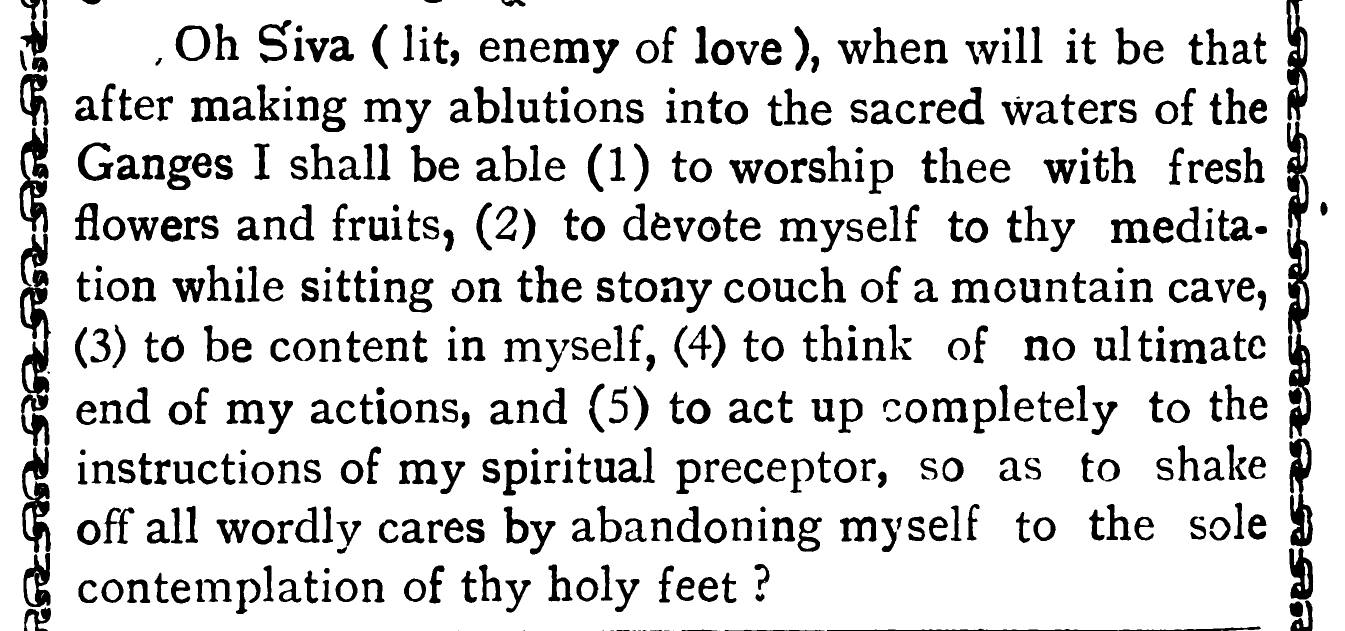
Oh Siva ( lit, enemy of love), when will it be that after making my ablutions into the sacred waters of the Ganges I shall be able (1) to worship thee with fresh flowers and fruits, ( 2 ) to devote myself to thy medita tion while sitting on the stony couch of a mountain cave, (3) to be content in myself, (4) to think of no ultimate end of my actions, and (5) to act up completely to the instructions of my spiritual preceptor, so as to shake off all wordly cares by abandoning myself to the sole contemplation of thy holy feet?


Gopinath1896
all
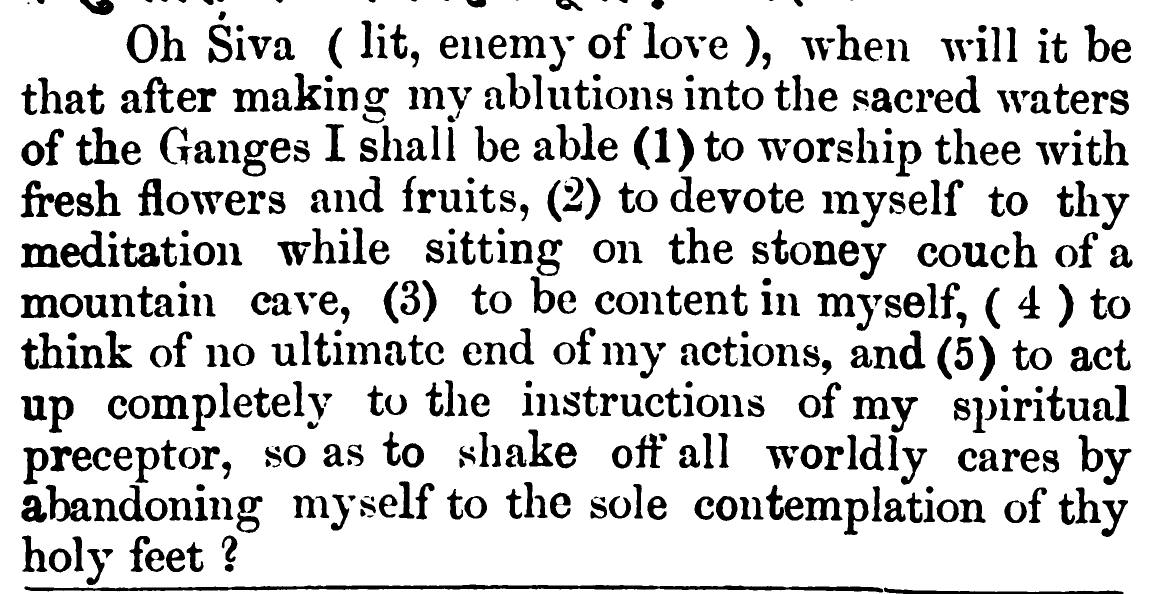
स्वात्वा गानैः पयोभिः शुचिकुसुमफलै
रर्चयित्वा विभो त्वां ध्येये घ्यानं नियोज्य
क्षितिधरकुहरयावपर्यङ्कमूले । आत्मारामो
Sफलाशी गुरुवचनरतस्त्वत्प्रसादात्स्मरारे
दुःखान्मोक्ष्ये कदाहं तवचरणरतो ध्यानमा-
गैकप्रश्नः ॥ ९२ ॥
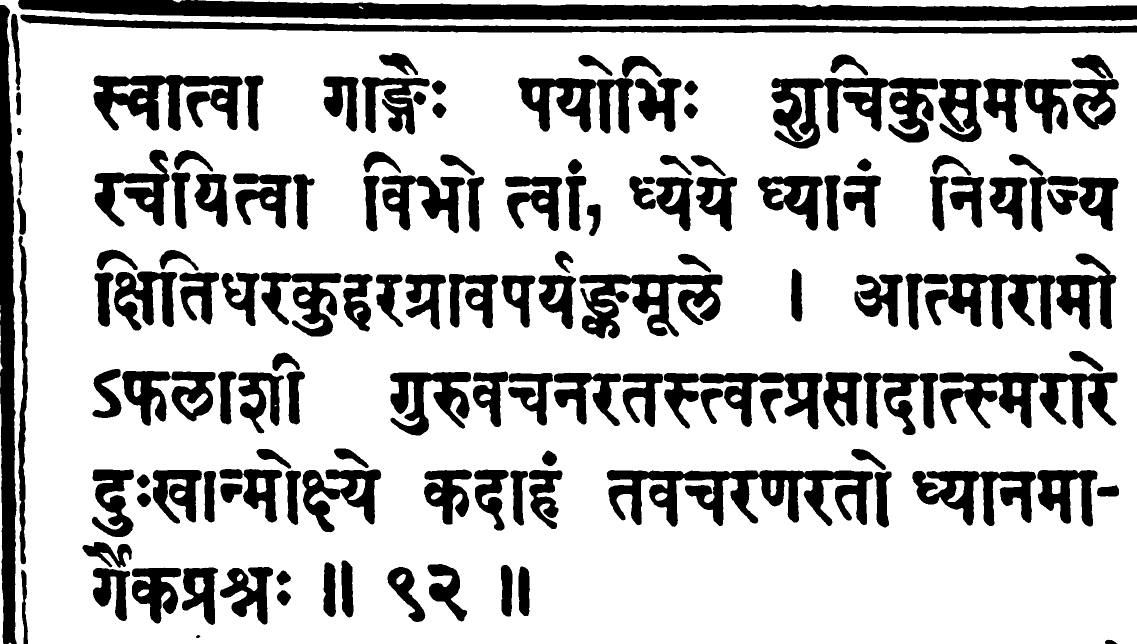
हे प्रभो ! गंगाजल से स्नान करके सुंदर पुष्प और फलादिकसे आपका पूजन करके पर्वतकी कंदराके शिलारूप पर्यकपर बैठाडुवा ध्यान करनेके योग्य आपके चरणारविंदों में मन लगाकर और आत्मानंदमें मम होकर स्वर्गादिफल प्राप्त करनेकी अभिलाषा न करके हे महादेव ! श्रीगुरु महाराजके वचनोंका पालन करता हुवा आपके चरणकमलोंका एकान्त भक्त होकर संसार के दुःखों से मैं कब निवृत्त हूंगा ! ॥ ९२ ॥
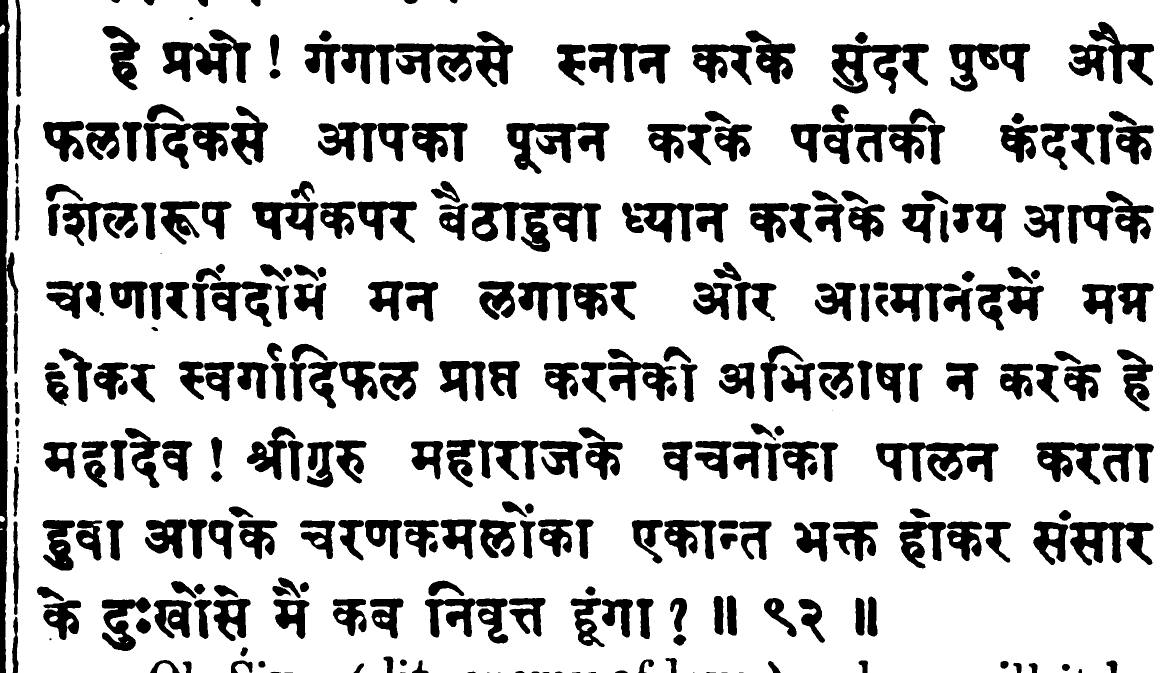
Oh Siva ( lit, enemy of love ), when will it be that after making my ablutions into the sacred waters of the Ganges I shall be able (1) to worship thee with fresh flowers and fruits, (2) to devote myself to thy meditation while sitting on the stoney couch of a mountain cave, (3) to be content in myself, ( 4 ) to think of no ultimate end of my actions, and (5) to act up completely to the instructions of my spiritual preceptor, so as to shake off all worldly cares by abandoning myself to the sole contemplation of thy holy feet?


Kosambi
all
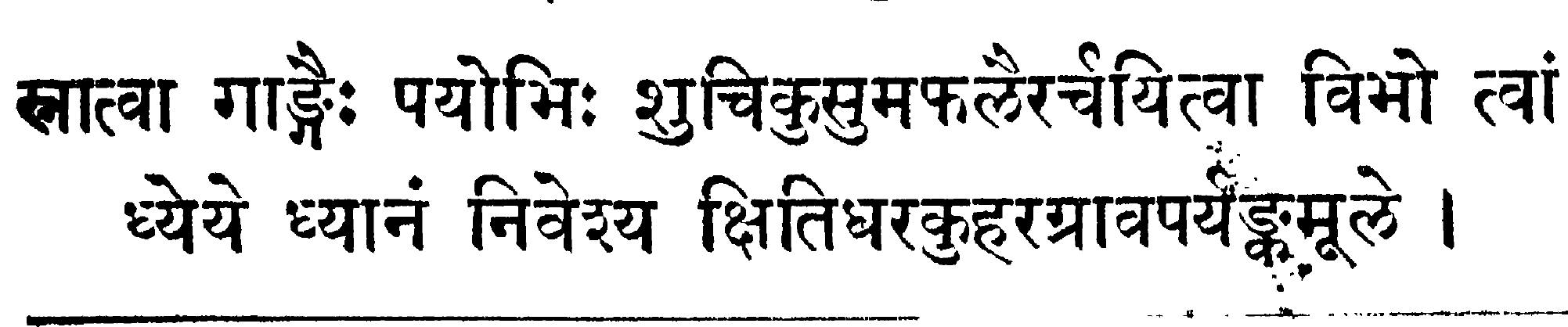
स्नात्वा गाङ्गैः पयोभिः शुचिकुसुमफलैरर्चयित्वा विभो त्वां
ध्येये ध्यानं निवेश्य क्षितिधरकुहरग्रावपर्यंङ्कमूले ।
आत्मारामः फलाशी गुरुवचनरतस् त्वत्प्रसादात् स्मरारे
दुःखं मोक्ष्ये कदाहं समकरचरणे पुंसि सेवासमुत्थम् ॥ ३४५ ॥

Footnote
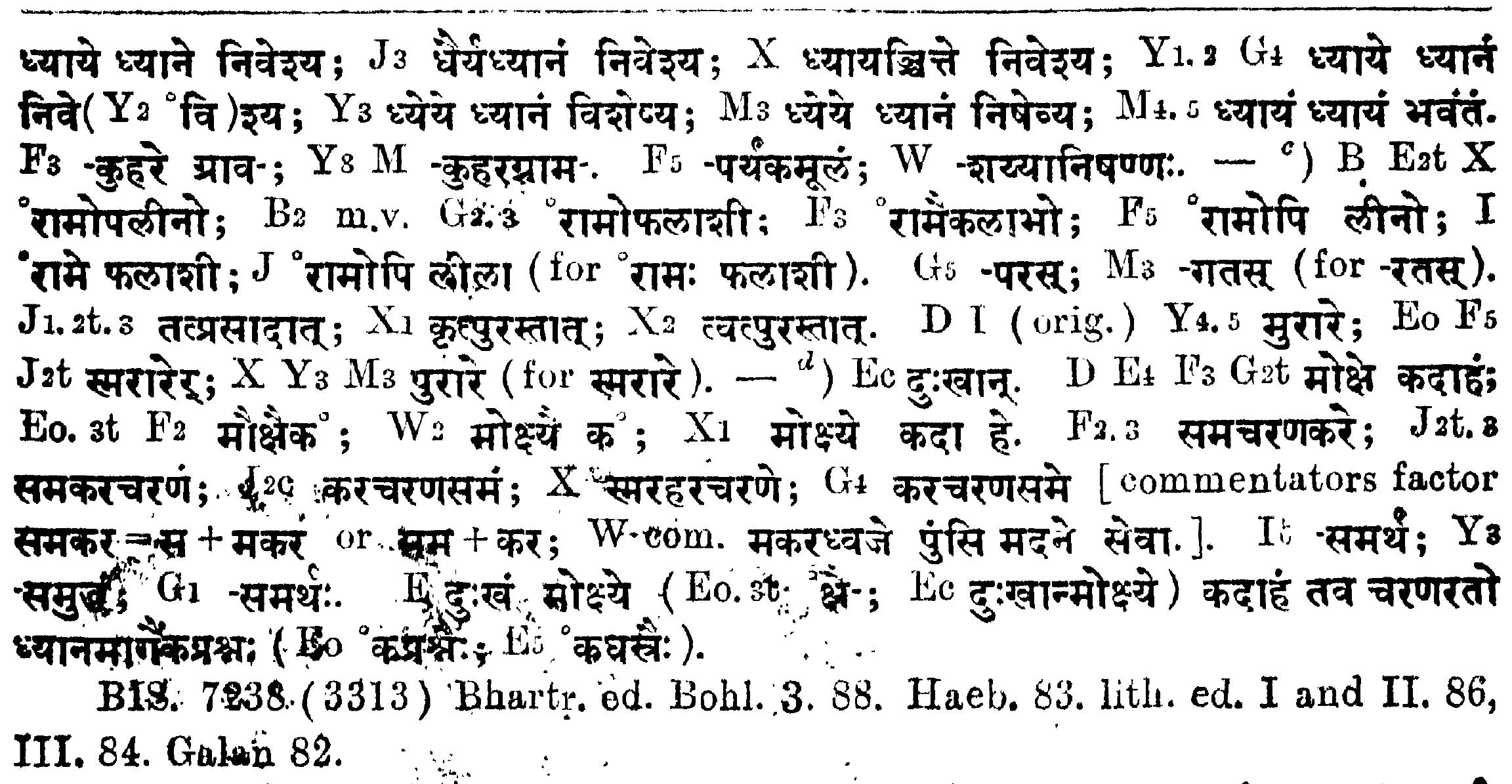
ध्याये ध्याने निवेश्य ; J3 धैर्यध्यानं निवेश्य ; X ध्यायचित्ते निवेश्य ; Y1.3 G + ध्याये ध्यानं
निवे ( Y2 ° वि ) श्य ; Y3 ध्येये ध्यानं विशेष्य ; Ms ध्येये ध्यानं निषेव्य ; M. ध्यायं ध्यायं भवंतं .
F3 - कुहरे ग्राव ; Ys M - कुहरनाम F० - पर्यकमूलं ; W शय्यानिषण्णः . ° ) BEat X
' रामोपलीनो ; B2 m.v. Gas रामोफलाशी : 3 रामकलाभो ; Fs रामोपि लीनो ;
' रामे फलाशी ; J रामोपि लीला ( for रामः फलाशी ) . पं परस् ; M3 - गतस् ( for रतस् - ) .
J1.2t . 3 तत्प्रसादात् ; X ] कृत्पुरस्तात् ; Xa त्वत्पुरस्तात् . D I ( orig . ) Y4.5 मुरारे ; Eo Fs
Jat स्मरारेइ ; X Y3 M3 पुरारे ( for स्मरारे ) . – ) Ec दुःखान् . DE Is Get मोझे कदाई ,
Eo . 3t F2 मौक ; W : मोक्ष्यै क ; X1 मोक्ष्ये कदा हे . F3 . 3 समचरणकरे ; Jat . a
समकरचरणं ; 429 करचरणसमं ; X " स्मरहरचरणे ; G + करचरणसमे [ commentators factor
समकर स + मकर or भ्रम + कर ; W.vom . मकरध्वजे पुंसि मदने सेवा . ] . I समर्थ ; Y3
समुख G1 समर्थः दुःखं मोक्ष्ये ( Eo . ॐ , Le दुःखान्मोक्ष्ये ) कदाहं तव चरणरतो
ध्यानमाकप्रश्नः ( Io घस्रैः ) .
B19 . 7238 ( 3313 ) Bhartr ed . Bohl . 3. 88. Haeb 83 litli ed . I and II . 86 ,
III . 84. Galan 82 .
Commentary