Ryder
EXTRAVAGANCE
They cook their grain in beryl kettles
With fuel of sandal-shoots,
They plough with ploughs of precious metals
To get the yercum-roots,
They make a hedge of camphor wood
About the humblest corn,
Unhappy fools! who are not good
On earth where they were born.
Tawney
In emerald vessels tallow boil,
And light the fire with spice,
With golden ploughs turn up the soil
And then sow worthless rice,
Thus wiser far than if thou spend
An easy life on earth;
Since all things must on works depend,
Why throw away thy birth?
Telang
all
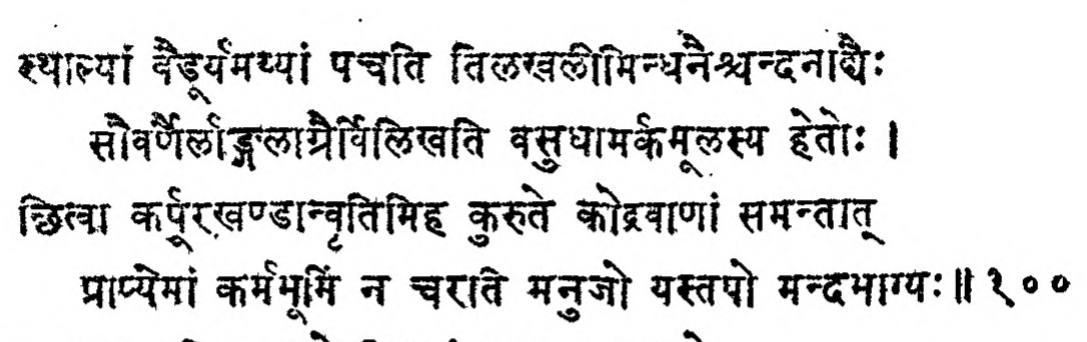
स्थाल्यां वैडूर्यमय्यां पचति तिलखलीमिन्धनैश्चन्दनाद्यैः
सौवर्णैर्लाङ्गलाग्रैर्विलिखति वसुधामर्कमूलस्य हेतोः ।
छित्त्वा कर्पूरखण्डान्वृतिमिव कुरुते कोद्रवाणां समन्तात्
प्राप्येमां कर्मभूमिं न चरति मनुजो यस्तपो मन्दभाग्यः॥ १००
Notes
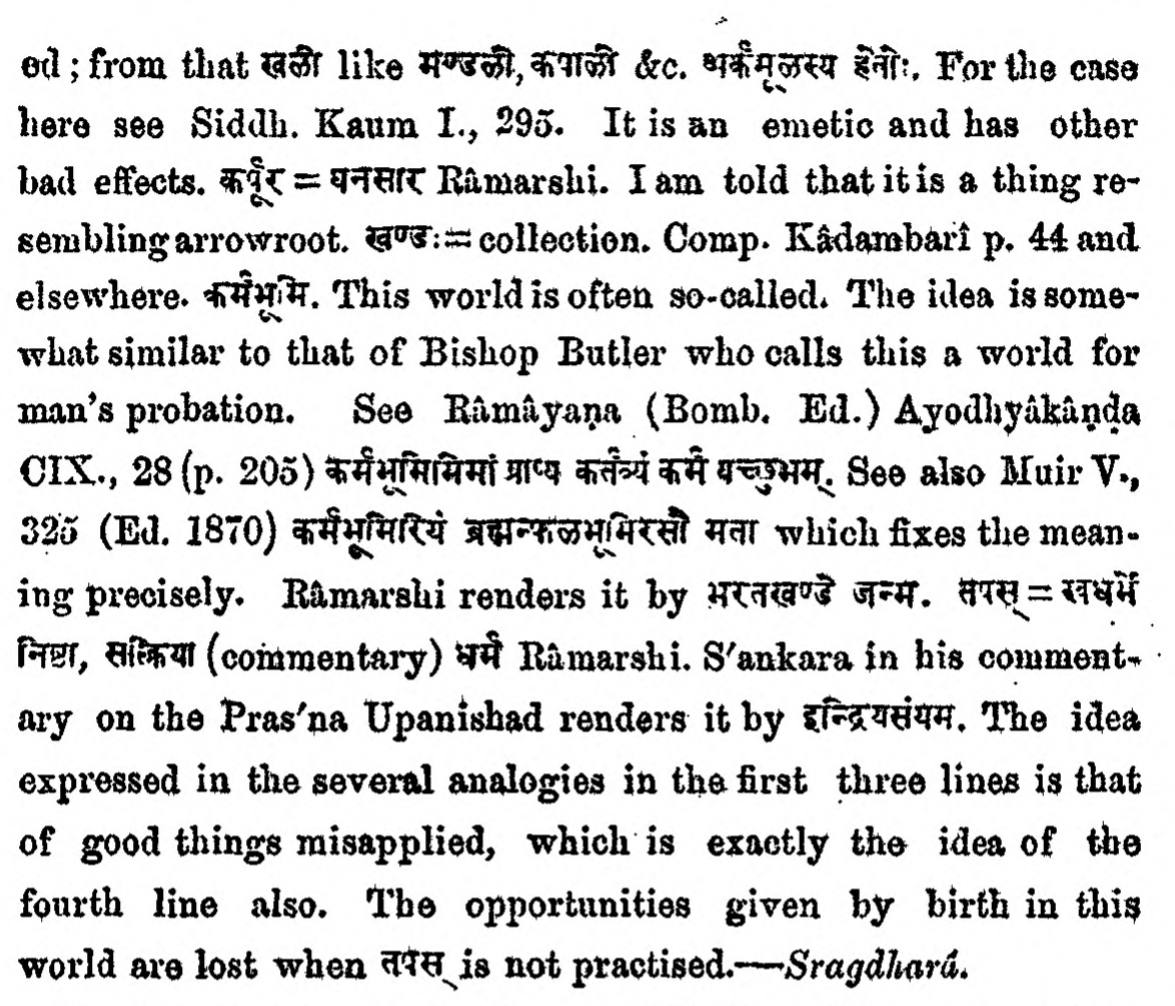
St. C.—तिलखली = तिलपिष्टक Râmarshi. खल is given in the Medinî Kosha as meaning कल्क i. e. the refuse after the oil is extracted ; from that खली like मण्डली, कपाली &c. अर्कमूलस्य हेतोः. For the case here see Siddh. Kaum I., 295. It is an emetic and has other bad effects. कर्पूर = घनसार Râmarshi. I am told that it is a thing resembling arrowroot. खण्डः= collection. Comp. Kâdambarî p. 44 and elsewhere. कर्मभूमि. This world is often so-called. The idea is somewhat similar to that of Bishop Butler who calls this a world for man's probation. See Râmâyaṇa (Bomb. Ed.) Ayodhyâkâṇḍa CIX., 28 (p. 205) कर्मभूमिमिमां प्राप्य कर्तव्यं कर्म यच्छुभम्. See also Muir V., 325 (Ed. 1870) कर्मभूमिरियं ब्रह्मन्फलभूमिरसौ मता which fixes the meaning precisely. Râmarshi renders it by भरतखण्डे जन्म. तपस् = स्वधर्मे निष्ठा, सत्क्रिया (commentary) धर्म Râmarshi. S'ankara in his commentary on the Pras'na Upanishad renders it by इन्द्रियसंयम. The idea expressed in the several analogies in the first three lines is that of good things misapplied, which is exactly the idea of the fourth line also. The opportunities given by birth in this world are lost when तपस् is not practised.—Sragdharâ.


Kale
all

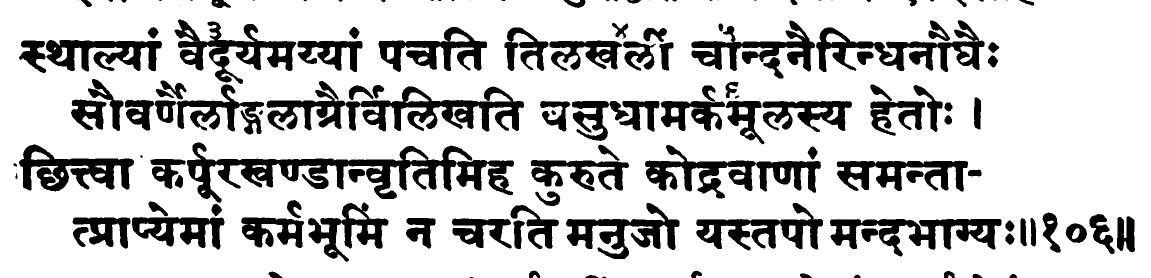
स्थाल्यां वैदूर्यमय्यां पचति तिलखलीं चान्दनैरिन्धनौघैः
सौवर्णैर्लाङ्गलाग्रैर्विलिखति वसुधामर्कमूलस्य हेतोः ।
छित्त्वा कर्पूरखण्डान्वृतिमिह कुरुते कोद्रवाणां समन्ता-
त्प्राप्येमां कर्मभूमिं न चरति मनुजो यस्तपो मन्दभाग्यः॥१०६॥
Translation
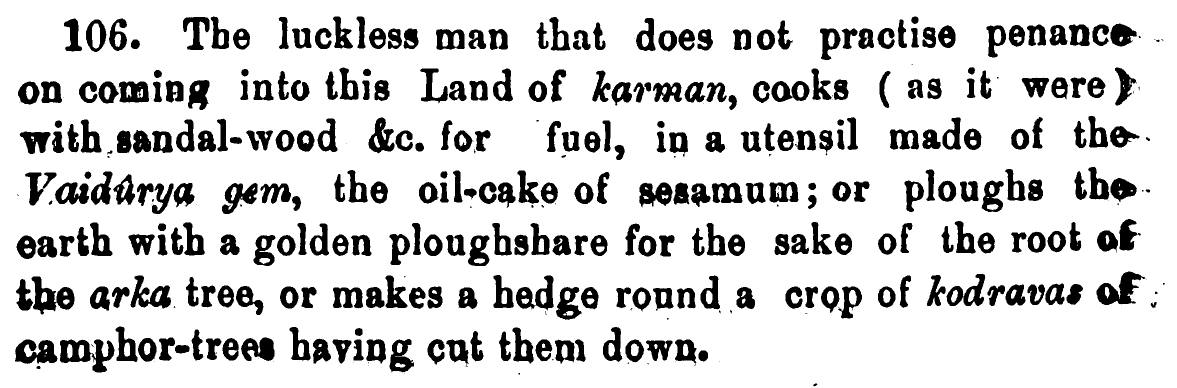
106. The luckless man that does not practise penance on coming into this Land of karman, cooks ( as it were ) with sandal-wood &c. for fuel, in a utensil made of the Vaidûrya gem, the oil-cake of sesamum; or ploughs the earth with a golden ploughshare for the sake of the root of the arka tree, or makes a hedge round a crop of kodravas of camphor-trees having cut them down.
Notes
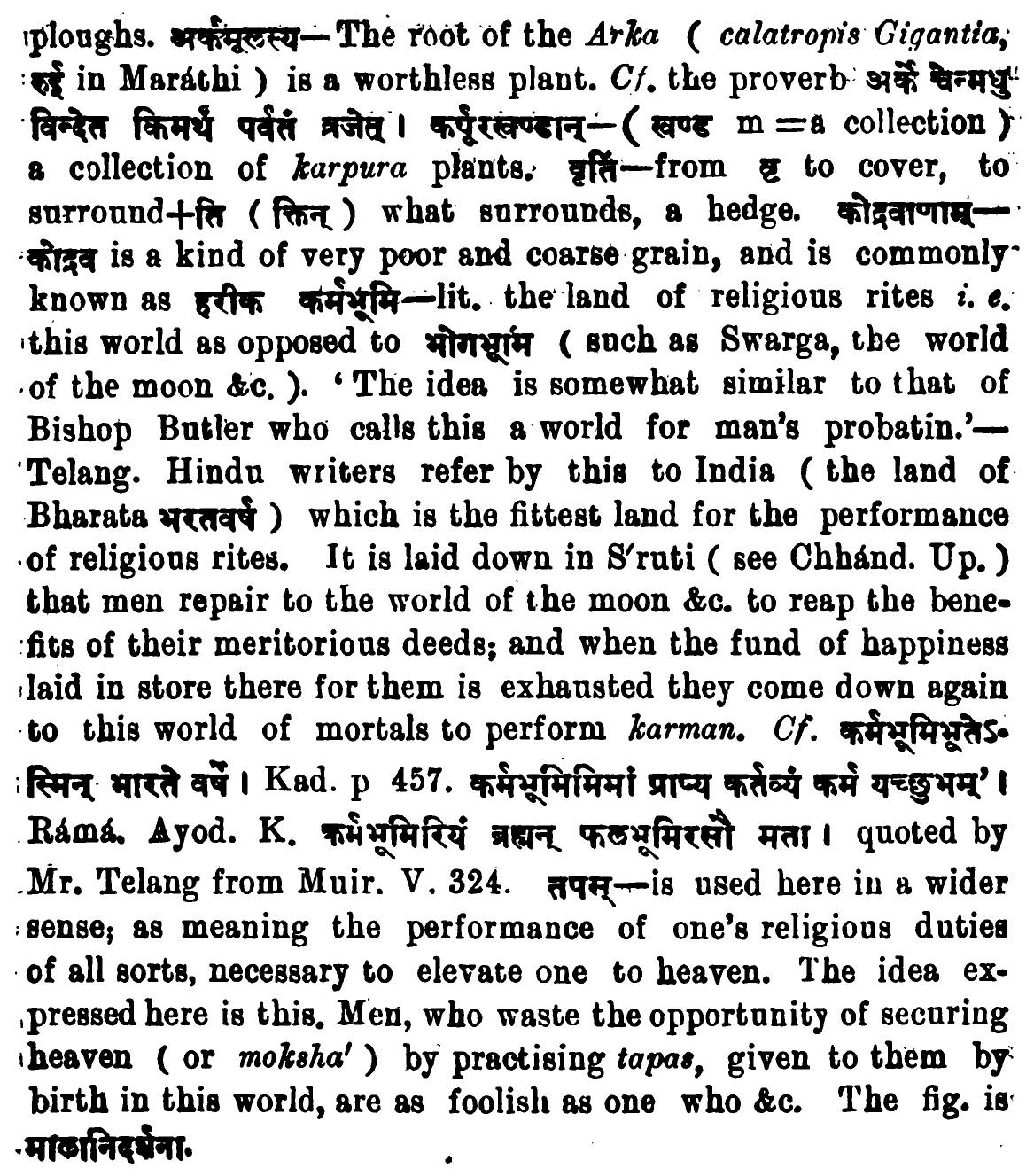
Sl. 106. स्थाली–a cooking vessel; स्थकति तिष्ठत्यन्नमत्र । वैदूर्य–lapis–lazuli; विदूरे अद्रौ भवम् (ष्यञ् i. e. अ) so called because first obtained from the mountain Vidùra. तिलखली—The cake of sesamum after oil has been pressed out of it; oil-cake. विलिखति–Scratches, ploughs. अर्कमूलस्य—The root of the Arka ( calatropis Gigantia, रुई in Maráthi ) is a worthless plant. Cf. the proverb अर्के चेन्मधु विन्देत किमर्थं पर्वतं व्रजेत् । कर्पूरखण्डान्—( खण्ड m =a collection ) a collection of karpura plants. वृतिं—from वृ to cover, to surround+ति ( क्तिन् ) what surrounds, a hedge. कोद्रवाणाम्— कोद्रव is a kind of very poor and coarse grain, and is commonly known as हरीक कर्मभूमि—lit. the land of religious rites i. e. this world as opposed to भोगभूमि ( such as Swarga, the world of the moon &c. ). ‘The idea is somewhat similar to that of Bishop Butler who calls this a world for man’s probatin.’— Telang. Hindu writers refer by this to India ( the land of Bharata भरतवर्ष ) which is the fittest land for the performance of religious rites. It is laid down in S'ruti ( see Chhánd. Up. ) that men repair to the world of the moon &c. to reap the benefits of their meritorious deeds; and when the fund of happiness laid in store there for them is exhausted they come down again to this world of mortals to perform karman. Cf. कर्मभूमिभूतेऽस्मिन् भारते वर्षे । Kad. p 457. कर्मभूमिमिमां प्राप्य कर्तव्यं कर्म यच्छुभम्’ । Rámá. Ayod. K. कर्मभूमिरियं ब्रह्मन् फलभूमिरसौ मता । quoted by Mr. Telang from Muir. V. 324. तपस्—is used here in a wider sense; as meaning the performance of one’s religious duties of all sorts, necessary to elevate one to heaven. The idea expressed here is this. Men, who waste the opportunity of securing heaven ( or moksha' ) by practising tapas, given to them by birth in this world, are as foolish as one who &c. The fig. is मालानिदर्शना.


Gopinath1914
all
स्थाल्यां वैदूर्यमय्यां पचति तिलकणानिन्ध-
नैश्चन्दनाद्यैः सौवर्णेल सौवर्णैर्लाङ्गलायैर्विलिखति ङ्गलायै विलिखति
वसुधामर्कमूलस्य हेतोः ॥ छित्त्वा कर्पूर-
खण्डान्वृतिमिह कुरुते कोद्रवाणां समन्ता-
त्प्राप्येमां कर्मभूमि न चरति मनुजो यस्तपो
मन्दभाग्यः ॥ १०० ॥
जो मंदभागी इस कर्मभूमि (संसार) में जन्म लेकर तपश्चरण नहीं करता वह निस्संदेह उस मूर्खके समान है जो तुच्छ तिलकणोंको वैदूर्यमणिके पात्र में रखकर चंदनादिके सुगंधित इंधन से पकाना चाहता है, अथवा अर्ककी जड़ प्राप्त करनेके हेतु सुवर्णमय लांगलसे पृथ्वीका संशोधन करता है, अथवा सामान्य कोद्रव ( कोदूं) के धान्यकी रक्षा के निमित्त कपूरकी बाड़ लगाता है ॥ १०० ॥
Like those foolish and unfortunate beings who cook a quantity of sesamum in a caldron of Vaidûryamani ( वदूर्यमणि or Lapsus lazule) by the fuel of sandal and other valuable woods; or who dig up the earth with a goldenedged plough in order to obtain the worthless root of the Arka; or protect the poor Kodrava grains by fencing its field with camphor pieces; the condition of the man who after being born into this world of trial does not observe the sacred rites of his religion is indeed very miserable and pitiable.
Footnote
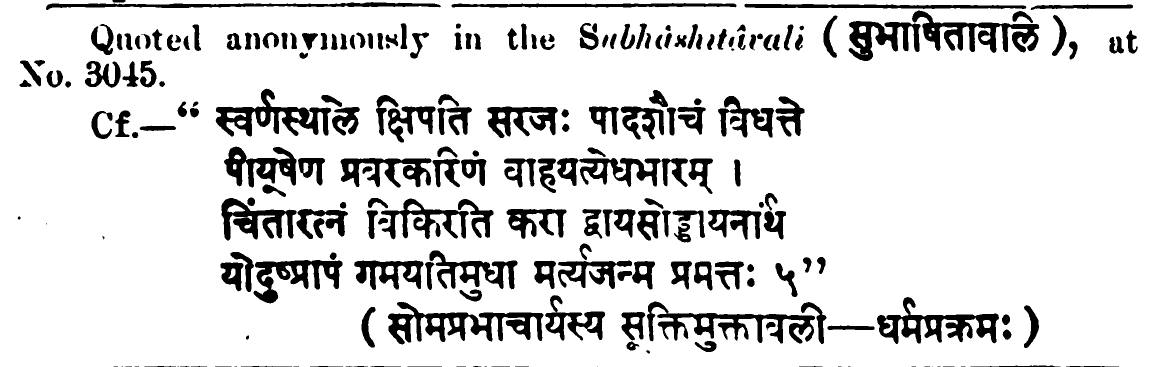
Quoted anonymously in the Subhashitavali ( सुभाषितावलि ), at No. 3045. Cf. - " स्वर्णस्थाले क्षिपति सरजः पादशौचं विधत्ते पीयूषेण प्रवरकरिणं वाडयत्येधभारम् । चिंतारस्नं विकिरनि कराद्वायमोड्डायनार्थे यो दुष्प्रापं गमयनि मुत्रा मर्त्यजन्म प्रमत्तः ५” ( सोमप्रभ चार्यस्य सूक्तिमुक्तावली - धर्मप्रक्रमः )
Gopinath1896
all
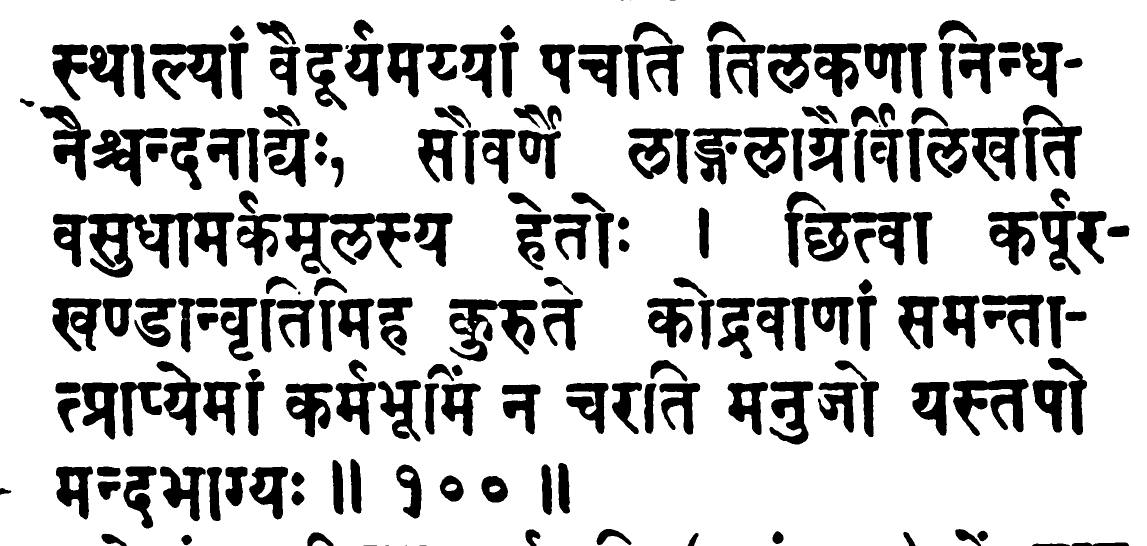
स्थाल्यां वैदूर्यमय्यां पचति तिलकणा निन्ध-
नैश्चन्दनाद्यैः, सौवर्णे लाङ्गलायै विलिखति
वसुधामर्कमूलस्य हेतोः । छित्वा कर्पूर-
खण्डान्वृतिमिह कुरुते कोद्रवाणां समन्ता-
त्प्राप्येमा कर्मभूमिं न चरति मनुजो यस्तपो
मन्दभाग्यः ॥ १०० ॥
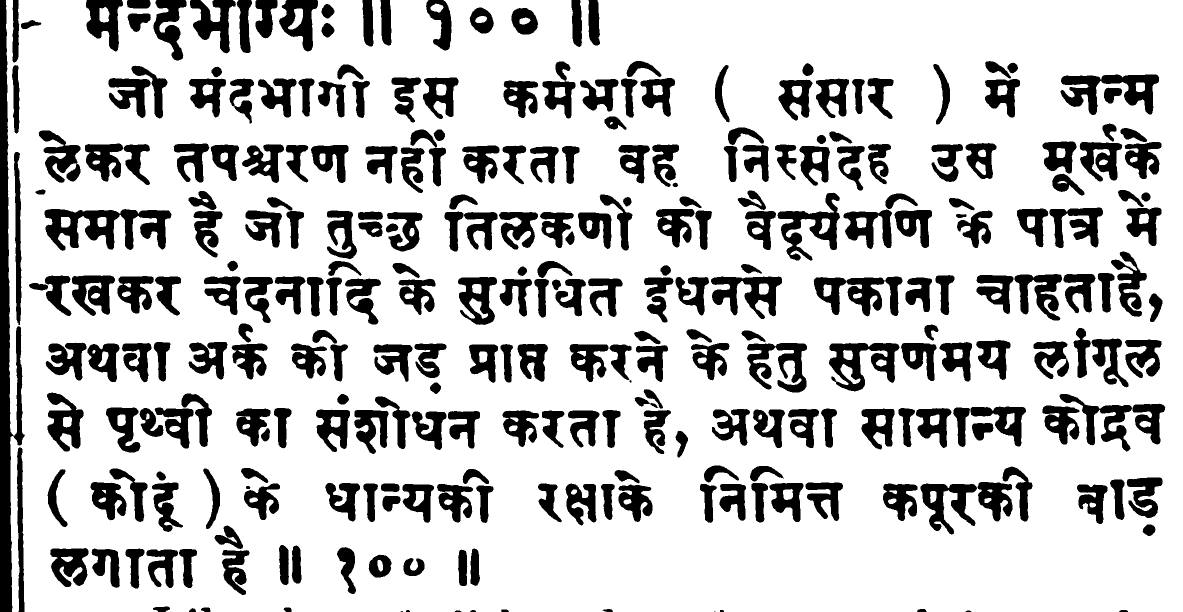
जो मंदभागी इस कर्मभूमि ( संसार ) में जन्म लेकर तपश्चरण नहीं करता वह निस्संदेह उस मूर्खके समान है जो तुच्छ तिलकणों को वैदूर्यमणि के पात्र में - रखकर चंदनादि के सुगंधित इंधन से पकाना चाहता है, अथवा अर्क की जड़ प्राप्त करने के हेतु सुवर्णमय लांगूल से पृथ्वी का संशोधन करता है, अथवा सामान्य कोद्रव ( को ) के धान्यकी रक्षाके निमित्त कपूरकी बाड़ लगाता है ॥ १०० ॥
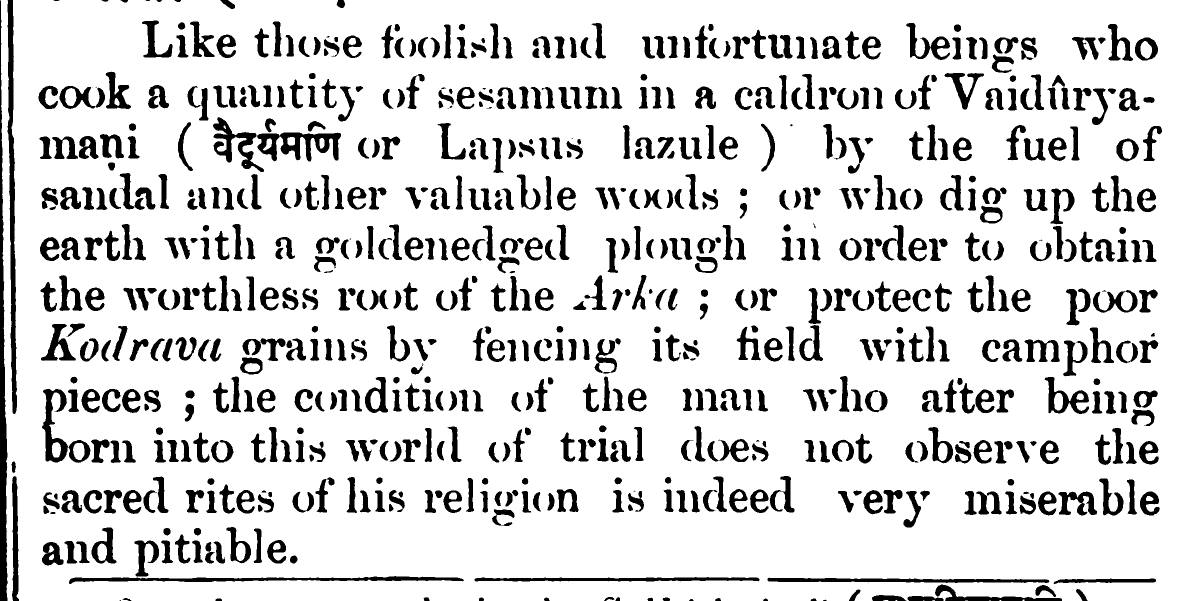
Like those foolish and unfortunate beings who cook a quantity of sesamum in a caldron of Vaidŵryamani ( वैदूर्यमणि or Lapsus lazule ) by the fuel of sandal and other valuable woods; or who dig up the earth with a goldenedged plough in order to obtain the worthless root of the Arka; or protect the poor Kodrava grains by fencing its field with camphor pieces; the condition of the man who after being born into this world of trial does not observe the sacred rites of his religion is indeed very miserable and pitiable.
Kosambi
all
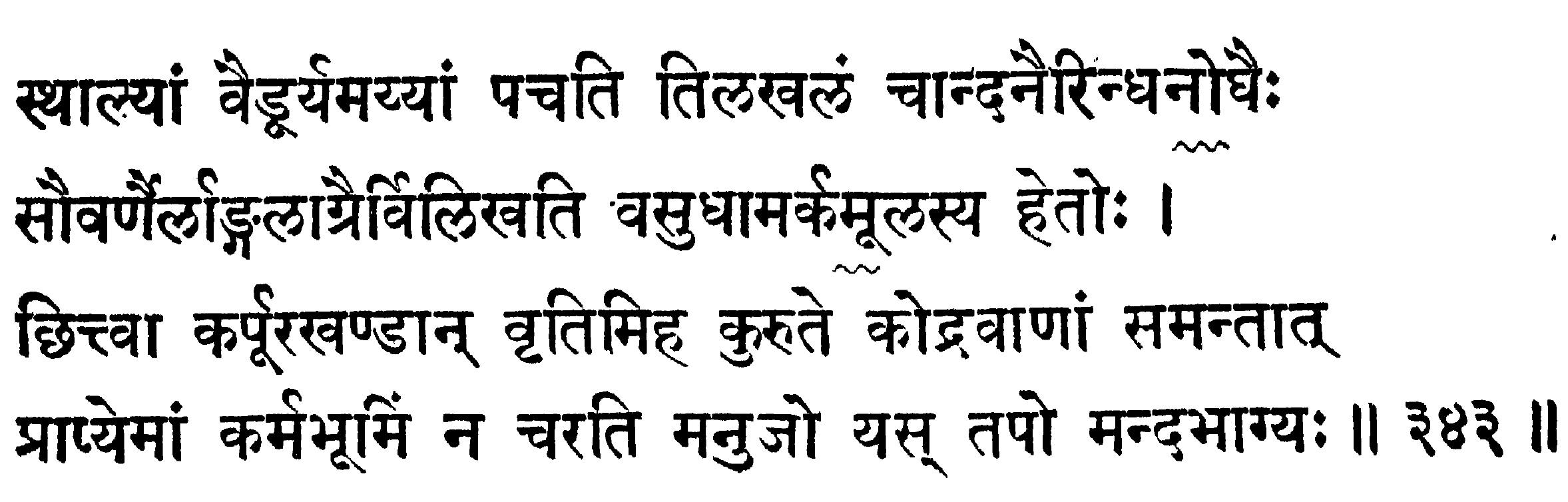
स्थाल्यां वैडूर्यमय्यां पचति तिलखलं चान्दनैरिन्धनोघैः
सौवर्णैर्लाङ्ग लाप्रैर्विलिखति वसुधामर्कमूलस्य हेतोः ।
छित्त्वा कर्पूरखण्डान् वृतिमिह कुरुते कोद्रवाणां समन्तात्
प्राध्येमां कर्मभूमिं न चरति मनुजो यस् तपो मन्दभाग्यः ॥ ३४३ ॥
Footnote
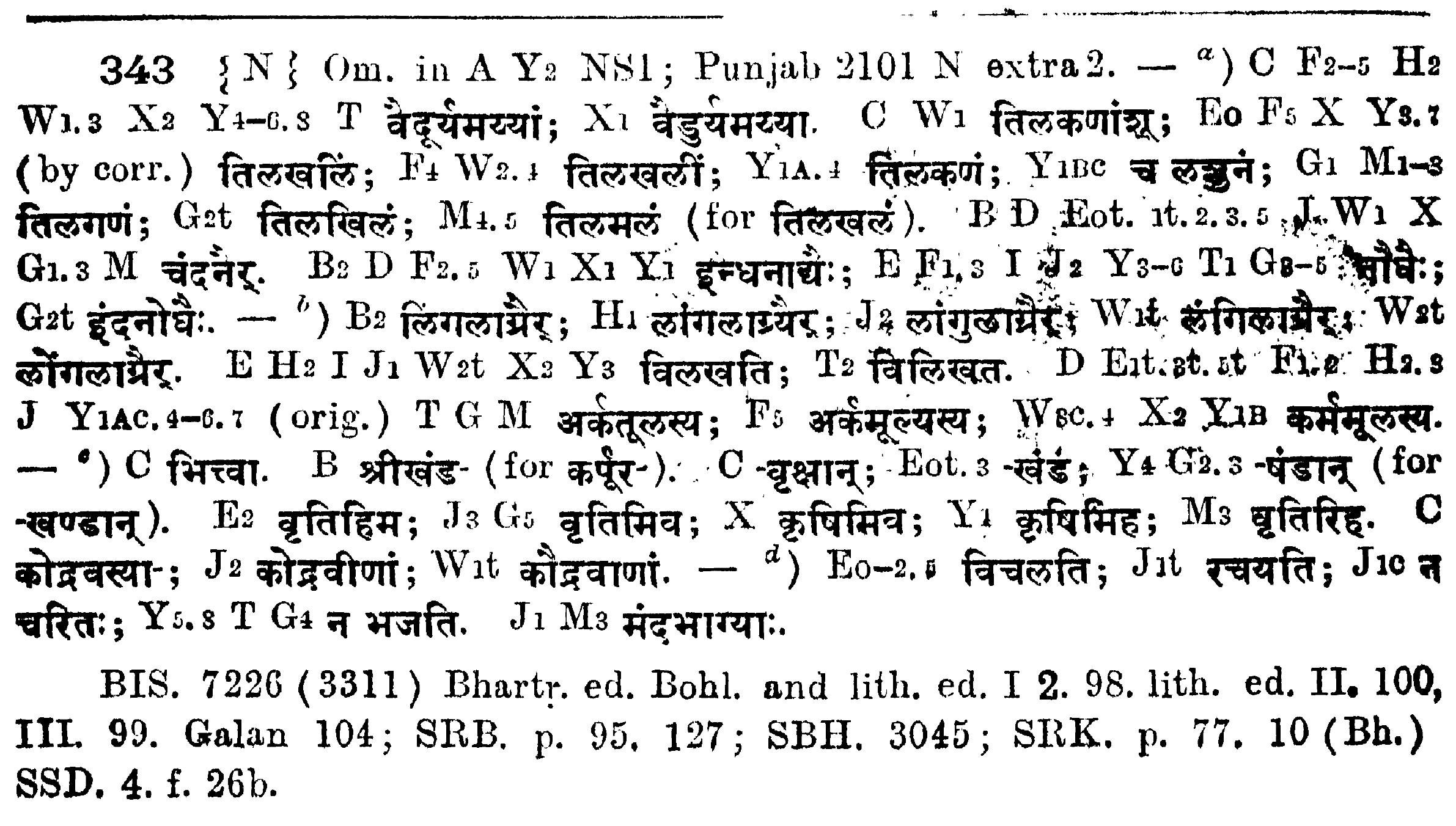
343 { N } Om . in A Y ? NS1 ; Punjab 2101 N extra 2 . “ ) CF 2 - 5 H 2
W1.3 X2_Y1-6.4 T वैदूर्यमय्यां ; X | बैडुर्यमय्या . C W1 तिलकणांशू ; Eo Fs X Ys .
( by corr . ) तिलखलिं ; F1 W2.1 तिलखलीं ; Y1A . 1 तिलकणं ; Y1Be च लजुनं ; G1 M1-3
तिलगणं ; Get तिलखिलं ; M 1.5 तिलमलं ( for तिलखलं ) . BDEot it.2.3.5MW X
G1.3M चंदनैर् . B2 DF 2. 5 5 W X1 Y1 इन्धनाद्यैः ; EFis I 2 X 3 - 0T1 GB - 6 लौघे ::
Gat इंदनोधैः -- ) B : लिंगलामैर ; H लागलायैर ; J लांगुलामै : Wt लंगिकार : Wat
लोंगलामैर् . E H I J 1 W2t X 2 X 3 विलखति ; T2 विलिखत D Eat att Five Has
J_Y1Ac.4–6.7 ( orig . ) TGM अर्कतूलस्य ; Fs अर्कमूल्यस्य ; Wee . + X 2 X1B कर्ममूलस्य .
• ° ) C भित्त्वा . B श्रीखंड ( for कर्पूर ) : C वृक्षान् ; Eot . 3 खंड ; Y + G2.3 षंडान् ( for
-खण्डान् ) . E2 वृतिहिम ; Ja 3 Go वृतिमिव ; X कृषिमिव ; X X4 कृषिमिह ; M3 वृतिरिह C C
कोद्रवस्या ; J2 कोद्रवीणां ; Wat कौद्रवाणां . 2 ) Eo - 2.4 विचलति ; Jat रचयति ; Jio न
चरितः ; Y.8 T G + न भजति J1 M3 मंदभाग्या :.
BIS . 7226 ( 3311 ) Bhartr ed . Bohl . and lith ed . I 2 98 lith ed . II . 100 ,
III . 99. Galan 104 ; SRB . p . 95 127 ; SBH . 3045 ; SRK . p . 77 10 ( Bh . )
SSD . 4. f . 26b .
Commentary