Tawney
Those men may boast of being born, whose skulls gleam white on Śiva's head,
The final meed of holy saints, and chiefs whose souls in battle fled;
But oft I muse how men can swell with pride at causing those to bow.
Who, if they save their precious lives, care little for the when and how.
Mādhavānanda
स जात: कोऽप्यासीन्मदनरिपुणा मूधि्र्न धवलं
कपालं यस्योच्यैविर्निहितमलंकारविधये ।
नृभि: प्राणत्राणप्रवणमतिभि: कैश्चिदधुना
नमद्भि: क: पुंसामयमतुलदर्पज्वरभर: ।।६०।।
60. That man is indeed born (truly great) whose white skull (after death) is placed by (Śiva) the enemy of Madana (Cupid) high on the head as an ornament; (and) what is (worth) this rising fever of exceeding pride in men, who are nowadays adored by some people with minds intent on the preservation of their lives!
[The great Śiva is called Kapālī; Kapāla meaning ‘skull’. The popular belief is that He puts on His head the skull of a hero whose wonderful life lived on earth merits this distinction.]
Telang
all
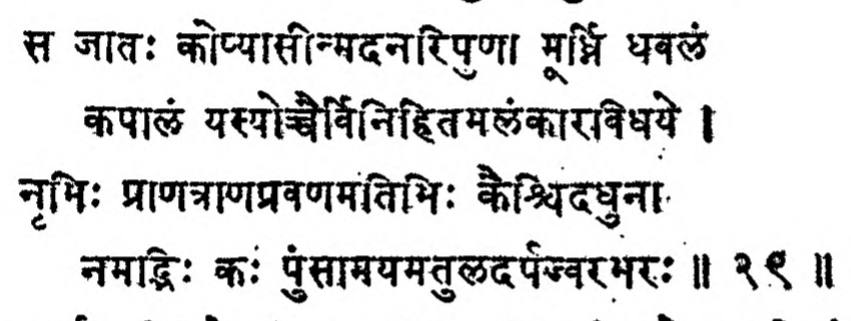
स जातः कोप्यासीन्मदनरिपुणा मूर्ध्नि धवलं
कपालं यस्योच्चैर्विनिहितमलंकारविधये ।
नृभिः प्राणत्राणप्रवणमतिभिः कैश्चिदधुना
नमद्भिः कः पुंसामयमतुलदर्पज्वरभरः ॥ २९ ॥
Notes
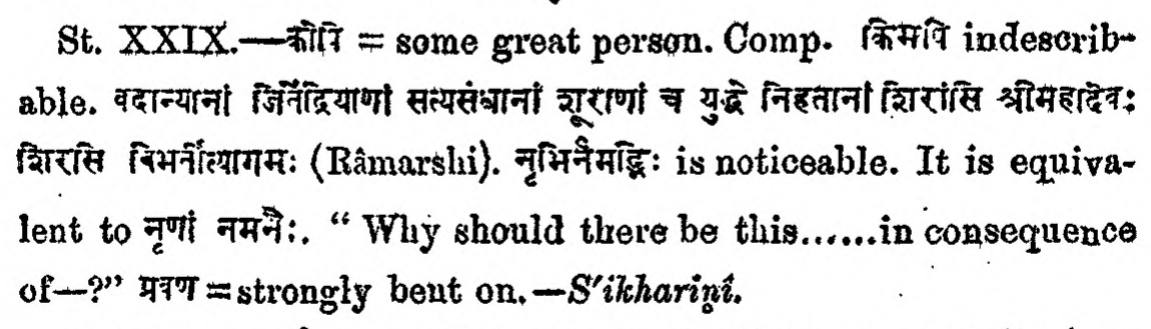
St. XXIX.—कोपि = some great person. Comp. किमपि indescribable. वदान्यानां जितेंद्रियाणां सत्यसंधानां शूराणां च युद्धे निहतानां शिरांसि श्रीमहादेवः शिरसि बिभर्तीत्यागमः (Râmarshi). नृभिर्नमद्भिः is noticeable. It is equivalent to नृणां नमनैः. “ Why should there be this......in consequence of—?” प्रवण = strongly bent on.—S'ikhariṇî.

Kale
all

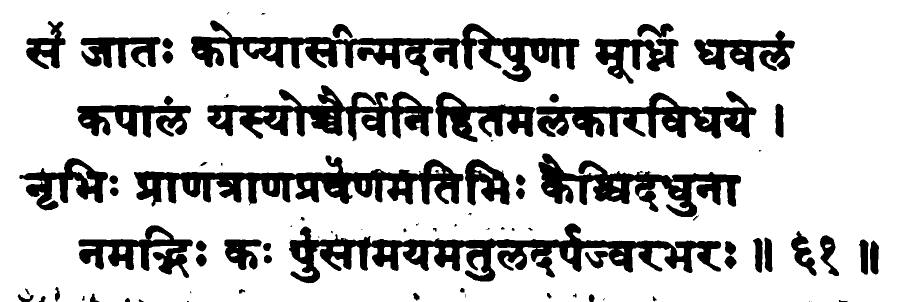
स जातः कोप्यासीन्मदनरिपुणा मूर्ध्नि धवलं
कपालं यस्योच्चैर्विनिहितमलंकारविधये ।
नृभिः प्राणत्राणप्रवणमतिभिः कैश्चिदधुना
नमद्भिः कः पुंसामयमतुलदर्पज्वरभरः ॥ ६१ ॥
Translation
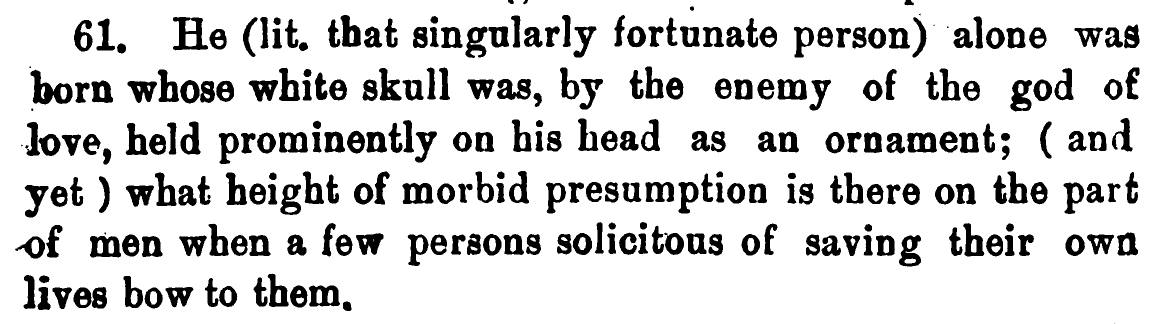
61. He (lit. that singularly fortunate person) alone was born whose white skull was, by the enemy of the god of love, held prominently on his head as an ornament; ( and yet ) what height of morbid presumption is there on the part of men when a few persons solicitous of saving their own lives bow to them.
Notes
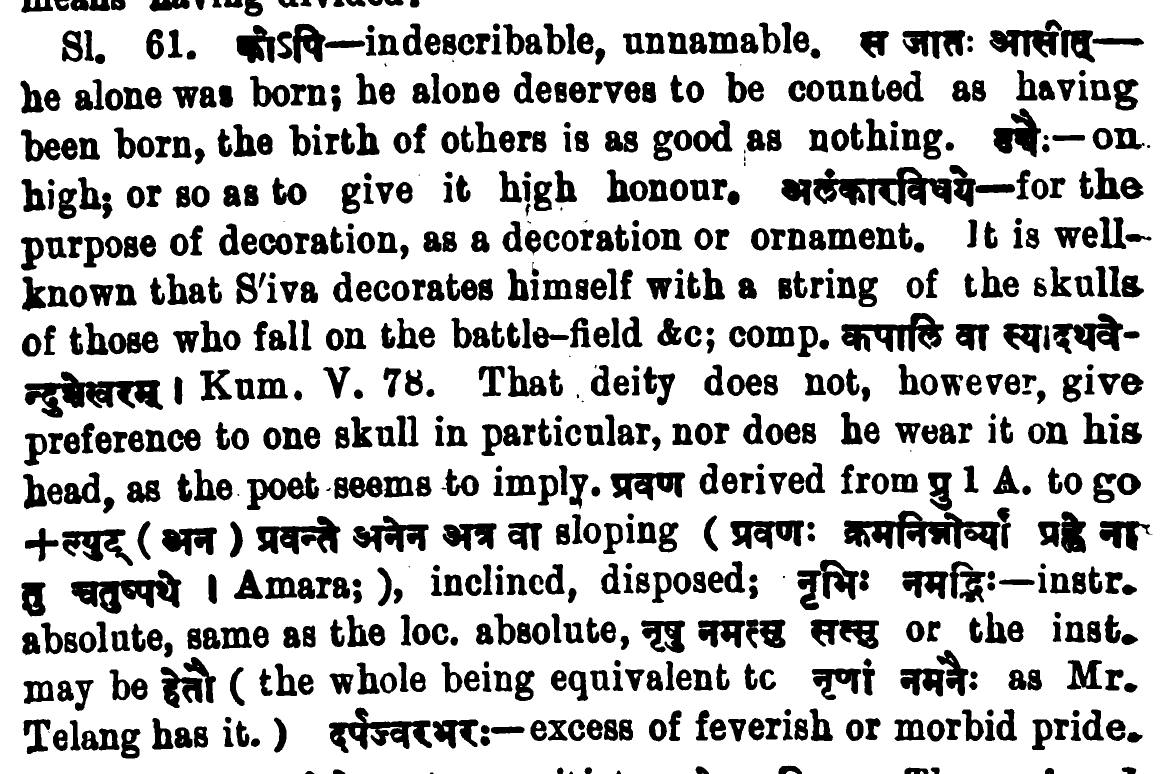
Sl. 61. कोऽपि—indescribable, unnamable. स जातः आसीत्— he alone was born; he alone deserves to be counted as having been born, the birth of others is as good as nothing. उच्चैः—on high; or so as to give it high honour. अलंकारविधये—for the purpose of decoration, as a decoration or ornament. It is wellknown that S'iva decorates himself with a string of the skulls of those who fall on the battle-field &c; comp. कपालि वा स्यादथवेन्दुशेखरम् । Kum. V. 78. That deity does not, however, give preference to one skull in particular, nor does he wear it on his head, as the poet seems to imply. प्रवण derived from प्रु 1 A. to go +ल्युट् ( अन ) प्रवन्ते अनेन अत्र वा sloping ( प्रवणः क्रमनिम्नोर्व्यां प्रह्वे नातु चतुष्पथे । Amara; ), inclined, disposed; नृभिः नमद्भिः—instr. absolute, same as the loc. absolute, नृषु नमत्सु सत्सु or the inst. may be हेतौ ( the whole being equivalent to नृणां नमनैः as Mr. Telang has it. ) दर्पज्वरभरः—excess of feverish or morbid pride.
Gopinath1914
all
स जातः कोऽप्यासीन्मदनरिपुणा मूर्ध्नि धव-
लं कपालं यस्योच्चैर्विनिहितमलङ्कारविधये ॥
नृभिः प्राणत्राणप्रवणमतिभिः कैश्चिदधुना
नमद्भिः कः पुंसामयमतुलदर्पज्वरभरः ॥ २८ ॥
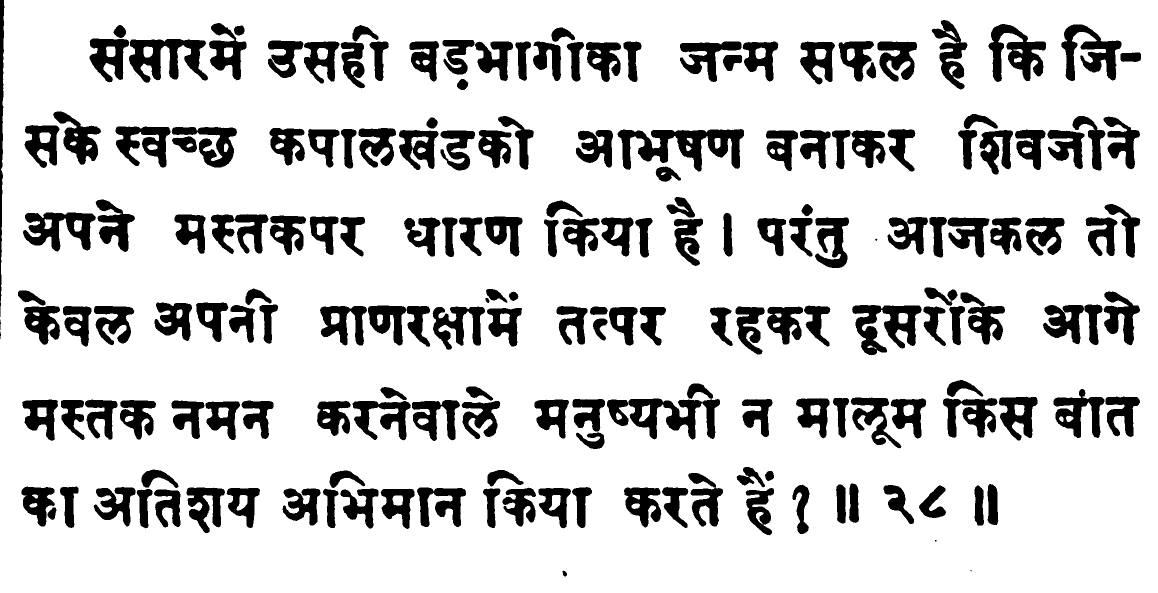
संसारमें उसही बड़भागीका जन्म सफल है कि जिसके स्वच्छ कपालखंड को आभूषण बनाकर शिवजीने अपने मस्तकपर धारण किया है । परंतु आजकल तो केवल अपनी प्राणरक्षामें तत्पर रहकर दूसरोंके आगे मस्तक नमन करनेवाले मनुष्य भी न मालूम किस बातका अतिशय अभिमान किया करते हैं ? ॥ २८ ॥
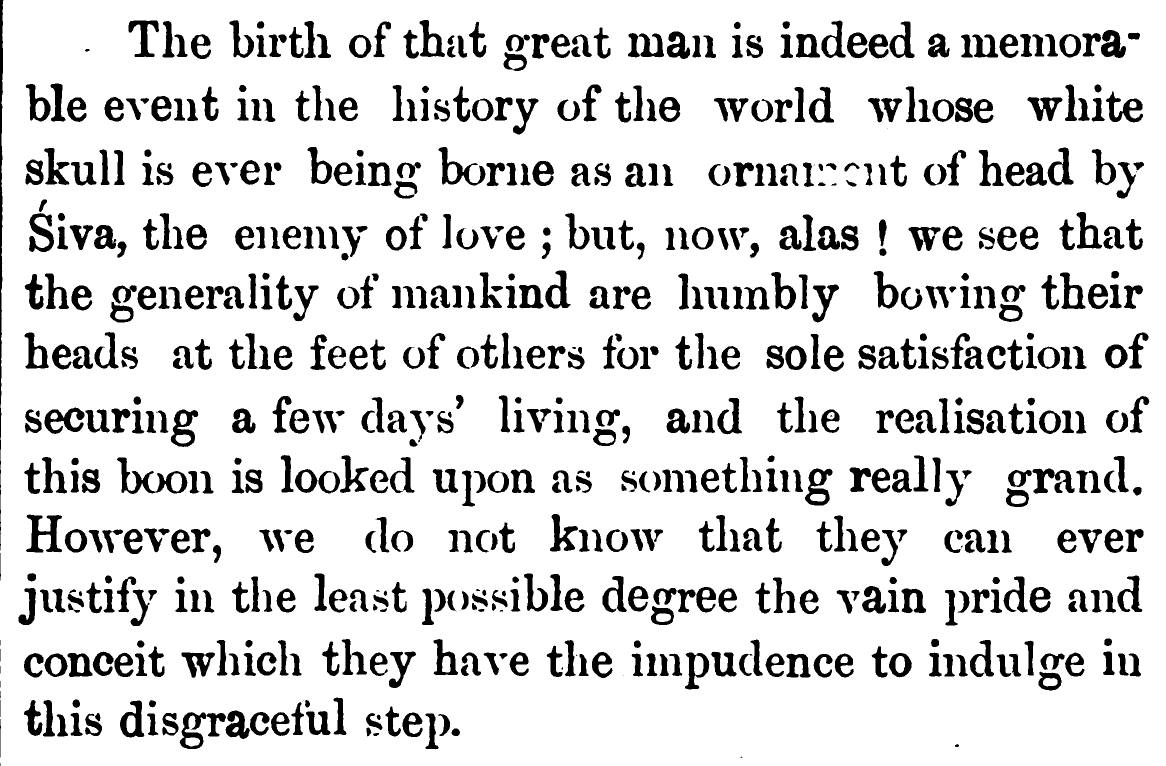
The birth of that great man is indeed a memorable event in the history of the world whose white skull is ever being borne as an ornament of head by Siva, the enemy of love; but, now, alas! we see that the generality of mankind are humbly bowing their heads at the feet of others for the sole satisfaction of securing a few days' living, and the realisation of this boon is looked upon as something really grand. However, we do not know that they can ever justify in the least possible degree the vain pride and conceit which they have the impudence to indulge in this disgraceful step.

Gopinath1896
all
स जातः कोऽप्यासीन्मदनरिपुणा मूर्ध्नि ध-
वलं, कपालं यस्योच्चैर्विनिहितमलङ्कारविधये ।
नृभिः प्राणत्राणप्रवणमतिभिः कैश्चिदधुना,
नमद्भिः कः पुंसामयमतुलदर्पज्वरभरः ॥ २८॥
संसार में उसही बड़भागीका जन्म सफल है कि जिसके स्वच्छ कपालखंडको आभूषण बनाकर शिवजीने अपने मस्तकपर धारण किया है । परंतु आजकल तो केवल अपनी प्राणरक्षा में तत्पर रहकर दूसरोंके आगे मस्तक नमन करनेवाले मनुष्यभी न मालूम किस बात का अतिशय अभिमान किया करते हैं ? ॥ २८ ॥
The birth of that great man is indeed a memorable event in the history of the world whose white skull is ever being borne as an ornament of head by Śiva, the enemy of love; but, now, alas! we see that the generality of mankind are humbly bowing their heads at the feet of others for the sole satisfaction of securing a few days' living, and the realisation of this boon is looked upon as something really grand. However, we do not know that they can ever justify in the least possible degree the vain pride and conceit which they have the impudence to indulge in this disgraceful step.


Kosambi
all
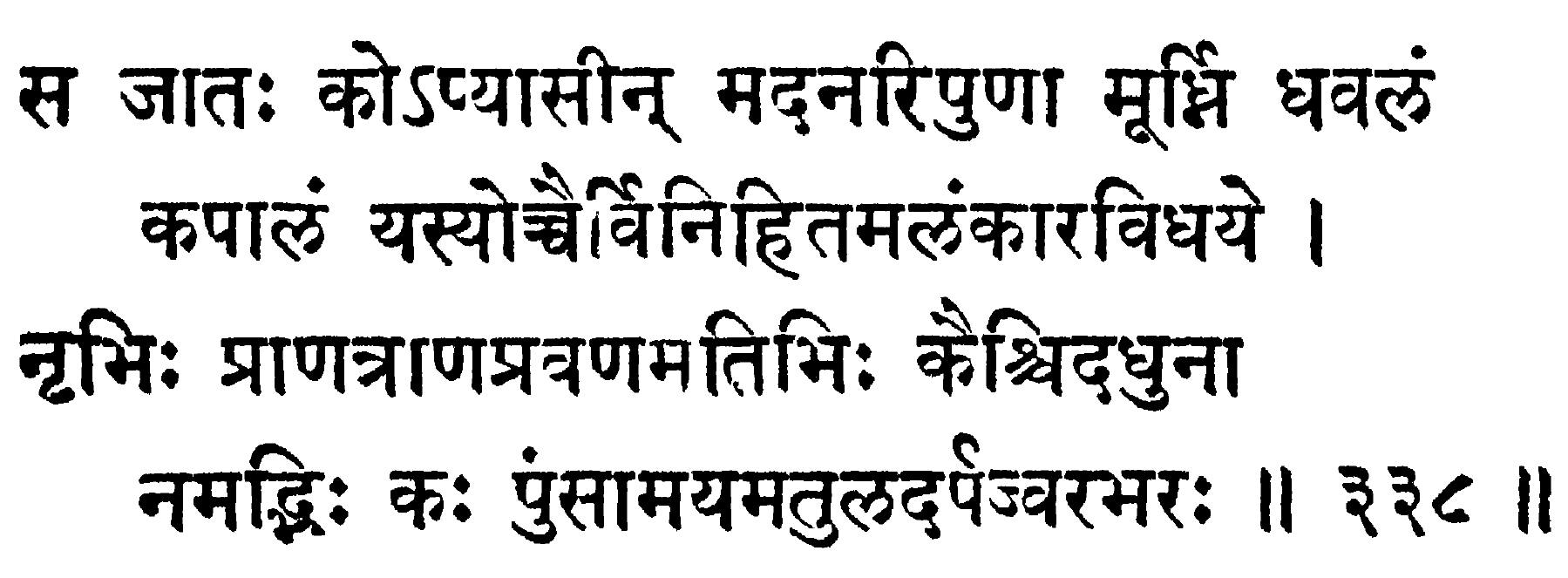
स जातः कोऽप्यासीन् मदनरिपुणा मूर्ध्नि धवलं
कपालं यस्यो चैर्विनिहितमलंकारविधये ।
नृभिः प्राणत्राणप्रवणमतिभिः कैश्चिदधुना
नमद्भिः कः पुंसामयमतुलदर्पज्वरभरः || ३३८ ||
Footnote
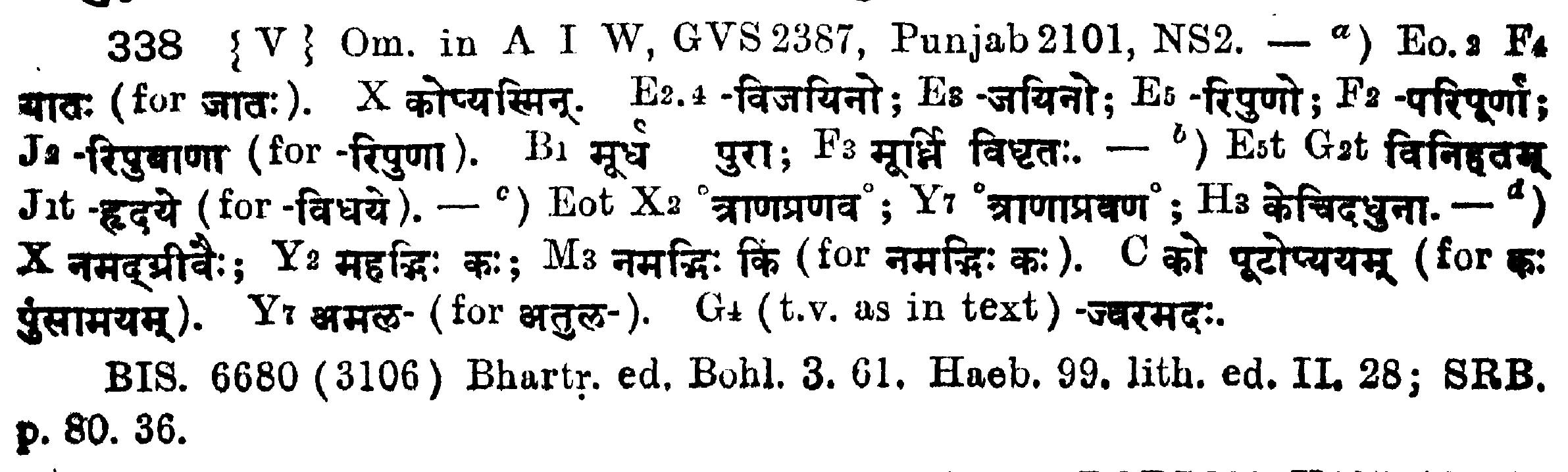
338 { V } Om . in A I W , GVS 2387 , Punjab 2101 , NS2 . a ) Eo . 2 F
यावः ( for जाव :) . X कोप्यस्मिन् . E2 . विजयिनो ; Es जयिनो ; Es - रिपुणो ; F2 - परिपूर्णा ;
Ja Jat - रिपुबाणा -हृदये ( for ( for -विधये -रिपुणा ) . – ) . ° ) B1 Eot मूर्ध X 2 ' पुरा त्राणप्रणव ; F : ' मूर्ध्नि ; X7 विटतः ' त्राणाप्रवण . 6 ; ) H3 Est केचिदधुना Gat विनिहतम् . - हवा 4 )
X नमग्रीवैः ; X 2 महद्भिः कः ; M3 नमद्भिः किं ( for नमद्भिः कः ) . C को पूटोप्ययम् ( for कः
पुंसामयम् ) . Y7 अमल- ( for अतुल - ) . G G + ± ( tv as in text ) -ज्वरमदः .
BIS . 6680 ( 3106 ) Bhartr ed Bohl . 3. 61. Haeb . 99 lith ed . II . 28 ; SRB .
p . 80. 36 .
Commentary