Tawney
When maidens see a tinge of white
Streak a man's hair, they shun his sight,—
'Tis like the white bone on the brink
Of wells whence only outcasts drink.
Mādhavānanda
वर्णं सितं झटिति वीक्ष्य शिरोरुहाणां
स्थानं जरापरिभवस्य तदा पुमांसम् ।
आरोपितास्थिशतकं परिहृत्य यान्ति
चण्डालकूपमिव दूरतरं तरुण्य: ।।७४।।
74. Seeing the grey hairs on the head of a man, emblematic of discomfiture by old age, youthful women at once fly away from him, as if from a Chandāla’s (the untouchable in caste) well whereon is placed a structure of bones!
[आरोपितास्थिशतकं—May be taken to qualify पुमांसम् or कूपम्. If it be taken to qualify the former, it would mean: this framework of bones (meaning the old man).
It was a custom in former times with the Chandālas to line their well with bones for ornamentation.]
Telang
all
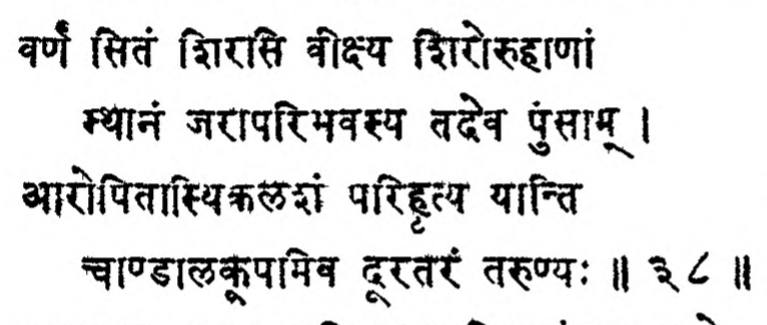
वर्णं सितं शिरसि वीक्ष्य शिरोरुहाणां
स्थानं जरापरिभवस्य तदेव पुंसाम् ।
आरोपितास्थिकलशं परिहृत्य यान्ति
चाण्डालकूपमिव दूरतरं तरुण्यः ॥ ३८ ॥
Notes
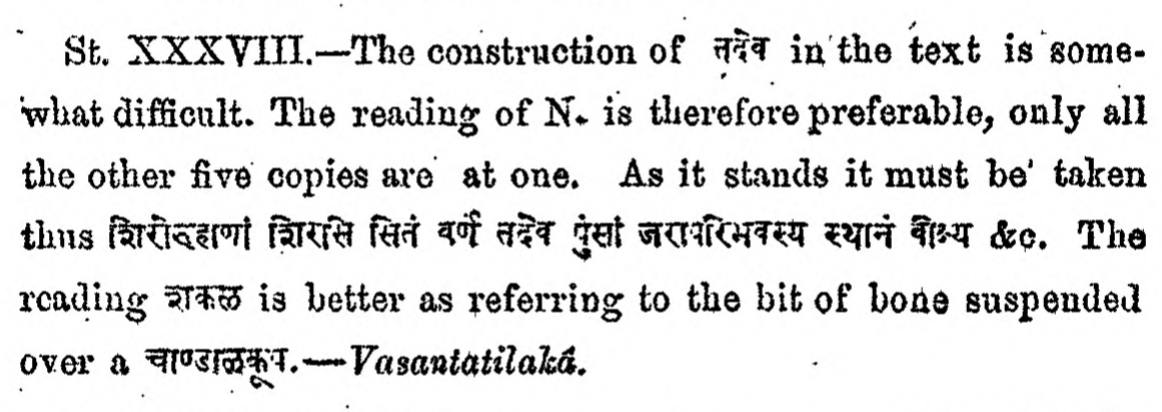
St. XXXVIII.—The construction of तदेव in the text is somewhat difficult. The reading of N. is therefore preferable, only all the other five copies are at one. As it stands it must be taken thus शिरोरुहाणां शिरसि सितं वर्णं तदेव पुंसां जरापरिभवस्य स्थानं वीक्ष्य &c. The reading शकल is better as referring to the bit of bone suspended over a चाण्डालकूप.—Vasantatilakâ.

Kale
all
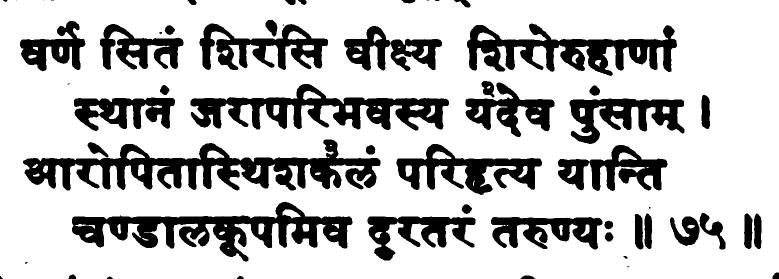
वर्णं सितं शिरसि वीक्ष्य शिरोरुहाणां
स्थानं जरापरिभवस्य यदेव पुंसाम् ।
आरोपितास्थिशकलं परिहृत्य यान्ति
चण्डालकूपमिव दूरतरं तरुण्यः ॥ ७५ ॥
Translation
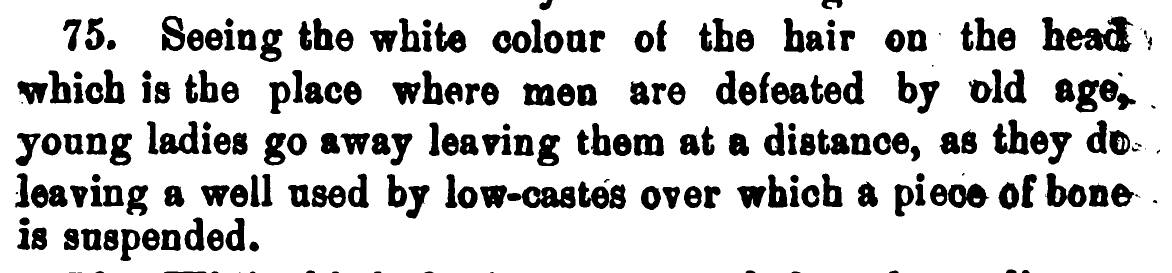
75. Seeing the white colour of the hair on the head which is the place where men are defeated by old age, young ladies go away leaving them at a distance, as they do leaving a well used by low-castes over which a piece of bone is suspended.
Notes
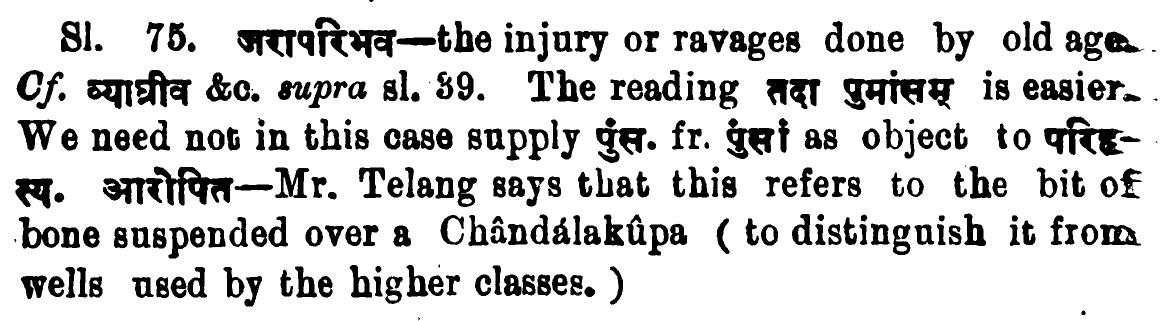
Sl. 75. जरापरिभव—the injury or ravages done by old age. Cf. व्याघ्रीव &c. supra sl. 39. The reading तदा पुमांसम् is easier. We need not in this case supply पुंस. fr. पुंसां as object to परिहस्य. आरोपित—Mr. Telang says that this refers to the bit of bone suspended over a Chândálakûpa ( to distinguish it from wells used by the higher classes. )

Kosambi
all
Footnote
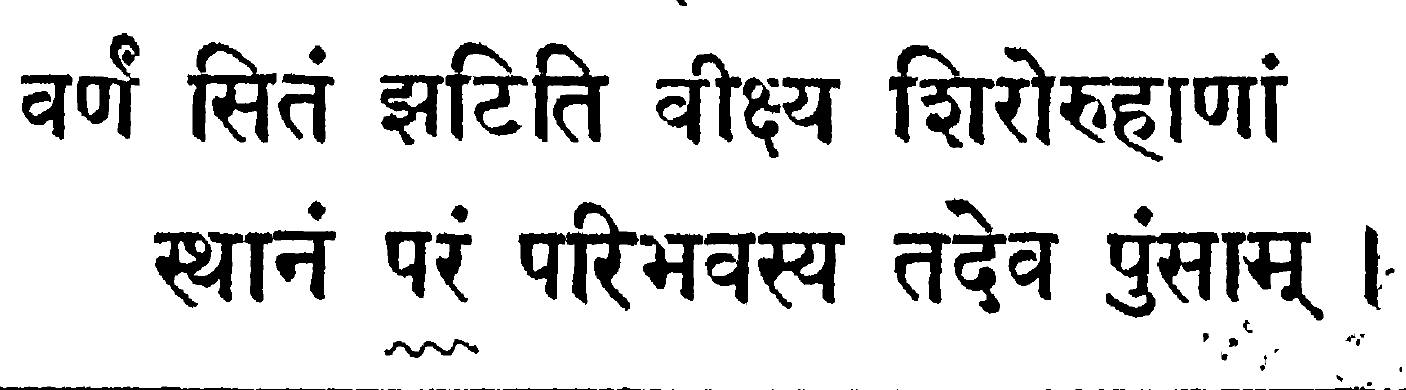
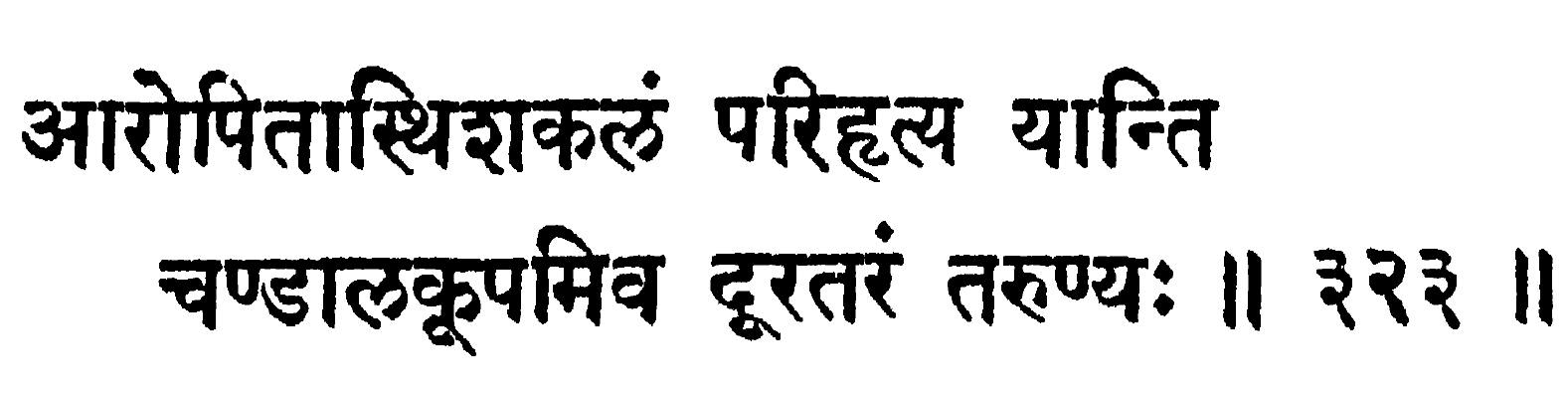
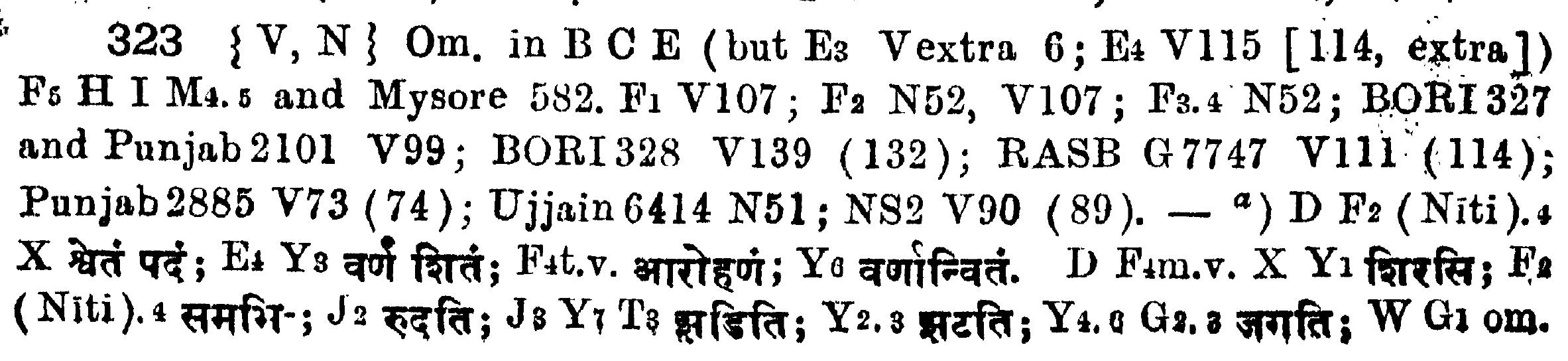
323 { V , N } Om · in B CE ( but E3 Vextra 6 ; E4 V115 [ 114 , extra ] )
Fs H I M45 and Mysore 582. F1 V107 ; F2 N52 , V107 ; F3 . 4 N52 ; BORI 327
and Punjab 2101 V99 ; BORI328 V139 ( 132 ) ; RASB G7747 V111 ( 114 ) ;
Punjab 2885 V73 ( 74 ) ; Ujjain 6414 N51 ; NS2 V90 ( 89 ) . – “ ) D F2 ( Niti ) . 4
X श्वेतं पदं ; E + Y3 वर्ण शितं ; Fat.v. आरोहणं ; Y० वर्णान्वितं . DF + m.v . X Y 1 शिरसि ; Es
( Niti ) . 4 समभि- ; J2 रुदति ; Js J3 Yy Yr T३ T३ झडिति झडिति ; ; Y2 X 2. . 3 3 झटति ; Y4.0 G2 3 जगति ; W Gaom .
Footnote
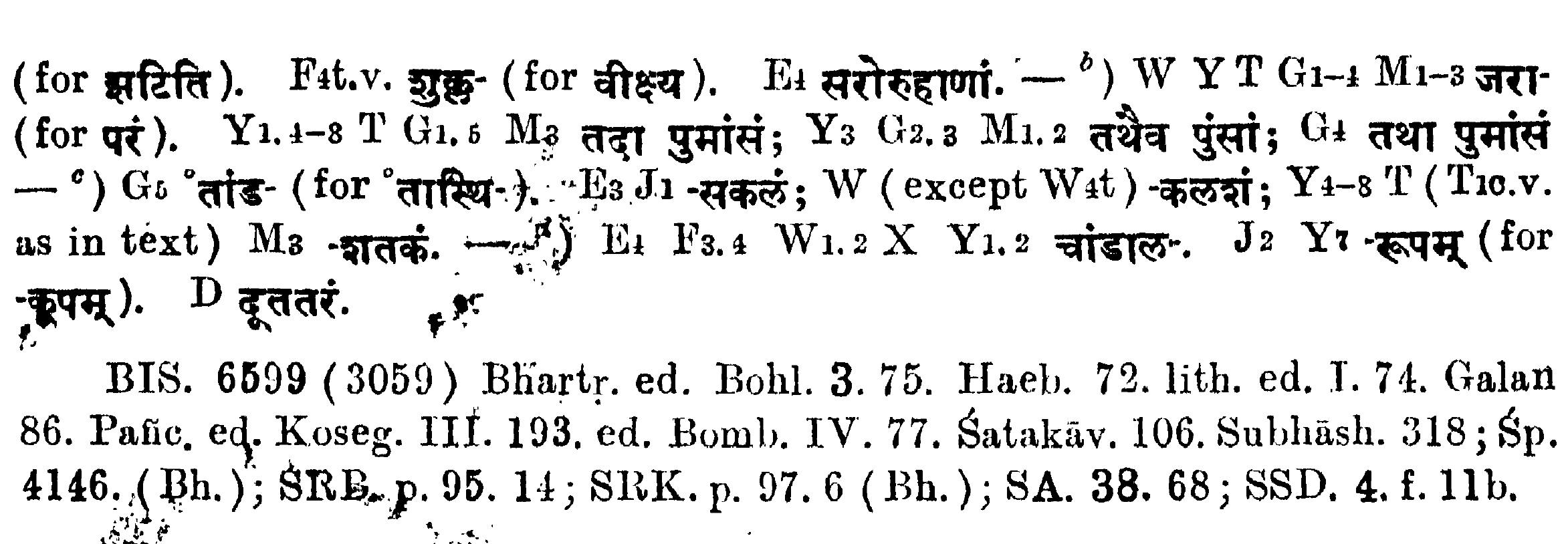
( for झटिति ) . Fat.v. शुक्ल - ( for वीक्ष्य ) . B1 सरोरुहाणां - 4 ) W Y T G1-1 M1-3 जरा
( for परं ) . Y1 . 1 - 8 TG16 M ? तदा पुमांसं ; Y3 G2.3 M1 . 2 तथैव पुंसां ; G + तथा पुमांसं
– ॰ ) G & तांड- ( for तास्थि ) . E3 J1 -सकलं ; W ( except Wat ) -कलशं ; Y + 4 ' T ( T10.v.
as in text ) M3 -शतकं . ) E1 F3.4 W1.2 X Y 1.2 चांडाल- J2 X7 Y1 रूपम् ( for
कूपम् ) . D दूततरं . **
BIS . 6599 ( 3059 ) Bhartr . ed . Bohl . 3.75 . Haeb . 72. lith ed . I. 74. Galan
86. Paic . eq . Koseg . IIf . 193. ed . Bomb IV . 77. Satakāv . 106. Subhash . 318 ; Śp .
4146. ( Bh . ) ; ŚREp . 95. 14 ; SRK . p . 97.6 ( Bh . ) ; SA 38. 68 ; SSD . 4. f.11b .
Commentary