Tawney
Great-hearted men would sooner part with life
Than honour, as their mother ever dear,
To which in evil days they still adhere,
Nor wage with self-respect unholy strife.
Telang
all
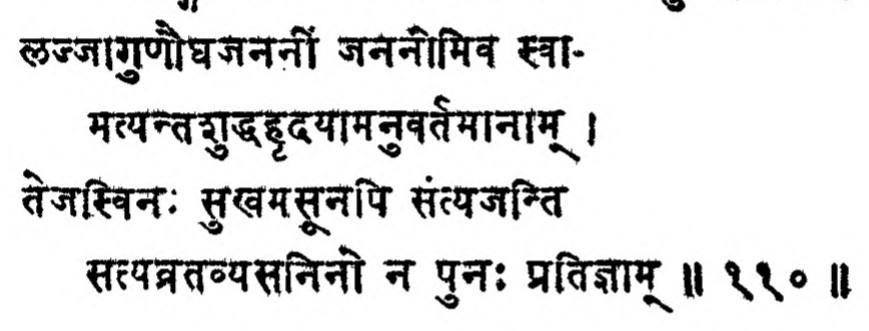
लज्जागुणौघजननीं जननीमिव स्वा-
मत्यन्तशुद्धहृदयामनुवर्तमानाम् ।
तेजस्विनः सुखमसूनपि संत्यजन्ति
सत्यव्रतव्यसनिनो न पुनः प्रतिज्ञाम् ॥ ११० ॥
Notes
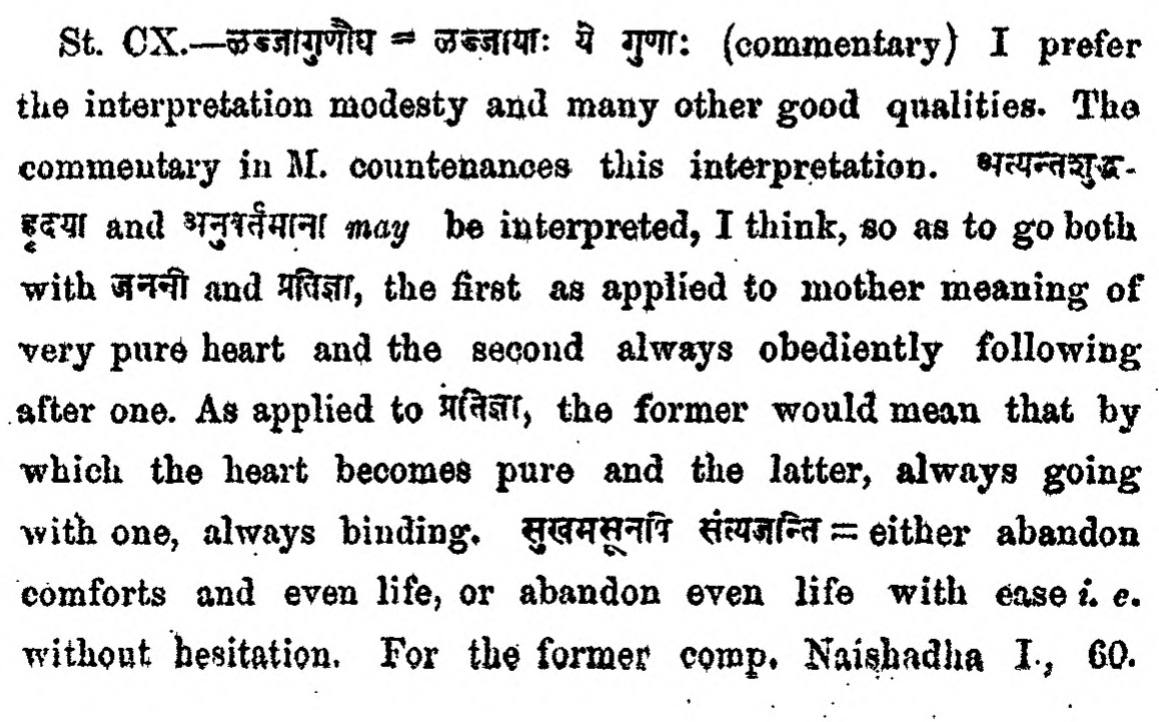
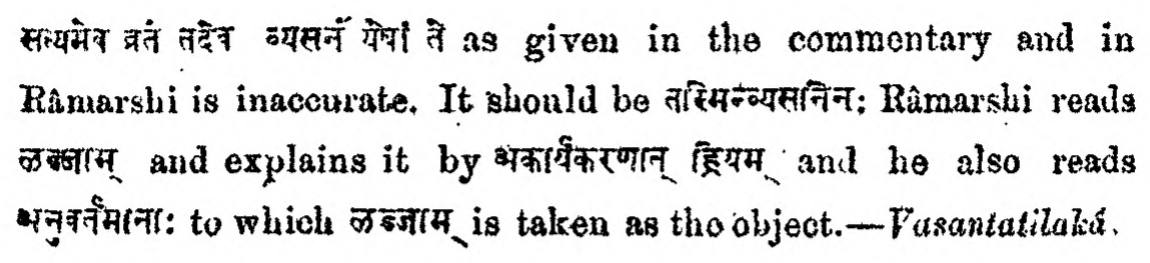
St. CX.—लज्जागुणौघ = लज्जायाः ये गुणाः (commentary) I prefer the interpretation modesty and many other good qualities. The commentary in M. countenances this interpretation. अत्यन्तशुद्धहृदया and अनुवर्तमाना may be interpreted, I think, so as to go both with जननी and प्रतिज्ञा, the first as applied to mother meaning of very pure heart and the second always obediently following after one. As applied to प्रतिज्ञा, the former would mean that by which the heart becomes pure and the latter, always going with one, always binding. सुखमसूनपि संत्यजन्ति = either abandon comforts and even life, or abandon even life with ease i. e. without hesitation. For the former comp. Naishadha I., 60. सत्यमेव व्रतं तदेव व्यसनं येषां ते as given in the commentary and in Râmarshi is inaccurate. It should be तस्मिन्व्यसनिनः Râmarshi reads लज्जाम् and explains it by अकार्यकरणात् ह्रियम् and he also reads अनुवर्तमानाः to which लज्जाम् is taken as the object.—Vasantatilakâ.

Kale
all
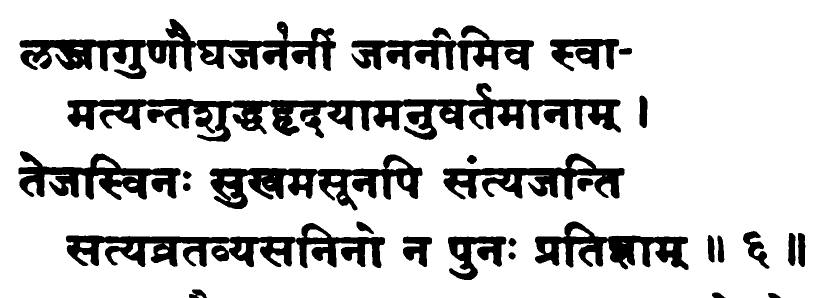
लज्जागुणौघजननीं जननीमिव स्वा-
मत्यन्तशुद्धहृदयामनुवर्तमानाम् ।
तेजस्विनः सुखमसूनपि संत्यजन्ति
सत्यव्रतव्यसनिनो न पुनः प्रतिज्ञाम् ॥ ६ ॥
Translation
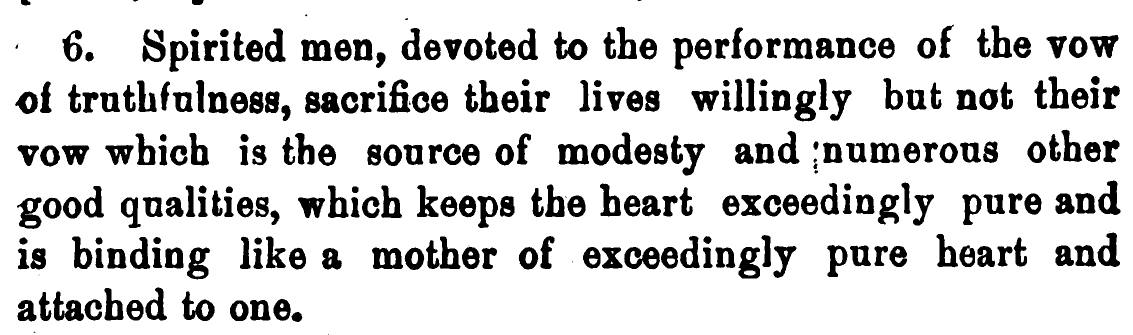
6. Spirited men, devoted to the performance of the vow of truthfulness, sacrifice their lives willingly but not their vow which is the source of modesty and numerous other good qualities, which keeps the heart exceedingly pure and is binding like a mother of exceedingly pure heart and attached to one.
Notes
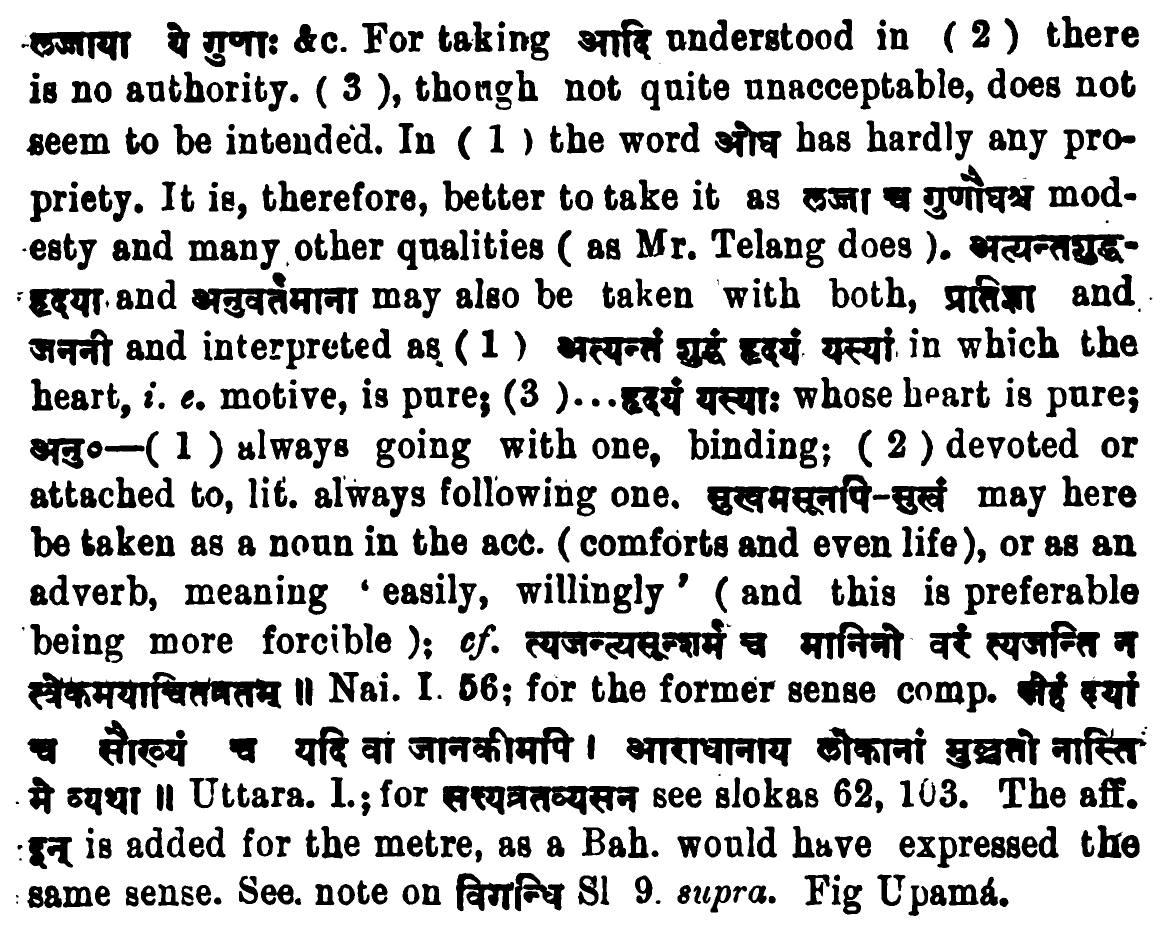
Sl. 6. लज्जा &c.—This is interpreted in three ways:—( 1 ) लज्जा एव गुणः तस्यौघः; ( 2 ) लज्जादयो ये गुणास्तेषां &c. and ( 3 ) लज्जाया ये गुणाः &c. For taking आदि understood in ( 2 ) there is no authority. ( 3 ), though not quite unacceptable, does not seem to be intended. In ( 1 ) the word ओघ has hardly any propriety. It is, therefore, better to take it as लज्जा च गुणौघश्च modesty and many other qualities ( as Mr. Telang does ). अत्यन्तशुद्धहृदया and अनुवर्तमाना may also be taken with both, प्रतिज्ञा and जननी and interpreted as ( 1 ) अत्यन्तं शुद्धं हृदयं यस्यां in which the heart, i. e. motive, is pure; ( 3 )...हृदयं यस्याः whose heart is pure; अनु०—( 1 ) always going with one, binding; ( 2 ) devoted or attached to, lit. always following one. सुखमसूनपि-सुखं may here be taken as a noun in the acc. ( comforts and even life ), or as an adverb, meaning ‘ easily, willingly ’ ( and this is preferable being more forcible ); cf. त्यजन्त्यसून्शर्म च मानिनो वरं त्यजन्ति न स्त्वेकमयाचितव्रतम् ॥ Nai. I. 56; for the former sense comp. स्नेहं दयां च सौख्यं च यदि वा जानकीमपि । आराधनाय लोकानां मुञ्चतो नास्ति मे व्यथा ॥ Uttara. I.; for सत्यव्रतव्यसन see slokas 62, 103. The aff. इन् is added for the metre, as a Bah. would have expressed the same sense. See. note on विगन्धि Sl 9. supra. Fig Upamá.


Gopinath1914
all
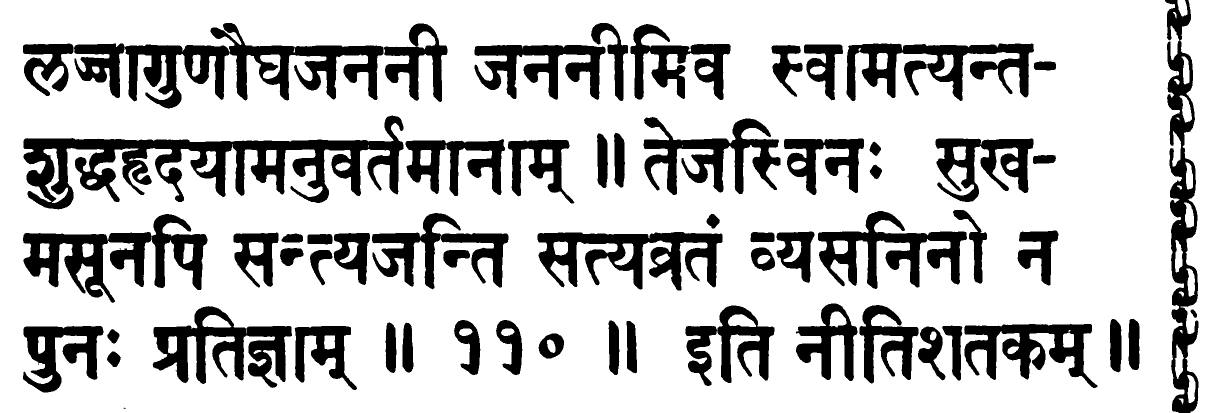
लज्जागुणौघजननी जननीमिव स्वामत्यन्त-
शुद्धहृदयामनुवर्तमानाम् ॥ तेजस्विनः सुख-
मसूनपि सन्त्यजन्ति सत्यत्रतं व्यसनिनो न
पुनः प्रतिज्ञाम् ॥ ११० ॥ इति नीतिशतकम् ॥
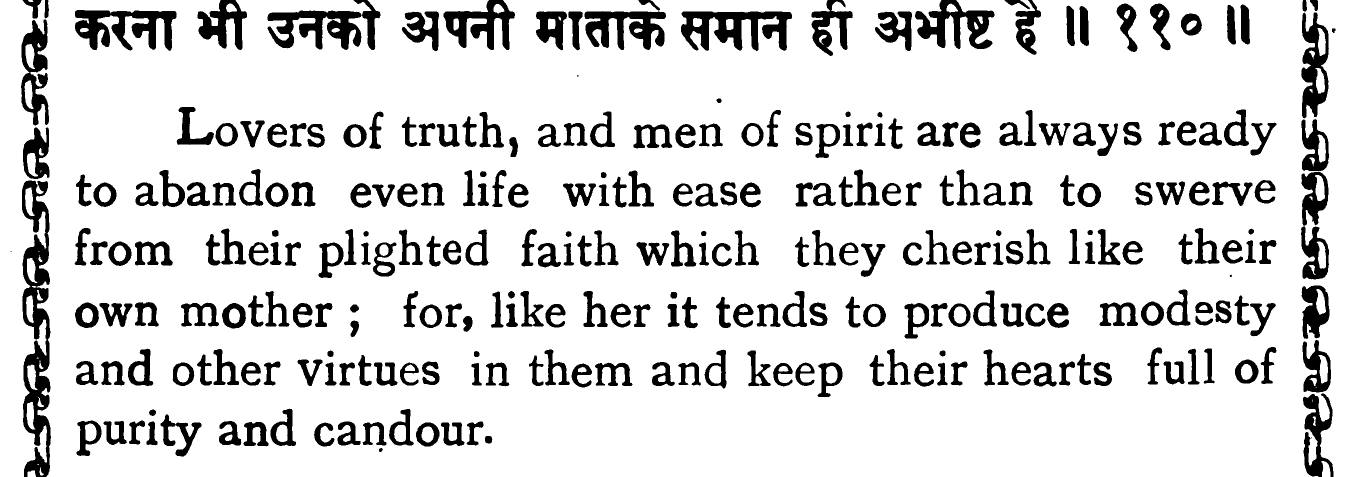
सत्यभाषण करनेवाले तेजस्वी मनुष्य अपनी प्रतिज्ञा भंग करने की अपेक्षा प्राणत्याग करने को श्रेष्ठ समझते हैं क्योंकि जो प्रतिज्ञा उनको लज्जादि उत्तमगुणोंमें प्रवृत्त करती है उसका पालन करना भी उनको अपनी माताके समान ही अभीष्ट है ॥ ११० ॥
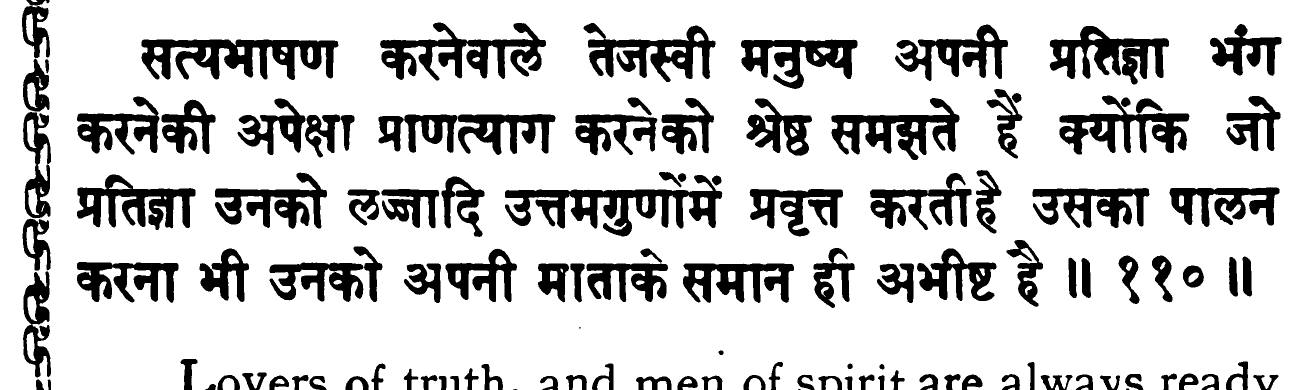
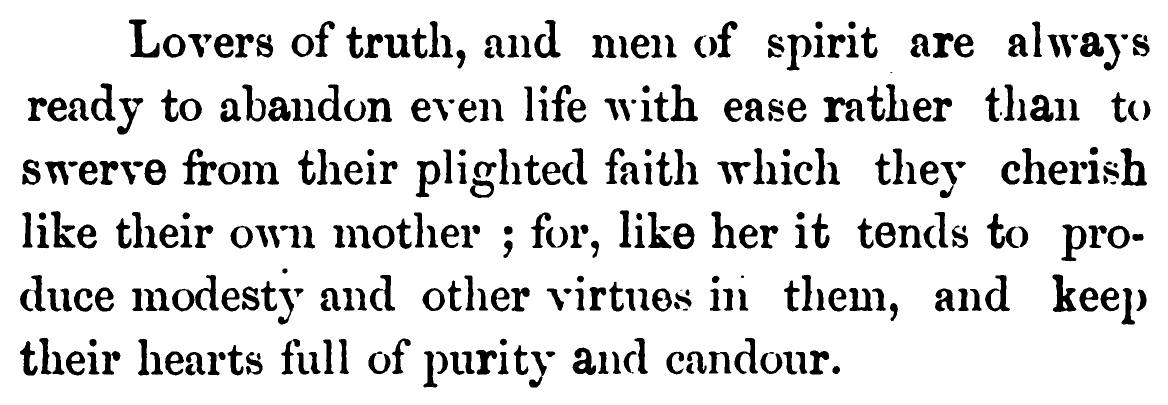
Lovers of truth, and men of spirit are always swerve ready to abandon even life with ease rather than to from their plighted faith which they cherish like their mother; for, like her it tends to produce modesty own and other virtues in them and keep their hearts full of purity and candour.

Footnote
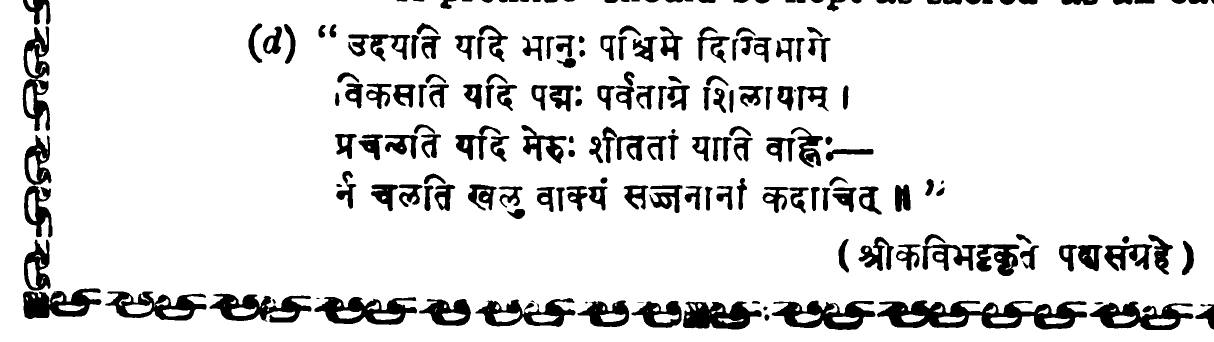
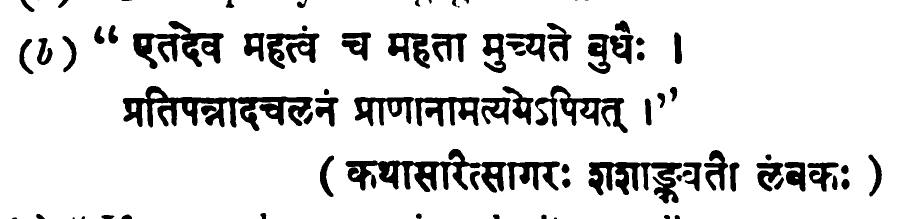
(b) " एतदेव महत्वं च महतामुच्यते बुधैः । " प्रतिपन्नादचलनं प्राणानामस्ययेऽपि यत् । ( कथासरित्सागरः शशाङ्कवतीलंबकः )

Footnote
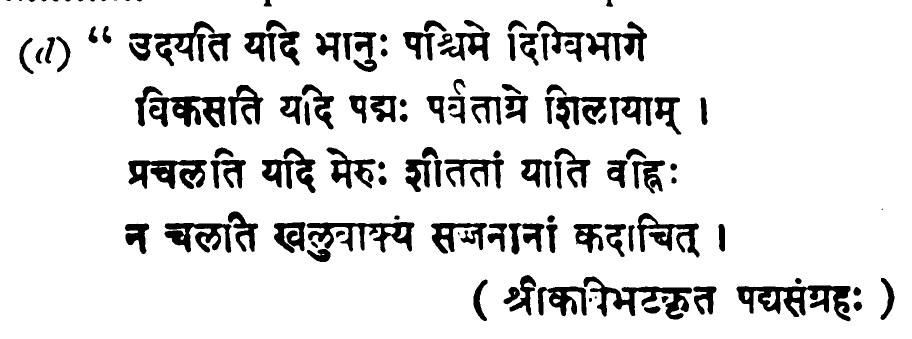
(c) "If you make a promise be it a small or a great matter fulfil it. A promise should be kept as sacred as an oath." PRIVEF

Gopinath1896
all
लज्जागुणौघजननी जननीमिवस्वा, मत्यन्त
शुद्धहृदयामनुवर्तमानाम् । तेजस्विनः सुखम-
सूनपि सन्त्यजन्ति, सत्यत्रतं व्यसनिनो न
पुनः प्रतिज्ञाम् ॥ ११० ॥
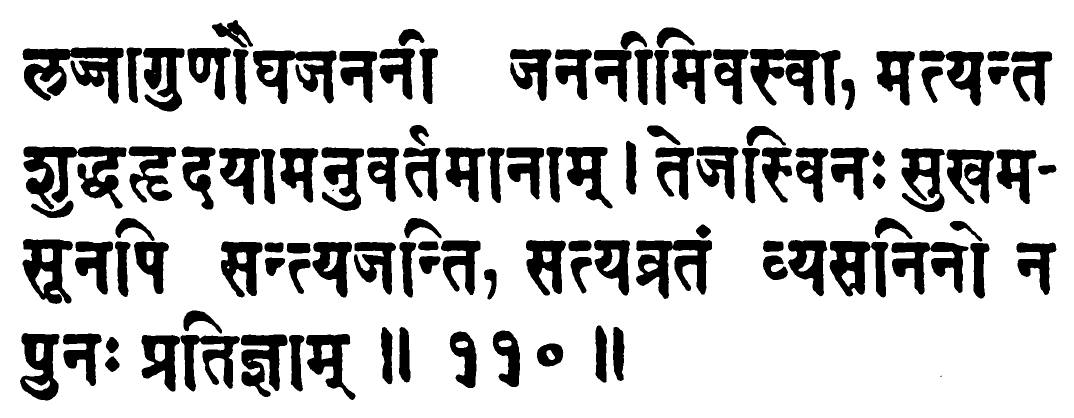
सत्यभाषण करनेवाले तेजस्वी मनुष्य अपनी प्रतिज्ञा भंग करने की अपेक्षा प्राणत्याग करने को श्रेष्ठ समझते हैं क्योंकि जो प्रतिज्ञा उनको लज्जादिउत्तमगुणों में प्रवृत करती है उसका पालन करनाभी उनको अपनी माताके समान ही अभीष्ट है ॥ ११० ॥
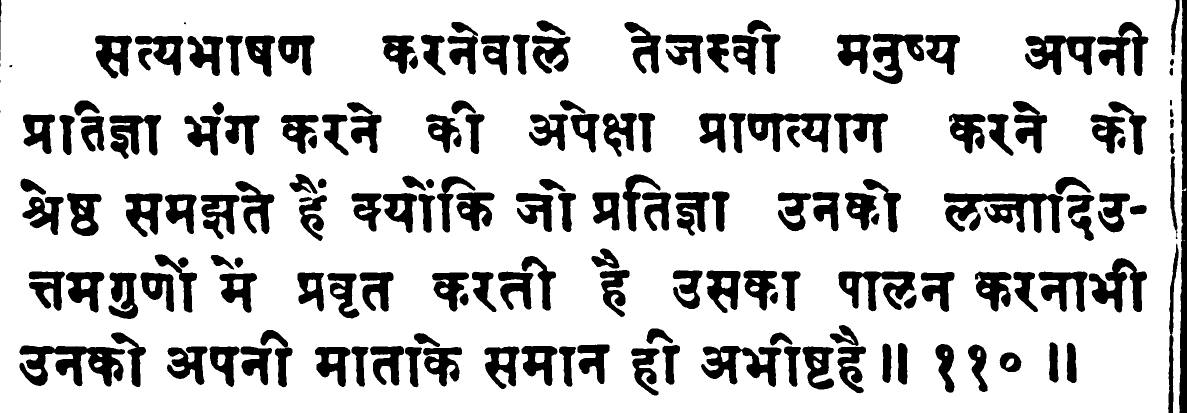
Lovers of truth, and men of spirit are always ready to abandon even life with ease rather than to swerve from their plighted faith which they cherish like their own mother ; for, like her it tends to produce modesty and other virtues in them, and keep their hearts full of purity and candour.

Footnote
(b ) " एतदेव महत्वं च महता मुच्यते बुधैः । प्रतिपन्नादचलनं प्राणानामत्ययेऽपियत् । " ( कथासरित्सागरः शशाङ्कवती लंबकः )
Footnote
(^) “ If you make a promise be it a small or a great matter fulfil it.........A promise should be kept as sacred as an oath.”

Kosambi
all
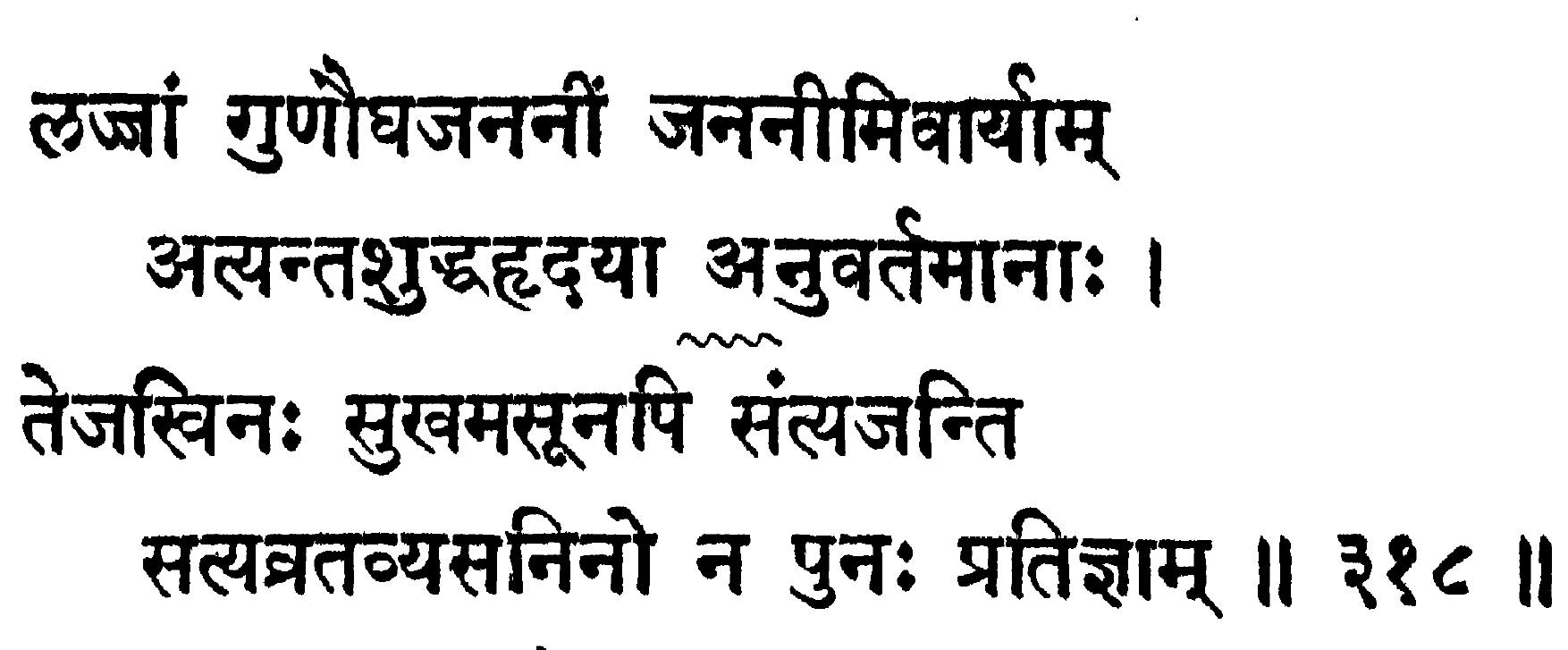
लज्जां गुणौघजननीं जननीमिवार्याम्
अत्यन्तशुद्धहृदया अनुवर्तमानाः ।
तेजस्विनः सुखमसूनपि संत्यजन्ति
सत्यव्रतव्यसनिनो न पुनः प्रतिज्ञाम् ॥ ३१८ ॥
Footnote
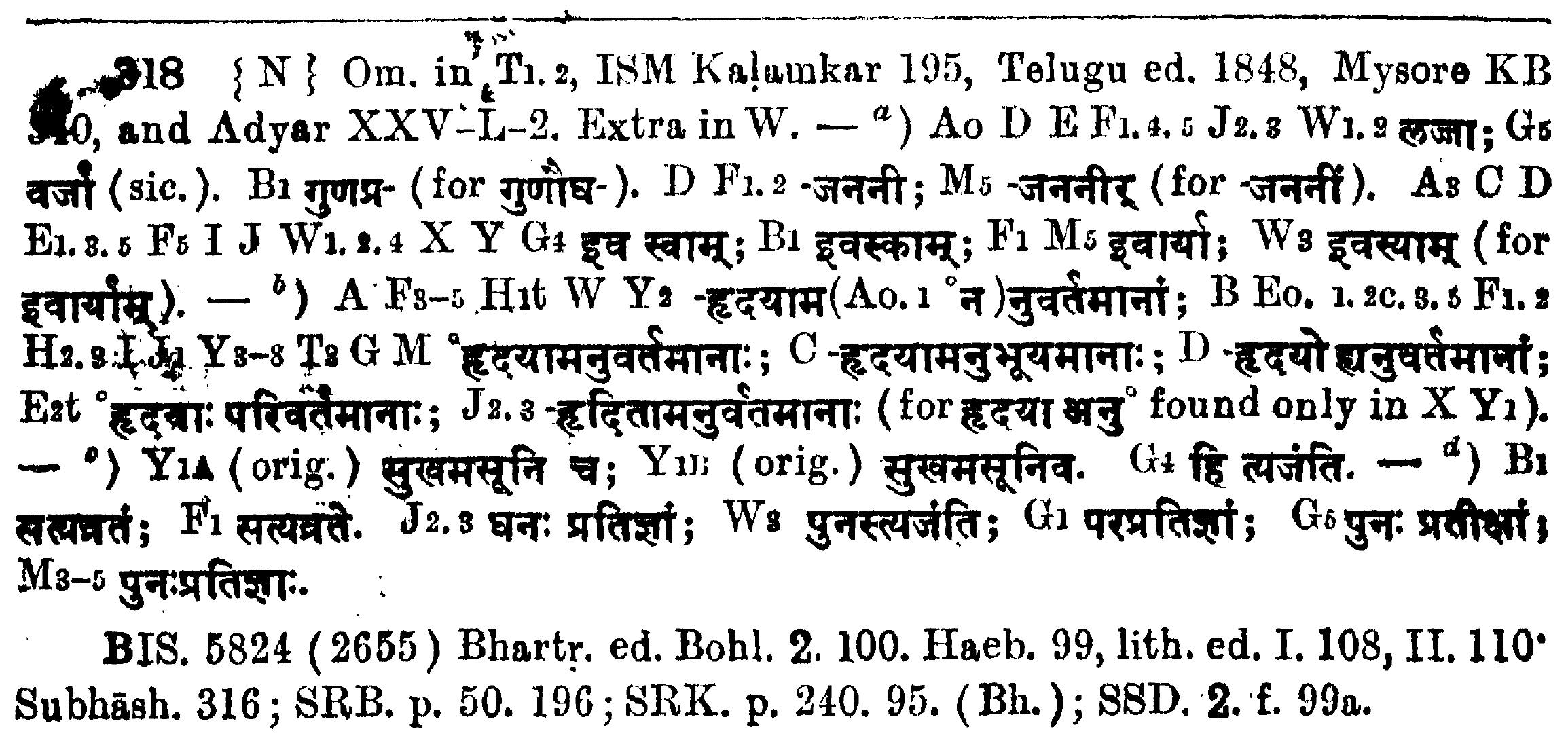
1318 { N } Om . in T1 . 2 , ISM Kalamkar 195 , Telugu ed . 1848 , Mysore KB
S40 , and Adyar XXV - I - 2 Extra in W. – 4 ) A0 DEF1.4 5 J23 W1 . 2 लज्जा ; जै 5
वर्जा ( sic . ) . B1 गुणप्र- ( for गुणौष- ) . D F1 . 2 जननी ; M5 -जननीर् ( for जननीं ) . AsCD
E1.8.5F6 I J W18.4 X Y G4 इव स्वाम् ; B1 इवस्काम् ; F1 Ms इवार्या ; W3 इवस्याम् ( for
इवार्याम् ) . – ० ) A F3-5 Hit W Y 2 हृदयाम ( A0.1 ' न ) नुवर्तमानां ; B Eo . 1. 20. 3. 5 F1 , 2
H24 : 434_Y3-4 T3 & GM M ' हृदयामनुवर्तमानाः ; C हृदयामनुभूयमानाः ; D हृदयो ह्यनुवर्तमानां ;
Eat हृदवाः परिवर्तमानाः ; J2.3 - हृदितामनुर्वतमानाः ( for हृदया अनु " found only in X X Y1 ) .
- ) Y14 ( orig . ) सुखमसूनि च ; Y1 ; ( orig . ) सुखमसूनिव . ( G + हि त्यज॑ति - ) B1
सत्यव्रतं ; F1 सत्यव्रते . J2 . s घनः प्रतिज्ञां ; Ws पुनस्त्यर्जति ; G1 परप्रतिज्ञां ; G० पुनः प्रतीक्षां 3
Ms - 6 पुनःप्रतिज्ञा .. :
BIS . 5824 ( 2655 ) Bhartr , ed . Bohl . 2. 100. Haeb . 99 , lith ed . I. 108 , II . 110
Subhāsh . 316 ; SRB . p . 50. 196 ; SRK . p . 240.95 . ( Bh . ) ; SSD . 2.f.99a .
Commentary