Ryder
THE STUBBORN FOOL-II
With sufficient toil and travail
You may gather oil from gravel;
The mirage perhaps your thirsty lips may cool;
If you seek it night and morn,
You may find a rabbit's horn;
But you never can convince a stubborn fool.
Brough
If only you squeeze hard enough, you will
Press oil from sand;
And, if you’re thirsty, even drink your fill
From a mirage.
Sooner or later you may somewhere find
A rabbit’s horn:
But never hope to change the stubborn mind
Of a born fool.
Tawney
If you squeeze with might and main,
Oil from sand you may obtain;
If with parching thirst you burn,
Some mirage may serve your turn;
If you wander far and wide,
Rabbits' horns may grace your side;
But you'll never—trust my rule—
Please a headstrong, bumptious fool.
More
XXXI
Oil from the sand a man may strain,
If chance he squeeze with might and main;
The pilgrim at the magic well
Of the mirage his desert thirst may quell.
So traveling far a man by luck
May find a hare horned like a buck; —
But who by art may straighten out
The crooked counsels of a stubborn lout?
Telang
all
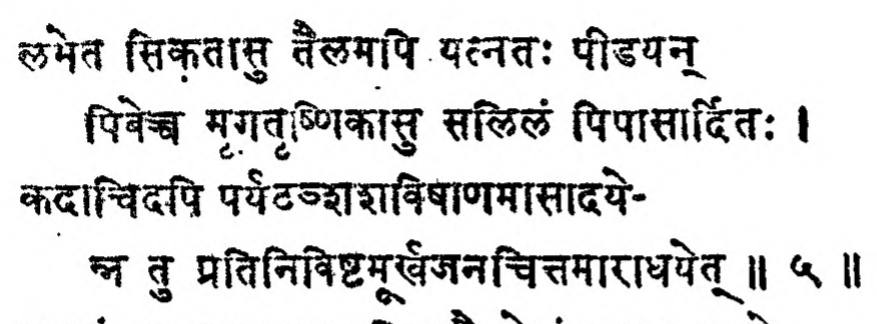
लभेत सिकतासु तैलमपि यत्नतः पीडयन्
पिबेच्च मृगतृष्णिकासु सलिलं पिपासार्दितः ।
कदाचिदपि पर्यटञ्शशविषाणमासादये-
न्न तु प्रतिनिविष्टमूर्खजनचित्तमाराधयेत् ॥ ५ ॥
Notes
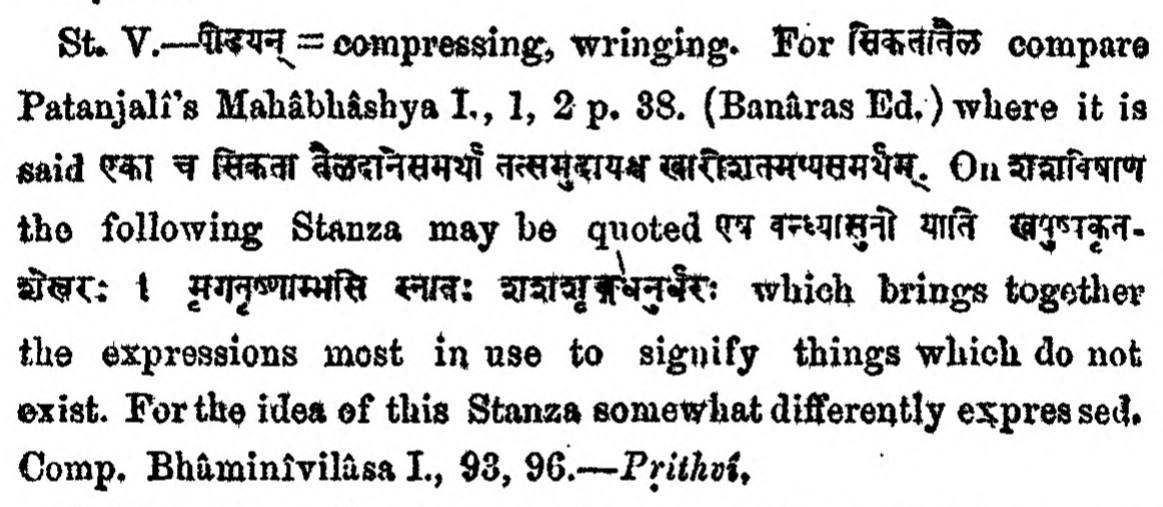
St. V.—पीडयन् = compressing, wringing. For सिकतातैल compare Patanjalî’s Mahâbhâshya I., 1, 2 p. 38. (Banâras Ed.) where it is said एका च सिकता तैलदानेऽसमर्था तत्समुदायश्च खारीशतमप्यसमर्थम्. On शशविषाण the following Stanza may be quoted एष वन्ध्यासुतो याति खपुष्पकृतशेखरः । मृगतृष्णाम्भसि स्नातः शशशृङ्गधनुर्धरः which brings together the expressions most in use to signify things which do not exist. For the idea of this Stanza somewhat differently expressed. Comp. Bhâminîvilâsa I., 93, 96.—Pṛithvî.

Kale
all

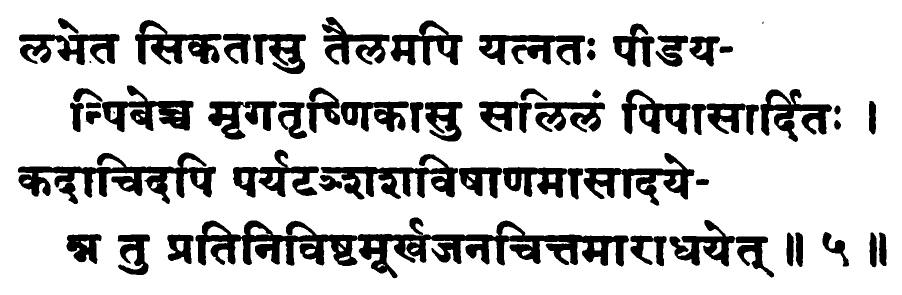
लभेत सिकतासु तैलमपि यत्नतः पीडय-
न्पिबेच्च मृगतृष्णिकासु सलिलं पिपासार्दितः ।
कदाचिदपि पर्यटञ्शशविषाणमासादये-
न्न तु प्रतिनिविष्टमूर्खजनचित्तमाराधयेत् ॥ ५ ॥
Translation
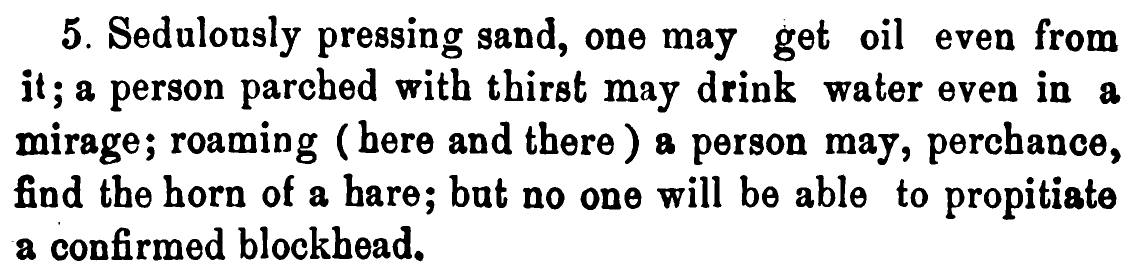
5. Sedulously pressing sand, one may get oil even from it; a person parched with thirst may drink water even in a mirage; roaming ( here and there ) a person may, perchance, find the horn of a hare; but no one will be able to propitiate a confirmed blockhead.
Notes
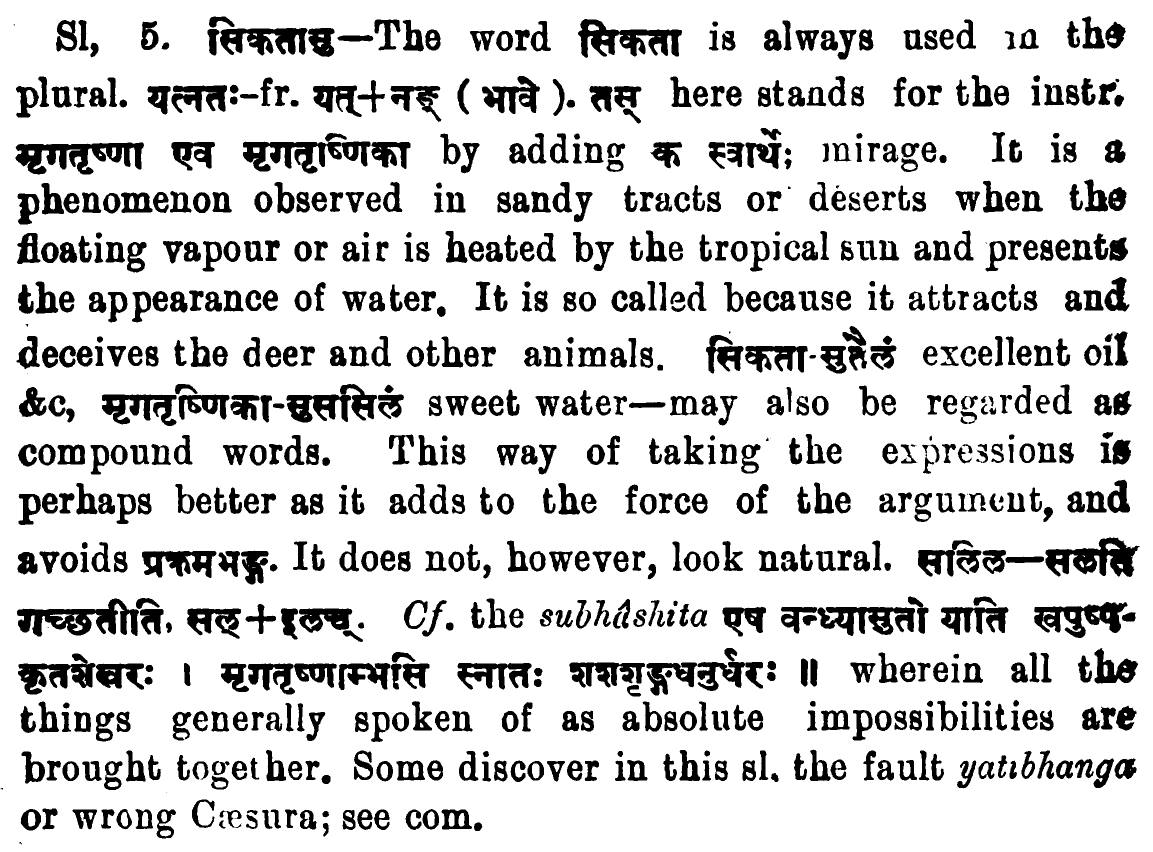
Sl, 5. सिकतासु—The word सिकता is always used in the plural. यत्नतः–fr. यत्+नङ् ( भावे ). तस् here stands for the instr. मृगतृष्णा एव मृगतृष्णिका by adding क स्वार्थे; mirage. It is a phenomenon observed in sandy tracts or deserts when the floating vapour or air is heated by the tropical sun and presents the appearance of water. It is so called because it attracts and deceives the deer and other animals. सिकता-सुतैलं excellent oil &c, मृगतृष्णिका-सुसलिलं sweet water—may also be regarded as compound words. This way of taking the expressions is perhaps better as it adds to the force of the argument, and avoids प्रक्रमभङ्ग. It does not, however, look natural. सलिल—सलति गच्छतीति, सल्+इलच्. Cf. the subhâshita एष वन्ध्यासुतो याति खपुष्पकृतशेखरः । मृगतृष्णाम्भसि स्नातः शशशृङ्गधनुर्धरः ॥ wherein all the things generally spoken of as absolute impossibilities are brought together. Some discover in this sl. the fault yatibhanga or wrong Cæsura; see com.
Gopinath1914
all
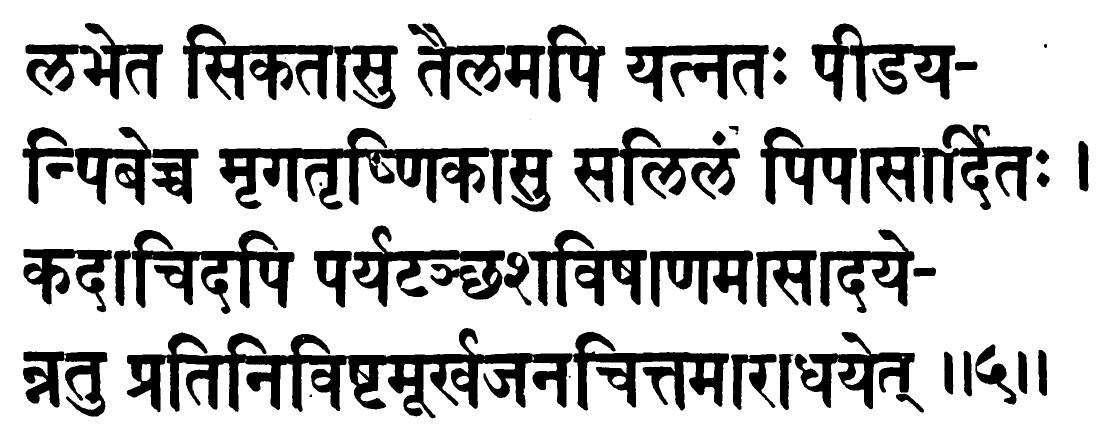
लभेत सिकतासु तैलमपि यत्नतः पीडय -
पिबेच्च मृगतृष्णिकासु सलिलं पिपासार्दितः ।
कदाचिदपि पर्यटञ्छशविषाणमासादये-
न्नतु प्रतिनिविष्टमूर्खजनचित्तमाराधयेत् ॥५॥
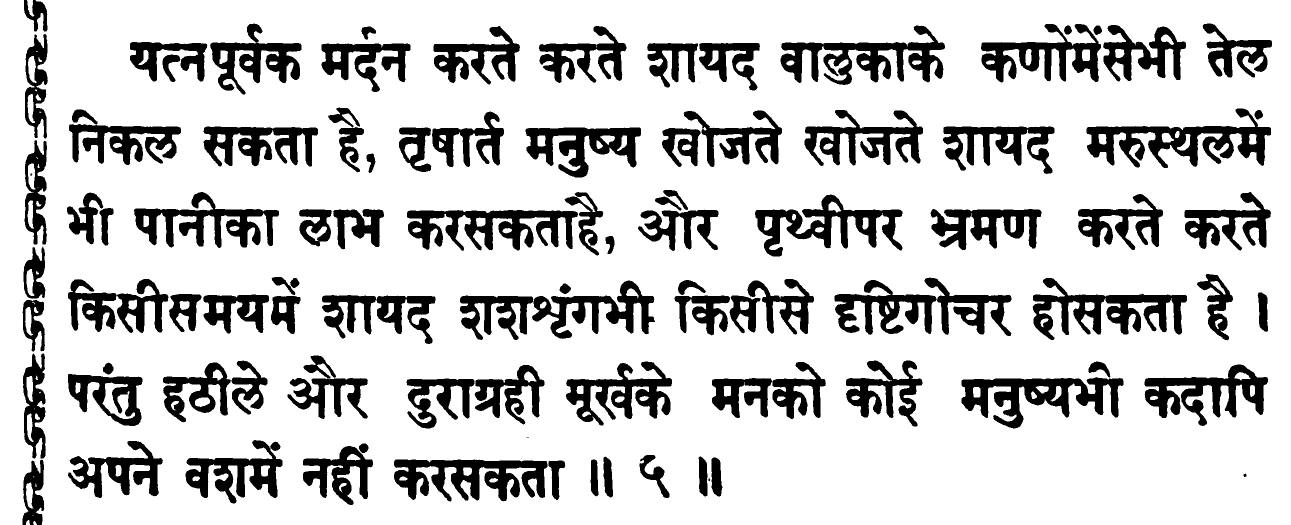
यत्नपूर्वक मर्दन करते करते शायद वालुकाके कणोंमेंसेभी तेल निकल सकता है, तृषार्त मनुष्य खोजते खोजते शायद मरुस्थलमें भी पानीका लाभ करसकता है, और पृथ्वीपर भ्रमण करते करते किसी समय में शायद शशशृंगभी किसीसे दृष्टिगोचर होसकता है । परंतु हठीले और दुराग्रही मूर्खके मनको कोई मनुष्य भी कदापि अपने वशमें नहीं करसकता ॥ ५ ॥
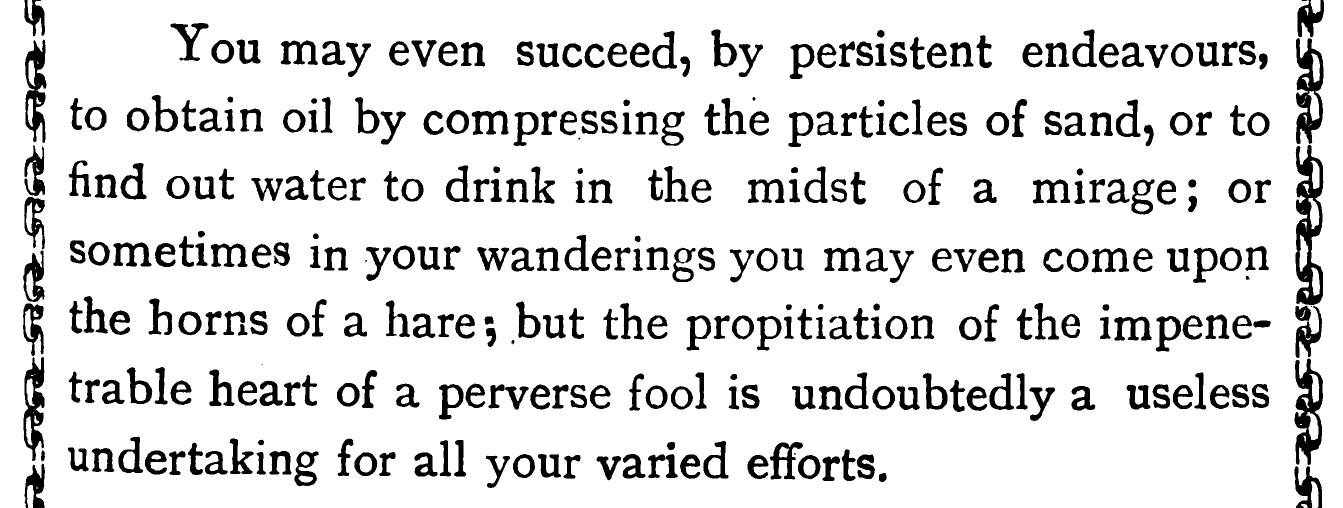
You may even succeed, by persistent endeavours, to obtain oil by compressing the particles of sand, or to find out water to drink in the midst of a mirage; or sometimes in your wanderings you may even come upon the horns of a hare; but the propitiation of the impenetrable heart of a perverse fool is undoubtedly a useless undertaking for all your varied efforts.
'भरण्यरुदितं कृतं शवशरीरमुद्वर्तितं, स्थळे जमवरोपितं सुचिरमूषरे वर्षितम् ।
वपुच्छमवनामितं बधिरकर्णजापः कृतः कृतान्धमुखमण्डना यदबुधो जनः सेवितः ॥ '



Gopinath1896
all
लभेत सिकतासु तैलमपि यत्नतः पीडय -
न्पिबेच्च मृगतृष्णिकासु सलिलं पिपासार्दितः ।
कदाचिदपि पर्यटभ्छशविषाणमासादये-
न्नतु प्रतिनिविष्टमूर्खजनचित्तमाराधयेत् ॥ ५ ॥
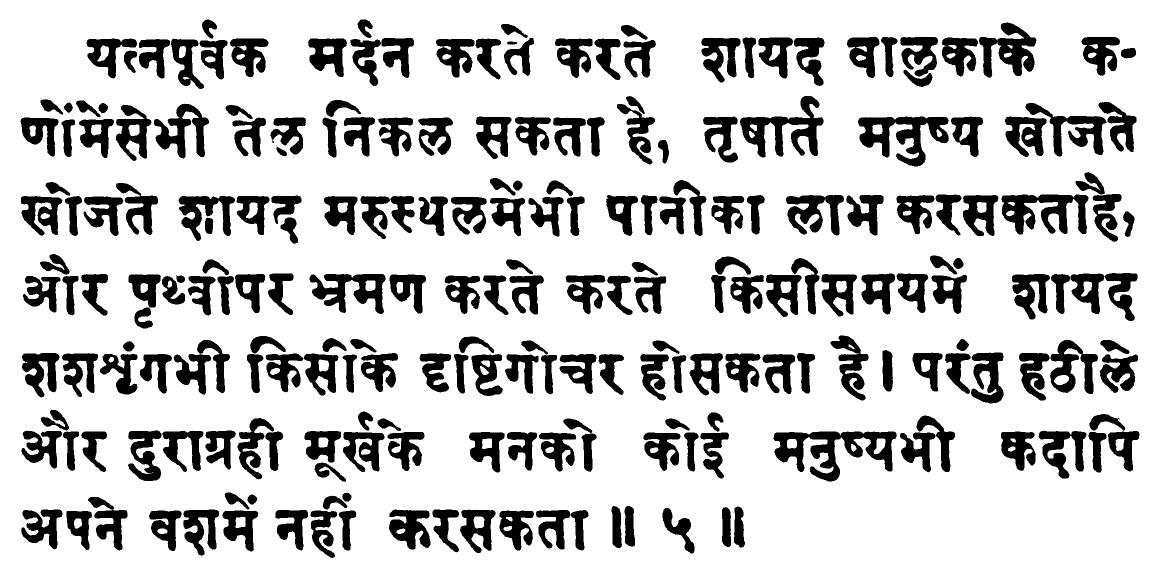
यत्नपूर्वक मर्दन करते करते शायद वालुकाके कणोंमेंसेभी तेल निकल सकता है, तृषार्त मनुष्य खोजते खोजते शायद मरुस्थलमेंभी पानीका लाभ कर सकता है, और पृथ्वीपर भ्रमण करते करते किसीसमय में शायद शशशृंगभी किसीके दृष्टिगोचर होसकता है। परंतु हठीले और दुराग्रही मूर्खके मनको कोई मनुष्य भी कदापि अपने वश में नहीं करसकता ॥ ५ ॥
You may even succeed, by persistent endeavours, to obtain oil by compressing the particles of sand, or to find out water to drink in the midst of a mirage; or sometimes in your wanderings you may even come upon the horns of a hare; but the propitiation of the impenetrable heart of a perverse fool is undoubtedly a useless undertaking for all your varied efforts.
Footnote
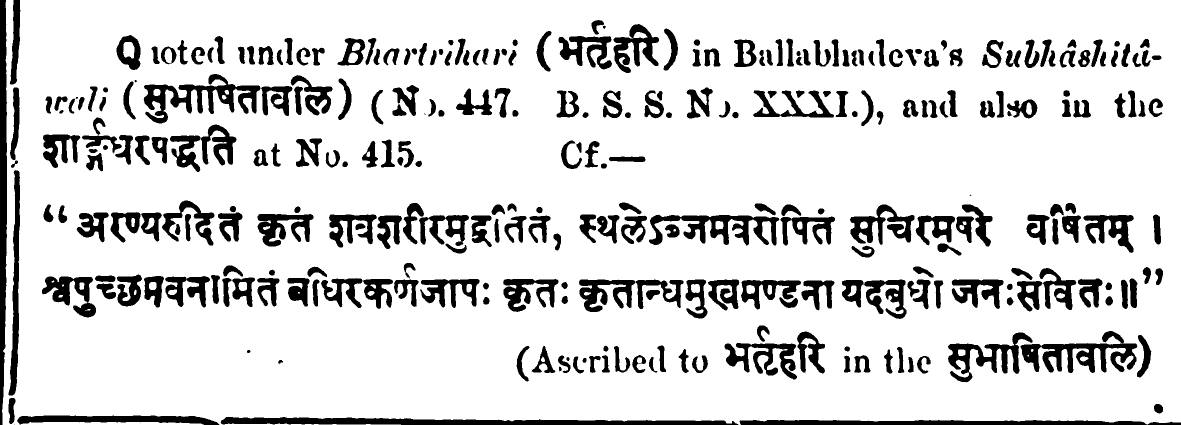
Quoted under Bhartrihari (HR) in Ballabhadeva's Subhâshitâcoli ( सुभाषितावलि) (N) 447. B. SS. N. XXXI.), and also in the शार्ङ्गधरपद्धति at No. 415. Cf.— " अरण्यरुदितं कृतं शवशरीरमुद्वर्तितं स्थलेऽञ्जमवरोपितं सुचिरमूषरे वर्षितम् । श्वपुच्छमवनामितं बधिर कर्णजापः कृतः कृतान्धमुख मण्डना यदबुधो जनः सेवितः ॥ " (Ascribed to भर्तृहरि in the सुभाषितावलि)
Kosambi
all
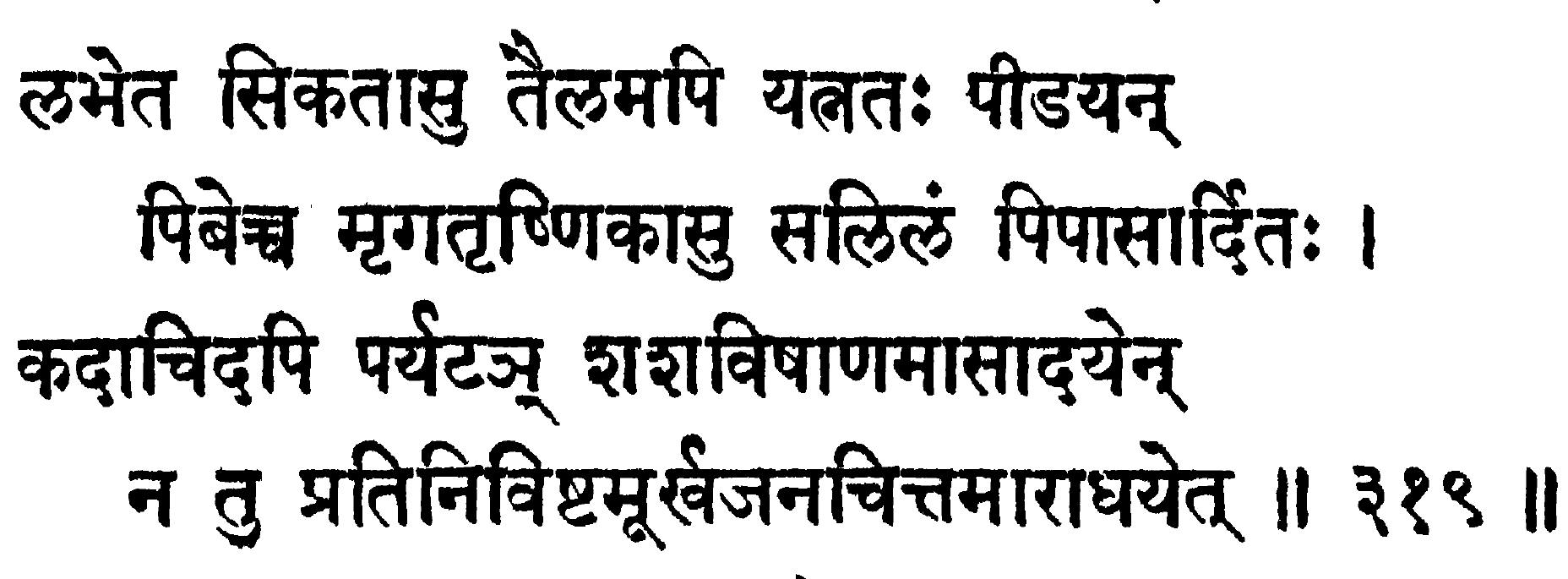
लभेत सिकतासु तैलमपि यत्नतः पीडयन्
पिबेच्च मृगतृष्णिकासु सलिलं पिपासार्दितः ।
कदाचिदपि पर्यटञ् शशविषाणमासादयेन्
न तु प्रतिनिविष्टमूर्खजनचित्तमाराधयेत् ॥ ३१ ९ ॥
Footnote
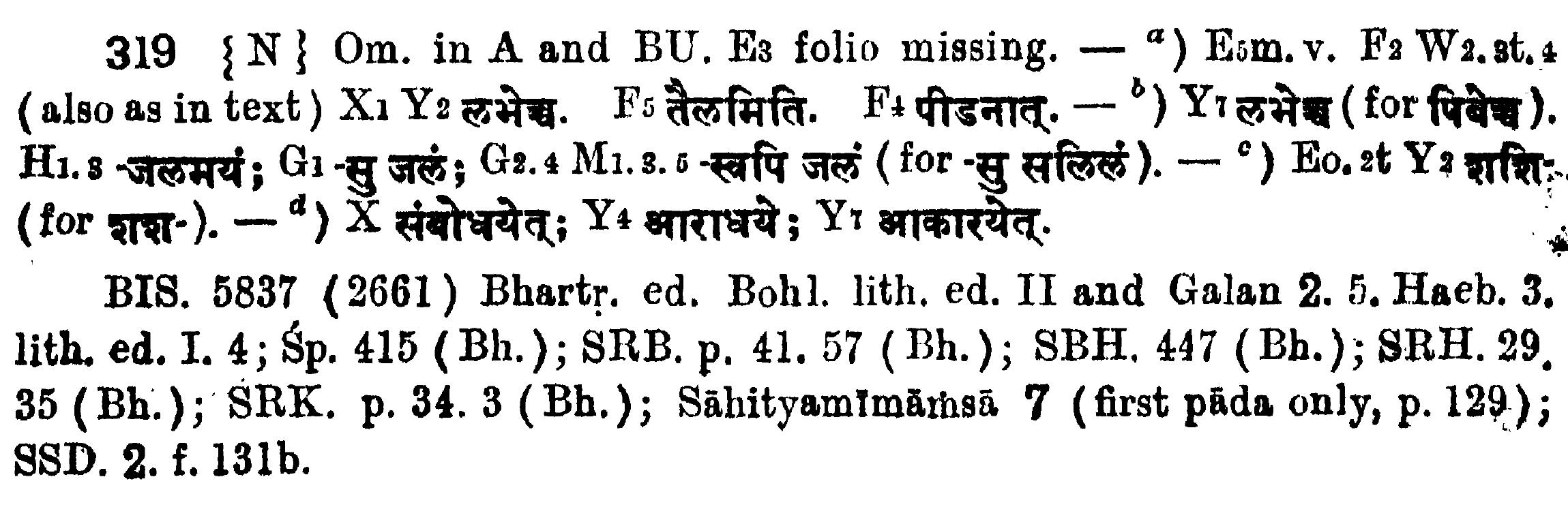
319 { N } Om . in A and BU . Es folio missing . a ) Eom.v. F3 W2 . 3t . 4
( also as in text ) X1 Y 2 लभेच्च . Fs तैलमिति F + पीडनात् . - - 0 ) Y1 लभेच ( for पिबेच ) .
H1.8 जलमयं ; G1 -सु जलं ; G2.4 M1 . 3.5 - स्वपि जलं ( for- सु सलिलं ) . - B ° ) Eo . at Y ? शशि
( for शश ) . - 4 d ) X संबोधयेत् ; Y + आराधये ; Y1 आकारयेत् .
BIS . 5837 ( 2661 ) Bhartṛ . ed . Bohl . lith . ed . II and Galan 2. 5. Haeb . 3 .
lith . ed . I. 4 ; Śp . 415 ( Bh . ) ; SRB . p . 41.57 ( Bh . ) ; SBH 447 ( Bh . ) ; SRH . 29 .
35 ( Bh . ) ; SRK . p . 34. 3 ( Bh . ) ; Sahityamīmārhsã 7 ( first pāda only , p . 129 ) ;
SSD . 2. f 131b .
Commentary