Ryder
UNINTELLIGIBLE VIRTUE
Are palace-joys so incomplete?
Is song a despicable pleasure?
And is there anything so sweet
As clasping her you love and treasure?
Yet pious men account these things
As vain as flickering candlelight
'Neath dancing moths on troubled wings;
And to the woods they take their flight.
Tawney
Tis sweet in palaces to dwell,
Where music's strains voluptuous swell;
'Tis sweet to hear the loved one's voice;
But wise men, of deliberate choice,
Have run from these to forest glades,
Assured all earthly pleasure fades,
Swift as the moth in heedless game
Puffs out the taper's feeble flame.
More
XCII
Is there no pleasure in these palace halls,
Where love invites and music ever calls?
No pleasure, when the revelers troop away,
If one, the loveliest, stay?
Yet have the prudent weighed the world as froth;
Lo, as a candle-flame by wing of moth
Is fluttered, so they count its fickle mood;
They turn to solitude.
Mādhavānanda
रम्यं हर्म्यतलं न किं वसतये श्रव्यं न गेयादिकं
किं वा प्राणसमासमागमसुखं नैवाधिकप्रीतये ।
किंतु भ्रान्तपतङ्गपक्षपवनव्यालोलदीपाङ्कुर-
च्छायाचञ्चलमाकलय्य सकलं सन्तो वनान्तं गता: ।।८०।।
80. Is not a palace pleasant to dwell in? Is not music with its accompaniments agreeable to listen to? Is not the society of women, dear as life itself, very pleasing? Yet, wise men have gone away to the forest, regarding these things as unstable as the shadow of a lamp’s flame flickering through the puff of the wings of a deluded moth.
[ भ्रान्त also means ‘hovering’.]
Telang
all
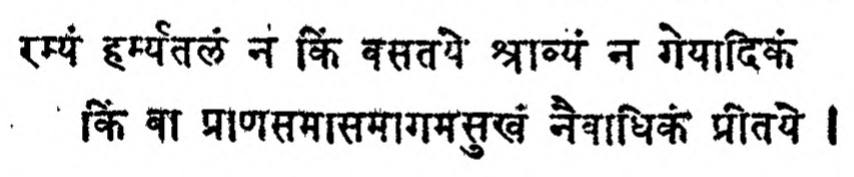
रम्यं हर्म्यतलं न किं वसतये श्रव्यं न गेयादिकं
किं वा प्राणसमासमागमसुखं नैवाधिकं प्रीतये ।
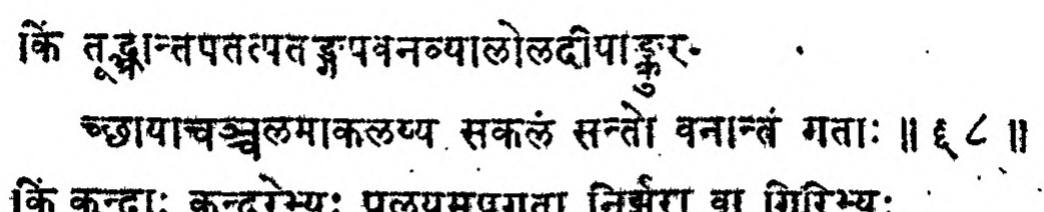
किं तूद्भ्रान्तपतत्पतङ्गपवनव्यालोलदीपाङ्कुर-
च्छायाचञ्चलमाकलय्य सकलं सन्तो वनान्तं गताः ॥ ६८ ॥
Notes
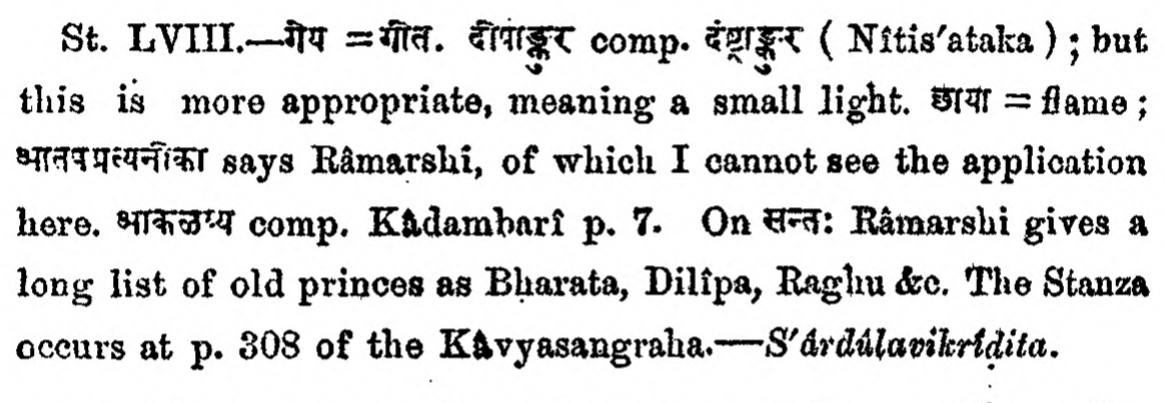
St. LVIII.—गेय = गीत. दीपाङ्कुर comp. दंष्ट्राङ्कुर (Nîtis'ataka); but this is more appropriate, meaning a small light. छाया = flame; आतपप्रत्यनीका says Râmarshi, of which I cannot see the application here. आकलप्य comp. Kâdambarî p. 7. On सन्तः Râmarshi gives a long list of old princes as Bharata, Dilîpa, Raghu &c. The Stanza occurs at p. 308 of the Kâvyasangraha.—S'ârdûlavikrîḍita.


Kale
all

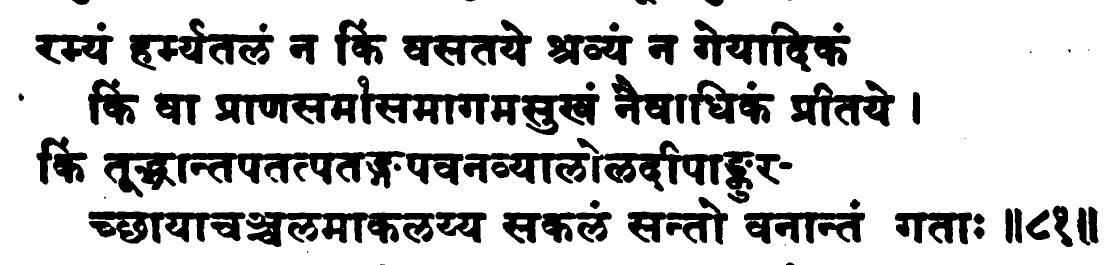
रम्यं हर्म्यतलं न किं वसतये श्रव्यं न गेयादिकं
किं वा प्राणसमासमागमसुखं नैवाधिकं प्रीतये ।
किं तूद्भ्रान्तपतत्पतङ्गपवनव्यालोलदीपाङ्कुर-
च्छायाचञ्चलमाकलय्य सकलं सन्तो वनान्तं गताः ॥८१॥
Translation
81. Is there not a delightful mansion for habitation; is not music &c. pleasing to the ear ( lit. fit to be heard); is not the happiness of the company of one as ( dear as ) life itself to (a man's) great gratification? But wise men have resorted to a forest considering all this as unstable as the shadow of a small lamp flickering in the wind ( caused by the wings ) of a moth madly falling upon it.


Notes
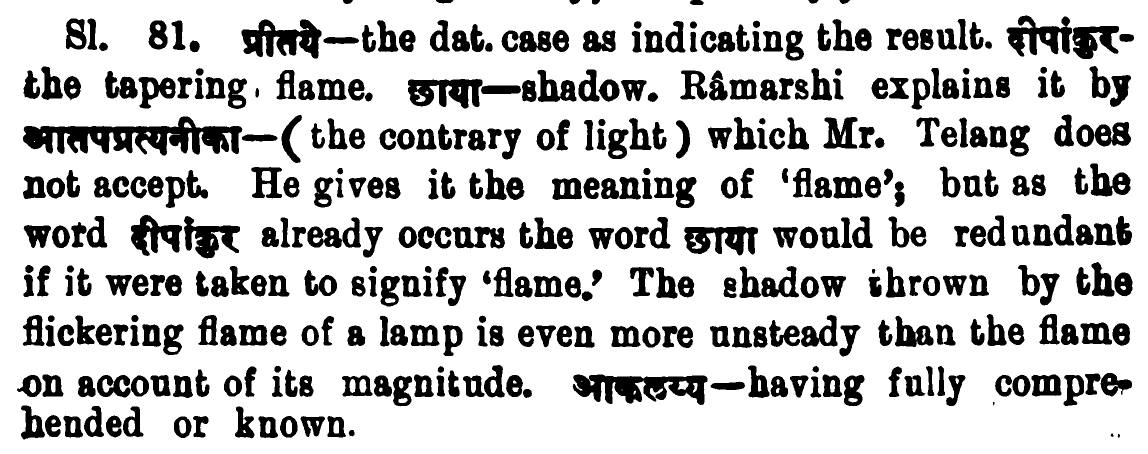
Sl. 81. प्रीतये—the dat. case as indicating the result. दीपांकुर- the tapering flame. छाया—shadow. Râmarshi explains it by आतपप्रत्यनीका—( the contrary of light ) which Mr. Telang does not accept. He gives it the meaning of ‘flame’; but as the word दीपांकुर already occurs the word छाया would be redundant if it were taken to signify ‘flame.’ The shadow thrown by the flickering flame of a lamp is even more unsteady than the flame on account of its magnitude. आकलय्य—having fully comprehended or known.
Gopinath1914
all
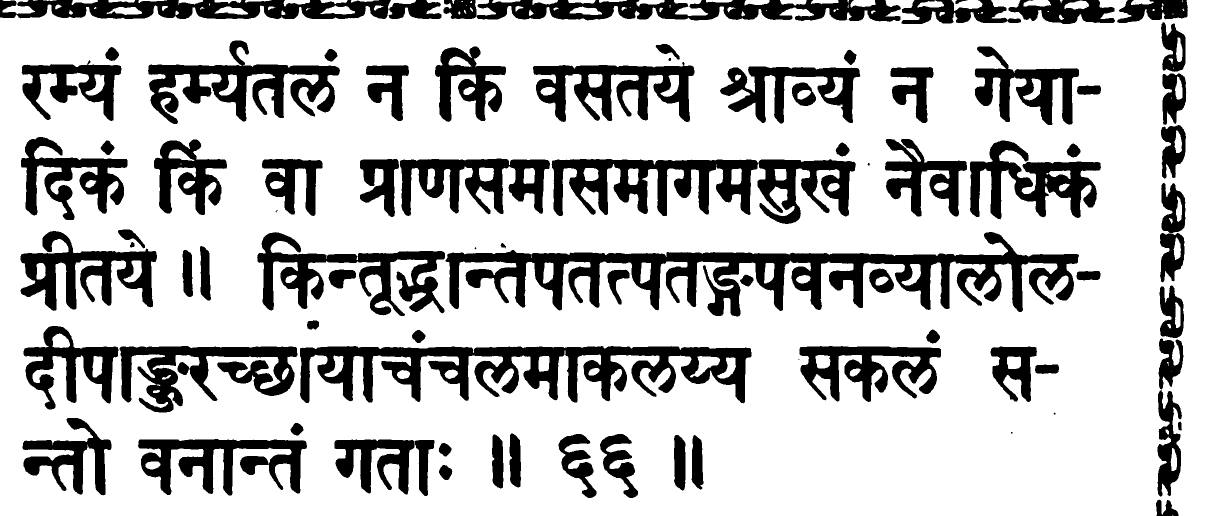
रम्यं हर्म्यतलं न किं वसतये श्राव्यं न गेया-
दिकं किं वा प्राणसमासमागमसुखं नैवाधिकं
प्रीतये । किन्तूद्धान्तपतत्पतङ्गपवनव्यालोल-
दीपाङ्कुरच्छायाचंचलमाकलय्य सकलं स-
न्तो वनान्तं गताः ॥ ६६ ॥
निवास करनेके लिए सुंदर सुंदर महल, श्रवण करनेके लिए मनोहर संगीत और भोग करनेके लिए प्राणप्यारीके समागमका सुख क्या इनके लिए विद्यमान न था ? ( अर्थात् था ) । परंतु इन साधुजनोंने पूर्वोक्त संसारसुखको भ्रमण करते हुए पड़नेवाले पतंगों पक्षोंकी पवनसे अस्थिर दीपककी छायाके समान चंचल समझकर गहन वनके एकान्त स्थानमें प्रस्थान करनाही उत्तम समझा है ॥ ६६ ॥
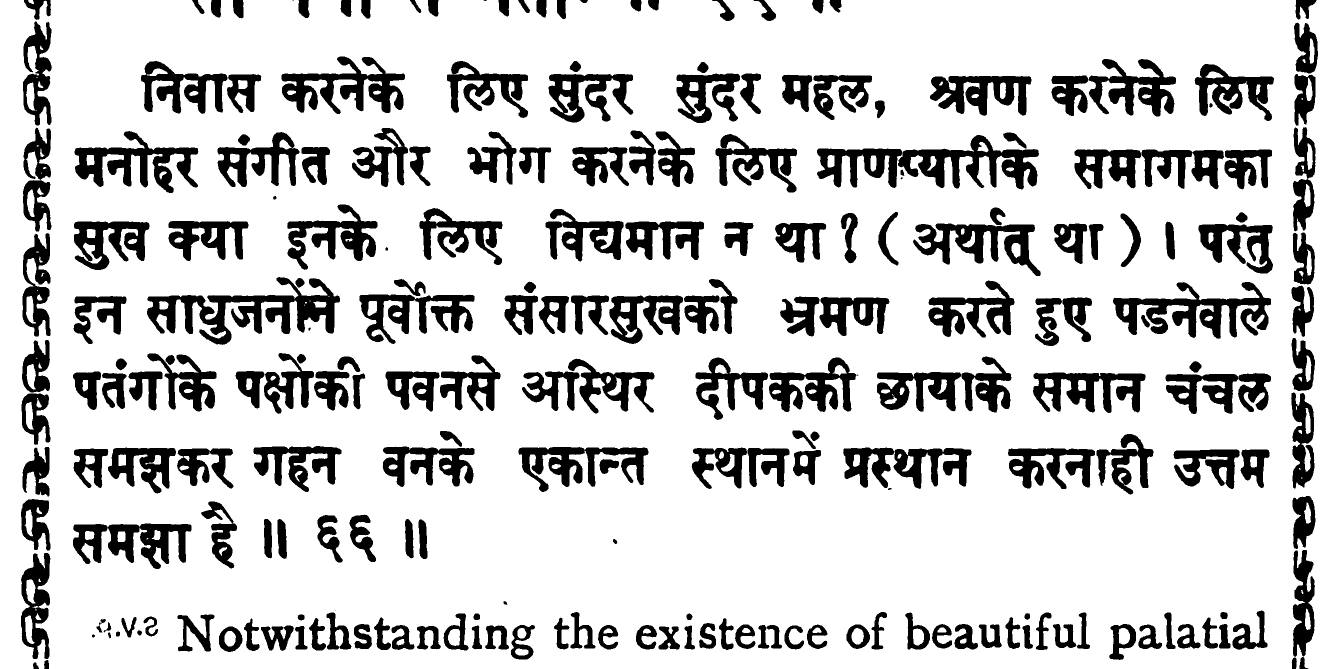
v. Notwithstanding the existence of beautiful palatial mansions for their dwelling, sweet music for their hearing and the enjoyment of a beloved wife for their love, the virtuous saints have forsaken them all and retired into forest (for the sake of meditating on God); because they have rightly understood the aforesaid objects as frail and momentary as the flickering flame of a lamp which is rendered the more unsteady on account of the flapping of a foolish moth hovering around its small and feeble light.

Gopinath1896
all
रम्यं हर्म्यतलं न किं वसतये श्राव्यं न गेया-
दिकं, किं वा प्राणसमासमागमसुखं नैवाधिकं
प्रीतये । किन्तु द्धान्तपतत्पतङ्गपवनव्यालोल-
दीपाङ्कर-च्छायाचंचलमाकलय्य सकलं स-
न्तो वनान्तं गताः ॥ ६६ ॥
निवास करनेके लिए सुंदर सुंदर महल, श्रवण करने के लिए मनोहर संगीत और भोग करनेके लिए प्राणप्यारीके समागमका सुख क्या इनके लिए विद्यमान न था ? (अर्थात् था) । परंतु इन साधुजनोंने पूर्वोक्त संसारसुखको भ्रमण करते हुए पड़नेवाले पतंगों के पक्षोंकी पवन से अस्थिर दीपककी छायाके समान चंचल समझ कर गहन बनके एकान्त स्थानमें प्रस्थान करनाही उत्तम समझा है ॥
Notwithstanding the existence of beautiful palatial mansions for their dwelling, sweet music for their hearing and the enjoyment of a beloved wife for their love, the virtuous saints have forsaken them all and retired into forest (for the sake of meditating on God); because they have rightly understood the aforesaid objects as frail and momentary as the flickering flame of a lamp which is rendered the more unsteady on account of the flapping of a foolish moth hovering around its small and feeble light.
Kosambi
all
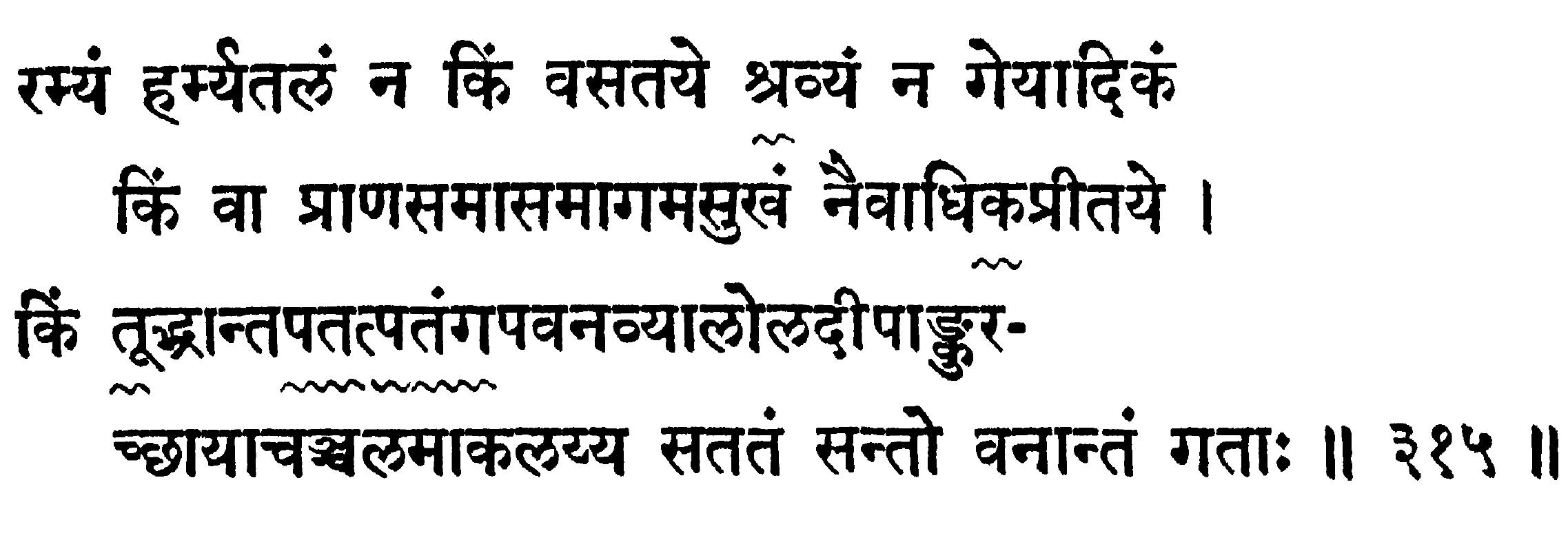
रम्यं हर्म्यतलं न किं वसतये श्रव्यं न गेयादिकं
किं वा प्राणसमासमागमसुखं नैवाधिकप्रीतये |
किं तद्धान्त पतत्पतंगपवनव्यालोलदीपाकर
च्छायाचञ्चलमाकलय्य सततं सन्तो वनान्तं गताः ॥ ३१५ ॥
Footnote
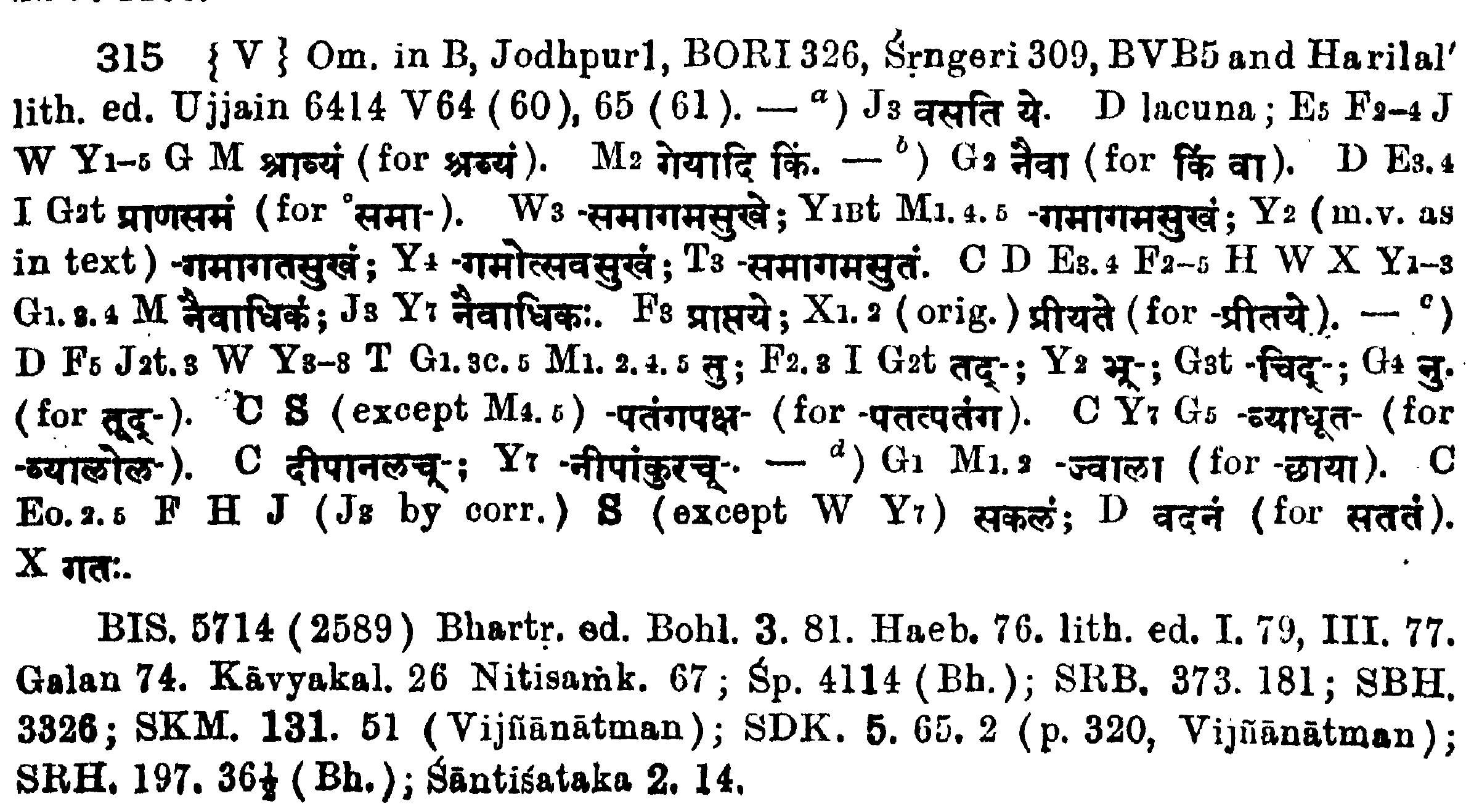
315 { V } Om in B , Jodhpur1 , BORI 326 , Srngeri 309 , BVB5 and Harilal '
lith . ed . Ujjain 6414 V64 ( 60 ) , 65 ( 61 ) . - a 4 ) J3 वसति ये . D lacuna ; E5 F2-4 J
W Y1 - 5 GM श्राव्यं ( for श्रव्यं ) . M2 गेयादि किं . — ) G2 नैवा ( for किं वा ) . D E3.4
I G2t प्राणसमं ( for समा- ) . W 3 - समागमसुखे ; Yant M1.4.5 गमागमसुखं ; Y2 ( m.v.as
in text ) गमागतसुखं ; Y + गमोत्सवसुखं ; T3 समागमसुतं C D Es . 4 F2-5 H W X Y1-8
G1 . 8.4 M नैवाधिकं ; Js Yr नैवाधिकः . Fs प्राप्तये ; X1 . 2 ( orig . ) प्रीयते ( for -प्रीतये . ) . - ( )
D Fs Jat.3 W Y3 - 8 T G1.3c5 M1 245 सु ; F2 . 3 I G2t तद् ; Ya भू ; Gst - -चिद् चिदू ; ; G + नु .
( for तूदू- ) . 08 ( except M4.0 ) -पतंगपक्ष- ( for पतत्पतंग ) . CYr G5 ] व्याधूत ( for
भ्यालोल ) . C दीपानलचू ; YT Y7 -नीपांकुरचू – ( 4 d ) G1 M13 -ज्वाला ( for छाया ) . C
E0 . 2.6 F H J ( Js by corr . ) 8 ( except W Y7 ) सकलं ; D वदनं ( for सततं ) .
X गतः .
BIS , 5714 ( 2589 ) Bhartr ed . Bohl . 3. 81. Haeb . 76. lith ed . I. 79 , III . 77 .
Galan 74. Kāvyakal . 26 Nitisamk . 67 ; Sp . 4114 ( Bh . ) ; SRB 373. 181 ; SBH .
3326 ; SKM . 131.51 ( Vijñānātman ) ; SDK ● 5. 65. 2 ( p . 320 , Vijñānātman ) ;
SRH . 197. 36 ( Bh . ) ; Santiśataka 2. 14 .
Commentary