Ryder
THE GOLDEN MOUNT
Why did God make the Golden Mount,
Fair riches' never-failing fount?
It never wakens longing in
Contented breasts that know not sin;
It never satisfied the mind
Of men with greedy passions blind;
Its wealth is for itself, I see;
It seems quite valueless to me.
Tawney
The heart of the contented man enjoys perpetual peace,
The covetous pine with lust of wealth; their cravings never cease;
Not Meru's peak, of gold entire, can captivate my soul,
Let him, who likes it, clamber up and carry off the whole.
Mādhavānanda
ये सन्तोषनिरन्तरप्रमुदितास्तेषां न भिन्ना मुदो
ये त्वन्ये धनलुब्धसंकुलधियस्तेषां न तृष्णा हता ।
इत्थं कस्य कृते कृत: स विधिना कीदृक्पदं संपदां
स्वात्मन्येव समाप्तहेममहिमा मेरुर्न मे रोचते ।।२९।।
29. The felicity of those, whom contentment unceasingly makes happy, is not interrupted, while cravings of those of greedy and confounded minds are never quenched. Such being the case, for whom did the Creator create the Meru, representing inconceivable wealth, but confining to itself the glorious potency of its gold? I would not covet it.
[कस्य कृते कृत: etc.—The idea is that Meru, the (fabled) mountain of gold, serves no useful purpose to anybody, and so I would not go in for it (न मे रोचते): because those that are contented feel quite happy without possessing it, and those that hanker after wealth never feel satisfied howsoever big might be their acquisitions. स्वात्मन्येव समाप्तहेममहिमा—Its gold serves only to glorify itself, but not to satisfy the greedy.]
Telang
all
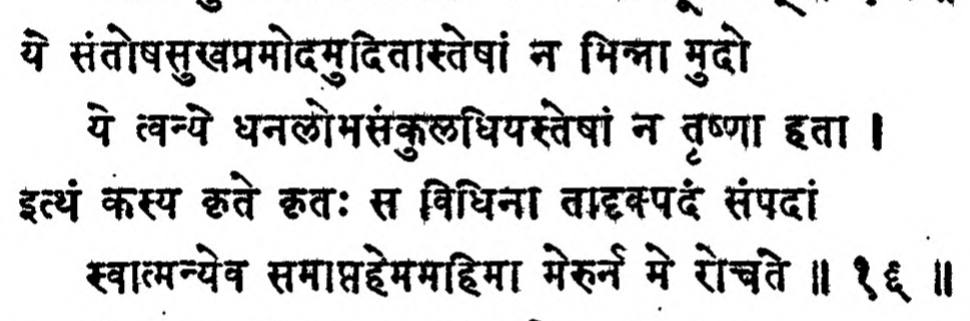
ये संतोषसुखप्रमोदमुदितास्तेषां न भिन्ना मुदो
ये त्वन्ये धनलोभसंकुलधियस्तेषां न तृष्णा हता ।
इत्थं कस्य कृते कृतः स विधिना तादृक्पदं संपदां
स्वात्मन्येव समाप्तहेममहिमा मेरुर्न मे रोचते ॥ १६ ॥
Notes
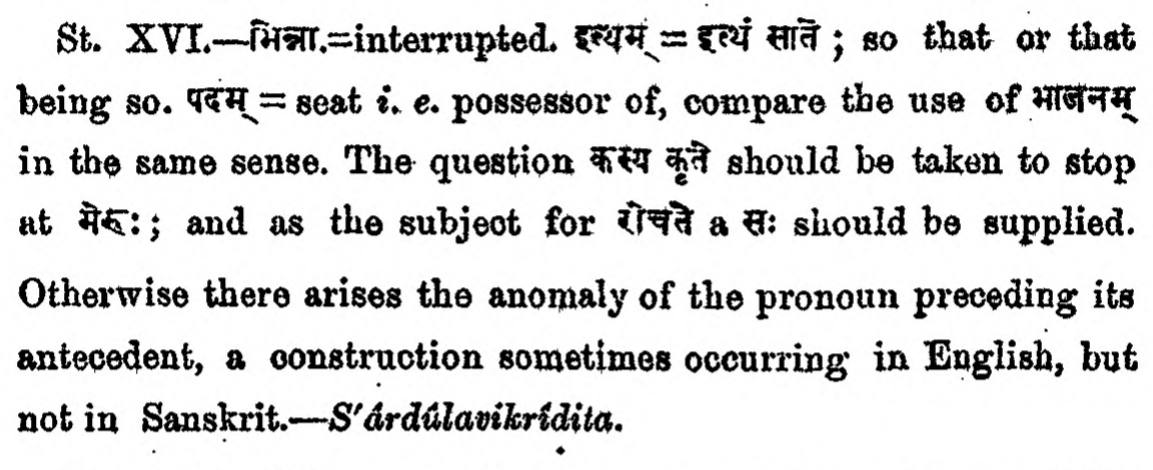
St. XVI.—भिन्ना.=interrupted. इत्थम् = इत्थं सति ; so that or that being so. पदम् = seat i. e. possessor of, compare the use of भाजनम् in the same sense. The question कस्य कृते should be taken to stop at मेरुः ; and as the subject for रोचते a सः should be supplied. Otherwise there arises the anomaly of the pronoun preceding its antecedent, a construction sometimes occurring in English, but not in Sanskrit.—S'ârdûlavikrîḍita.

Telang
all
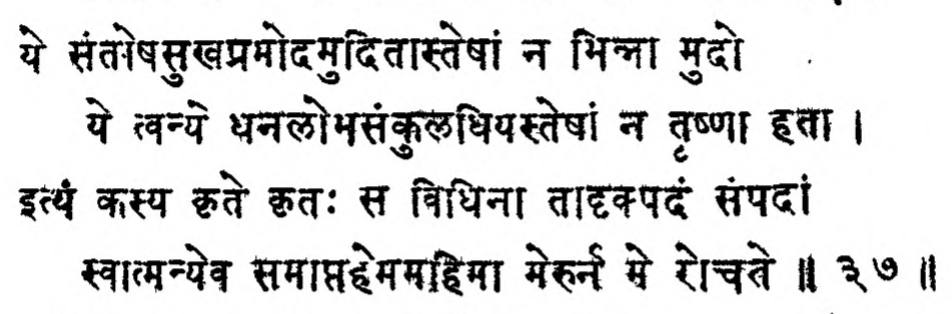
ये संतोषसुखप्रमोदमुदितास्तेषां न भिन्ना मुदो
ये त्वन्ये धनलोभसंकुलधियस्तेषां न तृष्णा हता ।
इत्थं कस्य कृते कृतः स विधिना तादृक्पदं संपदां
स्वात्मन्येव समाप्तहेममहिमा मेरुर्न मे रोचते ॥ ३७ ॥


Kale
all
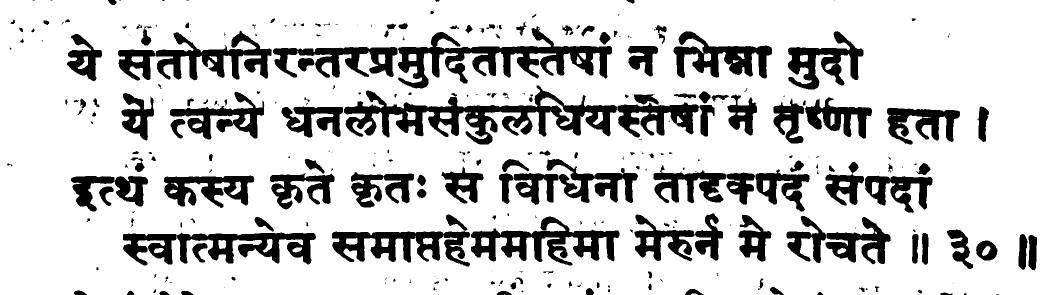
ये संतोषनिरन्तरप्रमुदितास्तेषां न भिन्ना मुदो
ये त्वन्ये धनलोभसंकुलधियस्तेषां न तृष्णा हता ।
इत्थं कस्य कृते कृतः स विधिना तादृक्पदं संपदां
स्वात्मन्येव समाप्तहेममहिमा मेरुर्न मे रोचते ॥ ३० ॥
Translation
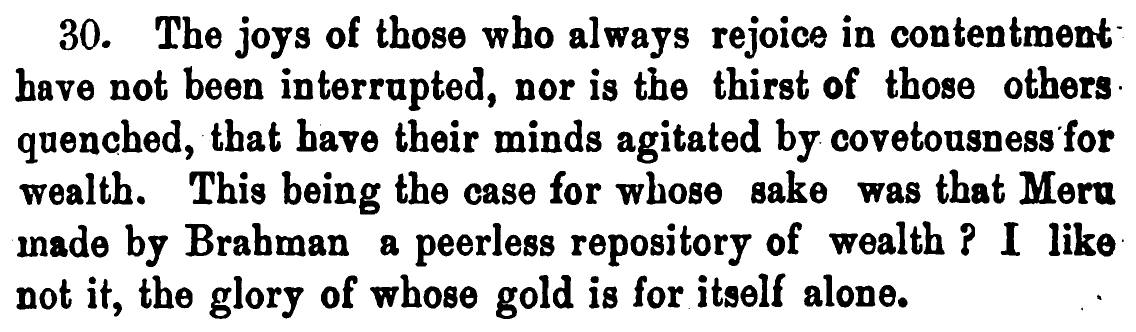
30. The joys of those who always rejoice in contentment have not been interrupted, nor is the thirst of those others quenched, that have their minds agitated by covetousness for wealth. This being the case for whose sake was that Meru made by Brahman a peerless repository of wealth ? I like not it, the glory of whose gold is for itself alone.
Notes
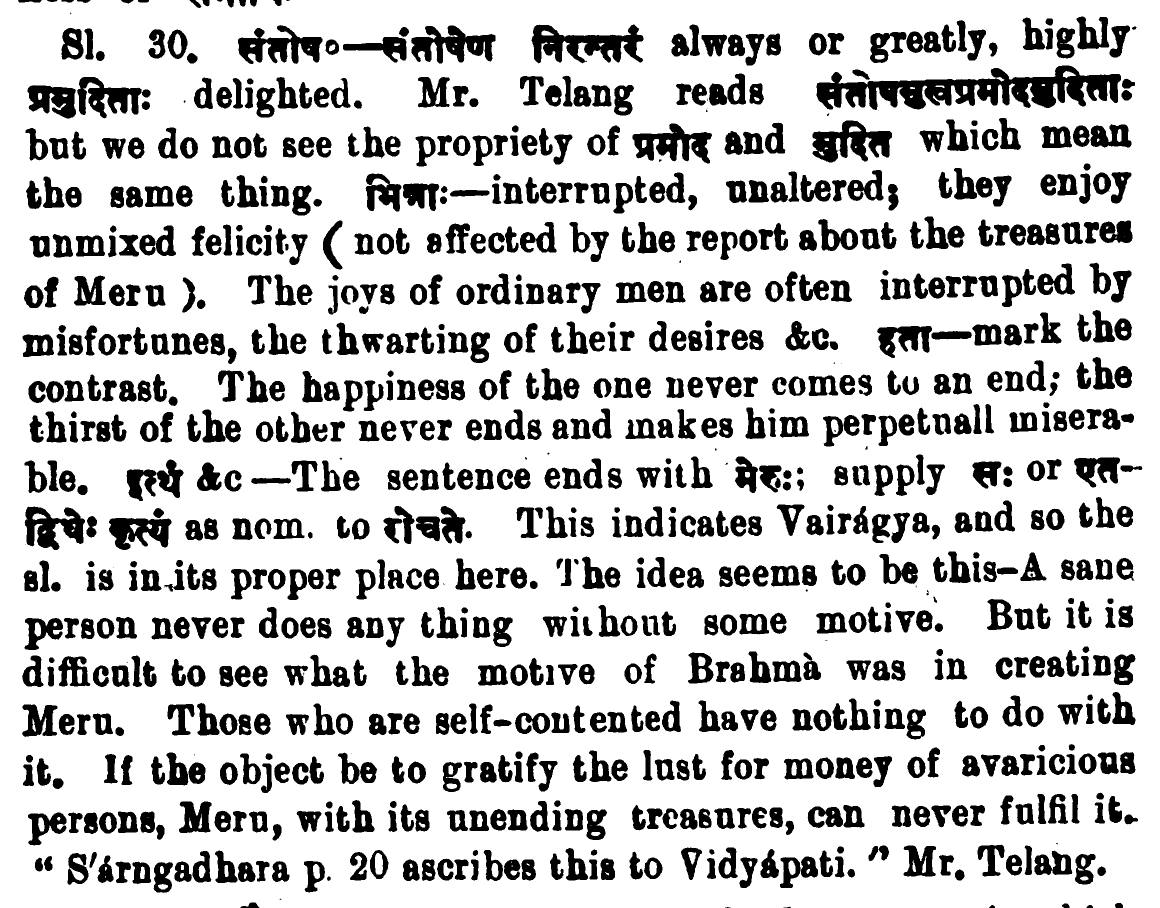
Sl. 30. संतोष०—संतोषेण निरन्तरं always or greatly, highly प्रमुदिताः delighted. Mr. Telang reads संतोषसुखप्रमोदमुदिताः but we do not see the propriety of प्रमोद and मुदित which mean the same thing. भिन्नाः—interrupted, unaltered; they enjoy unmixed felicity ( not affected by the report about the treasures of Meru ). The joys of ordinary men are often interrupted by misfortunes, the thwarting of their desires &c. हता—mark the contrast. The happiness of the one never comes to an end; the thirst of the other never ends and makes him perpetuall miserable. इत्थं &c —The sentence ends with मेरुः; supply सः or एतद्विधेः कृत्यं as nom. to रोचते. This indicates Vairágya, and so the sl. is in its proper place here. The idea seems to be this—A sane person never does any thing without some motive. But it is difficult to see what the motive of Brahmà was in creating Meru. Those who are self-contented have nothing to do with it. If the object be to gratify the lust for money of avaricious persons, Meru, with its unending treasures, can never fulfil it. “ S'árngadhara p. 20 ascribes this to Vidyápati. ” Mr. Telang.
Kosambi
all
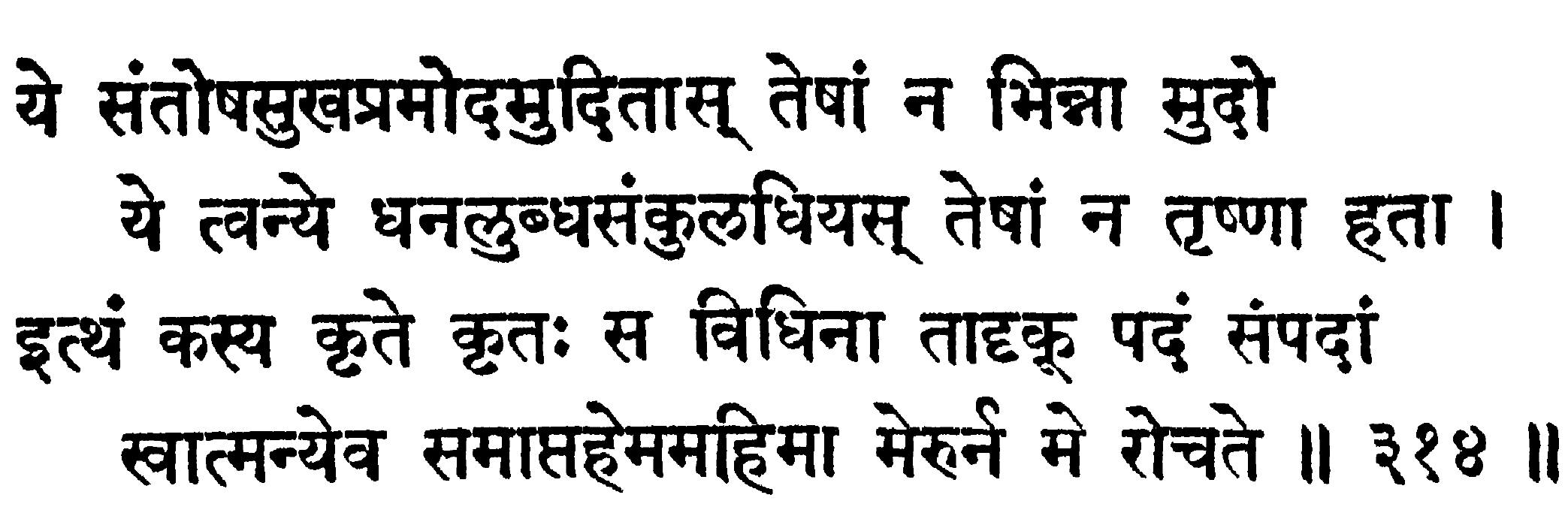
ये संतोषसुखप्रमोदमुदितास् तेषां न भिन्ना मुदो
ये त्वन्ये धनलुब्धसंकुलधियस् तेषां न तृष्णा हता ।
इत्थं कस्य कृते कृतः स विधिना तादृक् पदं संपदां
खात्मन्येव समाप्तहेममहिमा मेरुर्न मे रोचते ॥ ३१४ ॥
Footnote
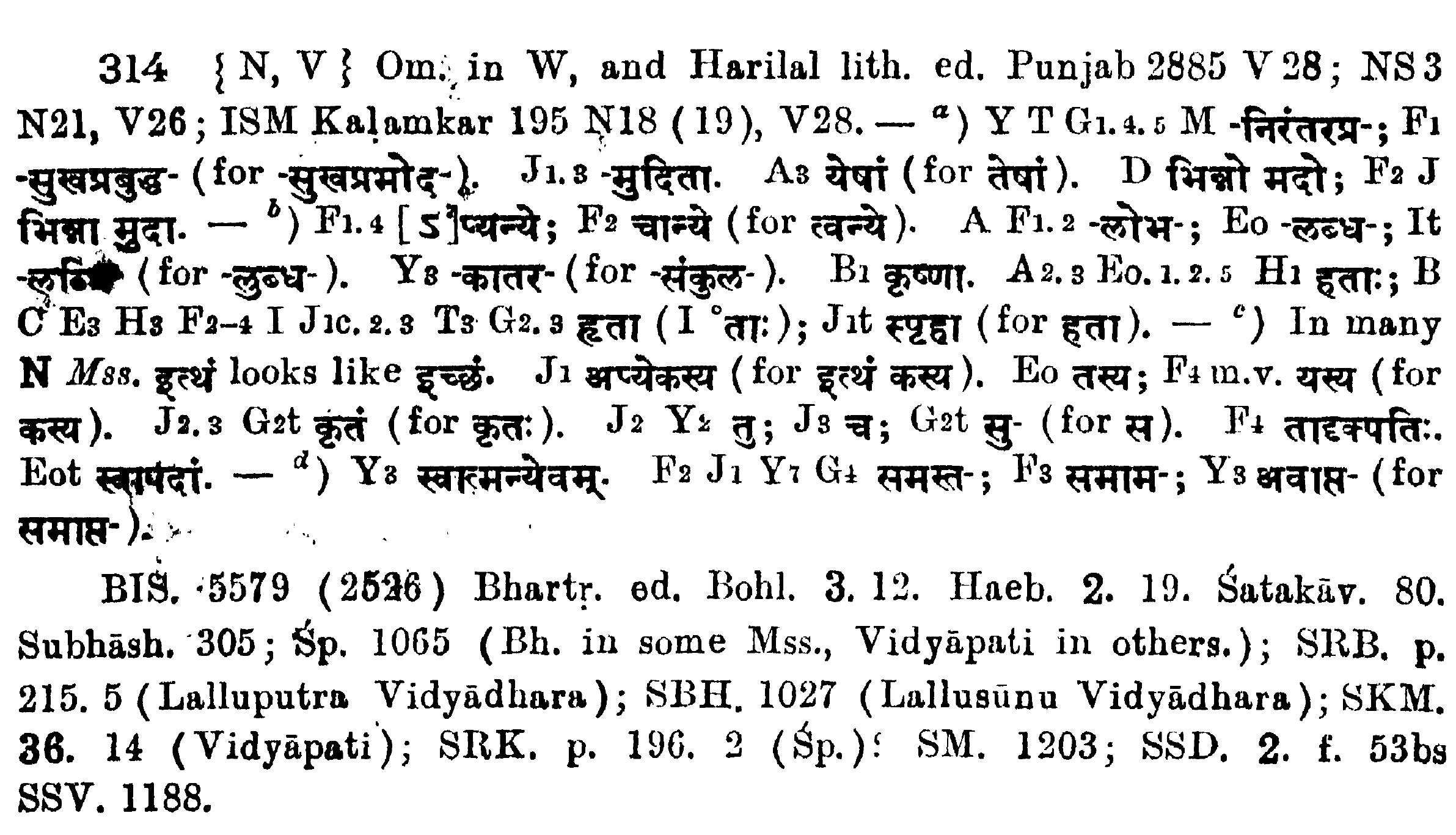
314 { N , V } Om . in W , and Harilal lith . ed . Punjab 2885 V 28 ; NS3
N21 , V26 ; ISM Kalamkar 195 Ņ18 ( 19 ) , V28 . — © a ) Y T G1 4 5 5 M -निरंतरप्र- ; F1
-सुखप्रबुद्ध ( for सुखप्रमोद ) . J1.3- मुदिता . As येषां ( for तेषां ) . D भिन्नो मदो ; F2 J
भिन्ना मुदा . 8 ) F1.4 [ 5 ] प्यन्ये ; F2 चान्ये ( for त्वन्ये ) . A F1 . 2 - लोभ- ; Eo -लब्ध- ; It
लम्बि ( for लुब्ध ) . Y8 Y 3 - - कातर- कातर- ( ( for For -संकुल- संकुल- ) ) . . B1 B1 कृष्णा . A23 Eo.1.2 . H1 हताः ; B
E3 H3 F2-4 I J1c . 2.3 T3 G2 . 3 हृता ( I ' ताः ) ; Jit स्पृहा ( for हता ) . c ) In many
N Mss . इत्थं looks like इच्छं . J1 अप्येकस्य ( for इत्थं कस्य ) . Eo तस्य ; Fam.v. यस्य ( for
कस्य ) . J2.3 G2t कृतं ( for कृतः ) . J2 Ya त ; Js च ; Get सु . ( for स ) . F½ तादृक्पतिः .
Eot स्वापदां . – ( ) X 3 स्वात्मन्येवम् F2 J1 Y1 G + समस्त ; 13 समाम ; Y 3 अवाप्त - ( for
समाप्त ) :.
BIS . -5579 ( 2526 ) Bhartr ed . Bohl . 3. 12. Haeb . 2. 19. Śatakāv . 80 .
Subhāsh . 305 ; Śp . 1065 ( Bh . in some Mss . , Vidyāpati in others . ) ; SRB.p.
215. 5 ( Lalluputra Vidyadhara ) ; SBH , 1027 ( Lallusūnu Vidyādhara ) ; SKM .
36. 14 ( Vidyāpati ) ; SRK . p . 196. 2 ( Sp . ) : SM . 1203 ; SSD . 2. f . 53bs
SSV . 1188 .
Commentary