Ryder
THE LAST DAY
When the celestial mount shall totter, burning
In all-devouring flame,
When seas go dry, where crocodiles are turning
And sharks no man may tame,
When the compact earth itself shall tumble sheer,
Great mountains madly dance,
What of our bodies, quivering like the ear
Of baby elephants?
Tawney
Mount Meru's golden mass shall melt at that last awful day,
The monster-peopled seas dry up, the earth dissolve away;
What hope for feeble human frames, whose breath doth come and go,
As swiftly as the elephant flaps his ear to and fro?
Mādhavānanda
यतो मेरु: श्रीमान्निपतति युगान्ताग्निवलित:
समुद्रा: शुष्यन्ति प्रचुरमकरग्राहनिलया: ।
धरा गच्छत्यन्तं धरणिधरपादैरपि धृता
शरीरे का वार्ता करिकलभकर्णाग्रचपले ।।७२।।
72. Seeing that, when set all over with the fires of cyclic destruction the stately mountain Meru topples down, the seas which are the abode of numerous sharks and aquatic animals are dried up, and the earth (itself) comes to an end, though held firm by the feet of mountains, what to speak of this body, which is as unsteady as the tip of the ear of a young elephant!
[धरणिधर—According to Hindu mythology the mountains are regarded as the supporters of the earth.
युगान्ताग्नि—The cosmic conflagration at the end of a cycle.]
Telang
all
यदा मेरुः श्रीमान्निपतति युगान्ताग्निनिहतः
समुद्राः शुष्यन्ति प्रचुरनिकरग्राहनिलयाः ।
धरा गच्छत्यन्तं धरणिधरपादैरपि धृता
शरीरे का वार्त्ता करिकलभकर्णाग्रचपले ॥ ७१ ॥
Notes
St. LXXI.—यदा. Comp. Nîtis'ataka St. 95. The Samudras are thus given by Râmarshi क्षीरोद, इक्षुरसोद, सुरोद, घृतोद, दधिमन्थोद, क्षारोद, शुद्धोद. निकर = collection St. 52. अन्त = रसातल (Râmarshi); I know of no authority for this and though the usual sense ‘destruction’ has not as much propriety, I think it is the only one admissible. धरणिधर = शेष or पर्वत (Râmarshi); with the former पाद = पादा इव चरणा इव प्रतीयमाना ये हस्ताः (sic). But the latter, पर्वत, ought alone to be adopted. For the idea of the mountains supporting the Earth see Kumâra. VI., 68.—S'ikhariṇî.

Kale
all

यदा मेरुः श्रीमान्निपतति युगान्ताग्निनिहतः
समुद्राः शुष्यन्ति प्रचुरमकरग्राहनिलयाः ।
धरा गच्छत्यन्तं धरणिधरपादैरपि धृता
शरीरे का वार्ता करिकलभकर्णाग्रचपले ॥ ७३ ॥
Translation
73. When the great mountain Meru, struck by the fire at the time of the destruction of the world, falls; when the seas, which are the abode of a vast number of sharks and alligators, dry up; when the earth, supported by the feet of mountains, goes to end; why talk of the human body which is unsteady like the end of a young elephant's ear?
Notes
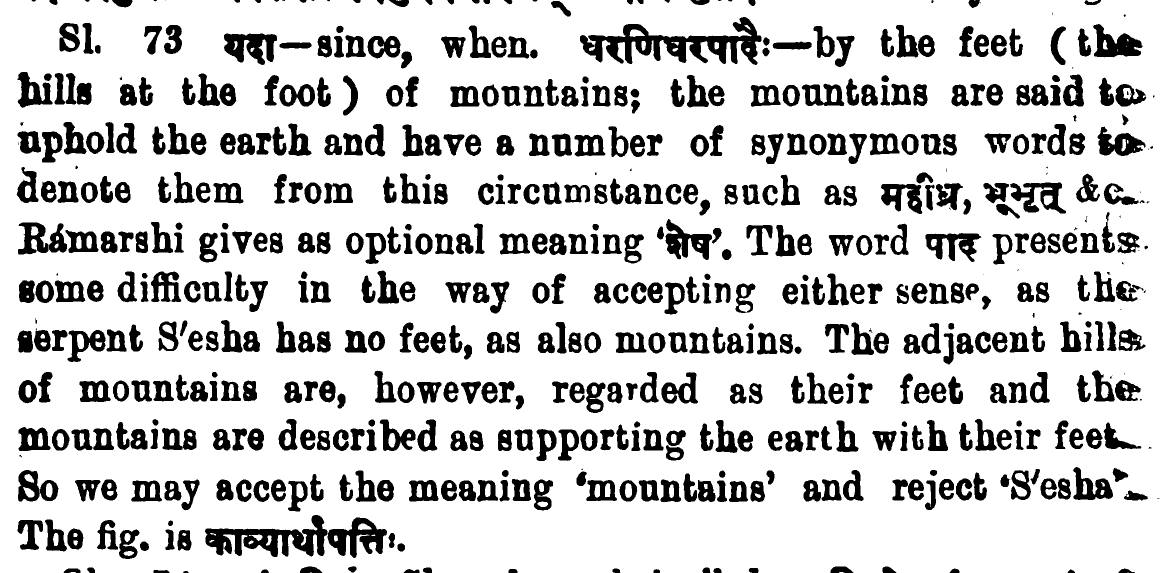
Sl. 73 यदा—since, when. धरणिधरपादैः—by the feet ( the hills at the foot ) of mountains; the mountains are said to uphold the earth and have a number of synonymous words to denote them from this circumstance, such as महीध्र, भूभृत् &c. Rámarshi gives as optional meaning ‘शेष’. The word पाद presents some difficulty in the way of accepting either sense, as the serpent S'esha has no feet, as also mountains. The adjacent hills of mountains are, however, regarded as their feet and the mountains are described as supporting the earth with their feet. So we may accept the meaning ‘mountains’ and reject ‘S'esha’. The fig. is काव्यार्थापत्तिः.
Gopinath1914
all
यदा मेरुः श्रीमान्निपतति युगान्ताग्निदलितः
समुद्राः शुष्यन्ति प्रचुरमकरग्राहनिलयाः ॥
धरा गच्छत्यन्तं धरणिधरपादैरपि धृता श-
रे का वार्ता करिकरभकर्णाचपले ॥ ६९ ॥
जब हम जानते हैं कि युगांत करनेवाली अग्निसे संतप्त होकर सुमेरु भी अवश्य पड़ जाता है, अनेकानेक मकर ग्राहादिको आश्रय देनेवाले समुद्र भी सुख जाते हैं और बड़े बड़े पर्वतोंसे दृढ हुई पृथ्वी भी अवश्य चलबिचल हो जाती है, तो हाथीके बच्चे के कर्णाग्रभागके समान अत्यंत चंचल इस शरीर के विनाश होने में कौनसा आश्चर्य है ? ॥ ६९॥
When we know that at the end of the four Yugas ( युगा: ) or ages, the splendid Meru (मेरु ) being attacked by the fire of universal destruction, shall also fall; when we see that vast seas, the abode of innumerable sharks and crocodiles, shall also dry; and when we are sure that the earth, though sustained by deep-rooted mountains, shall also collapse ; what possible faith can we fairly put into this feeble mortal frame which is as unsteady as the ever flapping ears of a young elephant ?
Footnote
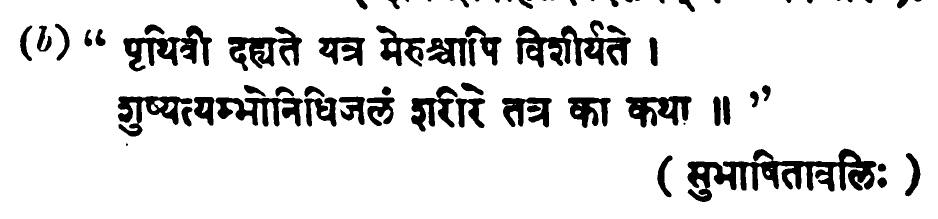
Cf. (a ) " शुष्यत्यम्बुधयस्तरङ्गगहनैरालिंगिताशाङ्गना गच्छन्स्युद्गत तुङ्गशृङ्गमुकुटोदग्रा गिरीन्द्राः क्षयम् । भ्रश्यत्येव वसुन्धराऽपि सहिता दिग्दन्तिभिर्यद्वशासर्वाशी सततं प्रधावति महाकालः स कोऽप्याकुलः ॥ " ( क्षेमेन्द्रविहित दर्पदलनम् । ४ विचारः )

Gopinath1896
all
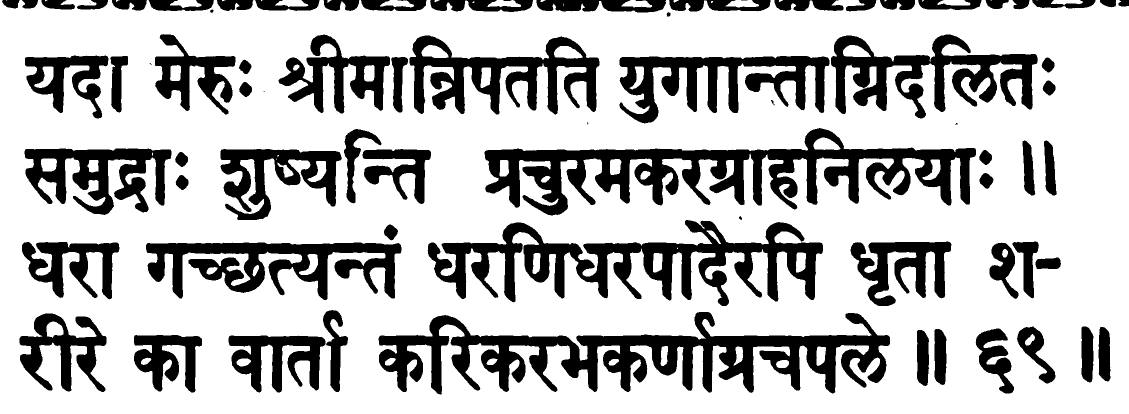
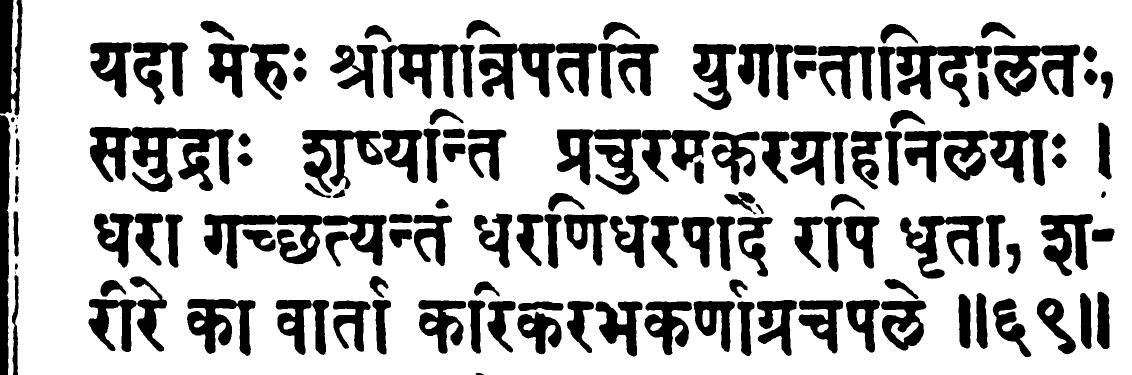
यदा मेरुः श्रीमान्निपतति युगान्ताग्रिदलितः,
समुद्राः शुष्यन्ति प्रचुरमकरग्राहनिलयाः ।
धरा गच्छत्यन्तं धरणिधरपादै रपि धृता, श-
रीरे का वार्ता करिकरभकर्णाग्रचपले ॥६९॥
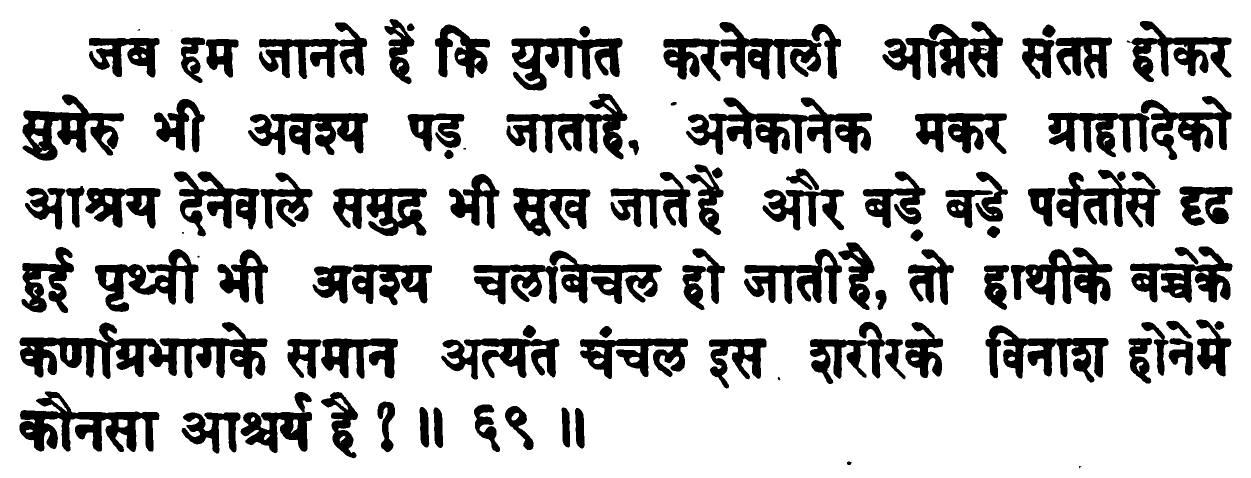
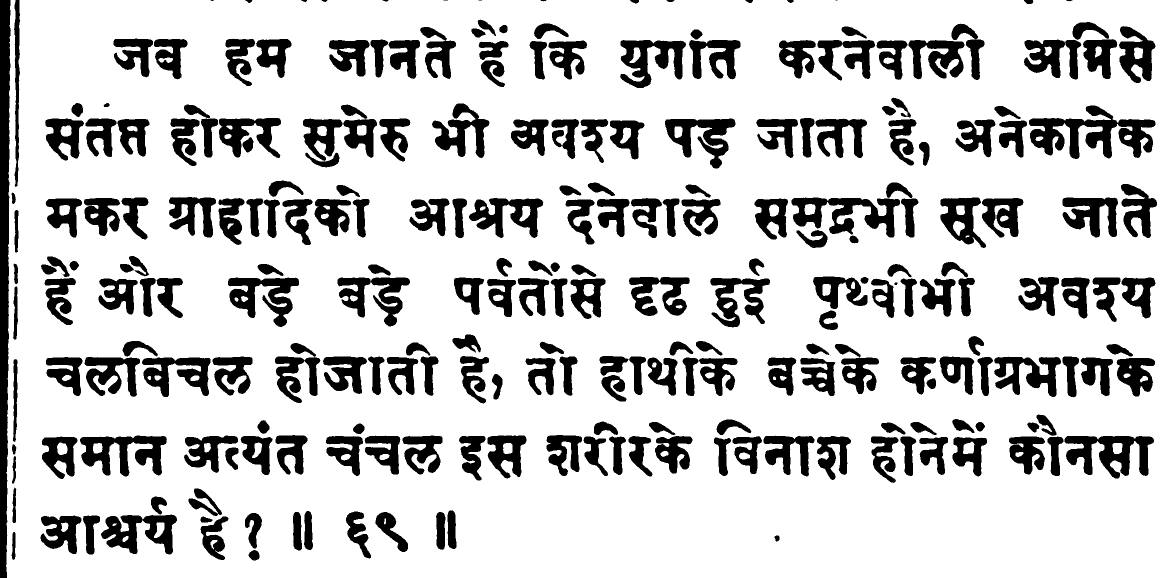
जब हम जानते हैं कि युगांत करनेवाली अमिसे संतप्त होकर सुमेरु भी अवश्य पड़ जाता है, अनेकानेक मकर ग्राहादिको आश्रय देनेवाले समुद्रभी सूख जाते हैं और बड़े बड़े पर्वतों से दृढ हुई पृथ्वी भी अवश्य चलबिचल होजाती है, तो हाथीके बच्चे के कर्णाग्रभाग के समान अत्यंत चंचल इस शरीर के विनाश होने में कौनसा आश्चर्य है ? ॥ ६९ ॥
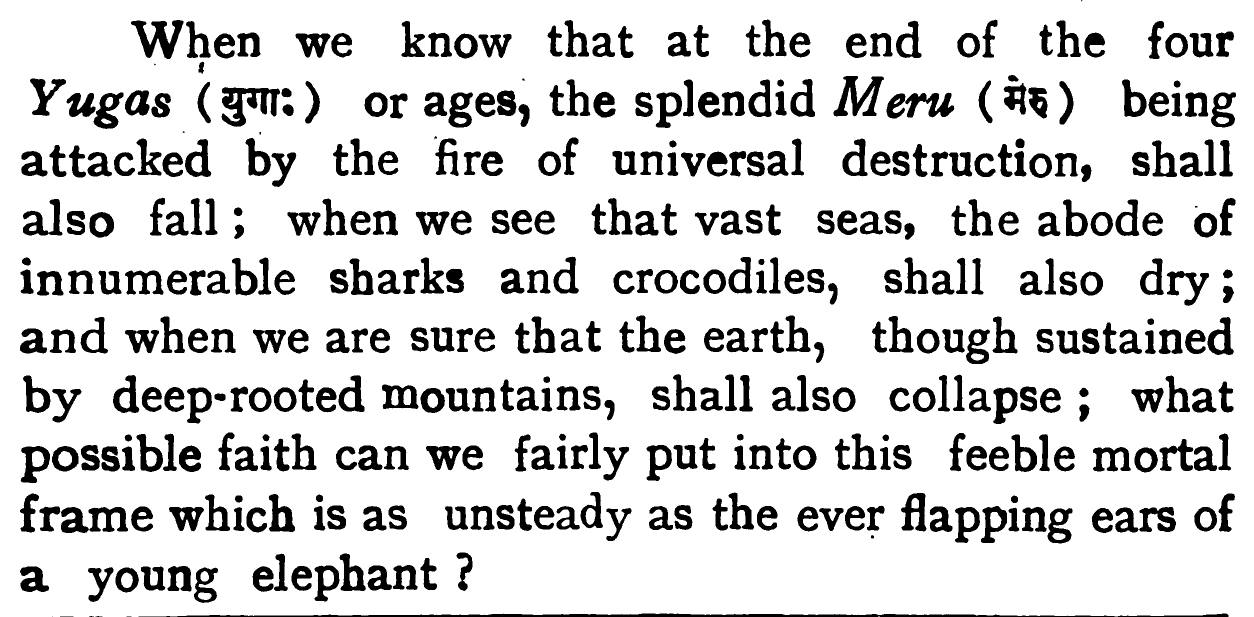
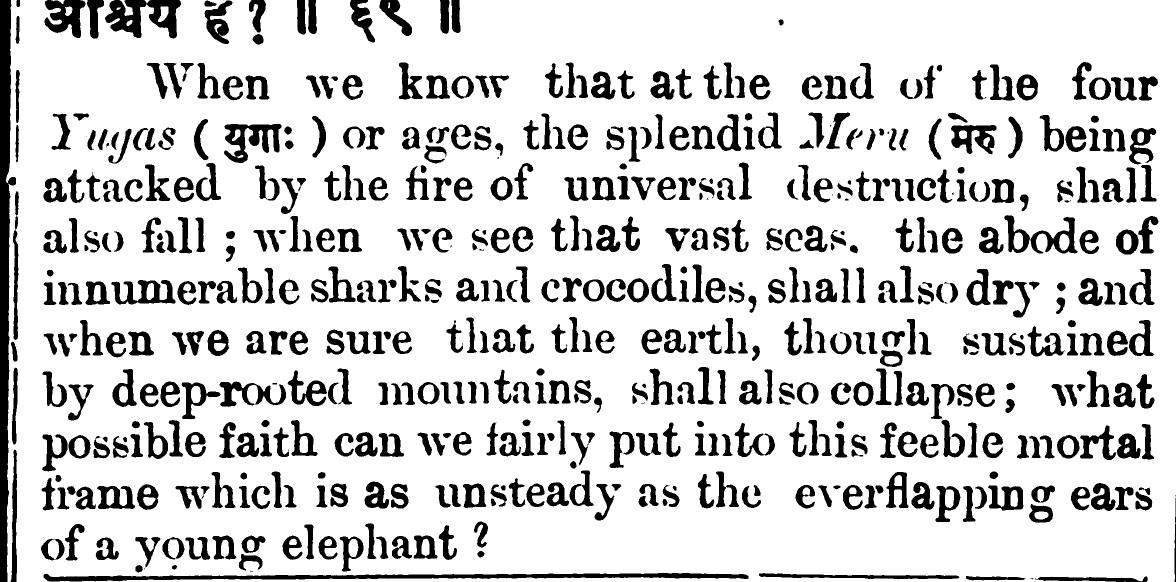
When we know that at the end of the four Yugas ( युगा: ) or ages, the splendid Meru (मेरु) being attacked by the fire of universal destruction, shall also fall ; when we see that vast seas. the abode of innumerable sharks and crocodiles, shall also dry; and when we are sure that the earth, though sustained by deep-rooted mountains, shall also collapse; what possible faith can we fairly put into this feeble mortal frame which is as unsteady as the everflapping ears of a young elephant ?
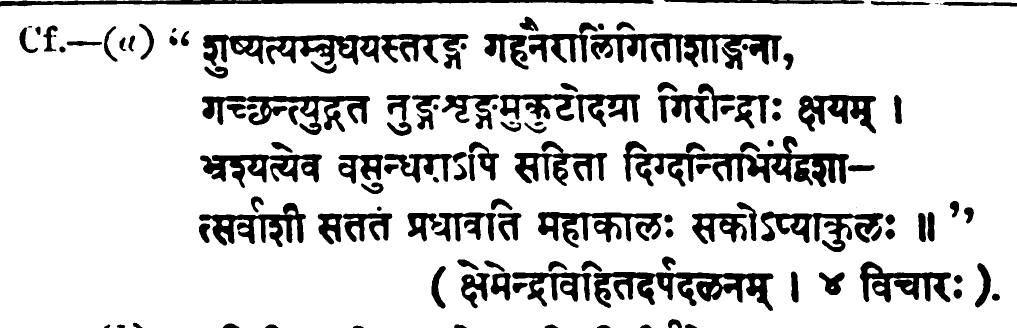
Footnote
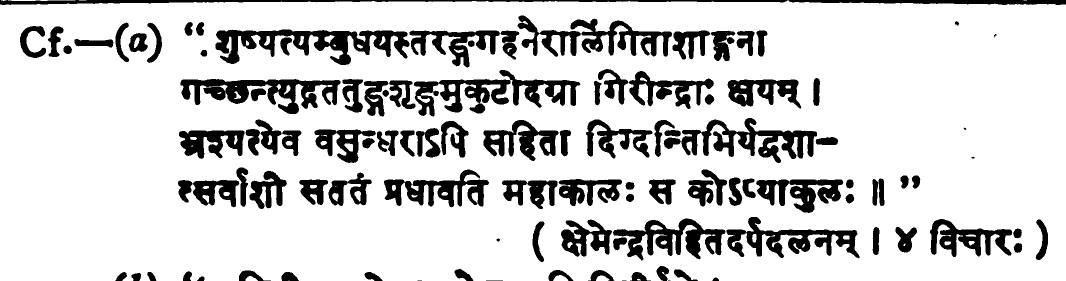
Cf. - (1) “ शुष्यत्यम्बुधयस्तरङ्ग गहनैरालिंगिताशाङ्गना, गच्छन्त्युद्गत तुङ्गशृङ्गमुकुटोदया गिरीन्द्राः क्षयम् । भ्रश्यत्येव वसुन्धराऽपि सहिता दिग्दन्तिभिर्यद्वशात्सर्वाशी सततं प्रधावति महाकालः सकोऽप्याकुलः ॥ ( क्षेमेन्द्रविहितदर्पदलनम् । ४ विचारः ).
Kosambi
all
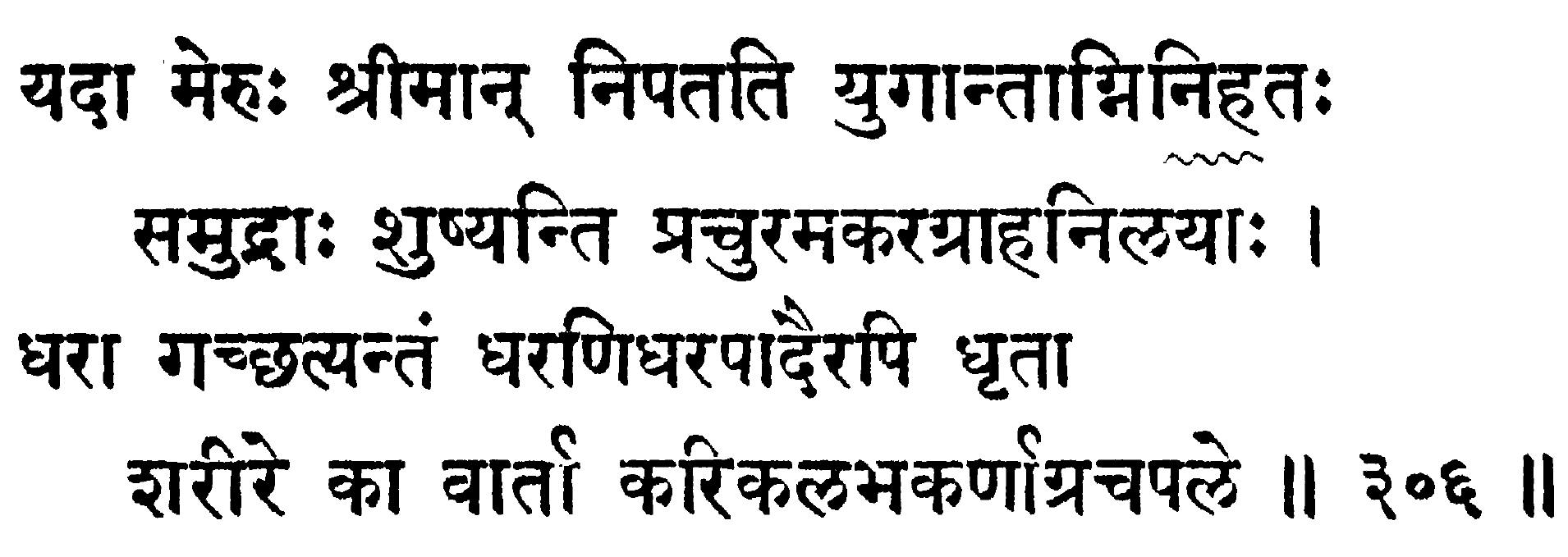
यदा मेरुः श्रीमान् निपतति युगान्ताग्निनिहतः
समुद्राः शुष्यन्ति प्रचुरमकरग्राहनिलयाः ।
धरा गच्छत्यन्तं धरणिधरपादैरपि धृता
शरीरे का वार्ता करिकलभकर्णाचपले ॥ ३०६ ॥
Footnote
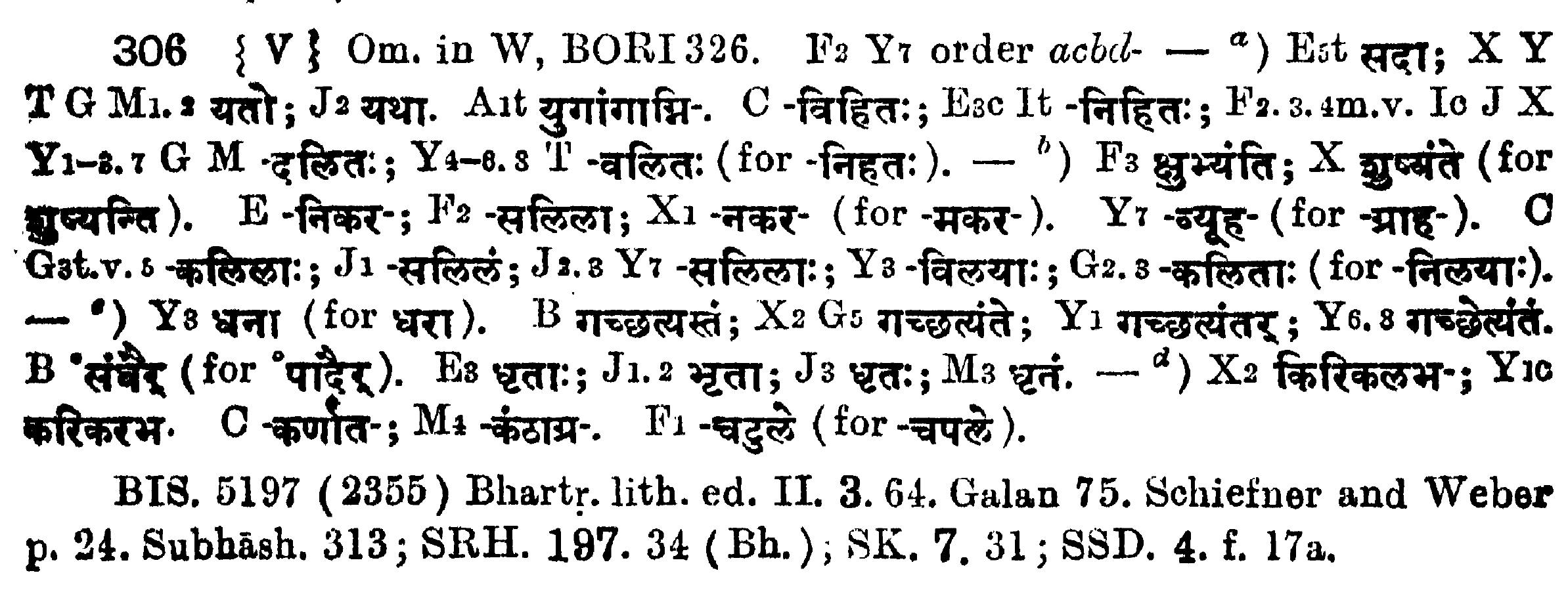
306 { V } Om . in W , BORI 326. F2 Y7 order acbd ● a ) Est सदा ; X XY Y
TGM 1. 3 यतो ; J2 यथा . Ait युगांगाग्नि C -विहितः ; Esc It -fafga : ; F2 . 3. 4m.v. Ic J X
Y1 - 4.7 GM दलित : ; Y4-6.3 T- वलितः ( for - निहतः ) . – 4 ) F3 क्षुभ्यंति ; X शुष्यंते ( for
शुष्यन्ति ) . E -निकर- ; 2 - सलिला ; X1 - नकर- ( for - मकर- ) . Y7 -व्यूह - ( for ग्राह- ) . O
' Gat.v. 3 -कलिला :; J1 -सलिलं ; J2.8 X7 - सलिला :; X 3 -विलयाः ; G2 . 3 -कलिताः ( for -निलयाः ) .
● ) Y3 धना ( for धरा ) . B गच्छत्यस्तं ; X 2 Gs गच्छत्यंते ; Y1 गच्छत्यंतर् ; Y6.8 गच्छेत्यंतं .
B संबैद ( for ' पदे ) . E3 धृताः ; J1.2 भृता ; J3 धृतः ; M3 धृतं . 2 ) X 2 किरिकलभ - Y10
करिकरभ C कर्णात ; M1 कंठाय- F1 चटुले ( for चपले ) .
BIS . 5197 ( 2355 ) Bhartṛ . lith . ed . II . 3. 64. Galan 75. Schiefner and Weber
p . 24. Subhāsh . 313 ; SRH . 187 34 ( Bh . ) ; SK 7 31 ; SSD . 4. f . 17a ,
Commentary