Tawney
Kind Fortune, seek some other love, I long not for thy dower;
And what to those whose lusts are dead avails thy golden shower?
Leave me to beg from day to day my dole of barley-meal,
The fig's broad leaf supplies a dish that none would care to steal.
Mādhavānanda
मातर्लक्ष्मि भजस्व कंचिदपरं मत्काङ्क्षिणी मा स्म भू-
र्भोगेषु स्पृहयालवस्तव वशे का नि:स्पृहाणामसि ।
सद्य:स्यूतपलाशपत्रपुटिकापात्रे पवित्रीकृतै-
भिर्क्षावस्तुभिरेव संप्रति वयं वृत्तिं समीहामहे ।।९३।।
93. O Mother Lakshmī (Goddess of wealth), serve (thou) someone else; do not long for me. Those who desire enjoyment are subject to thee, but what art thou to us who are free from desires? Now we wish to live upon food articles obtained from begging and placed, (conformably to its) being sanctified, in a receptacle of palāśa leaves pieced together on the spot.
[The palāśa vessels are enjoined in the Smṛtis as purifying the food kept in them.]
Telang
all
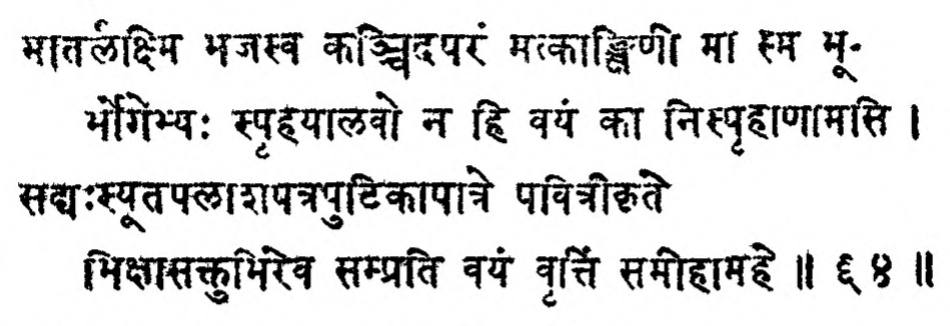
मातर्लक्ष्मि भजस्व कञ्चिदपरं मत्काङ्क्षिणी मा स्म भू-
र्भोगेभ्यः स्पृहयालवो न हि वयं का निस्पृहाणामसि ।
सद्यःस्यूतपलाशपत्रपुटिकापात्रे पवित्रीकृते
भिक्षासक्तुभिरेव सम्प्रति वयं वृत्तिं समीहामहे ॥ ६४ ॥
Notes
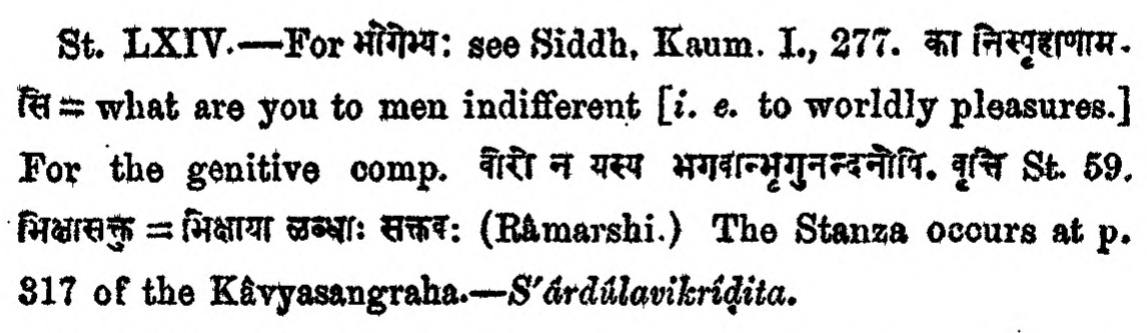
St. LXIV.—For भोगेभ्यः see Siddh. Kaum. I., 277. का निस्पृहाणामसि = what are you to men indifferent [i. e. to worldly pleasures.] For the genitive comp. वीरो न यस्य भगवान्भृगुनन्दनोपि. वृत्ति St. 59. भिक्षासक्तु = भिक्षाया लब्धाः सक्तवः (Râmarshi.) The Stanza occurs at p. 317 of the Kâvyasangraha.—S'ârdûlavikrîḍita.

Kale
all

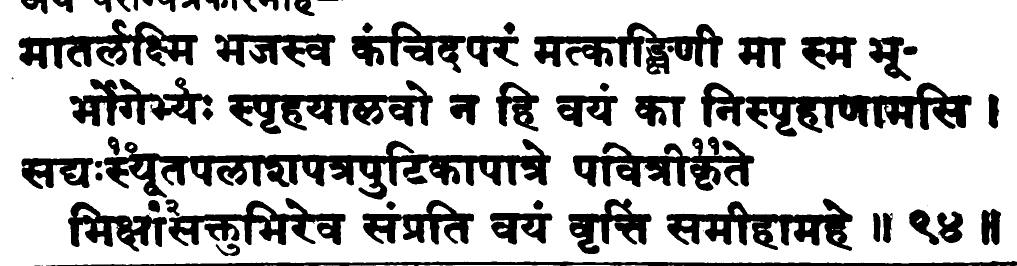
मातर्लक्ष्मि भजस्व कंचिदपरं मत्काङ्क्षिणी मा स्म भू-
र्भोगेभ्यः स्पृहयालवो न हि वयं का निस्पृहाणामसि ।
सद्यःस्यूतपलाशपत्रपुटिकापात्रे पवित्रीकृते
भिक्षासक्तुभिरेव संप्रति वयं वृत्तिं समीहामहे ॥ ९४ ॥
Translation
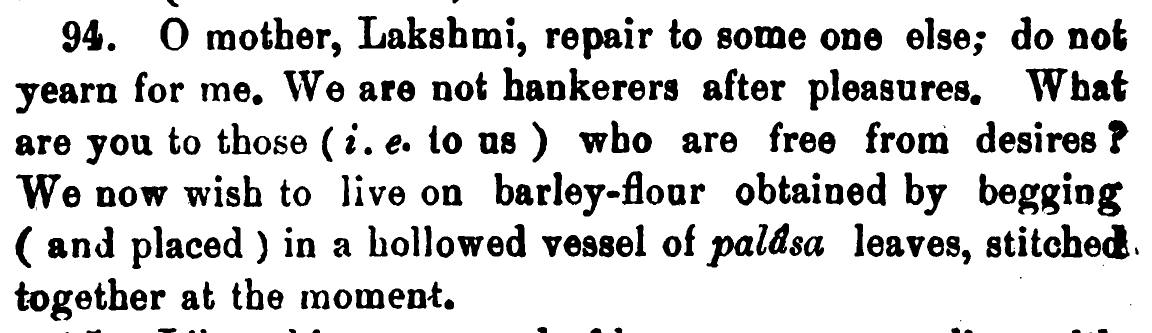
94. O mother, Lakshmi, repair to some one else; do not yearn for me. We are not hankerers after pleasures. What are you to those ( i. e. to us ) who are free from desires ? We now wish to live on barley-flour obtained by begging ( and placed ) in a hollowed vessel of palâsa leaves, stitched together at the moment.
Notes
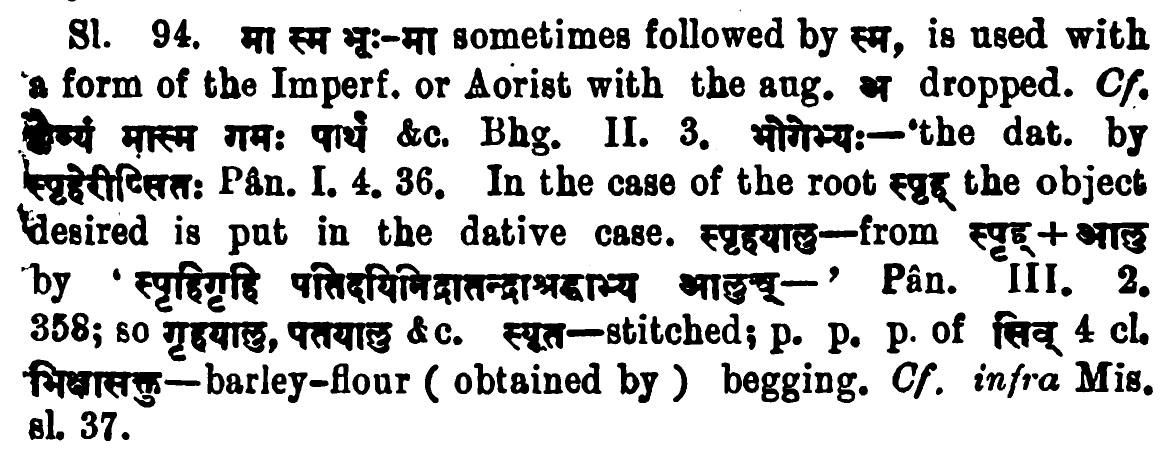
Sl. 94. मा स्म भूः–मा sometimes followed by स्म, is used with a form of the Imperf. or Aorist with the aug. अ dropped. Cf. क्लैब्यं मास्म गमः पार्थ &c. Bhg. II. 3. भोगेभ्यः—'the dat. by स्पृहेरीप्सितः' Pân. I. 4. 36. In the case of the root स्पृह् the object desired is put in the dative case. स्पृहयालु—from स्पृह्+आलु by 'स्पृहिगृहि पतिदयिनिद्रातन्द्राश्रद्धाभ्य आलुच्—' Pân. III. 2. 358; so गृहयालु, पतयालु &c. स्यूत—stitched; p. p. p. of सिव् 4 cl. भिक्षासक्तु—barley–flour (obtained by) begging. Cf. infra Mis. sl. 37.




Gopinath1914
all
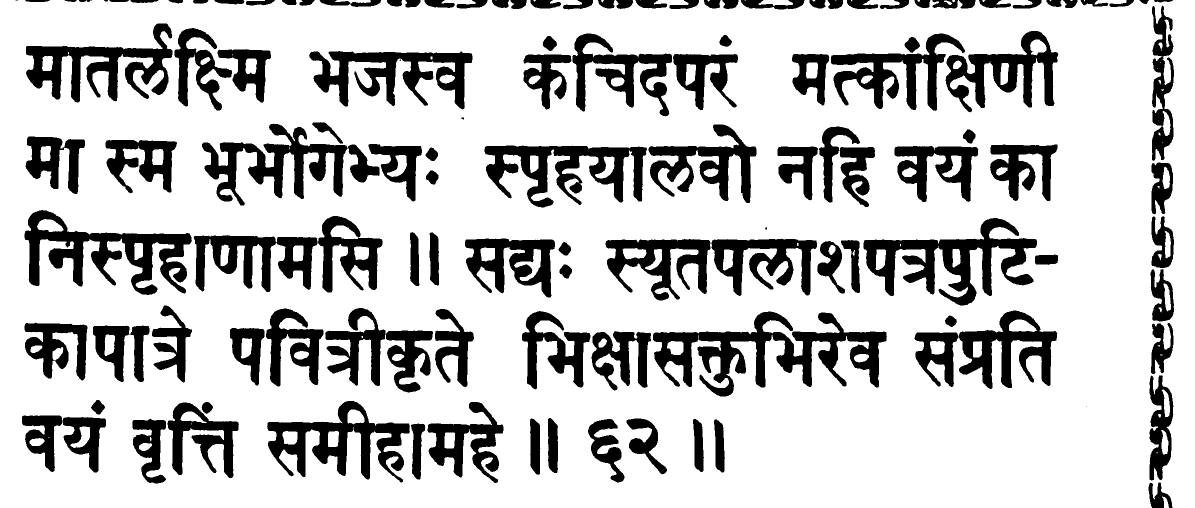
मातर्लक्ष्मि भजस्व कंचिदपरं मत्कांक्षिणी
मा स्म भूर्भोगेभ्यः स्पृहयालवो नहि वयं का
निस्पृहाणामसि ॥ सद्यः स्यूतपलाशपत्रपुटि-
कापात्रे पवित्रीकृते भिक्षासकुभिरेव संप्रति
वयं वृत्तिं समीहामहे ॥ ६२ ॥
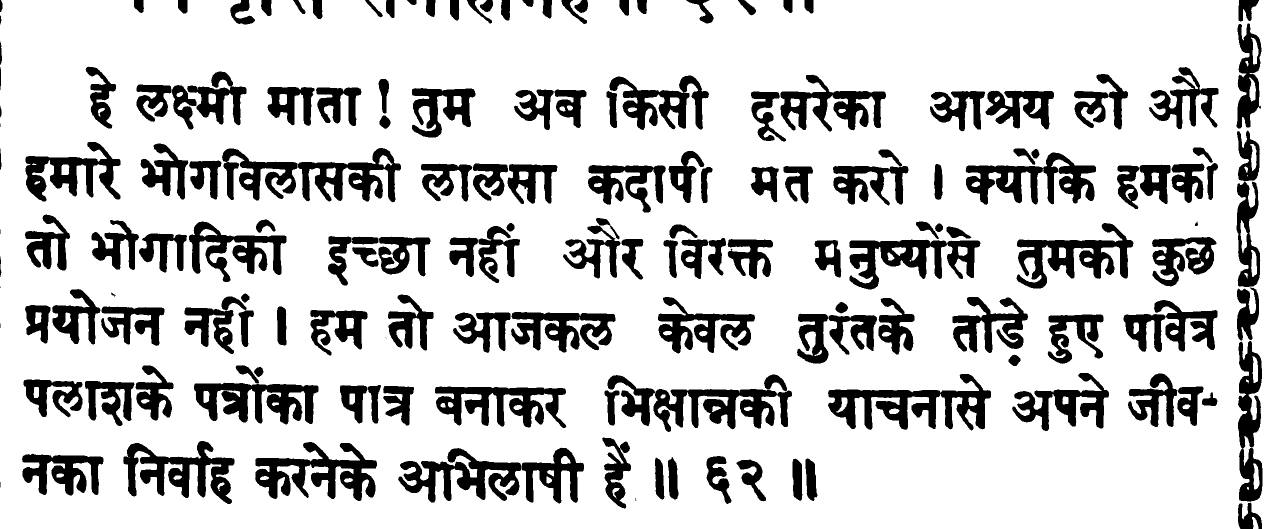
हे लक्ष्मी माता ! तुम अब किसी दूसरेका आश्रय लो और हमारे भोगविलासकी लालसा कदापी मत करो । क्योंकि हमको तो भोगादिकी इच्छा नहीं और विरक्त मनुष्योंसे तुमको कुछ प्रयोजन नहीं । हम तो आजकल केवल तुरंत के तोड़े हुए पवित्र पलाशके पत्रोंका पात्र बनाकर भिक्षान्नकी याचनासे अपने जीवनका निर्वाह करनेके अभिलाषी हैं ॥ ६२ ॥
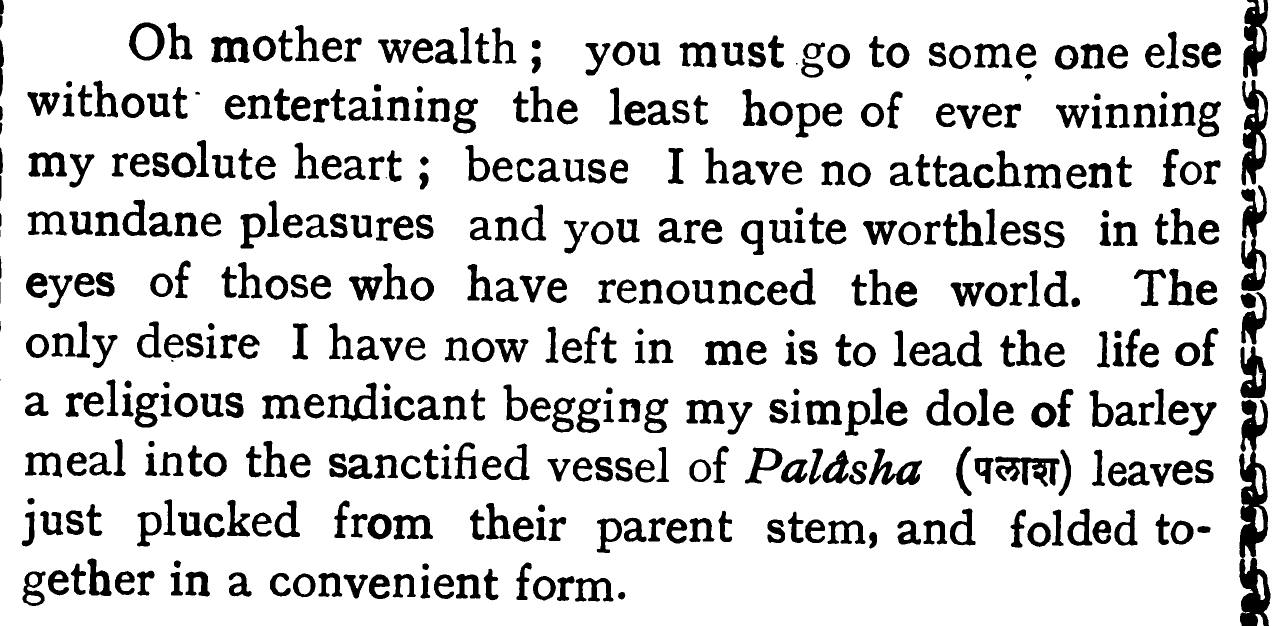
Oh mother wealth; you must go to some one else without entertaining the least hope of ever winning my resolute heart; because I have no attachment for mundane pleasures and you are quite worthless in the eyes of those who have renounced the world. The only desire I have now left in me is to lead the life of a religious mendicant begging my simple dole of barley meal into the sanctified vessel of Palasha (9) leaves just plucked from their parent stem, and folded together in a convenient form.
Gopinath1896
all
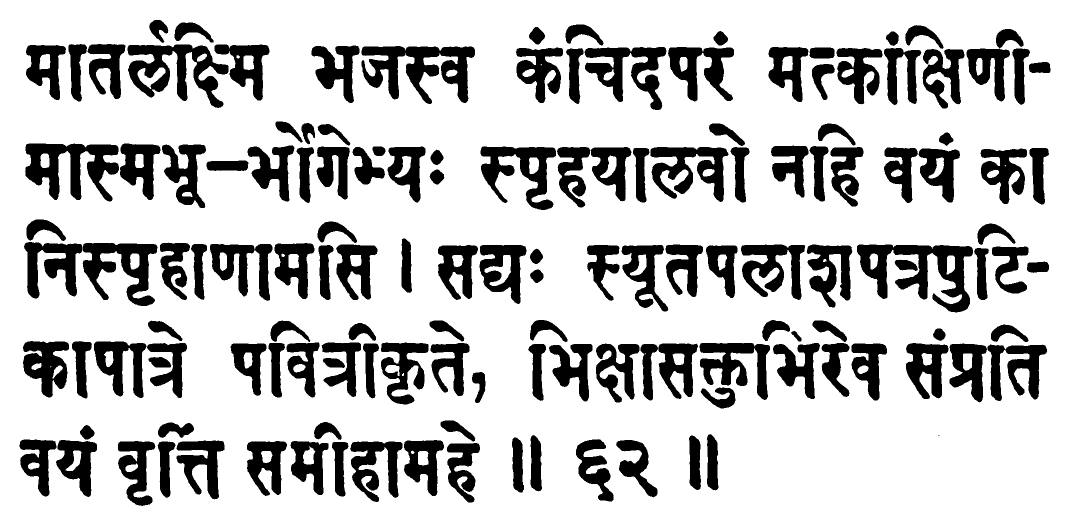
मातर्लक्ष्मि भजस्व कंचिदपरं मत्कांक्षिणी-
मास्मभू - भोगेभ्यः स्पृहयालवो नहि वयं का
निस्पृहाणामसि । सद्यः स्यूतपलाशपत्रपुटि-
कापात्रे पवित्रीकृते, भिक्षासनुभिरेव संप्रति
वयं वृत्तिं समीहामहे ॥ ६२ ॥
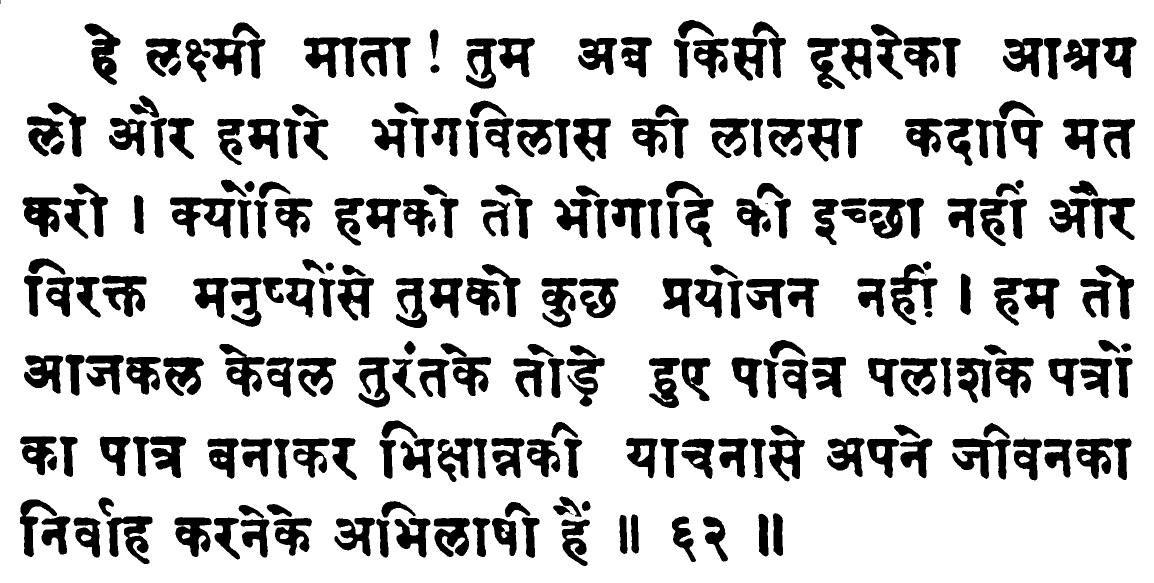
हे लक्ष्मी माता ! तुम अब किसी दूसरेका आश्रय लो और हमारे भोगविलास की लालसा कदापि मत करो 1 । क्योंकि हमको तो भोगादि की इच्छा नहीं और विरक्त मनुष्योंसे तुमको कुछ प्रयोजन नहीं । हम तो आजकल केवल तुरंतके तोड़े हुए पवित्र पलाशके पत्रों का पात्र बनाकर भिक्षान्नकी याचनासे अपने जीवनका निर्वाह करनेके अभिलाषी हैं ॥ ६२ ॥
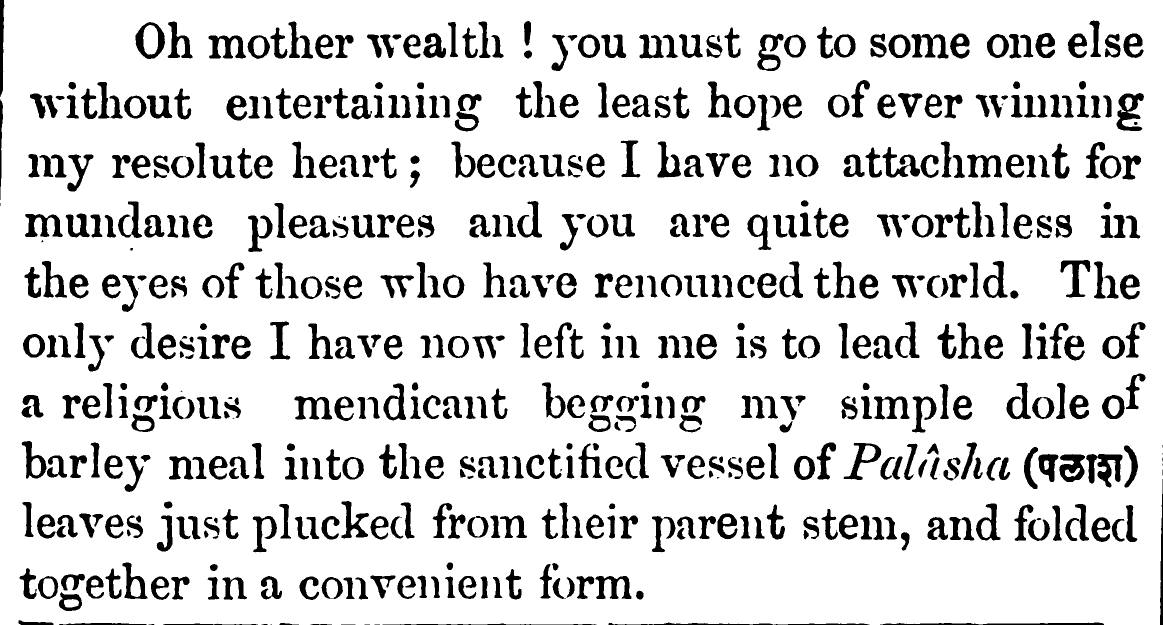
Oh mother wealth! you must go to some one else without entertaining the least hope of ever winning my resolute heart; because I have no attachment for mundane pleasures and you are quite worthless in the eyes of those who have renounced the world. The only desire I have now left in me is to lead the life of a religious mendicant begging my simple dole of barley meal into the sanctified vessel of Palasha (पलाश) leaves just plucked from their parent stem, and folded together in a convenient form.
Footnote
The stanza is same as sloka 11 in the Sántisataka. Part. IV. ( शान्तिशतकम् । ४ परिच्छेदः ).


Kosambi
all
मातर्लक्ष्मि भजस्व कंचिदपरं मत्काङ्क्षिणी मा स्म भूर्
भोगेभ्यः स्पृहयालवस् तव वशे का निःस्पृहाणामसि ।


Footnote
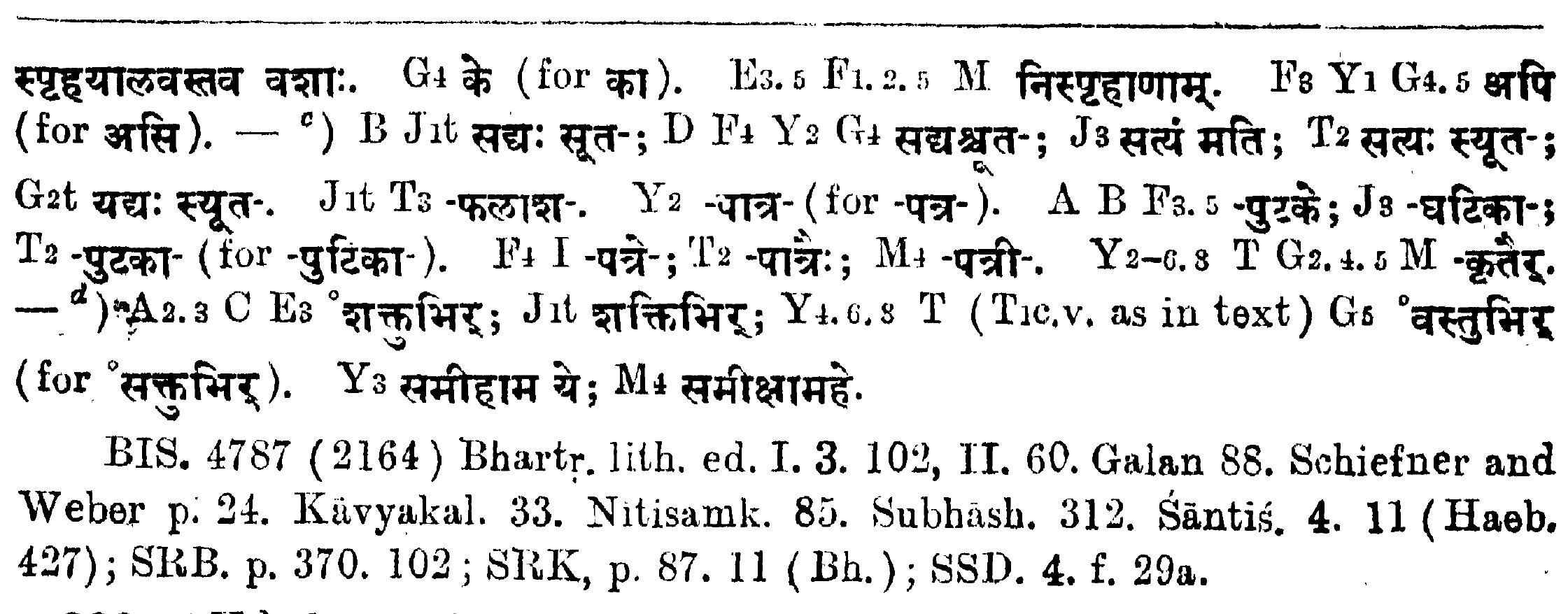
302 { V } Om . in W. Y7 missing . a ) G1 M2 लक्ष्मीरम्ब ( for मातर्लक्ष्मि ) .
Ea J10 लक्ष्मी . B1D I Js M4 किंचिदपरं ; Y1 T2.3 कं चिदपरं . B2 Est Y2 -कांक्षणी ; C
-प्रार्थिनी . J च ( for स्म ) . 6 ) F2_Y1–6.8_T_G ± .5M.5 भोगेपु ; F भोगिभ्य : B [ अ ] थ
विनिर्वृता वयमहो ; C D E F½ ( m.v. as in text ) स्पृहयालवो न हि वयं ; Y1.4.6 G2-4

Footnote
स्पृहयालवस्तव वशाः . G 1 के ( for का ) . E3.5 F1.25 M निस्पृहाणाम् . FY1G4.5 अपि
( for असि ) . - c ) B Jit सद्यः सूत- ; DF 4 Y 2 G + सद्यश्चत- ; J3 सत्यं मति ; T2 सत्यः स्यूत ;
Gat यद्यः स्यूत- Jit Ts - फलाश - Y2 - पात्र - ( for पत्र- ) . AB F 3.5 - पुटके ; J3 घटिका- ;
T2 -पुटका- ( for पुटिका ) . F 1 I -पत्रे - ; 12 - पात्रै : ; M + - पत्री - • Y2- 6.8 T G2 . 4.5 M - कृतैर .
* ) + A2.3 C E3 ° शक्तुभिर् ; Jit शक्तिभिर् ; Y1.6.8 T ( Tic.v. as in text ) G6 ° वस्तुभिर्
( for सक्तुभिर् ) . Y3 समीहाम ये ; M4 समीक्षामहे .
BIS . 4787 ( 2164 ) Bhartṛ . lith . ed . I. 3. 102 , II . 60. Galan 88. Schiefner and
Weber p . 24. Kavyakal . 33. Nitisamk . 85. Subhash 312. Santis . 4. 11 ( Haeb .
427 ) ; SRB . p . 370 102 ; SRK , p . 87.11 ( Bh . ) ; SS.D. 4. f . 293 .
Commentary