Tawney
Still Śiva's arm is strong to save,
Still may we plunge in Gangâ's wave,
Still one blue heaven bends over all,
Still Time sees mortals rise and fall,
Still poverty's our best defence,
Enough—renounce the joys of sense.
Telang
all
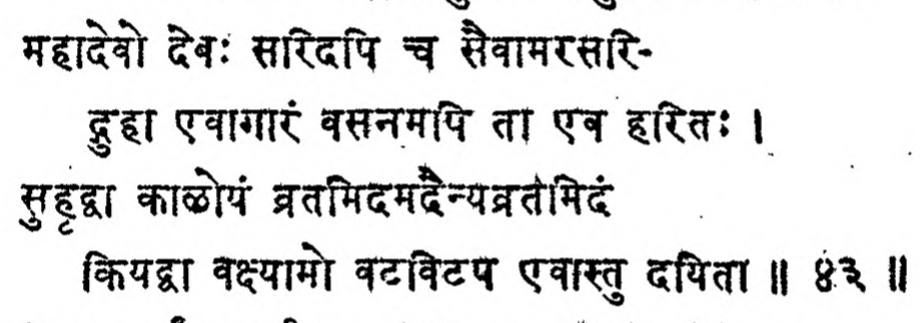
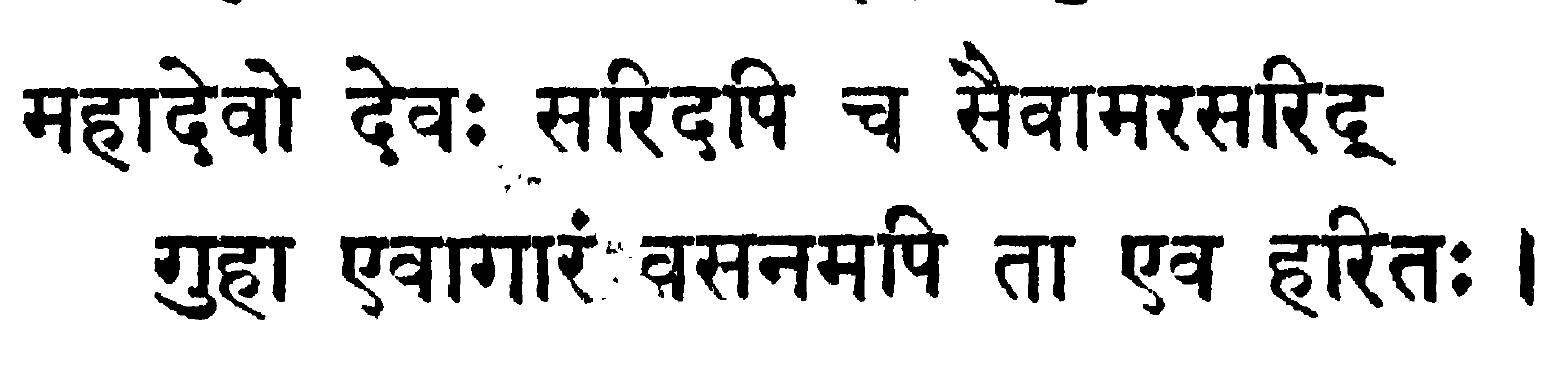
महादेवो देवः सरिदपि च सैवामरसरि-
द्गुहा एवागारं वसनमपि ता एव हरितः ।
सुहृद्वा कालोयं व्रतमिदमदैन्यव्रतमिदं
कियद्वा वक्ष्यामो वटविटप एवास्तु दयिता ॥ ४३ ॥
Notes
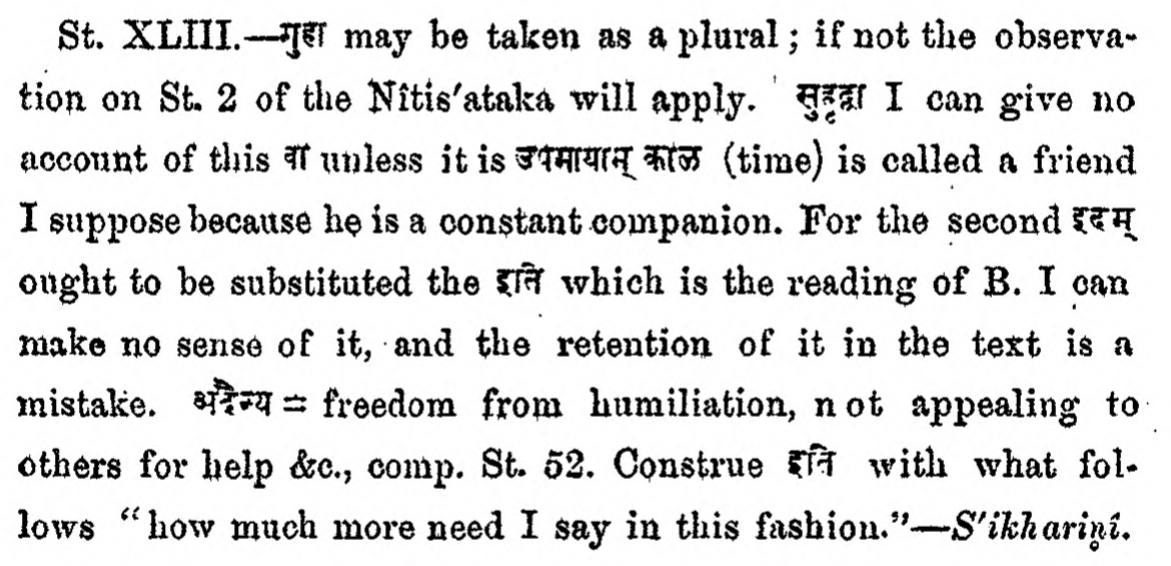
St. XLIII.—गुहा may be taken as a plural ; if not the observation on St. 2 of the Nîtis'ataka will apply. सुहृद्वा I can give no account of this वा unless it is उपमायाम् काल (time) is called a friend I suppose because he is a constant companion. For the second इदम् ought to be substituted the इति which is the reading of B. I can make no sense of it, and the retention of it in the text is a mistake. अदैन्य = freedom from humiliation, not appealing to others for help &c., comp. St. 52. Construe इति with what follows “how much more need I say in this fashion.”—S'ikhariṇî.

Kale
all
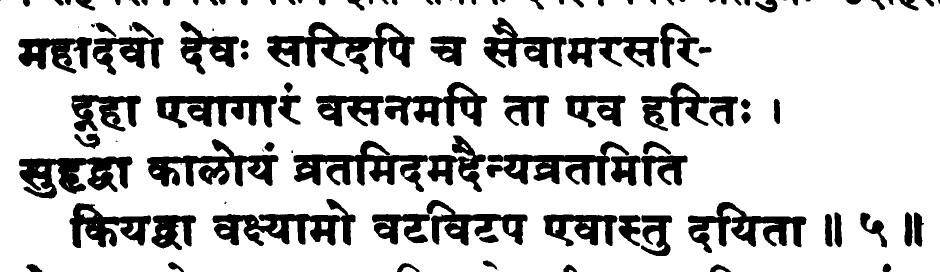
महादेवो देवः सरिदपि च सैवामरसरि-
द्गुहा एवागारं वसनमपि ता एव हरितः ।
सुहृद्वा कालोयं व्रतमिदमदैन्यव्रतमिति
कियद्वा वक्ष्यामो वटविटप एवास्तु दयिता ॥ ५ ॥
Translation
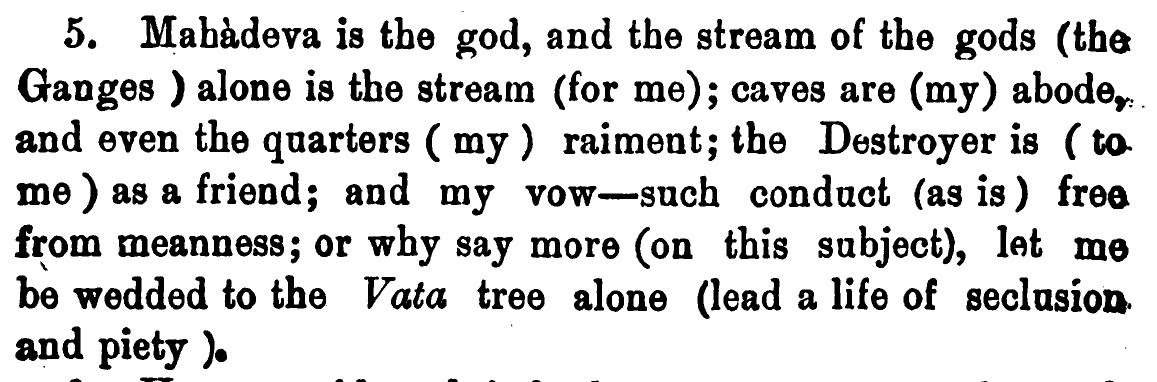
5. Mahàdeva is the god, and the stream of the gods (the Ganges ) alone is the stream (for me); caves are (my) abode, and even the quarters ( my ) raiment; the Destroyer is ( to me ) as a friend; and my vow—such conduct (as is ) free from meanness; or why say more (on this subject), let me be wedded to the Vata tree alone (lead a life of seclusion and piety ).
Notes
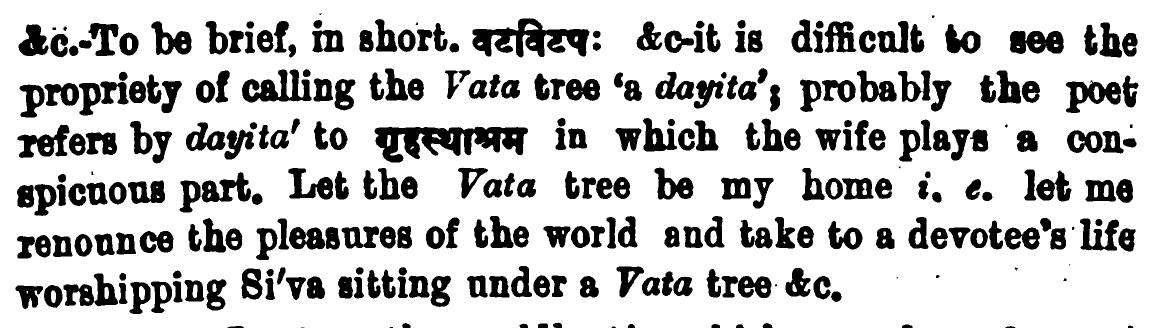
Sl. 5. अमरसरित्—The Ganges. हरितः-the quarters. अदैन्य-Not showing one’s poverty; or (2) freedom from meanness. सुहृद्वा-वा is used here either in the sense of एव or समुच्चय ( as also ). क्रियद्वा &c.-To be brief, in short. वटविटपः &c-it is difficult to see the propriety of calling the Vata tree ‘a dayita’; probably the poet refers by dayita’ to गृहस्थाश्रम in which the wife plays a conspicuous part. Let the Vata tree be my home i. e. let me renounce the pleasures of the world and take to a devotee’s life worshipping Si'va sitting under a Vata tree &c.

Gopinath1914
all
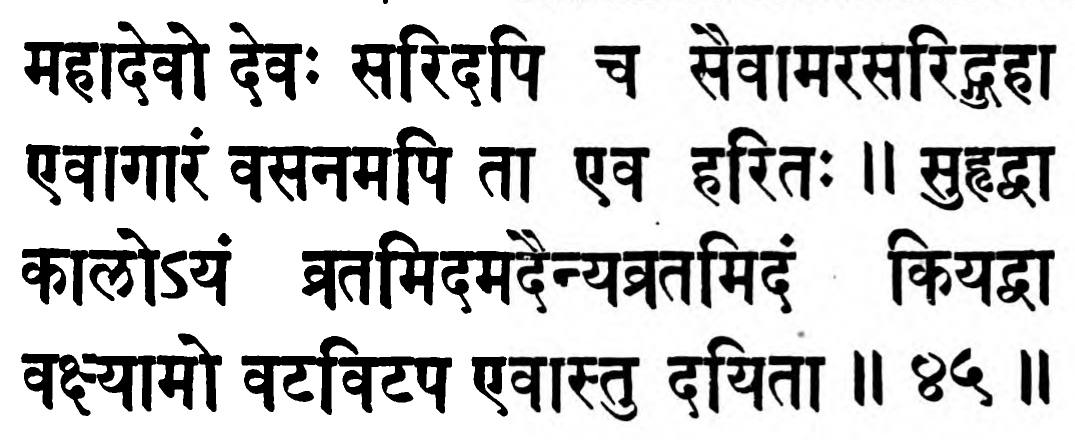
महादेवो देवः सरिदपि च सैवामरसरिगुहा
एवागारं वसनमपि ता एव हरितः ॥ सुहृद्वा
कालोऽयं व्रतमिदमदैन्यत्रतमिदं कियद्वा
वक्ष्यामो वटविटप एवास्तु दयिता ॥ ४५ ॥
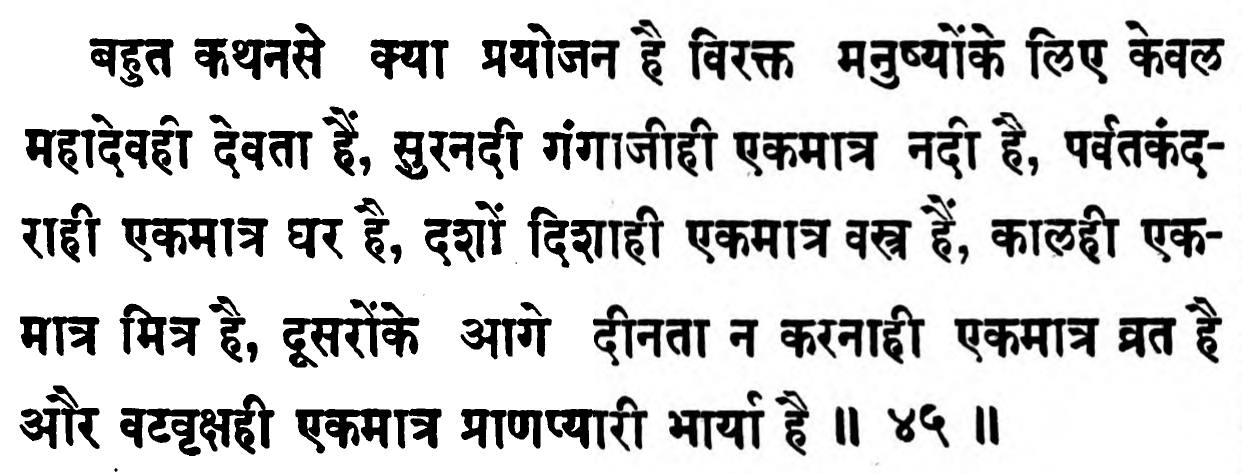
बहुत कथनसे क्या प्रयोजन है विरक्त मनुष्योंके लिए केवल महादेवही देवता हैं, सुरनदी गंगाजीही एकमात्र नदी है, पर्वतकंदराही एकमात्र घर है, दशों दिशाही एकमात्र वस्त्र हैं, कालही एकमात्र मित्र है, दूसरोंके आगे दीनता न करनाही एकमात्र व्रत है और वटवृक्षही एकमात्र प्राणप्यारी भार्या है ॥ ४५ ॥
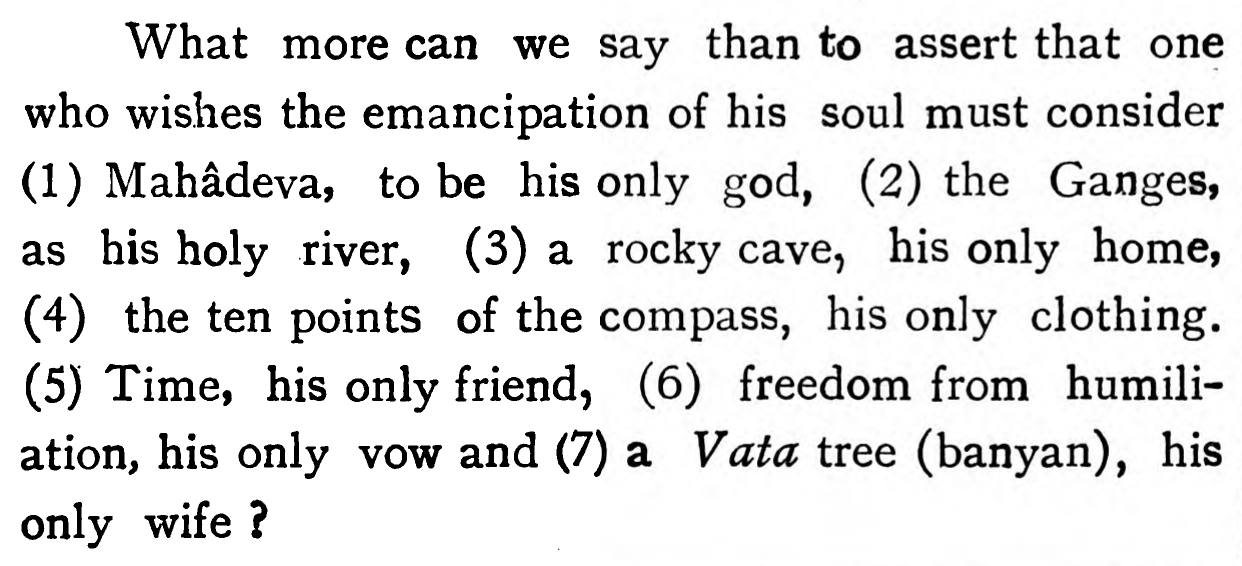
What more can we say than to assert that one who wishes the emancipation of his soul must consider (1) Mahádeva, to be his only god, (2) the Ganges, as his holy river, ( 3 ) a rocky cave, his only home, (4) the ten points of the compass, his only clothing. (5) Time, his only friend, ( 6 ) freedom from humiliation, his only vow and ( 7 ) a Vata tree (banyan ), his only wife ?
Footnote
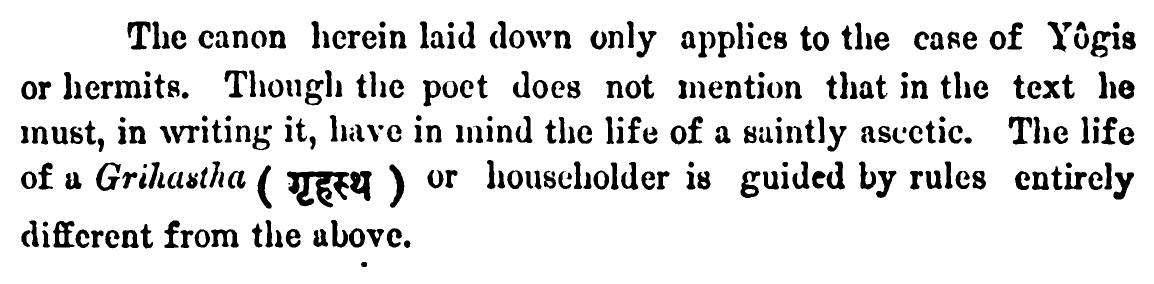
The canon herein laid down only applies to the case of Yogis or hermits. Though the poet does not mention that in the text he must, in writing it, have in mind the life of a saintly ascetic. The life of a Grihastha ( गृहस्थ ) or householder is guided by rules entirely different from the above.
Gopinath1896
all
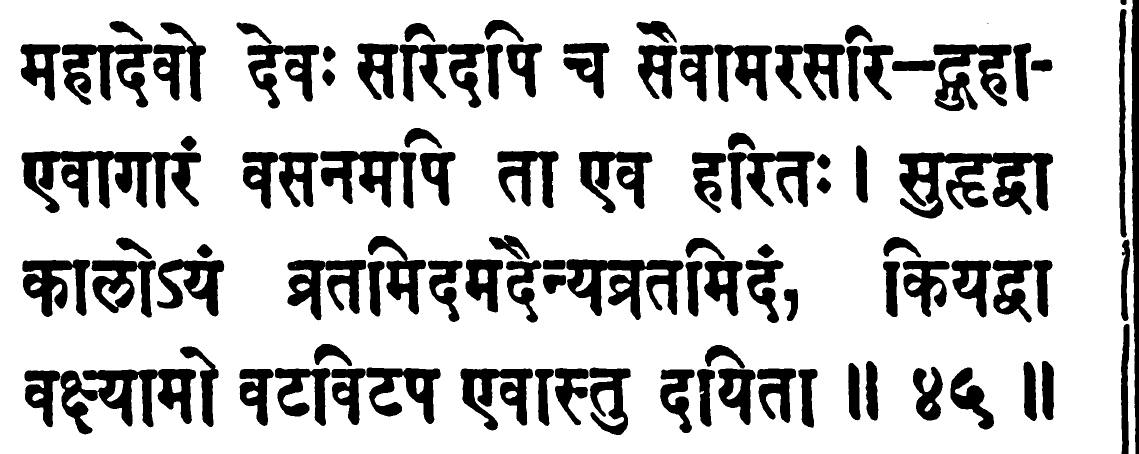
महादेवो देवः सरिदपि च सैवामरसरि-हा-
एवागारं वसनमपि ता एव हरितः । सुहृद्वा
कालोऽयं व्रतमिदमदैन्यव्रतमिदं, कियद्वा
वक्ष्यामो वटविटप एवास्तु दयिता ॥ ४५ ॥
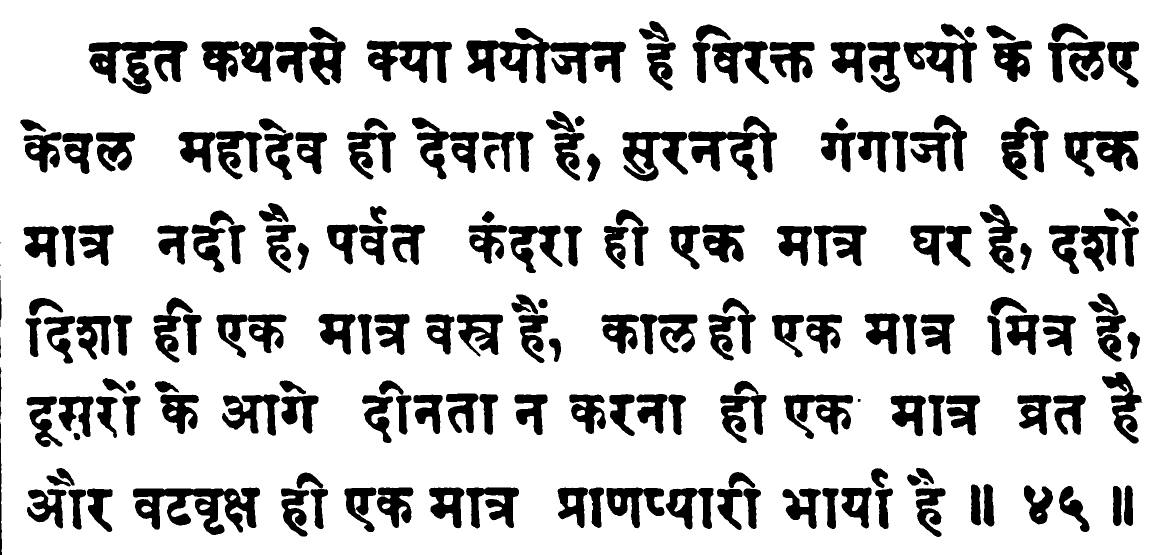
बहुत कथनसे क्या प्रयोजन है विरक्त मनुष्यों के लिए केवल महादेव ही देवता हैं, सुरनदी गंगाजी ही एक मात्र नदी है, पर्वत कंदरा ही एक मात्र घर है, दशों दिशा ही एक मात्र वस्त्र हैं, काल ही एक मात्र मित्र है, दूसरों के आगे दीनता न करना ही एक मात्र व्रत और वटवृक्ष ही एक मात्र प्राणप्यारी भार्या है ॥ ४५ ॥
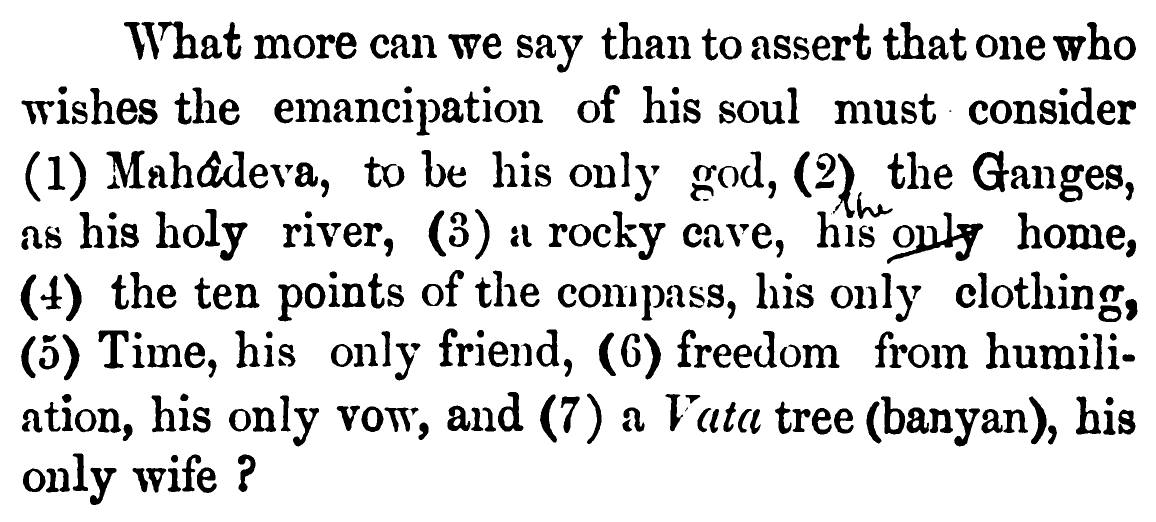
What more can we say than to assert that one who wishes the emancipation of his soul must . consider (1) Mah&deva, to be his only god, (2the ) the Ganges, as his holy river, (3) a rocky cave, his only home, ( 4 ) the ten points of the compass, his only clothing, (5) Time, his only friend, ( 6 ) freedom from humili ation, his only vow, and ( 7 ) a Fata tree (banyan), his only wife ?
Footnote
The canon herein laid down only applies to the case of Yogis or hermits. Though the poet does not mention that in the text he must, in writing it, have in mind the life of a saintly ascetic. The life of a Grihastha ( गृहस्थ ) or householder is guided by rules entirely different from the above.
Kosambi
all

Footnote
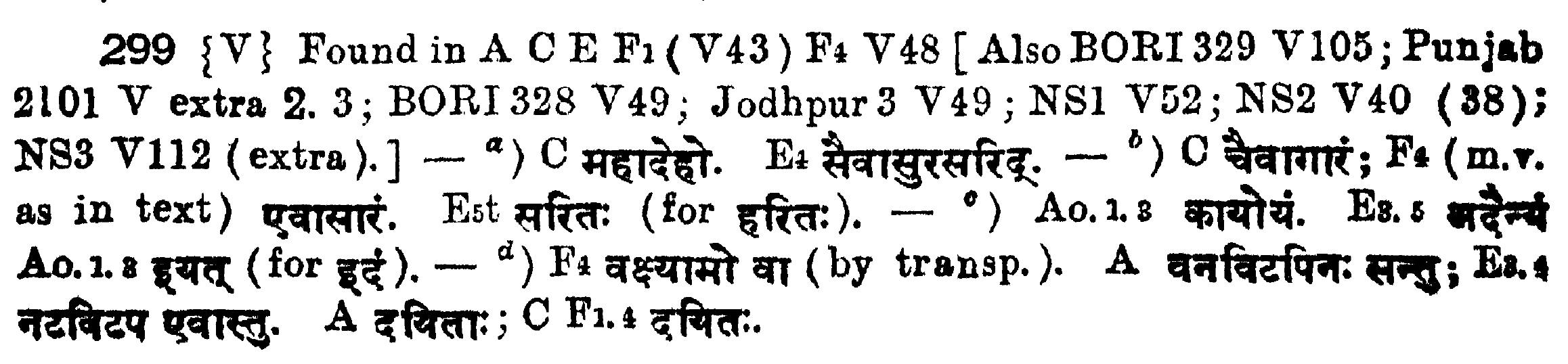
299 { V } Found in ACEF1 ( V43 ) F4V48 [ Also BORI 329 V105 ; Punjab
2101 V extra 2. 3 ; BORI 328 V49 ; Jodhpur 3 V49 ; NS1 V52 ; NS2V40 ( 38 ) ;
NS3 V112 ( extra ) . ] – 2 a ) C महादेहो . E + सैवासुरसरि . - . 0 ) C चैवागारं ; Fs ( m.v.
as in text ) एवासारं . Est सरितः ( for हरितः ) . ● ) A0 . 1.3 कायोयं . Ess अदैन्य
Ao . 1.8 इयत् ( for इदं ) . – 4 ) F वक्ष्यामो वा ( by transp . ) . A वनविटपिनः सन्तु , E8.4
नटविटप एवास्तु . A दविताः ; CF1.4 दयितः .

Commentary