Tawney
The chief of saints declare no joy can vie with theirs
Who fling on Siva's breast the burden of their cares,
Taking no thought for wealth, by daily bounty fed,
Blessed and pure, exempt from envy, pain, and dread.
Mādhavānanda
भिक्षाहारमदैन्यमप्रतिसुखं भीतिच्छिदं सर्वतो
दुर्मात्सर्यमदाभिमानमथनं दु:खौघविध्वंसनम् ।
सर्वत्रान्वहमप्रयत्नसुलभं साधुप्रियं पावनं
शम्भो: सत्रमवार्यमक्षयनिधिं शंसन्ति योगीश्वरा: ।।३०।।
30. The great yogīs describe food which begging brings as follows: it does not humiliate (vide verse no. 23); it is an independent pleasure (i.e., not dependent on the pleasure of earning money, fulfilling social duty, etc.); it is in all respects free from any anxious fear (i.e., about one’s expenditure, foodstores, etc.); it destroys wicked pride, egotism and impatience; it eradicates the manifold evils of worldly existence; it is easily available anywhere any day without efforts; it is the beloved of the holy men; it is a purification by itself; it is like the inexhaustible feeding-house of Śiva, access to which none can prevent.
Telang
all
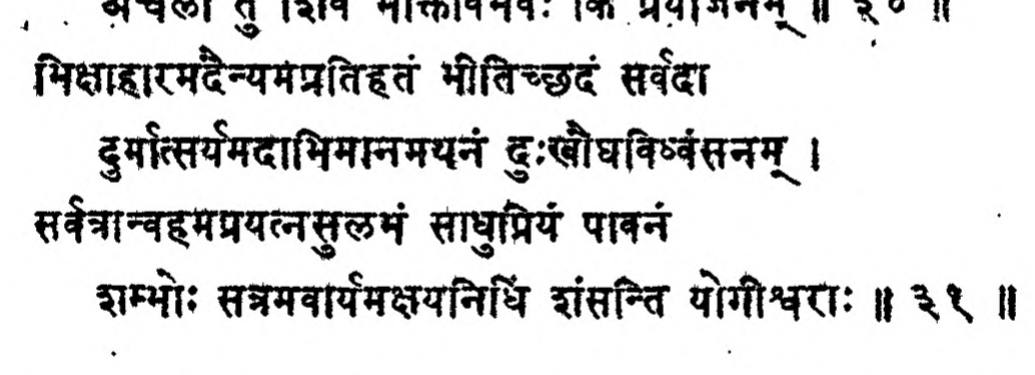
भिक्षाहारमदैन्यमप्रतिहतं भीतिच्छदं सर्वदा
दुर्मात्सर्यमदाभिमानमथनं दुःखौघविध्वंसनम् ।
सर्वत्रान्वहमप्रयत्नसुलभं साधुप्रियं पावनं
शम्भोः सत्रमवार्यमक्षयनिधिं शंसन्ति योगीश्वराः ॥ ३१ ॥
Notes
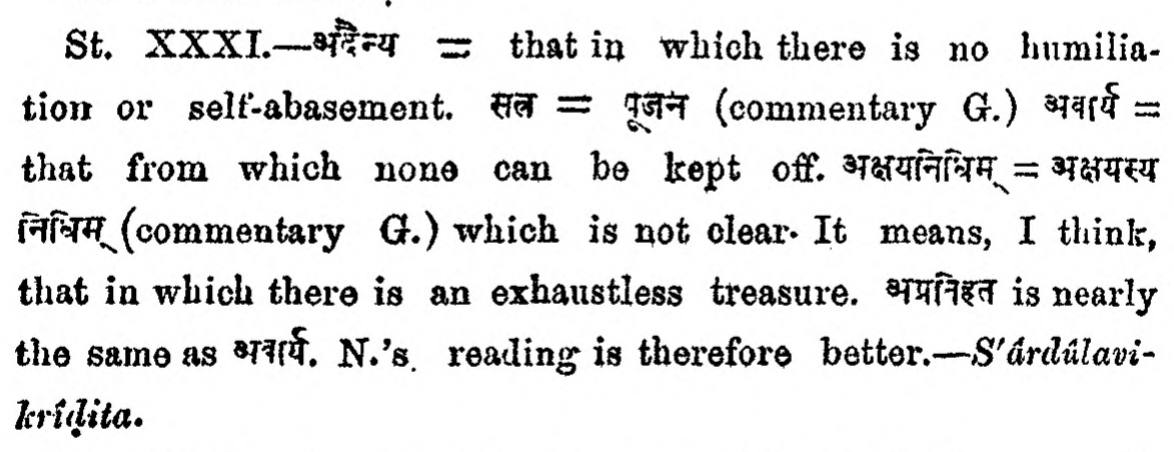
St. XXXI.—अदैन्य = that in which there is no humiliation or self-abasement. सत्र = पूजन (commentary G.) अवार्य = that from which none can be kept off. अक्षयनिधिम् = अक्षयस्य निधिम् (commentary G.) which is not clear. It means, I think, that in which there is an exhaustless treasure. अप्रतिहत is nearly the same as अवार्य. N.’s reading is therefore better.—S'ârdûlavikrîḍita.

Kale
all

भिक्षाहारमदैन्यमप्रतिसुखं भीतिच्छिदं सर्वदा
दुर्मात्सर्यमदाभिमानमथनं दुःखौघविध्वंसनम् ।
सर्वत्रान्वहमप्रयत्नसुलभं साधुप्रियं पावनं
शम्भोः सत्रमवार्यमक्षयनिधिं शंसन्ति योगीश्वराः ॥ ३१ ॥

Translation
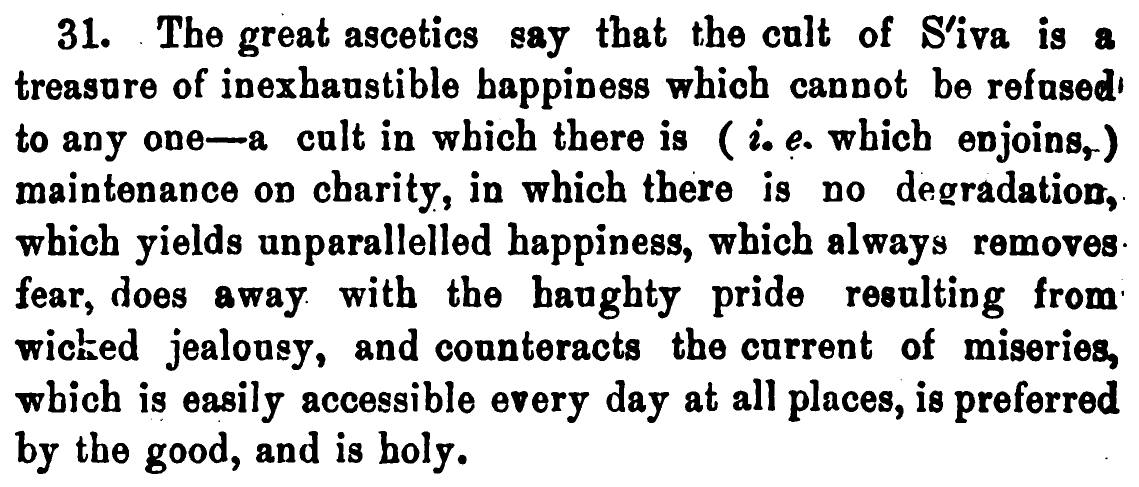
31. The great ascetics say that the cult of S'iva is a treasure of inexhaustible happiness which cannot be refused to any one—a cult in which there is ( i. e. which enjoins, ) maintenance on charity, in which there is no degradation, which yields unparallelled happiness, which always removes fear, does away with the haughty pride resulting from wicked jealousy, and counteracts the current of miseries, which is easily accessible every day at all places, is preferred by the good, and is holy.
Notes
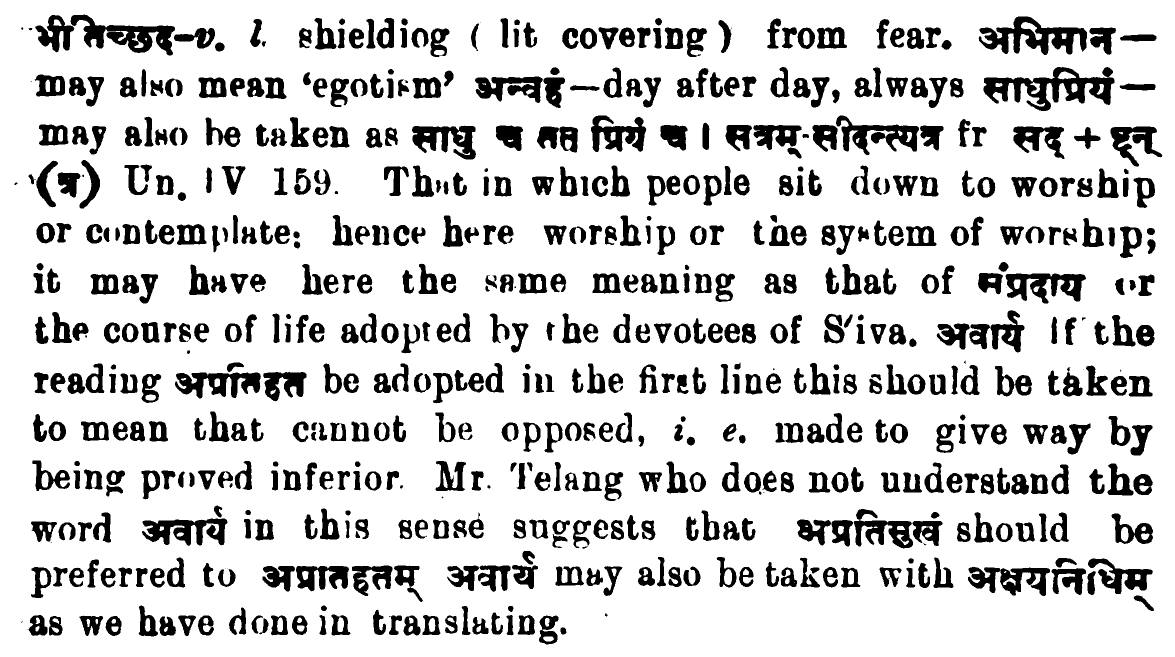
Sl. 31. अदैन्य–in which there is no self-abasement; in which one has not the misery of undergoing humiliation, or making abject supplication. अप्रतिमुखं-This reading is better than अप्रतिहतं as it nearly means the same thing as अवार्य. अप्रतिहत may mean knowing no obstruction, producing every desired effect. भीतिच्छद-v. l. shielding ( lit covering ) from fear. अभिमान— may also mean ‘egotism’ अन्वहं—day after day, always साधुप्रियं— may also be taken as साधु च तत् प्रियं च । सत्रम्-सीदन्त्यत्र fr सद् + ष्ट्रन् (त्र) Un. IV 159. That in which people sit down to worship or contemplate: hence here worship or the system of worship; it may have here the same meaning as that of संप्रदाय or the course of life adopted by the devotees of S'iva. अवार्य If the reading अप्रतिहत be adopted in the first line this should be taken to mean that cannot be opposed, i. e. made to give way by being proved inferior. Mr. Telang who does not understand the word अवार्य in this sense suggests that अप्रतिसुखं should be preferred to अप्रतिहतम् अवार्यं may also be taken with अक्षयनिधिम् as we have done in translating.

Kosambi
all
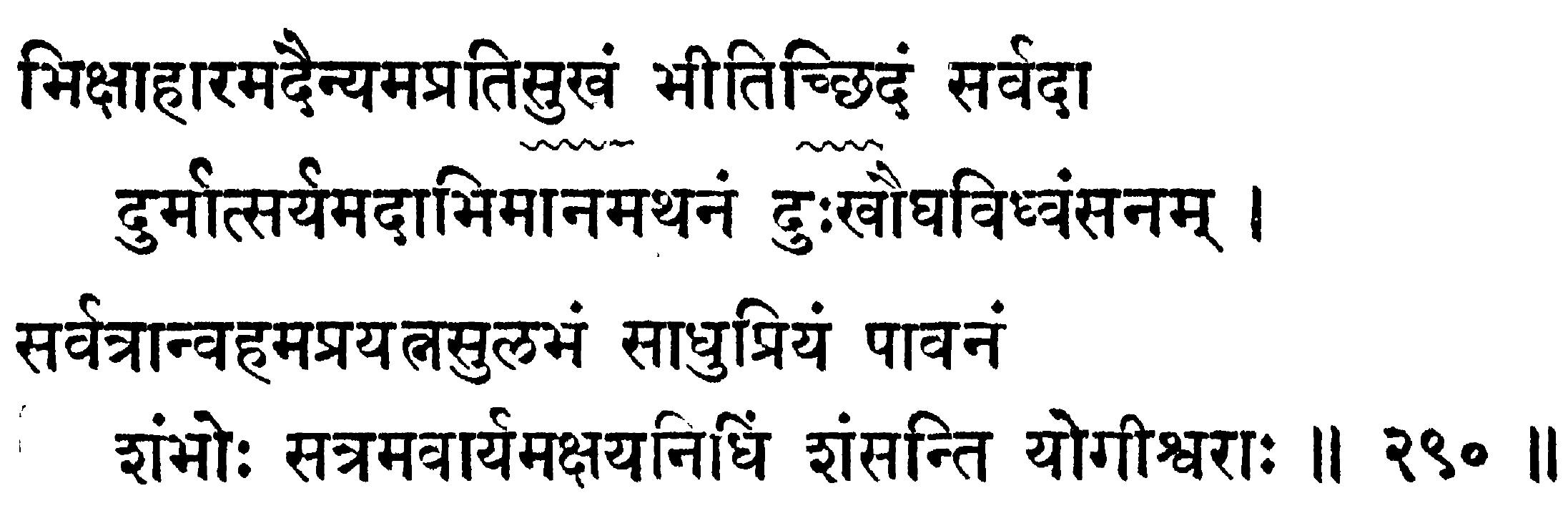
भिक्षाहारमदैन्यमप्रतिसुखं भीतिच्छिदं सर्वदा
दुर्मात्सर्यमदाभिमानमथनं दुःखौघविध्वंसनम् ।
सर्वत्रान्वहमप्रयत्नसुलभं साधुप्रियं पावनं
। शंभो : सत्रमवार्य मक्षयनिधिं शंसन्ति योगीश्वराः ॥ २ ९ ० ॥
Footnote
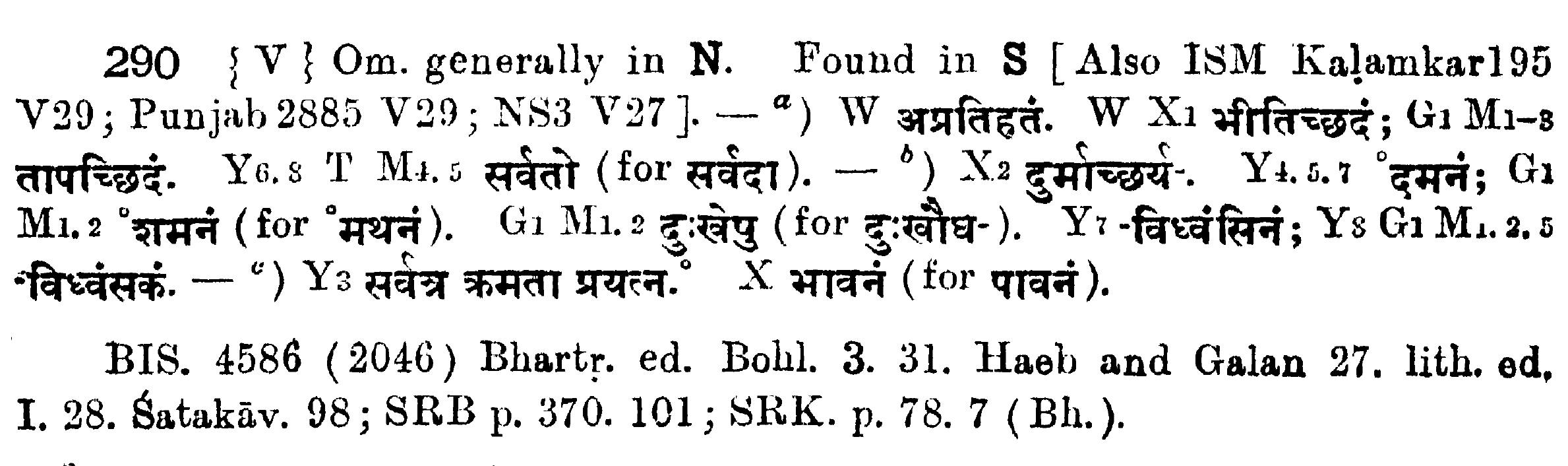
290 { V } Om . generally in N. Found in S [ Also ISM Kalamkar195
V29 ; Punjab 2885 V29 ; NS3 V27 ] . " ) W अप्रतिहतं . W X 1 भीतिच्छदं ; G1 M1 - 8
तापच्छिदं . Y6 . T M 1.5 सर्वतो ( for सर्वदा ) . - ० ) X 2 दुर्माच्छर्य Y + 5.7 दमनं ; Ga
M1 . 2 शमनं ( for ' मथनं ) . ( G1 M1 . 2 दुःखेषु ( for दुःखौध- ) . X 7 विध्वंसिनं ; Ys Ga Ma 25
विध्वंसकं . ५ ) Y3 सर्वत्र क्रमता प्रयत्न . X भावनं ( for पावनं ) .
BIS . 4586 ( 2046 ) Bhartr ed . Bobl . 3. 31. Haeb and Galan 27. lith , ed .
I. 28. Śatakāv . 98 ; SRB p . 370.101 ; SRK . p . 78.7 ( Bh . ) .
Commentary