Ryder
WHAT THEN?-II
Old rags, or fine, white silk that flows and clings-
Why should I care?
Poor wife, or horses, elephants, and things-
What difference there?
Sweet rice, or wretched food when day is o'er-
Why care again?
God's light, or groping in the dark once more-
What then? What then?
Tawney
The hermit's tattered patchwork robe, or courtier's silken weeds.
One wife to tend thy home, or troops of elephants and steeds.
One simple meal at close of day, or many a gorgeous feast.
It matters not, be but thy soul from earthly cares released.
Telang
all
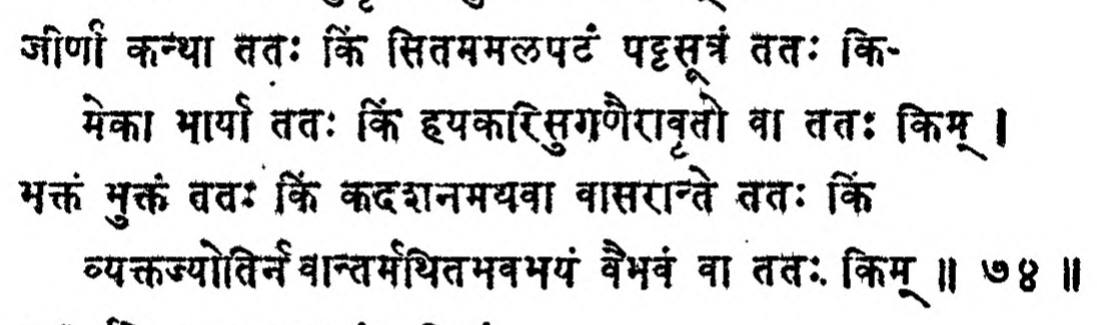
जीर्णा कन्था ततः किं सितममलपटं पट्टसूत्रं ततः कि-
मेका भार्या ततः किं हयकरिसुगणैरावृतो वा ततः किम् ।
भक्तं भुक्तं ततः किं कदशनमथवा वासरान्ते ततः किं
व्यक्तज्योतिर्नवान्तर्मथितभवभयं वैभवं वा ततः किम् ॥ ७४ ॥
Notes
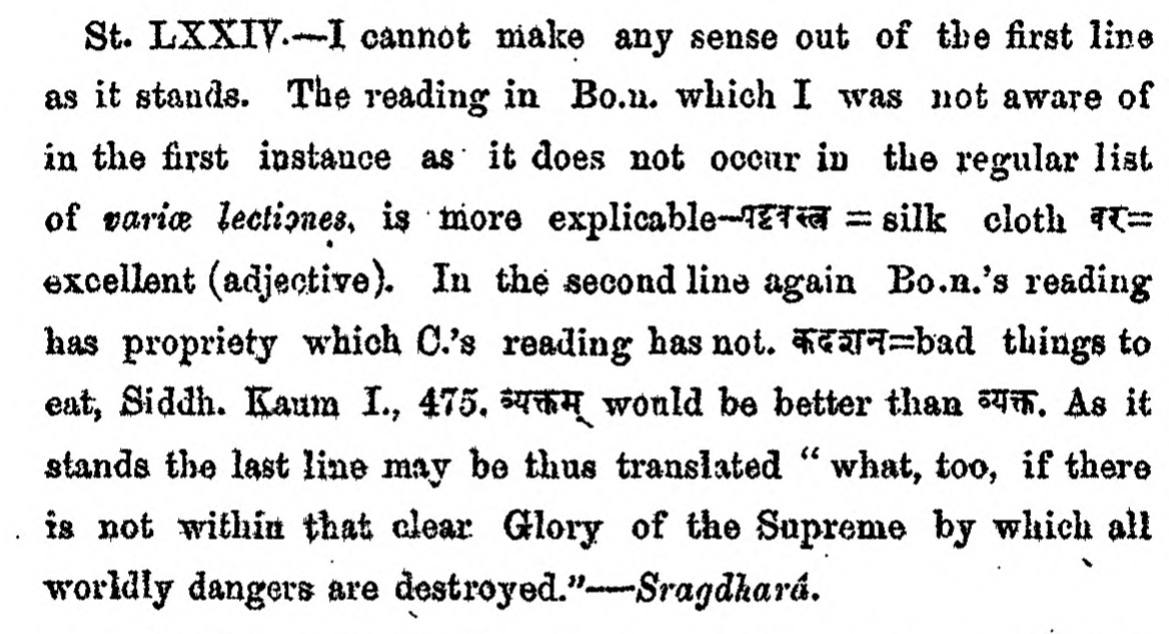
St. LXXIV.—I cannot make any sense out of the first line as it stands. The reading in Bo.n. which I was not aware of in the first instance as it does not occur in the regular list of variæ lectiones, is more explicable—पट्टवस्त्र = silk cloth वर= excellent (adjective). In the second line again Bo.n.’s reading has propriety which C.’s reading has not. कदशन=bad things to eat, Siddh. Kaum I., 475. व्यक्तम् would be better than व्यक्त. As it stands the last line may be thus translated “what, too, if there is not within that clear Glory of the Supreme by which all worldly dangers are destroyed.”—Sragdharâ.

Telang
all
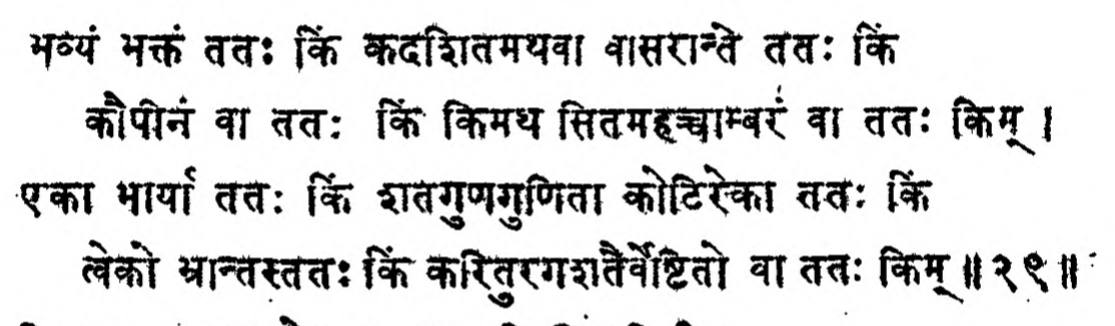
भव्यं भक्तं ततः किं कदशितमथवा वासरान्ते ततः किं
कौपीनं वा ततः किं किमथ सितमहच्चाम्बरं वा ततः किम् ।
एका भार्या ततः किं शतगुणगुणिता कोटिरेका ततः किं
त्वेको भ्रान्तस्ततः किं करितुरगशतैर्वेष्टितो वा ततः किम् ॥२९॥
Notes
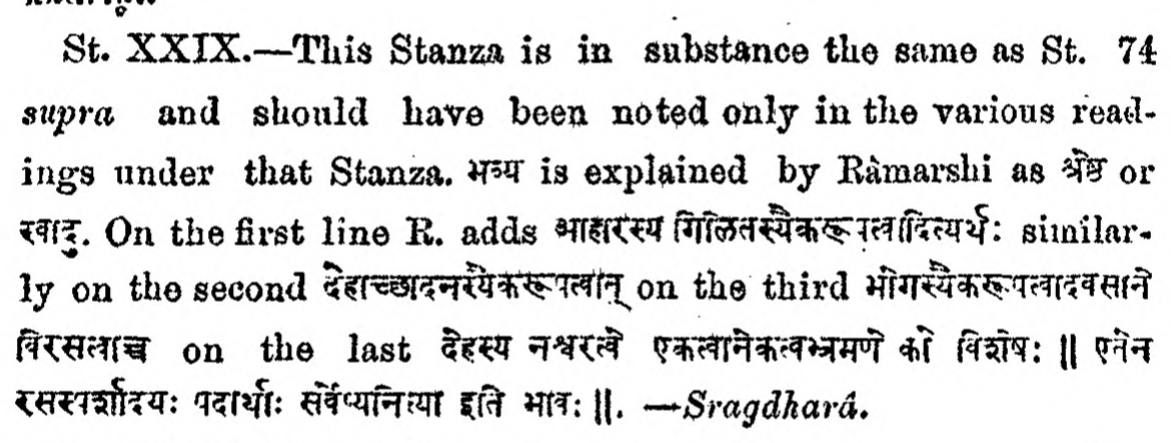
St. XXIX.—This Stanza is in substance the same as St. 74 supra and should have been noted only in the various readings under that Stanza. भव्य is explained by Râmarshi as श्रेष्ठ or स्वादु. On the first line R. adds आहारस्य गिलितस्यैकरूपत्वादित्यर्थः similarly on the second देहाच्छादनस्यैकरूपत्वात् on the third भोगस्यैकरूपत्वादवसाने विरसत्वाच्च on the last देहस्य नश्वरत्वे एकत्वानेकत्वभ्रमणे को विशेषः ॥ एतेन रसस्पर्शादयः पदार्थाः सर्वेप्यनित्या इति भावः ॥. —Sragdharâ.

Kale
all
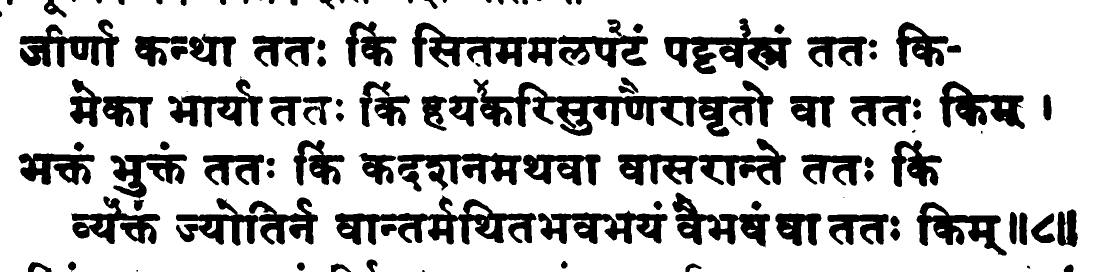
जीर्णा कन्था ततः किं सितममलपटं पट्टवस्त्रं ततः कि-
मेका भार्या ततः किं हयकरिसुगणैरावृतो वा ततः किम् ।
भक्तं भुक्तं ततः किं कदशनमथवा वासरान्ते ततः किं
व्यक्तं ज्योतिर्न वान्तर्मथितभवभयं वैभवं वा ततः किम् ॥८॥
Translation
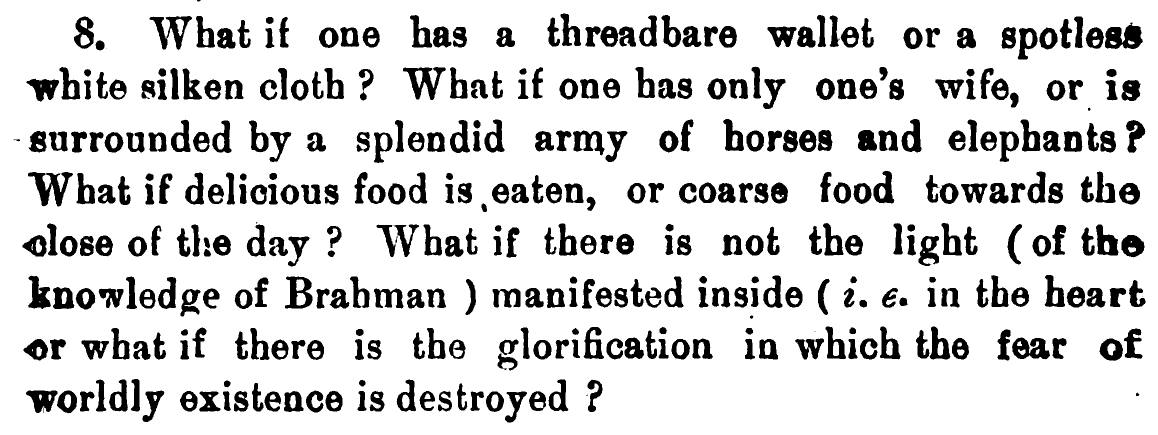
8. What if one has a threadbare wallet or a spotless white silken cloth ? What if one has only one's wife, or is surrounded by a splendid army of horses and elephants ? What if delicious food is eaten, or coarse food towards the close of the day ? What if there is not the light ( of the knowledge of Brahman ) manifested inside ( i. e. in the heart or what if there is the glorification in which the fear of worldly existence is destroyed ?
Notes
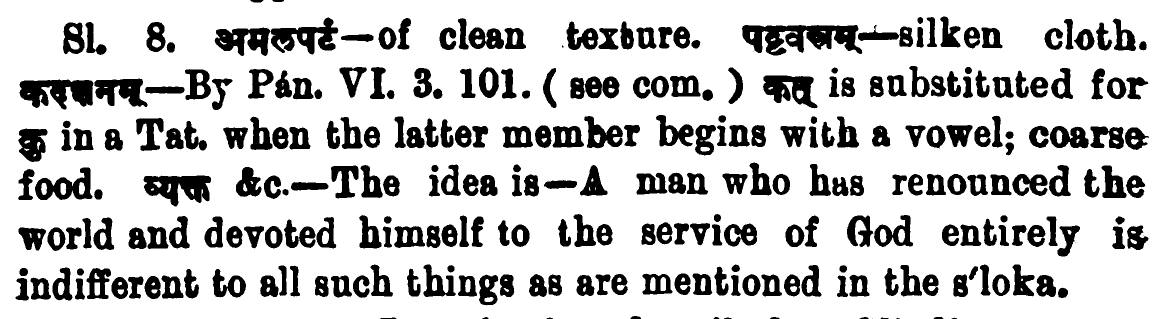
Sl. 8. अमलपटं—of clean texture. पट्टवस्त्रम्—silken cloth. कदशनम्—By Pán. VI. 3. 101. ( see com. ) कत् is substituted for कु in a Tat. when the latter member begins with a vowel; coarse food. व्यक्त &c.—The idea is—A man who has renounced the world and devoted himself to the service of God entirely is indifferent to all such things as are mentioned in the s'loka.

Kale
all
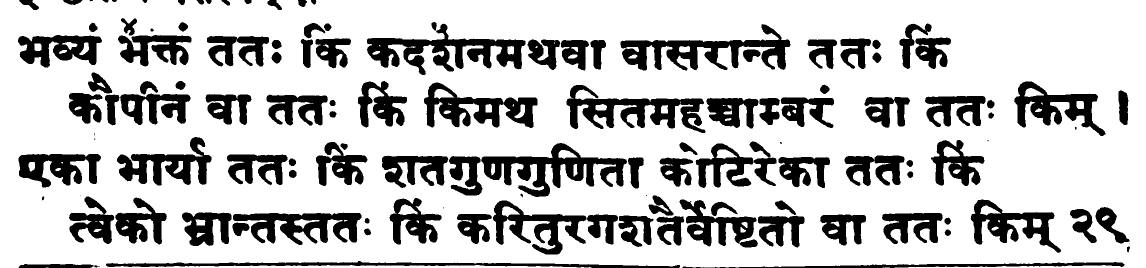
भव्यं भक्तं ततः किं कदशनमथवा वासरान्ते ततः किं
कौपीनं वा ततः किं किमथ सितमहच्चाम्बरं वा ततः किम् ।
एका भार्या ततः किं शतगुणगुणिता कोटिरेका ततः किं
त्वेको भ्रान्तस्ततः किं करितुरगशतैर्वेष्टितो वा ततः किम् २९
Commentary
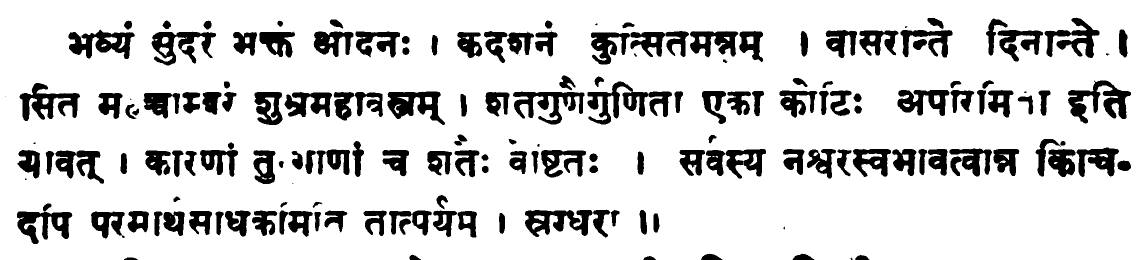
भव्यं सुंदरं भक्तं ओदनः । कदशनं कुत्सितमन्नम् । वासरान्ते दिनान्ते । सित महच्चाम्बरं शुभ्रमहावस्त्रम् । शतगुणैर्गुणिता एका कोटिः अपरिमिता इति यावत् । करिणां तुरगाणां च शतैः वेष्टितः । सर्वस्य नश्वरस्वभावत्वान्न किंचिदपि परमार्थसाधकमिति तात्पर्यम् । स्रग्धरा ॥
Translation
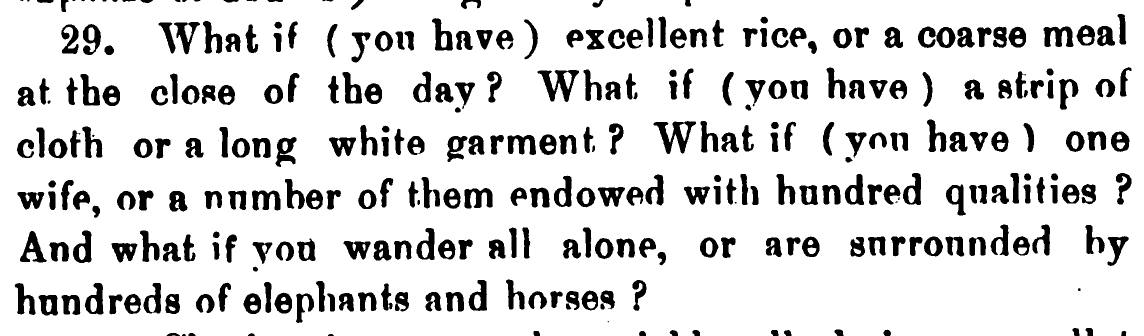
29. What if ( you have ) excellent rice, or a coarse meal at the close of the day ? What if ( you have ) a strip of cloth or a long white garment ? What if ( you have ) one wife, or a number of them endowed with hundred qualities ? And what if you wander all alone, or are surrounded by hundreds of elephants and horses ?
Notes
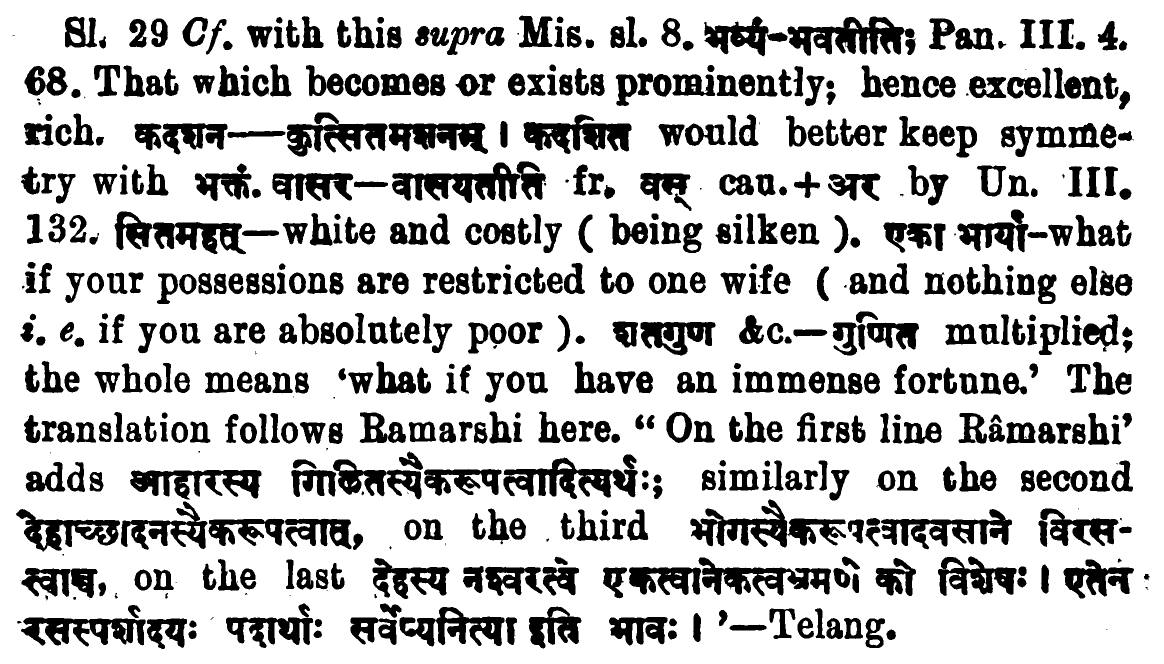
Sl. 29 Cf. with this supra Mis. sl. 8. भव्यं-भवतीति; Pan. III. 4. 68. That which becomes or exists prominently; hence excellent, rich. कदशन—कुत्सितमशनम् । कदशित would better keep symmetry with भुक्तं. वासर—वासयतीति fr. वस् cau. + अर by Un. III. 132. सितमहत्—white and costly ( being silken ). एका भार्या–what if your possessions are restricted to one wife ( and nothing else i. e. if you are absolutely poor ). शतगुण &c.—गुणित multiplied; the whole means ‘what if you have an immense fortune.’ The translation follows Ramarshi here. “On the first line Râmarshi’ adds आहारस्य गिलितस्यैकरूपत्वादित्यर्थः; similarly on the second देहाच्छादनस्यैकरूपत्वात्, on the third भोगस्यैकरूपत्वादवसाने विरसत्वाच्च, on the last देहस्य नश्वरत्वे एकत्वानेकत्वभ्रमणे को विशेषः । एतेन रसस्पर्शादयः पदार्थाः सर्वेप्यनित्या इति भावः । ’—Telang.

Gopinath1914
all
जीर्णा कन्था ततः किं सितममलपटं पट्ट-
सूत्रं ततः किं एका भार्या ततः किं हयकरि-
सुगणैरावृतो वा ततः किम् ॥ भक्तं भुक्तं
ततः किं कदशनमथवा वासरान्ते ततः किं
व्यक्तज्योतिर्न चान्तर्मथितभवभयं वैभवं वा
ततः किम् ॥ ७२ ॥
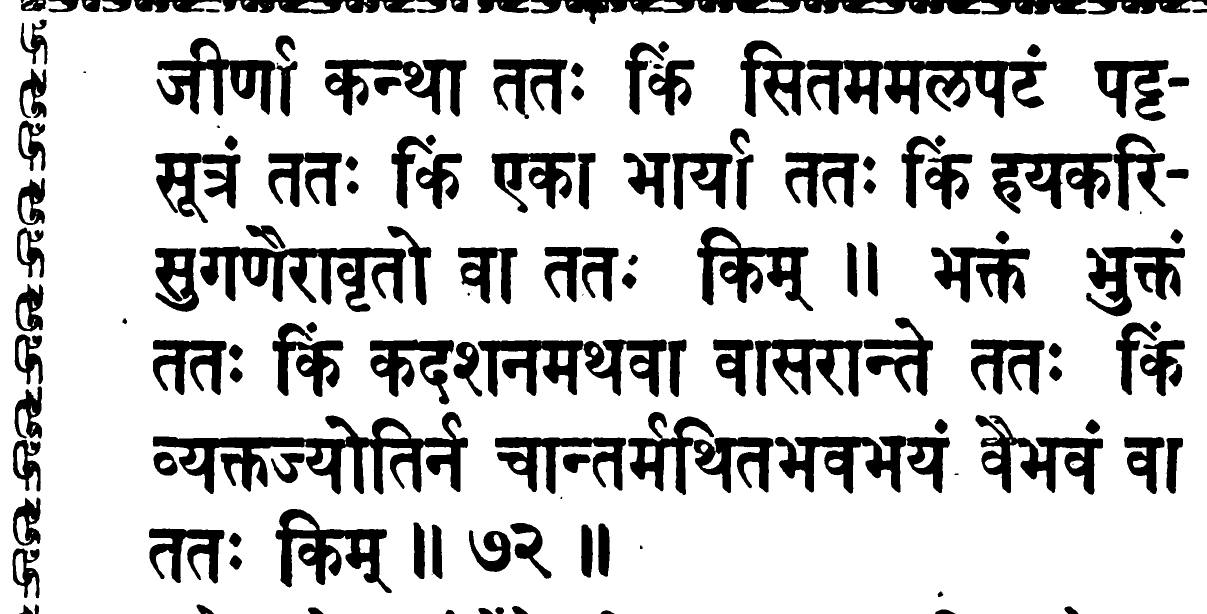
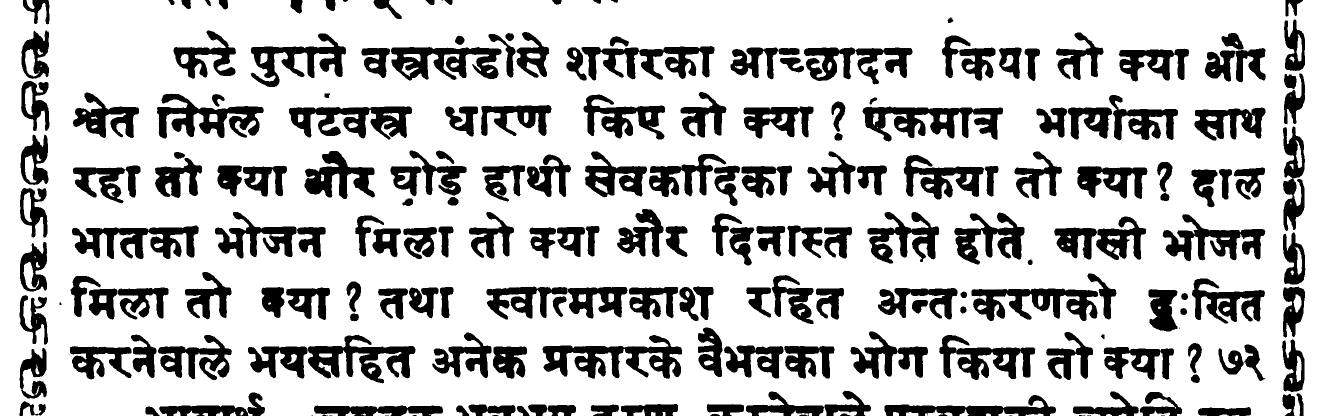
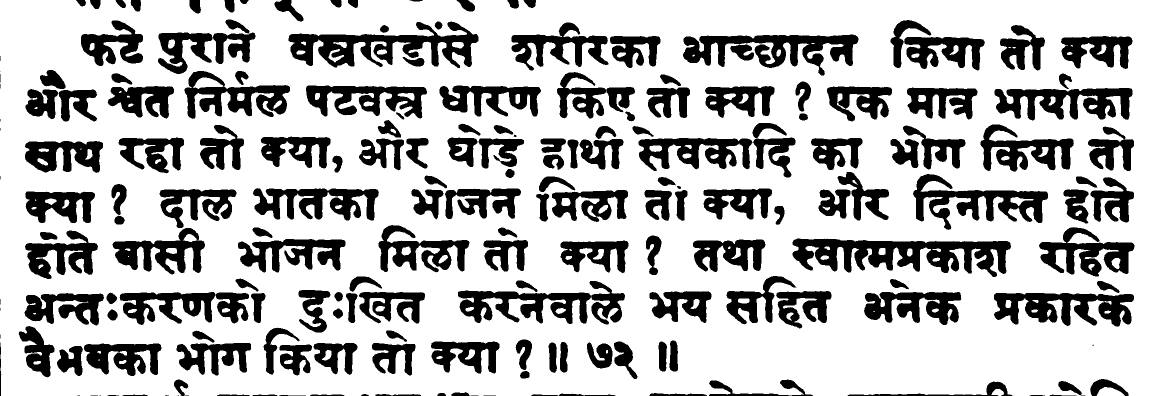
फटे पुराने वस्त्रखंडोंसे शरीरका आच्छादन किया तो क्या और श्वेत निर्मल पटवस्त्र धारण किए तो क्या ? एकमात्र भार्याका साथ रहा तो क्या और घोड़े हाथी सेवकादिका भोग किया तो क्या ? दाल भातका भोजन मिला तो क्या और दिनास्त होते होते. बाली भोजन मिला तो क्या ? तथा स्वात्मप्रकाश रहित अन्तःकरणको दुःखित करनेवाले भयसहित अनेक प्रकारके वैभवका भोग किया तो क्या ? ७२
भावार्थ - जबतक भवभय हरण करनेवाले परब्रह्मकी ज्योति हदयमें प्रकाशमान् न हो तबतक मनुष्यजन्म वृथाही समझना चाहिये ॥

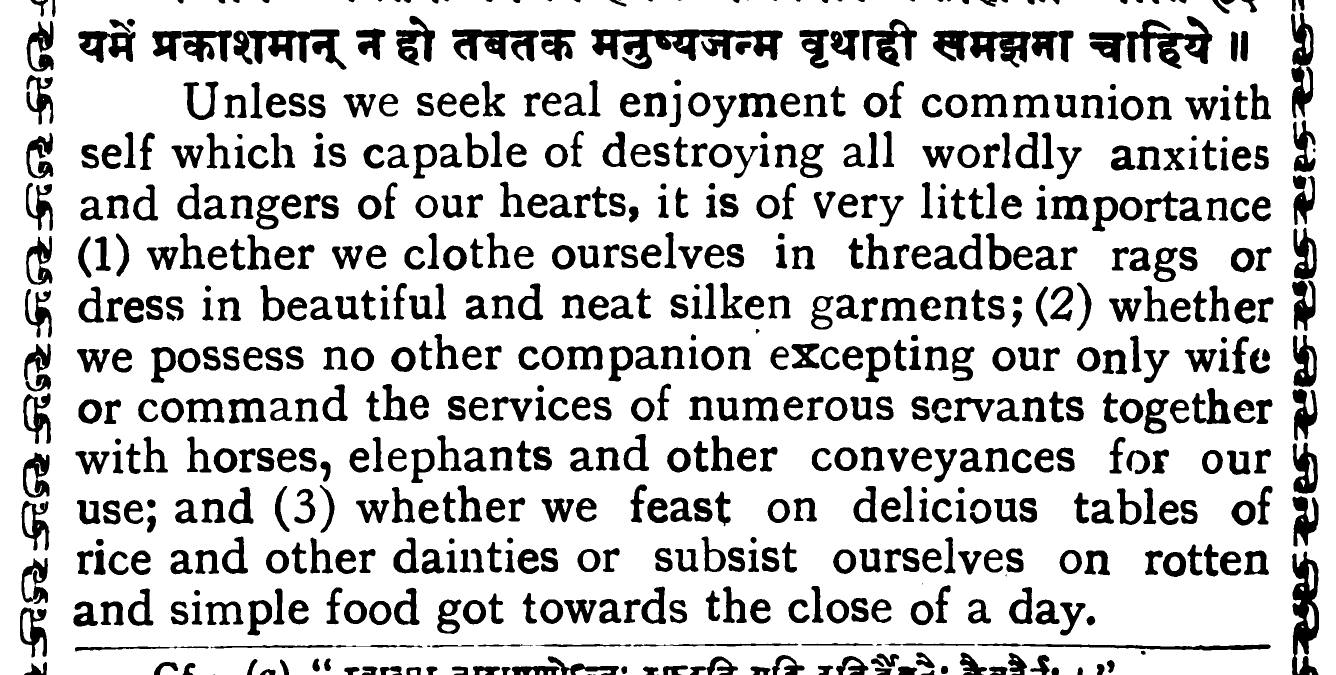
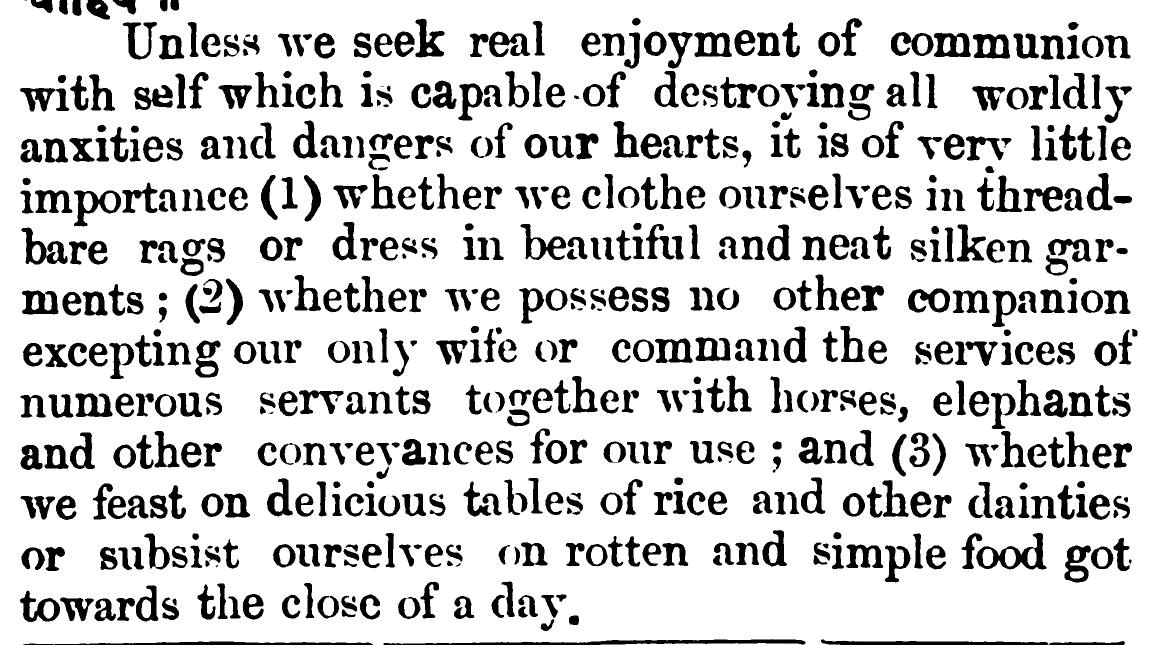
Unless we seek real enjoyment of communion with self which is capable of destroying all worldly anxities and dangers of our hearts, it is of very little importance (1) whether we clothe ourselves in threadbear rags or dress in beautiful and neat silken garments; (2) whether we possess no other companion excepting our only wife or command the services of numerous servants together with horses, elephants and other conveyances for our use; and (3) whether we feast on delicious tables of rice and other dainties or subsist ourselves on rotten and simple food got towards the close of a day.
Footnote
Cf. ( a ) " स्वारमा नारायणोऽन्तः स्फुरति यदि रति दैवतेः कैवतैर्नः । " ( भर्तृहरिनिर्वेदम् ).

Footnote
( 6 ) " विश्वाः कलाः परिचिता यदि वास्ततः किं सप्तं तपो यदि तदुग्रतरं ततः किम् । कीर्तिः कलंकविकला यदि सा ततः किमन्तर्विवेककलिका यदि नोब्ललास ॥ ८९ ॥ " (पद्मानन्दकविकृत वैराग्यशतकम् ).


Gopinath1896
all
जीर्णा कन्था ततः किं सितममलपट पट्ट-
सूत्रं सुगणै ततः किं, एका भार्या ततः किं हयकरि-
रावृतो वा ततः किम् । भक्तं भुक्तं
ततः किं कदशनमथवा वासरान्ते ततः किं,
व्यक्तज्योतिर्न चान्तर्मथितभवभयं वैभवं वा
ततः किम् ॥ ७२ ॥
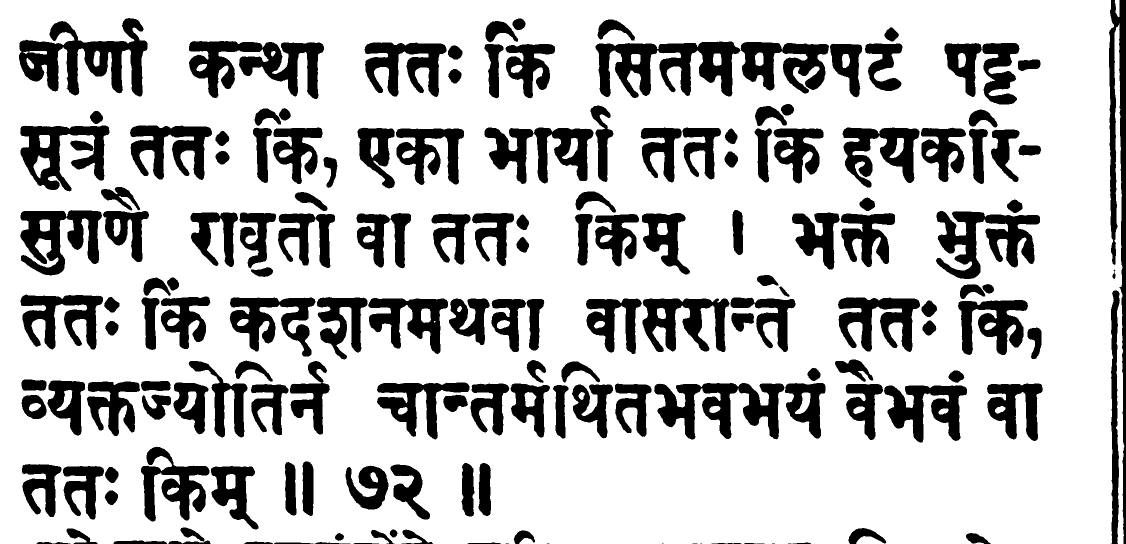
फटे पुराने वस्रखंडोंसे शरीरका आच्छादन किया तो क्या और श्वेत निर्मल पटवस्त्र धारण किए तो क्या ? एक मात्र भार्याका साथ रहा तो क्या, और घोड़े हाथी सेवकादि का भोग किया तो क्या ? दाल भातका भोजन मिला तो क्या, और दिनास्त होते होते बासी भोजन मिला तो क्या ? तथा स्वात्मप्रकाश रहित अन्तःकरणको दुःखित करनेवाले भय सहित अनेक प्रकारके वैभवका भोग किया तो क्या ? ॥ ७२ ॥
भावार्थ - जबतक भव भय हरण करनेवाले परब्रह्मकी ज्योति हृदयमें प्रकाशमान् न हो तबतक मनुष्यजन्म वृथाही समझना चाहिये ॥

Unless we seek real enjoyment of communion with self which is capable of destroying all worldly anxities and dangers of our hearts, it is of very little importance (1) whether we clothe ourselves in threadbare rags or dress in beautiful and neat silken garments ; (2) whether we possess no other companion excepting our only wife or command the services of numerous servants together with horses, elephants and other conveyances for our use ; and ( 3 ) whether we feast on delicious tables of rice and other dainties or subsist ourselves on rotten and simple food got towards the close of a day.
Footnote
C£.—(@) “ स्वात्मा नारायणोऽन्तः स्फुरति यदि रतिर्दैवतैः कैवतैर्नः । ” ( भर्तृहरि निर्वेदम् ).

Footnote
( 6 ) " विश्वाः कलाः परिचिता यदि तास्ततः किम्, तप्तं तपो यदि तदुग्रतरं ततः किम् । कीर्तिः कलंकविकला यदिसा ततः किम्, अन्तर्विवेक कलिका यदि नोललास ॥८९॥” (पद्मानन्दकविकृतवैराग्यशतकम्).



Kosambi
all
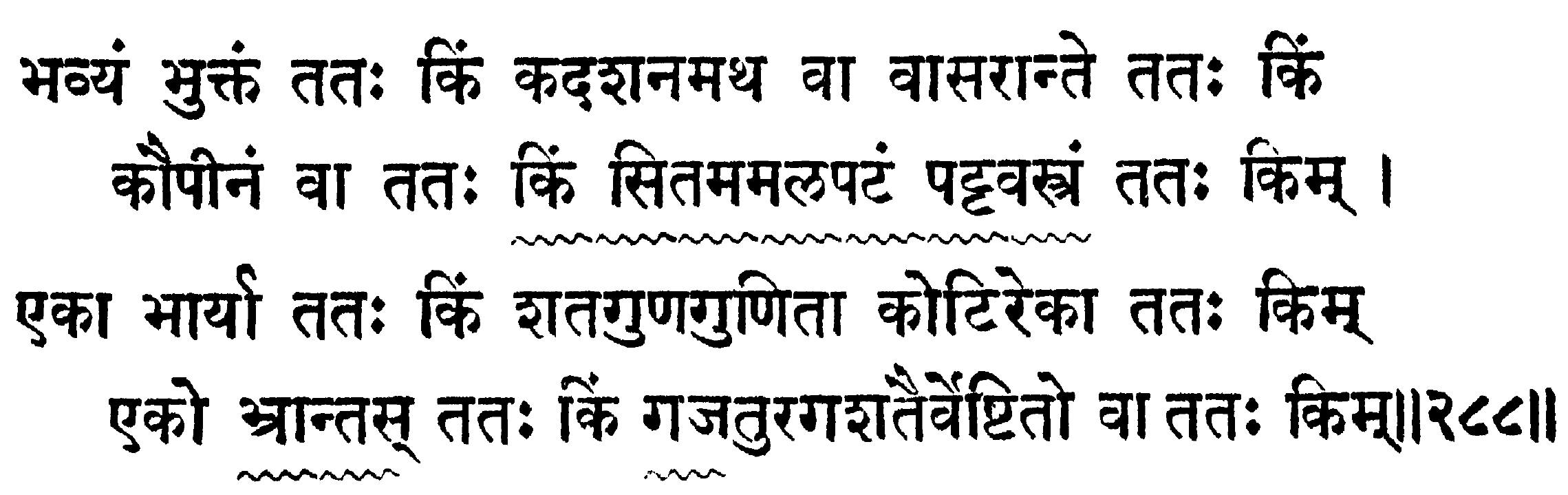
भव्यं भुक्तं ततः किं कदशनमथ वा वासरान्ते ततः किं
कौपीनं वा ततः किं सितममलपटं पट्टवस्त्रं ततः किम् ।
एका भार्या ततः किं शतगुणगुणिता कोटिरेका ततः किम्
एको भ्रान्तस् ततः किं गजतुरगशतैर्वेष्टितो वा ततः किम् ॥ २८८ ॥
Footnote
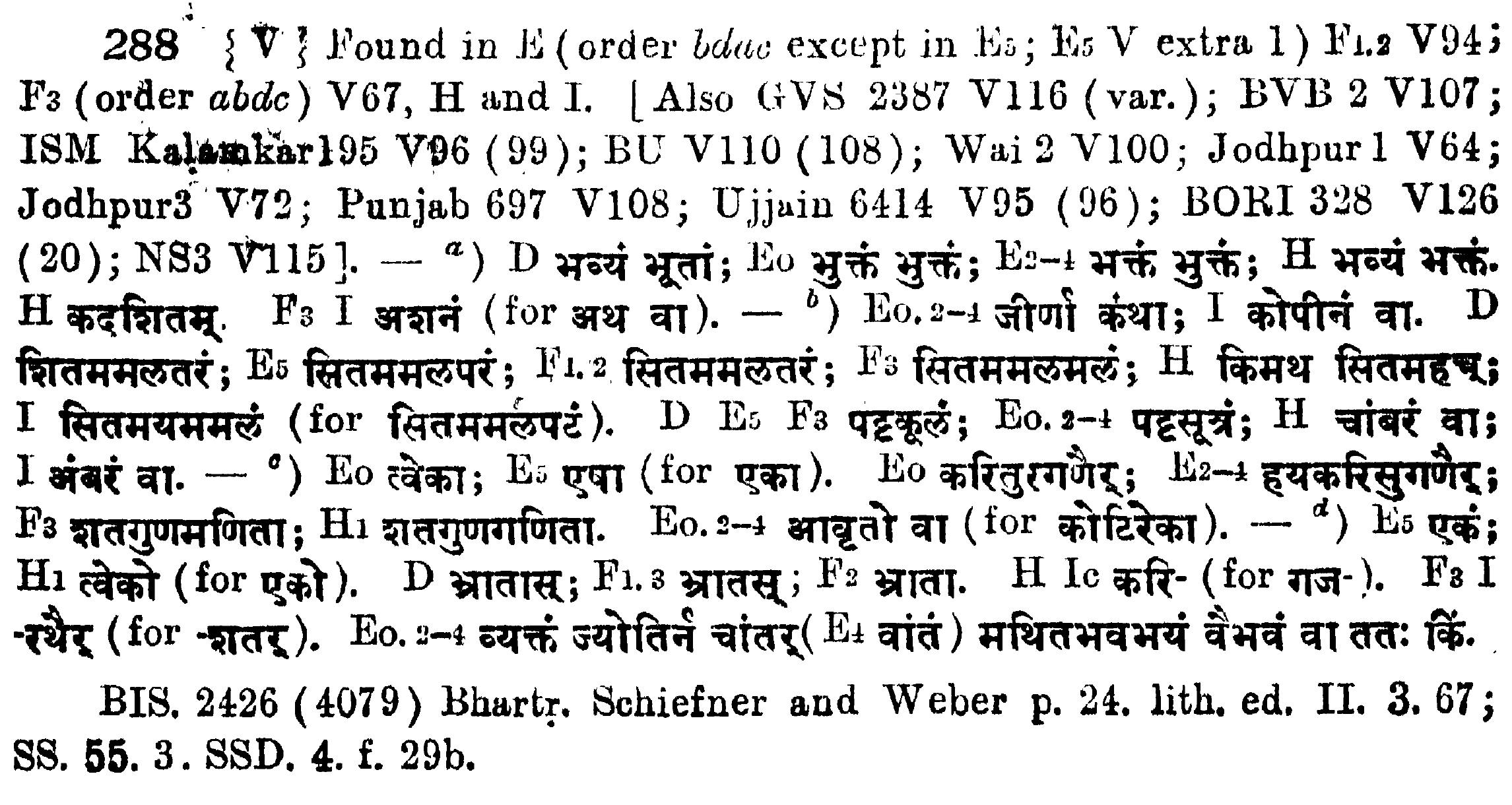
288 { V } Found in JE ( order bdac except in bis ; s V extra 1 ) F1.2 V94 ;
F3 ( order abdc ) V67 , H and I. [ Also GVS 2387 V116 ( var . ) ; BVB 2 V107 ;
ISM Kalamkar195796 ( 99 ) ; BU V110 ( 108 ) ; Wai ? V100 ; Jodhpur 1 V64 ;
Jodhpur 3 V72 ; Punjab 697 V108 ; Ujjain 6414 V95 ( 96 ) ; BORI 328 V126
( 20 ) ; NS3 V115 ] . 4 ) D भव्यं भूतां ; Do भुक्तं भुक्तं ; B : - भक्तं भुक्तं ; H भव्यं भक्तं .
H कदशितम् F3 I अशनं ( for अथ वा ) . Qanday 8 ) Bo . 2 - 1 जीर्णा कंथा ; I कोपीनं वा . D
शितममलतरं ; E6 सितममलपरं ; 11.2 सितममलतरं ; Is सितममलमलं ; H किमथ सितमहष् ;
I सितमयममलं ( for सितममलपटं ) . D E F3 पट्टकूलं ; Eo . 2 - + पट्टसूत्रं ; H चांबरं वा ;
I अंबरं वा . - 4 ) Eo स्वेका ; E एषा ( for एका ) . Bo करितुरगणैर् ; E24 हयकरिसुगणैर ;
F3 शतगुणमणिता ; H1 शतगुणगणिता . Eo . 2 - 1 आवृतो वा ( for कोटिरेका ) . - ) 15 एकं ;
H1 त्वेको ( for एको ) . D भ्रातास ; F1 . 3 भ्रातस् ' F2 भ्राता . H Ic करि- ( for गज- ) . F3 I
-रथैर् ( for शतर ) . Eo . 24 व्यक्तं ज्योतिर्न चांतर् ( E + वांतं ) मथितभवभयं वैभवं वा ततः किं .
BIS . 2426 ( 4079 ) Bhartṛ . Schiefner and Weber p . 24. lith . ed . II . 3. 67 ;
SS . 55. 3. SSD . 4. f . 29b .
Commentary