Tawney
Cowards shrink from toil and peril,
Vulgar souls attempt and fail;
Men of mettle, nothing daunted,
Persevere till they prevail.
Telang
all
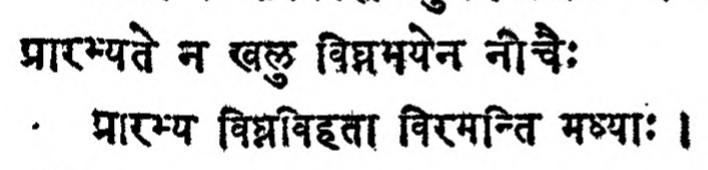
प्रारभ्यते न खलु विघ्नभयेन नीचैः
प्रारभ्य विघ्नविहता विरमन्ति मध्याः ।
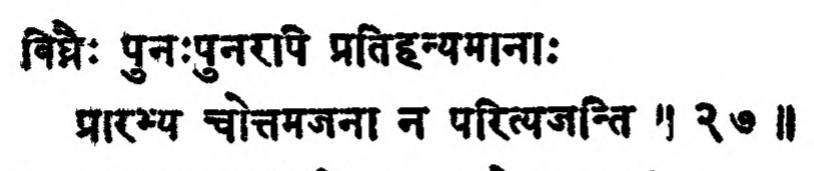
विघ्नैः पुनःपुनरपि प्रतिहन्यमानाः
प्रारभ्य चोत्तमजना न परित्यजन्ति ॥ २७ ॥
Notes
St. XXVII.—See Mudrârâkshasa Act III., p. 79. But see too Das'arûpâvaloka (Hall's Ed.) p. 62.—Vasantatilakâ.



Kale
all
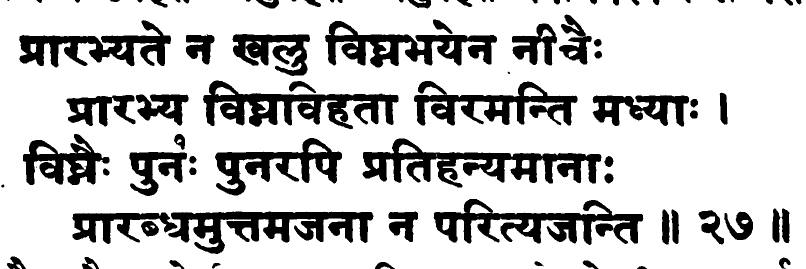
प्रारभ्यते न खलु विघ्नभयेन नीचैः
प्रारभ्य विघ्नविहता विरमन्ति मध्याः ।
विघ्नैः पुनः पुनरपि प्रतिहन्यमानाः
प्रारब्धमुत्तमजना न परित्यजन्ति ॥ २७ ॥
Translation
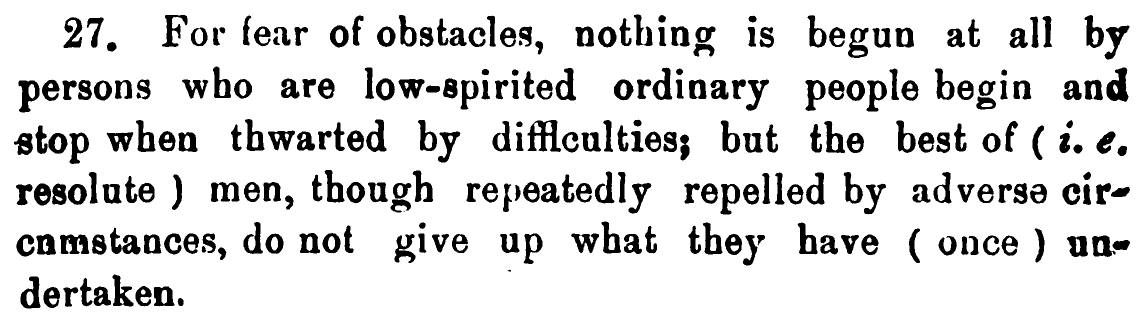
27. For fear of obstacles, nothing is begun at all by persons who are low-spirited ordinary people begin and stop when thwarted by difficulties; but the best of ( i. e. resolute ) men, though repeatedly repelled by adverse circumstances, do not give up what they have ( once ) undertaken.
Notes
Sl. 27. नीचैः—by low or poor-spirited men, men incapable of sustained exertion. निकृष्टाम् ईं शोभां चिनोतीति; नि + ई + चि + डः । मध्याः—men of the 2nd class. Cf. Mudràrákshasa Act. II. 70.

Gopinath1914
all
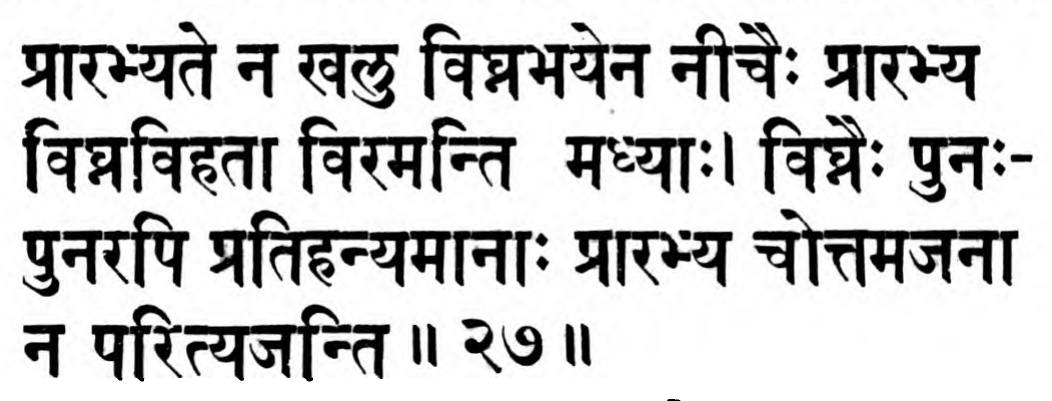
प्रारभ्यते न खलु विघ्नभयेन नीचैः प्रारभ्य
विघ्नविहता विरमन्ति मध्याः । विघ्नैः पुनः-
पुनरपि प्रतिहन्यमानाः प्रारभ्य चोत्तमजना
न परित्यजन्ति ॥ २७॥
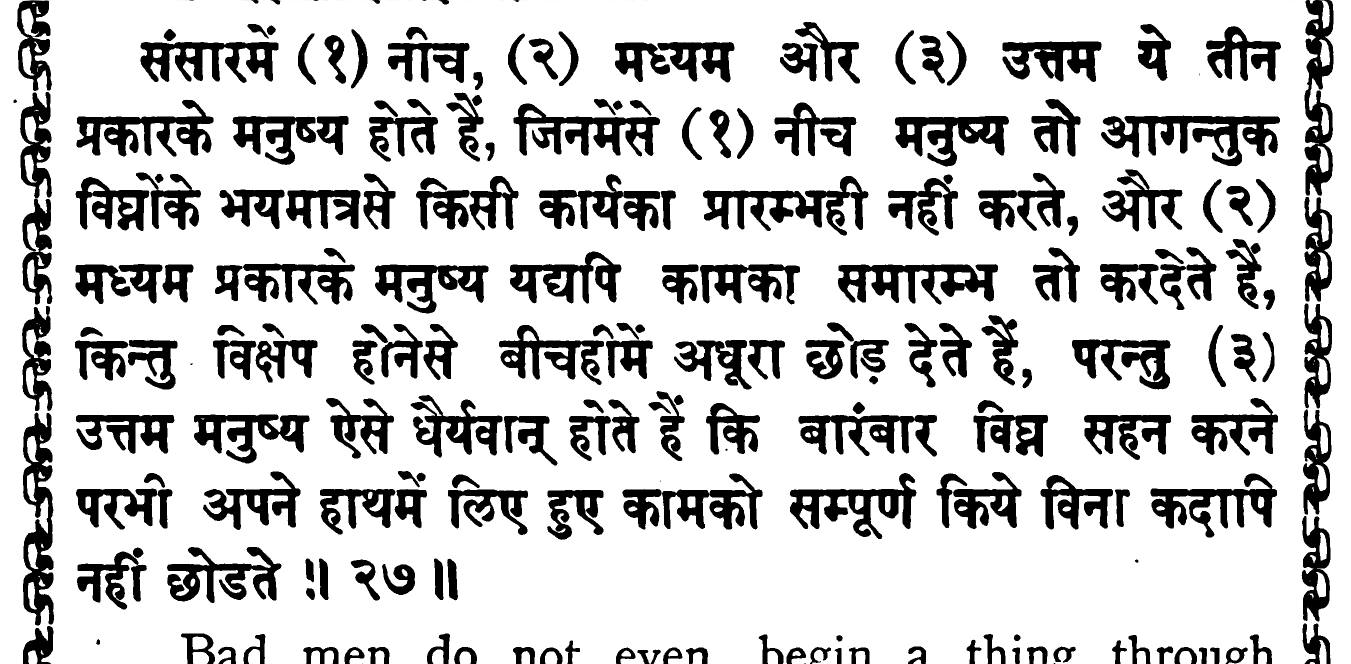
संसारमें (१) नीच, (२) मध्यम और (३) उत्तम ये तीन प्रकारके मनुष्य होते हैं, जिनमेंसे (१) नीच मनुष्य तो आगन्तुक विघ्नोंके भयमात्र से किसी कार्यका प्रारम्भही नहीं करते, और (२) मध्यम प्रकारके मनुष्य यद्यपि कामका समारम्भ तो करदेते हैं, किन्तु विक्षेप होनेसे बीचहीमें अधूरा छोड़ देते हैं, परन्तु (३) उत्तम मनुष्य ऐसे धैर्यवान् होते हैं कि बारंबार विघ्न सहन करने परभी अपने हाथ में लिए हुए कामको सम्पूर्ण किये विना कदापि नहीं छोडते ॥ २७ ॥
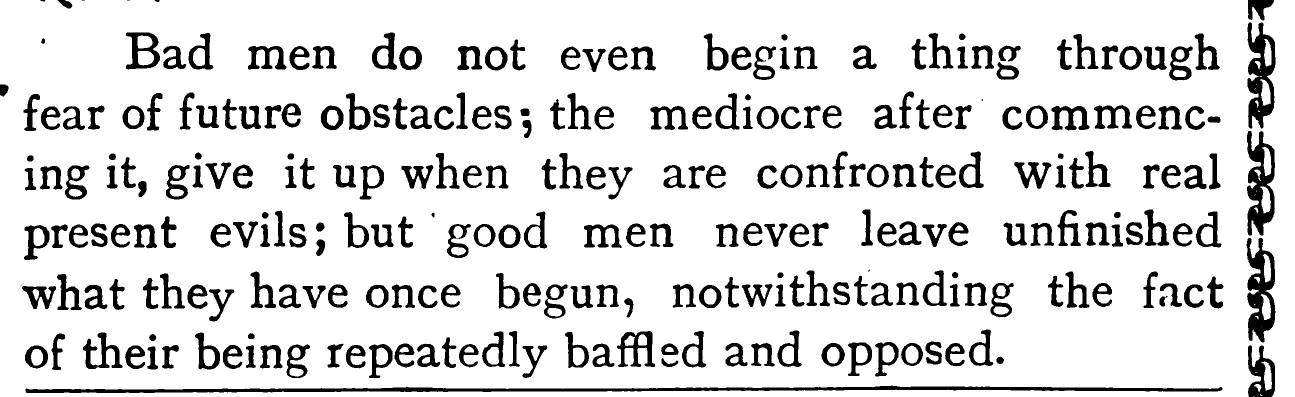
Bad men do not even begin a thing through fear of future obstacles; the mediocre after commencing it, give it up when they are confronted with real present evils; but good men never leave unfinished what they have once begun, notwithstanding the fact of their being repeatedly baffled and opposed.
Footnote
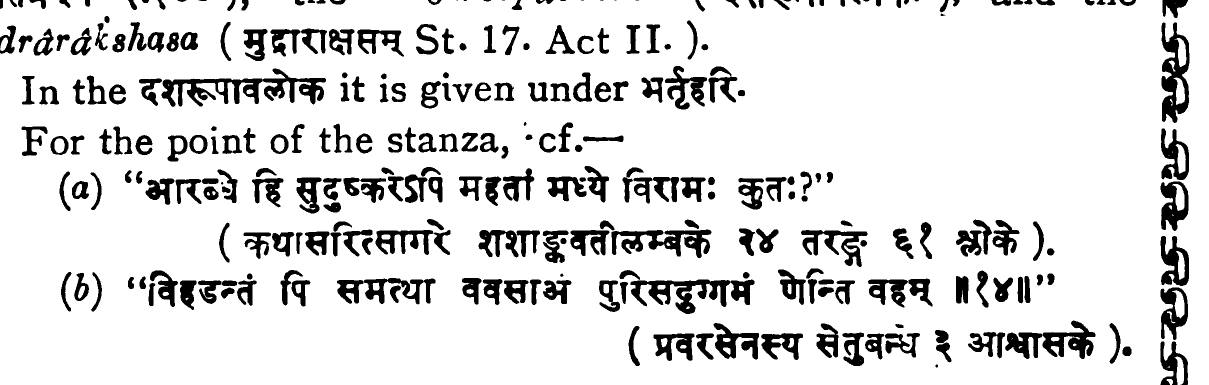
Quoted anonymously in Subhashitavali ( सुभाषितावलि ) ( No. 544. B. S. S. No. XXX1.). The stanza is also found in the Panchatantra ( पंचतंत्रम् | ३|१७७ ), the Daśaroopavaloka ( दशरूपावलोकः ), and the Mudrarakshasa ( मुद्राराक्षसम् St. 17. Act II. ).


Gopinath1896
all
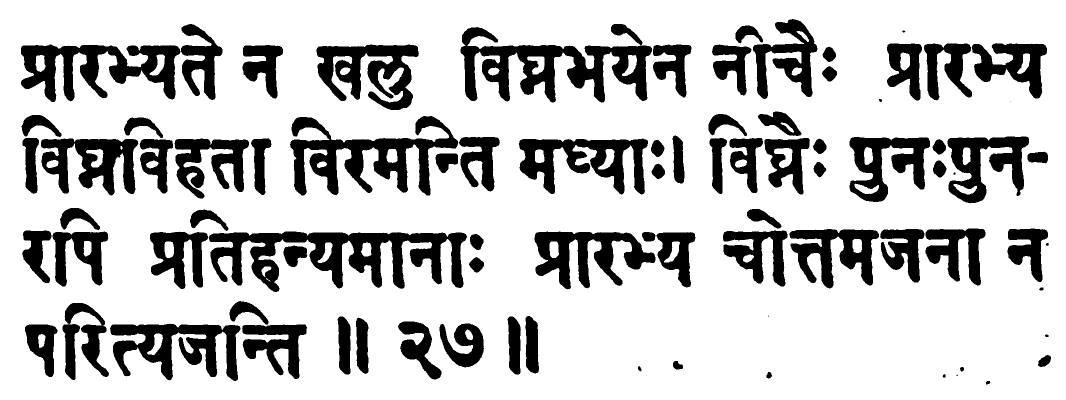
प्रारभ्यते न खलु विघ्नभयेन नीचैः प्रारभ्य
विघ्नविहता विरमन्ति मध्याः । विघ्नैः पुनःपुन-
रपि प्रतिहन्यमानाः प्रारभ्य चोत्तमजना न
परित्यजन्ति ॥ २७ ॥
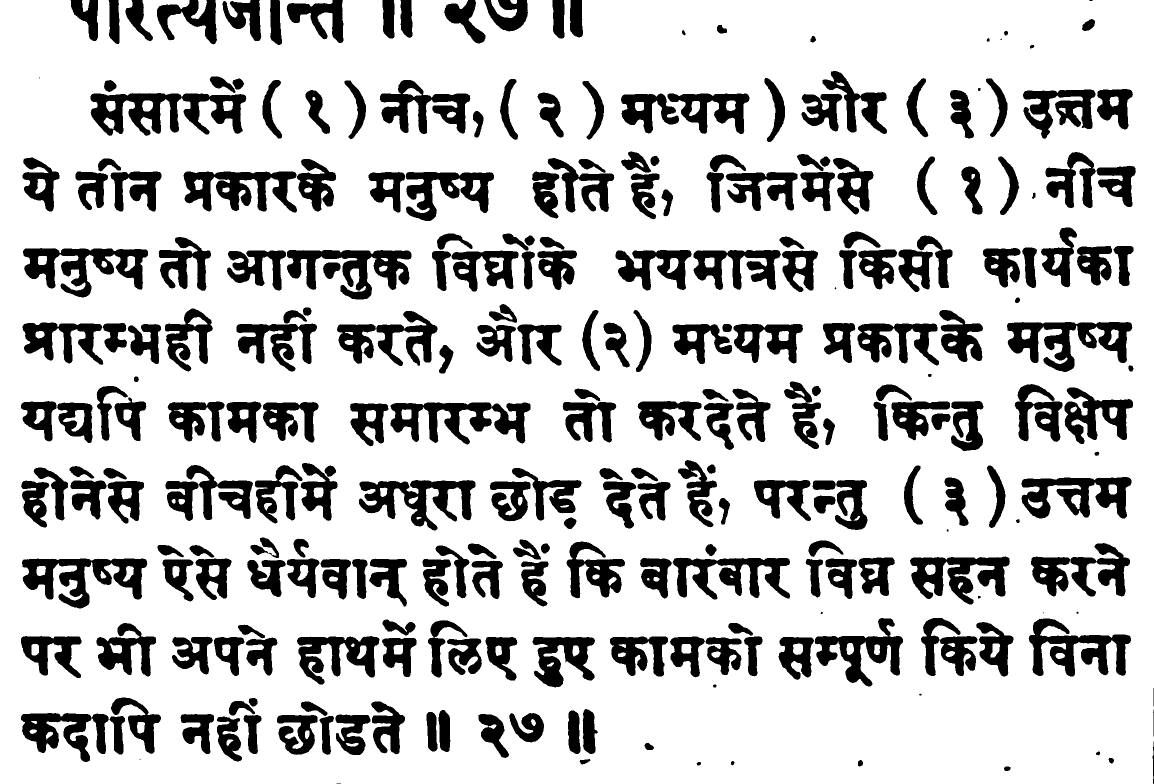
संसारमें ( १ ) नीच, (२) मध्यम ) और (३) उत्तम ये तीन प्रकारके मनुष्य होते हैं, जिनमेंसे ( १ ) नीच मनुष्य तो आगन्तुक विघ्नोंके भयमात्रसे किसी कार्यका प्रारम्भही नहीं करते, और (२) मध्यम प्रकारके मनुष्य यद्यपि कामका समारम्भ तो करदेते हैं, किन्तु विक्षेप होनेसे बीचही में अधूरा छोड़ देते हैं, परन्तु ( ३ ) उत्तम मनुष्य ऐसे धैर्यवान् होते हैं कि बारंबार विघ्न सहन करने पर भी अपने हाथ में लिए हुए कामको सम्पूर्ण किये विना कदापि नहीं छोडते ॥ २७ ॥
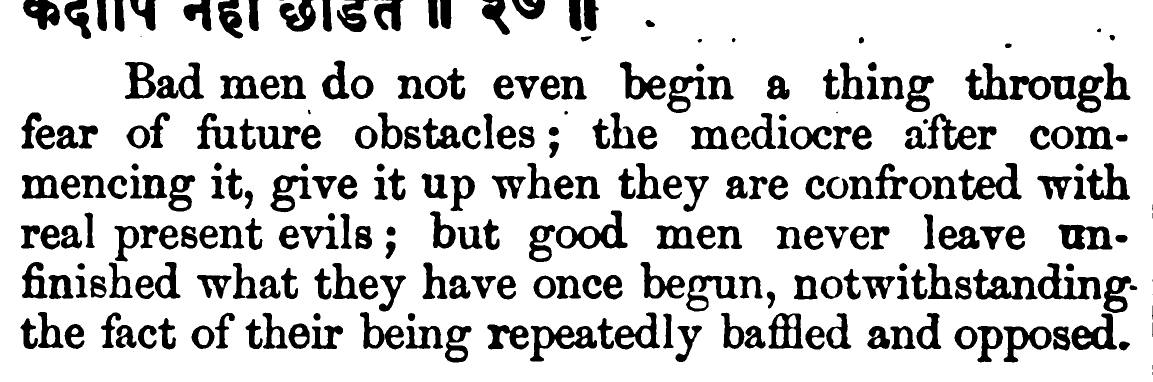
Bad men do not even begin a thing through fear of future obstacles; the mediocre after commencing it, give it up when they are confronted with real present evils; but good men never leave unfinished what they have once begun, notwithstandingthe fact of their being repeatedly baffled and opposed.
Footnote
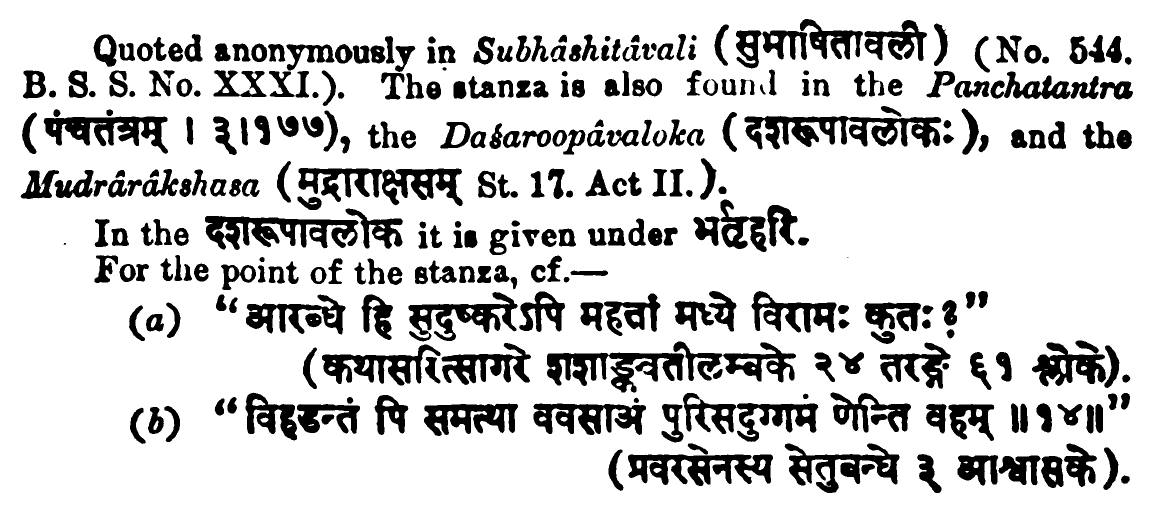
B. S. Quoted S. No. anonymously XXXI.). The in stanza Subhashitävali is also found ( सुभाषितावली in the Panchatantra ) (No. 544. (पंचतंत्रम् । ३।१७७), the Dasaroopávaloka (दशरूपावलोकः), and the Mudrarakshasa (मुद्राराक्षसम् St. 17. Act II. ). In the दशरूपावलोक it is given under भर्तृहरि. For the point of the stanza, cf.(a ) " आरब्धे हि सुदुष्करेऽपि महतां मध्ये विरामः कुतः ? " (कथासरित्सागरे शशाङ्कवतीलम्बके २४ तरङ्गे ६१ लोके). (ठ) “ विहडन्तं पि समत्था ववसाअं पुरिसदुग्गमं णेन्ति वहम् ॥ १४ ॥ " ( प्रवरसेनस्य सेतुबन्धे ३ आश्वासके).
Kosambi
all
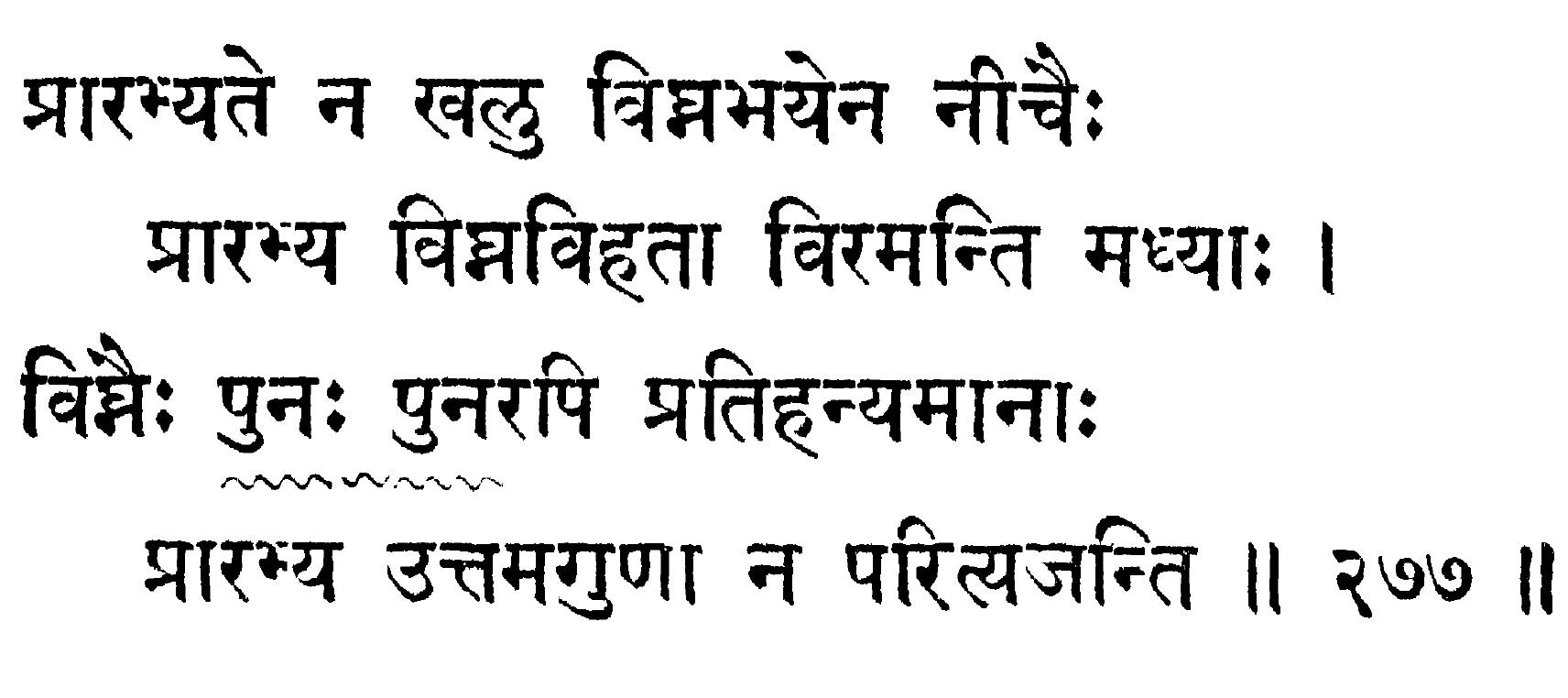
प्रारम्यते न खलु विघ्नभयेन नीचैः
प्रारभ्य विघ्नविहता विरमन्ति मध्याः ।
विः पुनः पुनरपि प्रतिहन्यमानाः
प्रारभ्य उत्तमगुणा न परित्यजन्ति ॥ २७७ ॥
Footnote
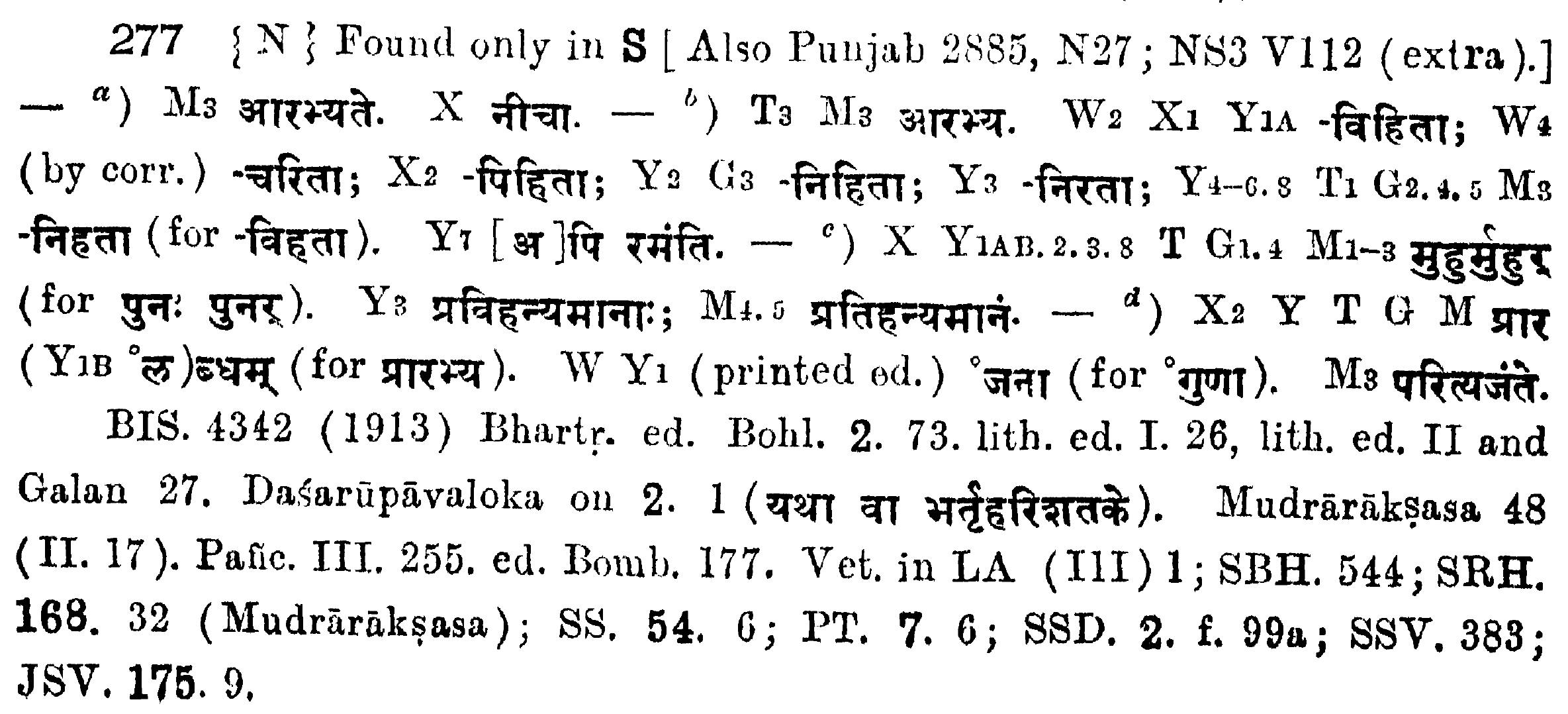
277 { N } Found only in S [ Also Punjab 2885 , N27 ; NS3 V112 ( extra ) . ]
a ) M3 आरभ्यते . x नीचा . 6 ) T3 M3 आरभ्य . W2 X1 Y14 -विहिता ; W4
( by corr . ) चरिता ; X 2 - पिहिता ; Y2 G 3 -निहिता ; Y3 -निरता ; Y 4-6.8 T1 G2 45 M3
-निहता ( for -विहता ) . Y1 [ अ ] पि रमंति . ° ) X Y1AB.2.3.8 TG1 . 4 + M1-3 3 मुहुर्मुहुर
( for पुनः पुनर् ) . Ya प्रविहन्यमानाः ; Ms.० प्रतिहन्यमानं . 4 ) X 2 Y_TGM प्रार
( Y1B ' ल ) ब्धम् ( for प्रारभ्य ) . WY1 ( printed ed . ) जना ( for गुणा ) . M3 परित्यज॑ते .
BIS . 4342 ( 1913 ) Bhartr . ed . Bohl . 2. 73 lith ed . I. 26 , lith ed . II and
Galan 27. Dasarūpāvaloka on 2. 1 ( यथा वा भर्तृहरिशतके ) . Mudrāraksasa 48
( II . 17 ) . Pafic . III . 255. ed . Bomb . 177. Vet in LA ( III ) 1 ; SBH 544 ; SRH .
168 32 ( Mudrārāksasa ) ; SS . 54. 6 ; PT . 7. 6 ; SSD . 2. f . 99 & ; SSV . 383 ;
JSV . 175.9 .
Commentary