Brough
Good noble men, after a fall
Bounce like a ball.
Th' ignoble fall another way:
Like lumps of clay.
Tawney
The good man, like a bounding ball,
Springs ever upward from his fall;
The wicked falls like lump of clay,
And crumbles into dust away.
Telang
all
Notes
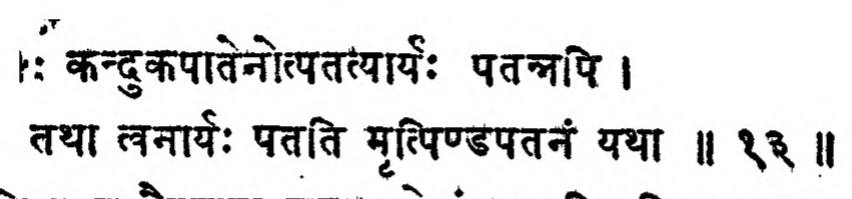
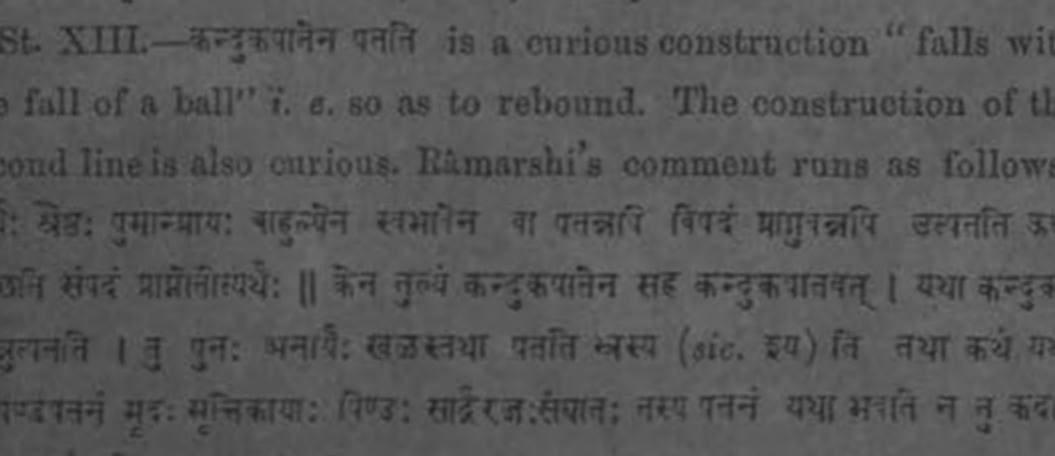
St. XIII.—कन्दुकपातेन पतति is a curious construction “falls with the fall of a ball” i. e. so as to rebound. The construction of the second line is also curious. Râmarshi’s comment runs as follows: आर्यः श्रेष्ठः पुमान्प्रायः बाहुल्येन स्वभावेन वा पतन्नपि विपदं प्राप्नुवन्नपि उत्पतति ऊर्ध्वं गच्छति संपदं प्राप्नोतीत्यर्थः ॥ केन तुल्यं कन्दुकपातेन सह कन्दुकपातवत् । यथा कन्दुकः पतन्नुत्पतति । तु पुनः अनार्यः खलस्तथा पतति भ्रस्य (sic. श्य) ति तथा कथं यथा मृत्पिण्डपतनं मृदः मृत्तिकायाः पिण्डः सार्द्ररजःसंघातः तस्य पतनं यथा भवति न तु कदाचिदुत्पतनं भवेत्.—Anushṭub.

Kale
all

Translation
18. Though falling, a noble man generally falls like a ball (i. e. to rise again); but a mean fellow falls like a lump of clay ( never to rise again ).

Notes
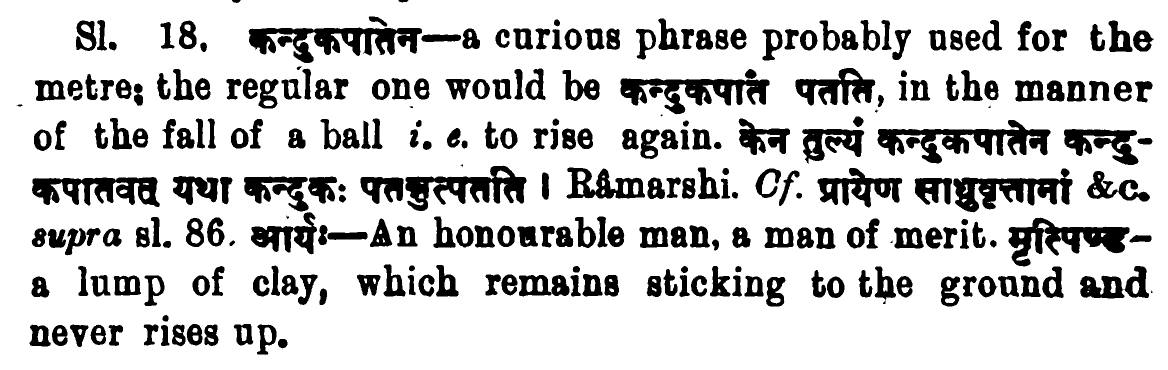
Sl. 18. कन्दुकपातेन—a curious phrase probably used for the metre; the regular one would be कन्दुकपातं पतति, in the manner of the fall of a ball i. e. to rise again. केन तुल्यं कन्दुकपातेन कन्दुकपातवत् यथा कन्दुकः पतन्नुत्पतति । Râmarshi. Cf. प्रायेण साधुवृत्तानां &c. supra sl. 86. आर्यः—An honourable man, a man of merit. मृत्पिण्ड- a lump of clay, which remains sticking to the ground and never rises up.
Kosambi
all
Footnote
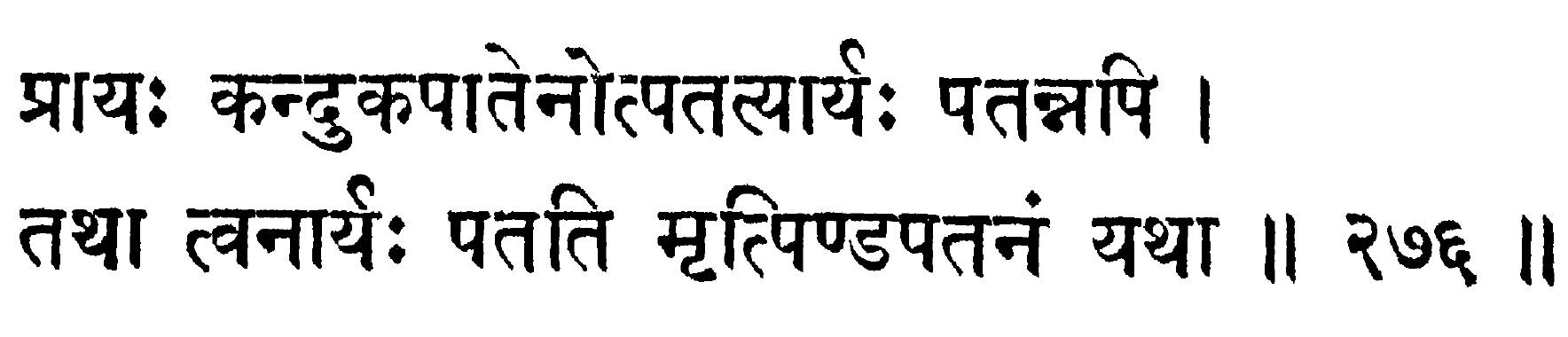
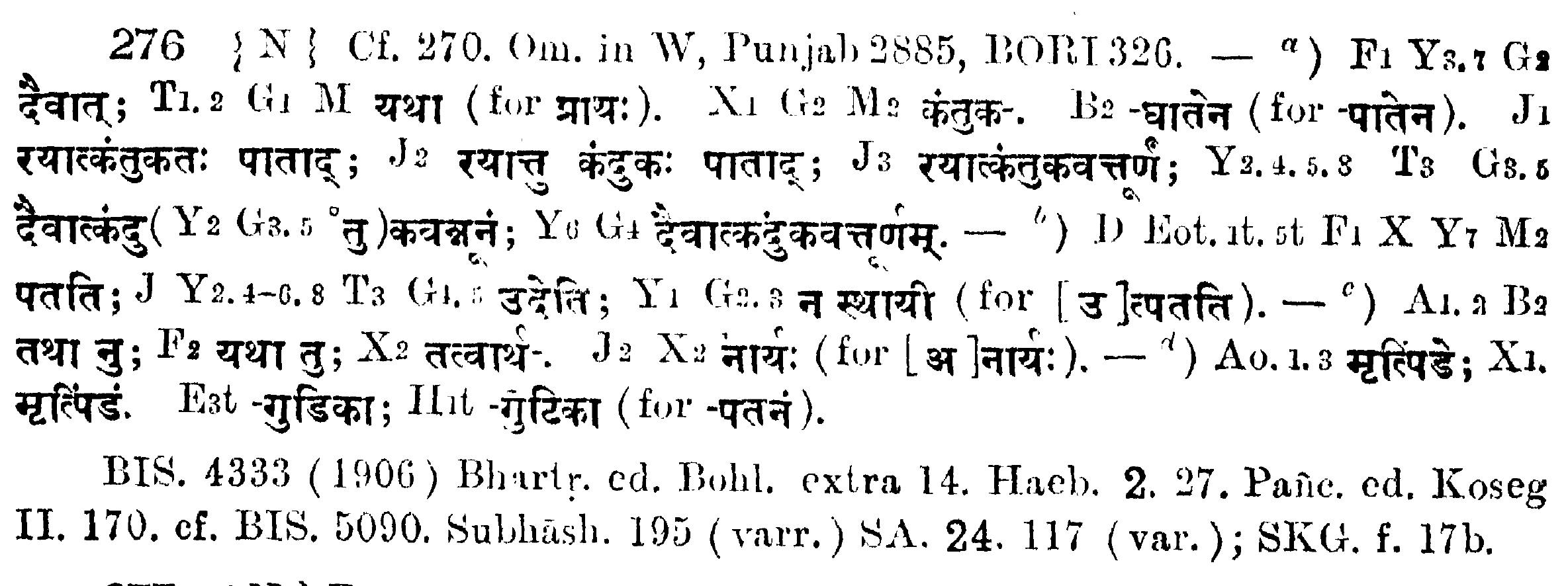
276 { N } Cf 270. Om . in W , Punjab 2885 , BOR1326 . a ) F1 Y 3.7 Ga
देवात् ; T1.2 G1 M यथा ( for प्रायः ) . Xi Ge Me कंतुक . B2 घातेन ( for पातेन ) . J 1
रयात्कंतुकतः पाताद् ; J रयात्तु कंदुकः पाता ; J3 रयाकंतुकवत्तर्णं ; X2.58 T3 Gs.6 5
दैवात्कंदु ( Y2 G3.5 ' तु ) कवन्ननं ; YoG दैवात्कदुकवत्तर्णम् . – ( ) 1 ) Bot it . st F1 X Y7 Ma
पतति ; J_Y2 . 4–6 , 4 T3 G16 उद्वेति ; X1 Ges न स्थायी ( for [ उ ] त्पतति ) . – " ) A1 2 Ba
तथा नु ; F2 यथा तु ; X 2 तत्वार्थ . J2 X 2 नार्य : ( for [ अ ] नार्यः ) . – ( ) A0 . 3.3 मृत्पिडे ; ; X1 .
मृत्पिडं Est - गुडिका ; IIit गुंटिका ( for पतनं ) .
BIS . 4333 ( 1906 ) Bhartr ed . Bobl extra 14. Haeb . 2. 27. Pajñc . ed . Koseg
II . 170. cf. BIS . 5000 Subhash 195 ( varr . ) SA . 24. 117 ( var . ) ; SKG . f . 17b .
Commentary