Tawney
The hand's a lordly dish,
The mouth with alms is fed,
The sky's a glorious robe,
The earth's a sumptuous bed,
Those live in high content
Who're free from passion's chain,
And works with all their brood
Of ignorance and pain.
Mādhavānanda
पाणि: पात्रं पवित्रं भ्रमणपरिगतं भैक्षमक्षय्यमन्नं
विस्तीर्णं वस्त्रमाशादशकमचपलं तल्पमस्वल्पमुर्वी ।
येषां नि:सङ्गताङ्गीकरणपरिणतस्वान्तसंतोषिणस्ते
धन्या: संन्यस्तदैन्यव्यतिकरनिकरा: कर्म निर्मूलयन्ति ।।९९।।
99. With the hand serving as sacred cup, with begged food that comes through wandering and never runs short, with the ten quarters as their ample garment and the earth as a fixed, spacious bed—blessed are they who, having forsaken the manifold worldly associations which an attitude of want breeds, and self-contented with a heart fully matured through their acceptance of absolute seclusion, root out all karma (i.e., the chain of cause and effect which grows on as action and desire in life follow each other).
[दैन्यव्यतिकरनिकरा:—we prefer to take as: ‘the many forms of contact with the world which result from the poverty of an attitude of seeking worldly objects’.]
Telang
all
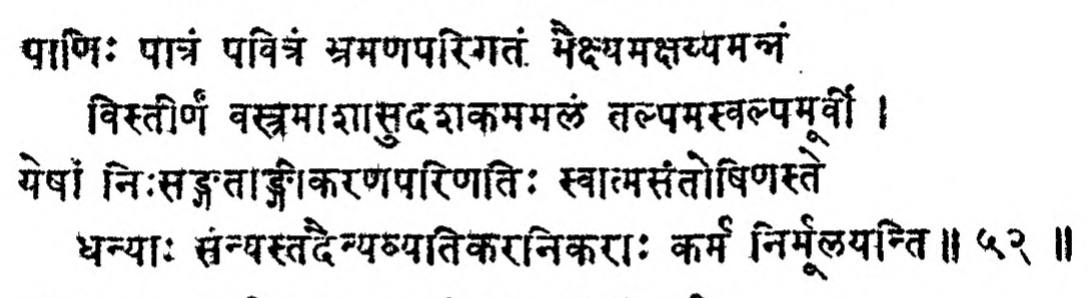
पाणिः पात्रं पवित्रं भ्रमणपरिगतं भैक्ष्यमक्षय्यमन्नं
विस्तीर्णं वस्त्रमाशासुदशकममलं तल्पमस्वल्पमुर्वी ।
येषां निःसङ्गताङ्गीकरणपरिणतिः स्वात्मसंतोषिणस्ते
धन्याः संन्यस्तदैन्यव्यतिकरनिकराः कर्म निर्मूलयन्ति ॥ ५२ ॥
Notes
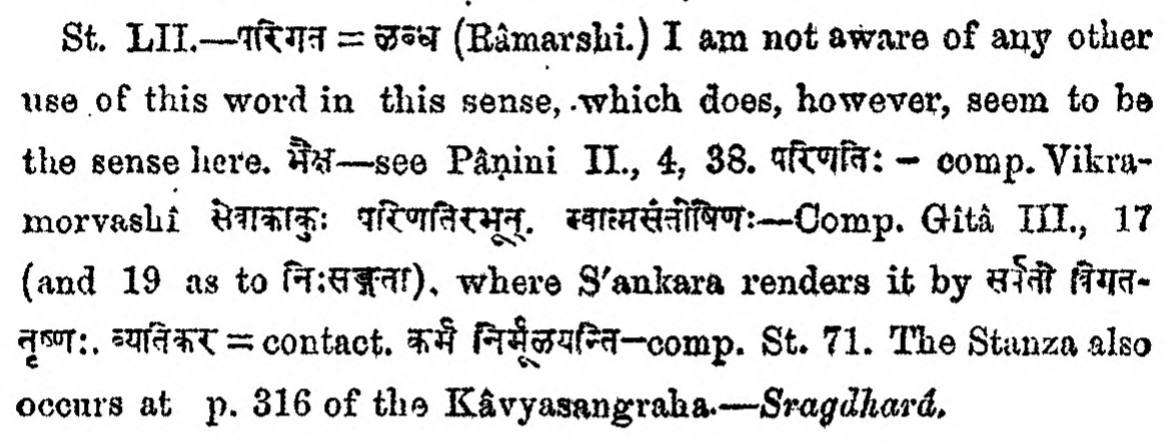
St. LII.—परिगत = लब्ध (Râmarshi.) I am not aware of any other use of this word in this sense, which does, however, seem to be the sense here. भैक्ष—see Pâṇini II., 4, 38. परिणतिः – comp. Vikramorvashî सेवाकाकुः परिणतिरभूत्. स्वात्मसंतोषिणः—Comp. Gîtâ III., 17 (and 19 as to निःसङ्गता), where S'ankara renders it by सर्वतो विगततृष्णः. व्यतिकर = contact. कर्म निर्मूलयन्ति—comp. St. 71. The Stanza also occurs at p. 316 of the Kâvyasangraha.—Sragdharâ.

Kale
all

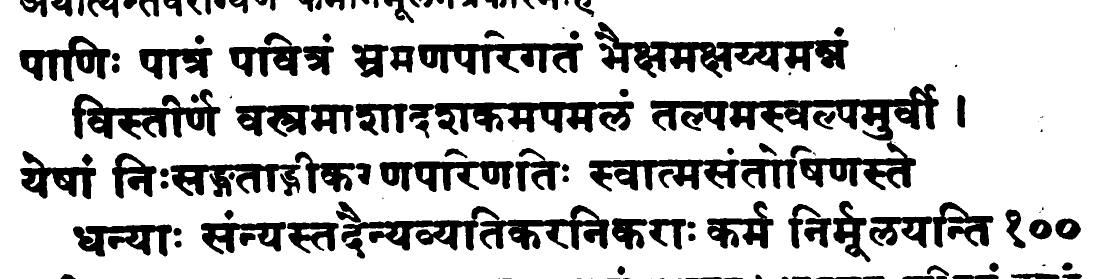
पाणिः पात्रं पवित्रं भ्रमणपरिगतं भैक्षमक्षय्यमन्नं
विस्तीर्णं वस्त्रमाशादशकमपमलं तल्पमस्वल्पमुर्वी ।
येषां निःसङ्गताङ्गीकरणपरिणतिः स्वात्मसंतोषिणस्ते
धन्याः संन्यस्तदैन्यव्यतिकरनिकराः कर्म निर्मूलयन्ति १००
Translation
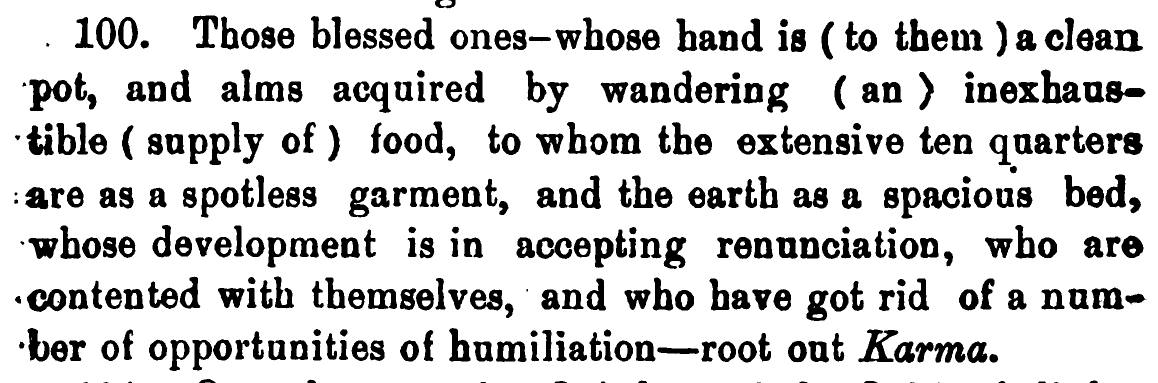
100. Those blessed ones–whose hand is ( to them ) a clean pot, and alms acquired by wandering ( an ) inexhaustible ( supply of ) food, to whom the extensive ten quarters are as a spotless garment, and the earth as a spacious bed, whose development is in accepting renunciation, who are contented with themselves, and who have got rid of a number of opportunities of humiliation—root out Karma.
Notes
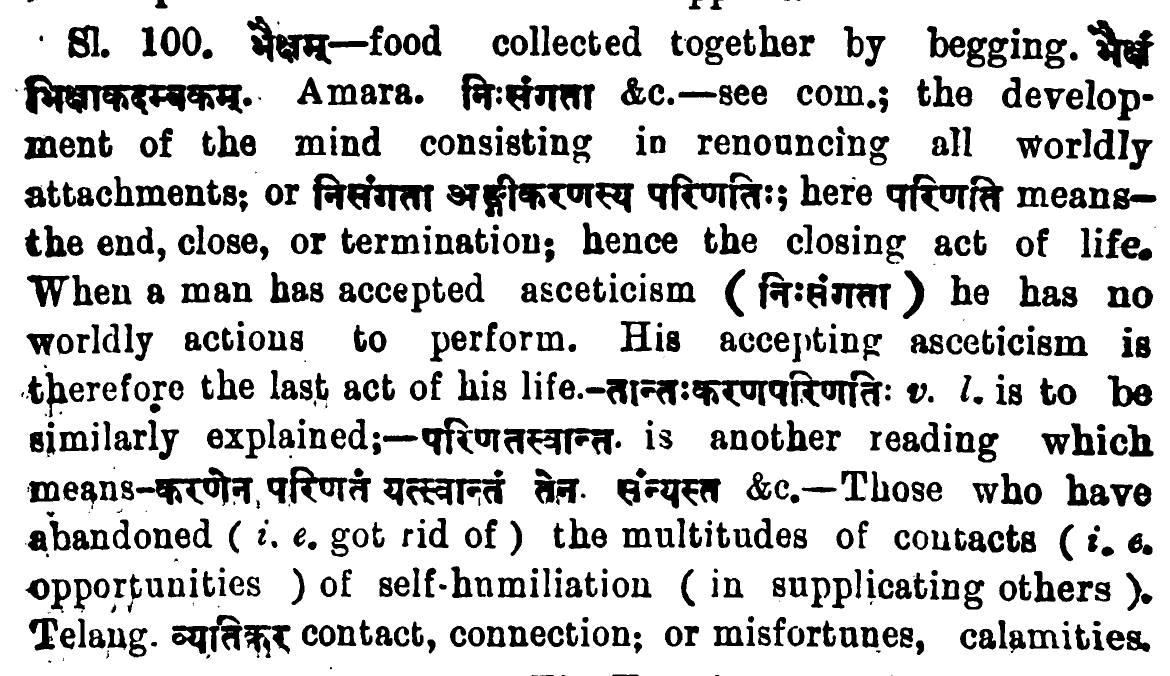
Sl. 100. भैक्षम्—food collected together by begging. भैक्षं भिक्षाकदम्बकम्. Amara. निःसंगता &c.—see com.; the development of the mind consisting in renouncing all worldly attachments; or निसंगता अङ्गीकरणस्य परिणतिः; here परिणति means— the end, close, or termination; hence the closing act of life. When a man has accepted asceticism ( निःसंगता ) he has no worldly actions to perform. His accepting asceticism is therefore the last act of his life.—तान्तःकरणपरिणतिः v. l. is to be similarly explained;—परिणतस्वान्त. is another reading which means—करणेन परिणतं यत्स्वान्तं तेन. संन्यस्त &c.—Those who have abandoned ( i. e. got rid of ) the multitudes of contacts ( i. e. opportunities ) of self-humiliation ( in supplicating others ). Telang. व्यतिकर contact, connection; or misfortunes, calamities.
Gopinath1914
all
पाणिः पात्रं पवित्रं भ्रमणपरिगतं भैक्ष्यम-
क्षय्यमन्नं विस्तीर्णं वस्त्रमाशादशकमपमलं
तल्पमस्वल्पमुर्वी ॥ येषां निःसङ्गताङ्गीकरण-
परिणतिः स्वात्मसंतोषिणस्ते धन्याः संन्य-
स्तदैन्यव्यतिकरनिकराः कर्म निर्मूलयन्ति ॥५१॥
जिन महात्माओंके समक्ष अपने हाथही पवित्र पात्र, द्वार द्वार भटककर मांगी हुई भिक्षाही अटूट अन्न, दशों दिशाही विस्तृत वस्त्र और यह अखिल पृथ्वीही निर्मल शय्याका काम देते हैं, तथा वैराग्यको स्वीकार करनाही जिनका मुख्य मनोरथ है, निजात्माके बीच जिनका संतोष है, और दैन्यरूप व्यसनोंका जिन्होंने परित्याग किया है वही महानुभाव शुभाशुभ कर्मोंका निर्मूल कर सकते हैं और वही धन्य हैं ॥ ५१ ॥
Those persons who have determined to put an end to their actions (i. e. who have entirely effaced from their minds the notion of good or bad) by considering their palms as sacred vessels, eating the plentiful supply of alms obtained by their continued wanderings, taking the ten expansive quarters of the globe as their neat clothing, and lying down upon the bed of extensive earth; those who have secured true mental contentment by thinking the attainment of worldly indifference as the ultimate end of their life; and those who have given up the various ways of degrading themselves before others, are indeed deserving of all praise and honour.


Gopinath1896
all
पाणिः पात्रं पवित्रं भ्रमणपरिगतं भैक्ष्यम-
क्षय्यमन्नं, विस्तीर्ण वस्त्रमाशादशकमपमलं
तल्पमस्वल्प मुव । येषां निःसङ्गताङ्गीकरण-
परिणतिः स्वात्मसंतोषिणस्ते, धन्याः संन्य-
स्तदैन्यव्यतिकरनिकराः कर्मनिर्मूलयन्ति ५३ ॥
जिन महात्माओंके समक्ष अपने हाथही पवित्र पात्र, द्वार द्वार भटक कर मांगीहुई भिक्षाही अटूट अन्न, दशों दिशाही विस्तृत वस्त्र और यह अखिल पृथ्वी ही निर्मल शय्या का काम देते हैं, तथा वैराग्यको स्वीकार करना ही जिनका मुख्य मनोरथ है, निजात्मा के बीच जिनका संतोष है, और दैन्यरूप व्यसनोंका जिन्होंने परित्याग किया है वही महानुभाव शुभाशुभ कर्मोंका निर्मूल कर सकते हैं और वही धन्य हैं ॥ ५१ ॥
Those persons who have determined to put an end to their actions (i. c. who have entirely effaced from their minds the notion of good or bad) by considering their palms as sacred vessels, eating the plentiful supply of alms obtained by their continued wanderings, taking the ten expansive quarters of the globe as their neat clothing, and lying down upon the bed of extensive earth; those who have secured true mental contentment by thinking the attainment of worldly indifference as the ultimate end of their life; and those who have given up the various ways of degrading themselves before others, are indeed deserving of all praise and honour.



Kosambi
all
पाणिः पात्रं पवित्रं भ्रमणपरिगतं मैक्ष्यमक्षय्यमन्नं
विस्तीर्ण वस्त्रमाश | दशकमपमलं तल्पमस्वल्पमुवीं ।
येषां निःसङ्गताङ्गीकरणपरिणतिः स्वात्मसंतोषिणसू ते
धन्याः संन्यस्तदैन्यव्यतिकरनिकराः कर्म निर्मूलयन्ति ॥ २६ ९ ॥
Footnote
269 { V } Om . in I J Wand Harilal's lith , ed . Missing in Y7 . a ) Xa
पाणे :. M3 भ्रमणपतगुता . B2 D Ko . 24t F3 4 X1 Y1 , 4–6 . 9 T CG 3. 1 M भैक्षम् ; Hot लब्ध
( for भैक्ष्यम् ) . H ॐ भैषय्यम् ; X 1 अप्येक्षम् ( for अक्षय्यम् ) . M3 अंग ( for अन्नं ) . – 1 )
A दशकमविकलं ; ; F2 [ उ ] दकमपि विमलं ; X दशकमपतुलं ; Y. T1G4 दशकमचपलं - ; T2.3
' दशकमपरुषं ; G० - धवलमपमलं ; M4.5 दशकमलमलं . Y 3 तव्यम् ( for तल्पम् ) . Y ?
आकल्पमुर्वी ; M : अल्पं स्वमुर्वी . - " ) X Yin T3 Ma एपां ; Ys योषा - ( for येषां ) . Xi
निःसंगिता ( for निःसङ्गता - ) . 12 [ अं ] तःकरणपरिणतिः 13. + [ [ अं ] गीकरणपरिणति- ; X
- [ अं ] गीकरणपरिणता ( X ३ तान् ) : X14 - 6.8 T G M1 apier - 3 - [ अं [ गीकरणपरिणत- ( T2.3 G1 . 2
° तः ) ; Y2 [ अं ] गीकरणपरिगत ; M + 5 - [ आलिंगनसुखमतुलं . B Fm.v. H X2 Y1-0 T G
M स्वांत- ( for स्वात्म- ) . – 4 ) B B ' निरताः ( Bat.v. as in text ) . Y3 कर्ममन्मूलयंति ; 12
कर्म निर्मूलयंतः ; T3 कर्म निर्मूलयंती ; M3 कर्ममुन्मूलयंति .
BIS . 4019 ( 1753 ) Bhartr . Galan 3 84. Nitisaink . 83. Santis . 4.7 ; SRB
p . 371 113 ; SSD . 4. f . 25a .
Commentary