Ryder
TWO KINGS
Flee from the palace where they say:
The king is sleeping; go away-
He has no time for you today-
Or-he will see you if you stay-
He will be angry anyway.
Flee to another, greater king,
My soul, who rules each mortal thing,
Whose palace knows no bolt, no ring,
No porter's harsh, sarcastic fling,
No pain, no human suffering.
Tawney
Leave those proud doors where surly slaves growl out "our lord's asleep,
We cannot wake him: if we do, his wrath no bounds will keep,"
But haunt the temple of that god who rules this mighty whole,
Whose gate no ill-bred porter keeps, who fills with bliss the soul.
Telang
all
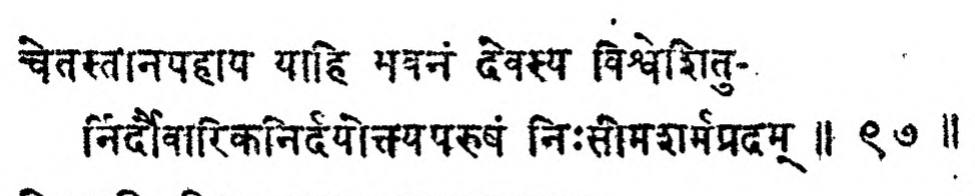
नायं ते समयो रहस्यमधुना निद्राति नाथो यदि
स्थित्वा द्रक्ष्यति कुप्यति प्रभुरिति द्वारिषु येषां वचः ।
च्चेतस्तानपहाय याहि भवनं देवस्य विश्वेशितु-
निर्दौवारिकनिर्दयोक्त्यपरुषं निःसीमशर्मप्रदम् ॥ ९७ ॥

Notes
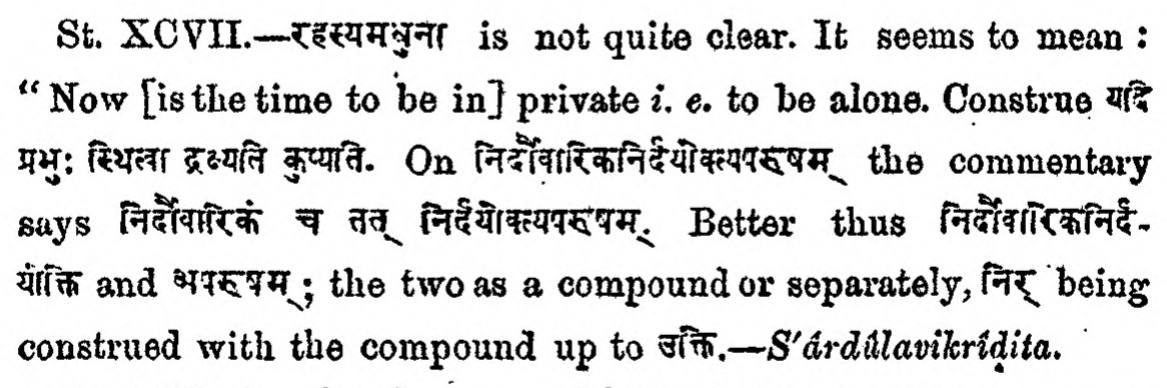
St. XCVII.—रहस्यमधुना is not quite clear. It seems to mean : “ Now [is the time to be in] private i. e. to be alone. Construe यदि प्रभुः स्थित्वा द्रक्ष्यति कुप्यति. On निर्दौवारिकनिर्दयोक्त्यपरुषम् the commentary says निर्दौवारिकं च तत् निर्दयोक्त्यपरुषम्. Better thus निर्दौवारिकनिर्दयोक्ति and अपरुषम् ; the two as a compound or separately, निर् being construed with the compound up to उक्ति.—S'ârdûlavikrîḍita.

Kale
all
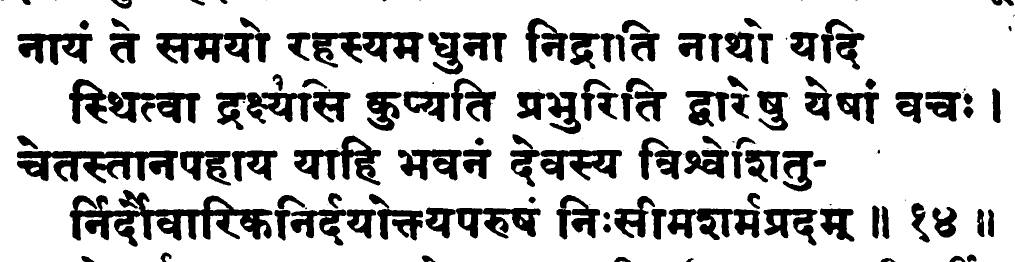
नायं ते समयो रहस्यमधुना निद्राति नाथो यदि
स्थित्वा द्रक्ष्यसि कुप्यति प्रभुरिति द्वारेषु येषां वचः ।
चेतस्तानपहाय याहि भवनं देवस्य विश्वेशितु-
र्निर्दौवारिकनिर्दयोक्त्यपरुषं निःसीमशर्मप्रदम् ॥ १४ ॥
Translation
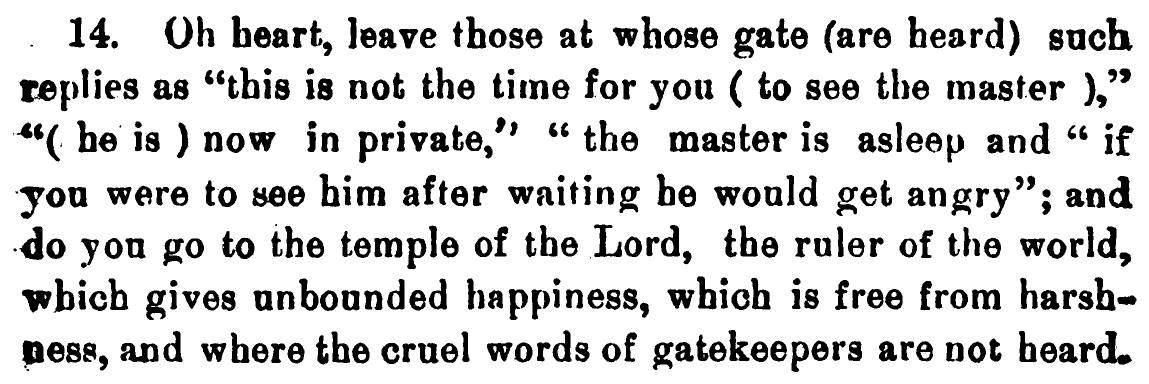
14. Oh heart, leave those at whose gate (are heard) such replies as “this is not the time for you ( to see the master ),” “( he is ) now in private,” “ the master is asleep and “ if you were to see him after waiting he would get angry”; and do you go to the temple of the Lord, the ruler of the world, which gives unbounded happiness, which is free from harshness, and where the cruel words of gatekeepers are not heard.
Notes
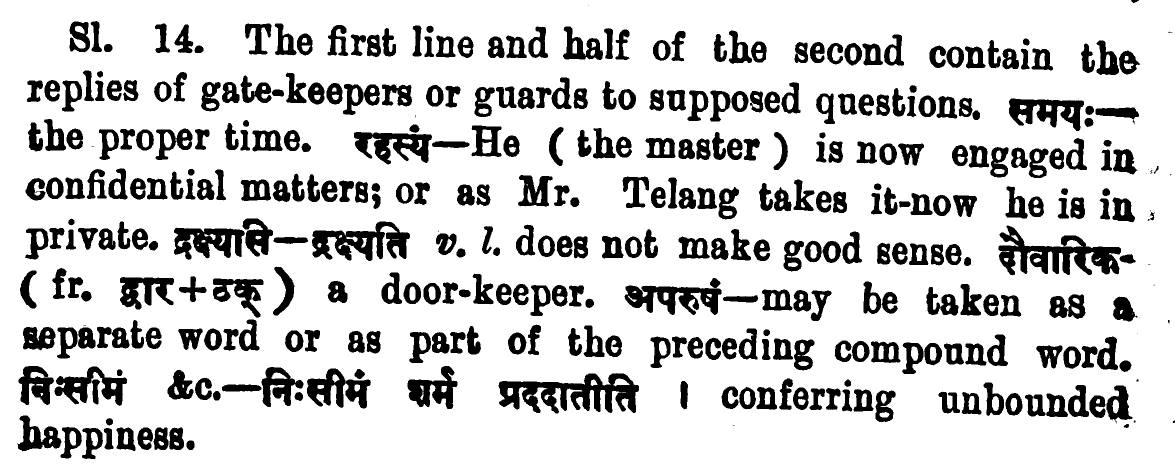
Sl. 14. The first line and half of the second contain the replies of gate-keepers or guards to supposed questions. समयः— the proper time. रहस्यं—He ( the master ) is now engaged in confidential matters; or as Mr. Telang takes it-now he is in private. द्रक्ष्यसि—द्रक्ष्यति v. l. does not make good sense. दौवारिक-( fr. द्वार+ठक् ) a door-keeper. अपरुषं—may be taken as a separate word or as part of the preceding compound word. निःसीमं &c.—निःसीमं शर्म प्रददातीति । conferring unbounded happiness.
Gopinath1914
all
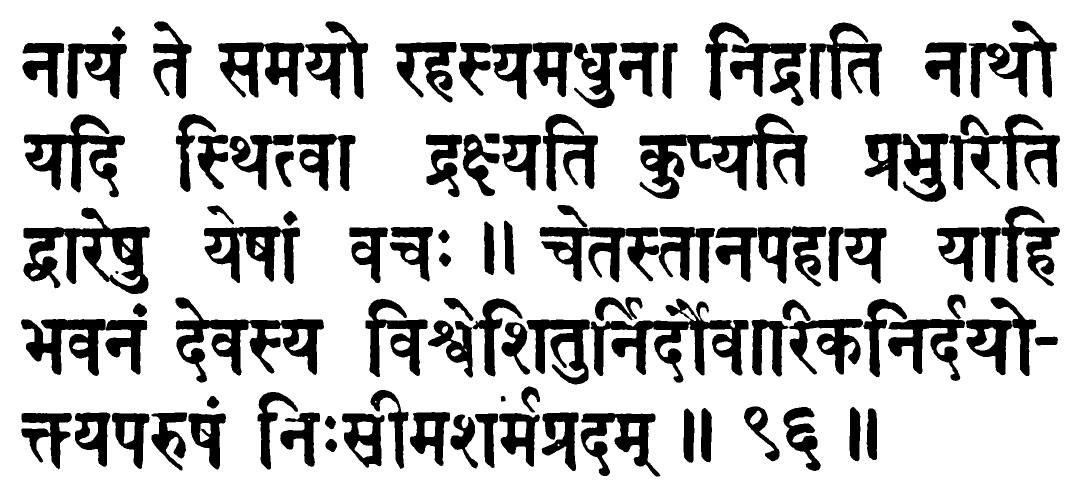
नायं ते समयो रहस्यमधुना निद्राति नाथो
यदि स्थित्वा द्रक्ष्यति कुप्यति प्रभुरिति
द्वारेषु येषां वचः ॥ चेतस्तानपहाय याहि
भवनं देवस्य विश्वेशितुर्निदौवारिकनिर्दयो-
त्यपरुषं निःसीमशमंप्रदम् ॥ ९६ ॥
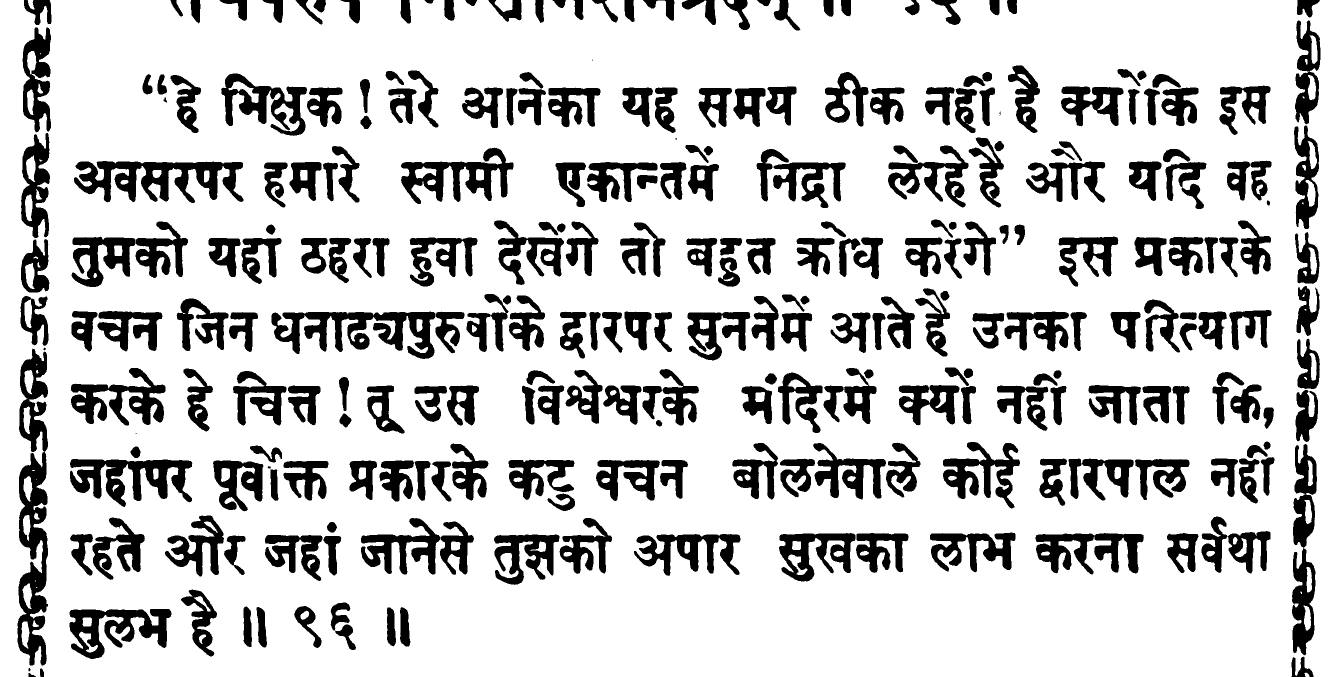
"हे भिक्षुक ! तेरे आने का यह समय ठीक नहीं है क्योंकि इस अवसरपर हमारे स्वामी एकान्तमें निद्रा लेरहे हैं और यदि वह तुमको यहां ठहरा हुवा देखेंगे तो बहुत क्रोध करेंगे" इस प्रकार के वचन जिन धनाढ्यपुरुषोंके द्वारपर सुनने में आते हैं उनका परित्याग करके हे चित्त ! तू उस विश्वेश्वरके मंदिरमें क्यों नहीं जाता कि, जहांपर पूर्वोक्त प्रकारके कटु वचन बोलनेवाले कोई द्वारपाल नहीं रहते और जहां जानेसे तुझको अपार सुखका लाभ करना सर्वथा सुलभ है ॥ ९६ ॥
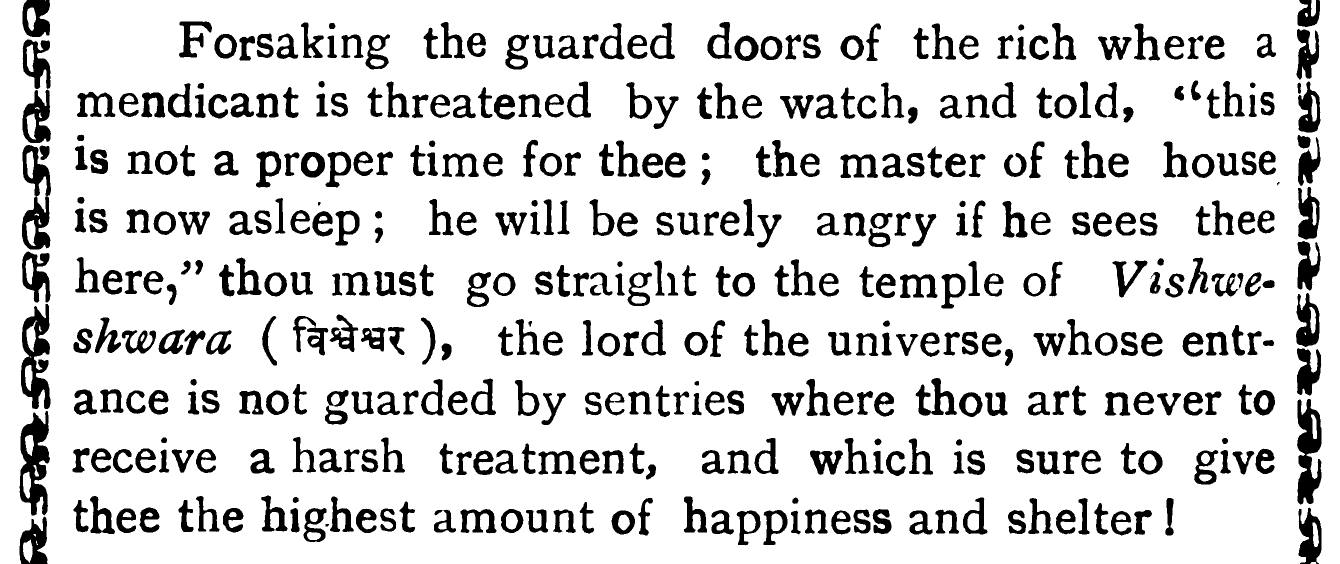
Forsaking the guarded doors of the rich where a mendicant is threatened by the watch, and told, "this is not a proper time for thee; the master of the house is now asleep; he will be surely angry if he sees thee here,” thou must go straight to the temple of Vishweshwara ( विश्वेश्वर ), the lord of the universe, whose entrance is not guarded by sentries where thou art never to receive a harsh treatment, and which is sure to give thee the highest amount of happiness and shelter !

Gopinath1896
all
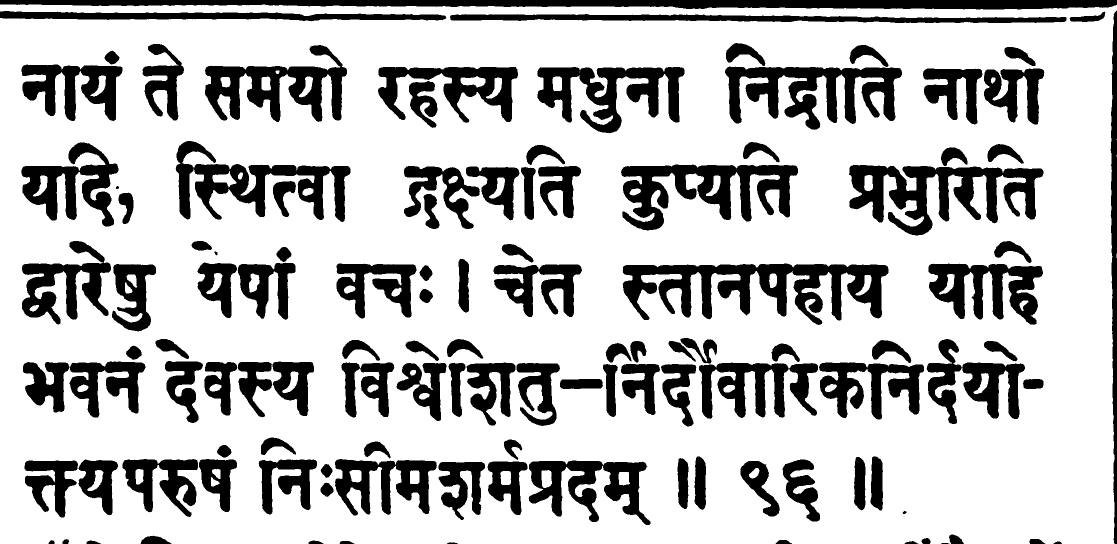
नायं ते समयो रहस्य मधुना निद्राति नाथो
यदि, स्थित्वा द्रक्ष्यति कुप्यति प्रभुरिति
द्वारेषु येषां वचः । चेत स्तानपहाय याहि
भवनं देवस्य विश्वेशितु - निर्दोवारिकनिर्दयो-
त्यपरुषं निःसीमशर्मप्रदम् ॥ ९६ ॥
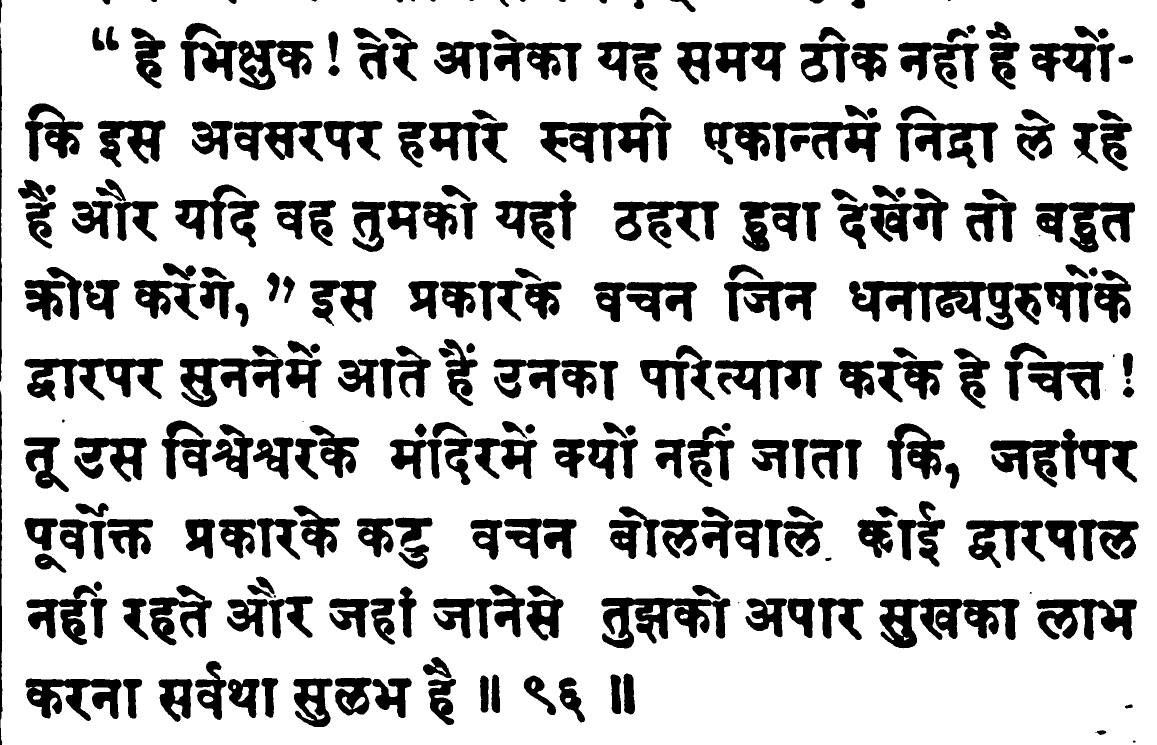
" हे भिक्षुक ! तेरे आनेका यह समय ठीक नहीं है क्योंकि इस अवसरपर हमारे स्वामी एकान्तमें निद्रा ले रहे हैं और यदि वह तुमको यहां ठहरा हुवा देखेंगे तो बहुत क्रोध करेंगे, " इस प्रकारके वचन जिन धनाढ्यपुरुषोंके द्वारपर सुननेमें आते हैं उनका परित्याग करके हे चित्त ! तू उस विश्वेश्वरके मंदिरमें क्यों नहीं जाता कि, जहांपर पूर्वोक्त प्रकारके कटु वचन बोलनेवाले कोई द्वारपाल नहीं रहते और जहां जानेसे तुझको अपार सुखका लाभ करना सर्वथा सुलभ है ॥ ९६ ॥
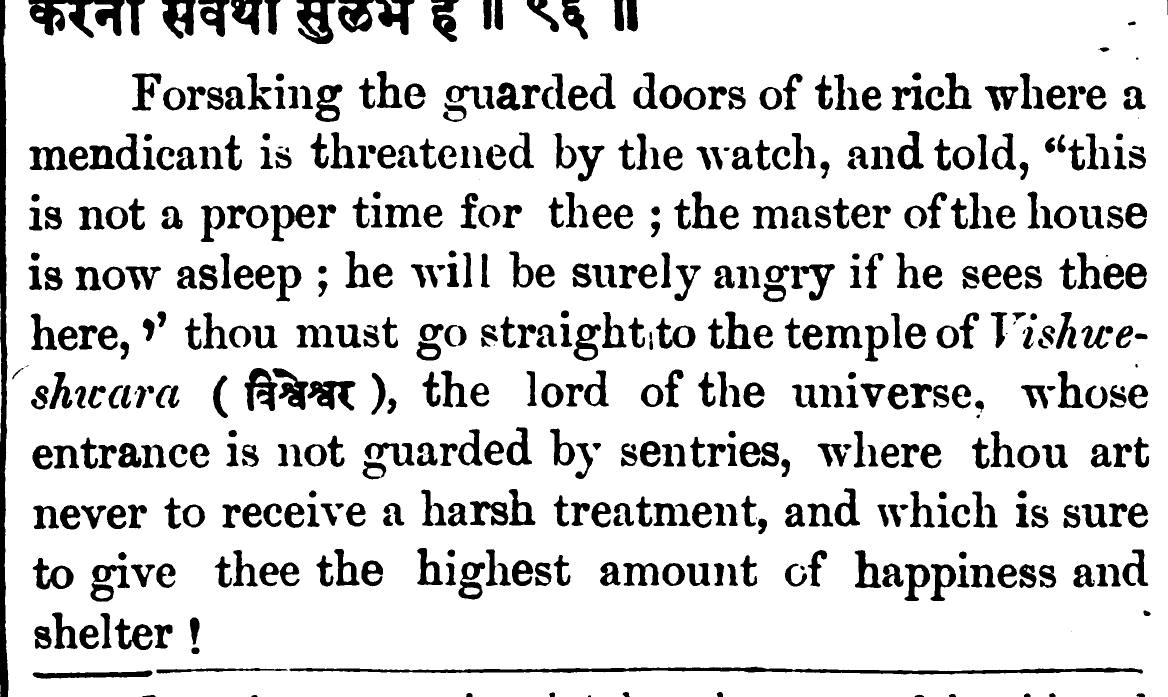
Forsaking the guarded doors of the rich where a mendicant is threatened by the watch, and told, "this is not a proper time for thee; the master of the house is now asleep; he will be surely angry if he sees thee here," thou must go straight to the temple of Vishweshrara ( विश्वेश्वर ), the lord of the universe, whose entrance is not guarded by sentries, where thou art never to receive a harsh treatment, and which is sure to give thee the highest amount of happiness and shelter!

Kosambi
all
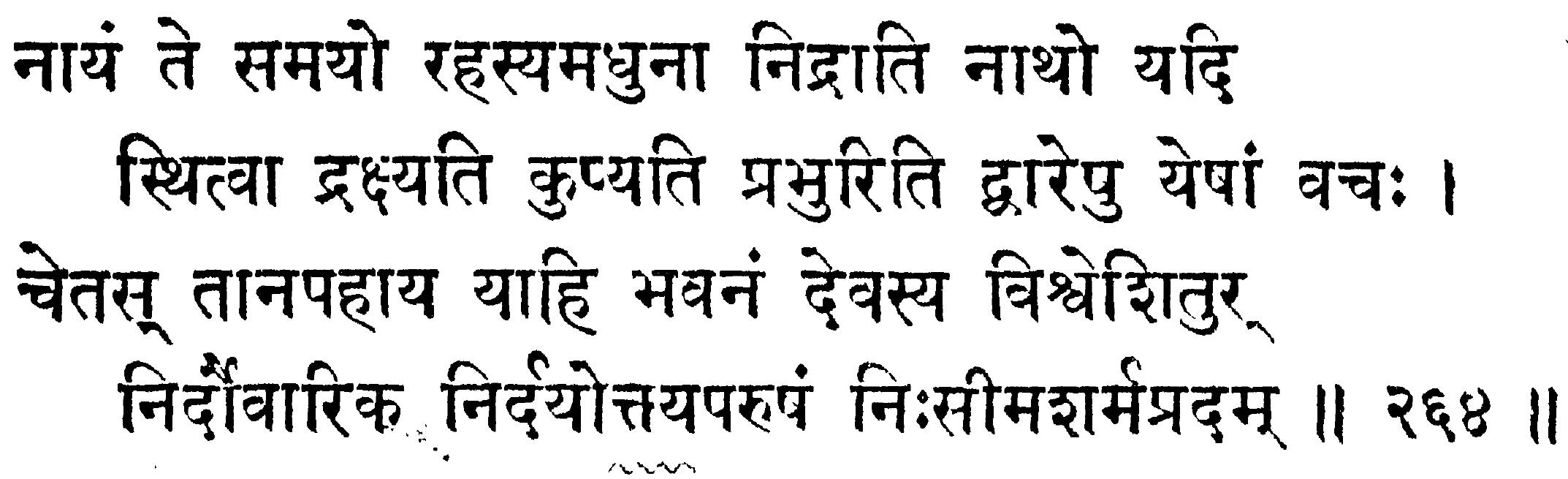
नायं ते समयो रहस्यमधुना निद्राति नाथो यदि
स्थित्वा द्रक्ष्यति कुप्यति प्रभुरिति द्वारेषु येषां वचः ।
चेतस् तानपहाय याहि भवनं देवस्य विश्वेशितुर्
निर्दोवारिक निर्दयोत्तयपरुपं निःसीमशर्मप्रदम् ॥ २६४ ॥
Footnote
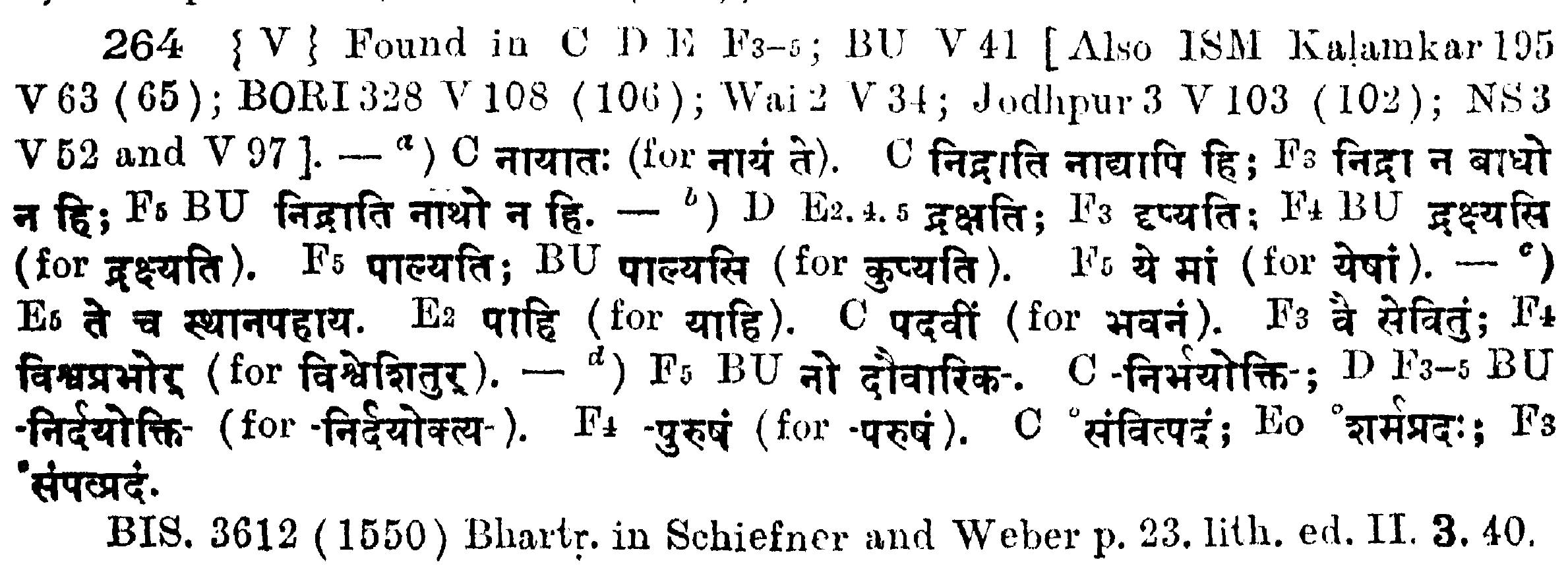
264 { V } Found in C D E F 3-5 ; BU V41 [ Also ISM Kalamkar 195
V 63 ( 65 ) ; BORI 328 V108 ( 106 ) ; Wai 2 V34 ; Jodhpur 3 V 103 ( 102 ) ; NS3
V 52 and V97 ] . a ) C C नायातः ( for नायं ते ) . निद्राति नाद्यापि हि ; : निद्रा न बाधो
न हि ; Fs BU निद्राति नाथो न हि . 4 ) D E2.5 क्षति ; F3 दृप्यति ; F½ BU द्रक्ष्यसि
( for द्रक्ष्यति ) . Fs पाल्यति ; BU पाल्यसि ( for कुप्यति ) . No ये मां ( for येषां ) . – )
E6 ते च स्थानपहाय . E2 पाहि ( for याहि ) . C पदवीं ( for भवनं ) . F3 वै सेवितुं ; F4
विश्वप्रभोर ( for विश्वेशितुर् ) – 4 ) F5 BU नो दौवारिक . C - निर्भयोक्ति ; D F3-5 BU
-निर्दयोक्ति ( for निर्दयोक्त्य- ) . Fi- पुरुषं ( for परुषं ) . C संवित्पदं ; Do शर्मप्रदः ; Fs
संपत्प्रदं .
BIS . 3612 ( 1550 ) Bhartṛ . in Schiefner and Weber p . 23. lith . ed . II . 3. 40 .
Commentary