Tawney
Hard fate to minister and bard assigned,
One must new turns and one new taxes find;
By honeyed language both aspire to climb,
This slowly builds his power, and that his rhyme;
A captious public both must toil to please,
And part unthanked with liberty and ease.
Telang
all
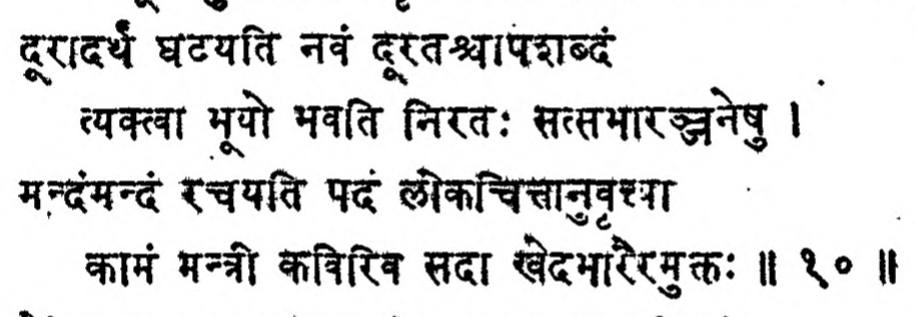
दूरादर्थं घटयति नवं दूरतश्चापशब्दं
त्यक्त्वा भूयो भवति निरतः सत्सभारञ्जनेषु ।
मन्दंमन्दं रचयति पदं लोकचित्तानुवृत्त्या
कामं मन्त्री कविरिव सदा खेदभारैरमुक्तः ॥ १० ॥
Notes
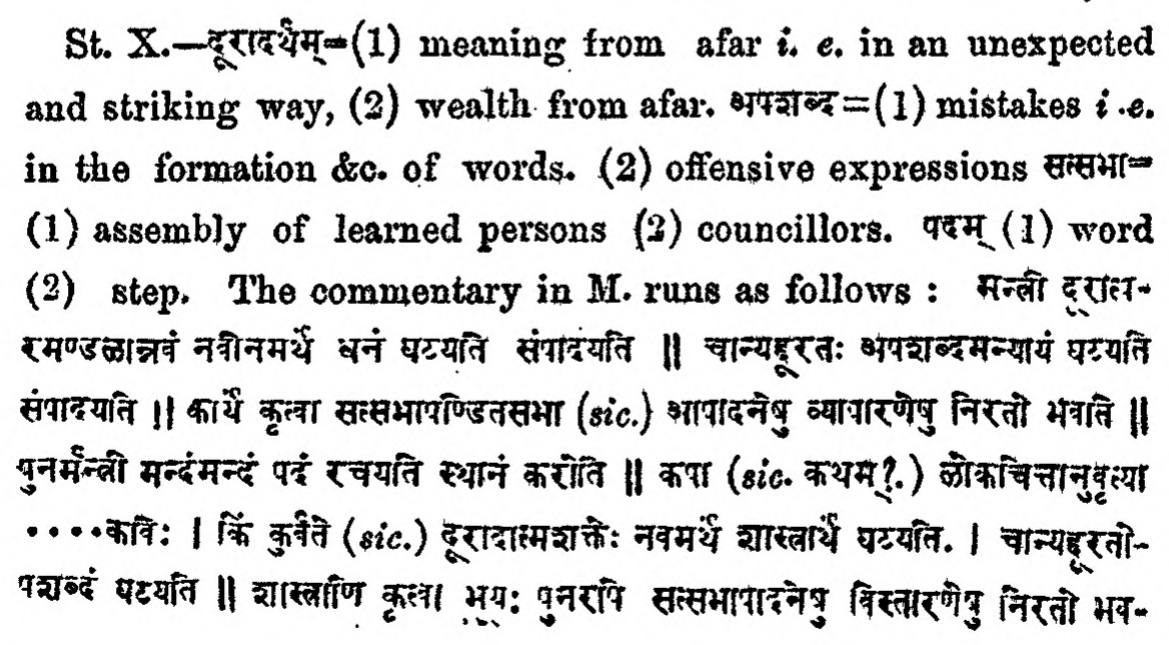
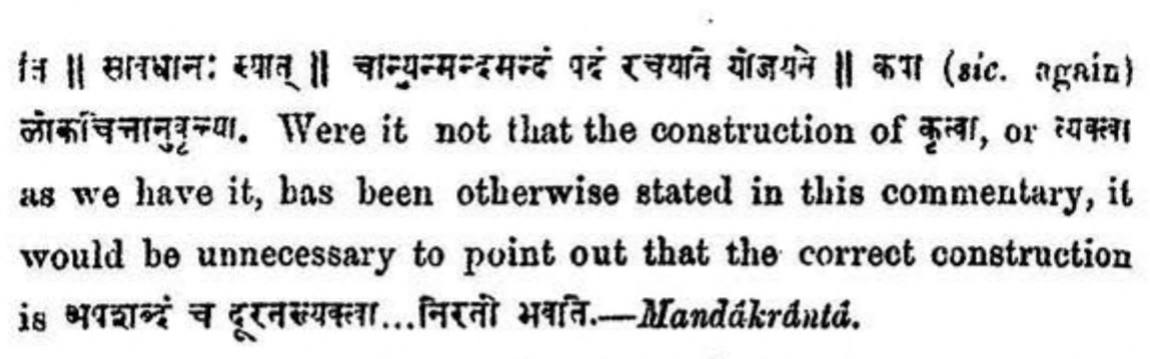
St. X.—दूरादर्थम्=(1) meaning from afar i. e. in an unexpected and striking way, (2) wealth from afar. अपशब्द = (1) mistakes i .e. in the formation &c. of words. (2) offensive expressions सत्सभा=(1) assembly of learned persons (2) councillors. पदम् (1) word (2) step. The commentary in M. runs as follows : मन्त्री दूरात्परमण्डलान्नवं नवीनमर्थं धनं घटयति संपादयति ॥ चान्यद्दूरतः अपशब्दमन्यायं घटयति संपादयति ॥ कार्यं कृत्वा सत्सभापण्डितसभा (sic.) आपादनेषु व्यापारणेषु निरतो भवति ॥ पुनर्मन्त्री मन्दंमन्दं पदं रचयति स्थानं करोति ॥ कपा (sic. कथम् ?.) लोकचित्तानुवृत्त्या ••••कविः । किं कुर्वते (sic.) दूरादात्मशक्तेः नवमर्थं शास्त्रार्थं घटयति. । चान्यद्दूरतोपशब्दं घटयति ॥ शास्त्राणि कृत्वा भूयः पुनरपि सत्सभापादनेषु विस्तारणेषु निरतो भवति ॥ सावधानः स्यात् ॥ चान्यन्मन्दमन्दं पदं रचयति योजयते ॥ कण (sic. again) लोकचित्तानुवृत्त्या. Were it not that the construction of कृत्वा, or त्यक्त्वा as we have it, has been otherwise stated in this commentary, it would be unnecessary to point out that the correct construction is अपशब्दं च दूरतस्त्यक्त्वा...निरतो भवति.—Mandâkrântâ.



Kale
all
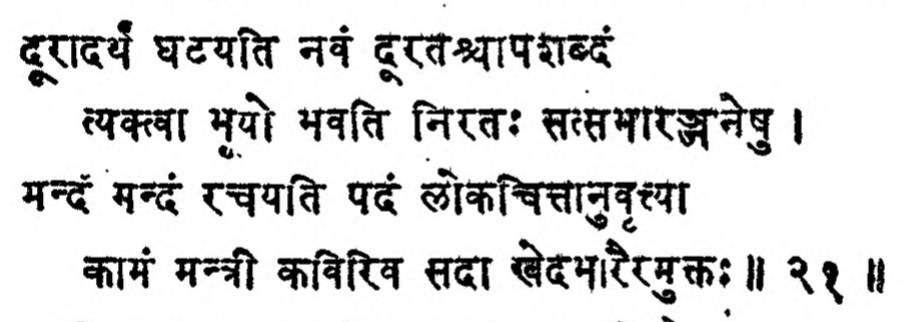
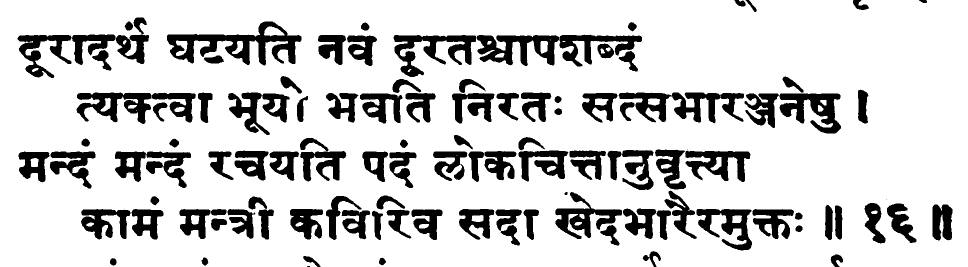
दूरादर्थं घटयति नवं दूरतश्चापशब्दं
त्यक्त्वा भूयो भवति निरतः ससभारञ्जनेषु ।
मन्दं मन्दं रचयति पदं लोकचित्तानुवृत्त्या
कामं मन्त्री कविरिव सदा खेदभारैरमुक्तः ॥ १६ ॥
Translation
16. Verily a statesman, who brings in new wealth from afar, avoiding dispute (or, war, lit. the sound of bows ) altogether, becomes engrossed in pleasing the assembly of the wise and takes his steps slowly and slowly agreeably to the heart (wishes) of the subjects, is never free from the burden of anxiety, like a poet who brings out charming (lit. fresh) meaning ( from words which are ) far apart ( in sense ), leaves at a distance unsuitable words again, becomes deeply engaged in pleasing the assembly of the wise, and arranges words with care agreeably to popular taste.

Notes
Sl. 16. In this sl. a minister and a poet are described as having a similar function to do, by epithets which are slishta. दूरात्—(1) from afar; may also be metaphorical; (2) far apart i. e. by using words in a slishta or secondary ( लाक्षणिक) sense; by presenting a striking picture to the mind far beyond the conception of ordinary men. अर्थ—(1) wealth or a political end; (2) the intended sense. अपशब्दं त्यक्त्वा—Avoiding wrangling; or offensive words; or take the whole as चापशब्दं the twanging sound of the bow. i. e. achieving lofty aims by a wise stroke of policy without having recourse to war.; (2) faulty or offensive expressions, wrong words. सत्सभा—(1) assemblies of good ( or politically clever ) people, political bodies; (2) assemblies of learned ( able to appreciate सहृदय ) men. पदम्—(1) step; ( 2 ) words. लोकचित्त०—(1) by consulting public opinion; (2) by going along with the current of ideas and conforming to the tastes of his times. For a similar comparison between a minister and a poet, see Mud. IV. 2; Sis. XI. 6.

Kosambi
all
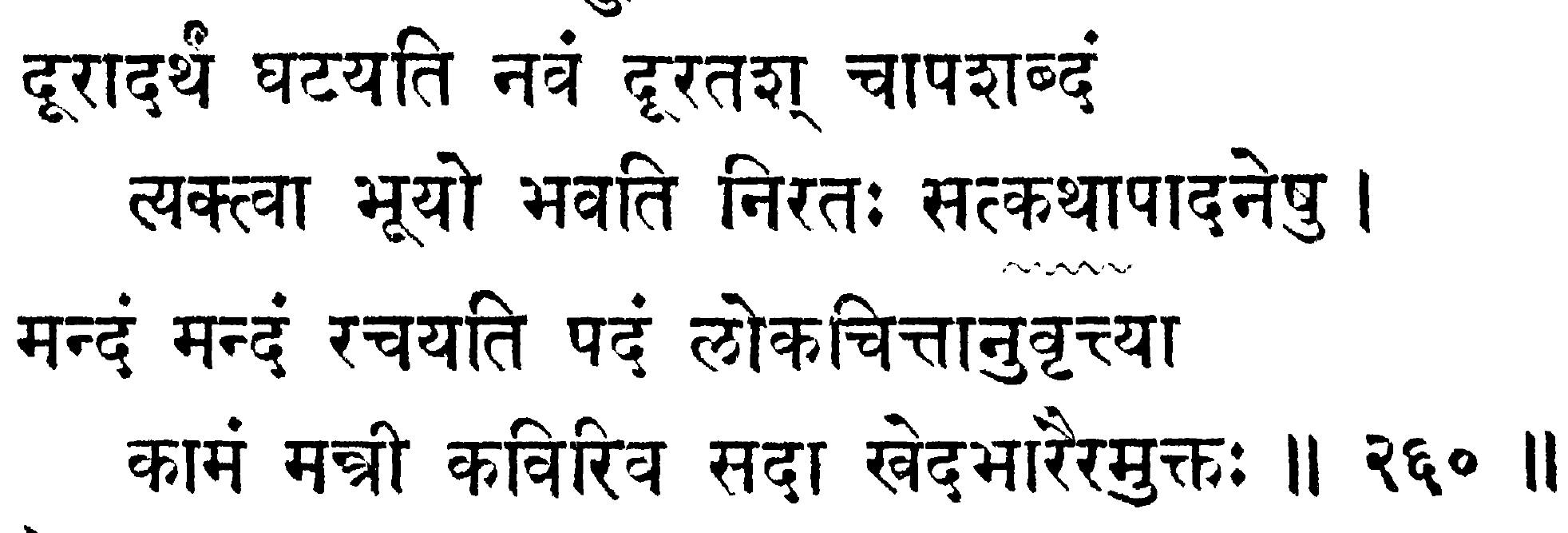
दूरादर्थं घटयति नवं दूरतश् चापशब्द
त्यक्त्वा भूयो भवति निरतः सत्कथापादनेषु ।
मन्दं मन्दं रचयति पदं लोकचित्तानुवृत्त्या
कामं मन्त्री कविरिव सदा खेदभारैरमुक्तः ॥ २६० ॥
Footnote
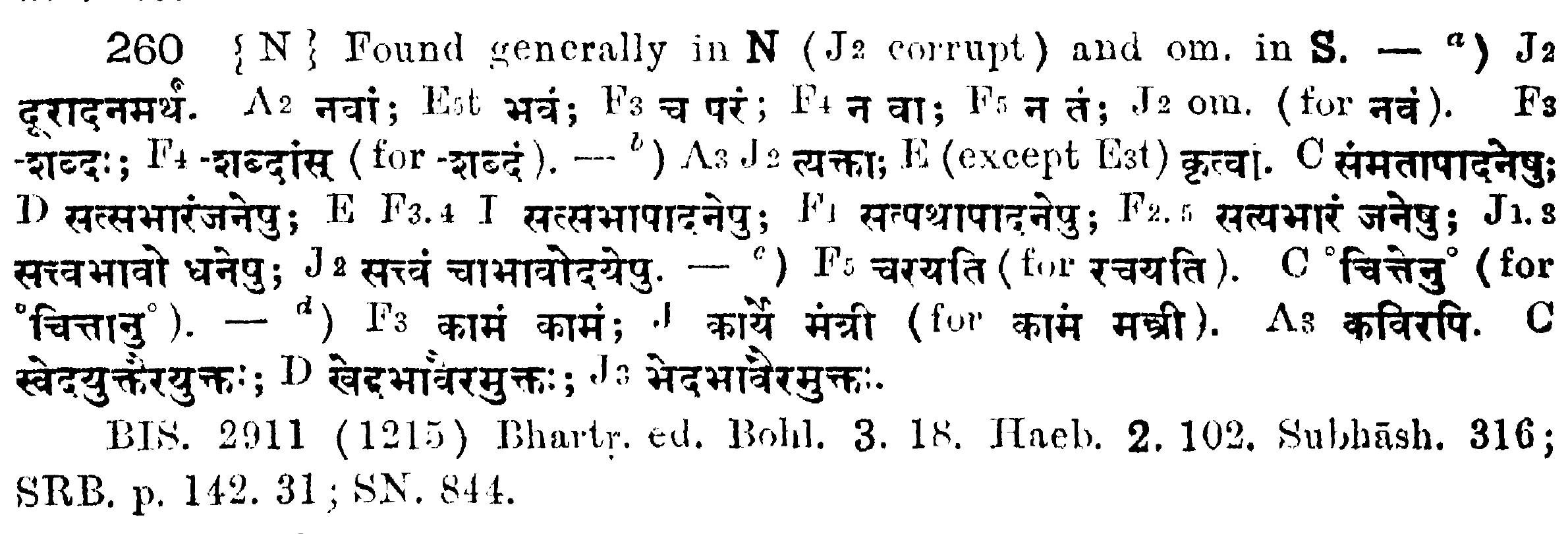
260 { N } Found generally in N ( J2 corrupt ) and om . in S. Bardin a ) Ja
दूरादनमर्थ . 12 नवां ; Est भवं ; F3 च परं ; F + न वा ; Fs न तं ; J2 om . ( for नवं ) . Fs
-शब्दः ; F + - शब्दांस ( for शब्दं ) . - 2 ८ ) A3 J2 त्यक्ता ; E ( except Est ) कृत्वा . C संमतापादनेषु ;
D 1 ) सत्सभारंजनेषु ; E F3.4 I सत्सभापादनेषु ; 11 सत्पथापादनेषु ; 12. सत्यभारं जनेषु ; Ji.s
सत्त्वभावो धनेषु ; ; J2 सत्त्वं चाभावोदयेपु . - " ) F5 चरयति ( for रचयति ) . C ° चित्तेनु ( for
' चित्तानु " ) . 4 ) F3 कामं कामं ; / " कार्य मंत्री ( for काम मन्त्री ) . As कविरपि . C
स्वेदयुक्तरयुक्तः ; D खेदभावरमुक्तः ; Ja भेदभावैरमुक्त :
BIS . 2911 ( 1215 ) Bhartr . ed . Bohl . 3. 18. Haeb 2 102. Subhāsh . 316 ;
SR.B. p . 142.31 ; SN . 844 .
Commentary