Tawney
Though fortune shower her blessings everywhere,
But few will reach the poor man's lowly head;
Though rain-clouds all day long their treasures shed,
Three drops at most reward the _châtak's_ prayer.
Telang
all
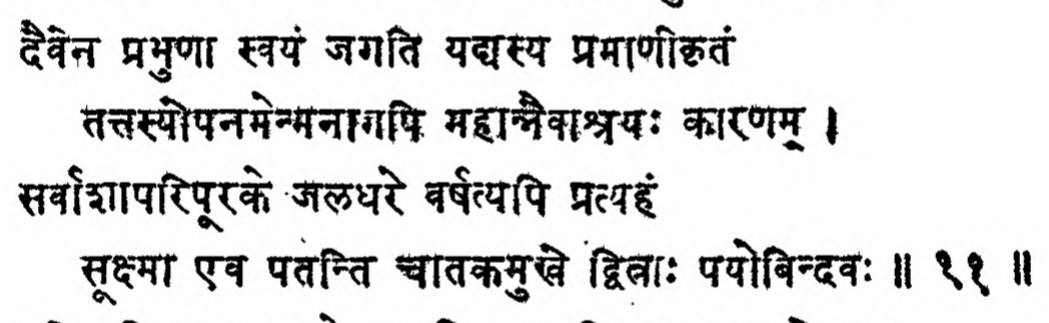
दैवेन प्रभुणा स्वयं जगति यद्यस्य प्रमाणीकृतं
तत्तस्योपनमेन्मनागपि महान्नेवाश्रयः कारणम् ।
सर्वाशापरिपूरके जलधरे वर्षत्यपि प्रत्यहं
सूक्ष्मा एव पतन्ति चातकमुखे द्वित्राः पयोबिन्दवः ॥ ११ ॥
Notes
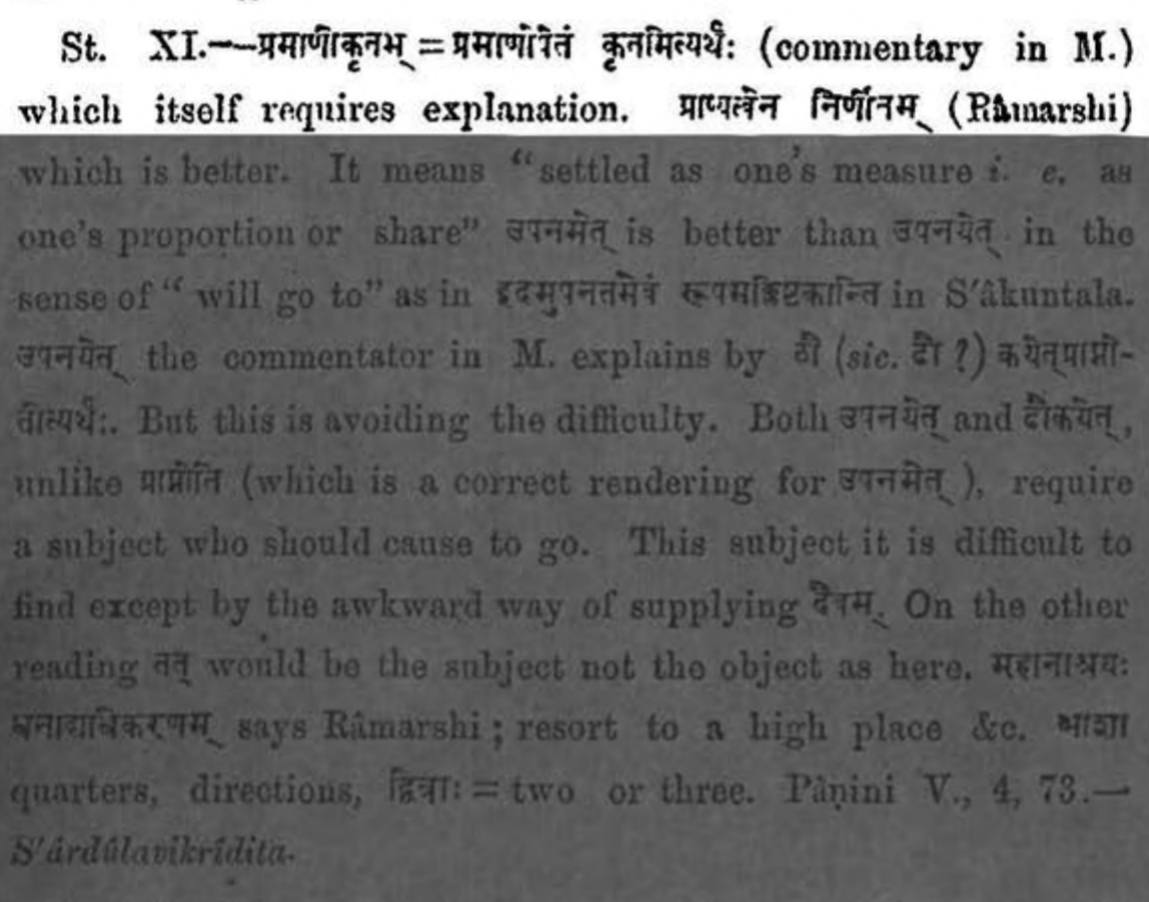
St. XI.—प्रमाणीकृतम् = प्रमाणोपेतं कृतमित्यर्थः (commentary in M.) which itself requires explanation. प्राप्यत्वेन निर्णीतम् (Râmarshi) which is better. It means “settled as one’s measure i. e. as one’s proportion or share” उपनमेत् is better than उपनयेत् in the sense of “ will go to” as in इदमुपनतमेवं रूपमक्लिष्टकान्ति in S’âkuntala. उपनयेत् the commentator in M. explains by ठौ (sic. ढौ ?) कयेत्प्राप्नोतीत्यर्थः. But this is avoiding the difficulty. Both उपनयेत् and ढौकयेत्, unlike प्राप्नोति (which is a correct rendering for उपनमेत् ), require a subject who should cause to go. This subject it is difficult to find except by the awkward way of supplying दैवम्. On the other reading तत् would be the subject not the object as here. महानाश्रयः धनाद्यधिकरणम् says Râmarshi; resort to a high place &c. आशा quarters, directions, द्वित्राः = two or three. Pâṇini V., 4, 73.— S’ârdûlavikrîḍita.

Kale
all

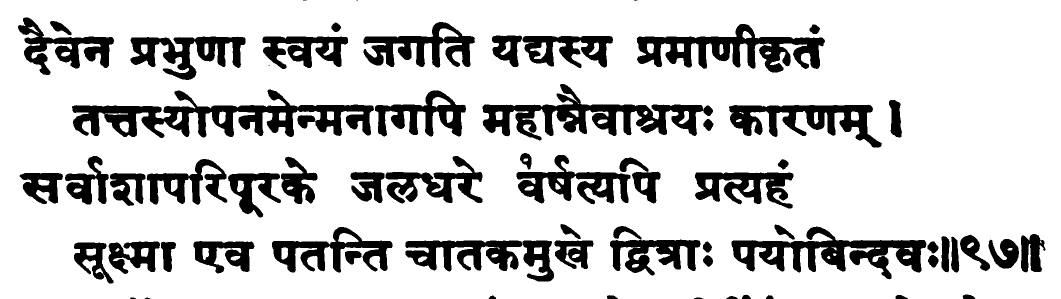
दैवेन प्रभुणा स्वयं जगति यद्यस्य प्रमाणीकृतं
तत्तस्योपनमेन्मनागपि महान्नेवाश्रयः कारणम् ।
सर्वाशापरिपूरके जलधरे वर्षत्यपि प्रत्यहं
सूक्ष्मा एव पतन्ति चातकमुखे द्वित्राः पयोबिन्दवः॥९७॥
Translation
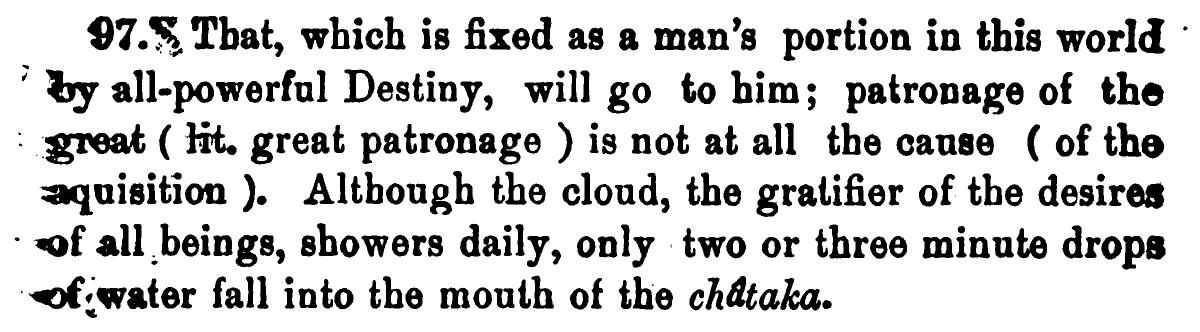
97. That, which is fixed as a man’s portion in this world by all-powerful Destiny, will go to him; patronage of the great ( lit. great patronage ) is not at all the cause ( of the aquisition ). Although the cloud, the gratifier of the desires of all beings, showers daily, only two or three minute drops of water fall into the mouth of the châtaka.
Notes
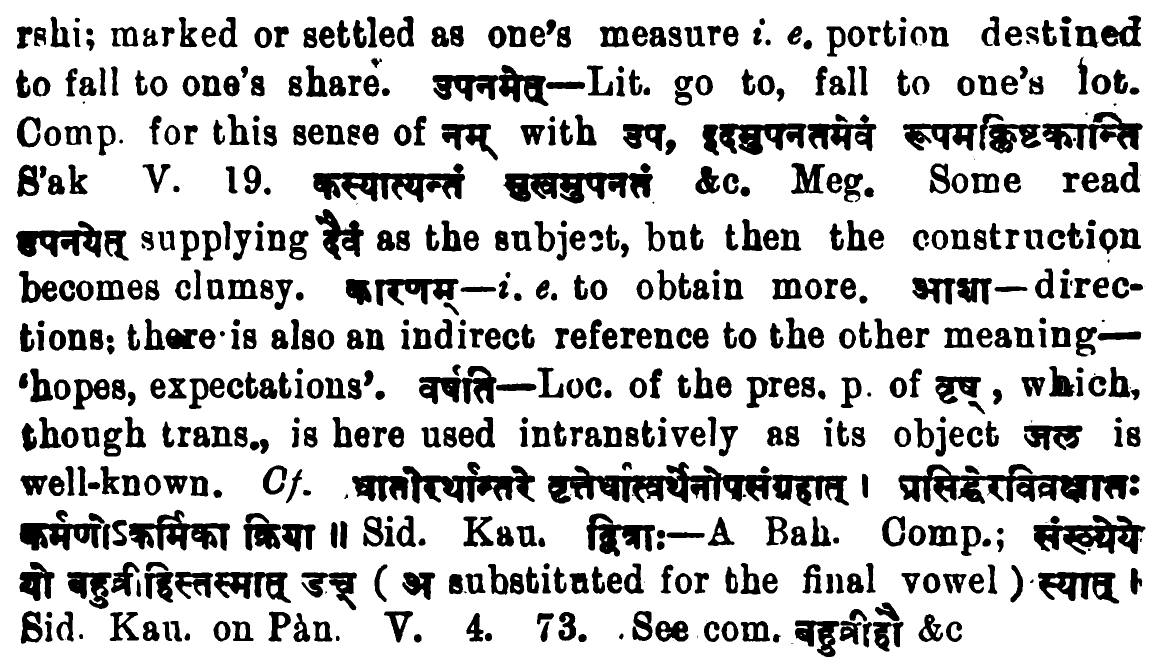
Sl. 97. प्रभुणा—प्रभवतीति प्रभुः, used in a literal sense, powerful, having power to dispense. प्रमाणीकृतं-प्राप्यत्वेन निर्णीतम् Rámarshi; marked or settled as one's measure i. e. portion destined to fall to one's share. उपनमेत्—Lit. go to, fall to one's lot. Comp. for this sense of नम् with उप, इदमुपनतमेवं रूपमक्लिष्टकान्ति S'ak V. 19. कस्यात्यन्तं सुखमुपनतं &c. Meg. Some read उपनयेत् supplying दैवं as the subject, but then the construction becomes clumsy. कारणम्—i. e. to obtain more. आशा—directions; there is also an indirect reference to the other meaning— 'hopes, expectations'. वर्षति—Loc. of the pres. p. of वृष् , which, though trans., is here used intranstively as its object जल is well-known. Cf. धातोरर्थान्तरे वृत्तेर्धात्वर्थेनोपसंग्रहात् । प्रसिद्धेरविवक्षातः कर्मणोऽकर्मिका क्रिया ॥ Sid. Kau. द्वित्राः—A Bah. Comp.; संख्येये यो बहुव्रीहिस्तस्मात् डच् ( अ substituted for the final vowel ) स्यात् । Sid. Kau. on Pàn. V. 4. 73. See com. बहुव्रीहौ &c

Kosambi
all
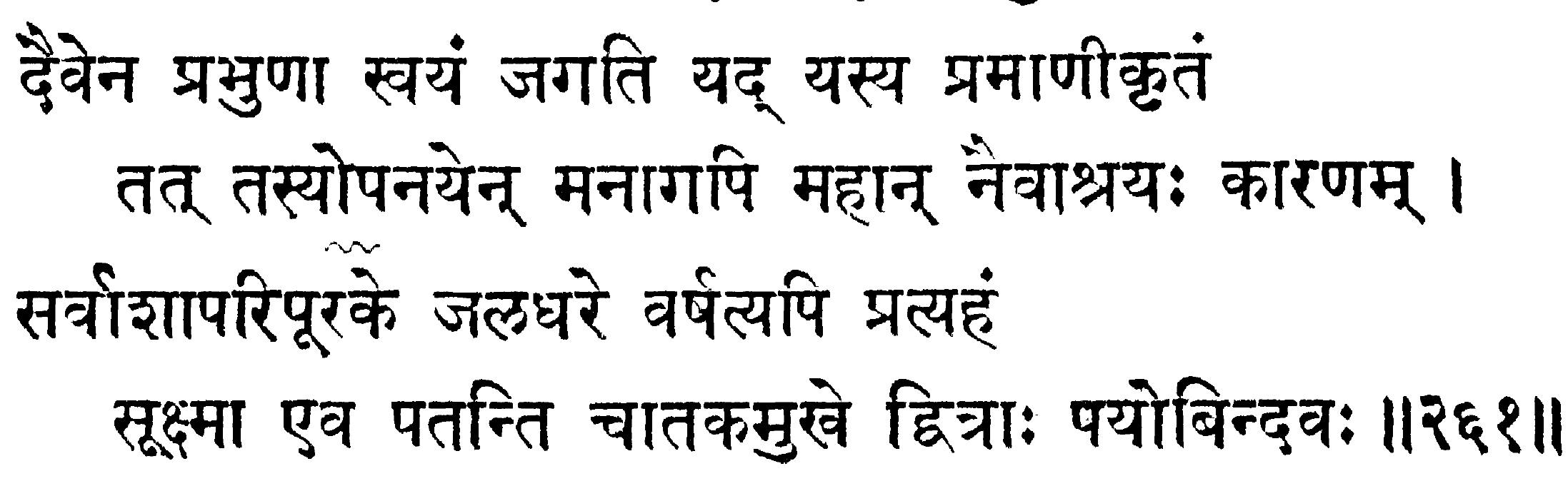
दैवेन प्रभुणा स्वयं जगति यद् यस्य प्रमाणीकृतं
तत् तस्योपनयेन् मनागपि महान् नैवाश्रयः कारणम् ।
सर्वाशापरिपूरके जलधरे वर्ष त्यपि प्रत्यहं
सूक्ष्मा एव पतन्ति चातकमुखे द्वित्राः पयोबिन्दवः ॥२६१ ॥
Footnote
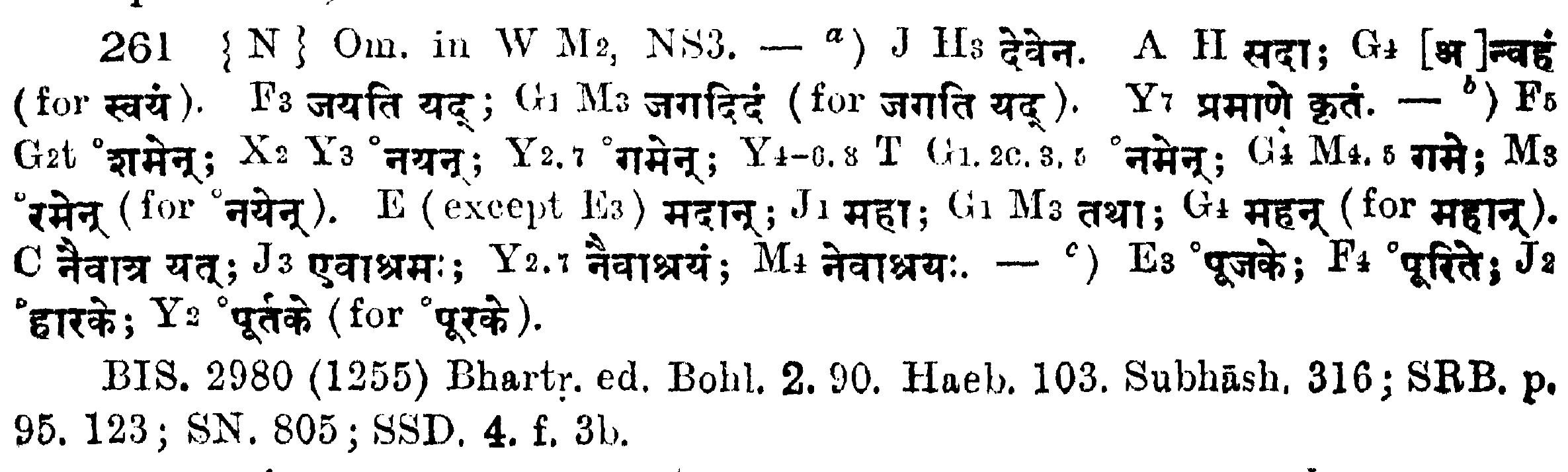
261 { N } Om . in W M2 , NS3 . a ) J H3 देवेन . AII A सदा ; G + [ अ ] न्वहं
( for स्वयं ) . F3 जयति यद् ; ( 1 M3 जगदिदं ( for जगति यद् ) . Y7 प्रमाणे कृतं . 6 ) F5
G2t शमेन् ; X 2 X 3 ° नयन् ; X2.7 ° गमेन् ; Y4-0.8 T 61.20.36 6 ° नमेन् ; Gi Ga Ma 6 गमे ; Ms
" रमेनू ( for a नयेन् ) . E ( except E3 ) मदान् ; J 1 महा ; G1 M3 तथा ; Ga महन् ( for महान् ) .
C नैवात्र यत् ; J3 एवाश्रमः ; X 2.1 नैवाश्रयं ; M ½ नेवाश्रयः . c ) E3 पूजके ; F + पूरिते ; Ja
' हारके ; Y : पूर्तके ( for पूरके ) .
BIS . 2980 ( 1255 ) Bhartr ed . Boil . 2.90 . Haeb . 103. Subhāsh 316 ; SRB.p.
95. 123 ; SN . 805 ; SSD 4. f . 3b .
Commentary