Tawney
A woman's heart is like a glass, reflecting every face,
Her secret thoughts, like mountain paths, are difficult to trace,
Her fancy wavers, like the dew which lotus-leaves enclose,
Her faults, like deadly Upas-buds, develop as she grows.
More
XX
Harder than faces in a glass designed,
A woman's heart to bind ;
Like mountain paths up cragged heights that twist,
Her ways are lightly missed.
Like early dew-drops quivering on a leaf,
Her thoughts are idly brief;
And errors round her grow, as on a vine
The poison-tendrils twine.
Telang
all
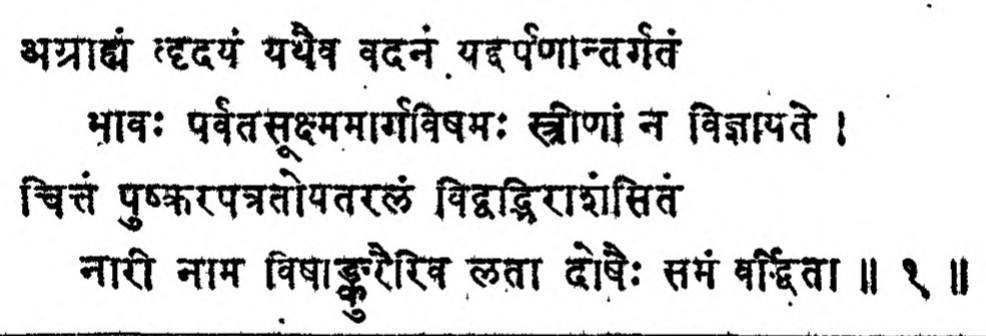
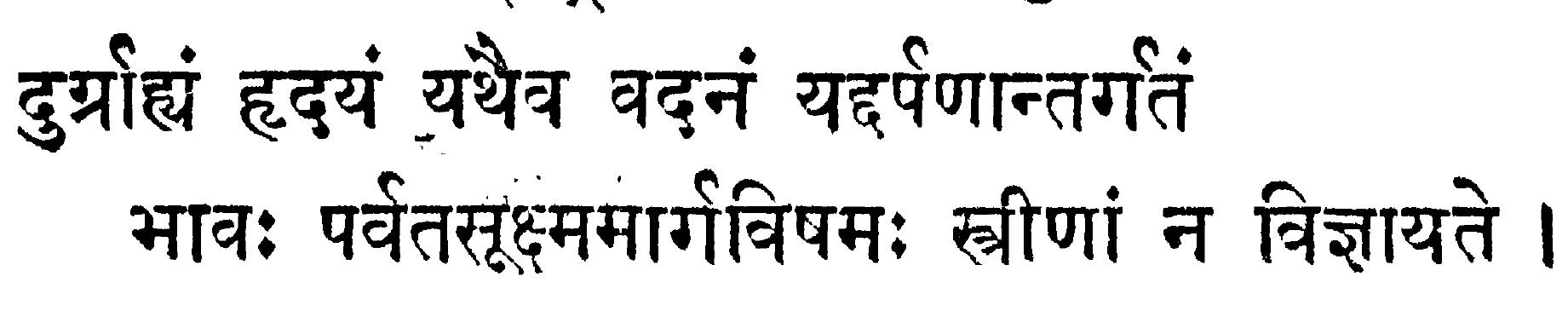
अग्राह्यं हृदयं यथैव वदनं यद्दर्पणान्तर्गतं
भावः पर्वतसूक्ष्ममार्गविषमः स्त्रीणां न विज्ञायते ।
चित्तं पुष्करपत्रतोयतरलं विद्वद्भिराशंसितं
नारी नाम विषाङ्कुरैरिव लता दोषैः समं वर्द्धिता ॥ १ ॥
Notes
Stanza I.—भावः. For the meaning of this word see Raghu II., 26 and Kumâra. III., 68 with Mallinâtha’s comments on those two passages. See also Sṛingâras'ataka 2, where the commentator renders it by चित्ताभिप्राय as Râmarshi renders it here. सूक्ष्ममार्ग = अलभ्यमार्ग (commentary in M.) a narrow path. पुष्करपत्त्रतोय is a very common simile for every thing fickle, unsteady. आशंसितः in the sense of शंसित not the more usual hoped or expected. The defects pointed out in the first three lines like germs of poison develop as a woman grows. नाम is an idiomatic expletive equivalent to “verily” compare note to St. 20. The commentary in M. and Râmarshi have नामेति संबोधने which is not quite intelligible; should it be संभावने ? See note Stanza 57 supra.—S'ârdûlavikrîḍita.

Kale
all
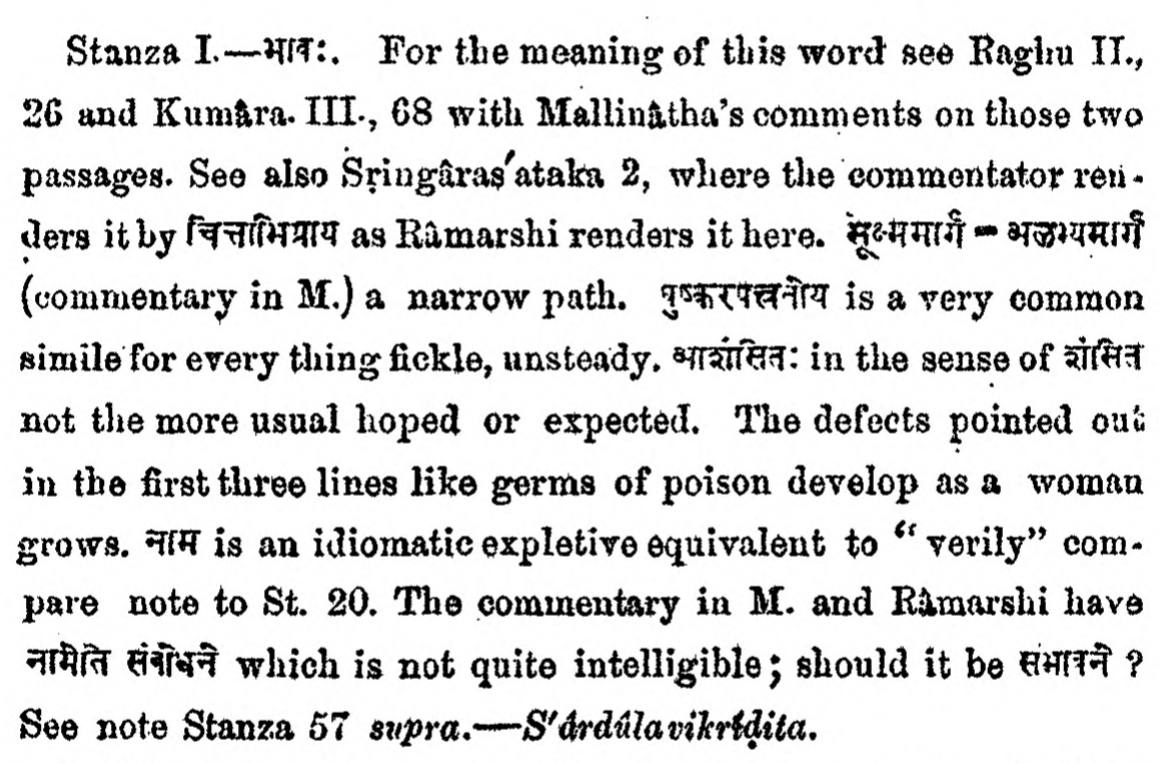
अग्राह्यं हृदयं यथैव वदनं यद्दर्पणान्तर्गतं
भावः पर्वतसूक्ष्ममार्गविषमः स्त्रीणां न विज्ञायते ।
चित्तं पुष्करपत्रतोयतरलं विद्वद्भिराशंसितं
नारी नाम विषाङ्कुरैरिव लता दोषैः समं वर्धिता ॥ ७ ॥
Translation
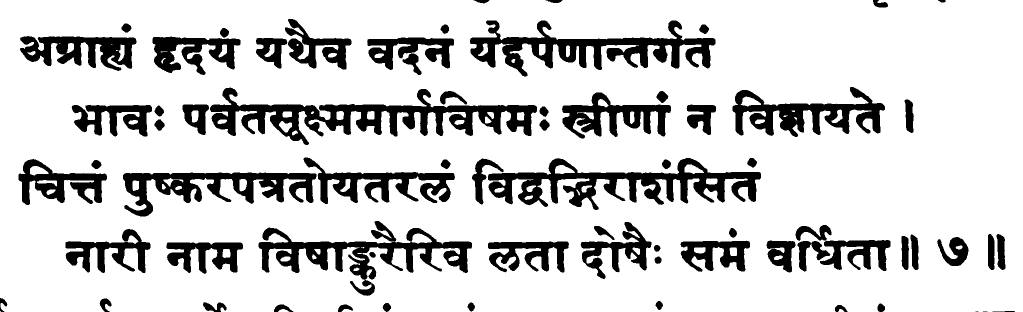
7. Like unto the face reflected in a mirror the heart of women cannot be caught ( comprehended ); their feeling, intricate like the faint mountain-track, cannot be gauged; their heart has been described by the wise as fickle like water on a lotus-leaf; a woman growing with faults is, evidently, like a creeper growing with its poisonous shoots.
Notes
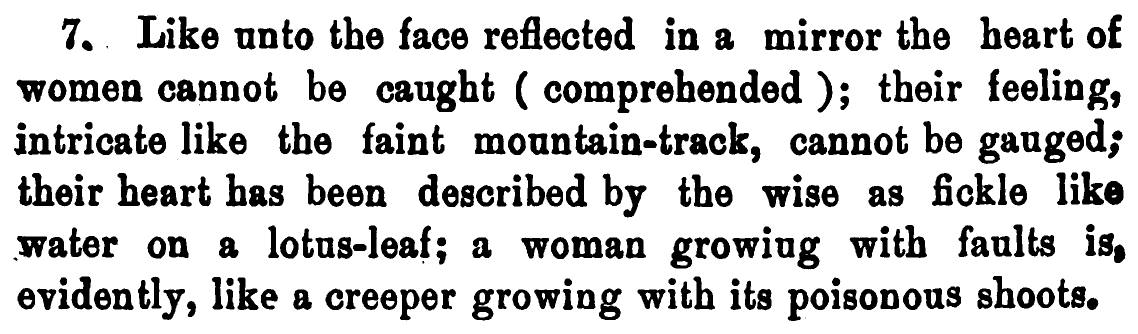
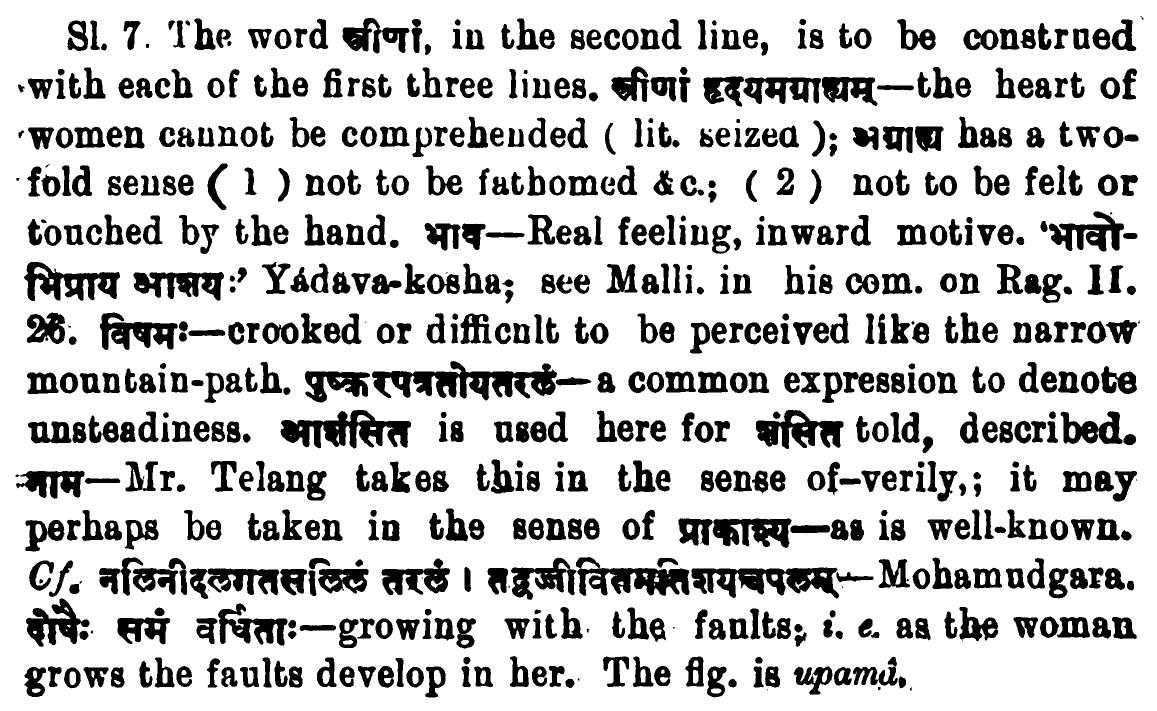
Sl. 7. The word स्त्रीणां, in the second line, is to be construed with each of the first three lines. स्त्रीणां हृदयमग्राह्यम्—the heart of women cannot be comprehended ( lit. seized ); अग्राह्य has a twofold sense ( 1 ) not to be fathomed &c.; ( 2 ) not to be felt or touched by the hand. भाव—Real feeling, inward motive. ‘भावोभिप्राय आशयः’ Yádava-kosha; see Malli. in his com. on Rag. II. 26. विषमः—crooked or difficult to be perceived like the narrow mountain-path. पुष्करपत्रतोयतरलं— a common expression to denote unsteadiness. आशंसित is used here for शंसित told, described. नाम—Mr. Telang takes this in the sense of–verily,; it may perhaps be taken in the sense of प्राकाश्य—as is well-known. Cf. नलिनीदलगतसलिलं तरलं । तद्वज्जीवितमतिशयचपलम्—Mohamudgara. दोषैः समं वर्धिताः—growing with the faults, i. e. as the woman grows the faults develop in her. The fig. is upamá.

Kosambi
all

Footnote
259 { N } Found generally in N ; F1 N49 and 77. Om . in S. " ) CE
: Io भग्राह्यं ; It आप्रायं . J 2 वदनं ( for हृदयं ) . B2 CEst F ( F1 second time ) तथैव ;
J1 तदेव ( for यथैव ) . B1 H I स- , IFi तद् ( for यद् ) . Est F1-4 स्थितं ( for -गतं ) .
0 ) F14 J1 दुर्गमार्ग ; J2 . 3 मार्गदुर्ग ( for सूक्ष्ममार्ग ) . - ० ) J2 ज्ञातं दुष्कर BC


Commentary