Tawney
Sloth is the foe that makes our souls his lair,
Vigour the friend that saves us from despair.



Kale
all

Notes
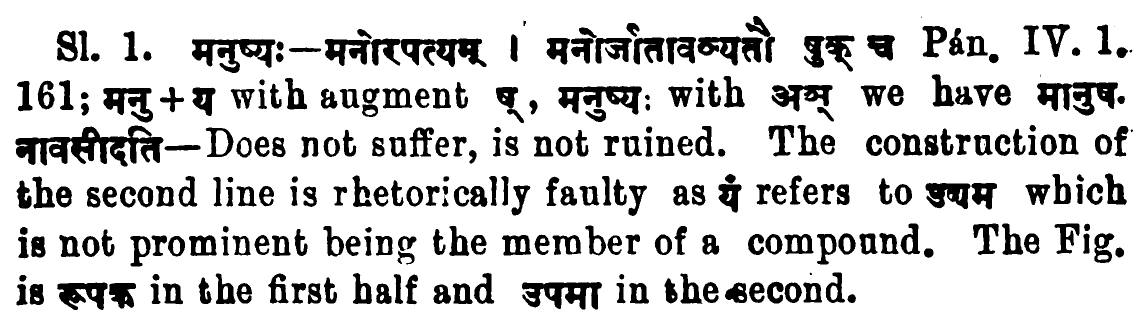
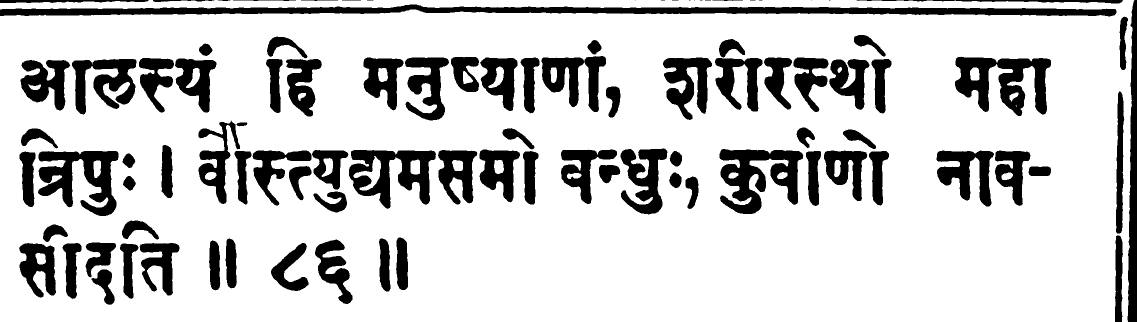
Sl. 1. मनुष्यः—मनोरपत्यम् । मनोर्जातावण्यतौ षुक् च Pán. IV. 1. 161; मनु + य with augment षु, मनुष्यः with अञ् we have मानुष. नावसीदति—Does not suffer, is not ruined. The construction of the second line is rhetorically faulty as यं refers to उद्यम which is not prominent being the member of a compound. The Fig. is रूपक in the first half and उपमा in the second.
Gopinath1914
all
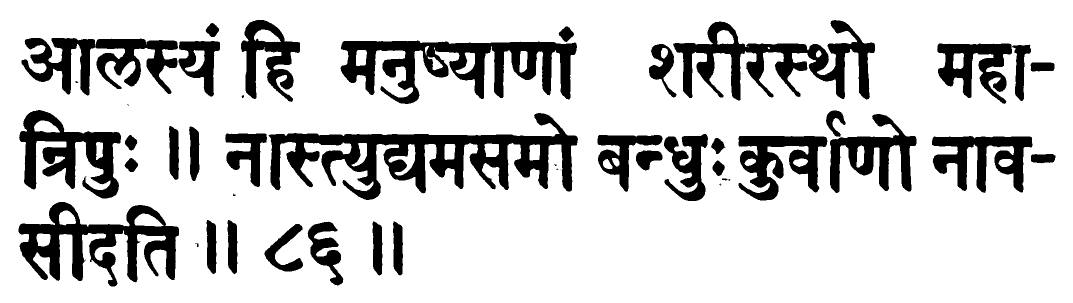
आलस्य, मनुष्योंके शरीरमें बैठा हुवा बडा भारी शत्रु है और उद्यम उनका हितसाधन करनेवाला असामान्य बंधु है । उद्यम करके कभी पछताना नहीं पड़ता ॥ ८६ ॥
Footnote
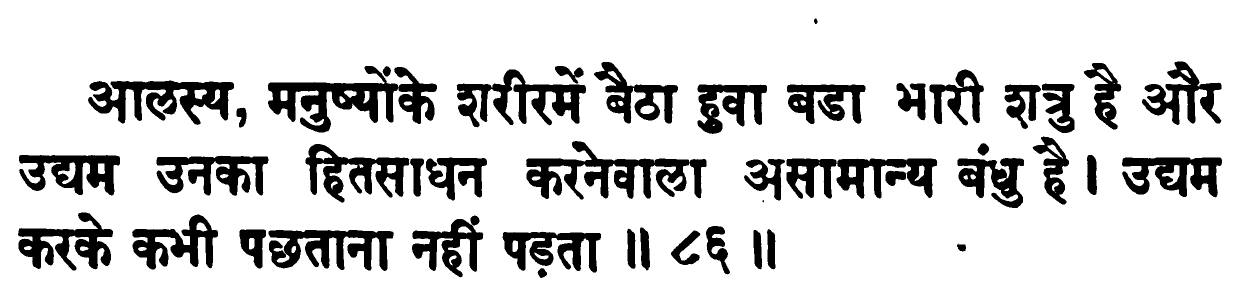
For the point of the stanza compare the well-known English proverb.. "God helps those who help [themselves." Though at first sight this will not appear an exact parallel to the text, yet a little reflection will convince a thoughtful reader of the precies similarity of the powerful thought of the above adage which lays it down that to be active is to secure the help of God, the best of friends.
Gopinath1896
all
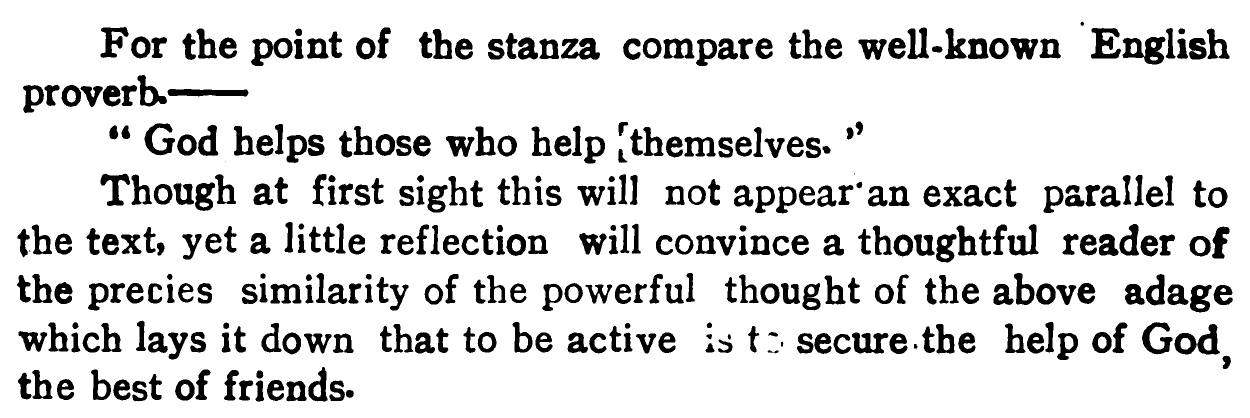
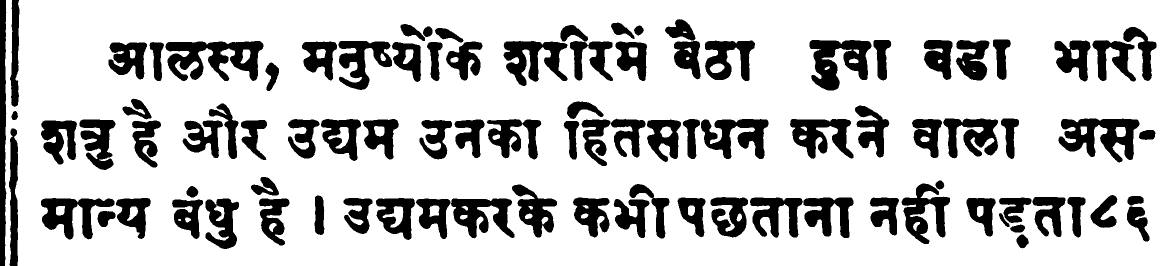
आलस्य, मनुष्यों के शरीर में बैठा हुवा बडा भारी शत्रु है और उद्यम उनका हितसाधन करने वाला असमान्य बंधु है । उद्यमकर के कभी पछताना नहीं पड़ता ८६
Footnote
For the point of the stanza compare the well-known English proverb "God helps those who help themselves." Though at first sight this will not appear an exact parallel to the text, yet a little reflection will convince a thoughtful reader of the precise similarity of the powerful thought of the above adage which lays it down that to be active is to secure the help of God, the best of friends.
Kosambi
all

Footnote
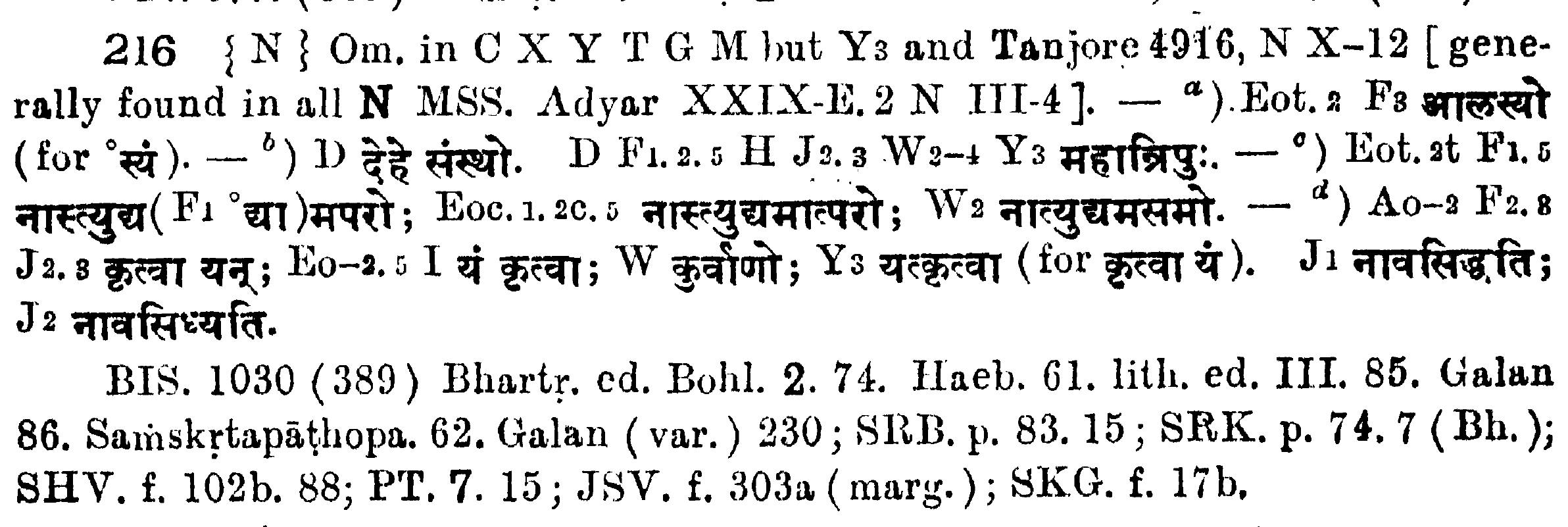
216 { N } Om . in C X Y T GM but Y3 and Tanjore 4916 , N X - 12 [ gene
rally found in all N MSS . Adyar XXIX - E . 2 N III - 4 ] . 2 ) Eot . 2 F3 आलस्यो
( for ° स्यं ) . – ' 6 ' ) ) 1 ) देहे संस्थो . D F1.2.5 H J2 3 W2 - + Y3 महात्रिपुः – ° ) Eot at F1.5
नास्त्युथ ( F1 द्या ) मपरो ; Eoc.1.20.5 नास्त्युद्यमात्परो ; W2 नात्युद्यमसमो . 4 ) A0 – 2 F2 . 8
J2.3 कृत्वा यन् ; Eo - 2.5 I यं कृत्वा ; W कुर्वाणो ; Y3 यत्कृत्वा ( for कृत्वा यं ) . J1 नावसिद्धति ;
J2 नावसिध्यति .
BIS . 1030 ( 389 ) Bhartr . ed . Bohl . 2. 74. Haeb . 61. lith . ed . III . 85. Galan
86. Sanskrtapāthopa . 62. Galan ( var . ) 230 ; SRB p . 83.15 ; SRK . p . 74 ♥ 7 ( Bh . ) ;
SHV . f 102b 88 ; PT . 7. 15 ; JSV . f . 303a ( marg . ) ; SKG . f . 17b .
Commentary