Tawney
Hard is our lot within th' imprisoning womb,
Our youth beset with separation's doom,
Loathsome our age, the theme of woman's mirth,
Say then, ye men, what joy ye find on earth?
Mādhavānanda
कृच्छ्रेणामेध्यमध्ये नियमिततनुभि: स्थीयते गर्भवासे
कान्ताविश्लेषदु:खव्यतिकरविषमो यौवने चोपभोग: ।
वामाक्षीणामवज्ञाविहसितवसतिर्वृद्धभावोऽप्यसाधु:
संसारे रे मनुष्या वदत यदि सुखं स्वल्पमप्यस्ति किंचित् ।।३७।।
37. In the womb man lies within impure matter in discomfort with limbs cramped; in youth enjoyment is tainted with the intense suffering of mental distraction arising from separation from our beloved; even old age (is undesirable), being the object of contemptible laughter from women. (Then) oh men, say if there is a particle of happiness in the world.
[The idea is that none of the stages of life, beginning from the embryo, are worth living, as they are attended with serious drawbacks.]
Telang
all
कृच्छ्रेणामेध्यमध्ये नियमिततनुभिः स्थीयते गर्भमध्ये
कान्ताविश्लेषदुःखव्यतिकरविषमे यौवने विप्रयोगः ।
नारीणामप्यवज्ञा विलसति नियतं वृद्धभावोप्यसाधुः
संसारे रे मनुष्या वदत यदि सुखं स्वल्पमप्यस्ति किंचित् ॥१०६॥


Notes
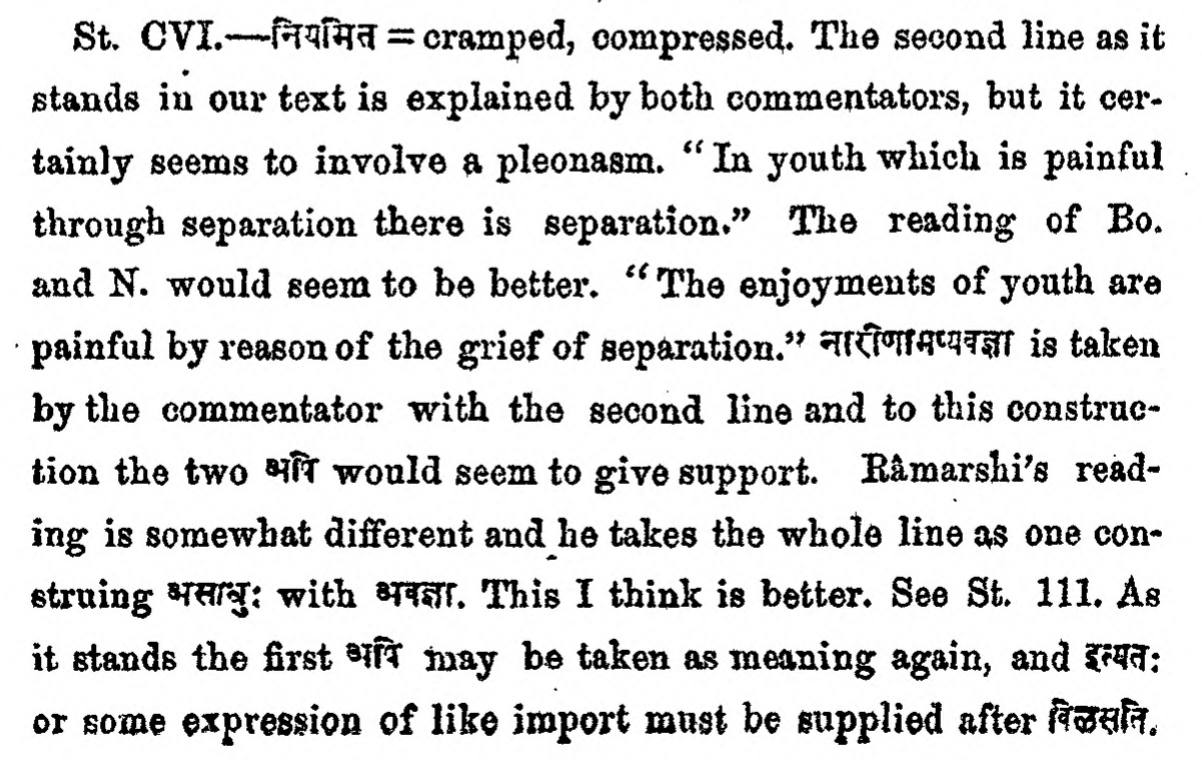
St. CVI.—नियमित = cramped, compressed. The second line as it stands in our text is explained by both commentators, but it certainly seems to involve a pleonasm. “In youth which is painful through separation there is separation.” The reading of Bo. and N. would seem to be better. “The enjoyments of youth are painful by reason of the grief of separation.” नारीणामप्यवज्ञा is taken by the commentator with the second line and to this construction the two अपि would seem to give support. Râmarshi's reading is somewhat different and he takes the whole line as one construing असाधुः with अवज्ञा. This I think is better. See St. 111. As it stands the first अपि may be taken as meaning again, and इत्यतः or some expression of like import must be supplied after विलसति. This construction makes each line contain an assertion and its reason. The commentator would make the third line only a mere assertion without reason assigned.—Sragdharâ.



Kale
all

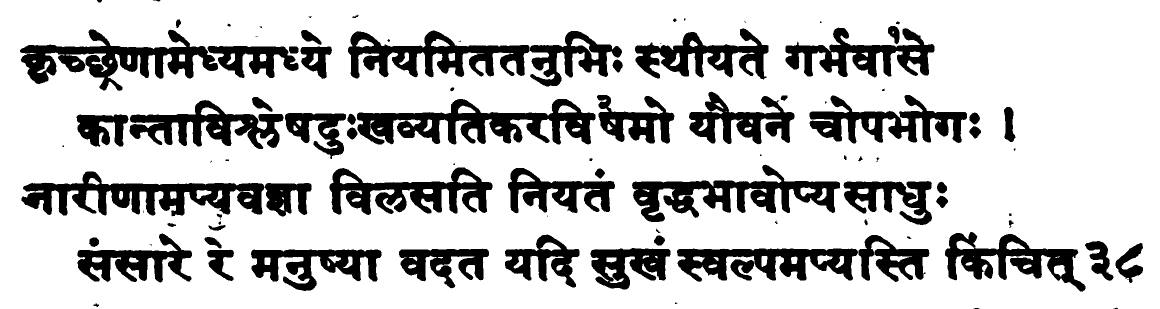
कृच्छ्रेणामेध्यमध्ये नियमिततनुभिः स्थीयते गर्भवासे
कान्ताविश्लेषदुःखव्यतिकरविषमो यौवने चोपभोगः ।
नारीणामप्यवज्ञा विलसति नियतं वृद्धभावोप्यसाधुः
संसारे रे मनुष्या वदत यदि सुखं स्वल्पमप्यस्ति किंचित् ३८
Translation
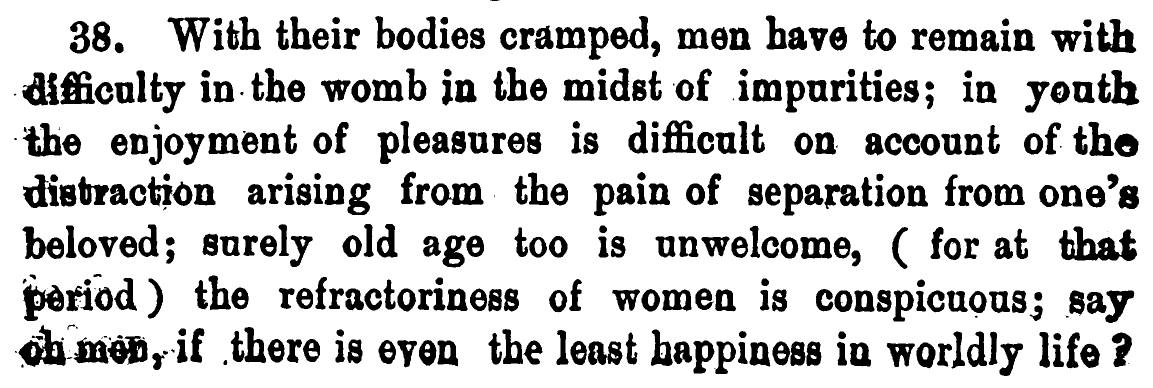
38. With their bodies cramped, men have to remain with difficulty in the womb in the midst of impurities; in youth the enjoyment of pleasures is difficult on account of the distraction arising from the pain of separation from one’s beloved; surely old age too is unwelcome, ( for at that period ) the refractoriness of women is conspicuous; say oh men, if there is even the least happiness in worldly life ?
Notes
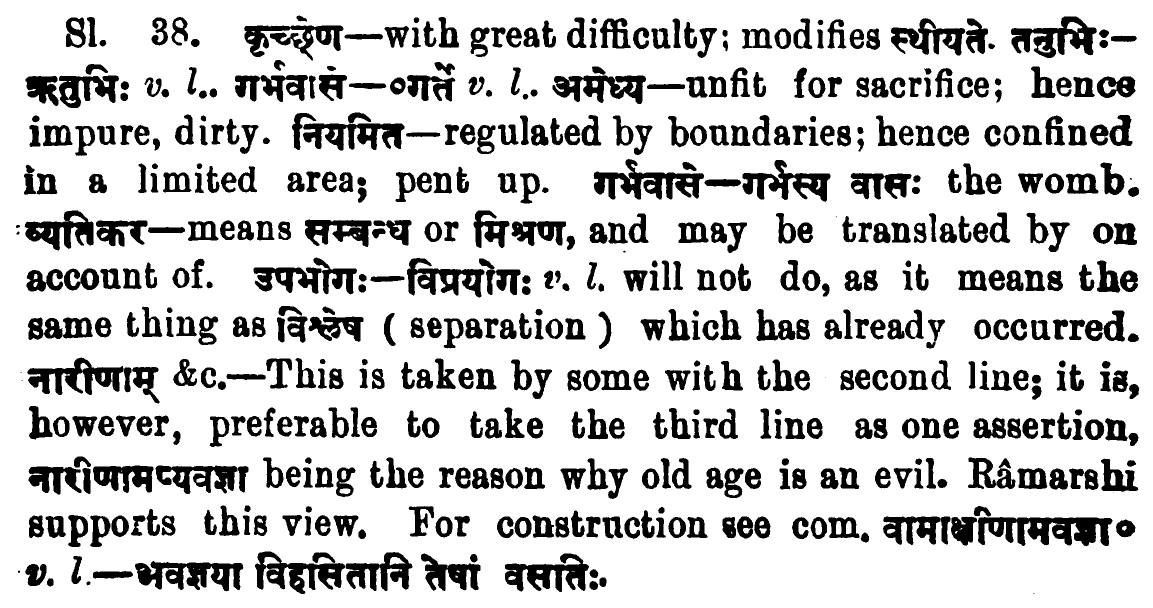
Sl. 38. कृच्छ्रेण—with great difficulty; modifies स्थीयते. तनुभिः— ऋतुभिः v. l.. गर्भवासं—०गर्तें v. l.. अमेध्य—unfit for sacrifice; hence impure, dirty. नियमित—regulated by boundaries; hence confined in a limited area; pent up. गर्भवासे—गर्भस्य वासः the womb. व्यतिकर—means सम्बन्ध or मिश्रण, and may be translated by on account of. उपभोगः—विप्रयोगः v. l. will not do, as it means the same thing as विश्लेष ( separation ) which has already occurred. नारीणाम् &c.—This is taken by some with the second line; it is, however, preferable to take the third line as one assertion, नारीणामप्यवज्ञा being the reason why old age is an evil. Râmarshi supports this view. For construction see com. वामाक्षीणामवज्ञा० v. l.—अवज्ञया विहसितानि तेषां वसतिः.

Gopinath1914
all
नियमिततनुभिः स्थीयते
कृच्छ्रेणामेध्यमध्ये गर्भवासे कान्ताविश्लेषदुःखव्यतिकर विषमे
यौवने विप्रयोगः ॥ नारिणामप्यवज्ञाविलसित-
वृद्धभावोऽप्यसाधुः संसारे रे मनुष्या
वदत वदनो यदि सुखं स्वल्पमप्यस्ति किंचित् ॥ १०५ ॥
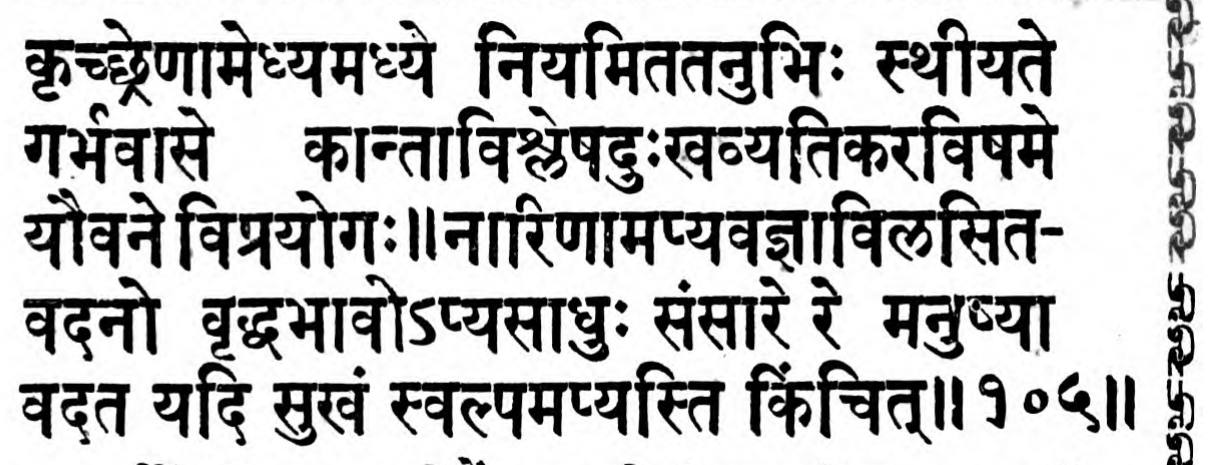
जब गर्भ में निवास करते हैं तब तो विण्मूत्रादियुक्त अपवित्रस्थानमें अपने अंगको संकुचित करके अत्यंत कष्टके साथ रहना पड़ता है, यौवन समय में कान्ताका वियोगरूपी दुःसह दुःख सहना पड़ता है और वृद्धावस्था में सुंदरियोंकी अवज्ञासे मन मलीन होना पड़ता है । इसलिए हे मनुष्यो ! यदि इस संसार में थोड़ासा सुख भी कहीं हो तो बतावो ॥ १०५ ॥
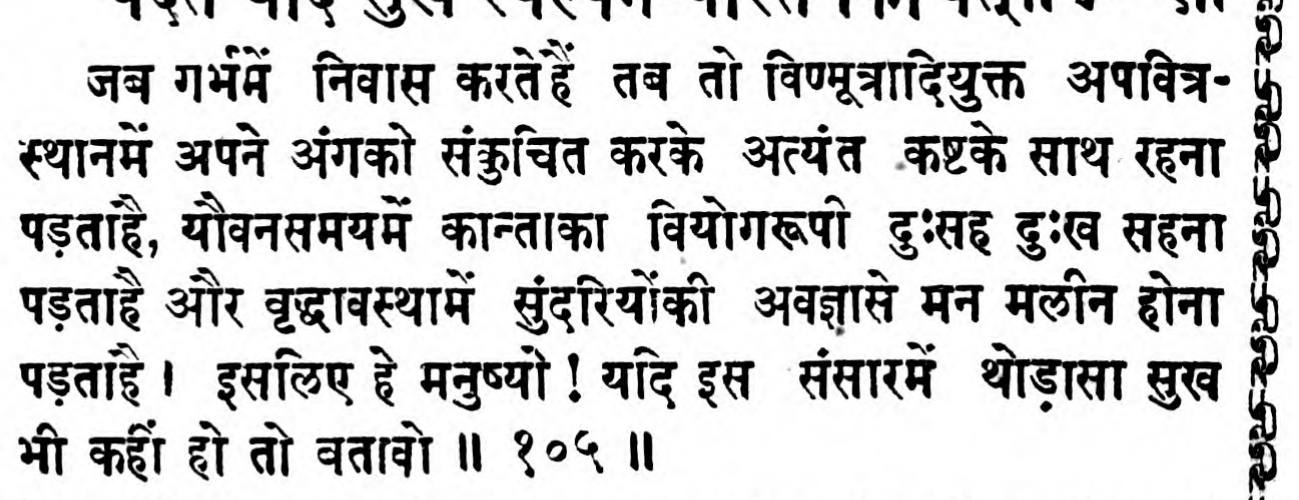
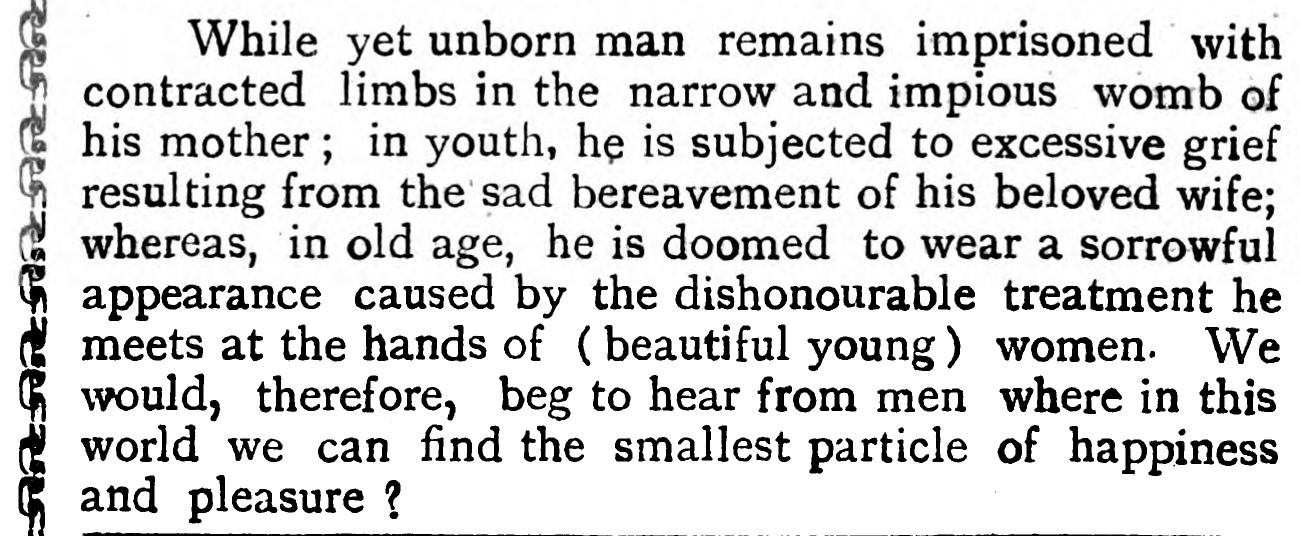
While yet unborn man remains imprisoned with contracted limbs in the narrow and impious womb of his mother; in youth, he is subjected to excessive grief resulting from the sad bereavement of his beloved wife; whereas, in old age, he is doomed to wear a sorrowful appearance caused by the dishonourable treatment he meets at the hands of (beautiful young) women. We would, therefore, beg to hear from men where in this world we can find the smallest particle of happiness and pleasure ?
Footnote
Cf.“ I find in life that suffering succeeds to suffering, and disappointment to disappointment, as wave to wave.' " ( Lord Lytton's Alice or The Mysteries Bk. V. Ch. I.).

Footnote
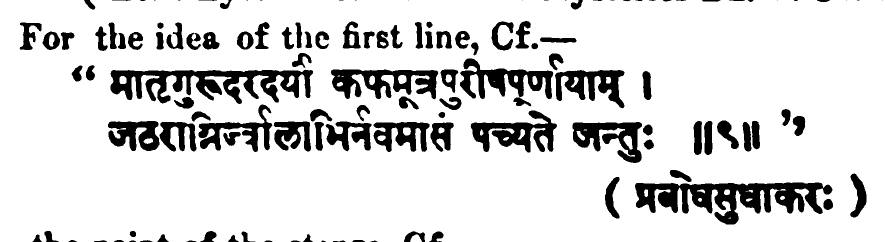
For the " idea of the first line, Cf. मातृगुरूदरदयां कफमूत्रपुरीषपूर्णायाम् । जठराग्निर्ज्यालाभिर्नवमासं पच्यते जन्तुः ॥ ९ ॥" (प्रबोधसुधाकरः )


Gopinath1896
all
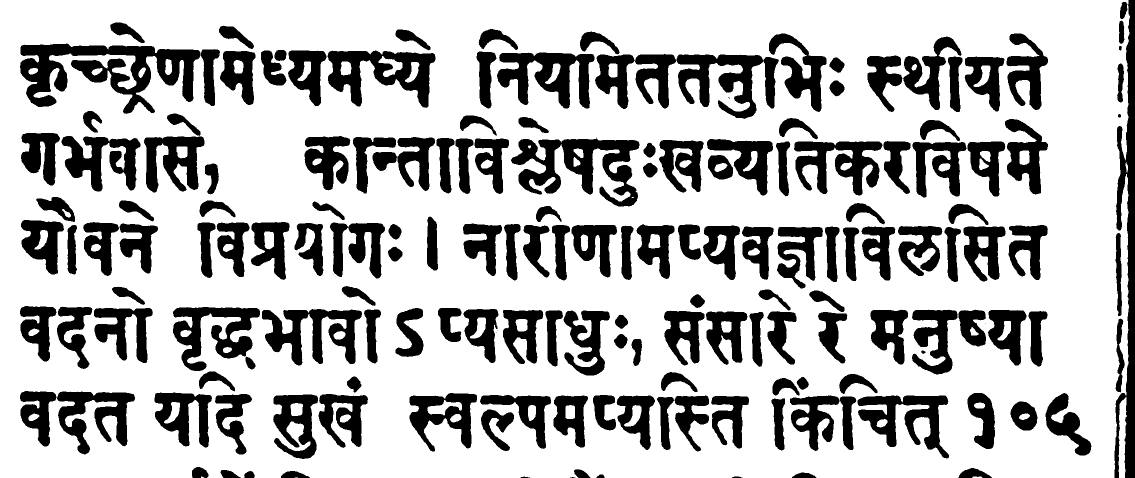
कृच्छ्रेणामेध्यमध्ये नियमिततनुभिः स्थीयते
गर्भवासे, कान्ताविश्लेषदुःखव्यतिकर विषमे
यौवने विप्रयोगः । नारीणामप्यवज्ञाविलसित
वदनो वृद्धभावोऽप्यसाधुः, संसारे रे मनुष्या
वदत यदि सुखं स्वल्पमप्यस्ति किंचित् २०५
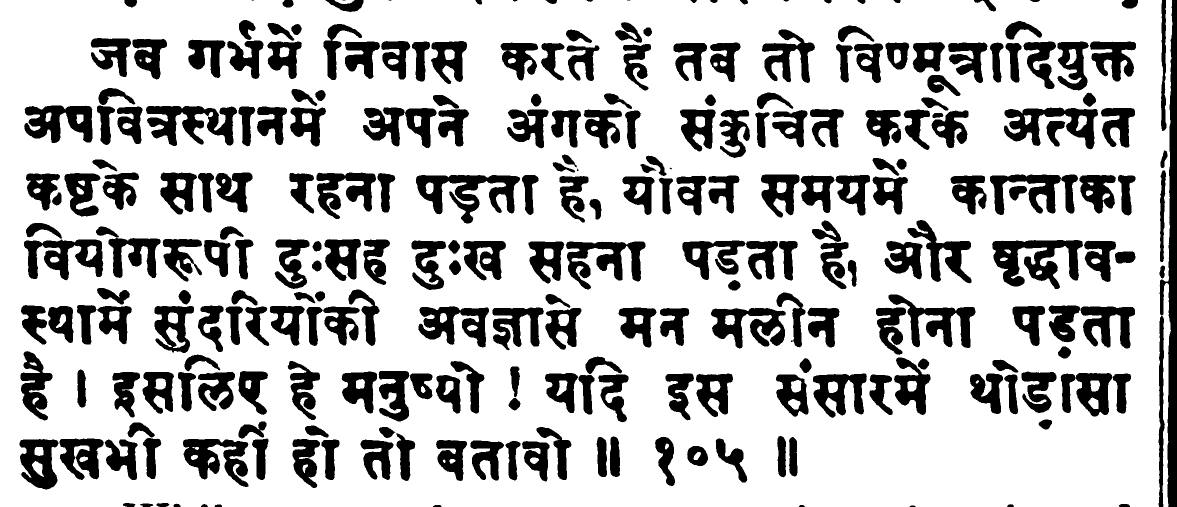
जब गर्भ में निवास करते हैं तब तो विण्मूत्रादियुक्त अपवित्रस्थान में अपने अंगको संकुचित करके अत्यंत कष्ट के साथ रहना पड़ता है, यौवन समय में कान्ताका वियोगरूपी दुःसह दुःख सहना पड़ता है, और वृद्धावस्थामें सुंदरियोंकी अवज्ञासे मन मलीन होना पड़ता है । इसलिए हे मनुष्यो ! यदि इस संसार में थोड़ासा सुखभी कहीं हो तो बतावो ॥ १०५ ॥
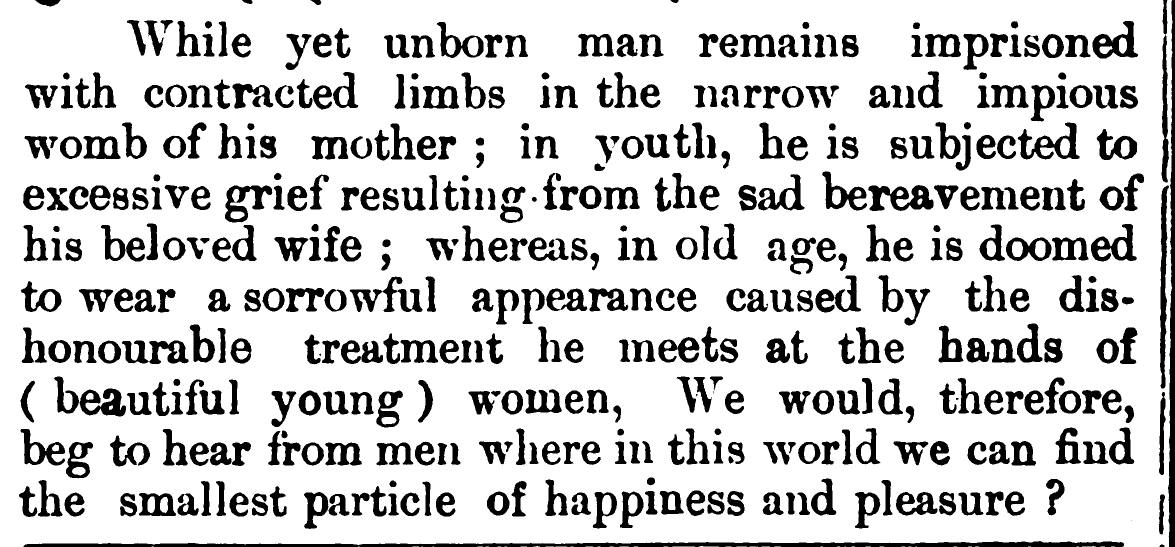
While yet unborn man remains imprisoned with contracted limbs in the narrow and impious womb of his mother; in youth, he is subjected to excessive grief resulting from the sad bereavement of his beloved wife; whereas, in old age, he is doomed to wear a sorrowful appearance caused by the dishonourable treatment he meets at the hands of ( beautiful young ) women, We would, therefore, beg to hear from men where in this world we can find the smallest particle of happiness and pleasure?
Footnote
Cf.—“ I find in life that suffering succeeds to " suffering, and dis appointment to disappointment, as wave to wave. ( Lord Lytton's Alice or The Mysteries Bk. V. Ch. I. ).

Footnote
For the idea of the first line, Cf. -" मातृगुरूदरदय कफमूत्रपुरीषपूर्णायाम् । जठराग्रिलाभिर्नवमासं पच्यते जन्तुः ॥९॥ " (प्रबोधसुधाकरः )

Kosambi
all
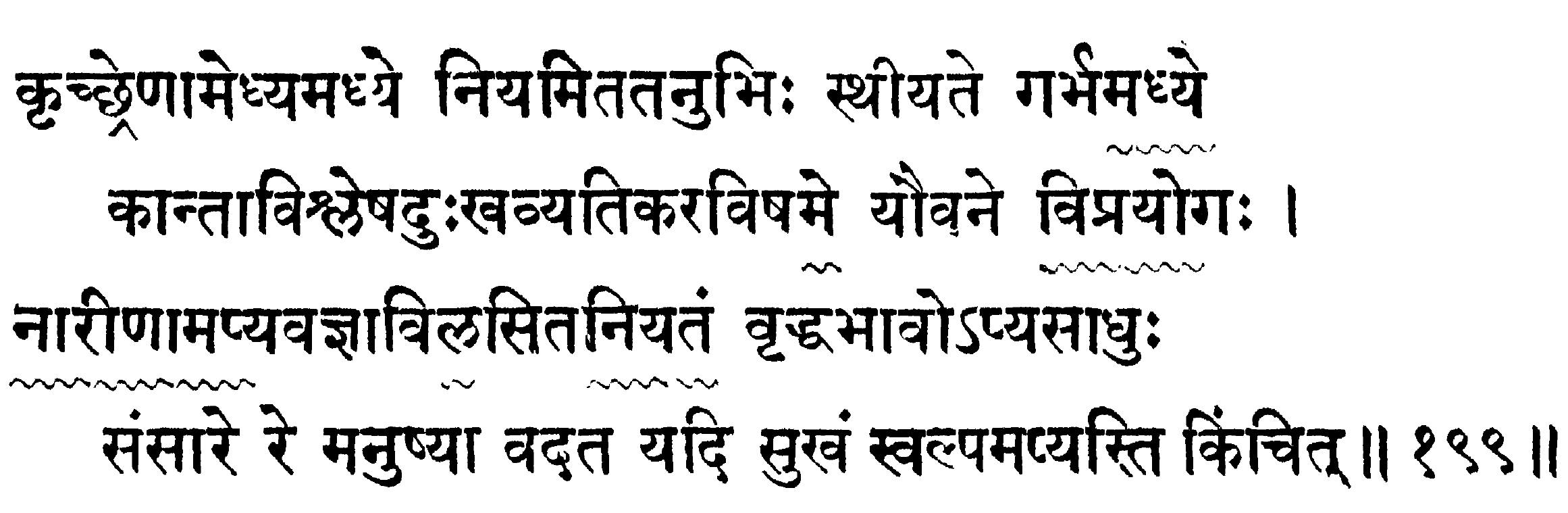
कृच्छ्रेणामेध्यमध्ये नियमिततनुभिः स्थीयते गर्भमध्ये
कान्ताविश्लेषदुःखव्यतिकरविषमे यौवने विप्रयोगः ।
नारीणामप्यवज्ञाविलसितनियतं वृद्धभावोऽप्यसाधुः
संसारे रे मनुष्या वदत यदि सुखं स्वल्पमप्यस्ति किंचित् ॥ १ ९९ ॥
Footnote
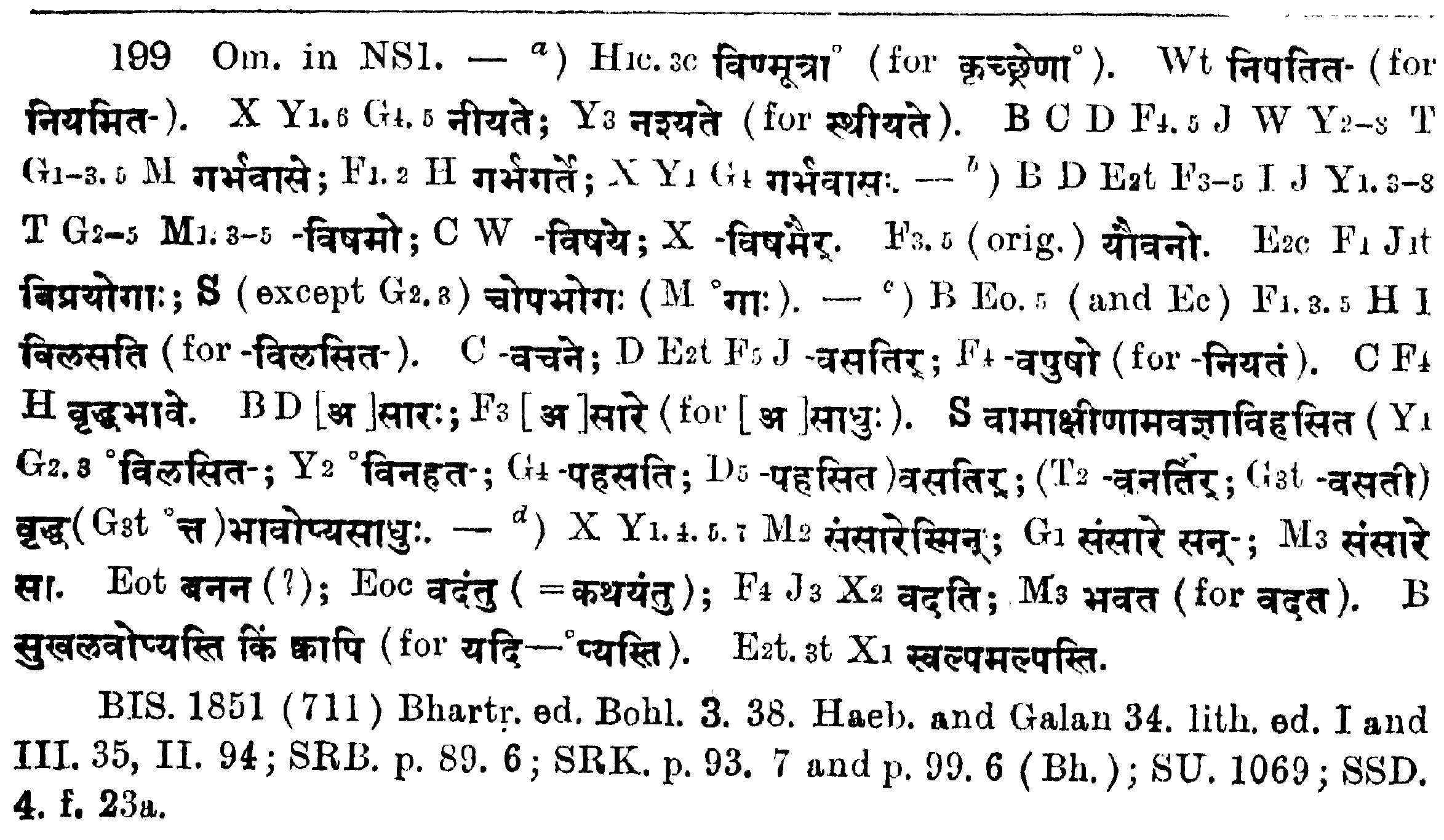
199 Om . in NS1 . a ) H10 . 30 विमूत्रां ' ( for कृच्छ्रणा O ) . Wt निपतित- ( for
नियमित - ) . X Y 1.6 G4.5 नीयते ; Y3 नश्यते ( for स्थीयते ) . BCDF45J W Y2-1 T
( G1 - 3.5 M गर्भवासे ; F1 . 2 H गर्भगर्ते ; X Y1G4 गर्भवासः --- 1 ) B D Eat F3-5 I J X1 . 6–4
T G2 - 5 M1 : 3-5 -विषमो ; CW -विषये ; X -विषमैर् 3.5 ( orig . ) यौवनो . E2c Fi Jit
बिप्रयोगा :; 8 ( except G2 . 3 ) चोपभोगः ( M. गाः ) . © ) B Eo . 5 ( and Ec ) F1 3 5 HI
विलसति ( for- विलसित- ) . C वचने ; D Eat Fs J वसतिर् ; F + वपुषो ( for नियतं ) . CF +
H वृद्धभावे BD [ अ ] सार :; F3 [ अ ] सारे ( for [ अ ] साधु : ) . S वामाक्षीणामवज्ञाविहसित ( Y
G2.8 विलसित ; Y2 " विनहत ; G + पहसति ; 15 - पहसित ) वसतिर् ; ( 12 - वनतिर् ; ( iat - वसती )
वृद्ध ( Gst ' त ) भावोप्यसाधुः . d २ ) X Y1.4.17 M ± संसारेस्मिन् ; G1 G 1 संसारे संसारे सन्- ; M3 संसारे
सा . Eot बनन ( 3 ) ; Eoc वदंतु ( = कथयंतु ) ; F4 J3 X 2 वदति ; M3 भवत ( for वदत ) . B
सुखलवोप्यस्ति किं क्वापि ( for यदि - ० व्यस्ति ) . Eat . st X1 स्वल्पमल्पस्ति .
BIS . 1851 ( 711 ) Bhartr . ed . Bohl . 3. 38. Haeb . and Galan 34. lith . ed . I and
III . 35 , II . 94 ; SRB . p . 89.6 ; SRK . p . 93. 7 and p . 99.6 ( Bh . ) ; SU . 1069 ; SSD .
4. f . 23a .
Commentary