Ryder
ENTER INTO THY CLOSET
Although thou sink to hell, fly through the air,
Or flutter o'er the earth and never cease,
Think not, my soul, to find salvation there:
Remember God at home, who gives thee peace.
Tawney
You mount to heaven, again you sink to hell,
You roam the world around with anxious breast,
And yet not e'en by chance your thought doth dwell
On Him who only gives the spirit rest.
Mādhavānanda
पातालमाविशसि यासि नभो विलङ्घ्य
दिङ्मण्डलं भ्रमसि मानस चापलेन ।
भ्रान्त्यापि जातु विमलं कथमात्मनीनं
न ब्रह्म संस्मरसि निर्वृतिमेषि येन ।।७०।।
70. Being thus agitated, O mind, thou (now) descendest into the nether regions, (now) soarest up beyond the skies, and wanderest all around the four quarters. Why, even by mistake, thou dost not once concentrate on that Brahman, of the nature of Self and bereft of all imperfections, whereby you may attain supreme bliss!
[आत्मनीनम् —means ‘belonging to Self,’ as the real state of Self is Brahman. The other reading, आत्मलीनम्, would mean, ‘submerged in Self,’ being its substance or reality.]
Telang
all
पातालमाविशसि यासि नभो विलङ्घ्य
दिङ्मण्डलं भ्रमसि मानसचापलेन ।
भ्रान्त्यापि जातु विमलं कथमात्मनीनं
तद्ब्रह्म न स्मरसि निर्वृतिमेषि येन ॥ ७७ ॥
Notes
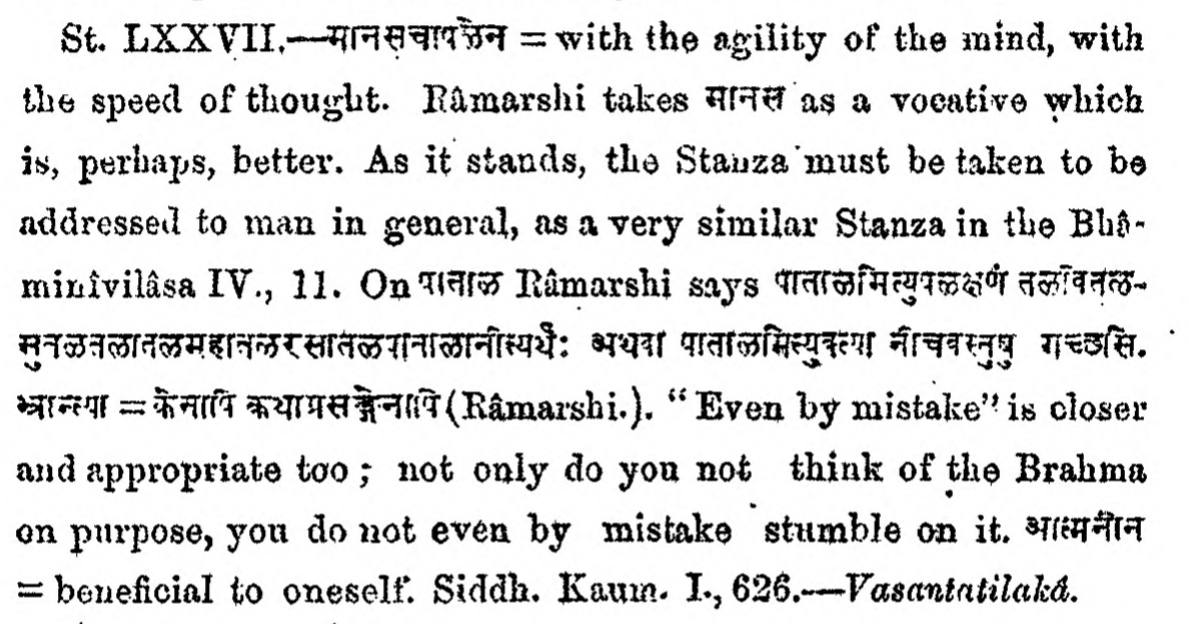
St. LXXVII.—मानसचापलेन = with the agility of the mind, with the speed of thought. Râmarshi takes मानस as a vocative which is, perhaps, better. As it stands, the Stanza must be taken to be addressed to man in general, as a very similar Stanza in the Bhâminîvilâsa IV., 11. On पाताल Râmarshi says पातालमित्युपलक्षणं तलवितलसुतलतलातलमहातलरसातलपातालानीत्यर्थः अथवा पातालमित्युक्त्या नीचवस्तुषु गच्छसि. भ्रान्त्या = केनापि कथाप्रसङ्गेनापि (Râmarshi.). “Even by mistake” is closer and appropriate too; not only do you not think of the Brahma on purpose, you do not even by mistake stumble on it. आत्मनीन = beneficial to oneself. Siddh. Kaum. I., 626.—Vasantatilakâ.

Kale
all

पातालमाविशसि यासि नभो विलङ्घ्य
दिङ्मण्डलं भ्रमसि मानस चापलेन ।
भ्रान्त्यापि जातु विमलं कथमात्मनीनं
तद्ब्रह्म न स्मरसि निर्वृतिमेषि येन ॥ ७१ ॥
Translation
71. O mind with your celerity you dive into the neither world, soar beyond the heavens and wander as far as the encircling directions. How is it that even by mistake you never remember that pure Brahman which is ( always ) beneficial to oneself and by which you attain beatitude?
Notes
Sl. 71. मानस Voc. sing.; some take मानसचापलेन as a comp. meaning 'with the swiftness of thought ( lit. mind ,' and suppose the verse to be addressed to man in general. Râmarshi favours the former view. जातु—with the negative means 'Never.' आत्मनीनम्—आत्मने हितम् tending to one's benefit. आत्मविश्वजनभोगोत्तरपदात् खः । Pân. V. 1. 9. आत्मन् , विश्वजन, and compounds having भोग for their latter member take ख ( ईन ) in the sense of ‘तस्मै हितम्’ as पितृभोगीन &c.



Gopinath1914
all
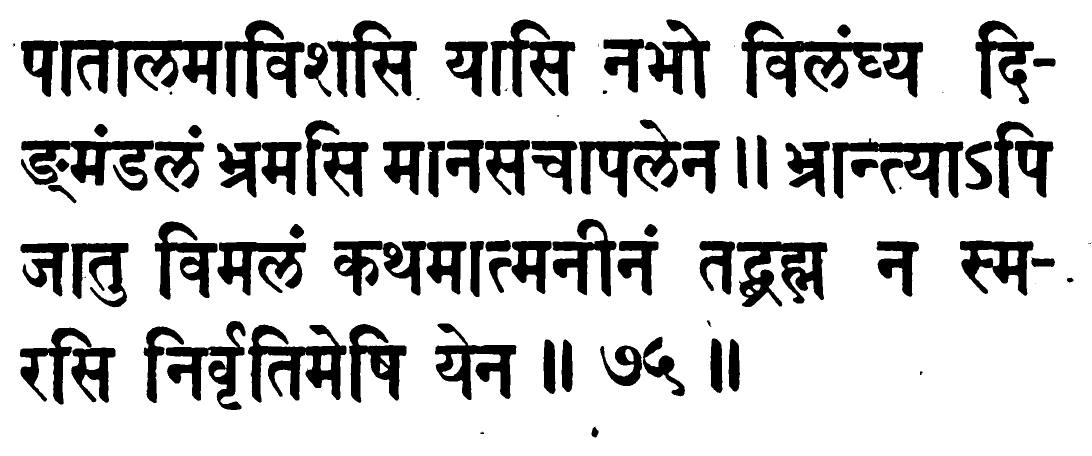
पातालमाविशसि यासि नभो विलंघ्य दि-
मंडलं भ्रमसि मानसचापलेन ॥ भ्रान्त्याऽपि
जातु विमलं कथमात्मनीनं तद्ब्रह्म न स्म
रसि निर्वृतिमेषि येन ॥ ७५ ॥
हे मन ! तू अपनी स्वाभाविक चंचलतासे कभी तो पातालमें 25 प्रवेश कर जाता है, कभी उछल करके आकाशमें गमन करने लगता है और कभी दशों दिशाओंमें इधरका उधर भ्रमण करता फिरता है; परंतु कैसे खेदकी बात है कि तू भूलकर भी उस आत्मप्रकाश परब्रह्मका कभी स्मरण नहीं करता कि जिसके चिन्तवन करनेसे तेरी मोक्ष हो सकती है ! ॥ ७५ ॥
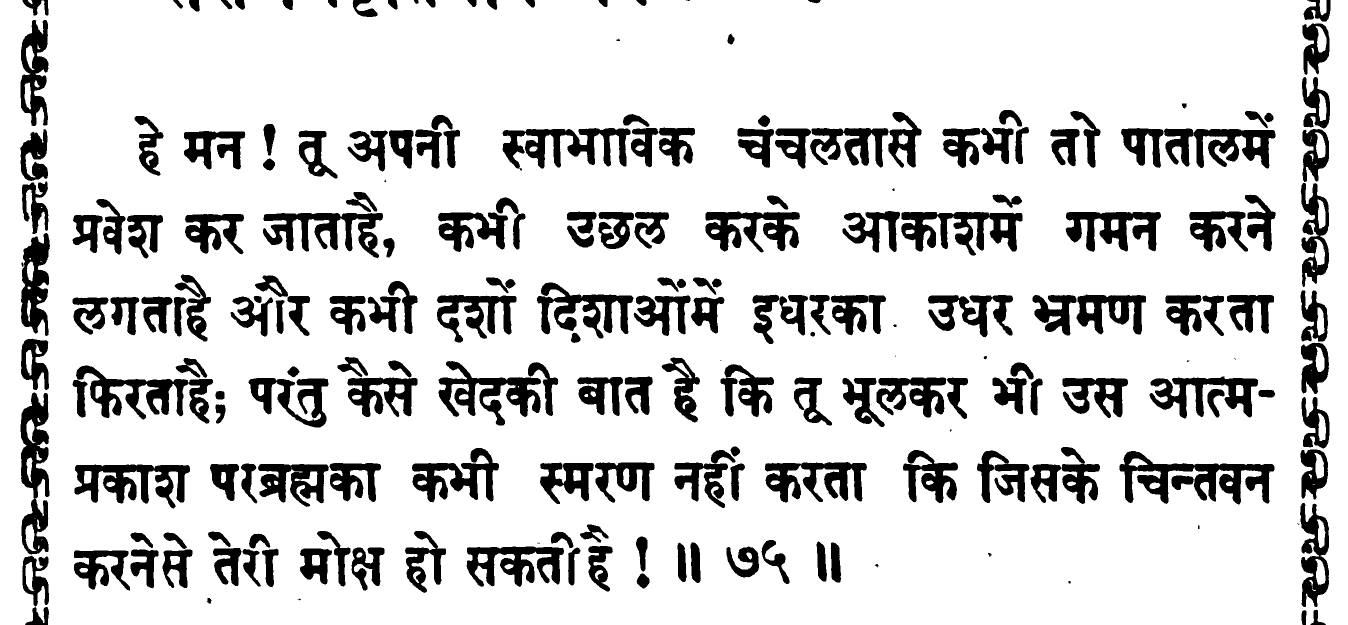
By thy natural unsteadiness sometimes thou penetratest into Pátála ( पाताल ) or the depths of nether regions, sometimes traversest etherial spaces, and sometimes wanderest over different quarters of the globe ; but oh mind ! thou never thinkest, even by mistake, of that supreme Being who is sitting within thy ownself; and by whose meditation thou canst easily attain to the highest contentment and happiness!


Gopinath1896
all
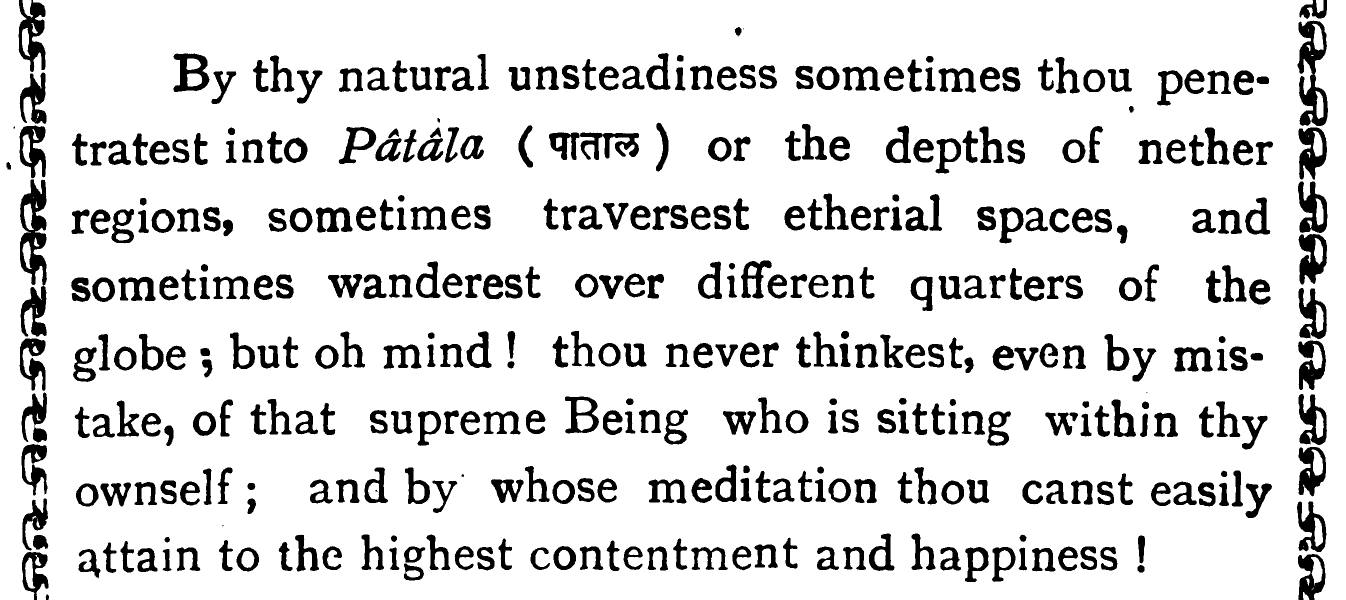
पातालमाविशसि यासि नभो विलंघ्य, दि-
ङ्मडलं भ्रमसि मानसचापलेन । भ्रान्त्याऽपि
जातु विमलं कथमात्मनीनं, तद्ब्रह्म न स्म-
रसि निर्वृति मेषियेन ॥ ७५ ॥
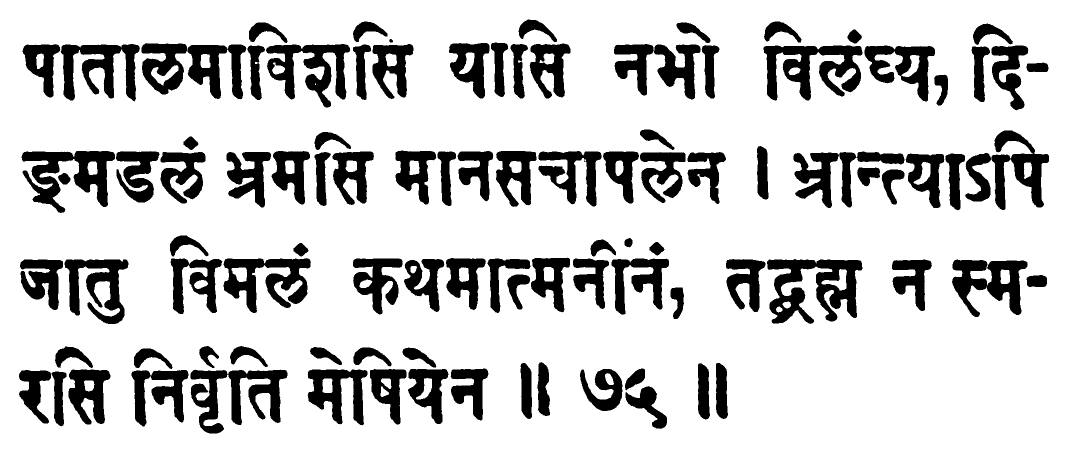
हे मन ! तू अपनी स्वाभाविक चंचलता से कभी तो पाताल में प्रवेश कर जाता है, कभी उछल करके आकाशमें गमन करने लगता है और कभी दशों दिशाओंमें इधरका उधर भ्रमण करता फिरता है; परंतु कैसे खेदकी बात है कि तू भूलकर भी उस आत्मप्रकाश परब्रह्मका कभी स्मरण नहीं करता कि जिसके चिन्तवन करनेसे तेरी मोक्ष हो सकती है ! ॥ ७५ ॥
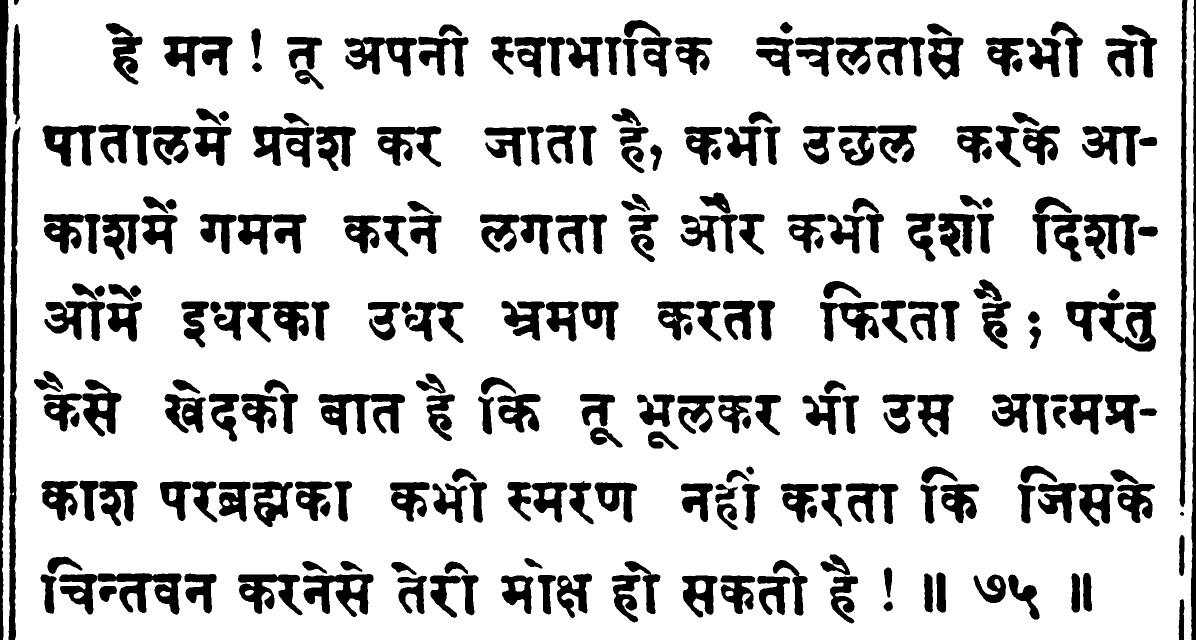
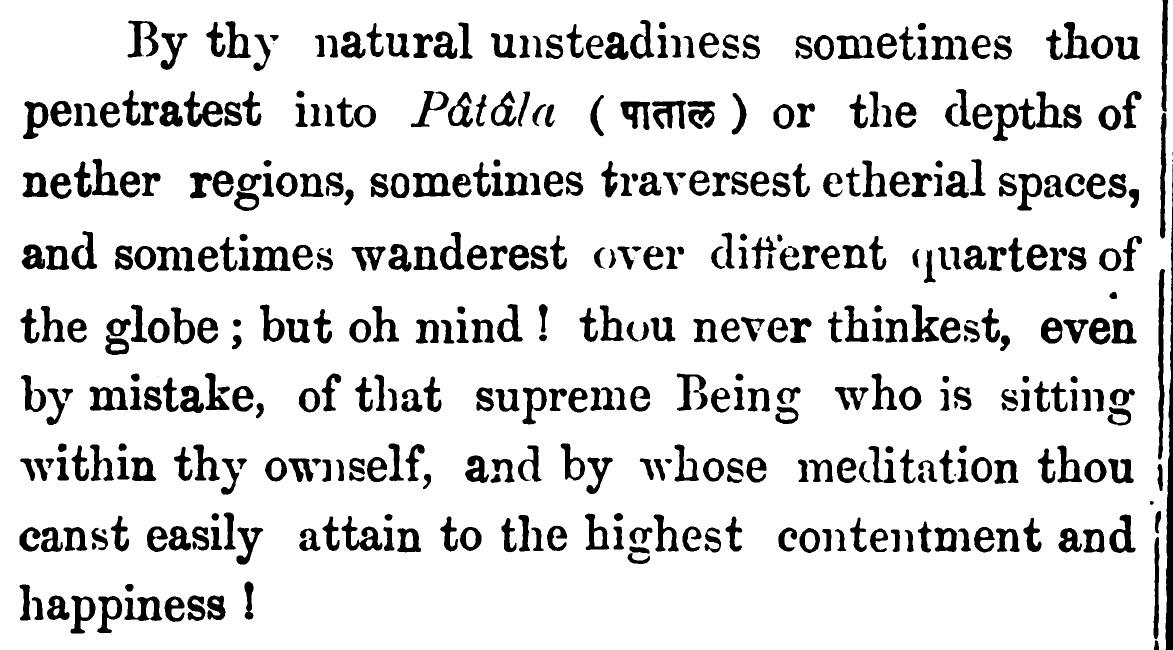
By thy natural unsteadiness sometimes thou penetratest into Pat&la ( पाताल ) or the depths of nether regions, sometimes traversest etherial spaces, and sometimes wanderest over different quarters of the globe ; but oh mind ! thou never thinkest, even by mistake, of that supreme Being who is sitting within thy ownself, and by whose meditation thou canst easily attain to the highest contentment and happiness !
Footnote
The verse is ascribed to lregnate ( अर्गट ) in the Subhashitórali ( सुभाषितावलि) at No. 3447.


Kosambi
all
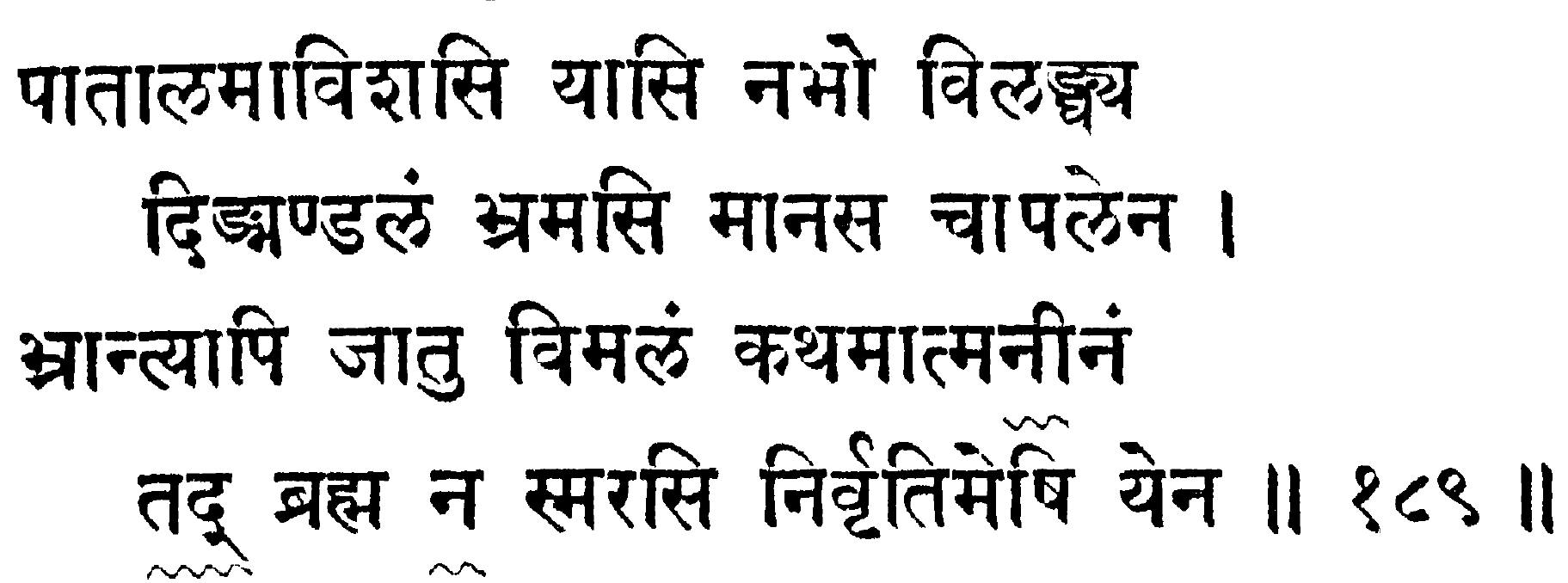
पातालमाविशसि यासि नभो विलय
दिङ्मण्डलं भ्रमसि मानस चापलेन ।
भ्रान्त्यापि जातु विमलं कथमात्मनीनं
तद् ब्रह्म न स्मरसि निर्वृतिमेषि येन ॥ १८ ९ ॥
Footnote
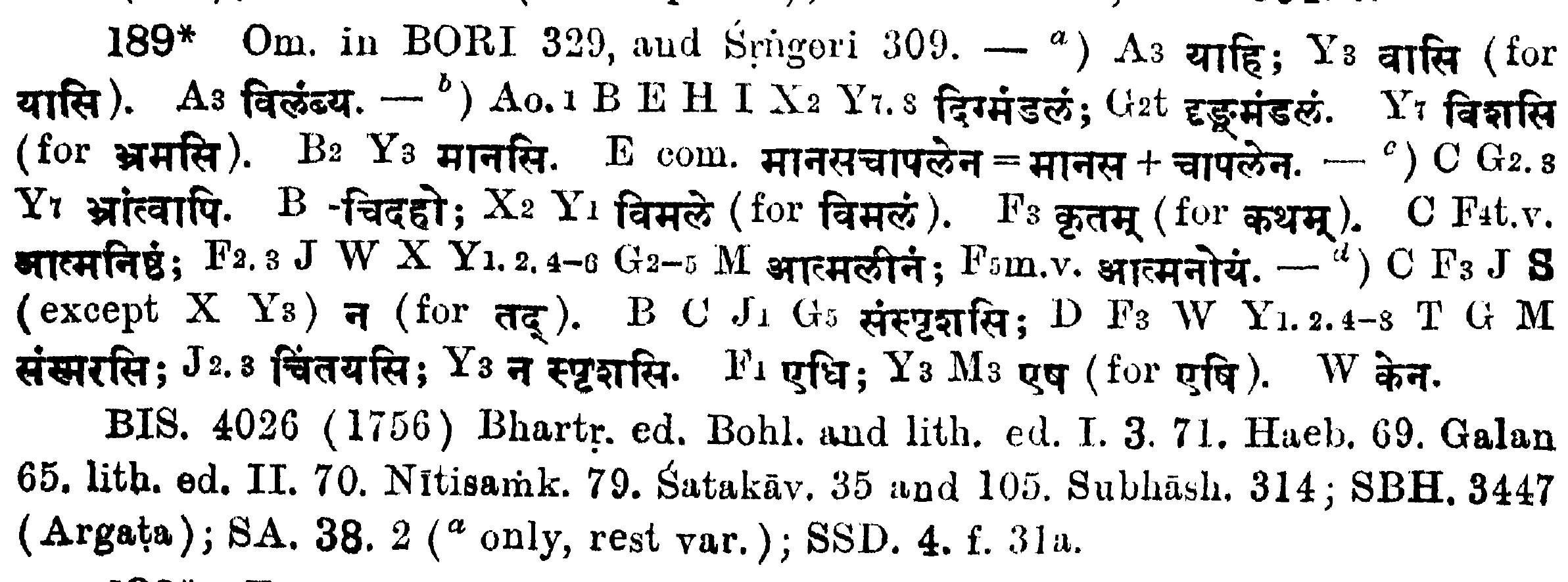
189 * Om . in BORI 329 , aud Srngori 309 . a ) A3 याहि ; Y : वासि ( for
यासि ) . A3 विलंब्य . - 4 ) Ao . 1 BEHI X2 Y7.8 दिग्मंडलं ; Gat ङूमंडलं . Y7 विशसि
( for भ्रमसि ) . B2 Y3 मानसि . E com . मानसचापलेन - - मानस + चापलेन . ° ) C G2 . 3
Y1 भ्रांत्वापि . B -चिदहो ; X 2 Y | विमले ( for विमलं ) . F3 कृतम् ( for कथम् ) . C Ft.v.
आत्मनिष्ठं ; F2 . 3 J W X Y1 . 2. 4 - 0 G2 - 5 M आत्मलीनं ; Fsm.v. आत्मनोयं . – “ ) C F3 JS
( except X Y 3 ) न ( for तद् ) . B C J1G5 संस्पृशसि ; D F3 W Y1.2.4-8 TG_M
संस्मरसि ; J2.3 चिंतयसि ; Y3 न स्पृशसि . I'1 एधि ; Y3 M3 एष ( for एषि ) . W केन .
BIS . 4026 ( 1756 ) Bhartṛ . ed . Bohl . and lith . ed . I. 3. 71. Haeb . 69. Galan
65. lith ed . II . 70. Nitisamk . 79. Satakāv . 35and 105. Subhāsh . 314 ; SBH 3447
( Argata ) ; SA 38. 2 ( º only , rest var . ) ; SSD . 4. f . 31a .
Commentary