Tawney
Pillowed on banks of moss, with roots and berries fed,
Enwound with strips of bark, our wants shall all be sped—
Off to the woodland shades, and gladly leave behind
These men of stammering speech, with wealth-bewildered mind.
Mādhavānanda
पुण्यैर्मूलफलैस्तथा प्रणयिनीं वृत्तिं कुरुष्वाधुना
भूशय्यां नवपल्लवैरकृपणैरुत्तिष्ठ यावो वनम् ।
क्षुद्राणामविवेकमूढमनसां यत्रेश्वराणां सदा
वित्तव्याधिविकारविह्वलगिरां नामापि न श्रूयते ।।२६।।
26. Therefore, now, accepting fruits and roots, ordained as sacred, for the most enjoyable means of maintenance, and (so also) the earth (laid on) with verdant leafy twigs for your bed, oh, rise, let us repair to the forest, where even the name is not heard of the ignoble rich whose minds are stultified by indiscretion and whose speech is constantly delirious with the maladies of wealth.
Telang
all
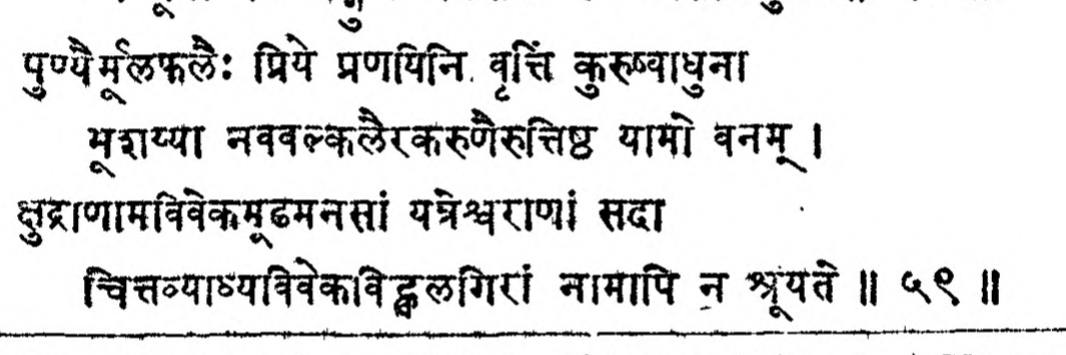
पुण्यैर्मूलफलैः प्रिये प्रणयिनि वृत्तिं कुरुष्वाधुना
भूशय्या नववल्कलैरकरुणैरुत्तिष्ठ यामो वनम् ।
क्षुद्राणामविवेकमूढमनसां यत्रेश्वराणां सदा
चित्तव्याध्यविवेकविह्वलगिरां नामापि न श्रूयते ॥ ५९ ॥
Notes
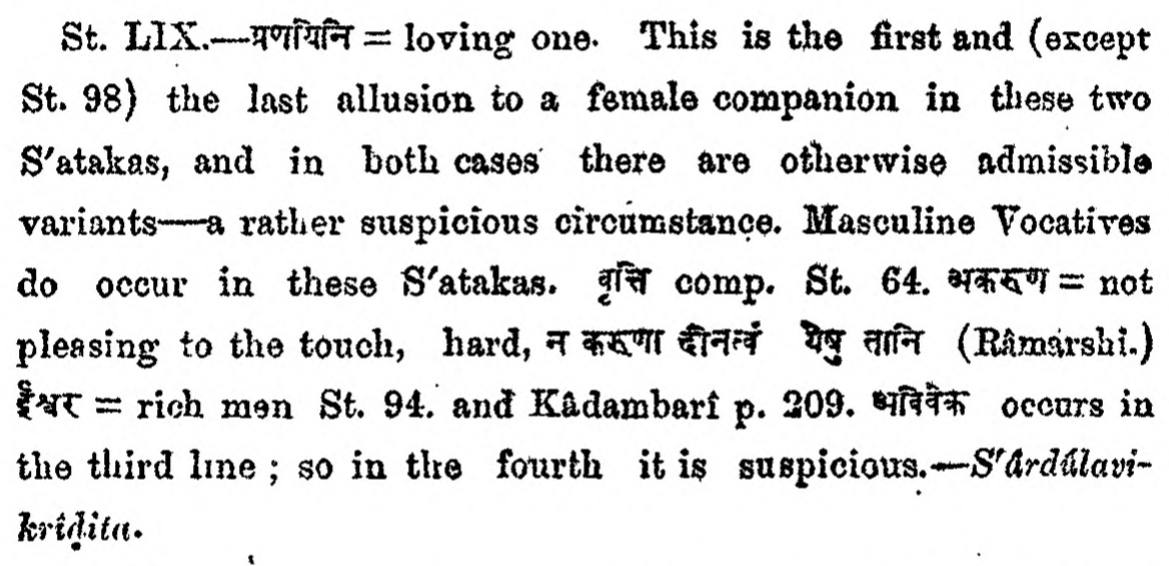
St. LIX.—प्रणयिनि = loving one. This is the first and (except St. 98) the last allusion to a female companion in these two S'atakas, and in both cases there are otherwise admissible variants—a rather suspicious circumstance. Masculine Vocatives do occur in these S'atakas. वृत्ति comp. St. 64. अकरुण = not pleasing to the touch, hard, न करुणा दीनत्वं येषु तानि (Râmarshi.) ईश्वर = rich men St. 94. and Kâdambarî p. 209. अविवेक occurs in the third line ; so in the fourth it is suspicious.—S'ârdûlavikrîḍita.

Kale
all

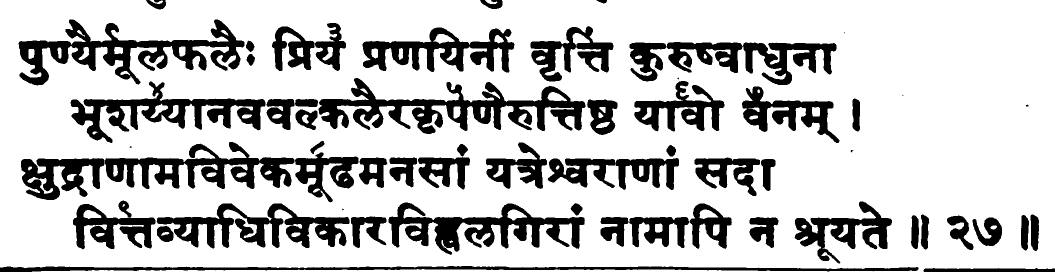
पुण्यैर्मूलफलैः प्रिय प्रणयिनीं वृत्तिं कुरुष्वाधुना
भूशय्यानववल्कलैरकृपणैरुत्तिष्ठ यावो वनम् ।
क्षुद्राणामविवेकमूढमनसां यत्रेश्वराणां सदा
वित्तव्याधिविकारविह्वलगिरां नामापि न श्रूयते ॥ २७ ॥
Translation
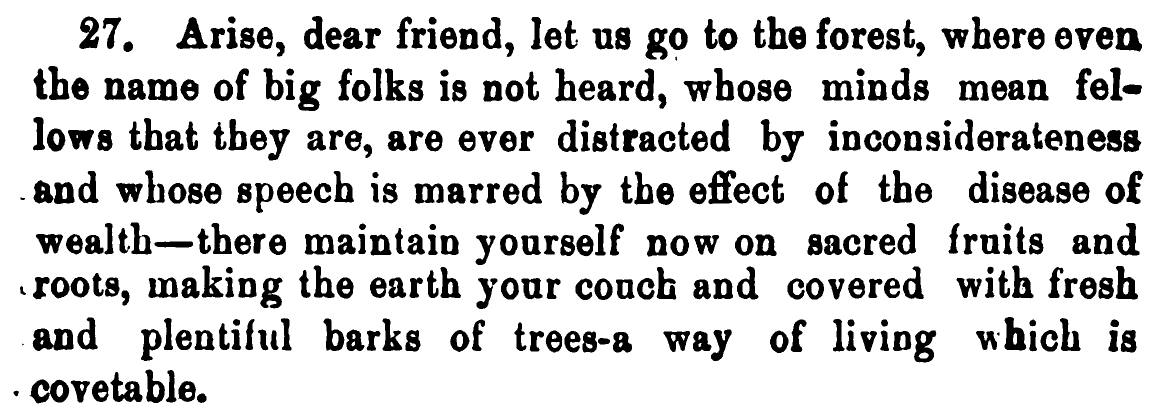
27. Arise, dear friend, let us go to the forest, where even the name of big folks is not heard, whose minds mean fellows that they are, are ever distracted by inconsiderateness and whose speech is marred by the effect of the disease of wealth—there maintain yourself now on sacred fruits and roots, making the earth your couch and covered with fresh and plentiful barks of trees-a way of living which is covetable.
Notes
Sl 27. The reading प्रिय has been adopted in this ed. instead of प्रिये, as mas. vocatives often occur, while a female is rarely addressed in this Sátaka. प्रणयिनि violates the metre. प्रणयिनीं—must be taken with वृत्ति some how. Another reading is प्रियैश्च सलिलैः; but this, too, is not satisfactory, as there is no propriety of प्रियैः. अकरुण v. l.—not pleasing, harsh to the touch; rough. यामः is replaced by यावः which is found in one ed. ईश्वराणां—goes with नामापि, and means ‘of rich people’; cf. ( Mis. sl. 11.) वित्त &c.—विकाराः such as rudeness, vanity &c. Mr. Telang’s reading is चित्तव्याधि which is redundant as we have already got विवेकमूढ. For the idea cf. Mis. sl. 32.







Gopinath1914
all
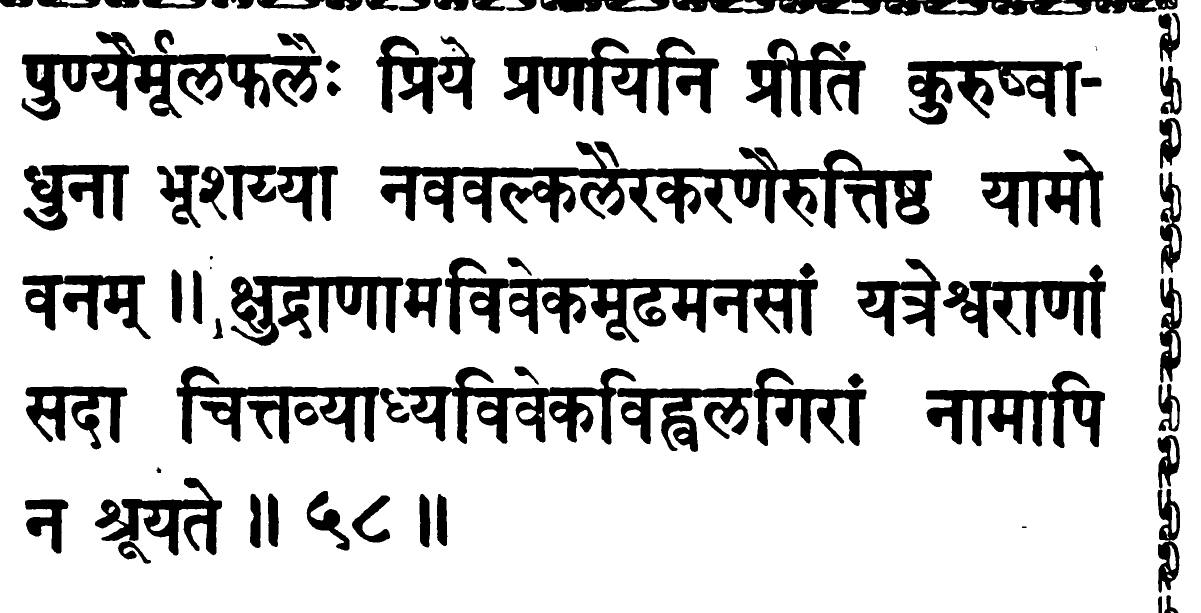
पुण्यैर्मूलफलैः प्रिये प्रणयिनि प्रीतिं कुरुष्वा-
धुना भूशय्या नववल्कलैरकरणैरुत्तिष्ठ यामो
वनम् ॥ क्षुद्राणामविवेकमूढमनसां यत्रेश्वराणां
सदा चित्तव्याध्यविवेकविह्वल गिरां नामापि
न श्रूयते ॥ ५८ ॥
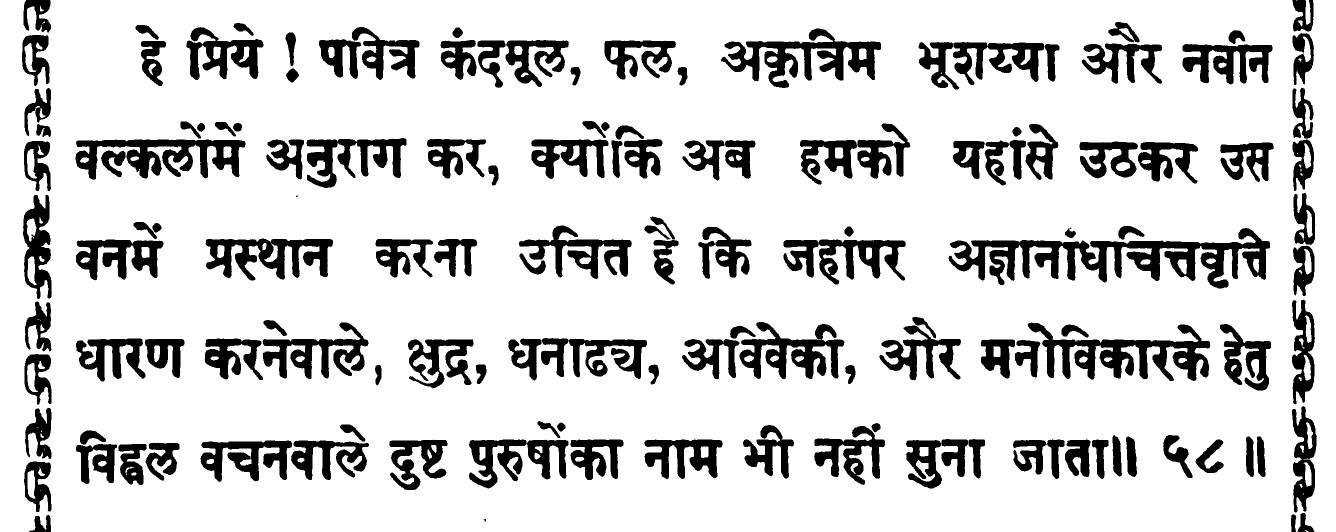
हे प्रिये ! पवित्र कंदमूल, फल, अकृत्रिम भूशय्या और नवीन वल्कलोंमें अनुराग कर, क्योंकि अब हमको यहांसे उठकर उस वनमें प्रस्थान करना उचित है कि जहांपर अज्ञानांधचित्तवृत्ि धारण करनेवाले, क्षुद्र, धनाढ्य, अविवेकी, और मनोविकारके हेतु विह्वल वचनवाले दुष्ट पुरुषोंका नाम भी नहीं सुना जाता ॥ ५८ ॥
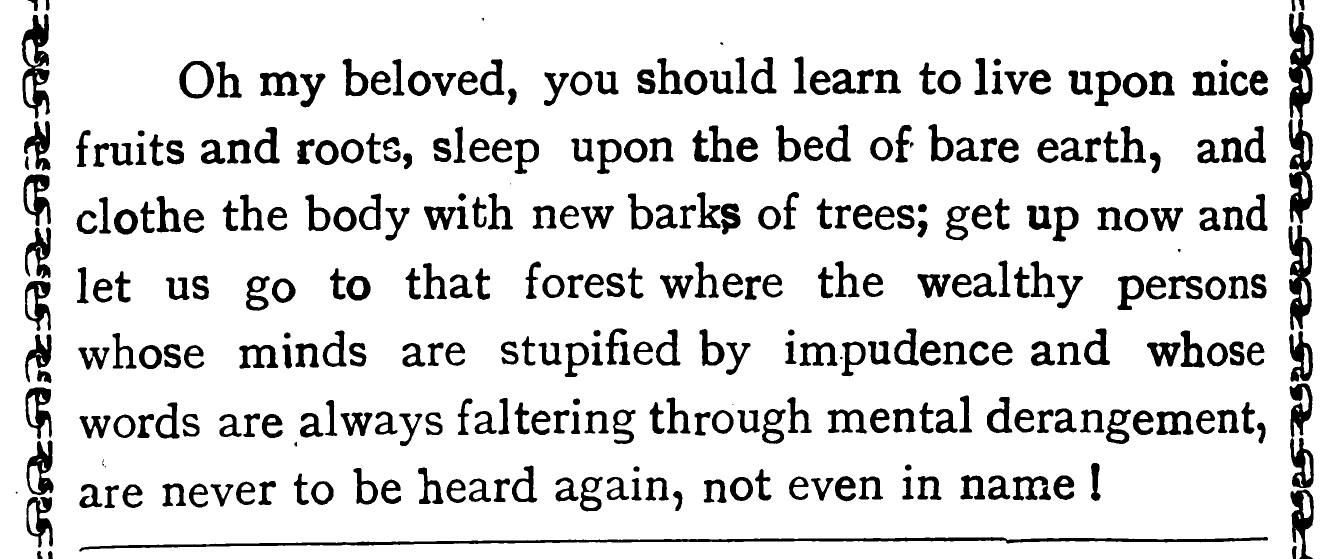
Oh my beloved, you should learn to live upon nice fruits and roots, sleep upon the bed of bare earth, and clothe the body with new barks of trees; get up now and let us go to that forest where the wealthy persons whose minds are stupified by impudence and whose words are never are to always be heard faltering againthrough , not even mental in namederangement! ,

Gopinath1896
all
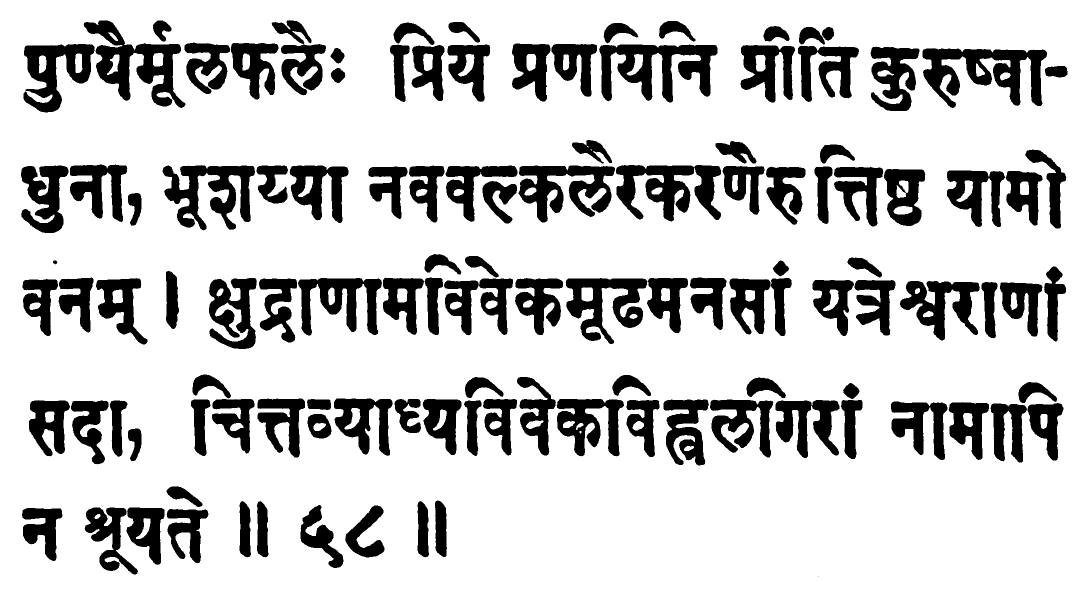
पुण्यैर्मूलफलैः प्रिये प्रणयिनि प्रीतिं कुरुष्वा-
धुना, भूशय्या नववल्कलैरकरणैरुत्तिष्ठ यामो
वनम् । क्षुद्राणामविवेकमूढमनसां यत्रेश्वराणां
सदा, चित्तव्याध्यविवेकविह्वलींगरां नामापि
न श्रूयते ॥ ५८ ॥
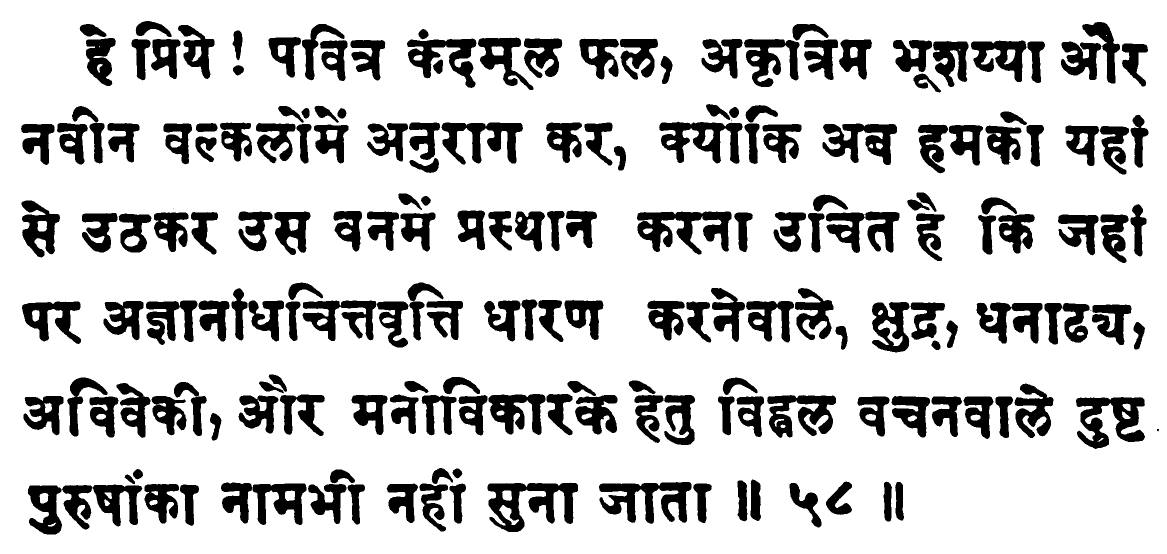
हे प्रिये ! पवित्र कंदमूल फल, अकृत्रिम भूशय्या और नवीन वल्कलों में अनुराग कर, क्योंकि अब हमको यहां से उठकर उस वनमें प्रस्थान करना उचित है कि जहां पर अज्ञानांधचित्तवृत्ति धारण करनेवाले, क्षुद्र, धनाढ्य, अविवेकी, और मनोविकार के हेतु विह्वल वचनवाले दुष्ट पुरुषोंका नामभी नहीं सुना जाता ॥ ५८ ॥
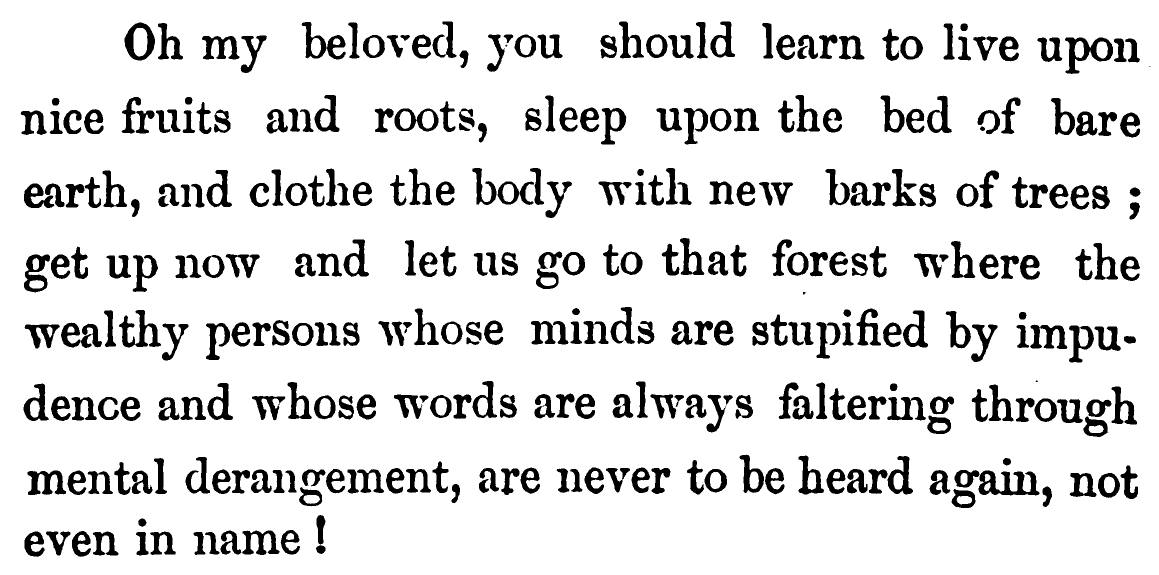
Oh my beloved, you should learn to live upon nice fruits and roots, sleep upon the bed of bare earth, and clothe the body with new barks of trees; get up now and let us go to that forest where the wealthy persons whose minds are stupified by impudence and whose words are always faltering through mental derangement, are never to be heard again, not even in name !

Kosambi
all
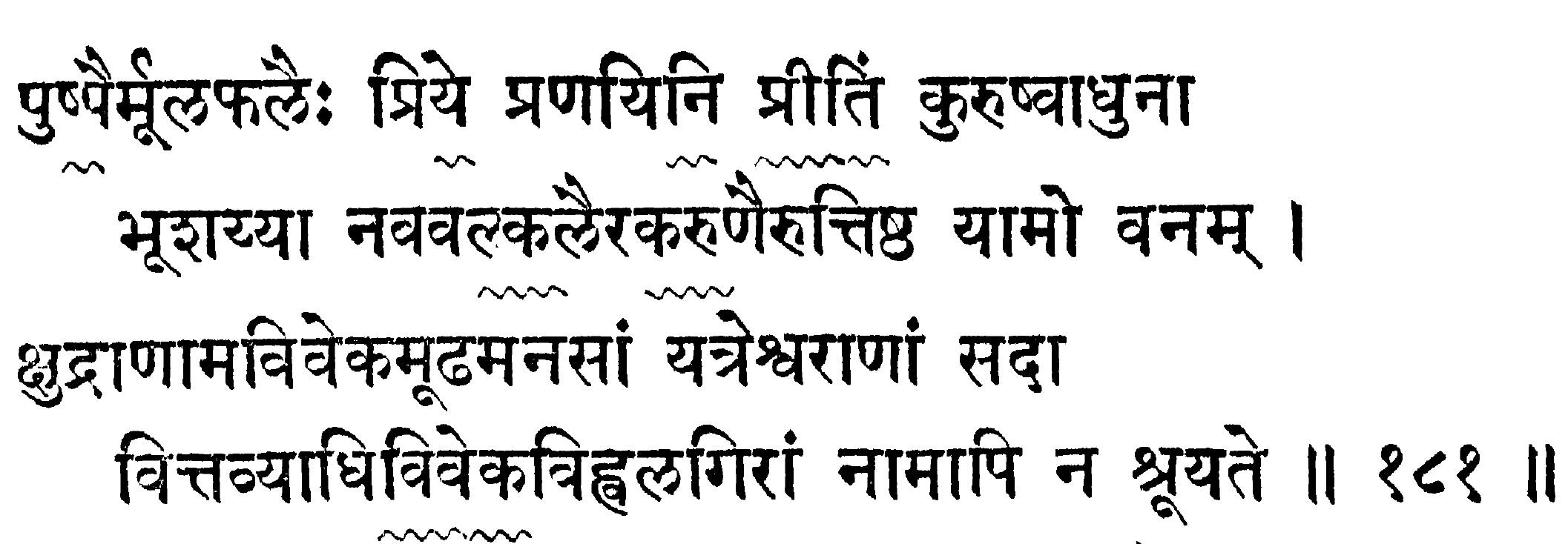
पुष्पैर्मूलफलैः प्रिये प्रणयिनि प्रीतिं कुरुष्वाधुना
भूशय्या नववल्कलैरकरुणैरुत्तिष्ठ यामो वनम् ।
क्षुद्राणामविवेकमूढमनसां यत्रेश्वराणां सदा
वित्तव्याधिविवेकविह्वलगिरां नामापि न श्रूयते ॥ १८१ ॥
Footnote
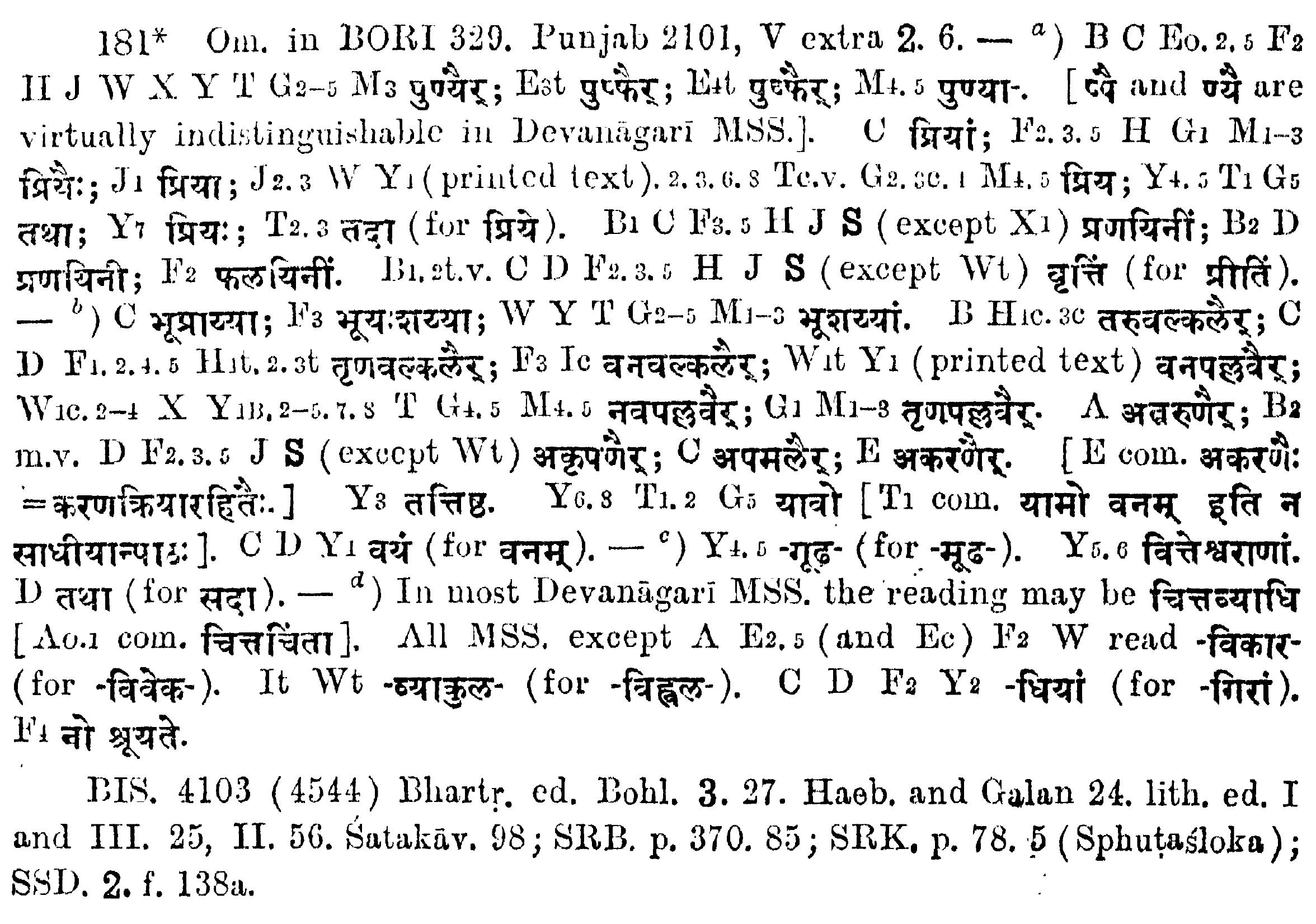
181 * Om . in BORI 329. Punjab 2101 , V extra 2. 6 . a ) B C Eo . 2. 5 Fa
II J W X Y T G2–5 M3 पुण्यैर् ; Est पुप्फैर् ; Dit पुर ; M 4.5 पुण्या . [ ट्वै and ण्यै are
virtually indistinguishable in Devanagari MSS . ) . C प्रियां ; 13.35 H G1 M1 - 3
प्रियैः ; J1 प्रिया ; J2 . 3 W X 1 ( printed text ) . 2.3.6.8 Te.v. G2.1M . प्रिय ; ; Y + 5T1G5
तथा ; Y1 प्रियः ; T2 . 3 तदा ( for प्रिये ) . B1CF5HJS ( except X 1 ) प्रणयिनीं ; B2 D
प्रणयिनी ; 12 फलयिनीं . Biatv . C D F 2.3.6 H J S ( except Wt ) वृत्तिं ( for प्रीतिं ) .
b ) भूप्राय्या ; 13 भूयः शय्या ; W Y T G2 - 5 M1 - 3 भूशय्यां B Hic . 30 तरुवल्कलैर् ; C
D F1.2.1.6 Hit . 2.3t तृणवल्कलैर् ; 3 Ie वनवल्कलैर ; Wit Yi ( printed text ) वनपल्लवैर ;
7 W1c.2–4_X_Y1B , 2–6,78 TG + 5 M45 नवपल्लवैर् ; Q1 M1-3 तृणपलवैर् A अतरुणैर् ; ; Ba
m.v. D F2.3.6_J S ( execpt Wt ) अकृपणैर् ; अपमलैर् ; E E अकरणैर् [ Ecom . अकरणैः
M = करणक्रियारहितै :. ] Y3 तत्तिष्ठ . Yo . 8 T1.2 G5 यात्रो [ T1 com . यामो वनम् इति न
साधीयान्पा : ] CD Y1 वयं ( for वनम् ) . – ° ) Y X 1.6 - गूढ़ - ( for -मूढ- ) . Y० . ० वित्तेश्वराणां .
ID तथा ( for सदा ) . – a 4 ) ) In most Devanagari Mss . the reading may be चित्तव्याधि
[ 10.1 com . चित्तचिंता ] . All MSS . except A E25 ( and Ec ) F2 W read -विकार
( for - विवेक - ) . It Wt - व्याकुल- ( for -विह्वल ) . C D F2 Y2 - धियां ( for -गिरां ) .
11 नो श्रूयते .
BIS . 4103 ( 4544 ) Bhartṛ , ed . Bohl . 3. 27. Haeb , and Galan 24. lith . ed . I
and III . 25 , II . 56. Satakāv . 98 ; SRB . p . 370 83 ; SRK . p . 78. 5 ( Sphutaśloka ) ;
SSD . 2. f . 138a .
Commentary