Tawney
To roam some woodland hermitage where Brahmans' chants resound,
And smoke of sacrificial fires blackens the trees around,
Begging one's bread from cell to cell, plants in the breast no thorns.
Like living poor amongst one's kin, bearing their hourly scorns.
Mādhavānanda
पुण्ये ग्रामे वने वा महति सितपटच्छन्नपालिं कपालिं
ह्यादाय न्यायगर्भद्विजहुतहुतभुग्धूमधूम्रोपकण्ठे ।
द्वारं द्वारं प्रविष्टो वरमुदरदरीपूरणाय क्षुधार्तो
मानी प्राणै: सनाथो न पुनरनुदिनं तुल्यकुल्येषु दीन: ।।२३।।
23. For the sake of filling the cavity of the stomach when hungry, a man of self-respect would wander from door to door with an earthen begging bowl (in hand) having its edge covered with white cloth, away in extensive woodlands or holy places, the outskirts of which are grey all over with the smoke of sacrificial fires tended by Brāhmanas versed in ritualistic niceties, and thus preserve the prāṇas, rather than live (like) a beggar from day to day among those who are socially equals.
[It should be remembered that living on alms for a man of true renunciation is held in high esteem in India, for no social merit can be higher than giving up the world for the sake of the national ideal of spirituality.
Woodlands—where recluses live.
Covered, etc.—this seems to have been the custom, to prevent the food from being seen by passers-by.]
Telang
all
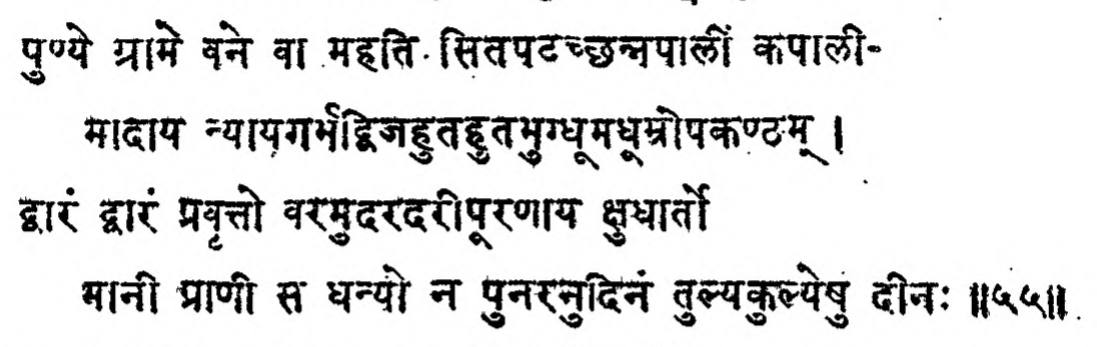
पुण्ये ग्रामे वने वा महति सितपटच्छन्नपालीं कपाली-
मादाय न्यायगर्भद्विजहुतहुतभुग्धूमधूम्रोपकण्ठम् ।
द्वारं द्वारं प्रवृत्तो वरमुदरदरीपूरणाय क्षुधार्तो
मानी प्राणी स धन्यो न पुनरनुदिनं तुल्यकुल्येषु दीनः ॥५५॥
Notes
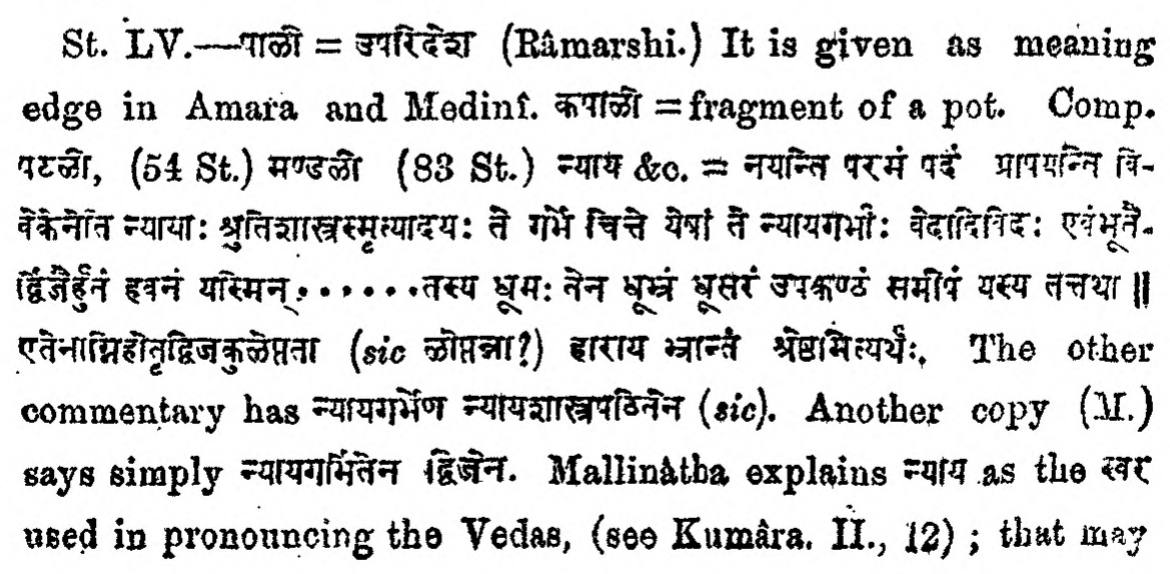
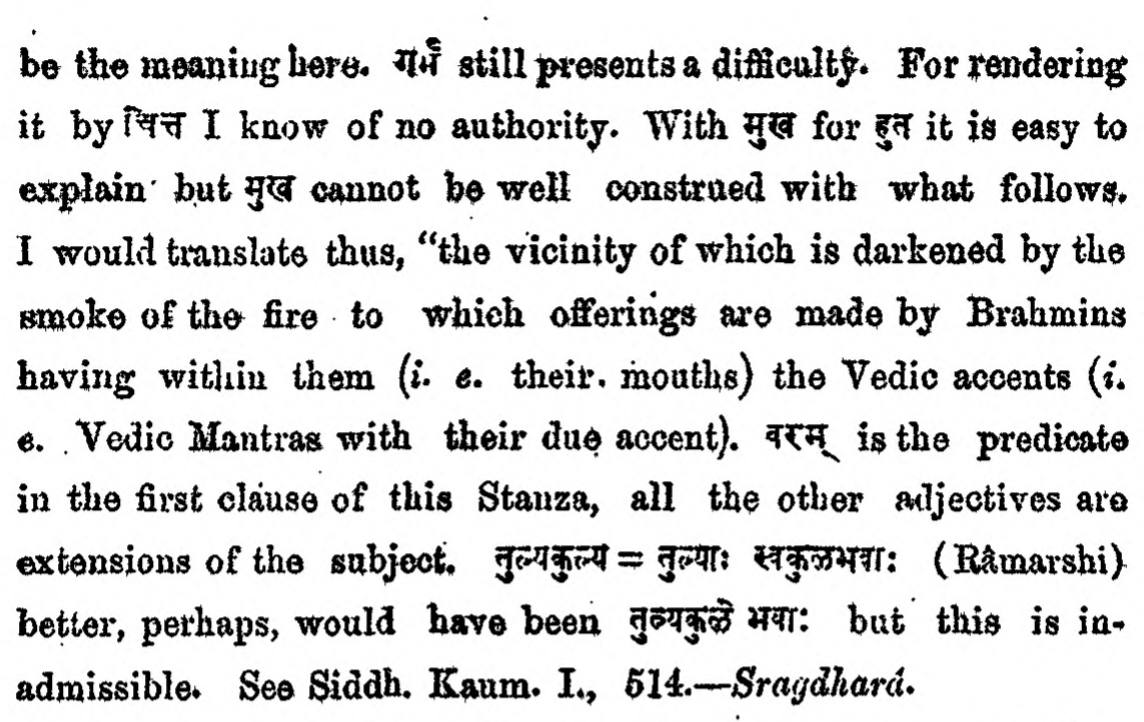
St. LV.—पाली = उपरिदेश (Râmarshi.) It is given as meaning edge in Amara and Medinî. कपाली = fragment of a pot. Comp. पटली, (54 St.) मण्डली (83 St.) न्याय &c. = नयन्ति परमं पदं प्रापयन्ति विवेकेनेति न्यायाः श्रुतिशास्त्रस्मृत्यादयः ते गर्भे चित्ते येषां ते न्यायगर्भाः वेदादिविदः एवंभूतैर्द्विजैर्हुतं हवनं यस्मिन्......तस्य धूमः तेन धूम्रं धूसरं उपकण्ठं समीपं यस्य तत्तथा ॥ एतेनाग्निहोतृद्विजकुलेप्तता (sic लोत्पन्ना?) हाराय भ्रान्तं श्रेष्ठमित्यर्थः. The other commentary has न्यायगर्भेण न्यायशास्त्रपठितेन (sic). Another copy (M.) says simply न्यायगर्भितेन द्विजेन. Mallinâtha explains न्याय as the स्वर used in pronouncing the Vedas, (see Kumâra. II., 12); that may be the meaning here. गर्भ still presents a difficulty. For rendering it by चित्त I know of no authority. With मुख for हुत it is easy to explain but मुख cannot be well construed with what follows. I would translate thus, “the vicinity of which is darkened by the smoke of the fire to which offerings are made by Brahmins having within them (i. e. their mouths) the Vedic accents (i. e. Vedic Mantras with their due accent). वरम् is the predicate in the first clause of this Stanza, all the other adjectives are extensions of the subject. तुल्यकुल्य = तुल्याः स्वकुलभवाः (Râmarshi) better, perhaps, would have been तुल्यकुले भवाः but this is inadmissible. See Siddh. Kaum. I., 514.—Sragdharâ.

Kale
all

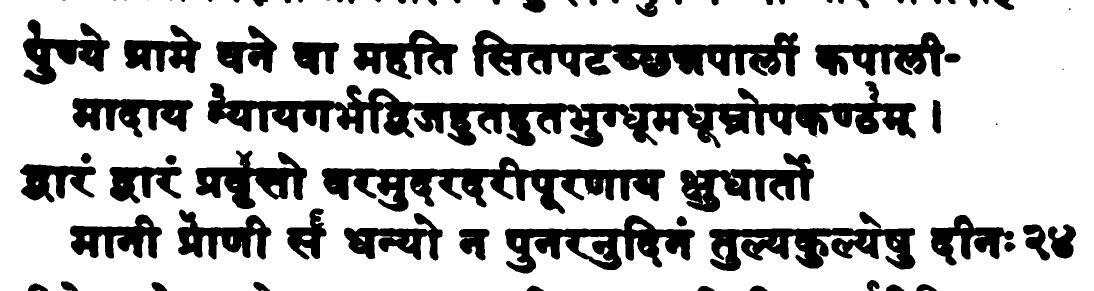
पुण्ये ग्रामे वने वा महति सितपटच्छन्नपालीं कपाली-
मादाय न्यायगर्भद्विजहुतहुतभुग्धूमधूम्रोपकण्ठम् ।
द्वारं द्वारं प्रवृत्तो वरमुदरदरीपूरणाय क्षुधार्तो
मानी प्राणी स धन्यो न पुनरनुदिनं तुल्यकुल्येषु दीनः२४
Translation
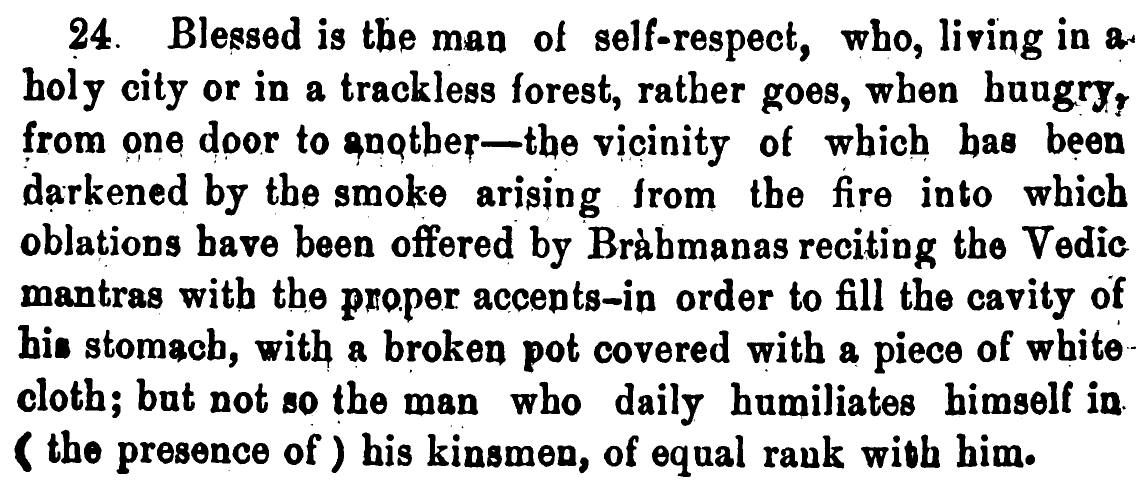
24. Blessed is the man of self-respect, who, living in a holy city or in a trackless forest, rather goes, when huugry, from one door to another—the vicinity of which has been darkened by the smoke arising from the fire into which oblations have been offered by Bràhmanas reciting the Vedic mantras with the proper accents–in order to fill the cavity of his stomach, with a broken pot covered with a piece of white cloth; but not so the man who daily humiliates himself in ( the presence of ) his kinsmen, of equal rank with him.
Notes
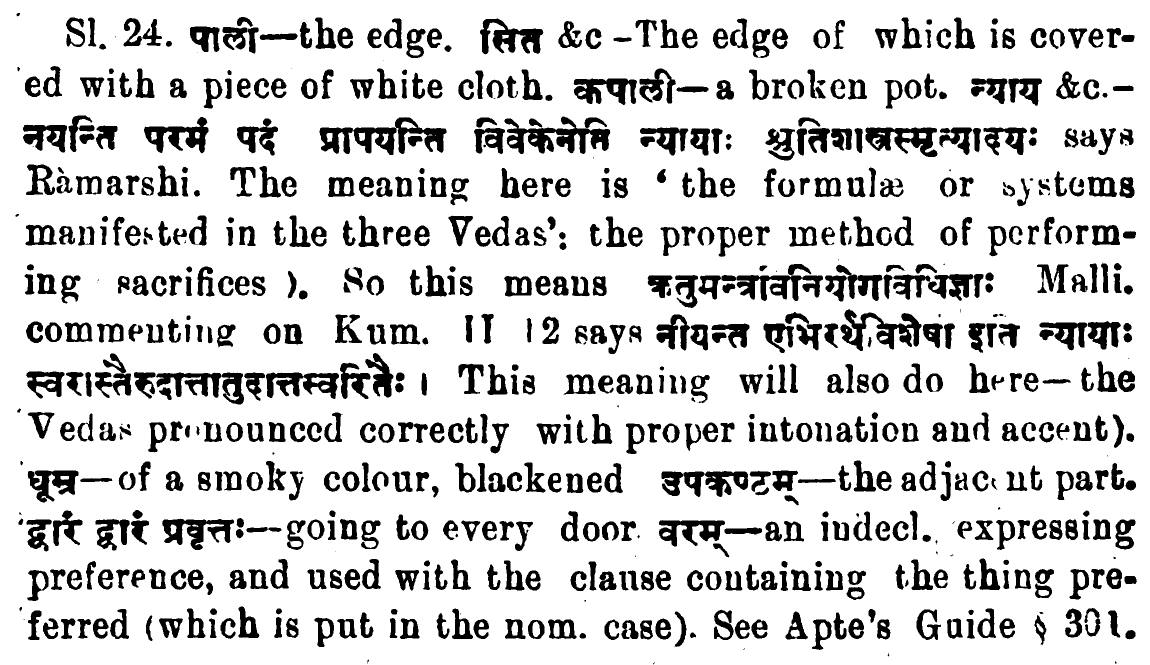
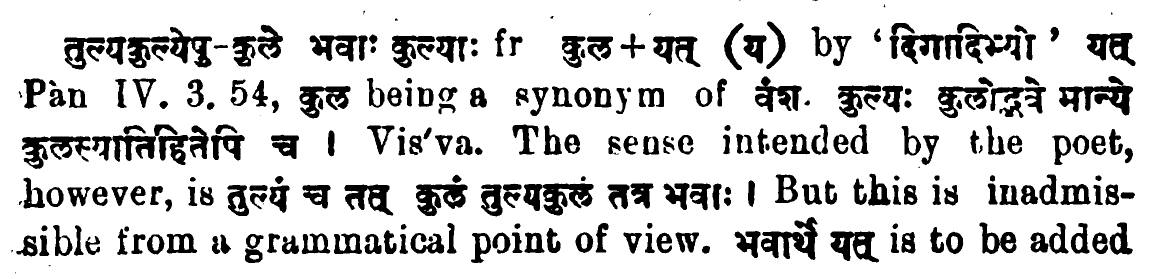
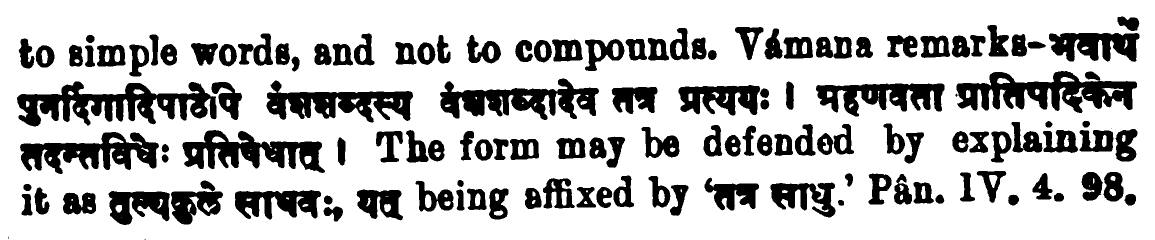
Sl. 24. पाली—the edge. सित &c –The edge of which is covered with a piece of white cloth. कपाली—a broken pot. न्याय &c.– नयन्ति परमं पदं प्रापयन्ति विवेकेनेति न्यायाः श्रुतिशास्त्रस्मृत्यादयः says Ràmarshi. The meaning here is ‘the formulæ or systems manifested in the three Vedas’: the proper method of performing sacrifices ). So this means क्रतुमन्त्राविनियोगविधिज्ञाः Malli. commenting on Kum. II 12 says नीयन्त एभिरर्थविशेषा इति न्यायाः स्वरास्तैरूदात्तानुदात्तस्वरितैः । This meaning will also do here—the Vedas pronounced correctly with proper intonation and accent). धूम्र—of a smoky colour, blackened उपकण्ठम्—the adjacent part. द्वारं द्वारं प्रवृत्तः–-going to every door वरम्—an indecl. expressing preference, and used with the clause containing the thing preferred (which is put in the nom. case). See Apte's Guide § 301. तुल्यकुल्येषु–कुले भवाः कुल्याः fr कुल + यत् (य) by ‘दिगादिभ्यो’ यत् Pàn IV. 3. 54, कुल being a synonym of वंश. कुल्यः कुलोद्भवे मान्ये कुलस्यातिहितेपि च । Vis'va. The sense intended by the poet, however, is तुल्यं च तत् कुलं तुल्यकुलं तत्र भवाः । But this is inadmissible from a grammatical point of view. भवार्थे यत् is to be added to simple words, and not to compounds. Vámana remarks-भवार्थे पुनर्दिगादिपाठेपि वंशशब्दस्य वंशशब्दादेव तत्र प्रत्ययः । ग्रहणवता प्रातिपदिकेन तदन्तविधेः प्रतिषेधात् । The form may be defended by explaining it as तुल्यकुले साधवः, यत् being affixed by ‘तत्र साधु.’ Pân. IV. 4. 98.






Gopinath1914
all
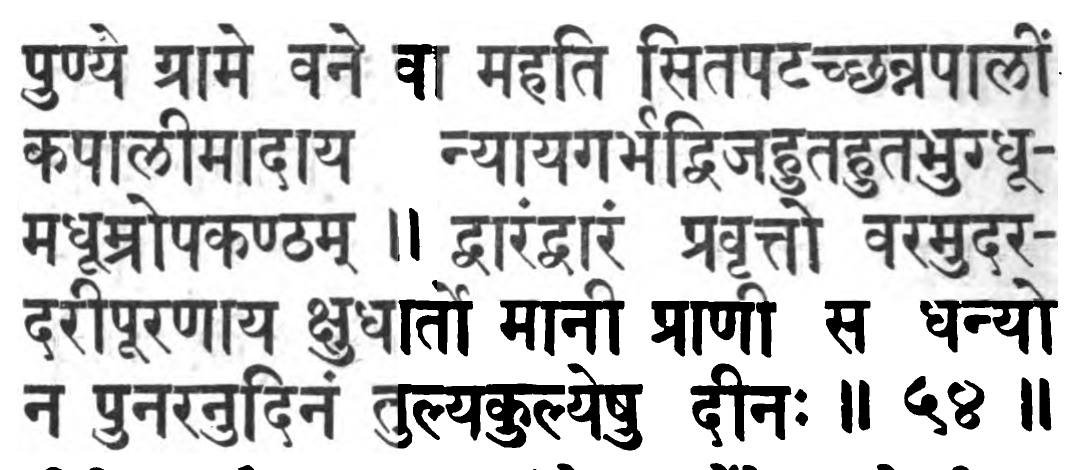
पुण्ये ग्रामे वने वा महति सितपटच्छन्नपालीं
कपालीमादाय न्यायगर्भद्विजहुतहुतभुग्धू-
मधूम्रोपकण्ठम् ॥ द्वारंद्वारं प्रवृत्तो वरमुदर-
दरीपूरणाय क्षुधात मानी प्राणी स धन्यो
न पुनरनुदिनं तुल्यकुल्येषु दीनः ॥ ५४ ॥
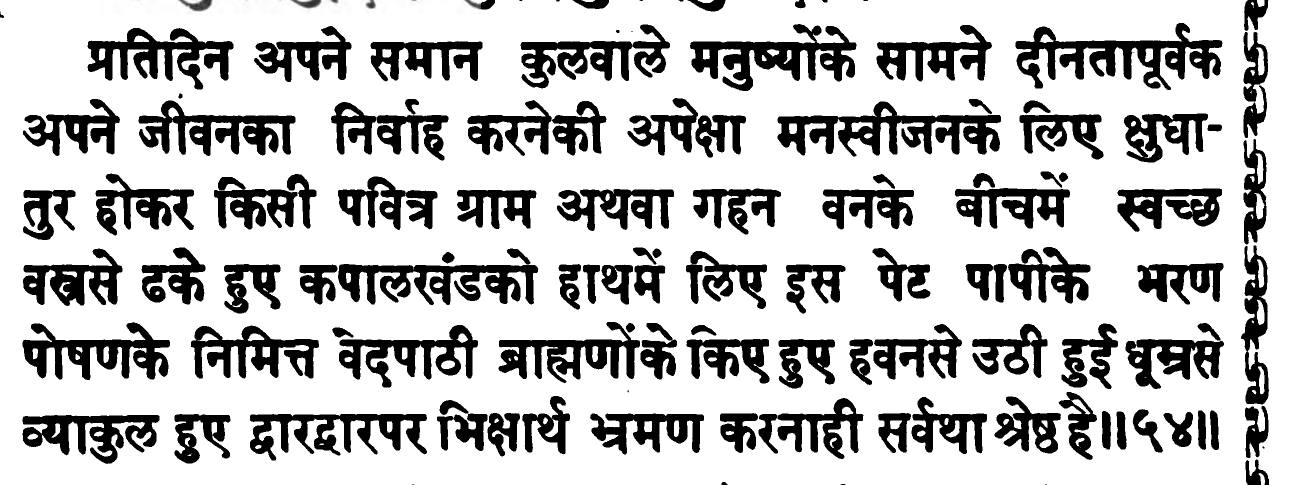
प्रतिदिन अपने समान कुलवाले मनुष्योंके सामने दीनतापूर्वक अपने जीवनका निर्वाह करनेकी अपेक्षा मनस्वीजनके लिए क्षुधा तुर होकर किसी पवित्र ग्राम अथवा गहन वनके बीचमें स्वच्छ वस्त्रसे ढके हुए कपालखंडको हाथमें लिए इस पेट पापीके भरण पोषणके निमित्त वेदपाठी ब्राह्मणों के किए हुए हवनसे उठी हुई धूम्रसे व्याकुल हुए द्वारद्वारपर भिक्षार्थ भ्रमण करनाही सर्वथा श्रेष्ठ है ॥ ५४ ॥
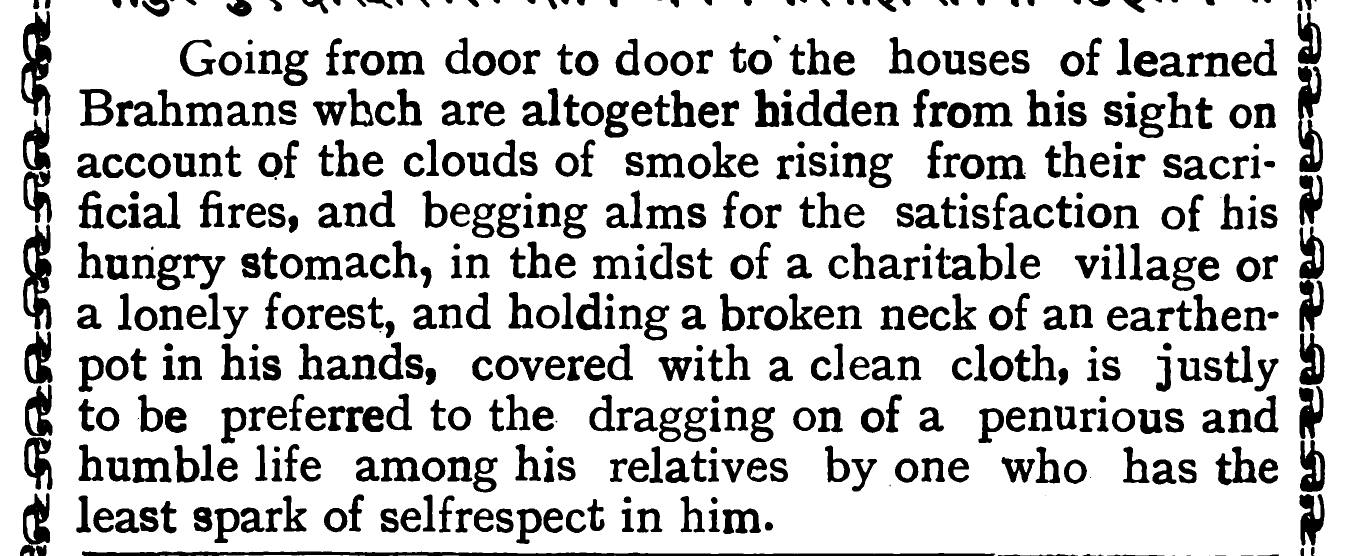
Going from door to door to the houses of learned account Brahmans whch clouds are altogether of smoke hidden rising from from his their sight sacri- on of the ficial fires, and begging alms for the satisfaction of his a hungry lonely stomachforestand , in the midst a of a charitable neck of an village or , holding broken earthenpot in his hands, covered with a clean cloth, is justly to be preferred to the dragging on of a penurious and humble life among his relatives by one who has the least spark of selfrespect in him.
Footnote
Quoted under Dipaka ( दीपक ) in the Auchityavicharacharcha ( औचित्यविचारचर्चा ), and under भर्तृहरि in the शार्ङ्गधरपद्धति at No. 254.

Footnote
Cf. - (a ) " वरमसिधारा तरुतलवासो वरमिह भिक्षा वरमुपवासः । वरमपि घोरे नरके पतनं नच धनगर्वितबान्धवशरणम् ॥ ९ ॥ " ( कविभट्टस्य पद्यसंग्रहः )

Footnote
(b) " वरं वनं व्याघ्रगजेन्द्रसेवितं दुमालयं पत्रफलाम्बुभोजनम् तृणानि शय्या वसनं च वल्कलं न बन्धुमध्ये धनहीनजीवितम् ॥ १४॥ " ( वररुचेनतिरने ).


Gopinath1896
all
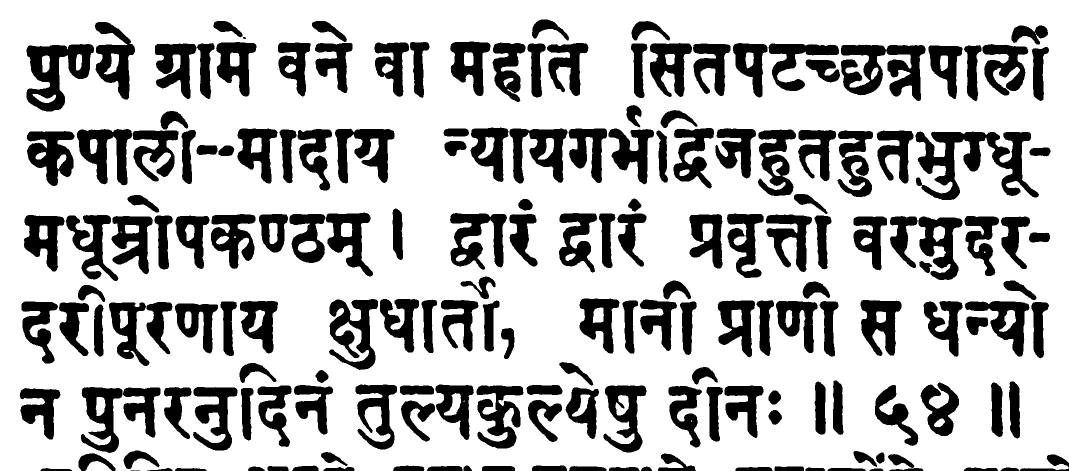
पुण्ये ग्रामे वने वा महति सितपटच्छन्नपालीं
कपाली -- मादाय न्यायगर्भद्विजहुतहुतभुग्धू-
मधूम्रोपकण्ठम् । द्वारं द्वारं प्रवृत्तो वरमुदर-
दरीपूरणाय क्षुधार्तो, मानी प्राणी स धन्यो
न पुनरनुदिनं तुल्यकुल्येषु दीनः ॥ ५४ ॥
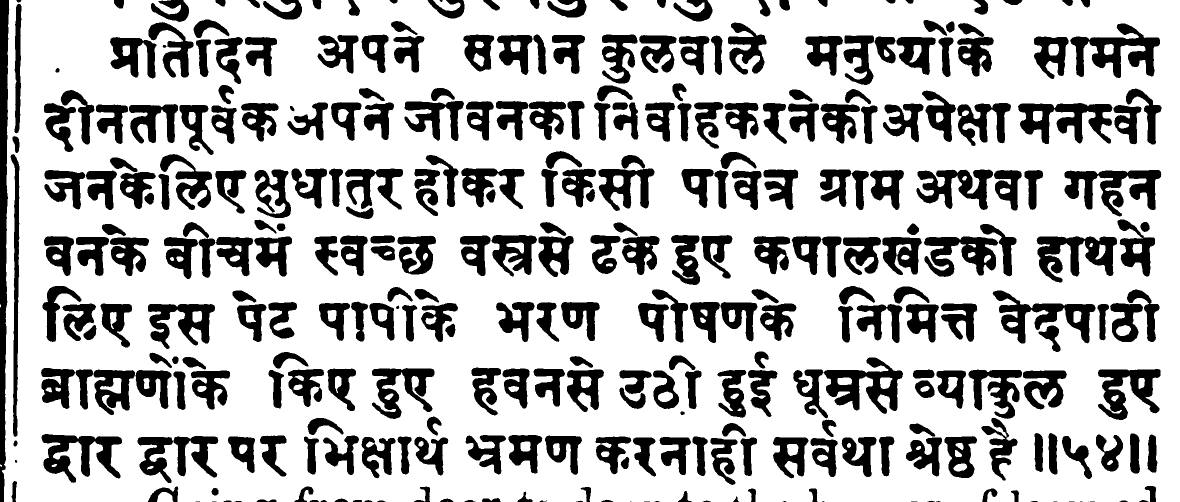
प्रतिदिन अपने समान कुलवाले मनुष्योंके सामने दीनतापूर्वक अपने जीवनका निर्वाहकरने की अपेक्षा मनस्वी जनके लिए क्षुधातुर होकर किसी पवित्र ग्राम अथवा गहन वनके बीच में स्वच्छ वस्त्रसे ढके हुए कपालखंडको हाथ में लिए इस पेट पापीके भरण पोषणके निमित्त वेदपाठी ब्राह्मणोंके किए हुए हवनसे उठी हुई धूम्रसे व्याकुल हुए द्वार द्वार पर भिक्षार्थ भ्रमण करनाही सर्वथा श्रेष्ठ है ॥५४॥
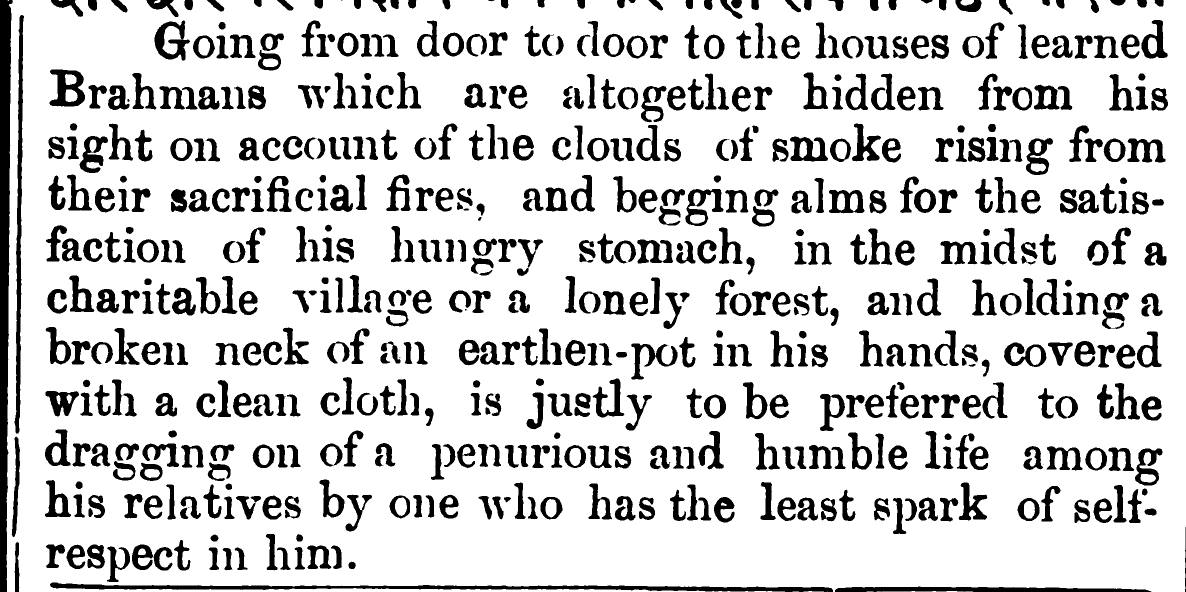
Going from door to door to the houses of learned Brahmans which are altogether hidden from his sight on account of the clouds of smoke rising from their sacrificial fires, and begging alms for the satisfaction of his hungry stomach, in the midst of a charitable village or a lonely forest, and holding a broken neck of an earthen-pot in his hands, covered with a clean cloth, is justly to be preferred to the dragging on of a penurious and humble life among his relatives by one who has the least spark of selfrespect in him.
Footnote
Quoted underDipaka ( ( दीपक ) in the Aurhityarichüracharcha (औचित्यविचारचर्चा ), and under भर्तृहरि in the शार्ङ्गधरपद्धति at No. 254.

Footnote
Cf.—(“) 66 “ वरमसिधारातरुतलवासो. वरमिह भिक्षा वरमुपवासः । वरमपि घोरे नरके पतनं, नच धनगर्वित बान्धवशरणम् ९॥” ( कविभट्टस्य पद्यसंग्रहः ).

Footnote
(b) " बरं वनं व्याघ्रगजेन्द्रसेवितं द्रुमालय पत्र फलाम्बुभोजनम् । तृणानिशय्या वसनं च वल्कलं, न बन्धुमध्ये धनहीन जीवितं १४" ( वररुचेनतिरले ).


Kosambi
all
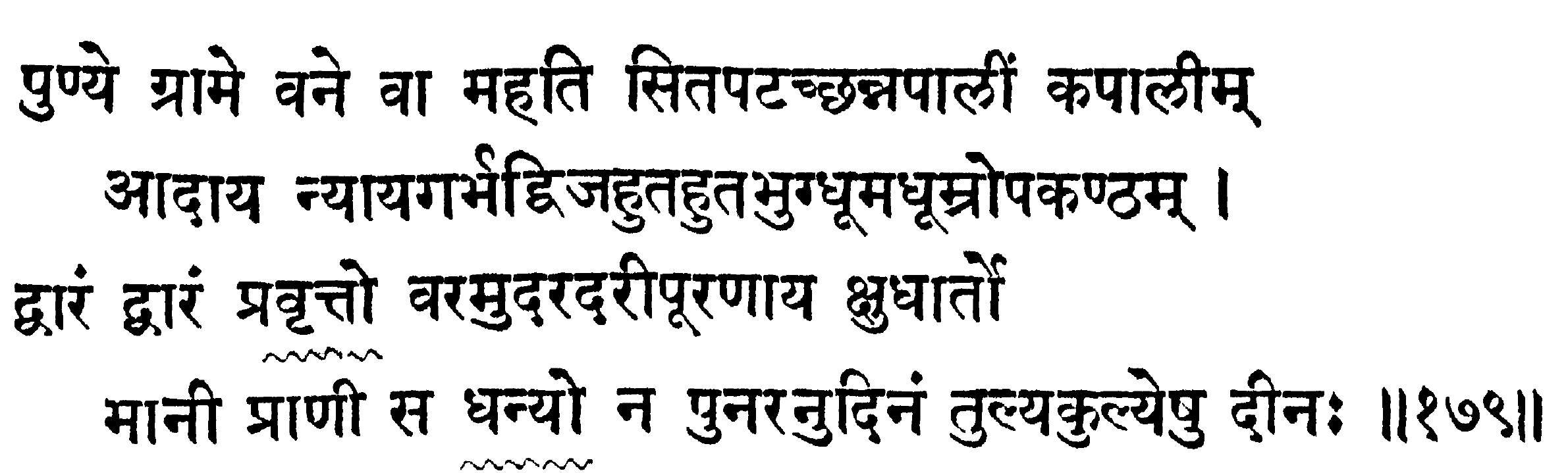
पुण्ये ग्रामे वने वा महति सितपटच्छन्नपालीं कपालीम्
आदाय न्यायगर्भद्विजहुतहुतभुग्धूमधूम्रोपकण्ठम् ।
द्वारं द्वारं प्रवृत्तो वरमुदरदरीपूरणाय क्षुधार्तो
मानी प्राणी स धन्यो न पुनरनुदिनं तुल्यकुल्येषु दीनः ॥१७ ९ ॥
Footnote
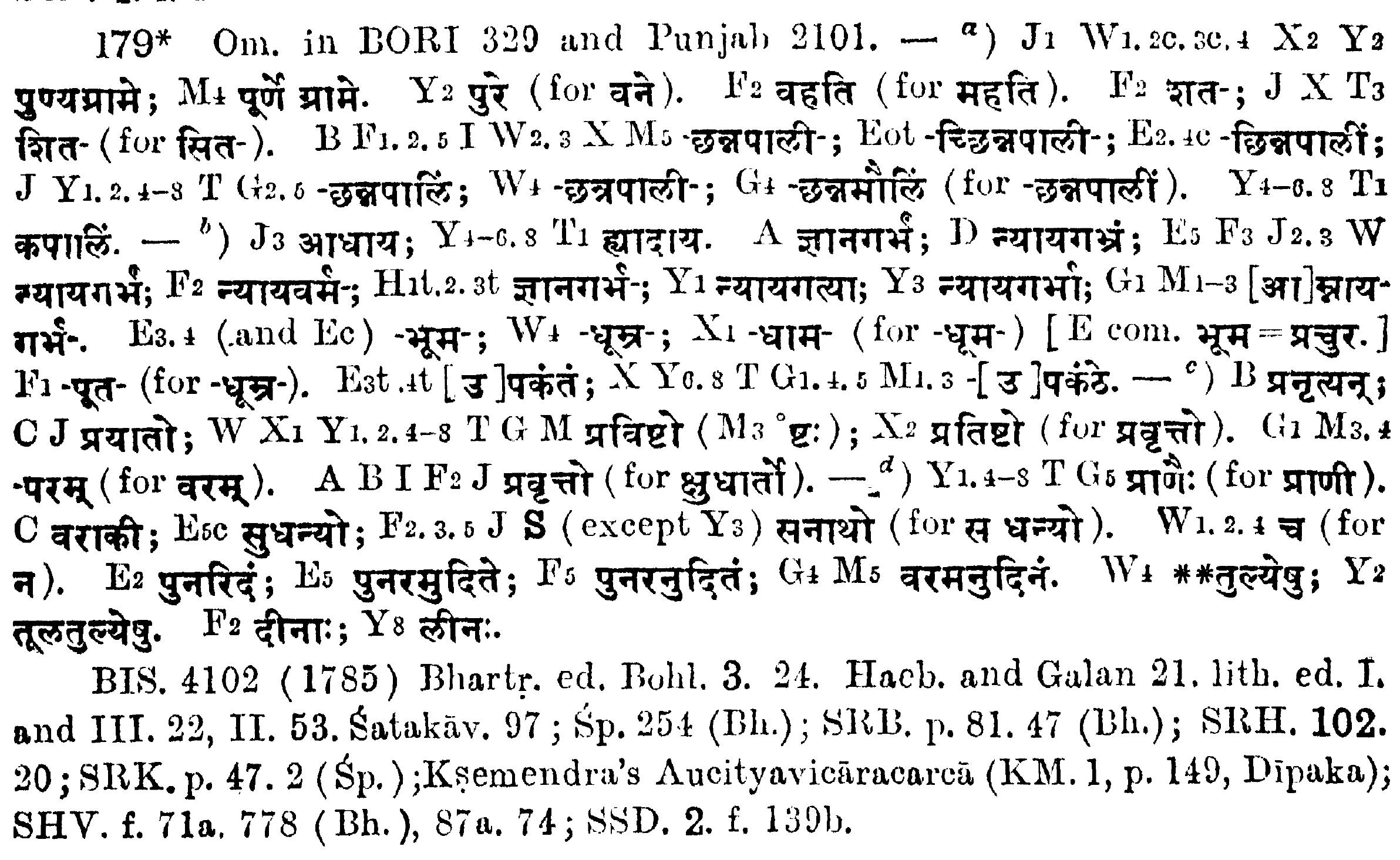
179 * Om . in BORI 320 and Punjab 2101. Cont a ) J1 W1.20.30 , + X 2 Y 2
पुण्यप्रामे ; M + पूर्णे ग्रामे X 2 पुरे ( for वने ) . F2 " : वहति ( for महति ) . F2 शत ; JX T3
शित - ( for सित- ) . BI125 I W2 . 3 X M5 छन्नपाली ; Eot -च्छिन्नपाली- ; E2 . 10 - छिन्नपालीं ;
J_Y1 . 2. ± −4 ' T G2 . 6 छन्नपालिं ; W + छत्रपाली ; G + छन्नमौलिं ( for -छन्नपालीं ) . Y4–6.4 T1
कपालिं . 1 ) J3 आघाय ; Y + - 6.8 11 ह्यादाय A A ज्ञानगर्भ ; ] ) न्यायगभ्रं ; Es F3 J2.3 W
न्यायगर्भ ; F2 न्यायवर्म ; Hit . 2. 3t ज्ञानगर्भ- ; Y1 न्यायगत्या ; Y3 न्यायगर्भा ; G1 M 1-3 [ आ ] म्नाय
गर्भ- E3 . + ( and Ec ) -भूम- ; W + धूम्र ; X 1 धाम - ( for धूम- ) [ E com . भूम - प्रचुर . ]
F1 -पूत - ( for धूम्र ) . Esta [ उ ] पतं ; X Y0 . 4 T G1 . ± 5 M1 3 [ उ ] पकंठे . - ) B प्रनृत्यन् ;
CJ प्रयातो ; W X1 Y 1 , 2 , 4 – 8 T GM प्रविष्टो ( M3 ° ट : ) ; X 2 प्रतिष्टो ( for प्रवृत्तो ) . ( 01 M3 , 4
-परम् ( for वरम् ) . A BIF 2 2 J प्रवृत्तो ( for क्षुधार्तो ) . – 2 d ) Y1 . 4 - 4 T G5 प्राणैः ( for प्राणी ) .
C वराकी ; Esc सुधन्यो ; F 2. 3. 6 JS ( except Y3 ) सनाथो ( for स धन्यो ) . W1 . 2. 4 च ( for
न ) . E2 पुनरिदं ; s पुनरमुदिते ; Is पुनरनुदितं ; ( GM6 वरमनुदिनं . W * * तुल्येषु ; X2
तूलतुल्येषु . F2 दीनाः ; Y8 लीनः .
BIS . 4102 ( 1785 ) Bhartṛ . ed . Bohl . 3. 24. Hacb . and Galan 21. lith . ed . I.
and III . 22 , II . 53. Satakāv . 97 ; Śp . 254 ( BL . ) ; SRB p . 81.47 ( Bh . ) ; SRH . 102 .
20 ; SRK . p . 47. 2 ( Śp . ) ; Kşemendra's Aucityavicaracarcă ( KM . 1 , p . 149 , Dipaka ) ;
SHV . f 71 778 ( Bh . ) , 870 74 ; SSD 2 f 139 ) .
Commentary