Tawney
The days seem long to those who drudge for pay,
And short to those who fritter life away;
When shall I sit and think how vain their moans,
A hermit pillowed on a bed of stones?
More
XCVII
How slow to him who haunts preferment's door
The long days drag! how lightly hurry o'er,
When the awakened soul hath thrown aside
Its load of worldly pride!
So, lying near my cavern's rocky ledge,
I 'd dream at ease upon the mountain edge;
And laugh a little in my heart, and then
Plunge into thought again.
Mādhavānanda
ये वर्तन्ते धनपतिपुर: प्रार्थनादु:खभाजो
ये चाल्पत्वं दधति विषयाक्षेपपर्याप्तबुद्धे: ।
तेषामन्त:स्फुरितहसितं वासराणि स्मरेयं
ध्यानच्छेदे शिखरिकुहरग्रावशय्यानिषण्ण: ।।२८।।
28. Reposing on a bed of stone within a mountain cave, during intervals of meditation, (well) may I recollect with an inward smile the days of those afflicted through their petitions before the rich, or of those grown mean through their minds being content with seeking enjoyments.
[If this verse is read differently with वर्धन्ते for वर्तन्ते and वासराणां for वासराणि the idea becomes, in the words of Mr. Telang: ‘The suppliant of the rich thinks the days too long as he has to suffer the trouble of constant entreaties often unsuccessful; the person engaged in the pursuit of worldly objects thinks time too short; he has never enough of it to compass all his numerous ends. On the other hand the philosopher laughs at both for their delusions.’ In this case ये in lines 1 and 2 refer to days, and for पर्याप्त in line 2 we have to read पर्यस्त too.]
Telang
all

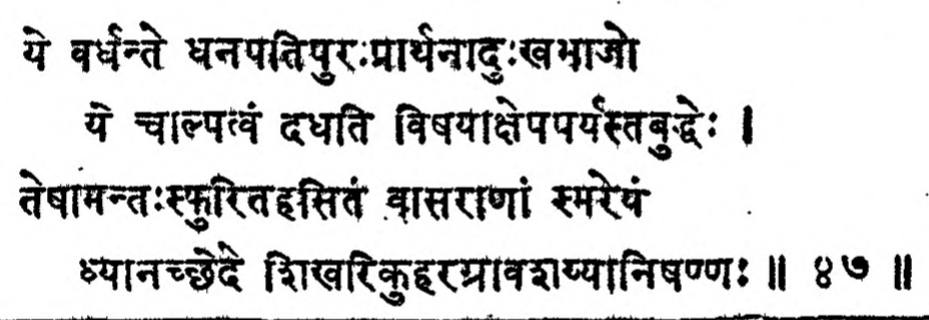
ये वर्धन्ते धनपतिपुरःप्रार्थनादुःखभाजो
ये चाल्पत्वं दधति विषयाक्षेपपर्यस्तबुद्धेः ।
तेषामन्तःस्फुरितहसितं वासराणां स्मरेयं
ध्यानच्छेदे शिखरिकुहरग्रावशय्यानिषण्णः ॥ ४७ ॥
Notes
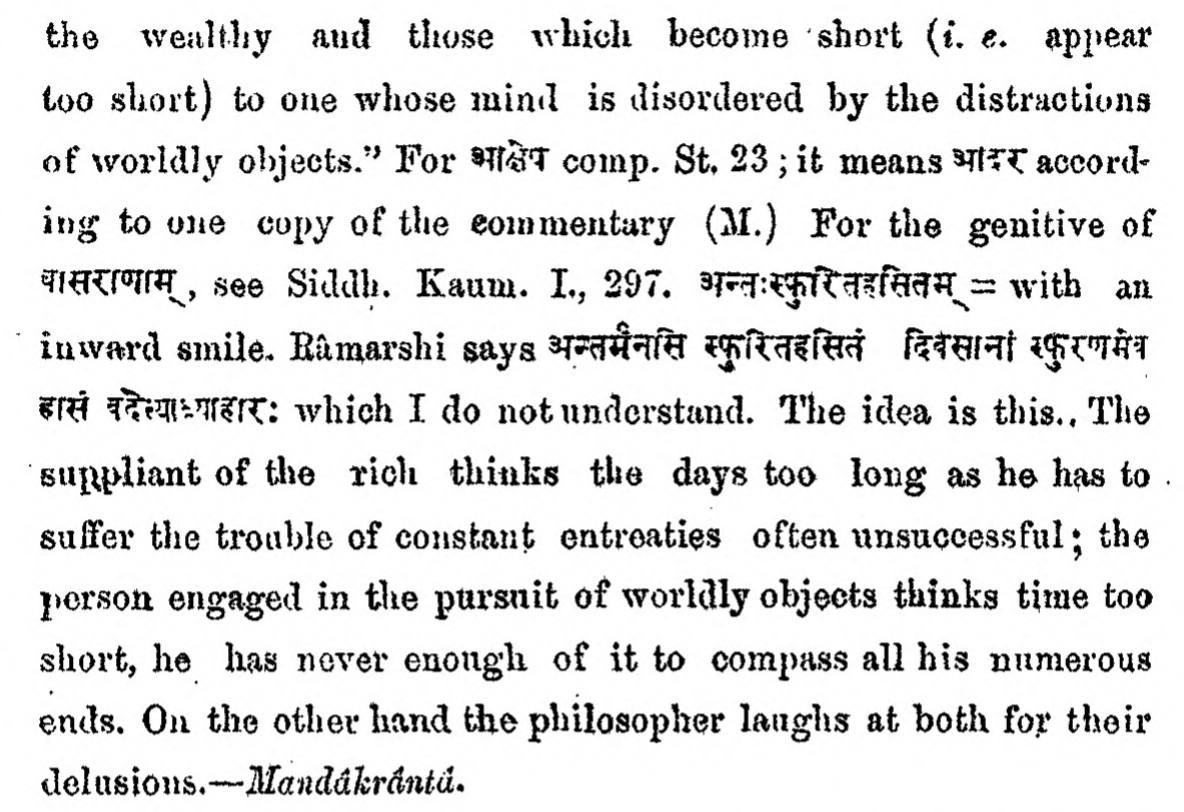
St. XLVII.—“The days which grow (i. e. appear interminable as it were) to one suffering the trouble of making entreaties to the wealthy and those which become short (i. e. appear too short) to one whose mind is disordered by the distractions of worldly objects.” For आक्षेप comp. St. 23; it means आदर according to one copy of the commentary (M.) For the genitive of वासराणाम्, see Siddh. Kaum. I., 297. अन्तःस्फुरितहसितम् = with an inward smile. Râmarshi says अन्तर्मनसि स्फुरितहसितं दिवसानां स्फुरणमेव हासं वदेत्याध्याहारः which I do not understand. The idea is this.. The suppliant of the rich thinks the days too long as he has to suffer the trouble of constant entreaties often unsuccessful; the person engaged in the pursuit of worldly objects thinks time too short, he has never enough of it to compass all his numerous ends. On the other hand the philosopher laughs at both for their delusions.—Mandâkrântâ.


Kale
all

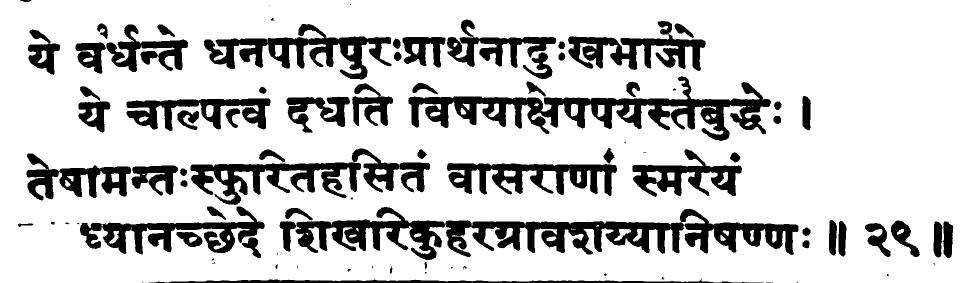
ये वर्धन्ते धनपतिपुरःप्रार्थनादुःखभाजो
ये चाल्पत्वं दधति विषयाक्षेपपर्यस्तबुद्धेः ।
तेषामन्तःस्फुरितहसितं वासराणां स्मरेयं
ध्यानच्छेदे शिखरिकुहरग्रावशय्यानिषण्णः ॥ २९ ॥
Translation
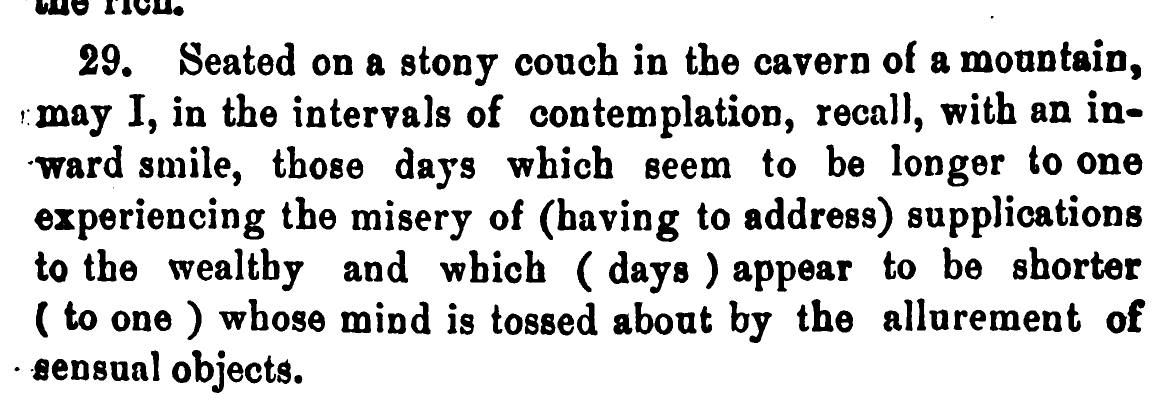
29. Seated on a stony couch in the cavern of a mountain, may I, in the intervals of contemplation, recall, with an inward smile, those days which seem to be longer to one experiencing the misery of (having to address) supplications to the wealthy and which ( days ) appear to be shorter ( to one ) whose mind is tossed about by the allurement of sensual objects.
Notes
Sl. 29. दर्घन्ते—appear long. The man who has the misery to supplicate the rich, often in vain, finds the days very long. आक्षेप means allurement or distraction; one commentary explains it also as आदर. पर्यस्त. lit. tossed about; hence distracted. अल्पत्वं दधति—the man engaged in the pursuit of wordly objects finds time too short to achieve all his ends. वासराणां the gen. by अधीगर्थदयेषां कर्मणि’ Pán II. 3. 52. ध्यानच्छेदे—ध्यान is defined by Patanjali as ‘तत्र प्रत्ययैकतानता ( sameness of perception; see com. sl. 99 ). ध्यानम्’—(1) at the end of my contemplation; (2) during the interval between two समाधि s. The idea is this— after I shall have broken my समाधि, I shall smile at the life of misery led by worldly people. May the time come when I shall be free from desire and renouncing the world enjoy the happiness of समाधि.



Gopinath1914
all
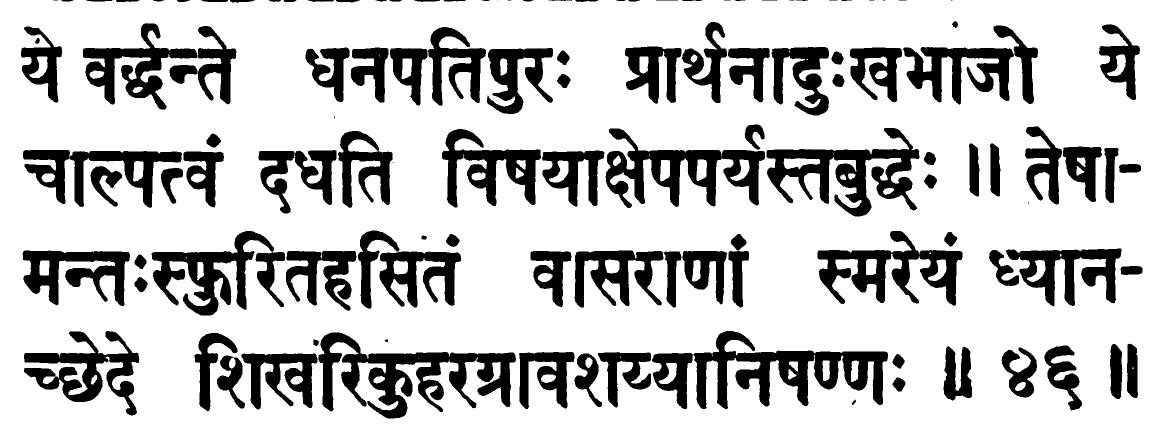
ये वर्द्धन्ते धनपतिपुरः प्रार्थनादुःखभाजो ये
चाल्पत्वं दधति विषयाक्षेपपर्यस्तबुद्धेः । तेषा-
मन्तःस्फुरितहसितं वासराणां स्मरेयं ध्यान-
च्छेदे शिखरिकुहरग्रावशय्यानिषण्णः ॥ ४६ ॥
जो दिवस धनाढ्य मनुष्योंके आगे याचनाके भंगसे उत्पन्न हुए दुःखके हेतु बहुत बड़े बड़े, और विषयवासनाके विलासमें मदान्ध होने के कारण अत्यंत छोटे प्रतीत होते हैं उन सबका पर्वतकंदराकी शिलारूप शय्यापर सोता हुवा में ध्यानावस्थासे विश्राम पाकर, आंतरिक उपहासके साथ किस अवसरपर स्मरण कर सकूंगा वही चितवन कर रहा हूं ॥ ४६ ॥
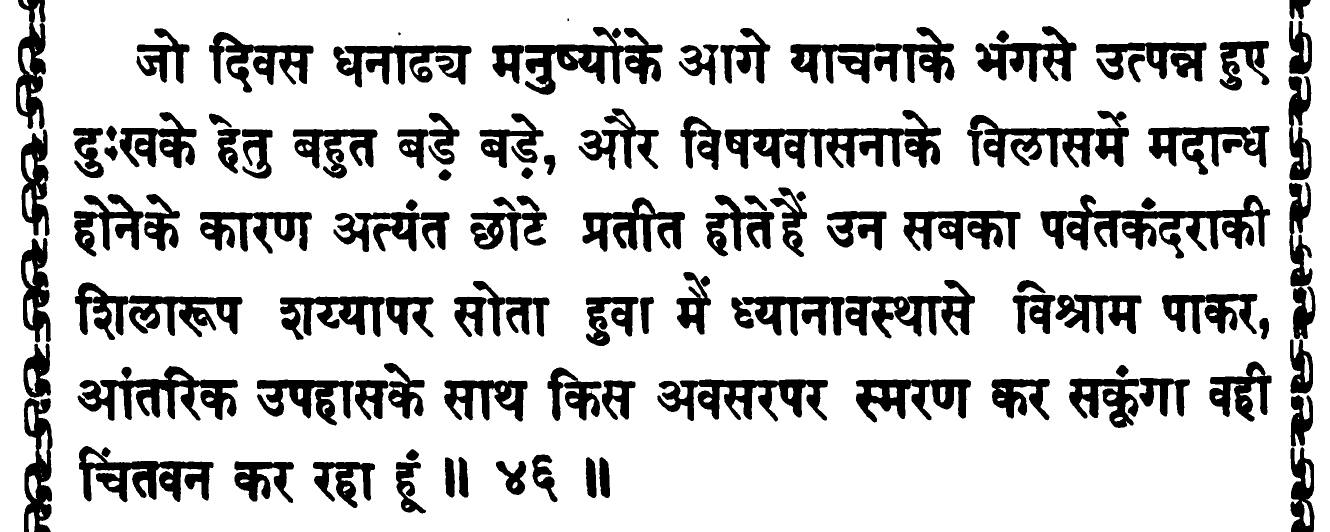
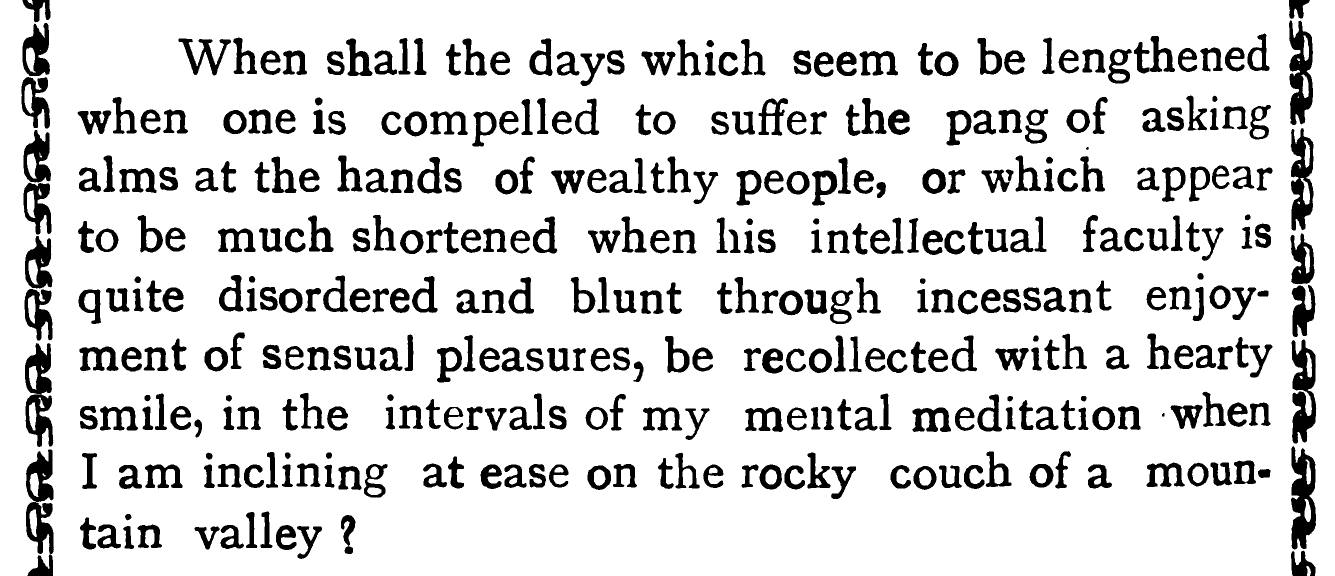
When shall the days which seem to be lengthened when one is compelled to suffer the pang of asking alms at the hands of wealthy people, or which appear to be much shortened when his intellectual faculty is quite disordered and blunt through incessant enjoyment of sensual pleasures, be recollected with a hearty smile, in the intervals of my mental meditation when I am inclining at ease on the rocky couch of a mountain valley ?
Footnote
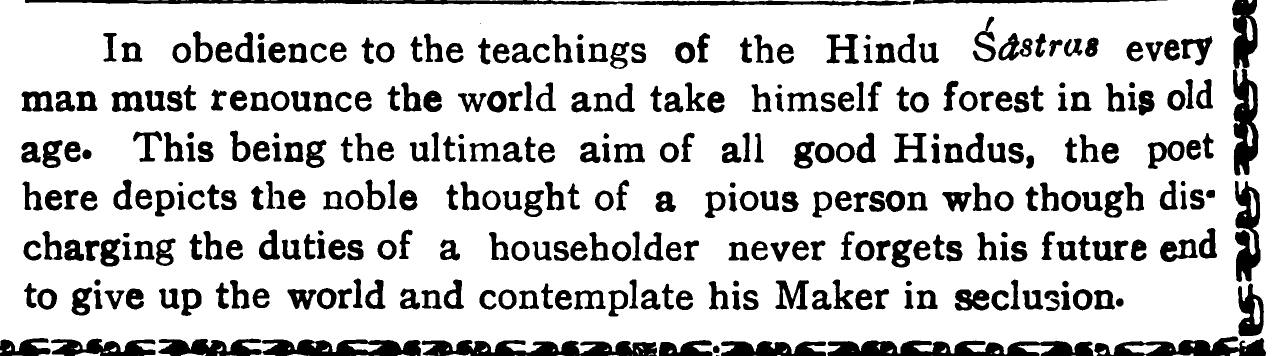
In obedience to the teachings of the Hindu Sastras every man must renounce the world and take himself to forest in his old age. This being the ultimate aim of all good Hindus, the poet here depicts the noble thought of a pious person who though discharging the duties of a householder never forgets his future end to give up the world and contemplate his Maker in seclusion.
Gopinath1896
all
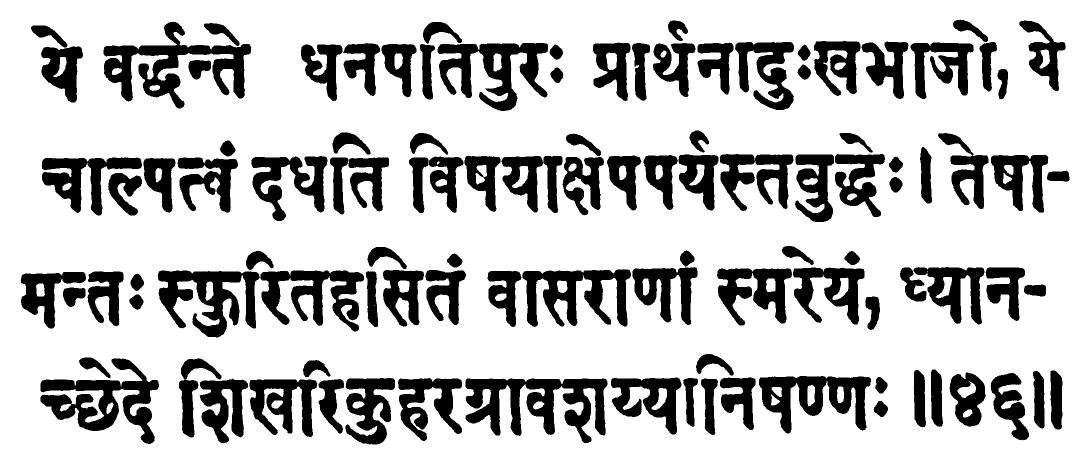
ये वर्द्धन्ते धनपतिपुरः प्रार्थनादुःखभाजो, ये
चाल्पत्वं दधति विषयाक्षेपपर्यस्तबुद्धेः । तेषा-
मन्तः स्फुरितहसितं वासराणां स्मरेयं, ध्यान-
च्छेदे शिखरिकुहरग्रावशय्यानिषण्णः ॥४६॥
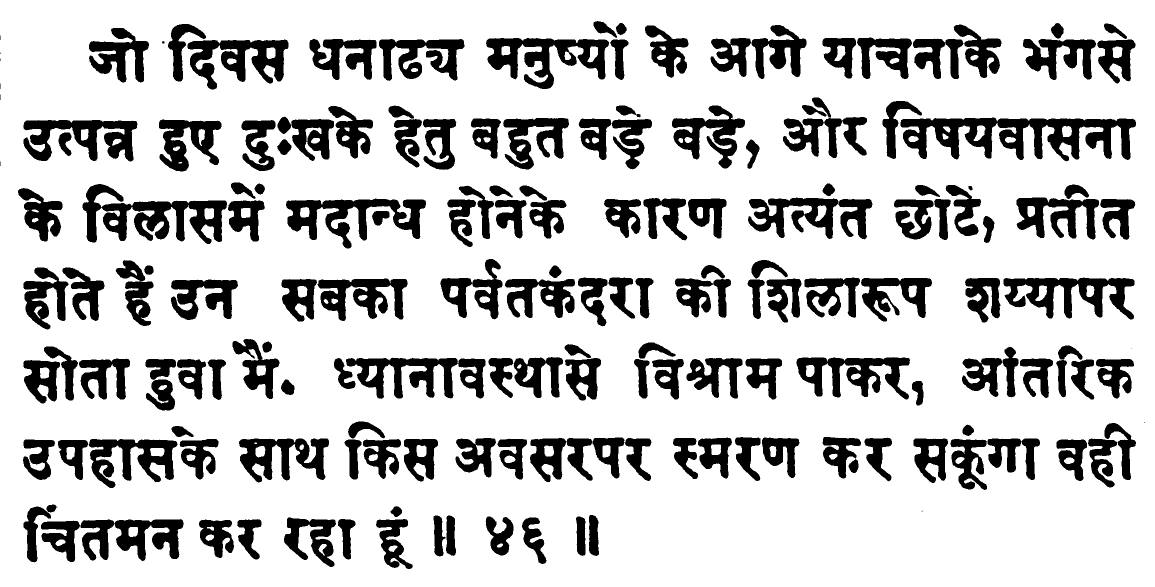
जो दिवस धनाढ्य मनुष्यों के आगे याचनाके भंग से उत्पन्न हुए दुःखके हेतु बहुत बड़े बड़े, और विषयवासना के विलास में मदान्ध होनेके कारण अत्यंत छोटे, प्रतीत होते हैं उन सबका पर्वतकंदरा की शिलारूप शय्यापर सोता हुवा मैं. ध्यानावस्थासे विश्राम पाकर, आंतरिक उपहासके साथ किस अवसरपर स्मरण कर सकूंगा वही चिंतमन कर रहा हूं ॥ ४६ ॥
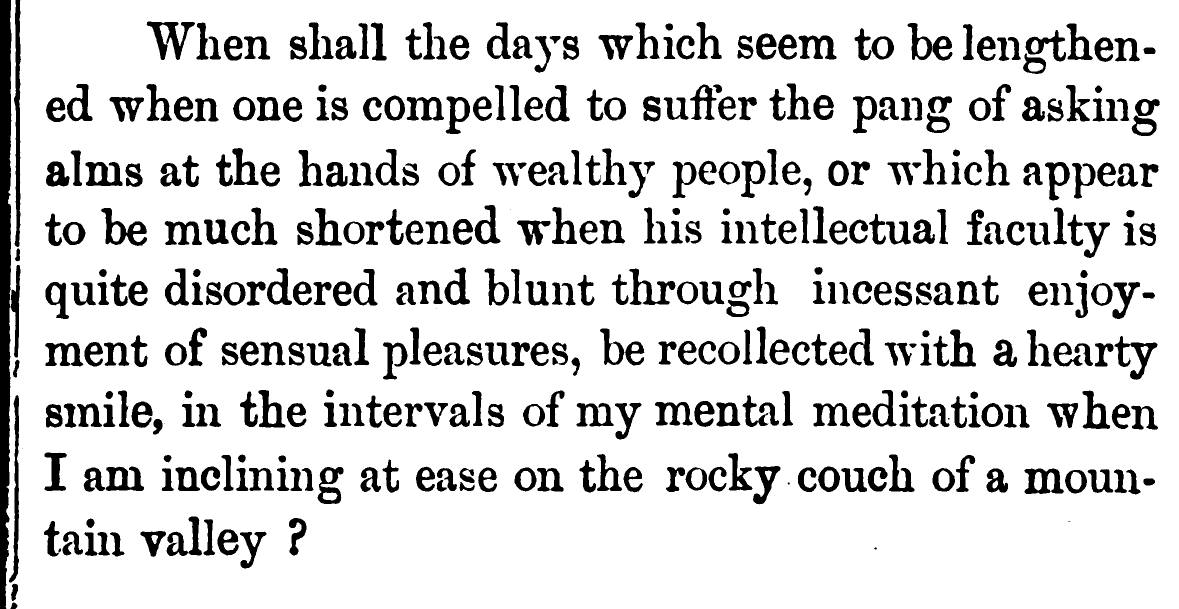
When shall the days which seem to be lengthened when one is compelled to suffer the pang of asking alms at the hands of wealthy people, or which appear to be much shortened when his intellectual faculty is quite disordered and blunt through incessant enjoyment of sensual pleasures, be recollected with a hearty smile, in the intervals of my mental meditation when I am inclining at ease on the rocky couch of a mountain valley ?
Footnote
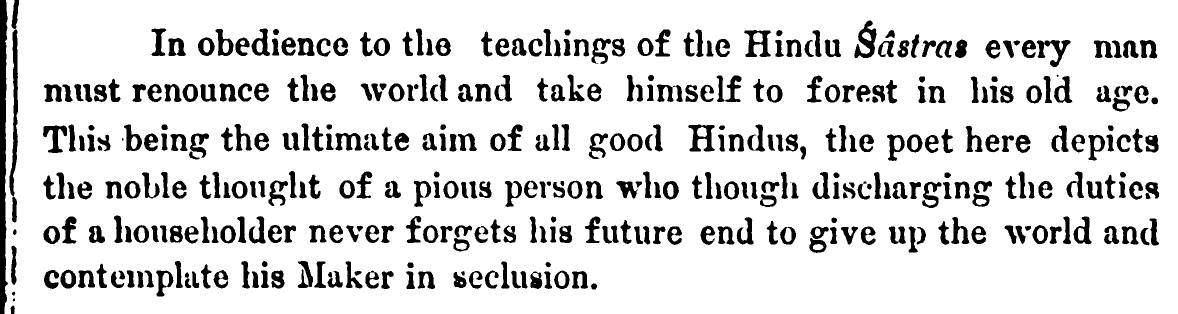
In obedience to the teachings of the Hindu Sâstras every man must renounce the world and take himself to forest in his old age. This being the ultimate aim of all good Hindus, the poet here depicts the noble thought of a pious person who though discharging the duties of a householder never forgets his future end to give up the world and contemplate his Maker in seclusion.
Kosambi
all
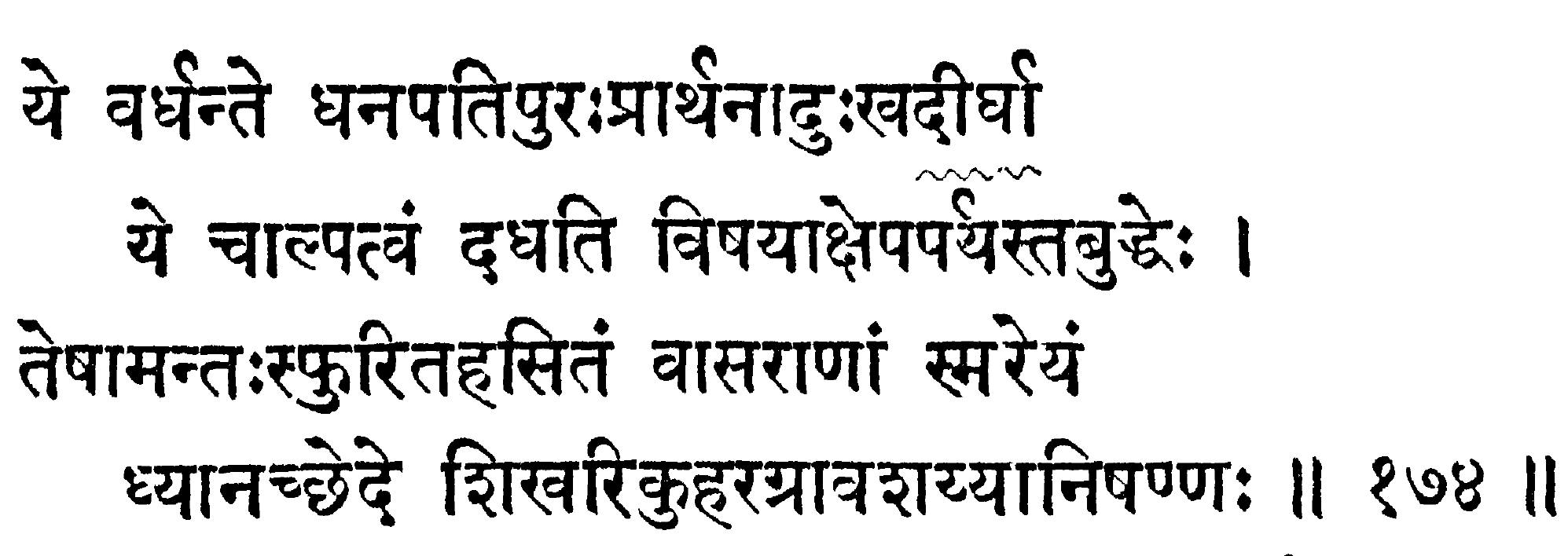
ये वर्धन्ते धनपतिपुरःप्रार्थना दुःखदीर्घा
ये चाल्पत्वं दधति विषयाक्षेपपर्यस्तबुद्धेः ।
तेषामन्तः स्फुरितहसितं वासराणां स्मरेयं
ध्यानच्छेदे शिखरिकुहरग्रावशय्यानिषण्णः ॥ १७४ ॥
Footnote
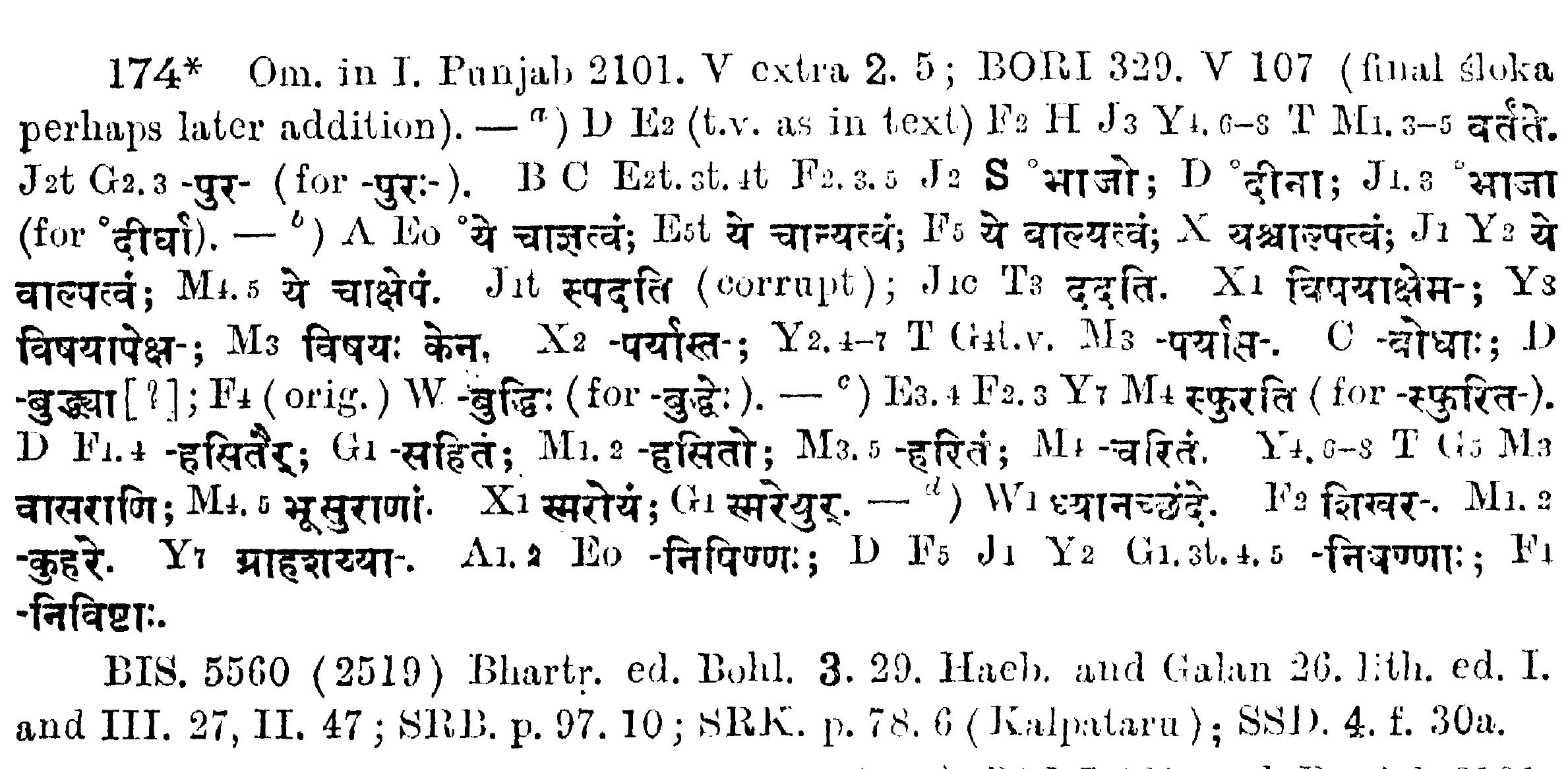
174 * Om in I. Punjab 2101. V cxtra 2. 5 ; BORI 329. V 107 ( final sloka
perhaps later addition ) – 4 ) D E2 ( tv as in text ) F3 H J3 Y 16 - 5T M1 . 3-5 वर्तते .
J2t G2 . 3 -पुर- ( for पुर : - ) . B C Eat.st it Fa3.5 J2 S ' भाजो ; D दीना ; J18 भाजा
( for दीर्घा ) . – ' 6 ) A Lo ये चाज्ञत्वं ; Est ये चान्यत्वं ; IIs ये बाल्यत्वं ; X यश्चारपत्वं ; J1 Y ? ये
वाल्पत्वं ; M 1.5 ये चाक्षेपं . Jit स्पदति ( corrupt ) ; Jio T3 ददति . X | विषयाक्षेम ; Ys
विषयापेक्ष ; M3 विषयः केन , X 2 -पर्यास्त ; X 2 1 7 I Gl.v. Ma - पर्याप्त C बोधाः ; D
बुद्ध्या [ १ ] ; F1 ( orig . ) W- बुद्धि : ( for- बुद्धे :) . -- ® ) E3 . + F2 3 Y7 M + स्फुरति ( for - स्फुरित- ) .
D F1 . + हसितैर् ; G1 सहित ; M1 . 2 हसितो ; M3 . 5 हरितं ; M + -चरितं . Y7 . G - ST ( s M3
वासराणि ; M. 5 भूसुराणां Xi स्मरोयं ; ( स्मरेथुर् . - -- ) W ध्यानच्छंदे 1 : शिखर M1 . 2
-कुहरे . Y1 ग्राहशय्या . A1.2 Do -निपिण्ण : ; D F5 J1 Y2 G1 365 नियण्णाः ; F1
-निविष्टाः
BIS . 5560 ( 2519 ) Bhartr . ed . Bohl . 3. 29. Hach and Galan 26. 1ith ed . I.
and III 27 , II 47 ; SRB p . 97. 10 ; SRK . p . 78.6 ( Kalpataru ) ; SSI ) . 4. f . 30a .
Commentary