Ryder
OLD AGE
Gone long ago are they who gave us birth;
Old friends are memories upon this earth;
Our lives are undermined and daily sink,
Like trees upon the river's sandy brink.
Tawney
Our parents long have passed away.
All old familiar faces fled.
Destruction nears us day by day,
Like trees in sandy river-bed.
More
LXXI
Fallen our father, fallen who bore
For us the pangs — they went before:
And some with our years grew, but they,
They too now tread on memory's dusty way.
And we ourselves from morn to morn
Now shiver like old trees forlorn
Upon a sandy shore, and all
Our care the lapping waves that haste our fall.
Mādhavānanda
वयं येभ्यो जाताश्चिरपरिचिता एव खलु ते
समं यै: संवृद्धा: स्मृतिविषयतां तेऽपि गमिता: ।
इदानीमेते स्म: प्रतिदिवसमासन्नपतना
गतास्तुल्यावस्थां सिकतिलनदीतीरतरुभि: ।।४८।।
48. Those from whom we were born, well, they are now on intimate footing with Eternity (long dead); those with whom we were brought up have also become objects of memory. Now (that we have become old) we are approaching nearer to our fall day by day, our condition being comparable to that of trees on the sandy bank of a river.
[चिरपरिचिता:—a simpler reading is चिरपरिगता:]
Telang
all

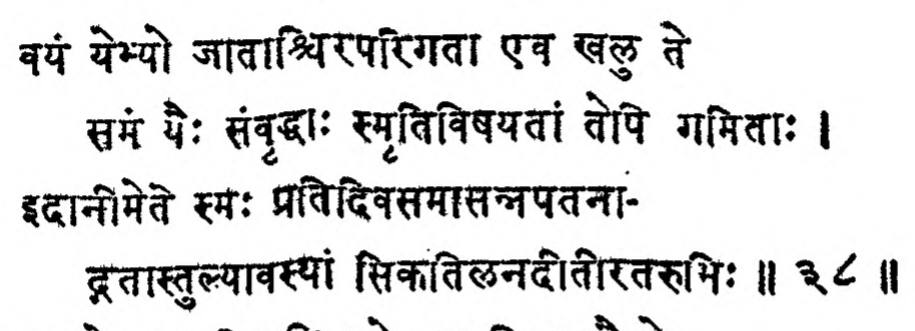
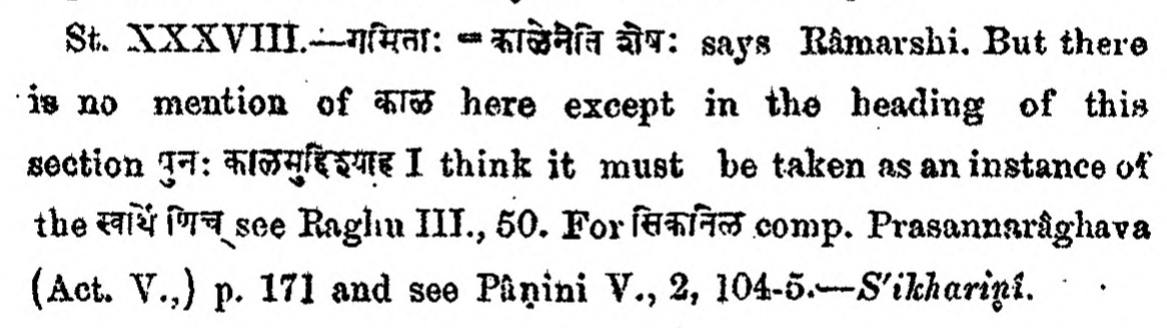
वयं येभ्यो जाताश्चिरपरिगता एव खलु ते
समं यैः संवृद्धाः स्मृतिविषयतां तेपि गमिताः ।
इदानीमेते स्मः प्रतिदिवसमासन्नपतना-
द्गतास्तुल्यवस्थां सिकतिलनदीतीरतरुभिः ॥ ३८ ॥
Notes
St. XXXVIII.—गमिताः = कालेनेति शेषः says Râmarshi. But there is no mention of काल here except in the heading of this section पुनः कालमुद्दिश्याह I think it must be taken as an instance of the स्वार्थे णिच् see Raghu III., 50. For सिकतिल comp. Prasannarâghava (Act. V.,) p. 171 and see Pâṇini V., 2, 104-5.—S'ikhariṇî.

Kale
all

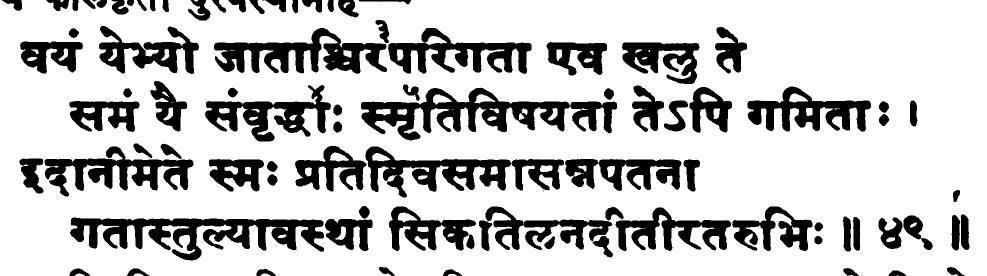
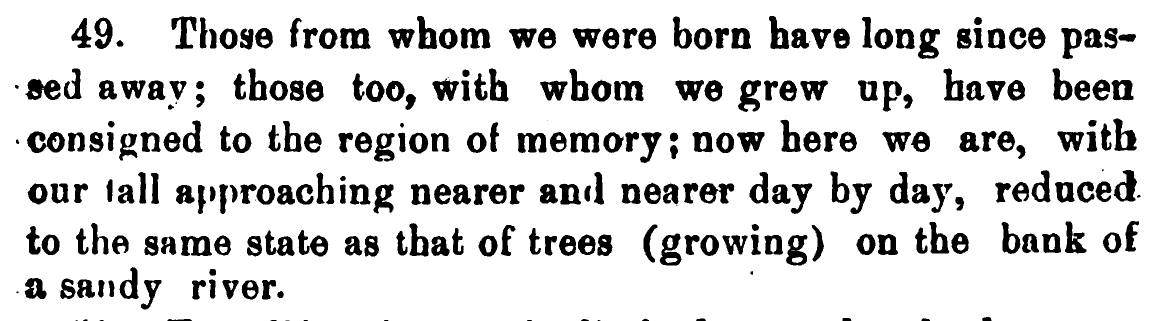
वयं येभ्यो जाताश्चिरपरिगता एव खलु ते
समं यै संवृद्धाः स्मृतिविषयतां तेऽपि गमिताः ।
इदानीमेते स्मः प्रतिदिवसमासन्नपतना
गतास्तुल्यवस्थां सिकतिलनदीतीरतरुभिः ॥ ४९ ॥
Translation
49. Those from whom we were born have long since passed away; those too, with whom we grew up, have been consigned to the region of memory; now here we are, with our fall approaching nearer and nearer day by day, reduced to the same state as that of trees (growing) on the bank of a sandy river.
Notes
Sl. 49. परिगताः—died; cf. परिगतः V. l. Veni. III. अपगताः is simpler. To explain गमिताः Ràmarshi adds कालेनेति शेषः. This will do very well. But Mr. Telang thinks गमित to be an instance of स्वार्थे णिच् and refers for a parallel instance to Rag. II. 50 In the passage referred to, however, the causal sense is not at all justifiable, which is not the case in the present passage. सिकतिल &c.—see Pán. V. 2. 105. quoted in the com; चादण् मतुप् च । सिकताः सन्त्यस्मिन्देशे इति सिकतिलः, सैकतः, सिकतावान् Sid. Kau. Fig. Upamá.

Gopinath1914
all
वयं येभ्यो जाताश्विरपरिगता एव खलु ते
समं यैः संवृद्धाः स्मृतिविषयतां तेपि गमिताः ॥
इदानीमेते स्मः प्रतिदिवसमासन्नपतनाद्गता-
स्तुल्यावस्थां सिकतिलनदीतीरतरुभिः ॥३७ ।
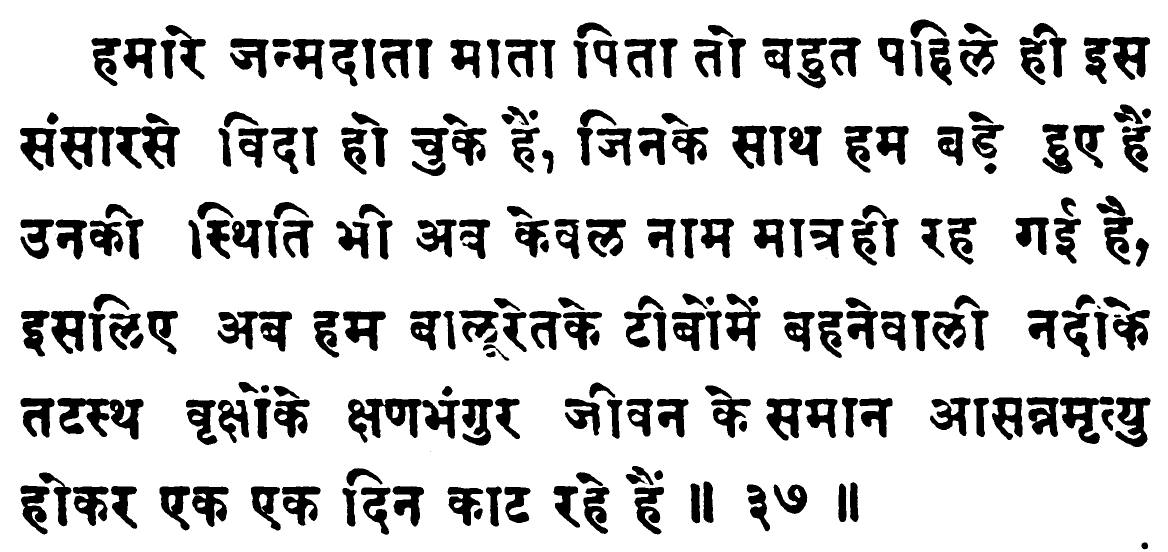
हमारे जन्मदाता माता पिता तो बहुत पहिलेही इस संसारसे बिदा होचुके हैं, जिनके साथ हम बड़े हुए हैं उनकी स्थिति भी अब केवल नाममात्रही रहगई है, इसलिए अब हम बालूरेत के टीबोंमें बहने वाली नदी के तटस्थ वृक्षोंके क्षणभंगुर जीवन के समान आसन्नमृत्यु होकर एक एक दिन काट रहे हैं ॥ ३७ ॥
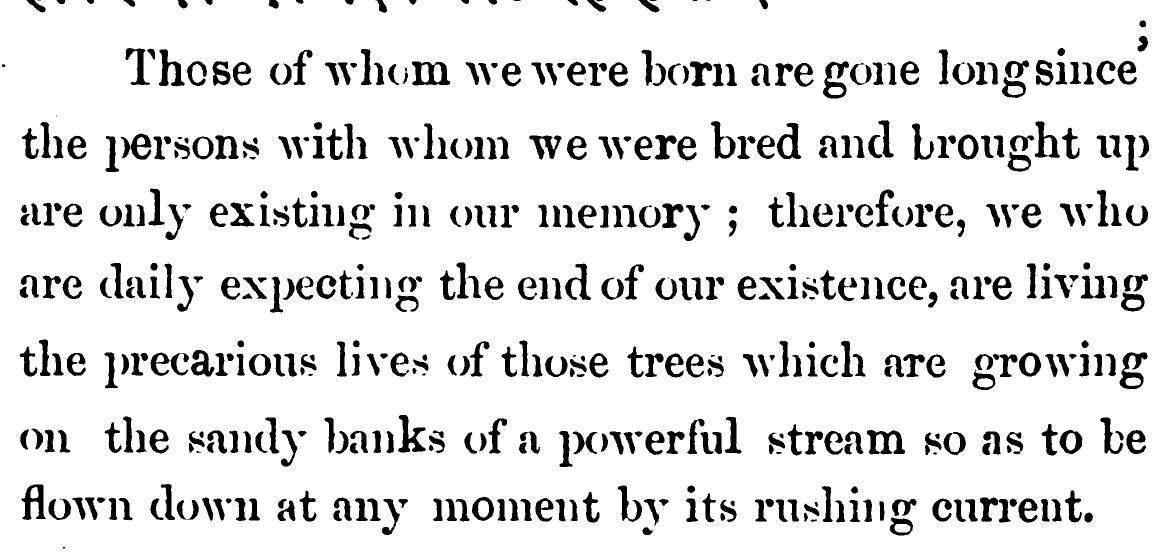
Those of whom we were born are gone long since; the persons with whom we were bred and brought up are only existing in our memory; therefore, we who daily expecting the end of our existence, are living the are precarious lives of those trees which are growing on the sandy banks of a powerful stream so as to be flown down at any moment by its rushing current.

Gopinath1896
all
वयं येभ्यो जाताश्विरपरिगता एव खलु ते,
समं संवृद्धा स्मृतिविषयतां तेऽपि गमिताः ।
इदानीमेते स्मः प्रतिदिवसमासन्नपतना-गता
स्तुल्यावस्थां सिकतिलनदीतीरतरुभिः॥३७॥
हमारे जन्मदाता माता पिता तो बहुत पहिले ही इस संसारसे विदा हो चुके हैं, जिनके साथ हम बड़े हुए हैं उनकी स्थिति भी अब केवल नाम मात्र ही रह गई है, इसलिए अब हम बालूरेतके टीबों में बहनेवाली नदीके तटस्थ वृक्षोंके क्षणभंगुर जीवन के समान आसन्नमृत्यु होकर एक एक दिन काट रहे हैं ॥ ३७ ॥
Those of whom we were born are gone long since' the persons with whom we were bred and brought up are only existing in our memory; therefore, we who are daily expecting the end of our existence, are living the precarious lives of those trees which are growing on the sandy banks of a powerful stream so as to be flown down at any moment by its rushing current.

External
Translation by John Cort: https://pbs.twimg.com/media/FxvrfY6XwAMBqPa?format=jpg
My parents died
many years ago.
Childhood friends live on
only in my memory.
Any day now
you will hear the news
of my passing.
I am like an old tree
living by a river,
my weak roots
clinging
to the crumbling,
sandy bank.
Kosambi
all
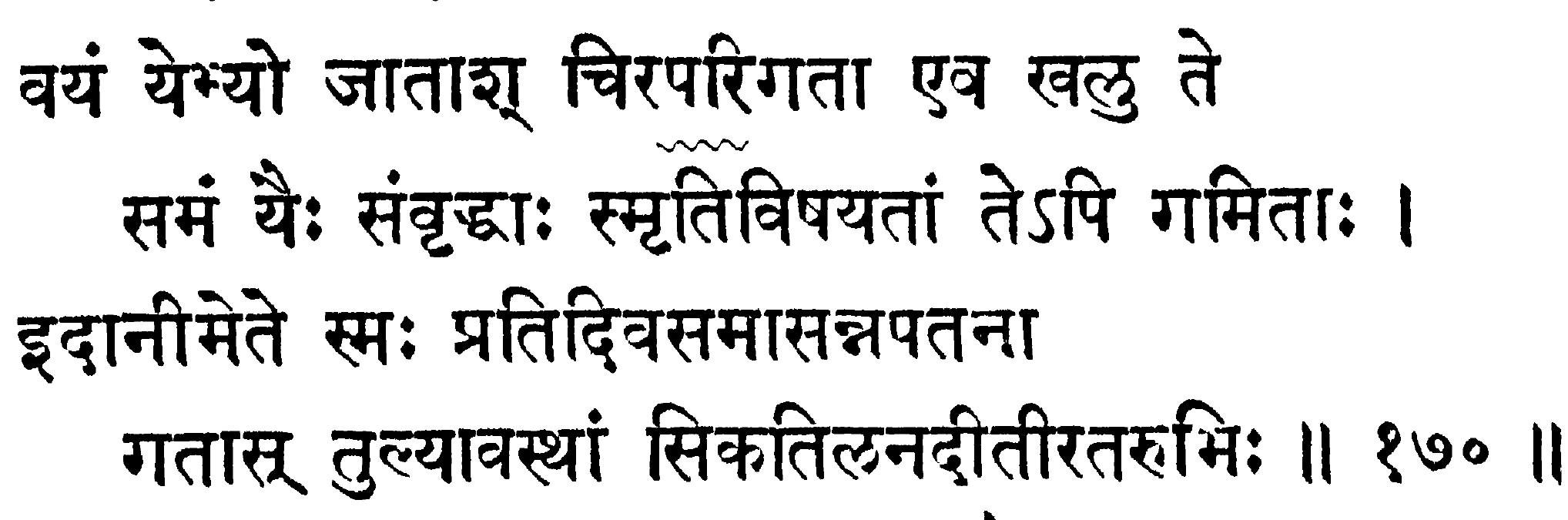
वयं येभ्यो जाताश् चिरपरिगता एव खलु ते
समं यैः संवृद्धाः स्मृतिविषयतां तेऽपि गमिताः ।
इदानीमेते स्मः प्रतिदिवसमासन्नपतना
गतास् तुल्यावस्थां सिकतिलनदीतीरतरुभिः ॥ १७० ॥
Footnote
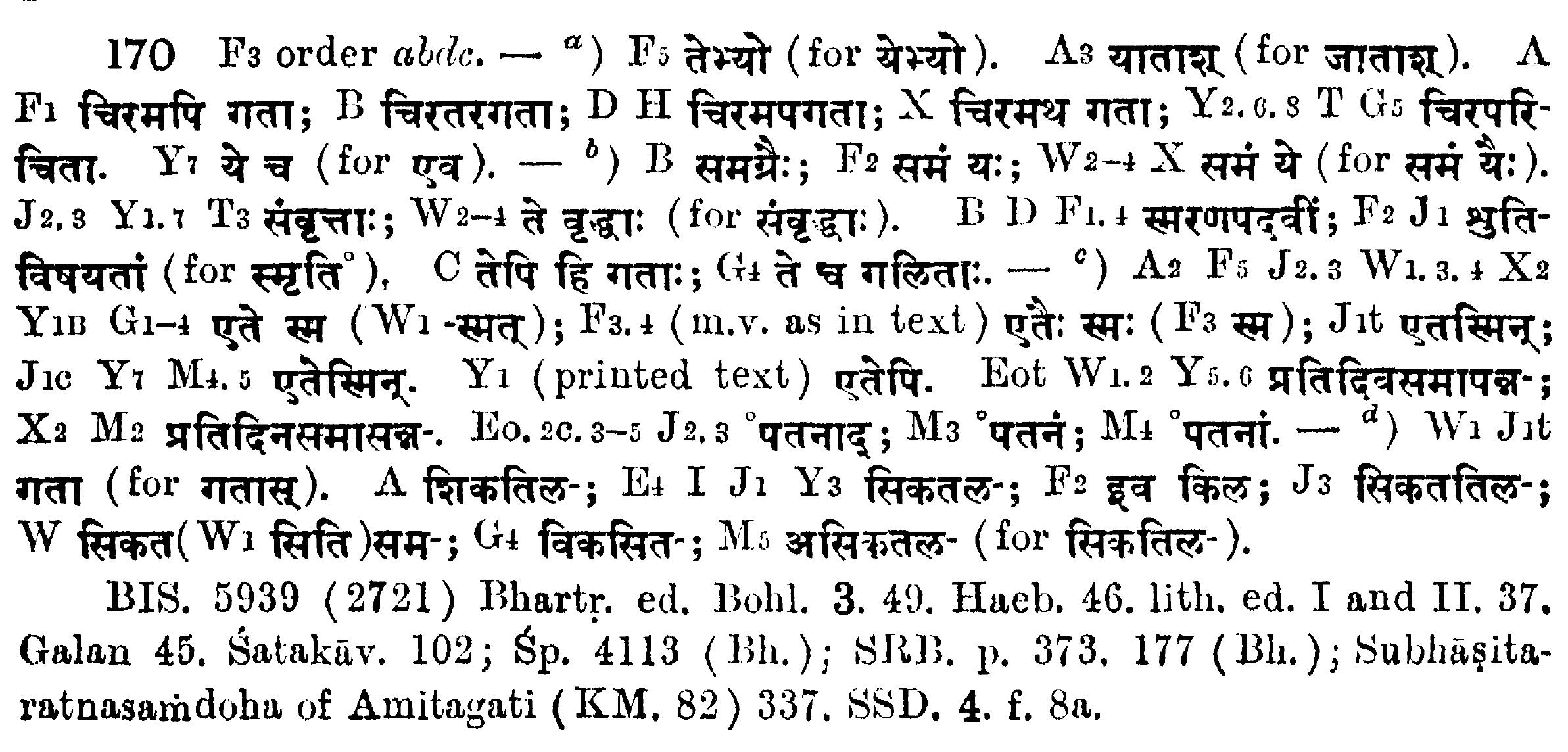
170 F3 order abde . a ) F5 तेभ्यो ( for येभ्यो ) . A3 याताश ( for जाताश ) . A
F1 चिरमपि गता ; B चिरतरगता ; D DH H चिरमपगता ; X चिरमथ गता ; Y2.6.8 TGs चिरपरि -
चिता . Y7 ये च ( for एव ) . 1 b ) B समग्रैः ; F2 समं यः ; W 2 - + X समं ये ( for समं यैः ) .
J2 . 3 Y1.7 T3 संवृत्ता :; W2-1 ते वृद्धा : ( for संवृद्धा : ) . B ) F1 . + स्मरणपदवीं ; F2 J1 श्रुति
विषयतां ( for स्मृति ) , C तेपि हि गताः ; ( 4 G + ते घ गलिताः . vid c ) A2 F5 J2 3 W1 . 3. + X 2
Y1B G1 - 1 एते स्म ( W1- स्मत् ) ; F3 + ( m.v. as in text ) एतैः स्मः ( F3 स्म ) ; Jit एतस्मिन् ;
J10 Y1 M 4.5 एतेस्मिन् . Y 1 ( printed text ) एतेपि . Eot W1 . 2 Y5.6 प्रतिदिवसमापन- ;
X 2 M 2 प्रतिदिनसमासन्न - Eo . 20.3-5 J2.3 पतनादू ; M3 पतनं ; M + ० पतनां . d ) Widit
गता ( for गतास् ) . A शिकतिल- ; E1 I J 1 Y 3 सिकतल- ; F2 इव किल ; J3 सिकततिल- ;
W सिकत ( W1 सिति ) सम- ; G + विकसित ; M.5 असिकतल- ( for सिकतिल- ) .
BIS . 5939 ( 2721 ) Bhartr ed . Bohl . 3. 49. Haeb . 46. lith ed . I and II . 37 .
Galan 45. Satakāv . 102 ; Sp . 4113 ( Bh . ) ; SRB p . 373 , 177 ( Bh . ) ; Subhagita
ratnasamdoha of Amitagati ( KM . 82 ) 337. SSD . 4. f . 8a .
Commentary