Tawney
You are a lord of acres,
But we are lords of song;
And we subdue the subtle,
If you subdue the strong;
The rich of you are speaking,
In me the wise believe.
And if you find me irksome,
Why then — I take my leave.
Mādhavānanda
अर्थानामीशिषे त्वं वयमपि च गिरामीश्महे यावदर्थं
शूरस्त्वं वादिदर्पव्युपशमनविधावक्षयं पाटवं न: ।
सेवन्ते त्वां धनाढ्या मतिमलहतये मामपि श्रोतुकामा
मय्यप्यास्था न ते चेत्त्वयि मम नितरामेव राजन्ननास्था ।।५२।।
52. Thou exercisest kingly power over riches, we do the same over words (i.e., ideas or scriptures) in all their senses. Thou art a hero (in battle), while we have never-failing skill in methods of subduing the pride of disputants. It is the rich who serve thee, while, intent on learning (higher truths), men serve us to have all imperfections of mind destroyed. If thou hast no regard for me, well, O king, I have absolutely none for thee.
Telang
all
अर्थानामीशिषे त्वं वयमपि च गिरामीश्महे यावदित्यं
शूरस्त्वं वादिदर्पज्वरशमनविधावक्षयं पाटवं नः ।
सेवन्ते त्वां धनाढ्या मतिमलहतये मामपि श्रोतुकामा
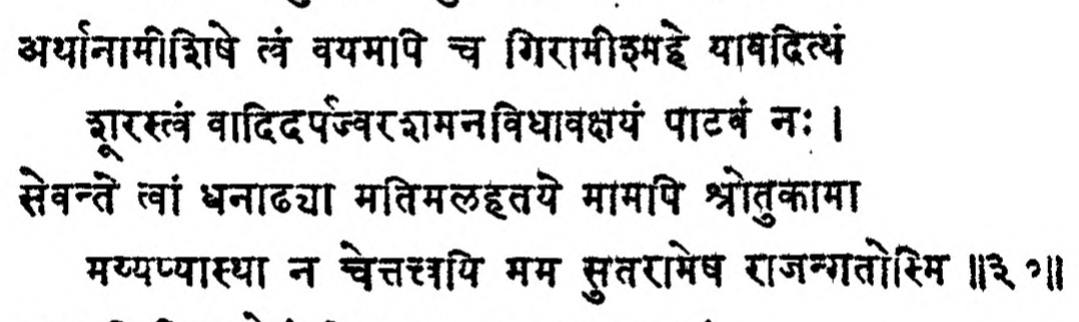
मय्यप्यास्था न चेत्त्वयि मम सुतरामेष राजन्गतोस्मि ॥३०॥
Notes
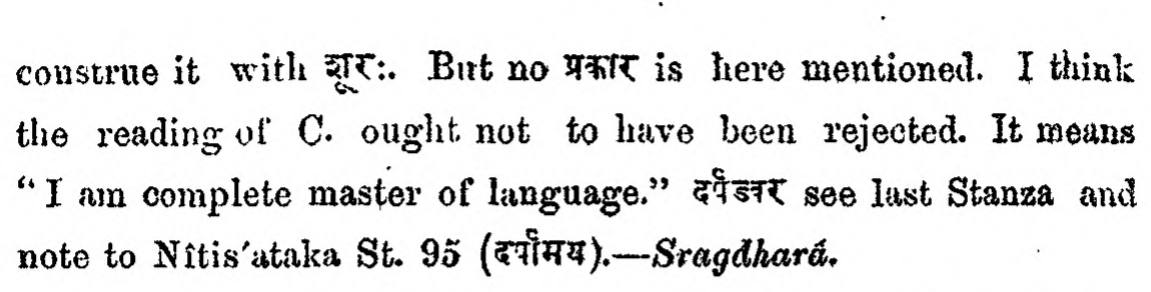
St. XXX.—अर्थानाम्. Siddh. Kaum. I., 297. यावत् = साकल्येन (Râmarshi.) इत्थम् = अमुना प्रकारेण according to the commentators who construe it with शूरः. But no प्रकार is here mentioned. I think the reading of C. ought not to have been rejected. It means “ I am complete master of language.” दर्पज्वर see last Stanza and note to Nîtis'ataka St. 95 (दर्पामय).—Sragdharâ.


Kale
all
अर्थानामीशिषे त्वं वयमपि च गिरामीश्महे यावदर्थं
शूरस्त्वं वादिदर्पज्वरशमनविधावक्षयं पाटवं नः ।
सेवन्ते त्वां धनाढ्या मतिमलहतये मामपि श्रोतुकामा
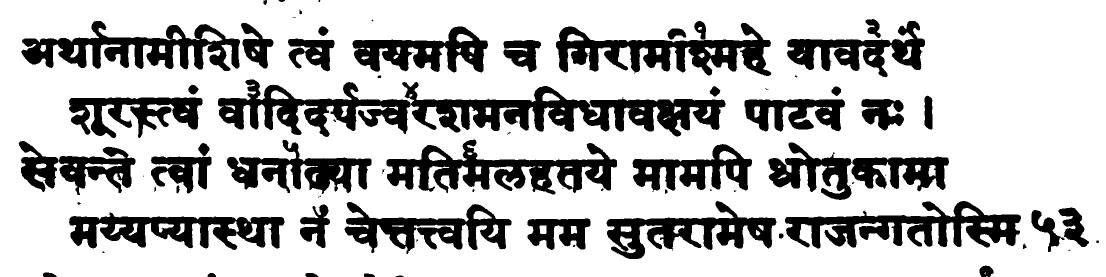
मय्यप्यास्था न चेत्तत्त्वयि मम सुतरामेष राजन्गतोस्मि ५३
Translation
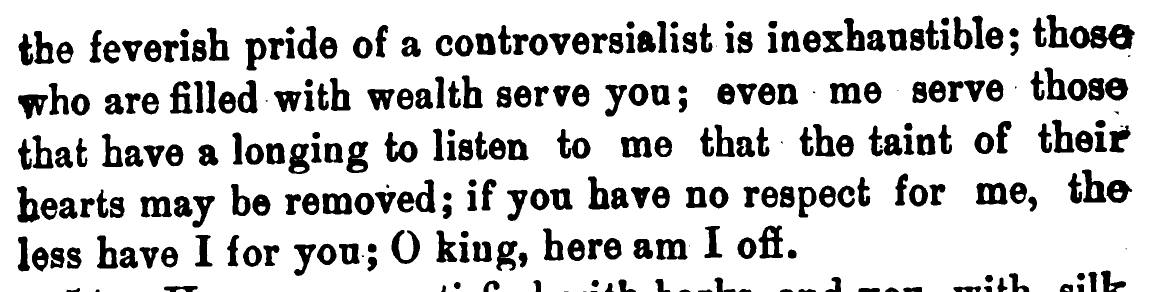
53. You are the lord of riches in full, we too of words in all their senses; you are brave, our skill in the act of subduing the feverish pride of a controversialist is inexhaustible; those who are filled with wealth serve you; even me serve those that have a longing to listen to me that the taint of their hearts may be removed; if you have no respect for me, the less have I for you; O king, here am I off.

Notes
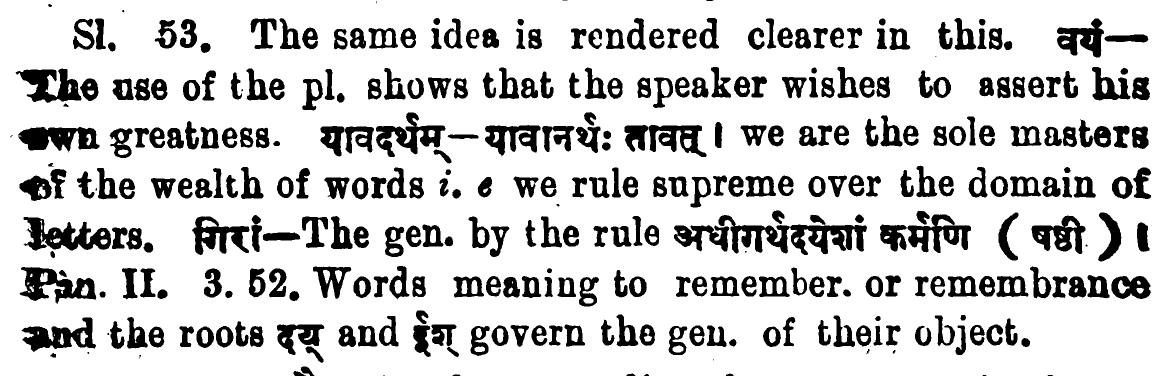
Sl. 53. The same idea is rendered clearer in this. वयं— The use of the pl. shows that the speaker wishes to assert his own greatness. यावदर्थम्—यावानर्थः तावत् । we are the sole masters of the wealth of words i. e we rule supreme over the domain of letters. गिरां—The gen. by the rule अधीगर्थदयेषां कर्मणि ( षष्ठी ) । Pàn. II. 3. 52. Words meaning to remember. or remembrance and the roots दय् and ईश् govern the gen. of their object.

Gopinath1914
all
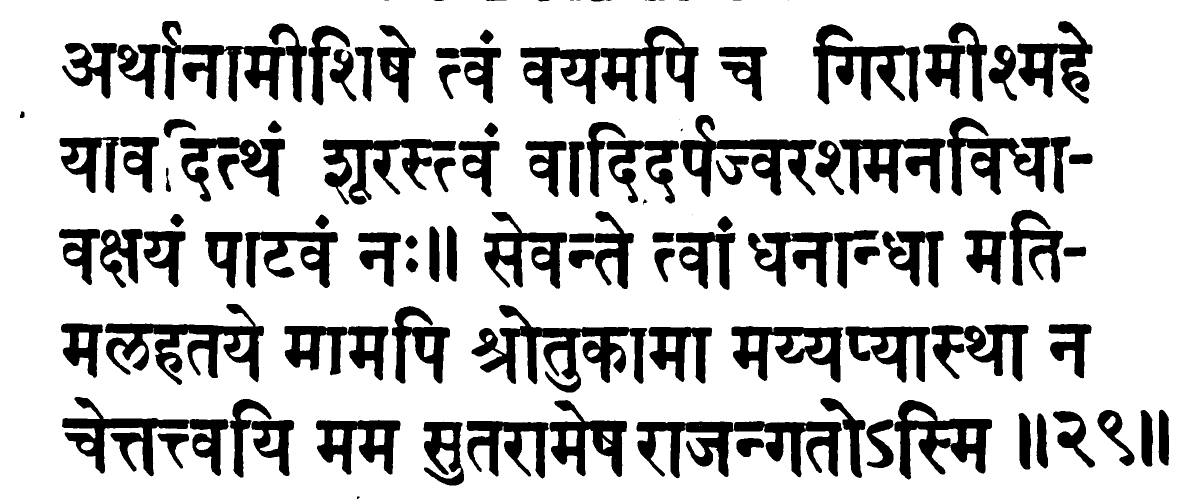
अर्थानामीशिषे त्वं वयमपि च गिरामीश्महे
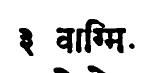
यावदित्थं शूरस्त्वं वादिदर्पज्वरशमनविधा-
वक्षयं पाटवं नः ॥ सेवन्ते त्वां धनान्धा मति-
मलहतये मामपि श्रोतुकामा मय्यप्यास्था न
चेत्तत्त्वयि मम सुतरामेष राजन्गतोऽस्मि ॥ २९ ॥
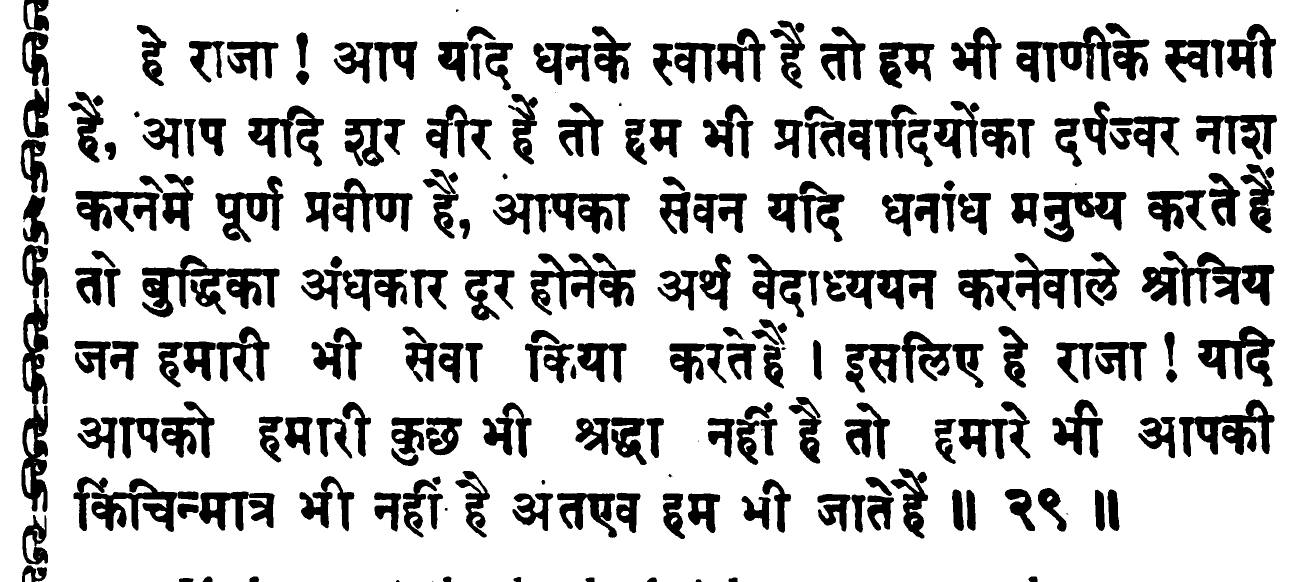
हे राजा ! आप यदि धनके स्वामी हैं तो हम भी वाणीके स्वामी हैं, आप यदि शुर वीर हैं तो हम भी प्रतिवादियोंका दर्पज्वर नाश करनेमें पूर्ण प्रवीण हैं, आपका सेवन यदि धनांध मनुष्य करते हैं तो बुद्धिका अंधकार दूर होनेके अर्थ वेदाध्ययन करनेवाले श्रोत्रिय जन हमारी भी सेवा किया करते हैं । इसलिए हे राजा ! यदि आपको हमारी कुछ भी श्रद्धा नहीं है तो हमारे भी आपकी किंचिन्मात्र भी नहीं है अंतएव हम भी जाते हैं ॥ २९ ॥
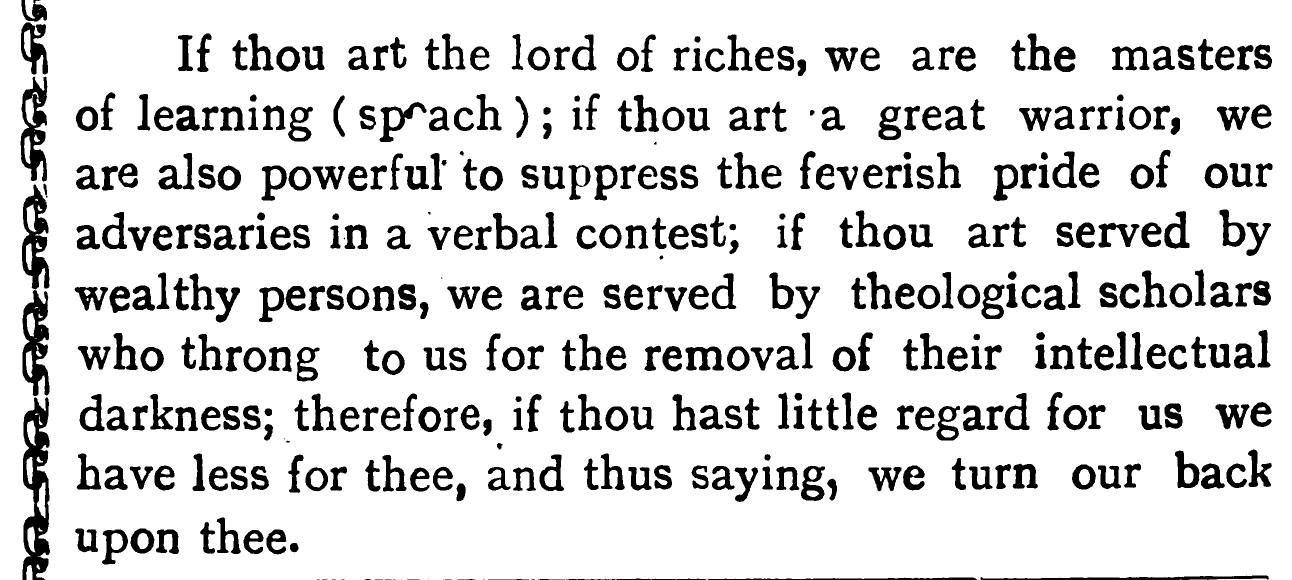
If thou art the lord of riches, we are the masters of learning (sprach); if thou art a great warrior, we are also powerful to suppress the feverish pride of our adversaries in a verbal contest; if thou art served by wealthy persons, we are served by theological scholars who throng to us for the removal of their intellectual darkness; therefore, if thou hast little regard for us we have less for thee, and thus saying, we turn our back upon thee.


Gopinath1896
all
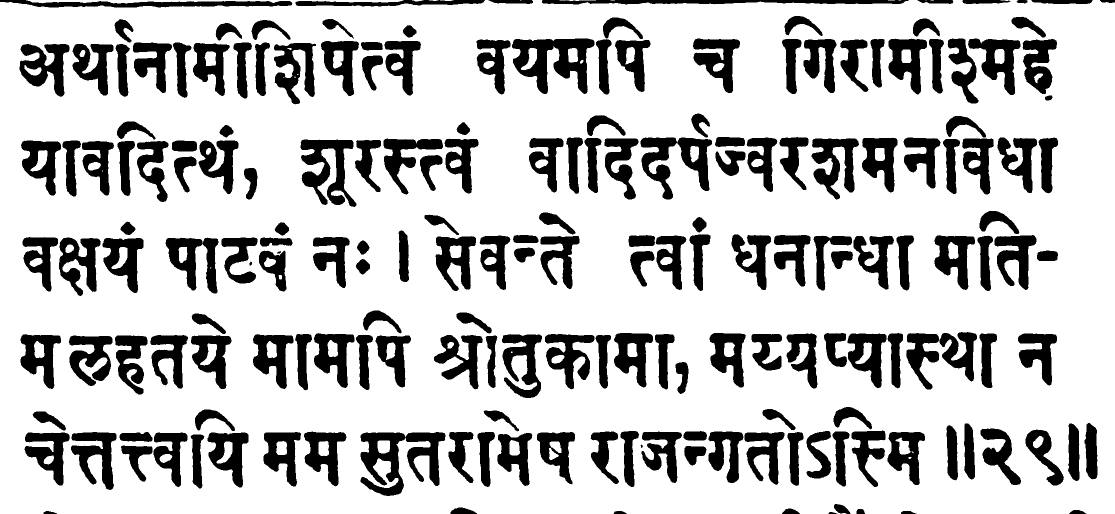
अर्थानामीशिपेत्वं वयमपि च गिरामी महे
यावदित्थं, शूरस्त्वं वादिदर्पज्वरशमनविधा
वक्षयं पाटं नः । सेवन्ते त्वां धनान्धा मति-
मलहतये मामपि श्रोतुकामा, मय्यप्यास्था न
चेत्तत्त्वयि मम सुतरामेष राजन्गतोऽस्मि ॥२९॥
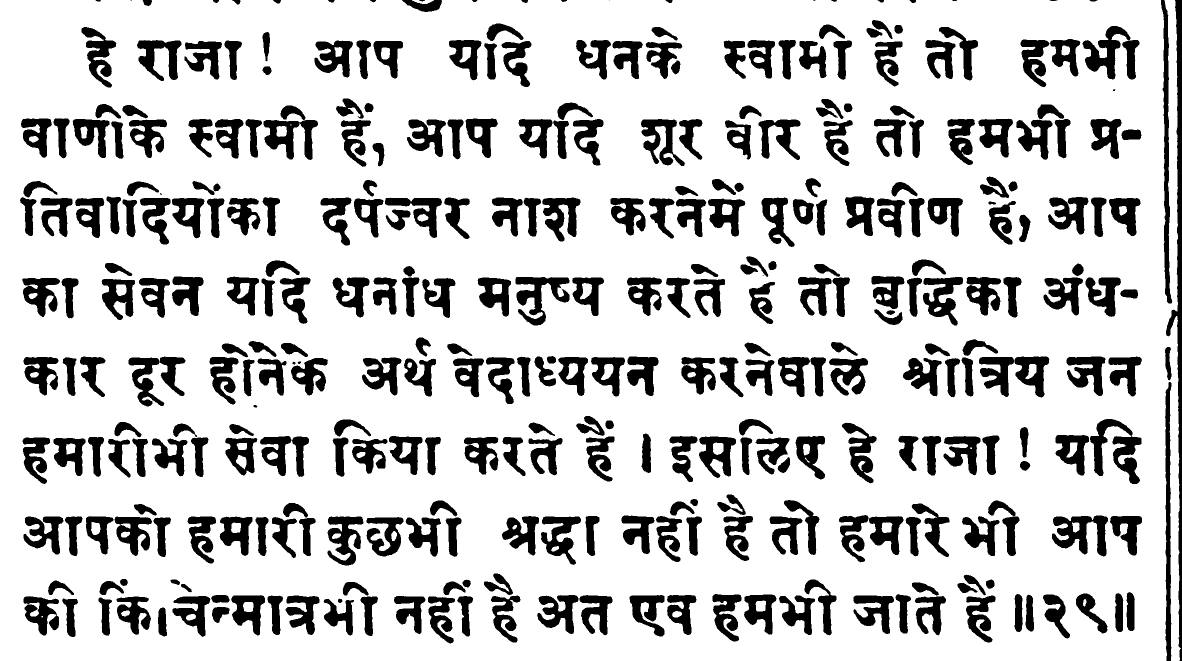
हे राजा ! आप यदि धनके स्वामी हैं तो हमभी वाणीके स्वामी हैं, आप यदि शूर वीर हैं तो हमभी प्रतिवादियोंका दर्पज्वर नाश करनेमें पूर्ण प्रवीण हैं, आप का सेवन यदि धनांध मनुष्य करते हैं तो बुद्धिका अंधकार दूर होनेके अर्थ वेदाध्ययन करनेवाले श्रोत्रिय जन हमारी भी सेवा किया करते हैं । इसलिए हे राजा ! यदि आपको हमारी कुछभी श्रद्धा नहीं है तो हमारे भी आप की किंचिन्मात्र भी नहीं है अत एव हमभी जाते हैं ॥ २९ ॥
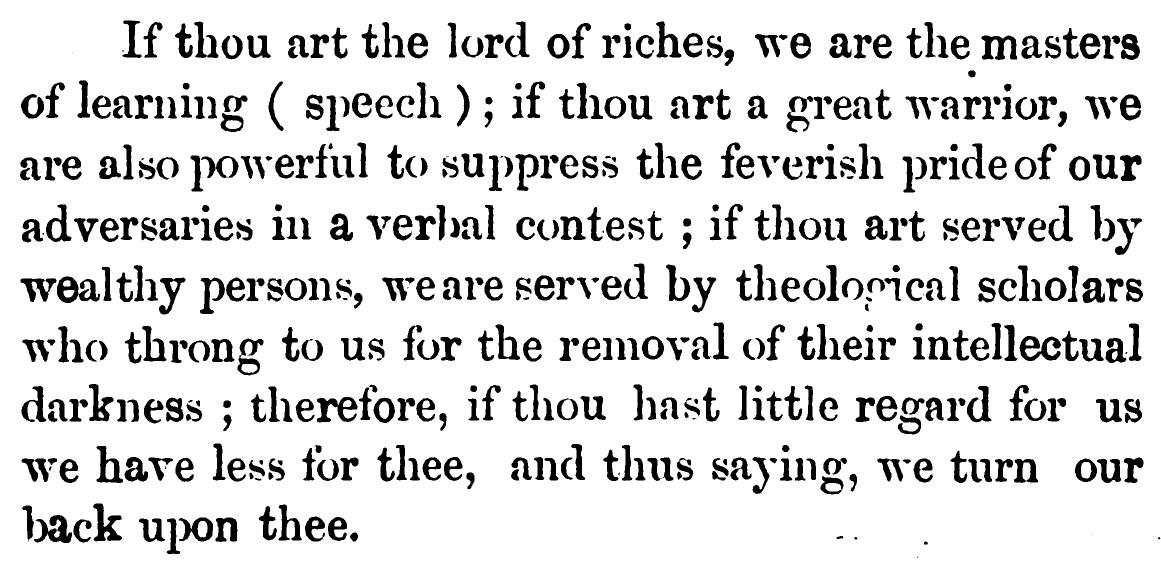
If thou art the lord of riches, we are the masters of learning ( speech ) ; if thou art a great warrior, we are also powerful to suppress the feverish pride of our adversaries in a verbal contest; if thou art served by wealthy persons, we are served by theological scholars who throng to us for the removal of their intellectual darkness; therefore, if thou hast little regard for us we have less for thee, and thus saying, we turn our back upon thee.

Kosambi
all
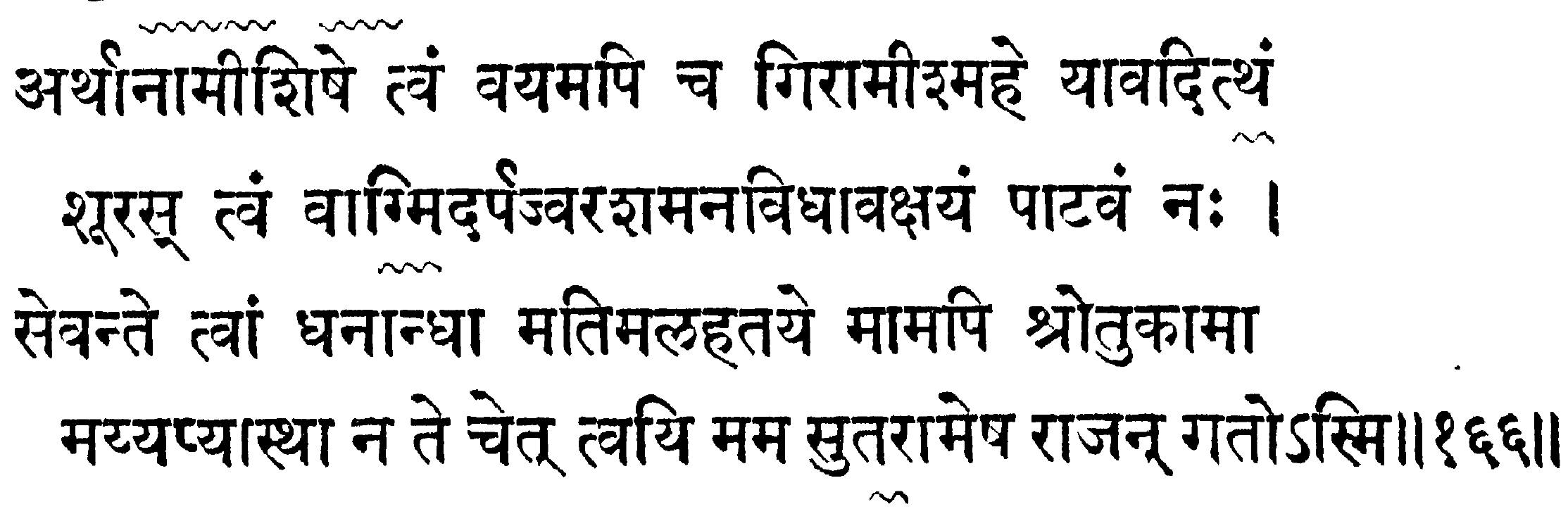
अर्थानामीशिषे त्वं वयमपि च गिरामीश्महे यावदित्थं
शूरस् त्वं वाग्मिदर्पज्वरशमनविधावक्षयं पाटवं नः ।
सेवन्ते त्वां धनान्धा मतिमलहतये मामपि श्रोतुकामा
मय्यप्यास्था न ते चेत् त्वयि मम सुतरामेष राजन् गतोऽस्मि ॥ १६६ ॥
Footnote
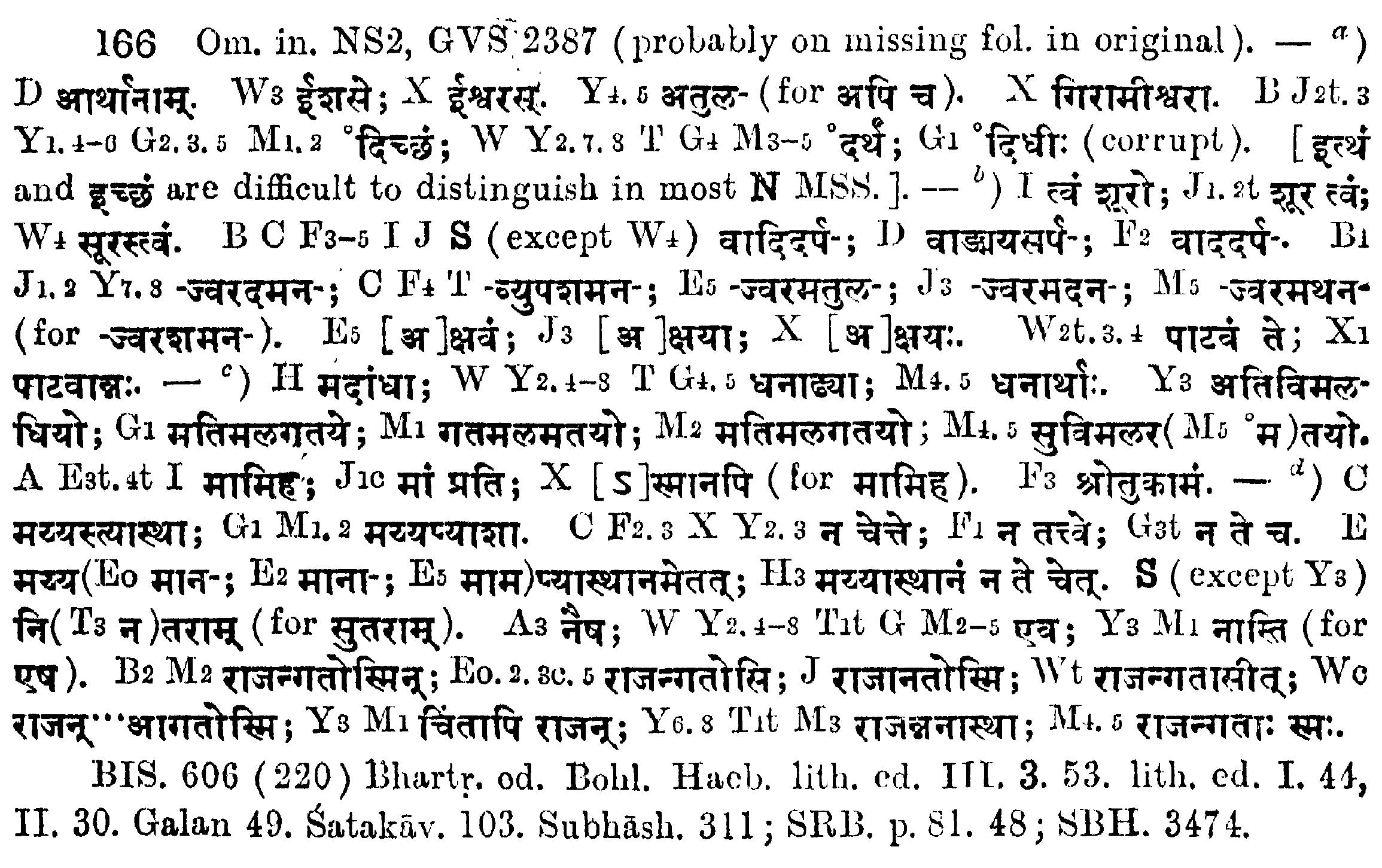
166 Om . in . NS2 , GVS 2387 ( probably on missing fol . in original ) . c . )
D आर्थानाम् W3 ईशसे ; X ईश्वरस् . Y.5 अतुल- ( for अपि च ) . X गिरामीश्वरा . BJat 3
Y1 . ± −0 G2 , 3.5_M1.2 ° दिच्छं ; W Y2.7.8 ' I ' G + M3-5 ° दर्थ ; G 1 ° दिधी : ( corrupt ) . [ [ इत्थं
and इच्छं are difficult to distinguish in most N MSS . ] . -- 0 ) I त्वं शूरो ; J1.2t शूर त्वं
W + सूरस्त्वं . B C F3-5 I J S ( except W1 ) वादिदर्प ; 1 ) वाङ्मयसर्प- ; 2 वाददर्प • Ba
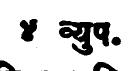
J1.2 Y7.8 -ज्वरदमन- ; C F + T व्युपशमन ; Es ज्वरमतुल ; J3 -ज्वरमदन ; Ms - ज्वरमथन
( for -ज्वरशमन- ) . Lo [ अ ] क्षवं ; J3 [ अ ] क्षया ; X [ अ ] क्षयः . W2t . 3. पाटवं ते ; X 1
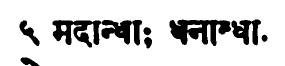
फाटवान्नः • - 0 ) H मदांधा ; W Y 2. 4 - 8 T G + 5 धनाढ्या ; M4.5 धनार्था :. Y3 अतिविमल
धियो ; G1 मतिमलगतये ; M1 गतमलमतयो ; M2 मतिमलगतयो ; Mi 5 सुविमलर ( M5 ° म ) तयो .
A Est.4t I मामिह ; J10 मां प्रति ; X [ s ] स्मानपि ( for मामिह ) . 13 श्रोतुकामं - 4 ) C
मय्यस्त्यास्था ; G1 G1 M1.2 M1 . 2 मय्यप्याशा मय्यप्याशा . . CF2 CF 2. . 3 3 X X Y2 Y 2. . 3 न चेत्ते ; I 1 न तत्त्वे ; Gst G3 न न ते च . E
मय्य ( Eo मान- ; 2 माना- ; E5 माम ) प्यास्थानमेतत् ; H3 मय्यास्थानं न ते चेत् . S ( except Y3 )
नि ( T3 न ) तराम् ( for सुतराम् ) . A3 नैष ; W Y2 . 1 –8 Tht GM2-5 एव ; Y3 Mi नास्ति ( for
एष ) . B2 M2 राजन्गतोस्मिन् ; Eo . 2. 80.5 राजन्गतोसि ; J राजानतोस्मि ; Wt राजन्गतासीत् ; Wo
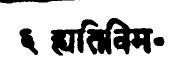
राजन् आगतोस्मि ; Y3M 1 चिंतापि राजनू ; Yo . 8 Tit M3 राजन्ननास्था ; M + 5 राजन्गताः स्मः .
BIS . 606 ( 220 ) Bhartr . od . Bohl . Hacb lith ed . ITL . 3. 53. lith ed . I. 44 ,
II . 30. Galan 49. Satakāv . 103. Subhāsh . 311 ; SRB . p . 81. 48 ; SBH . 3474 .
Commentary