Ryder
WHY GO TO COURT?
I am not fashion's changing sport,
I never acted, sang, nor hated;
What figure should I cut at court?
I am no lady languid-gaited.
Brough
I am no actor, nor a prince’s jester.
No king’s musician, nor a scheming courtier.
What place at court, then, for a man such as I am?
For neither am I a young attractive woman.
Tawney
What can I do in princely courts,
Unskilled in vice, and idle sports,
Nor singer, actor, rogue, nor clown,
Nor bent on pulling others down?
Mādhavānanda
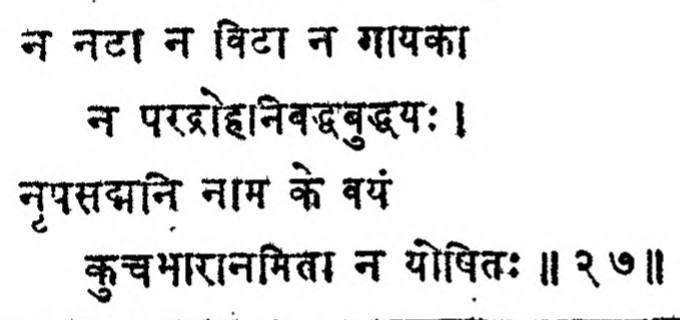
न नटा न विटा न गायका
न च सभ्येतरवादचुञ्चव: ।
नृपमीक्षितुमत्र के वयं
स्तनभारानमिता न योषित: ।।५६।।
56. Who are we to go to see a king—not dancers, court-jesters, or singers, nor experts in (learned) disputes with others in a court, nor youthful court mistresses! (That is, we have absolutely no business to go to a king.)
[The विट is generally a parasite of a prince.]
Telang
all
Notes
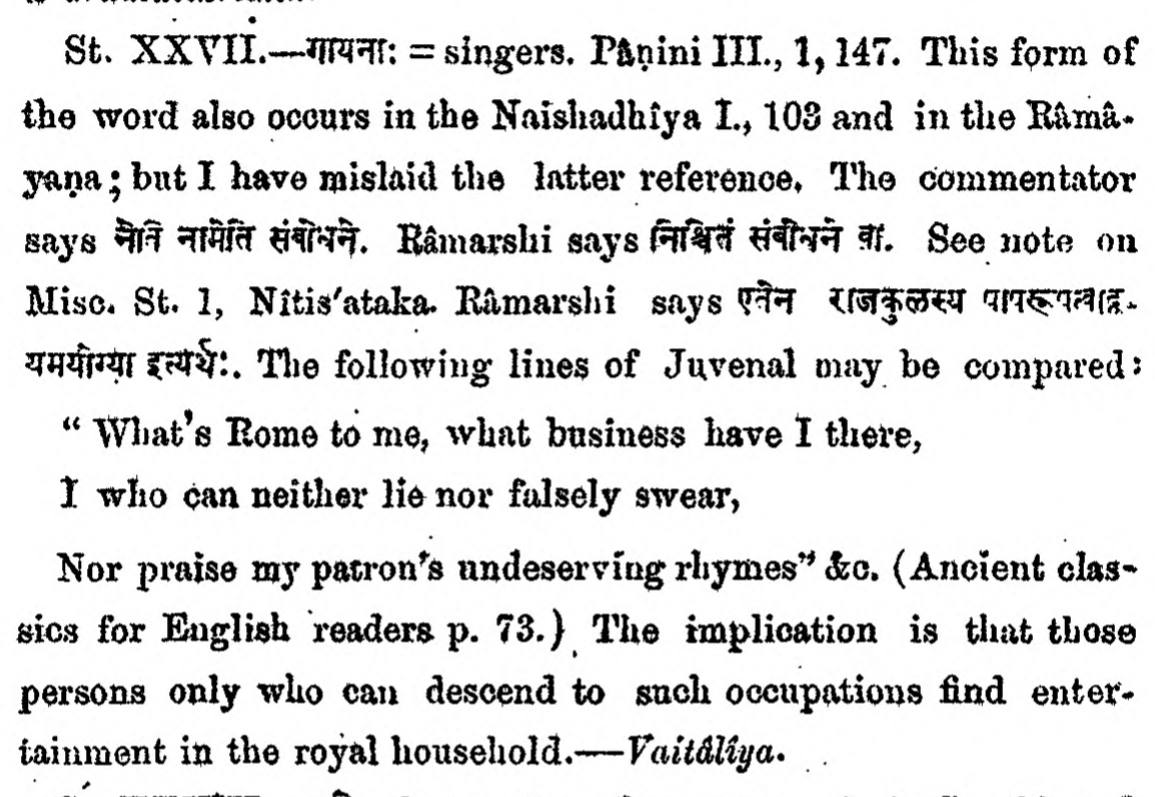
St. XXVII.—गायनाः = singers. Pâṇini III., 1, 147. This form of the word also occurs in the Naishadhîya I., 103 and in the Râmâyaṇa ; but I have mislaid the latter reference. The commentator says नेति नामेति संबोधने. Râmarshi says निश्चितं संबोधने वा. See note on Misc. St. 1, Nîtis'ataka. Râmarshi says एतेन राजकुलस्य पापरूपत्वाद्धयमयोग्या इत्यर्थः. The following lines of Juvenal may be compared :
“ What’s Rome to me, what business have I there,
I who can neither lie nor falsely swear,
Nor praise my patron’s undeserving rhymes” &c. (Ancient classics for English readers p. 73.) The implication is that those persons only who can descend to such occupations find entertainment in the royal household.—Vaitâlîya.

Kale
all


Translation
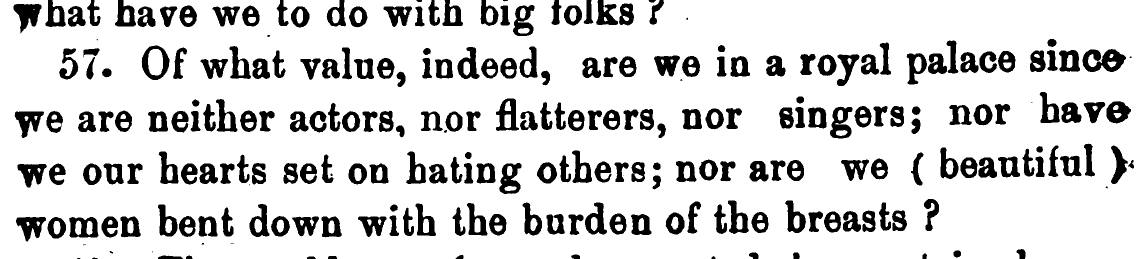
57. Of what value, indeed, are we in a royal palace since we are neither actors, nor flatterers, nor singers; nor have we our hearts set on hating others; nor are we ( beautiful ) women bent down with the burden of the breasts ?
Notes
Sl. 57. विटाः—flatterers, panderers. In dramas this word has a technical meaning. It means the companion of the hero or a king who is skilled in one art only. See com. गायनाः—ल्युट् ( अन ) added कर्तरि. नृपस०—A king's palace is frequented by buffoons, flatterers, and licentious and malicious people. The poet says, as he is none of these, a royal court is not the place for him. Mr. Telang here quotes from Juvenal the following parallel lines:—
“ What's Rome to me, what business have I there ?
I who can neither lie, nor falsely swear,
Nor praise my patron's underserving rhymes. ”


Gopinath1914
all
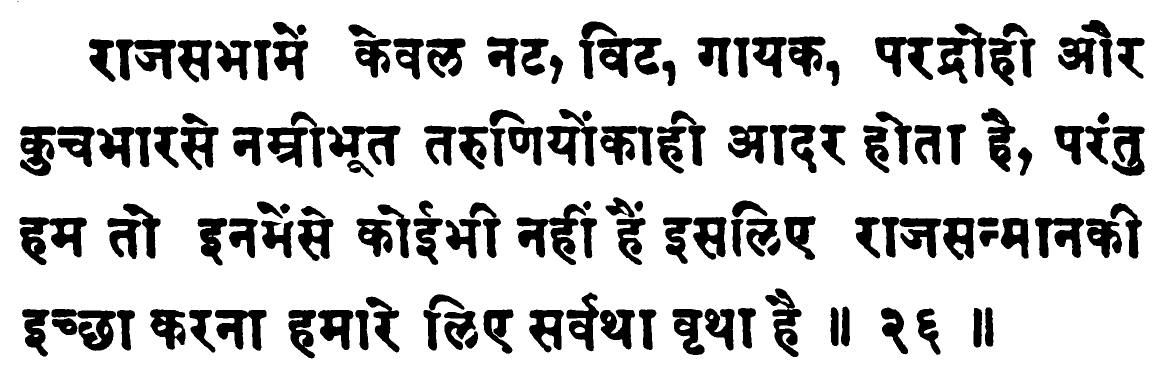
राजसभामें केवल नट, विट, गायक, परद्रोही और कुचभारसे नम्रीभूत तरुणियोंकाही आदर होता है, परंतु हम तो इनमें से कोई भी नहीं हैं इसलिए राजसन्मानकी इच्छा करना हमारे लिए सर्वथा वृथा है ॥ २६ ॥
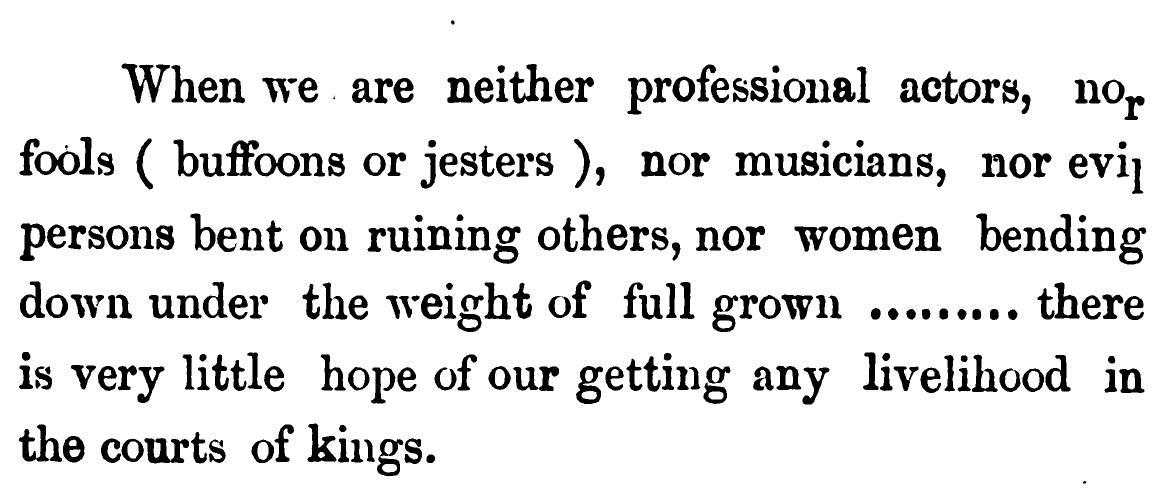
When we are neither professional actors, nor : fools ( buffoons or jesters ), nor musicians, nor evil persons bent on ruining others, nor women bending down under the weight of full grownthere is very little hope of our getting any livelihood in the courts of kings.

Footnote
" (b) लघु जनसे प्रीती जहाँ, रसिक नारिसे काम । बुध नर ऐसे देशको, दूरहिसे परनाम ॥ " ( रसिक कवि )

Gopinath1896
all
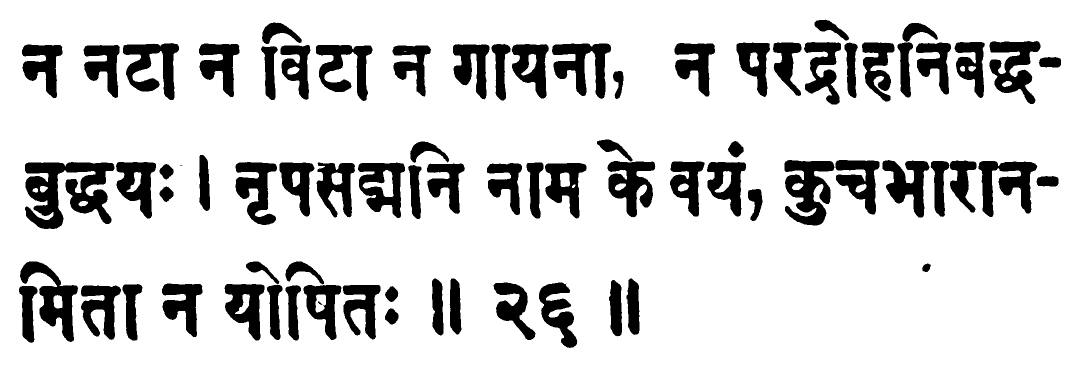
न नटा न विटा न गायना, न परद्रोह निबद्ध-
बुद्धयः । नृपसद्मनि नाम के वयं, कुचभारान-
मिता न योषितः ॥ २६ ॥
राजसभा में केवल नट, विट, गायक, परद्रोही और कुचभारसे नम्रीभूत तरुणियोंकाही आदर होता है, परंतु हम तो इनमें से कोई भी नहीं हैं इसलिए राजसन्मानकी इच्छा करना हमारे लिए सर्वथा वृथा है ॥ २६ ॥
When we are neither professional actors, noy fools ( buffoons or jesters ), nor musicians, nor evil persons bent on ruining others, nor women bending down under the weight of full grown .. there is very little hope of our getting any livelihood in the courts of kings.



Kosambi
all

Footnote
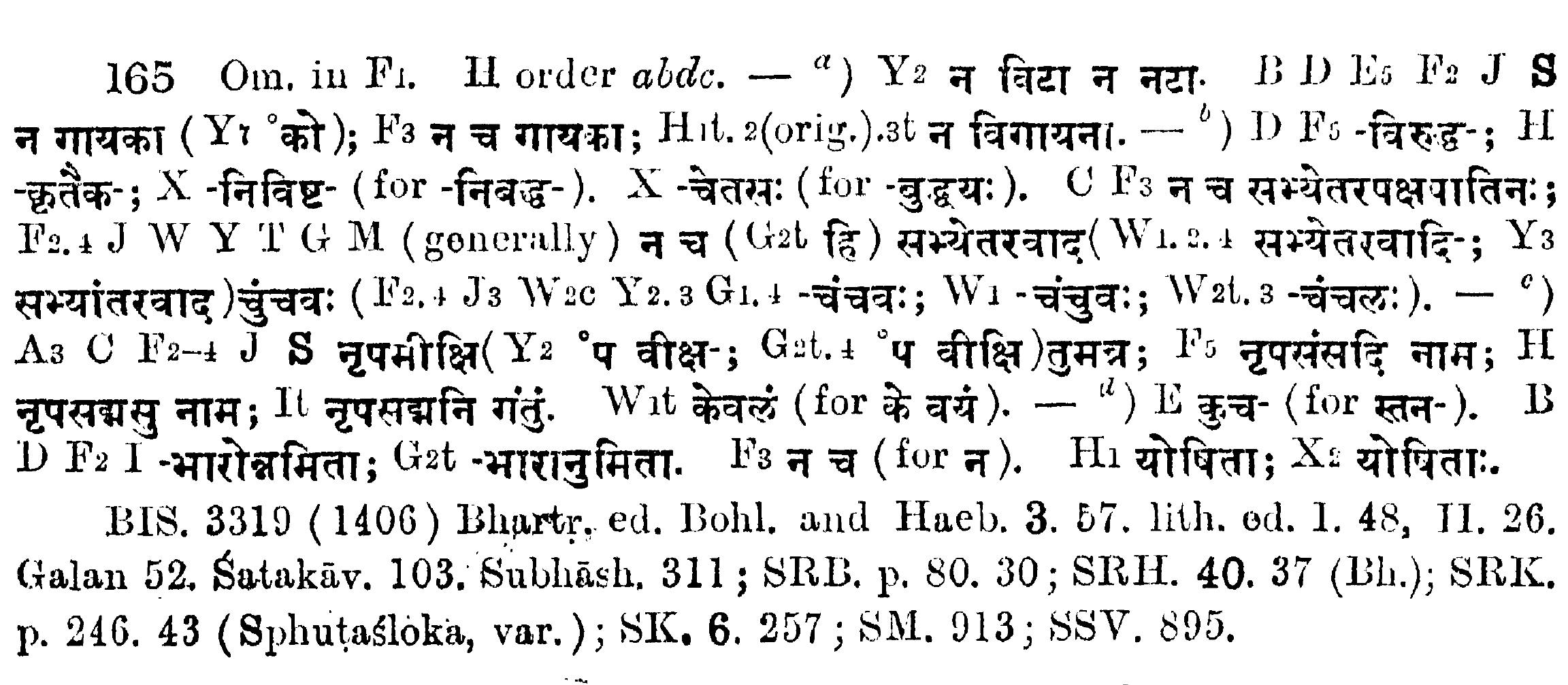
165 Om in F1 . H order abdc . " ) Y2 न विटा न नटा . B D E5 F2 JS
न गायका ( Yr को ) ; F3 न च गायका ; Hit . 2 ( orig . ) . . 3t न विगायना . — ) 1 ) Fs विरुद्ध ; H
-कृतैक ; X -निविष्ट ( for निबद्ध - ) . X चेतसः ( for बुद्धयः ) . ( F3 न च सभ्येतरपक्षपातिनः ;
F2 . 4 J_W_Y_T G_M ( generally ) न च ( Gat हि ) सभ्येतरवाद ( W1.9 ● सभ्येतरवादि ; Y3
सभ्यांतरवाद ) चुंचवः ( F2 , + J3 W2c X2 . 3G1 . + -चंचवः ; W 1 - चंचुव :; Wat . 3 - चंचल :) . " )
A3 C F2 - 4 J S S नृपमीक्षि ( Y2 ° प वीक्ष ; Get . 1 प ु वीक्षि ) तुमत्र ; 15 नृपसंसदि नाम ; H
नृपसद्मसु नाम ; It नृपसद्मनि गंतुं . Wit केवलं ( for के वयं ) . – “ ) E कुच - ( for स्तन - ) . B
D F2 I - भारोन्नमिता ; Get -भारानुमिता . F3 न च ( for न ) . H योषिता ; X : योषिताः .
IS 3310 ( 1406 ) Bhartr . ed . Bohl . and Haeb . 3. 57. lith . od . 148 , 11.26 .
Galan 52. Satakāv . 103. Subhāsh 311 ; SRB p . 80. 30 ; SRH 40. 37 ( BL . ) ; SRK .
p . 246.43 ( Sphutasloka , var . ) ; SK 6 • 257 ; SM 913 ; SSV . 895 .
Commentary