Tawney
Why suffer endless woes in vain
The favour of the great to gain?
Let false ambition's longings cease,
Learn to possess thy soul in peace,
And thou hast won the wishing-cap
That pours earth's treasures in thy lap.
Mādhavānanda
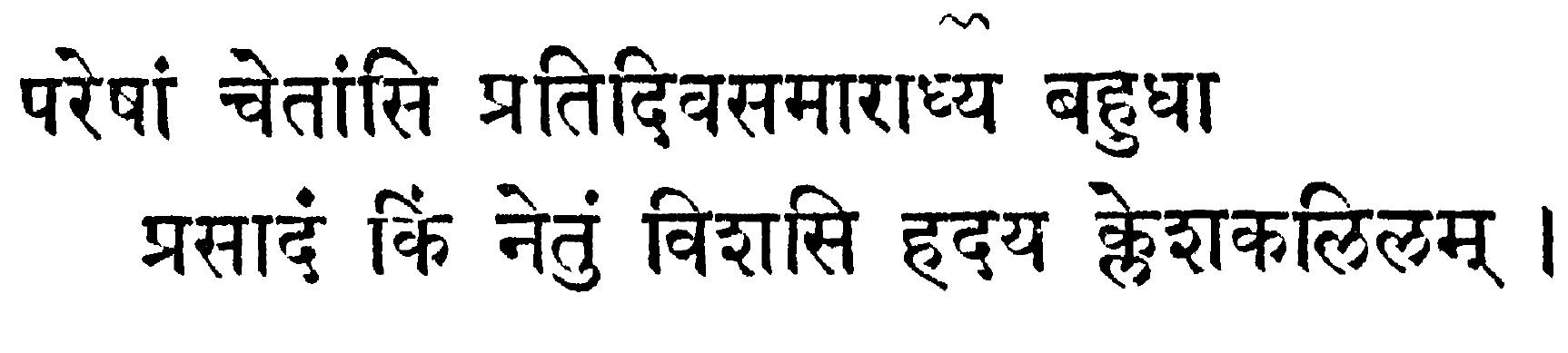
परेषां चेतांसि प्रतिदिवसमाराध्य बहुधा
प्रसादं किं नेतुं विशसि हृदय क्लेशकलितम् ।
प्रसन्ने त्वय्यन्त: स्वयमुदितचिन्तामणिगणो
विविक्त: संकल्प: किमभिलषितं पुष्यति न ते ।।६१।।
61. Why, O heart, dost thou set thyself on winning good graces, so hard to secure, by daily propitiating other men’s minds in various ways? When, being serene inwardly and free from society, thou hast gems of thought rising up of themselves (i.e., when desires do not induce your thinking), what objects mere wish (even) would not bring to thee?
[The idea would come out more clearly, if we read, as many have done, क्लेशकलिलं and चिन्तामणिगुण:; the first expression would then mean ‘a (chaotic) mass of troubles’ instead of ‘hard to secure’, and the verb विशसि would have its primary sense of ‘entering into’. स्वयमुदितचिन्तामणिगुण: would then mean ‘having the virtue of a philosopher’s stone developed of itself in thee’—i.e., प्राप्ति:, one of the eight yogic powers. विविक्त: we prefer to render as ‘free from the company of others’—a state opposed to what is implied when we have to depend on others for gratifying our desires.]
Telang
all
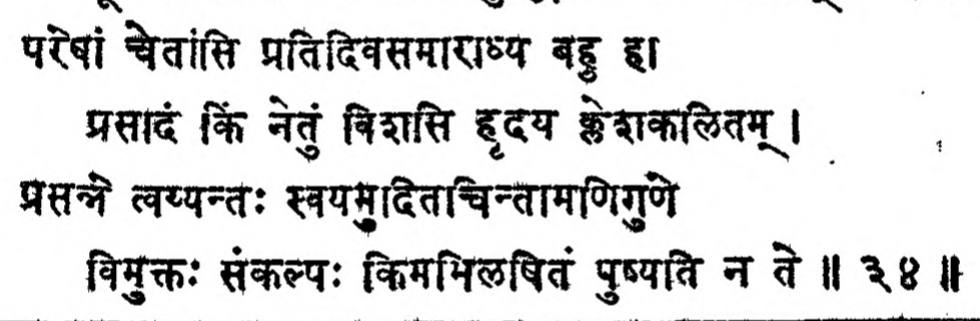
परेषां चेतांसि प्रतिदिवसमाराध्य बहु हा
प्रसादं किं नेतुं विशसि हृदय क्लेशकलितम् ।
प्रसन्ने त्वय्यन्तः स्वयमुदितचिन्तामणिगुणे
विमुक्तः संकल्पः किमभिलषितं पुष्यति न ते ॥ ३४ ॥
Notes
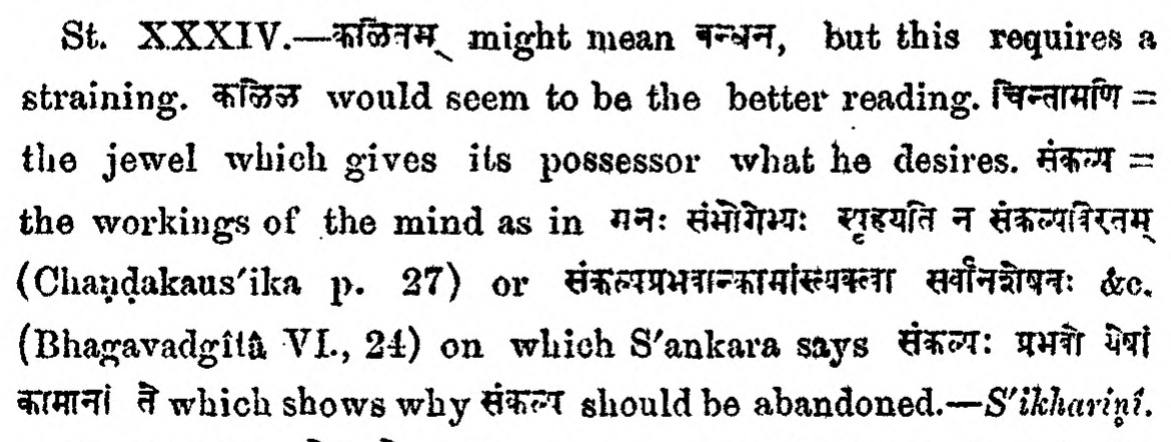
St. XXXIV.—कलितम् might mean बन्धन, but this requires a straining. कलिल would seem to be the better reading. चिन्तामणि = the jewel which gives its possessor what he desires. संकल्प = the workings of the mind as in मनः संभोगेभ्यः स्पृहयति न संकल्पविरमम् (Chaṇḍakaus'ika p. 27) or संकल्पप्रभवान्कामांस्त्यक्त्वा सर्वानशेषतः &c. (Bhagavadgîtâ VI., 24) on which S'ankara says संकल्पः प्रभवो येषां कामानां ते which shows why संकल्प should be abandoned.—S'ikhariṇî.

Kale
all
Introduction
इदानीमन्येषां प्रसादनान्मनःप्रसादस्योत्कर्षं प्रतिपादयन्मनःसंबोधनपूर्वं तन्नियमनप्रकारमाह—

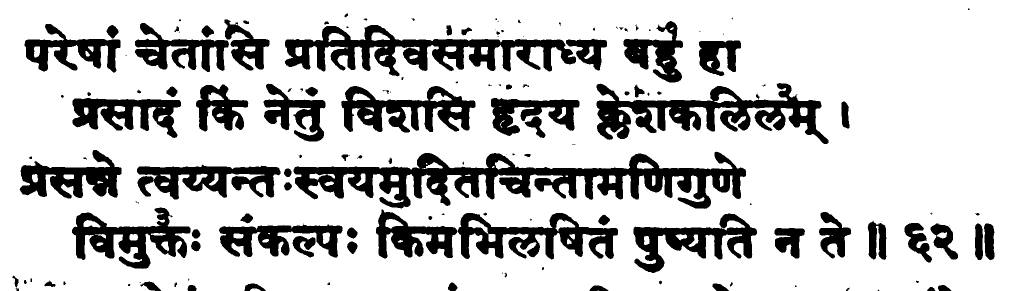
परेषां चेतांसि प्रतिदिवसमाराध्य बहु हा
प्रसादं किं नेतुं विशसि हृदय क्लेशकलिलंम् ।
प्रसन्ने त्वय्यन्तःस्वयमुदितचिन्तामणिगुणे
विमुक्तः संकल्पः किमभिलषितं पुष्यति न ते ॥ ६२ ॥
Translation
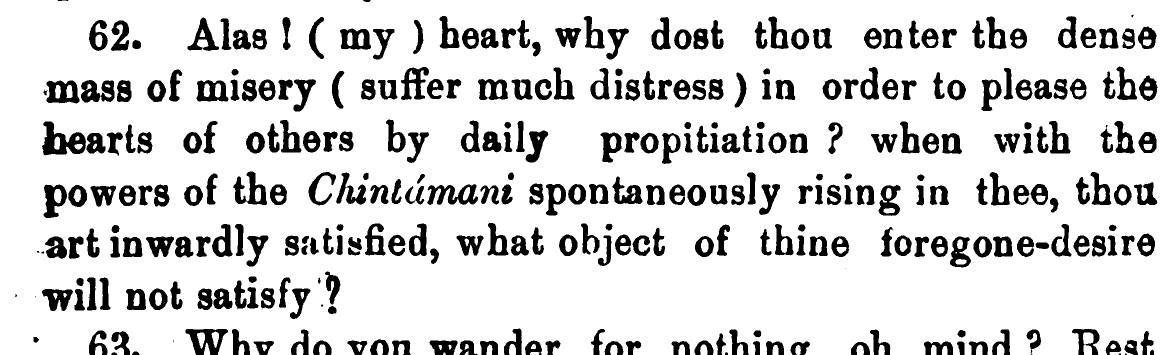
62. Alas ! ( my ) heart, why dost thou enter the dense mass of misery ( suffer much distress ) in order to please the hearts of others by daily propitiation ? when with the powers of the Chintámani spontaneously rising in thee, thou art inwardly satisfied, what object of thine foregone-desire will not satisfy ?
Notes
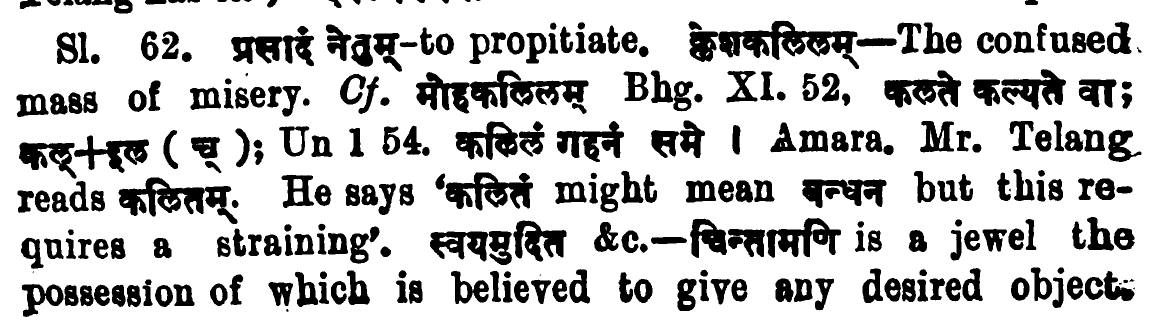
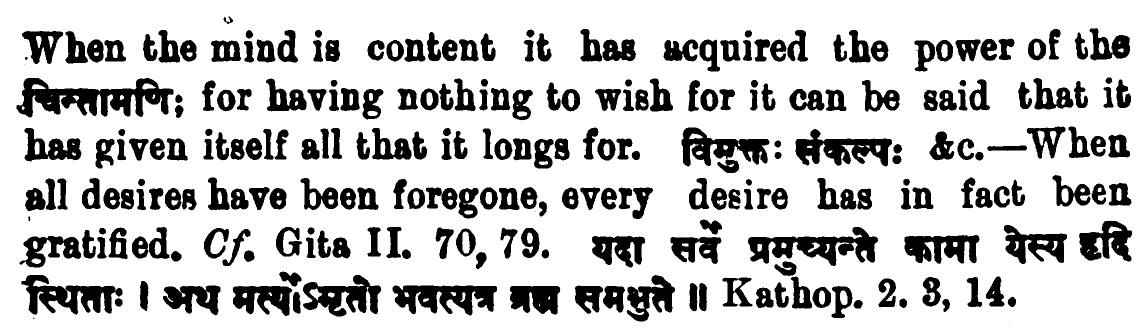
Sl. 62. प्रसादं नेतुम्-to propitiate. क्लेशकलिलम्—The confused mass of misery. Cf. मोहकलिलम् Bhg. XI. 52, कलते कल्यते वा; कल्+इल ( च् ); Un I 54. कलिलं गहनं समे । Amara. Mr. Telang reads कलितम्. He says ‘कलितं might mean बन्धन but this requires a straining’. स्वयमुदित &c.—चिन्तामणि is a jewel the possession of which is believed to give any desired object. When the mind is content it has acquired the power of the चिन्तामणि; for having nothing to wish for it can be said that it has given itself all that it longs for. विमुक्तः संकल्पः &c.—When all desires have been foregone, every desire has in fact been gratified. Cf. Gita II. 70, 79. यदा सर्वे प्रमुच्यन्ते कामा येस्य हृदि स्थिताः । अथ मर्त्योऽमृतो भवत्यत्र ब्रह्म समश्नुते ॥ Kathop. 2. 3, 14.

Gopinath1914
all
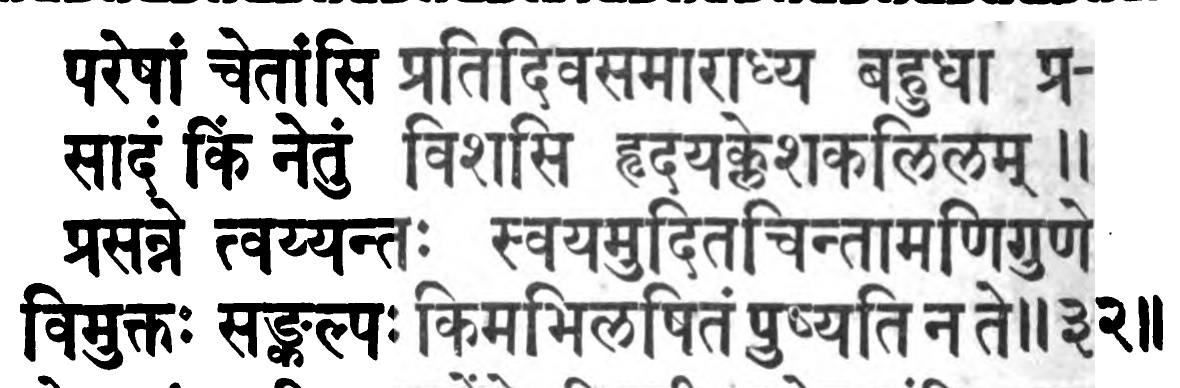
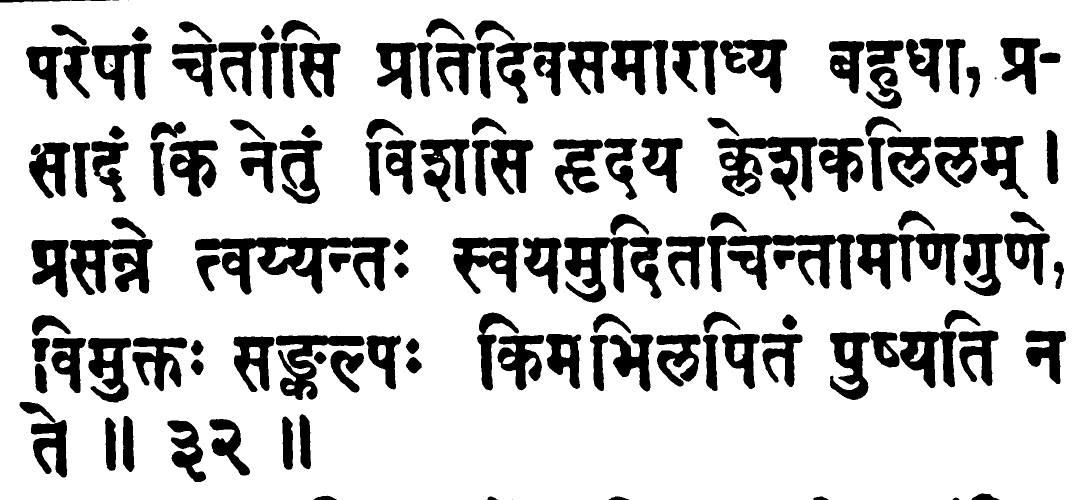
परेषां चेतांसि प्रतिदिवसमाराध्य बहुधा प्र-
सादं किं नेतुं विशसि हृदय केशकलिलम् ॥ ॥
त्वय्यन्तः
विमुक्तः प्रसन्ने सङ्कल्पः किमभिलषितं स्वयमुदितचिन्तामणिगुणे पुष्यति न ते ॥ ३२ ॥
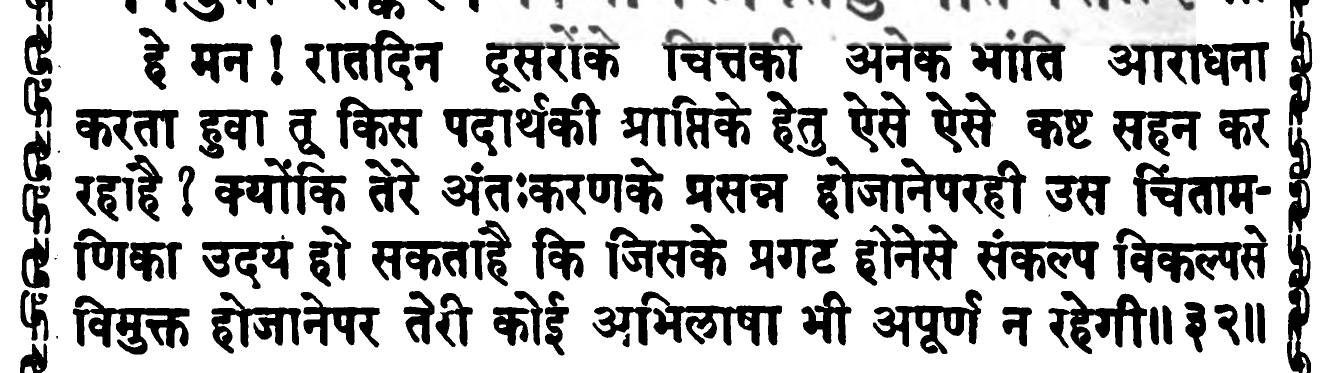
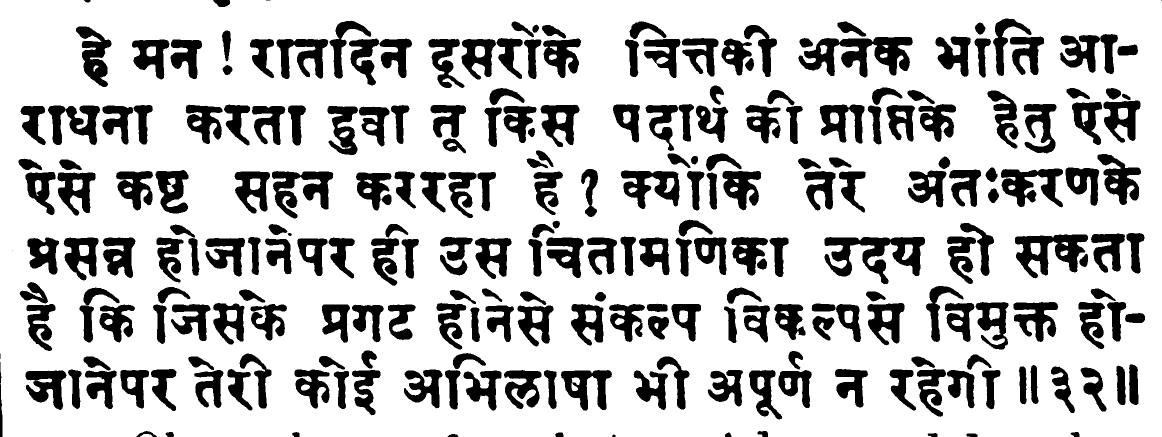
हे मन ! रातदिन दूसरोंके चित्तकी अनेक भांति आराधना करता हुवा तू किस पदार्थकी प्राप्तिके हेतु ऐसे ऐसे कष्ट सहन कर रहा है ? क्योंकि तेरे अंतःकरण के प्रसन्न होजानेपरही उस चिंतामणिका उदय हो सकता है कि जिसके प्रगट होनेसे संकल्प विकल्पसे विमुक्त होजानेपर तेरी कोई अभिलाषा भी अपूर्ण न रहेगी ॥ ३२ ॥
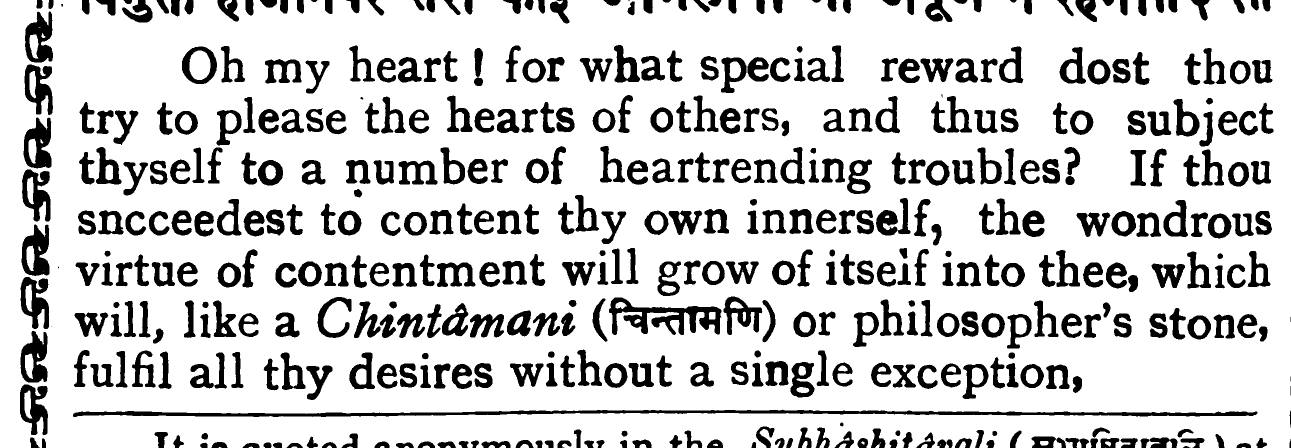
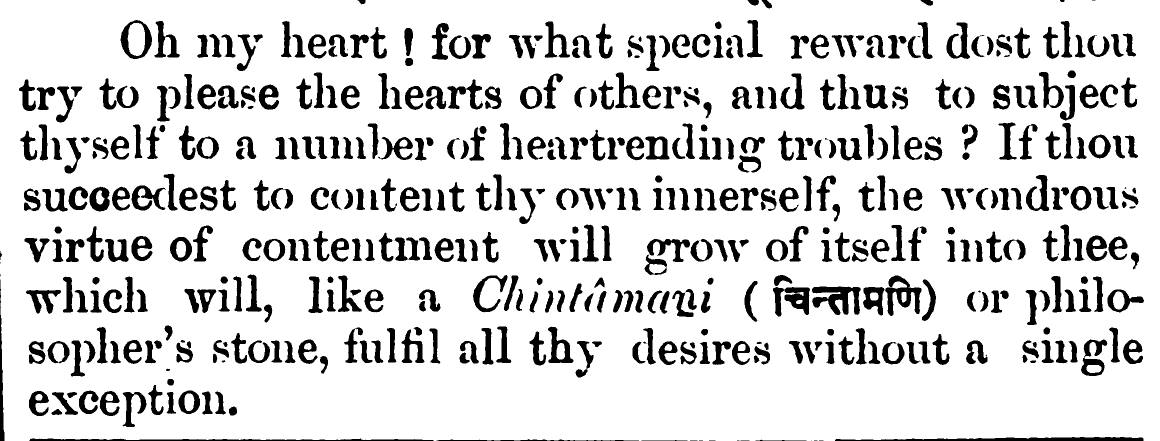
Oh my heart! for what special reward dost thou try to please the hearts of others, and thus to subject thyself to a number of heartrending troubles? If thou sncceedest to content thy own innerself, the wondrous virtue of contentment will grow of itself into thee, which will, like a Chintamani ( चिन्तामणि ) or philosopher's stone, fulfil all thy desires without a single exception,
Footnote
It is quoted anonymously in the Subhashitavali ( सुभाषितावलि) at No. 3410, and under Sankuka ( शंकुक) at No. 534.

Footnote
Cf.—(a) “The source of true happiness is inherent in the heart ; he is a fool who seeks it elsewhere. "


Footnote
(c) " My conscience is my crown; Contented thoughts my rest; My heart is happy in itself, My bliss is in my heart. " (Robert Southwell)

Footnote
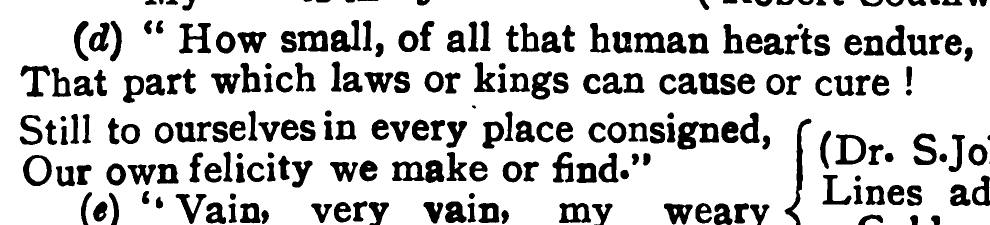
(d) " How small, of all that human hearts endure, That part which laws or kings can cause or cure ! Still Our to own " ourselves felicity in we every make place or findconsigned.” ,
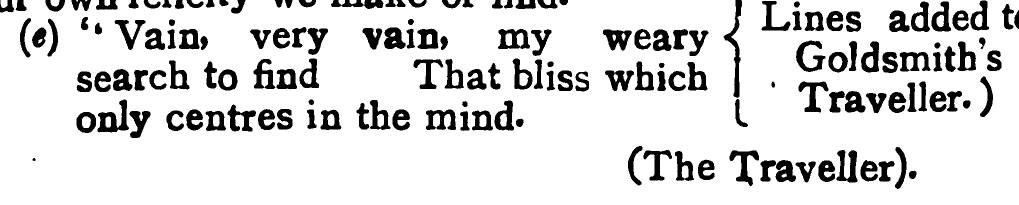
Gopinath1896
all
परेषां चेतांसि प्रतिदिवसमाराध्य बहुधा, प्र-
सादं कि नेतुं विशसि हृदय क्लेशकलिलम् क्लेशक लिलम् ।
प्रसन्ने त्वय्यन्तः स्वयमुदितचिन्तामणिगुणे,
विमुक्तः सङ्कल्पः किमभिलपितं पुष्यति न
ते ॥ ३२ ॥
हे मन ! रातदिन दूसरोंके चित्तकी अनेक भांति आराधना करता हुवा तू किस पदार्थ की प्राप्तिके हेतु ऐसे ऐसे कष्ट सहन कर रहा है ? क्योंकि तेरे अंतःकरण के प्रसन्न होजानेपर ही उस चिंतामणिका उदय हो सकता है कि जिसके प्रगट होने से संकल्प विकल्पसे विमुक्त होजानेपर तेरी कोई अभिलाषा भी अपूर्ण न रहेगी ॥ ३२ ॥
Oh my heart! for what special reward dost thou try to please the hearts of others, and thus to subject thyself to a number of heartrending troubles? If thou succeedest to content thy own innerself, the wondrous virtue of contentment will grow of itself into thee, which will, like a Chintamani ( चिन्तामणि ) or philo sopher's stone, fulfil all thy desires without a single exception.
Cf.—(a) “ The source of true happiness is inherent " in the heart ; he is a fool who seeks it elsewhere.


(c) " My conscience is niy crown :
Contented thoughts my rest;
My heart is happy in itself,
My bliss is in my heart. " ( Robert Southwell )

(d) "How That part smallwhich , of all laws that human hearts endureor , cure!
or kings can canse Still
to ourselves in every place consigned, fines Dr. S. Johnson.
Our own felicity we make or find. added to



Kosambi
all

Footnote
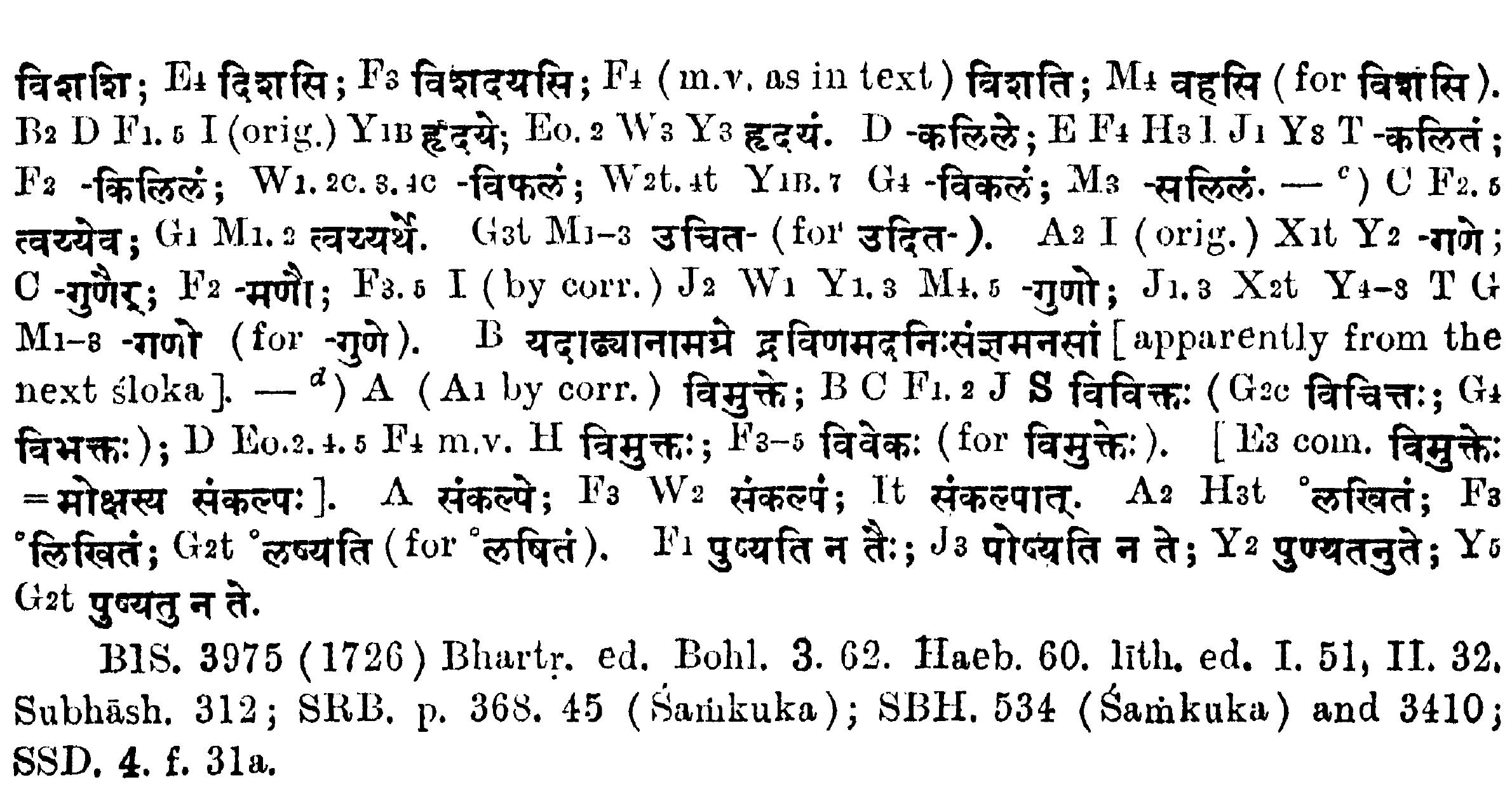
167 ) a A विधिवत् 202 ( and Ec ) बहु हा ; Est बहुधा हा ; Fa च मुधा ; F ‡ ( m.v.
as in text ) विधिना ( for बहुधा ) . Js दिवसमारा बहुविधा . - ) F3 किंचिन्नेतुं . Aot Xat

Footnote
विशशि ; D1 दिशसि ; F3 विशदयसि ; F + ( m.v. as in text ) विशति ; M M + वहसि ( for विशंसि ) .
B2 D F1.5 I ( orig . ) Y1B हृदये ; Eo . 2 W3 Y3 हृदयं . D -कलिले ; EF4 H3 ] Ji Y 8 : T -कलितं ;
F2 - किलिलं ; W 1.20.3.10 - विफलं ; Wat + t Yin.7 G4 -विकलं ; M3 -सलिलं . - " ) CF2.5
त्वय्येव ; G1 M. 1. 2 त्वथ्यर्थे . G 3t M1 - 3 उचित - ( fo1 ' उदित ) . A2 I ( orig . ) Xit Y2 -गणे ;
C - गुणैर् ; F2 - मणौ ; F3.6 I ( by corr . ) J2 W1 Y1.3M 4.5 गुणो ; J1.3 X2t_Y ± -4 T G
M1 - 8 -गणो ( ( for गुणे ) . B यदाढ्यानाम द्रविणमदनिःसंज्ञमनसां [ apparently from the
next sloka ] . — d ± ) A ( A1 by corr . ) विमुक्ते ; B C F12 J S विविक्तः ( G2ce विचित्तः ; G +
विभक्तः ) ; D E0.2 . ± 5 F + m.v . H विमुक्तः ; F3-5 विवेकः ( for विमुक्तेः ) . [ E3 com . विमुक्तेः
- मोक्षस्य संकल्प : ] . A संकल्पे ; F3 W2 संकल्पं ; It संकल्पात् . A2 H3t ° लखितं ; F3
' लिखितं ; G2t ' लष्यति ( for ' लषितं ) . 11 पुष्यति न तैः ; J3 पोष्यति न ते ; Y2 पुण्यतनुते ; Yo
Get पुष्यतु न ते .
B1S . 3975 ( 1726 ) Bhartr ed . Bohl . 3. 62. Haeb . 60. līth ed . I. 51 , II . 32 .
Subhāsh . 312 ; SRB . p . 368. 45 ( Samkuka ) ; SBH , 534 ( Śamkuka ) and 3410 ;
SSD . 4. f . 31a .
Commentary