Brough
You are the king: we too are highly placed.
Honoured for the deep wisdom we command.
You are praised for your riches: poets sing
Our fame in every comer of the land.
Thus no great difference lies between yourself
And us. - And, sire, if you despise our state,
We for our part care naught for anything.
Tawney
Thou art a king, I grant, but we are famed for boundless lore,
Thy wealth's renowned, our skill by bards proclaimed on every shore,
Between us no vast gulf is set: what though thou scorn our name,
Yet we, to all indifferent, heed not thy praise or blame.
Mādhavānanda
त्वं राजा वयमप्युपासितगुरुप्रज्ञाभिमानोन्नता:
ख्यातस्त्वं विभवैर्यशांसि कवयो दिक्षु प्रतन्वन्ति न: ।
इत्थं मानधनातिदूरमुभयोरप्यावयोरन्तरं
यद्यस्मासु पराङ्मुखोऽसि वयमप्येकान्ततो नि:स्पृहा: ।।५१।।
51. Thou art a king; we too are elevated through self-assurance about our wisdom acquired from our preceptor whom we served. Thou art celebrated through thy possessions; our fame is spread abroad in all quarters by learned men. Thus a great difference there is between us both, made by honour and riches. If thou art cold towards us, we too are perfectly indifferent towards thee.
[The śloka is addressed by a yati (one who has renounced the world) to a king. The yati wants to inform the king of the vanity of his possessions, and so is declaring that a yati is greater than the king. For the king is rich in wealth only, but he is rich in wisdom which should command even the respect of a king.
For मानधनातिदूरं another reading is मानद नातिदूरं which may be rendered thus—`not much difference, O proud (king)’.]
Telang
all
त्वं राजा वयमप्युपासितगुरुप्रज्ञाभिमानोन्नताः
ख्यातस्त्वं विभवैर्यशांसि कवयो दिक्षु प्रतन्वन्ति नः ।
इत्थं मानद नातिदूरमुभयोरप्यावयोरन्तरं
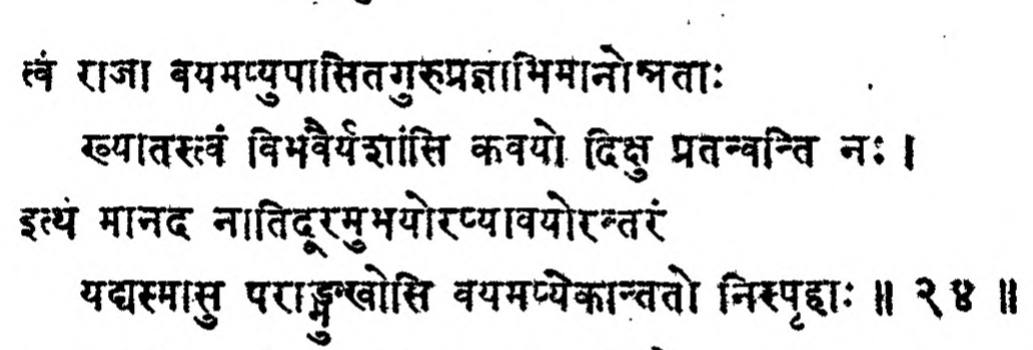
यद्यस्मासु पराङ्मुखोसि वयमप्येकान्ततो निस्पृहाः ॥ २४ ॥
Notes
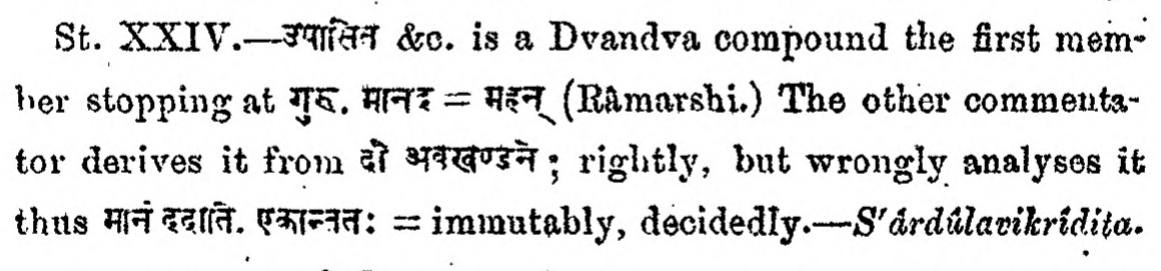
St. XXIV.—उपासित &c. is a Dvandva compound the first member stopping at गुरु. मानद = महत् (Râmarshi.) The other commentator derives it from दो अवखण्डने; rightly, but wrongly analyses it thus मानं ददाति. एकान्ततः = immutably, decidedly.—S'ârdûlavikrîdita.

Kale
all

त्वं राजा वयमप्युपासितगुरुप्रज्ञाभिमानोन्नताः
ख्यातस्त्वं विभवैर्यशांसि कवयो दिक्षु प्रतन्वन्ति नः ।
इत्थं मानद नातिदूरमुभयोरप्यावयोरन्तरं
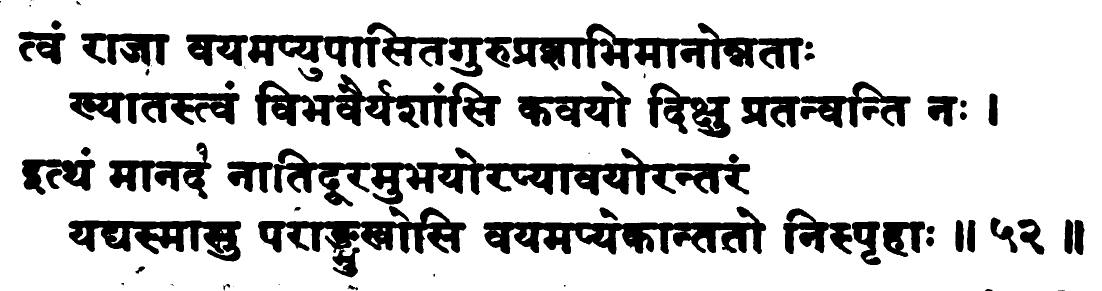
यद्यस्मासु पराङ्मुखोसि वयमप्येकान्ततो निस्पृहाः ॥ ५२ ॥
Translation
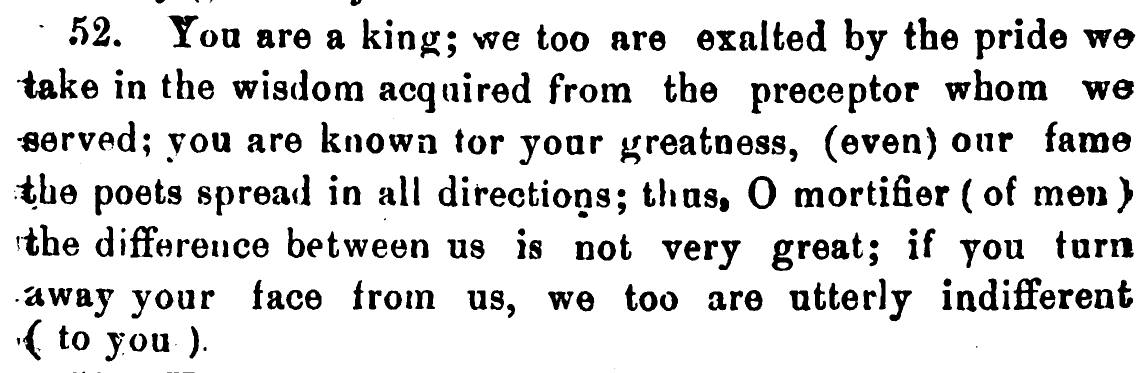
52. You are a king; we too are exalted by the pride we take in the wisdom acquired from the preceptor whom we served; you are known for your greatness, (even) our fame the poets spread in all directions; thus, O mortifier ( of men ) the difference between us is not very great; if you turn away your face from us, we too are utterly indifferent ( to you ).
Notes
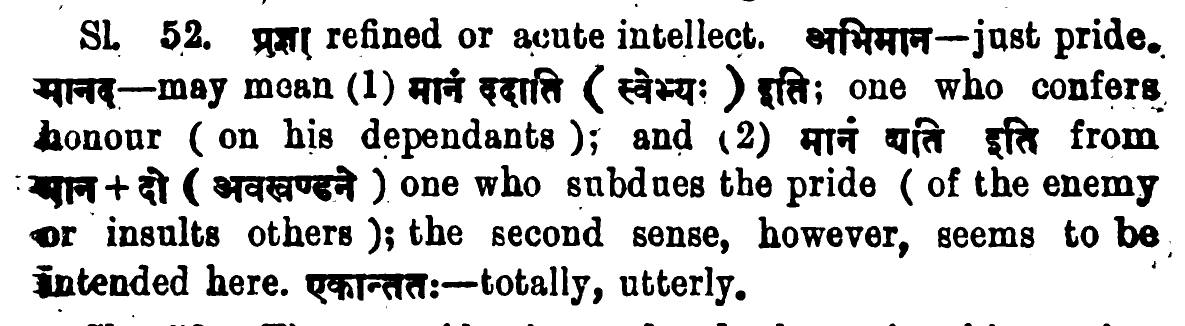
Sl. 52. प्रज्ञा refined or acute intellect. अभिमान—just pride. मानद—may mean (1) मानं ददाति ( स्वेभ्यः ) इति; one who confers honour ( on his dependants ); and (2) मानं द्यति इति from मान + दो ( अवखण्डने ) one who subdues the pride ( of the enemy or insults others ); the second sense, however, seems to be intended here. एकान्ततः—totally, utterly.
Gopinath1914
all
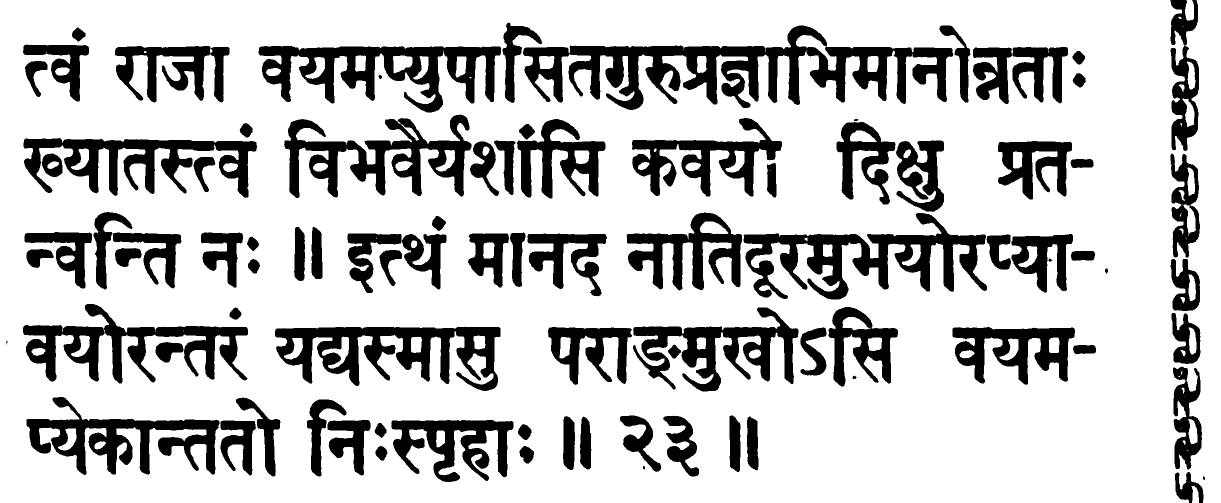
त्वं राजा वयमप्युपासितगुरुप्रज्ञाभिमानोन्नताः
ख्यातस्त्वं विभवैर्यशांसि कवयो दिक्षु प्रत-
न्वन्ति नः ॥ इत्थं मानद नातिदूरमुभयोरप्या-
वयोरन्तरं यद्यस्मासु पराङ्मुखोऽसि वयम-
प्येकान्ततो निःस्पृहाः ॥ २३ ॥
आप राजा हैं वैसे हम भी श्रीगुरुमहाराजकी उपासनासे पाई हुई प्रज्ञाशक्ति से समन्वित हैं, आप जैसे गजाश्वादिके ऐश्वर्य से विख्यात KAAAAAAANNNNNNANR हैं वैसे हमारा यश भी कविजन दशों दिशाओंमें फैलाते हैं । इसलिए हे अपमान करनेवाले राजा ! आपमें और हममें कुछ विशेष अंतर नहीं है, सो यदि आप हमारा यथोचित सत्कार करनेसे मुंह मोड़ते हैं तो हमको भी आपके आदरकी कोई वांछा नहीं है ॥ २३ ॥
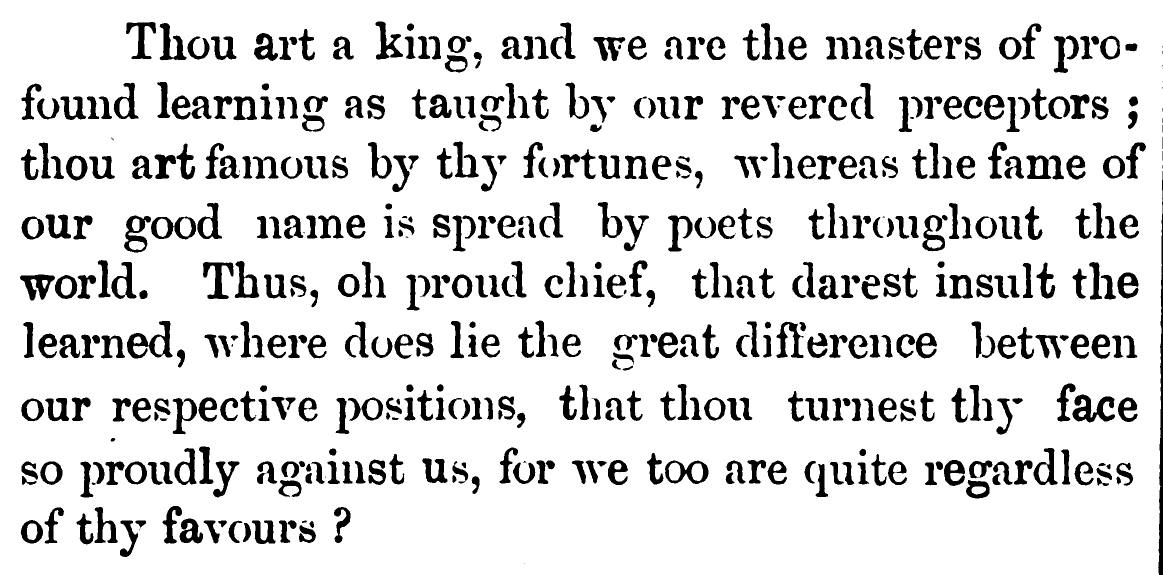
Thou art a king, and we are the masters of profound thou learning as taught fortunesby our whereas revered preceptorsfame of ; art famous by thy , the our good name is chiefspread by poets throughout insult the world. Thus, oh proud , that darest the learned, where does lie the great difference between our respective positions, that thou turnest thy face so proudly against us, for we too are quite regardless of thy favours ?
Gopinath1896
all
त्वं राजा वयमप्युपासितगुरुप्रज्ञाभिमानोन्नताः,
ख्यातस्त्वं विभवेर्यशांसि कवयो दिक्षु प्रत
न्वन्तिनः । इत्थं मानद नातिदूरमुभयोरप्या-
वयोरन्तरं यद्यस्मासु पराङ्मुखोऽसि वयम-
प्येकान्ततो निःस्पृहाः ॥ २३ ॥
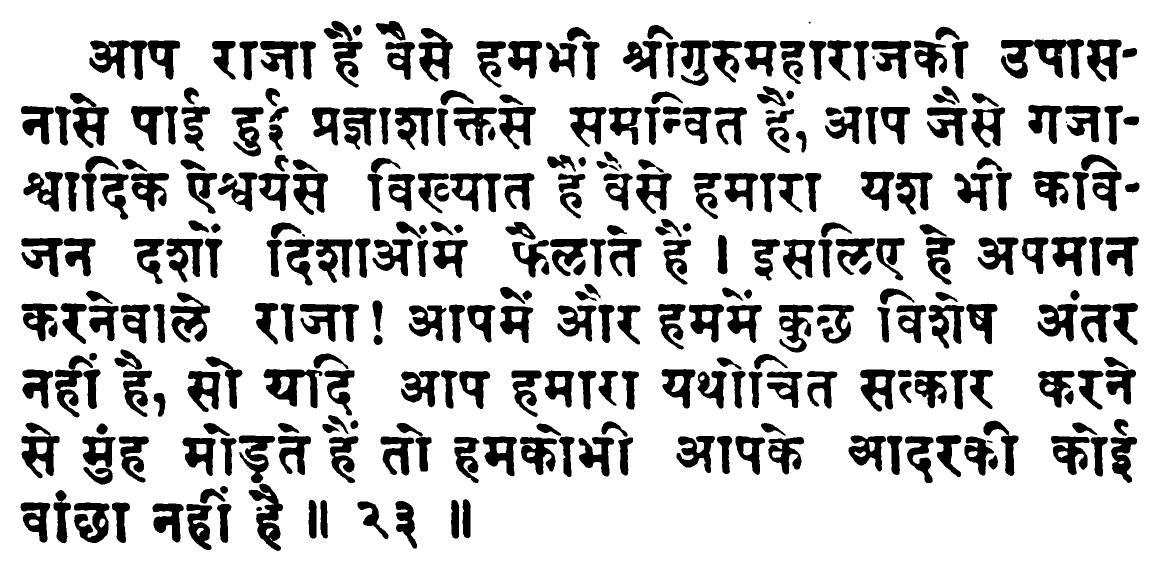
आप राजा हैं वैसे हमभी श्रीगुरुमहाराजकी उपासनासे पाई हुई प्रज्ञाशक्तिसे समन्वित हैं, आप जैसे गजाश्वादिके ऐश्वर्य से विख्यात हैं वैसे हमारा यश भी कविजन दशों दिशाओं में फैलाते हैं । इसलिए हे अपमान करनेवाले राजा ! आपमें और हममें कुछ विशेष अंतर नहीं है, सो यदि आप हमारा यथोचित सत्कार करने से मुंह हैं तो हमको भी आपके आदरकी कोई वांछा नहीं मोड़ते है ॥ ॥ २३ ॥
Thou art a king, and we are the masters of profound learning as taught by our revered preceptors; thou art famous by thy fortunes, whereas the fame of our good name is spread by poets throughout the world. Thus, oh proud chief, that darest insult the learned, where does lie the great difference between our respective positions, that thou turnest thy face so proudly against us, for we too are quite regardless of thy favours ?
Footnote
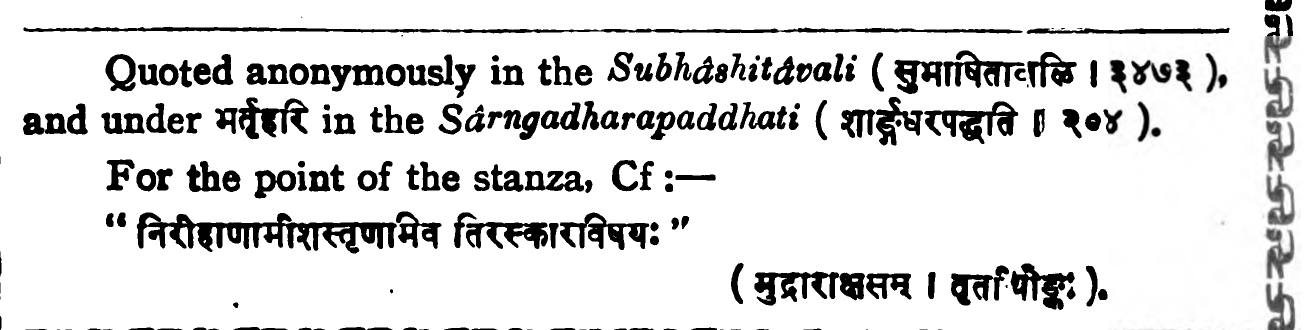
Quoted anonymously in the Subhashitirali ( सुभाषितावलि । ३४७३ ), and under भर्तृहरि in the Sarngadharapaddhati ( शार्ङ्गधरपद्धति । २०४ ).


Kosambi
all
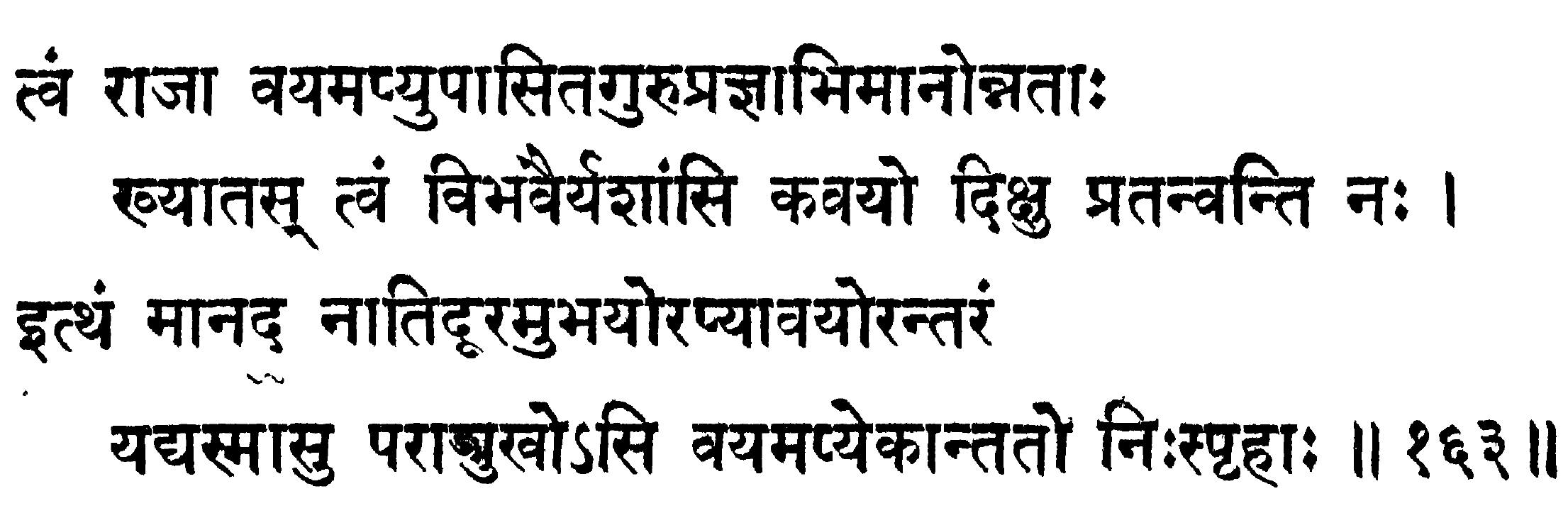
त्वं राजा वयमप्युपासितगुरुप्रज्ञाभिमानोन्नताः
ख्यातस् त्वं विभवैर्यशांसि कवयो दिक्षु प्रतन्वन्ति नः ।
इत्थं मानद नातिदुरमुभयोरप्यावयोरन्तरं
यद्यस्मासु परामुखोऽसि वयमध्येकान्ततो निःस्पृहाः ॥ १६३ ॥
Footnote
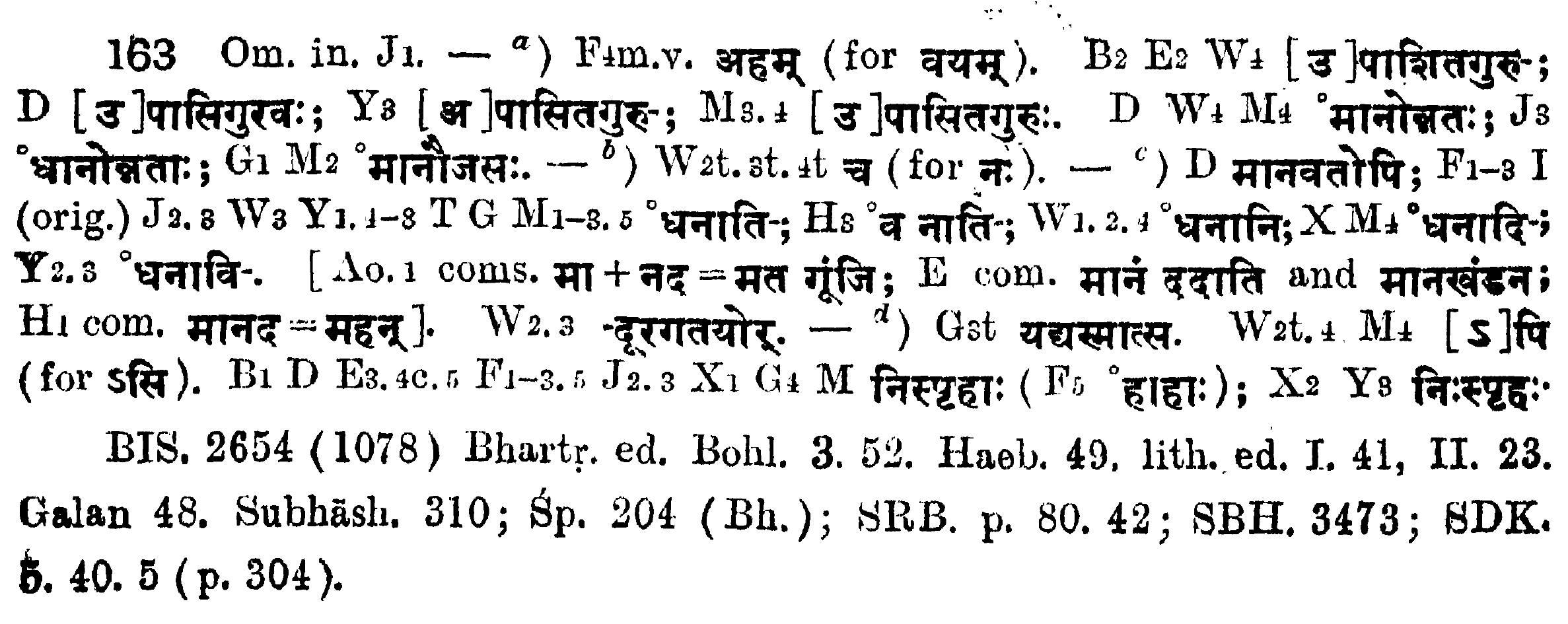
163 Om . in . Ji . a ) Fam.v. अहम् ( for वयम् ) . B2 E2 W + [ उ ] पाशितगुरु ;
D [ 3 ] पासिगुरवः ; Ya [ अ ] पासितगुरु- ; M3 . + [ उ ] पासितगुरु : DW M4 मानोन्नतः ; Js
' धानोन्नताः ; G1 M2 मानौजसः - 5 ) Wat.st. it च ( for न . ) . Bu " ) D मानवतोपि ; F1-3 I
( orig . ) J2.8 W3 Y1 . 1-8 T G M1 - 3 5 ° धनाति- ; Hs व नाति- ; W1.2.4 ° धनानि ; X M + धनादि ;
Y2.3 ° धनावि [ 210.1 conms . मा + नद - मत गूंजि ; E com . मानं ददाति and मानखंडन ;
Hi com . मानद - महन् ] . W2.3 -दूरगतयोर् . a ) Gst यद्यस्मात्स . W2t + M + [ s ] पि
( for ऽसि ) . B1D E3.40 5 F1 - 3.5 J23 X 1 G + M निस्पृहाः ( Fo ' हाहा :) : ) ; X 2 Xs निःस्पृहः
BIS . 2654 ( 1078 ) Bhartr ed . Bohl . 3. 52. Haeb 49 , lith ed . I. 41 , II . 23 .
Galan 48. Subhāsh . 310 ; Sp . 204 ( Bh . ) ; SRB . p . 80.42 ; SBE 3473 ; SDK .
5.40 5 ( p . 304 ) .
Commentary