Tawney
By mighty sages' will this world first saw its natal day,
Others have conquered it, and thrown with scorn its wealth away.
Others rule fourteen higher worlds all happier than ours,
Why then should lords of some few towns thus vaunt their petty powers?
Mādhavānanda
विपुलहृदयैरीशैरेतज्जगज्जनितं पुरा
विधृतमपरैर्दत्तं चान्यैविर्जित्य तृणं यथा ।
इह हि भुवनान्यन्ये धीराश्चतुर्दश भुञ्जते
कतिपयपुरस्वाम्ये पुंसां क एष मदज्वर: ।।५७।।
57. In ancient times (the kingdom of) this world was created by some large-hearted monarchs; by some was it sustained (i.e., ruled) and by others was it conquered and given away like straw. Even now, some heroes enjoy the fourteen divisions of the world. For what then is this feverish pride of men having sovereignty over a few towns only?
[चतुर्दश भुवनानि—The fourteen divisions of the world, that is, the entire created universe.]
Telang
all

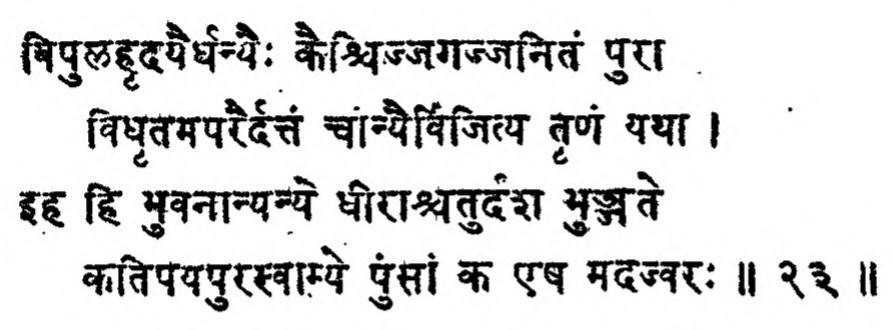
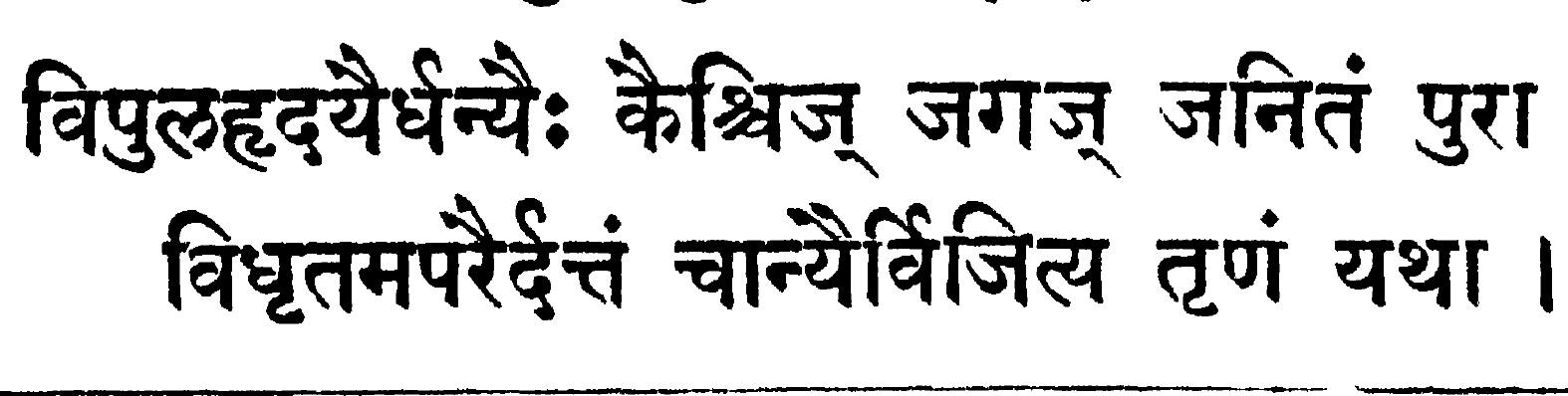
विपुलहृदयैर्धन्यैः कैश्चिज्जगज्जनितं पुरा
विधृतमपरैर्दत्तं चान्यैर्विजित्य तृणं यथा ।
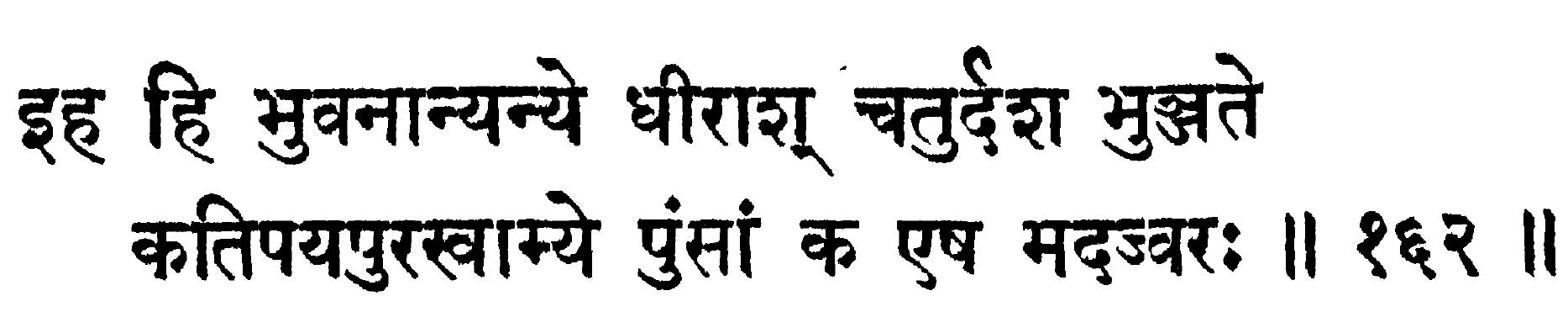
इह हि भुवनान्यन्ये धीराश्चतुर्दश भुञ्जते
कतिपयपुरस्वाम्ये पुंसां क एष मदज्वरः ॥ २३ ॥
Notes
St. XXIII.—तृणं यथा = the more common expression would be तृणमिव. This Stanza occurs at p. 308 of the Kâvyasangraha.—Hâriṇî.


Kale
all
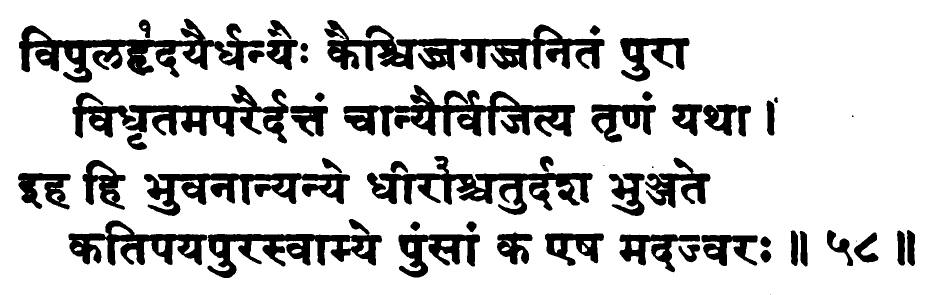
विपुलहृदयैर्धन्यैः कैश्चिज्जगज्जनितं पुरा
विधृतमपरैर्दत्तं चान्यैर्विजित्य तृणं यथा ।
इह हि भुवनान्यन्ये धीराश्चतुर्दश भुञ्जते
कतिपयपुरस्वाम्ये पुंसां क एष मदज्वरः ॥ ५८ ॥
Translation
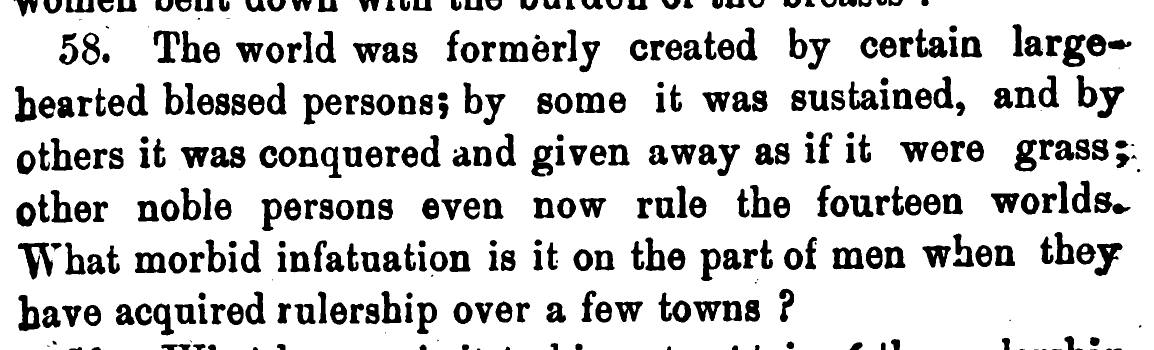
58. The world was formerly created by certain largehearted blessed persons; by some it was sustained, and by others it was conquered and given away as if it were grass; other noble persons even now rule the fourteen worlds. What morbid infatuation is it on the part of men when they have acquired rulership over a few towns ?
Notes
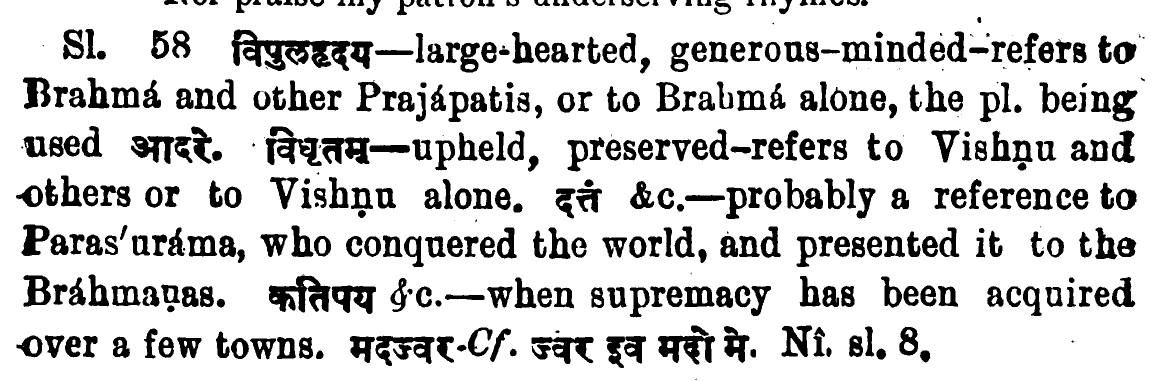
Sl. 58 विपुलहृदय—large-hearted, generous–minded–refers to Brahmá and other Prajápatis, or to Brahmá alone, the pl. being used आदरे. विधृतम्—upheld, preserved–refers to Vishṇu and others or to Vishṇu alone. दत्तं &c.—probably a reference to Paras'uráma, who conquered the world, and presented it to the Bráhmaṇas. कतिपय &c.—when supremacy has been acquired over a few towns. मदज्वर-Cf. ज्वर इव मदो मे. Nî. sl. 8.
Gopinath1914
all
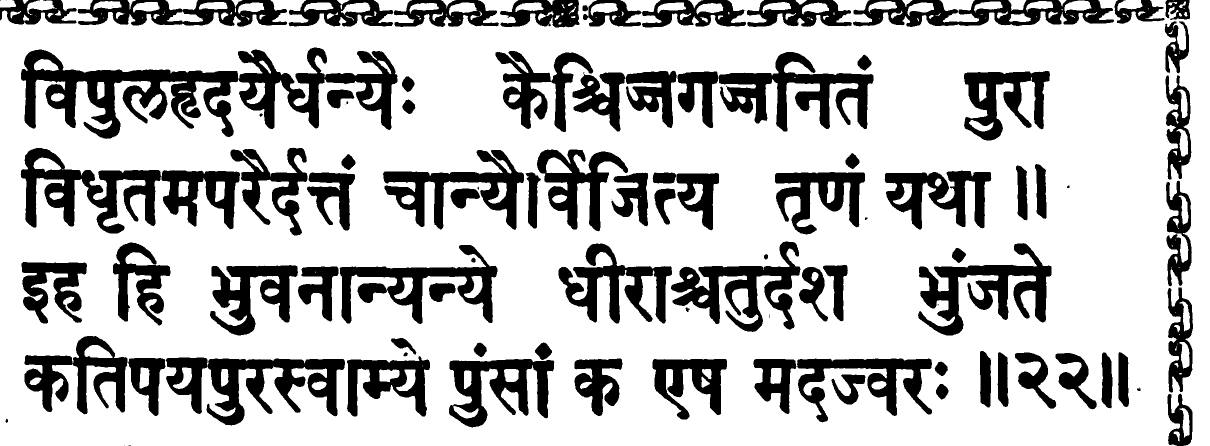
विपुलहृदयैर्धन्यैः कैश्चिज्जगजनितं पुरा
विधृतमपरैर्दत्तं चान्यैर्विजित्य तृणं यथा ॥
इह हि भुवनान्यन्ये धीराश्चतुर्दश भुंजते
कतिपयपुरस्वाम्ये पुंसां क एष मदज्वरः ॥ २२ ॥
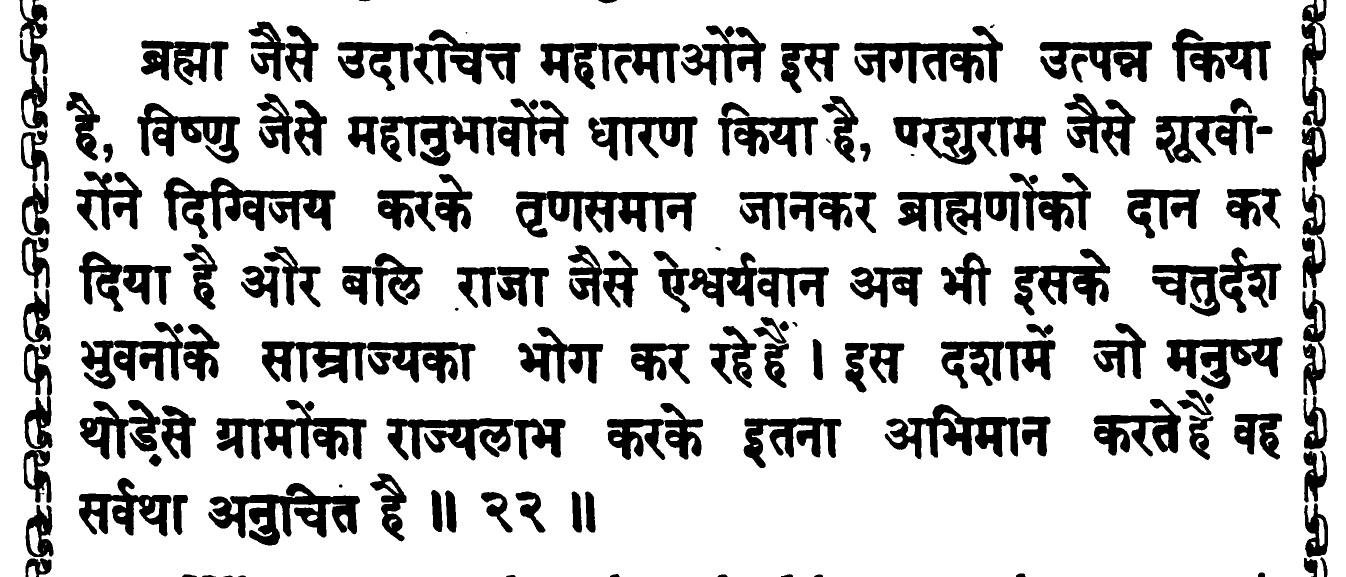
ब्रह्मा जैसे उदारचित्त महात्माओंने इस जगतको उत्पन्न किया है, विष्णु जैसे महानुभावोंने धारण किया है, परशुराम जैसे शूखीरोंने दिग्विजय करके तृणसमान जानकर ब्राह्मणोंको दान कर दिया है और बलि राजा जैसे ऐश्वर्यवान अब भी इसके चतुर्दश भुवनोंके साम्राज्यका भोग कर रहे हैं । इस दशामें जो मनुष्य थोडेसे ग्रामोंका राज्यलाभ करके इतना अभिमान करते हैं वह सर्वथा अनुचित है ॥ २२ ॥
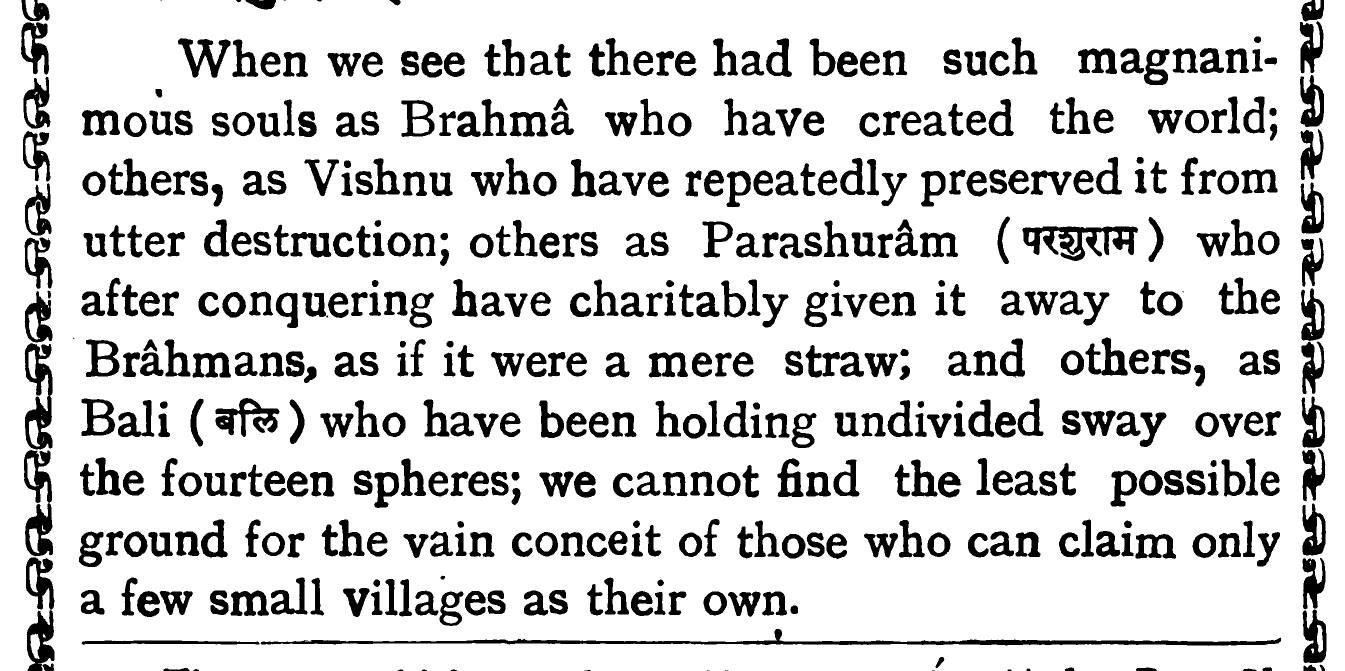
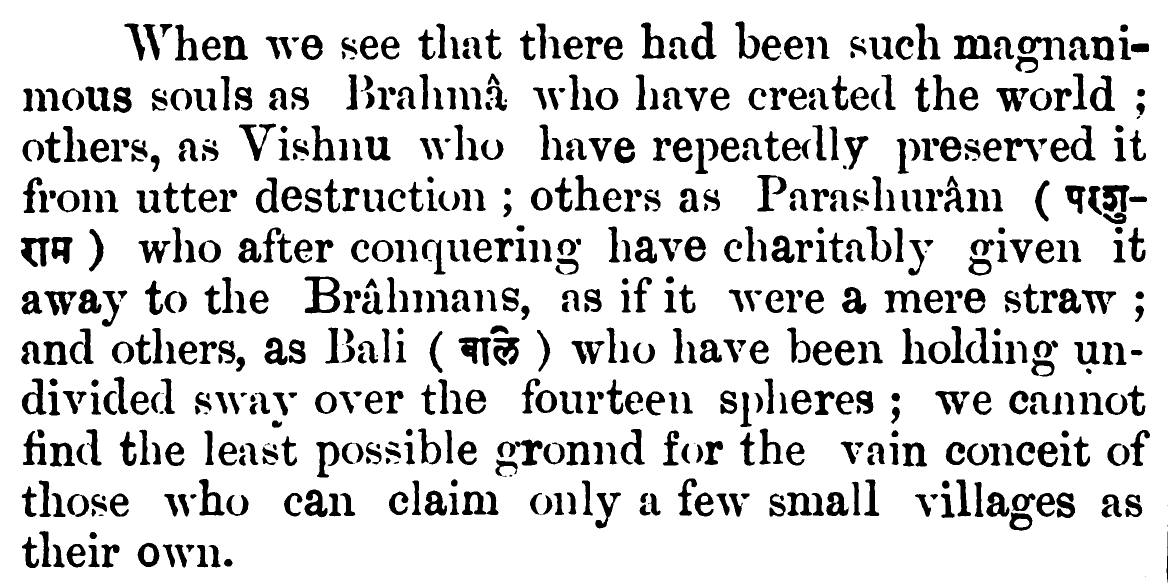
When we see that there had been such magnanimous souls as Brahmâ who have created the world; others, as Vishnu who have repeatedly preserved it from utter destruction; others as Parashuram ( परशुराम ) who after conquering have charitably given it away to the Brahmans, as if it were a mere straw; and others, as Bali (af) who have been holding undivided sway over the fourteen spheres; we cannot find the least possible ground for the vain conceit of those who can claim only a few small villages as their own.
Footnote
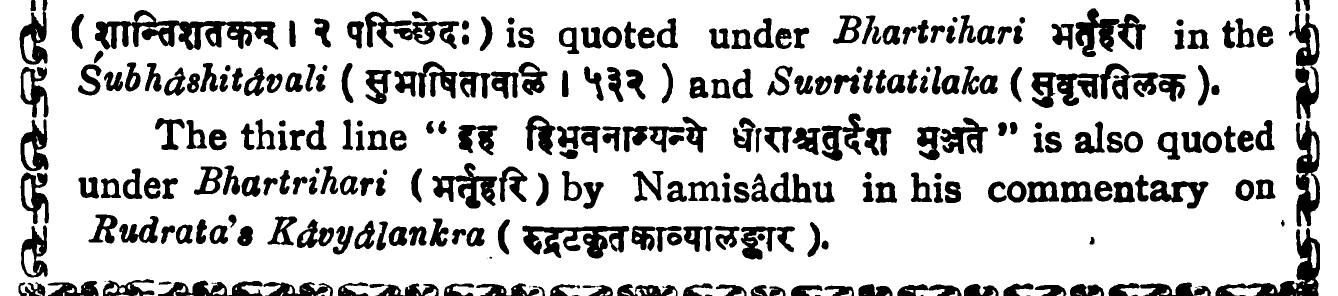
The verse which stands as 13th in the śantistaku Part II. ( शान्तिशतकम् । २ परिच्छेद: ) is quoted under Bhartrihari भर्तृहरी in the Subhashitavali ( सुभाषितावळि । ५३२ ) and Suvrittatilakca ( सुवृत्ततिलक ).

Gopinath1896
all
विपुलहृदयैर्धन्यः कैश्विजगज्जनितं पुरा,
विधृतमपरैर्दत्तं चान्यैर्विजित्य तृणं यथा ।
इह हि भुवनान्यन्ये धीराश्चतुर्दश भुजते,
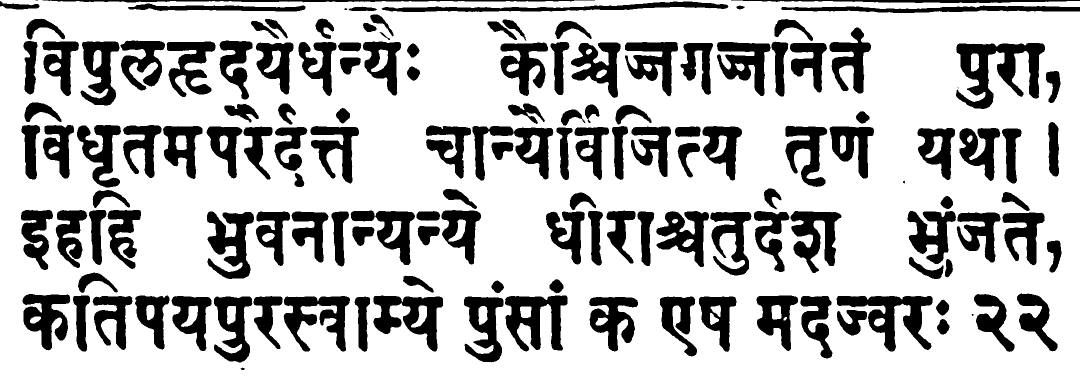
कतिपयपुरस्वाम्ये पुंसां क एष मदज्वरः २२
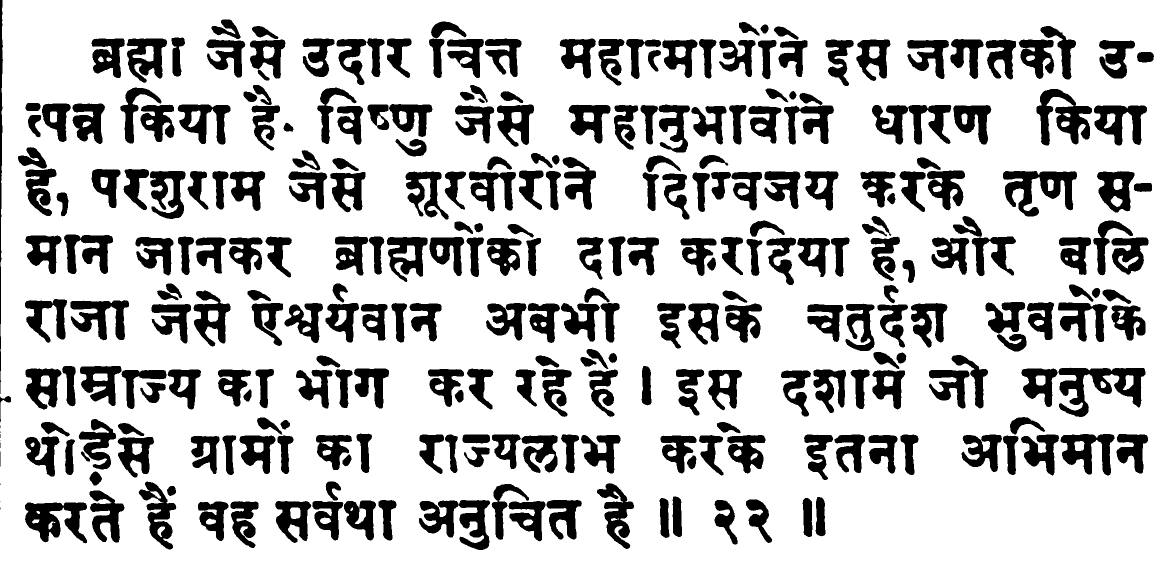
ब्रह्मा जैसे उदार चित्त महात्माओंने इस जगतको उत्पन्न किया है. विष्णु जैसे महानुभावोंने धारण किया है, परशुराम जैसे शूरवीरोंने दिग्विजय करके तृण समान जानकर ब्राह्मणोंको दान करदिया है, और बलि राजा जैसे ऐश्वर्यवान अबभी इसके चतुर्दश भुवनोंके साम्राज्य का भोग कर रहे हैं । इस दशामें जो मनुष्य थोडेसे ग्रामों का राज्यलाभ करके इतना अभिमान करते हैं वह सर्वथा अनुचित है ॥ २२ ॥
When we see that there had been such magnanimous souls as Brahmâ who have created the world; others, as Vishnu who have repeatedly preserved it from utter destruction ; others as Parashuram ( परशुराम ) who after conquering have charitably given it away to the Brahmans, as if it were a mere straw ; and others, as Bali ( बाल ) who have been holding undivided sway over the fourteen spheres; we cannot find the least possible gronnd for the vain conceit of those their ownwho . can claim only a few small villages as
Footnote
The verse which stands as 13th in the Santisataka. Part. II. ( शान्तिशतकम् । २ परिच्छेद: ) is quoted under Bhartrihari भर्तृहरि in the Subhashitàrali. ( सुभाषितावलि । ५३२ ) and Surrittatilaka ( सुवृत्ततिलक ).

Kosambi
all
Footnote
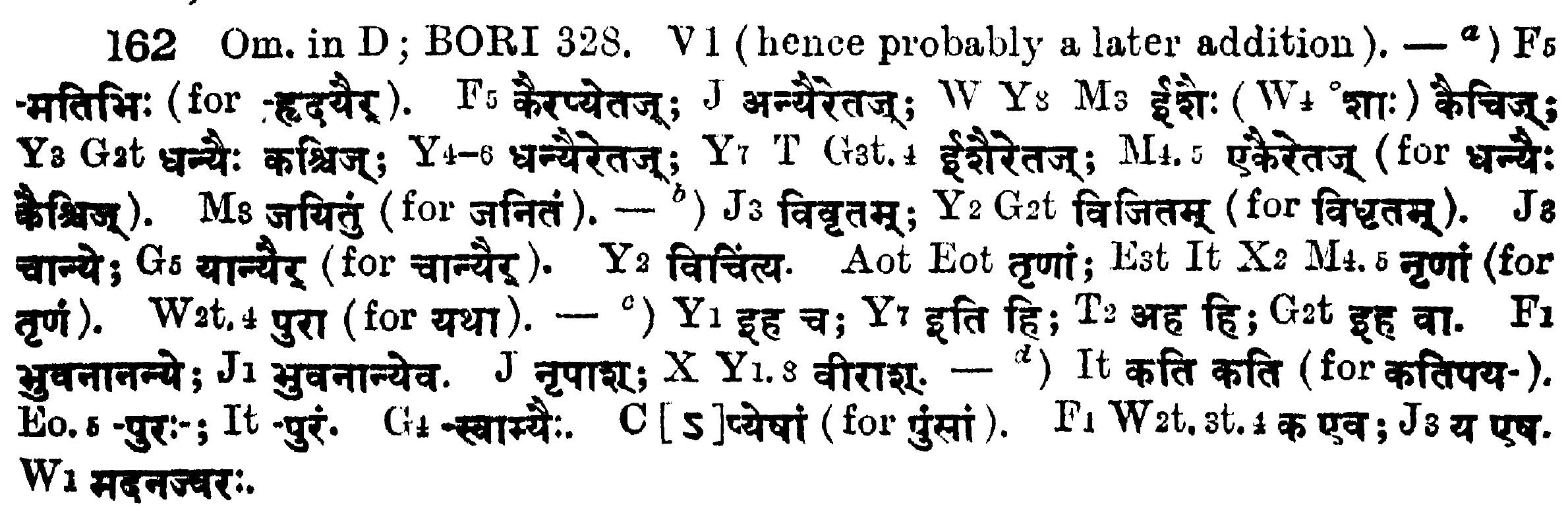
162 Om . in D ; BORI 328. V1 ( hence probably a later addition ) . a ) F's
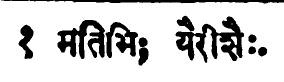
-मतिभिः ( for- हृदयैर् ) . F5 कैरप्येतज् ; J अन्यैरेतज् ; IV Y : M3 ईशै : ( IV + ' शा : ) कैचिज्
Ya Gat धन्यैः कश्विज ; Y 4-6 धन्यैरेतज् ; Y7 TG3.1 ईशैरेतज् ; Mi : एकैरेज् ( for धन्यैः
कैश्चिज् ) . Ms जयितुं ( for जनितं ) . – 3 ) J3 विवृतम् ; Y2 G2t विजितम् ( for विटतम् ) . Ja
चान्ये ; G5 यान्यैर् ( for चान्यैर् ) . Y : विचिंत्य Aot Eot तृणां ; Est It X2 M4 . 5 नृणां ( for
तृणं ) . Wat . + पुरा ( for यथा ) . ● ) Y1 इह च ; Yr Y 7 इति इति हि हि ; ; T : अह हि ; Gat इह वा . F1
भुवनानन्ये ; J1 भुवनान्येव J नृपाश ; X Y 18 वीराश . - 4 ) It कति कति ( for कतिपय- ) .
Ko . 6 -पुर : - ; It - पुरं . G + -स्वाम्यै : C [ s ] प्येषां ( for पुंसां ) . F1 Wat . 36. 4 क एव ; J३ य एष .
W1 मदनज्वर .
Footnote
BIS . 6155 ( 2829 ) Bharty . ed . Boil and Haeb . 3. 58 lith ed . I. 49 , II . 22 ,
III . 42. Galan 53. Santis . 2.13 ( Haeb 417 ) Subhāsh . 310 ; SRB . p . 80.37 ; SBH .
532 ( Bh . ) ; ; SDK 5. 39. 1 ( p . 303 , Bh . ) ; SRH . 167. 22 ; Suvrttatilaka of
Kşemendra ( KM . 2 , p . 52 , Bh . ) ; Namisādhu .

Commentary