Ryder
THE FAILURE OF EDUCATION
Uneducated moths will fly
Into the blazing fire;
Ignorant fish will take the hook
In the bait of their desire.
And we who know so many things
Forget the price, and feed
The creeping lusts that coil us round—
Oh! We are fools indeed.
Tawney
The moth unwitting rushes on the fire,
Through ignorance the fish devours the bait,
We men know well the foes that lie in wait.
Yet cannot shun the meshes of desire.
Mādhavānanda
अजानन्दाहात्म्यं पततु शलभस्तीव्रदहने
स मीनोऽप्यज्ञानाद्वडिशयुतमश्नातु पिशितम् ।
विजानन्तोऽप्येते वयमिह विपज्जालजटिला-
न्न मुञ्चाम: कामानहह गहनो मोहमहिमा ।।१८।।
18. Without knowing its burning power the insect jumps into the glowing fire; the fish through ignorance eats the bait attached to the hook; whereas we, even though having full discernment, do not renounce the sensual desires, complicated as they are with manifold dangers. Alas, how inscrutable is the power of delusion!
Telang
all
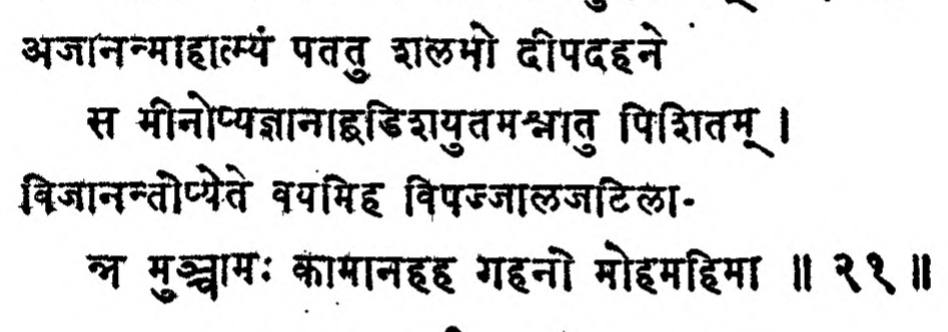
अजानन्माहात्म्यं पततु शलभो दीपदहने
स मीनोप्यज्ञानाद्वडिशयुतमश्नातु पिशितम् ।
विजानन्तोप्येते वयमिह विपज्जालजटिला-
न्न मुञ्चामः कामानहह गहनो मोहमहिमा ॥ २१ ॥
Notes
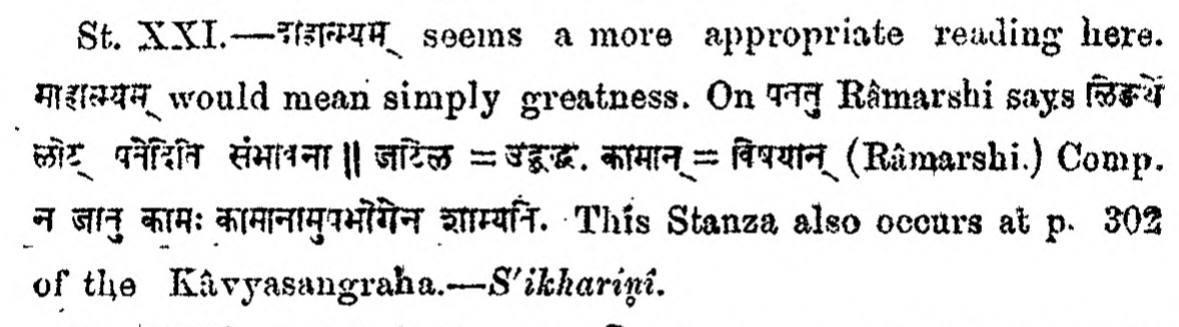
St. XXI.—दाहात्म्यम् seems a more appropriate reading here. माहात्म्यम् would mean simply greatness. On पततु Râmarshi says लिङर्थे लोट् पतेदिति संभावना ॥ जटिल = उद्बुद्ध. कामान् = विषयान् (Râmarshi.) Comp. न जातु कामः कामानामुपभोगेन शाम्यति. This Stanza also occurs at p. 302 of the Kâvyasangraha.—S'ikhariṇî.

Kale
all
Introduction
सत्यपि विषयोपभोगदोषज्ञाने यद्विषयाः परित्यक्तुं न शक्यन्ते तत्र मोहमहिमैव हेतुरिति निर्दिशति—

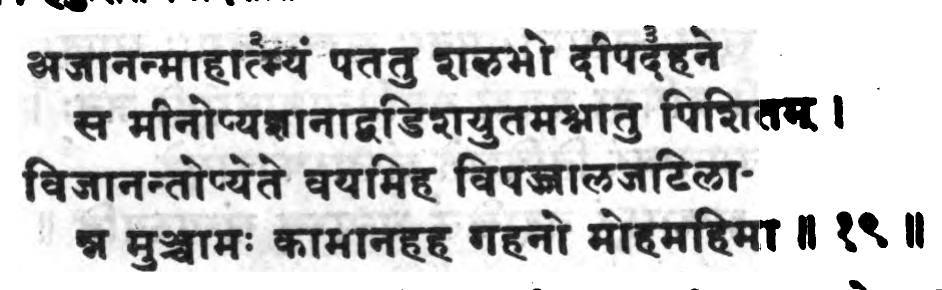
अजानन्माहात्म्यं पततु शलभो दीपदहने
स मीनोप्यज्ञानाद्वडिशयुतमश्नातु पिशितम् ।
विजानन्तोप्येते वयमिह विपज्जालजटिला-
न्न मुञ्चामः कामानहह गहनो मोहमहिमा ॥ १९ ॥
Translation
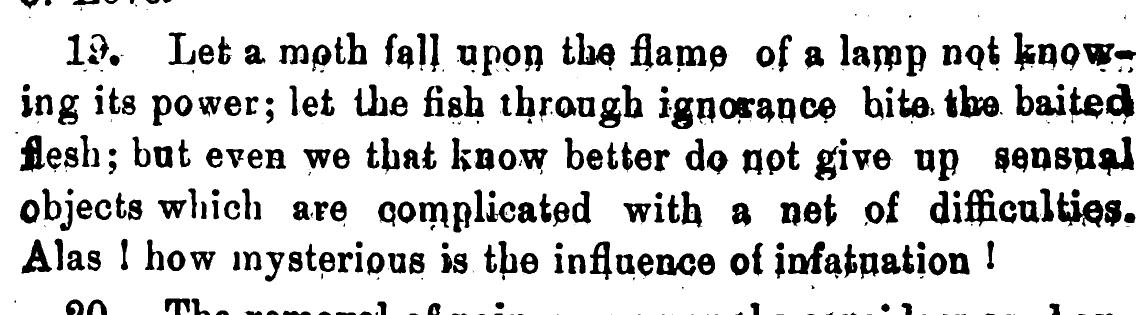
19. Let a moth fall upon the flame of a lamp not knowing its power; let the fish through ignorance bite the baited flesh; but even we that know better do not give up sensual objects which are complicated with a net of difficulties. Alas ! how mysterious is the influence of infatuation !
Notes
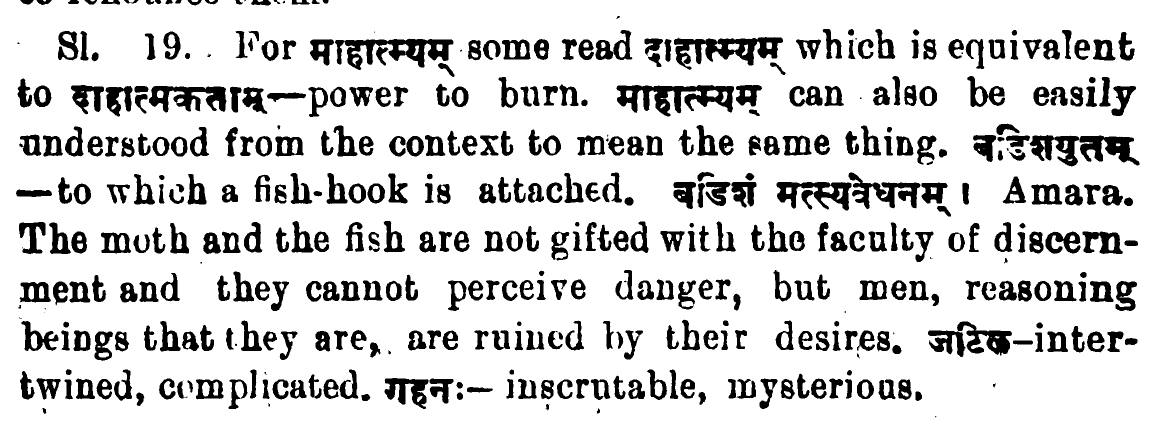
Sl. 19. For माहात्म्यम् some read दाहात्म्यम् which is equivalent to दाहात्मकताम्—power to burn. माहात्म्यम् can also be easily understood from the context to mean the same thing. बडिशयुतम् —to which a fish-hook is attached. बडिशं मत्स्यवेधनम् । Amara. The moth and the fish are not gifted with the faculty of discernment and they cannot perceive danger, but men, reasoning beings that they are, are ruined by their desires. जटिल–intertwined, complicated. गहनः– inscrutable, mysterious.

Gopinath1914
all
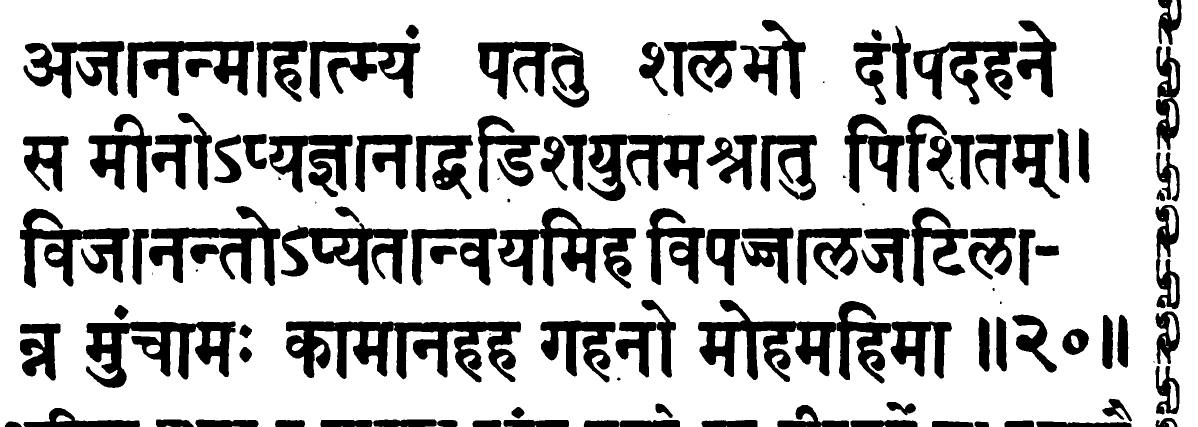
अजानन्माहात्म्यं पततु शलभो दीपदहने
समीनोऽप्यज्ञानाद्वडिशयुतमश्नातु पिशितम् ॥
विजानन्तोऽप्येतान्वयमिह विपज्जालजटिला-
न मुंचामः कामानहह गहनो मोहमहिमा ॥ २० ॥
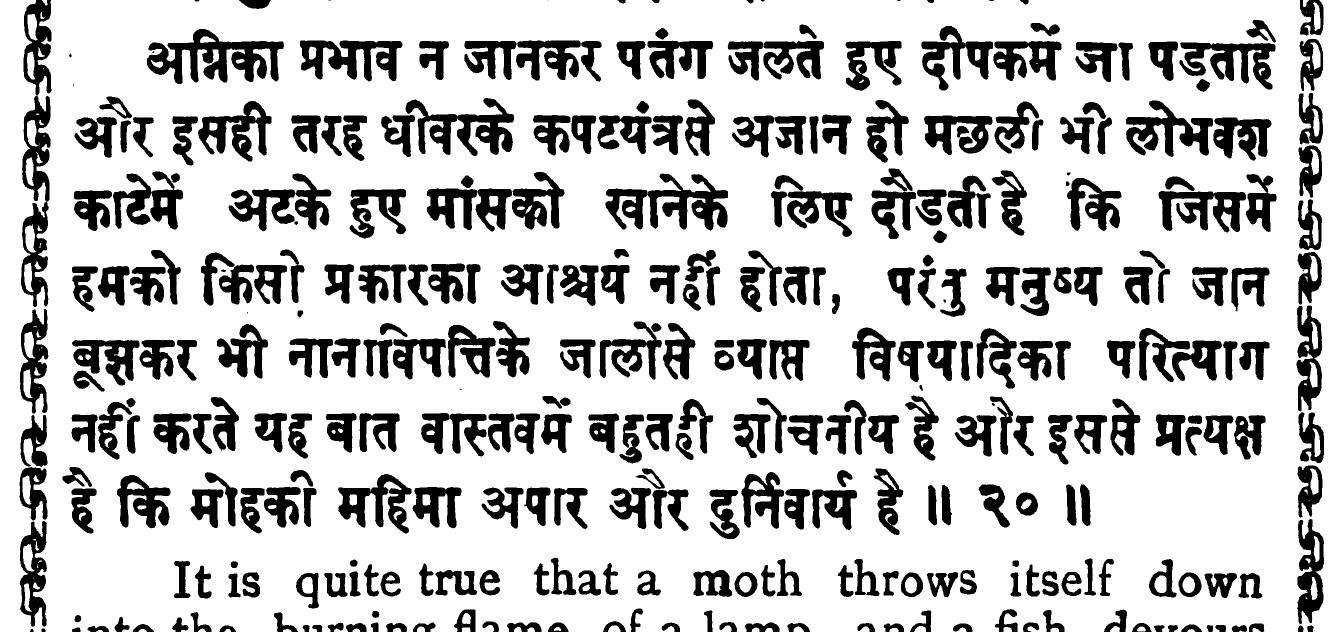
अग्निका प्रभाव न जानकर पतंग जलते हुए दीपकमें जा पड़ता है और इसही तरह धीवरके कपटयंत्रसे अजान हो मछली भी लोभवश काटेमें अटके हुए मांसको खानेके लिए दौड़ती है कि जिसमें हमको किस प्रकारका आश्चर्य नहीं होता, परंतु मनुष्य तो जान बूझकर भी नानाविपत्तिके जालोंसे व्याप्त विषयादिका परित्याग नहीं करते यह बात वास्तव में बहुतही शोचनीय है और इससे प्रत्यक्ष कि मोहकी महिमा अपार और दुर्निवार्य है ॥ २० ॥
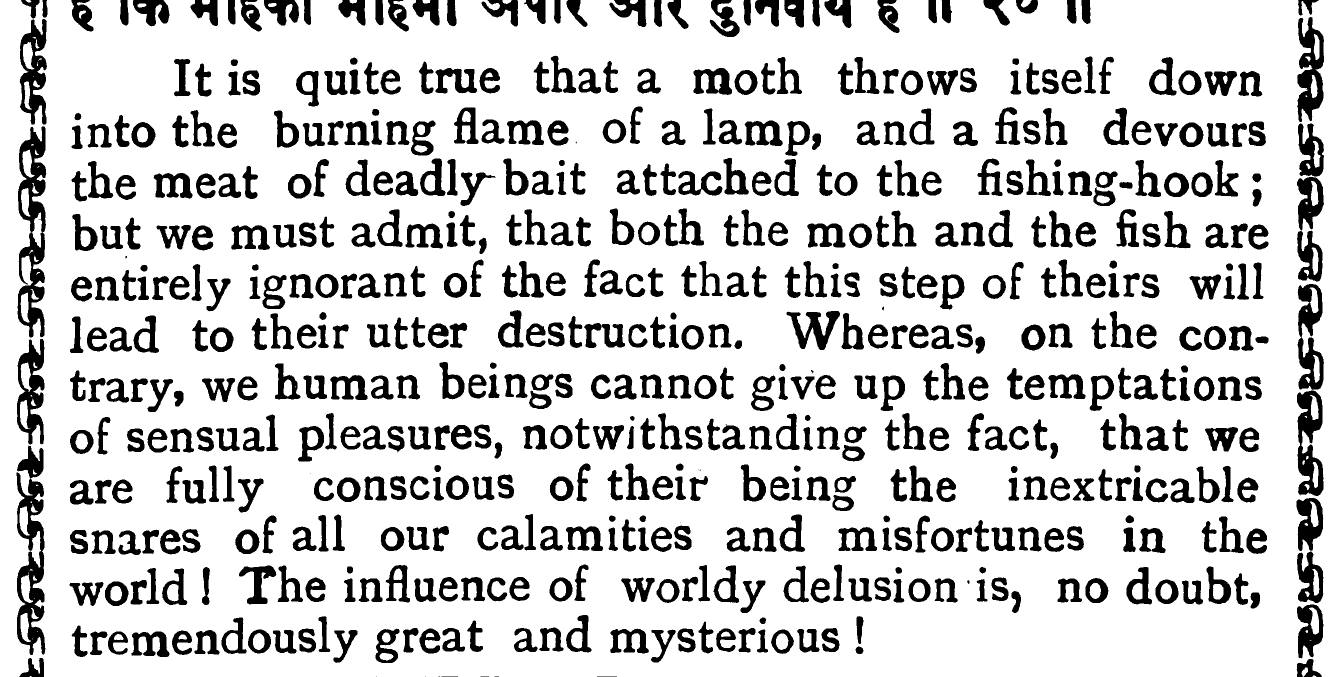
It is quite true that a moth throws itself down into the burning flame of a lamp, and a fish devours the meat of deadly bait attached to the fishing-hook; but we must admit, that both the moth and the fish are entirely ignorant of the fact that this step of theirs will lead to their utter destruction. Whereas, on the contrary, we human beings cannot give up the temptations of sensual pleasures, notwithstanding the fact, that we are fully conscious of their being the inextricable snares of all our calamities and misfortunes in the world! The influence of worldy delusion is, no doubt, tremendously great and mysterious!
Footnote
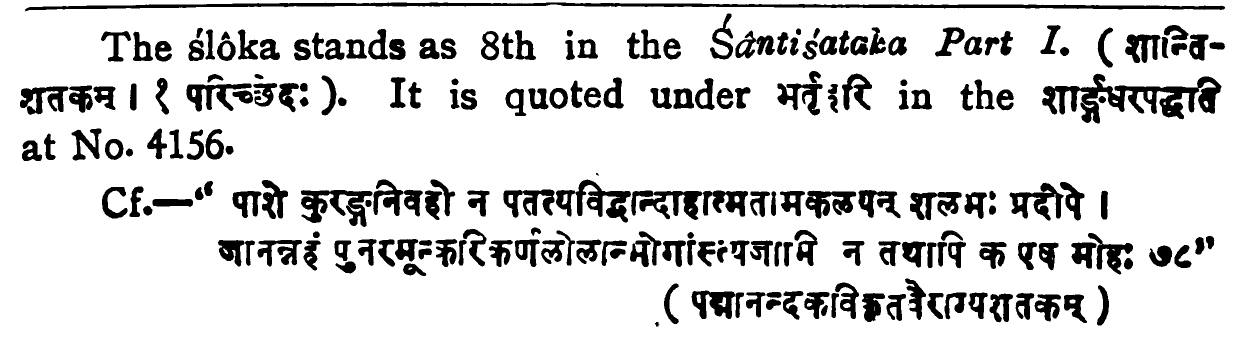
The ślôka stands as 8th in the Santiśataka Part I. (mizaशतकम् । १ परिच्छेदः). It is quoted under भर्तृहरि in the शार्ङ्गधरपद्धति at No. 4156. Cf. - " पाशे कुरङ्गनिवहो न पतत्यविद्वान्दाहारमत। मकलपन् शलमः प्रदीपे । जानन्नहं पुनरमून्करिकर्णलोलान्मोगांस्त्यजामि न तथापि क एष मोहः ७८" (पद्मानन्दकविकृत वैराग्यशतकम् )
Gopinath1896
all
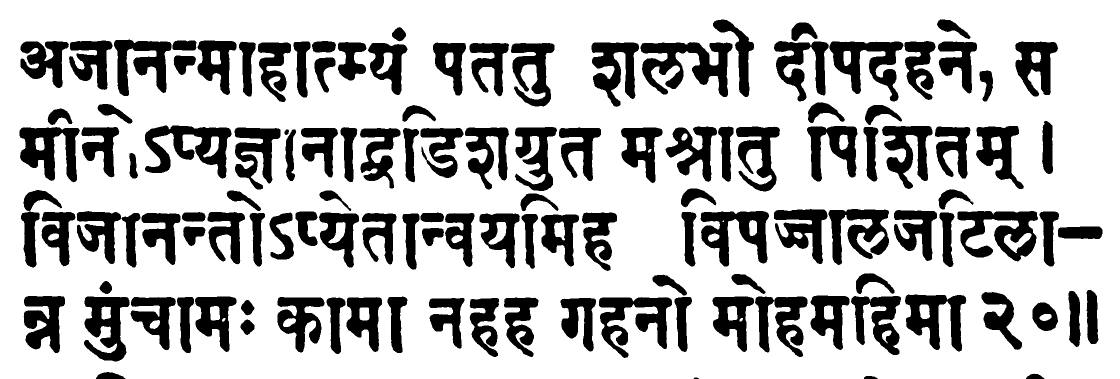
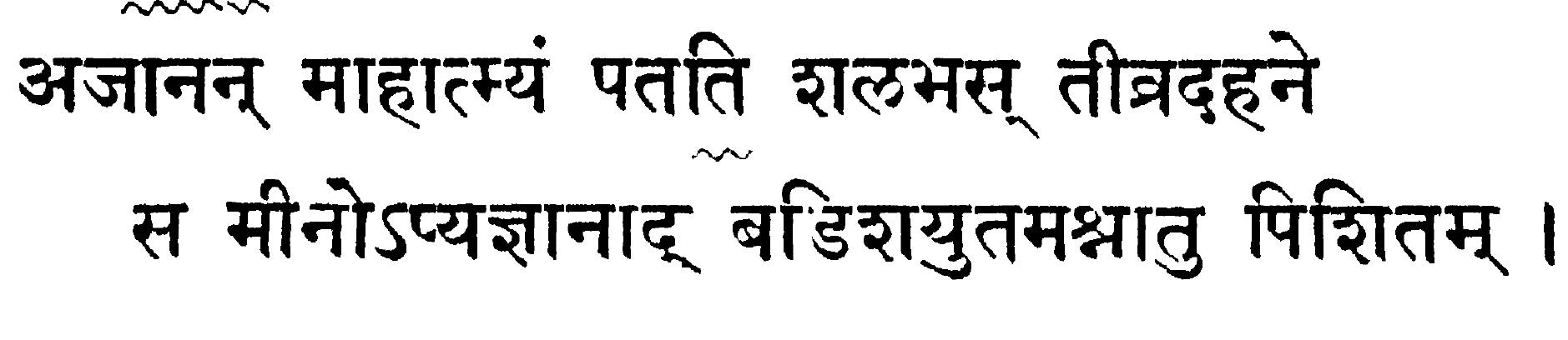
अजानन्माहात्म्यं पततु शलभो दीपदहने, स
मीनो ऽप्यज्ञानाद्वडिशयुत मश्नातु पिशितम् ।
विजानन्तोऽप्येतान्वयमिह विपज्जालजटिला-
न्न मुंचामः कामा नहह गहनो मोहमहिमा २०॥
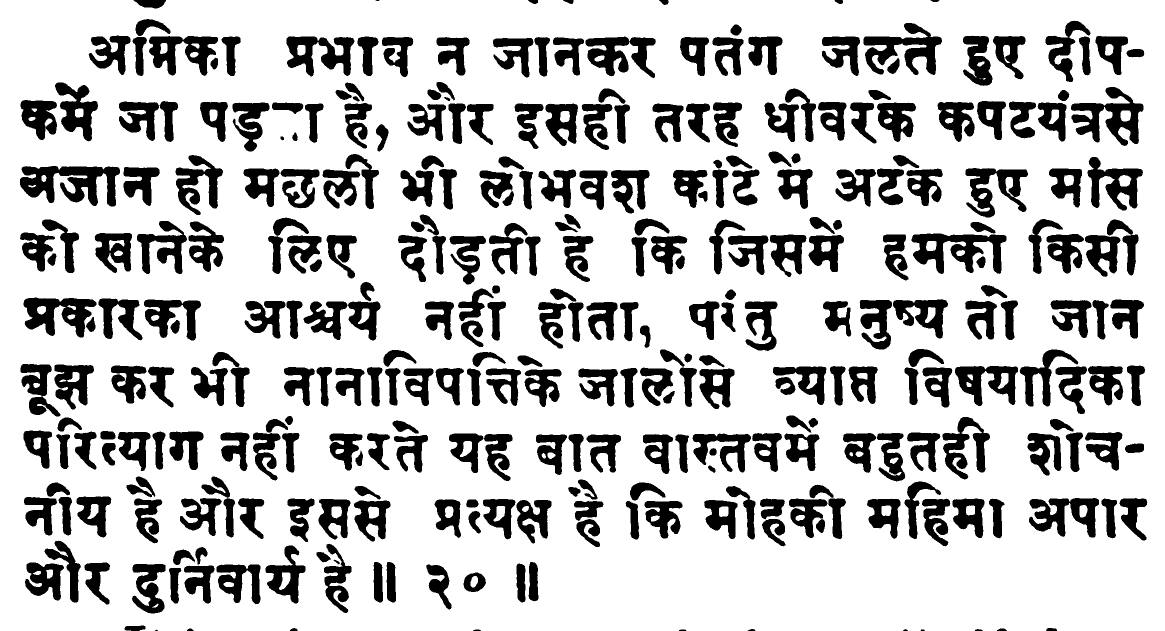
अमिका प्रभाव न जानकर पतंग जलते हुए दीपकमें जा पड़ता है, और इसही तरह धीवरके कपटयंत्रसे मजान हो मछली भी लोभवश कांटे में अटके हुए मांस को खानेके लिए दौड़ती है कि जिसमें हमको किसी प्रकारका आश्चर्य नहीं होता, परंतु मनुष्य तो जान चूझ कर भी नानाविपत्तिके जालोंसे व्याप्त विषयादिका परित्याग नहीं करते यह बात वास्तव में बहुतही शोचनीय है और इससे प्रत्यक्ष है कि मोहकी महिमा अपार और दुर्निवार्य है ॥ २० ॥
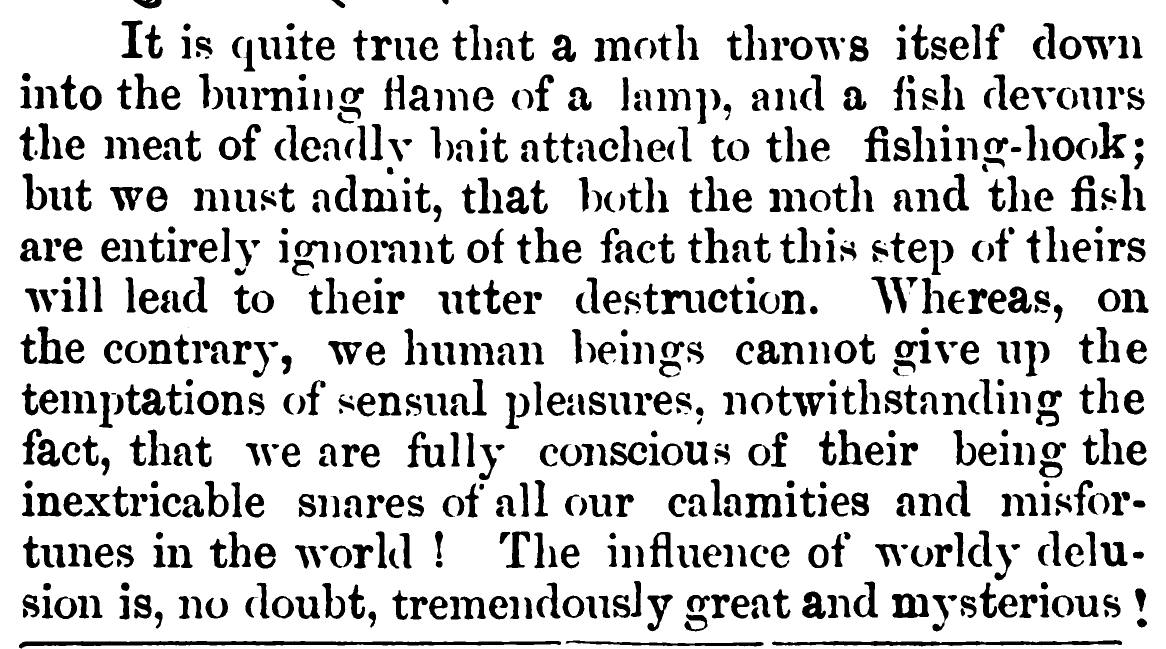
It is quite true that a moth throws itself down into the burning flame of a lamp, and a fish devours the meat of deadly bait attached to the fishing-hook; but we must admit, that both the moth and the fish are entirely ignorant of the fact that this step of theirs will lead to their utter destruction. Whereas, on the contrary, we human beings cannot give up the temptations of sensual pleasures, notwithstanding the fact, that we are fully conscious of their being the inextricable snares of all our calamities and misfortunes in the world! The influence of worldy delusion is, no doubt, tremendously great and mysterious !
Footnote
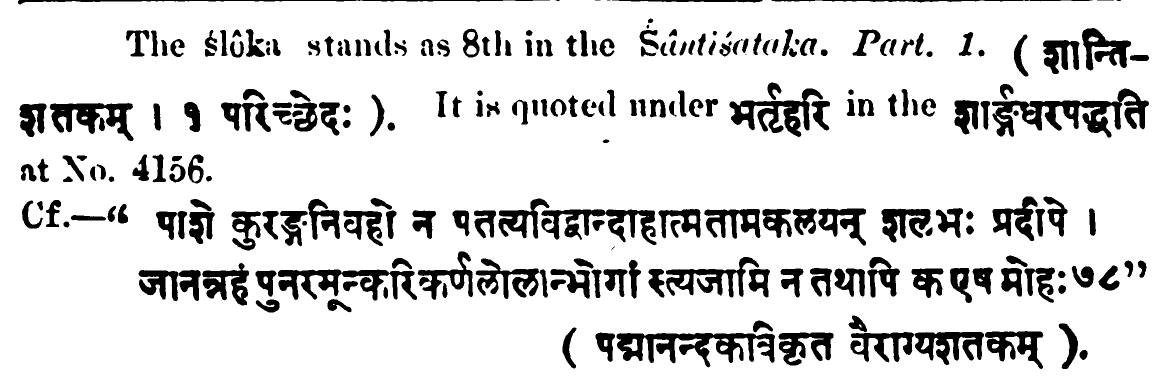
The flôka_stands as 8th in the Stutisatala. Part. 1. ( शान्तिशतकम् । १ परिच्छेदः ). It is quoted under भर्तृहरि in the शार्ङ्गधरपद्धति at No. 4156. Cf. - " पाशे कुरङ्गनिवहो न पतत्यविद्वान्दाहात्म तामकलयन् शलभः प्रदीपे । जानन्नहं पुनरमून्करि कर्ण लोलान्भोगां स्त्यजामि न तथापि क एष मोहः ७८" ( पद्मानन्दकविकृत वैराग्यशतकम् ).
Kosambi
all

Footnote
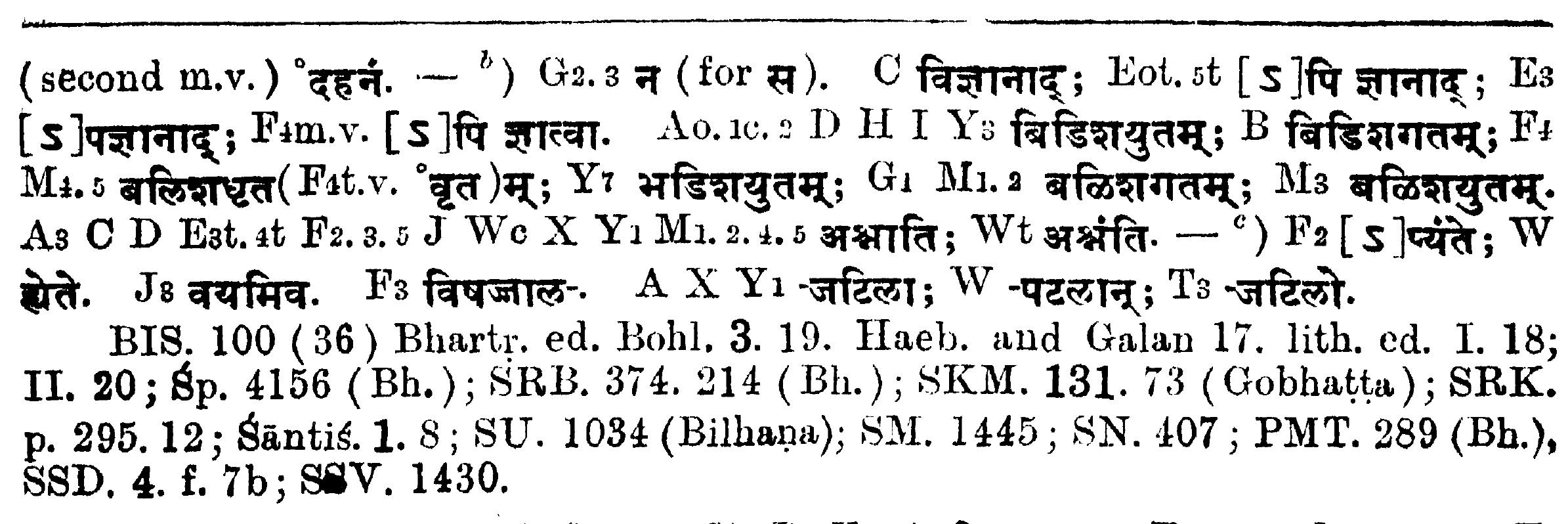
160 Om . in Ujjain 6414 . a ) C X1 महात्म्यं ; F1 H I J Y 4 – 4. 4 T_G_M4-5
दाहात्म्यं ; F2 अप्येषः ; F8.4m.v. दाहार्ति ( for माहात्म्यं ) . B E0 2.405 F1.24 H Io Ya
( by corr . ) 4 - 4 T G Ms पततु . E3 , 4 J2.8 G2 . 3 तत्र ; F8.4m.v. दीप- ( for तीव्र- ) . Fa

Footnote
( second m.v. ) ' दहनं . - 4 ) G2 . 3 न ( for स ) . C विज्ञानाद् ; Eot.st [ s ] पि E3
ज्ञानाद् ;
[ s ] पज्ञानाद् ; Fam.v. [ 5 ] पि ज्ञात्वा Ao . 1 D H I Y : बिडिशयुतम् ; B बिडिशगतम् ; F4
M. 3 बलिशत ( Fat.v. वृत ) म् ; Y7 भडिशयुतम् ; G1 M1.3 बळिशगतम् ; M3 बळिशयुतम् .
A3C D E3t . 4t F2 . 3. 5 J We X Y1 M1 . 2. ± ● 5 अश्नाति ; Wt अनंति . ° ) F 2 [ 5 ] [ प्यंते ; W
येते . Js वयमिव . F3 विषज्जाल . A X Y1 जटिला ; W -पटलान् ; Ts जटिलो .
BIS . 100 ( 36 ) Bhartr . ed . Bohl . 3. 19. Haeb . and Galan 17. lith . ed . I. 18 ;
II . 20 ; 8p . 4156 ( Bh . ) ; SRB . 374 214 ( Bh . ) ; SKM . 131.73 ( Gobhatta ) ; SRK .
p . 295. 12 ; Santis . 1. 8 ; SU . 1034 ( Bilbana ) ; SM . 1445 ; SN . 407 ; PMT . 289 ( Bh . ) ,
SSD . 4. f . 7b ; SAV . 1430 .
Commentary