Ryder
LOVE IS YOUNG
The wrinkles on my face are all untold;
My hair is gray and thin;
My limbs are sadly feeble grown, and old:
But love is young, and sin.
Tawney
Wrinkles deform my face.
And hoary hairs my head.
Withered my youthful grace.
But avarice blooms instead.
Mādhavānanda
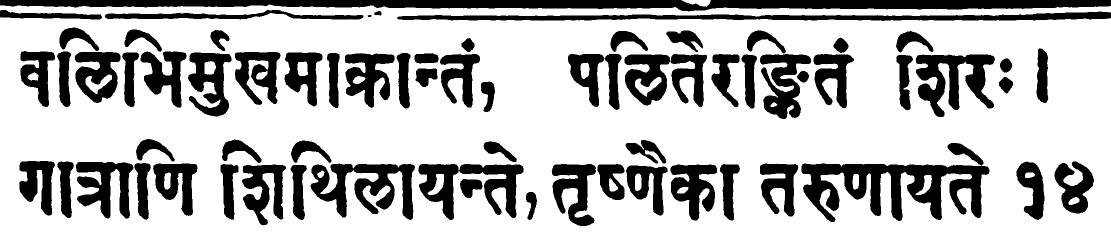
वलीभिर्मुखमाक्रान्तं पलितेनाङ्कितं शिर: ।
गात्राणि शिथिलायन्ते तृष्णैका तरुणायते ।।८।।
8. The face has been attacked with wrinkles, the head has been painted white with grey hair, the limbs are all enfeebled; but desire alone is rejuvenating.



Kale
all

Translation
9. Wrinkles have made an inroad on the face; the head is marked ( with gray hair ) all the limbs become feeble; greed alone keeps its vigour fresh.

Notes
Sl 9 All parts of the body indicate the advent of old age. Greed alone grows young, i. e., though old we feel as greedy as when we were young, or even more. आक्रान्तं-Over-ridden; on which a footing has been made by पलितं—gray hair: पलितं जरसा शौक्ल्यं Amara. तृष्णा here may also be taken as an उपलक्षण i. e. indicating kindred things—the feelings of the mind. तरुणायते— तरुणी इवाचरति is young Cf. जीर्यन्ते जीर्यतः केशा दन्ता जीर्यन्ति जीर्यतः । जीर्यतश्चक्षुषी श्रोत्रे तृष्णैका तरुणायते Pt. V. 16.
Gopinath1914
all

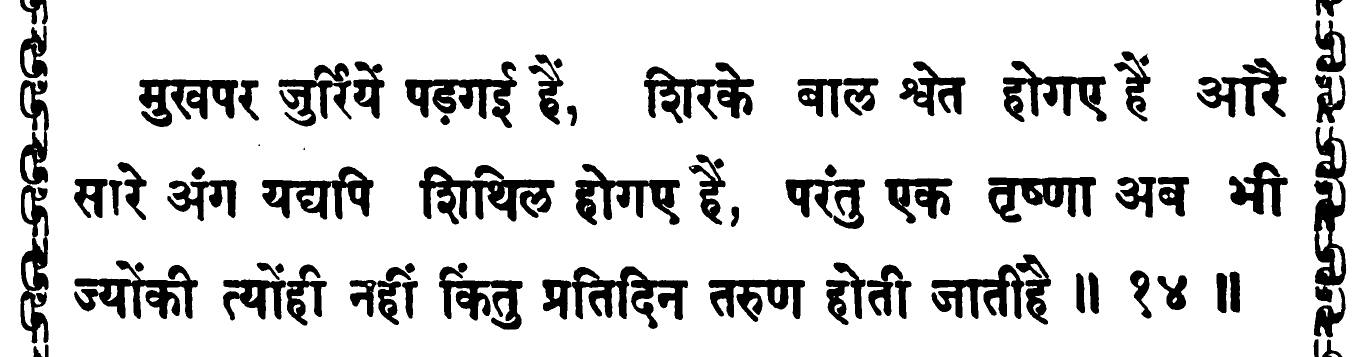
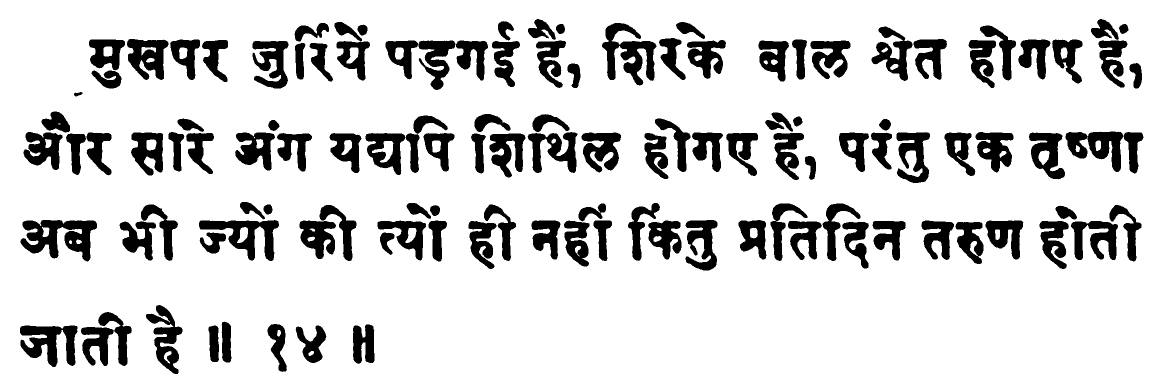
मुखपर जुर्रियें पड़गई हैं, शिरके बाल श्वेत होगए हैं और सारे अंग यद्यपि शिथिल होगए हैं, परंतु एक तृष्णा अब भी ज्योंकी त्योंही नहीं किंतु प्रतिदिन तरुण होती जाती है ॥ १४ ॥
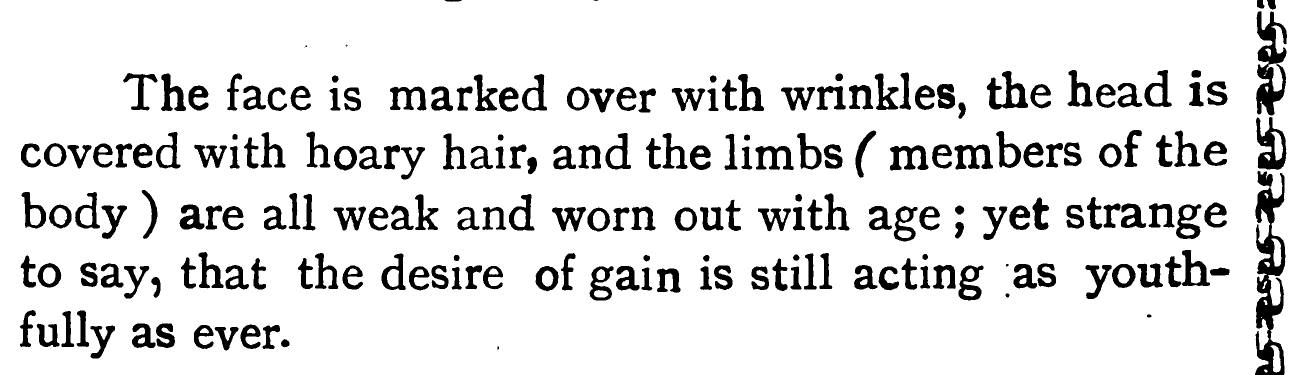
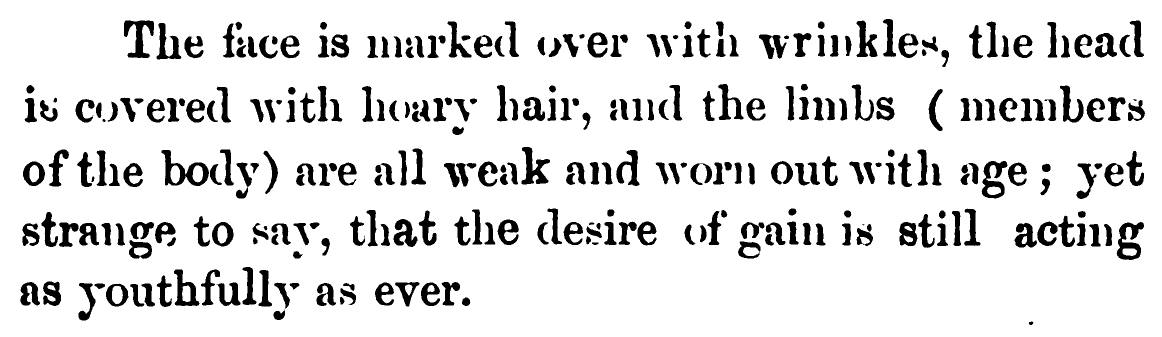
The face is marked over with wrinkles, the head is covered with hoary hair, and the limbs ( members of the body) are all weak and worn out with age; yet strange to say, that the desire of gain is still acting as youthfully as ever.
Quoted under Vyasamuni ( व्यासमुनि ) in the Subhashitávali ( सुभाषितावलि) at No. 3242, and Bhartrihari भर्तृहरि in the Sarngadharapaddhati ( शार्ङ्गधरपद्धति) at No. 419.


(b) " भङ्गं गलितं पलितं मुण्डं दशनविहीनं जातं तुण्डम् ।
करधृतकम्पितशोभितदण्डं तदपि न मुञ्चत्याशापिण्डम् " ” १५

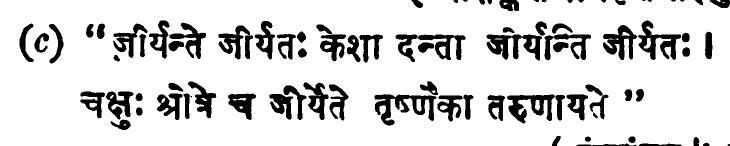
(c) " ज़ीर्यन्ते जीर्यतः केशा दन्ता जीर्यन्ति जीर्यतः ।
चक्षुः श्रोत्रे च जीर्येते तृष्णैका तरुणायते "

Gopinath1896
all
मुखपर जुर्रियें पड़ गई हैं, शिरके बाल श्वेत होगए हैं, और सारे अंग यद्यपि शिथिल होगए हैं, परंतु एक तृष्णा अब भी ज्यों की त्यों ही नहीं किंतु प्रतिदिन तरुण होती जाती है ॥ १४ ॥
The face is marked over with wrinkles, the head is covered with hoary hair, and the limbs (members of the body) are all weak and worn out with age; yet strange to say, that the desire of gain is still acting as youthfully as ever.
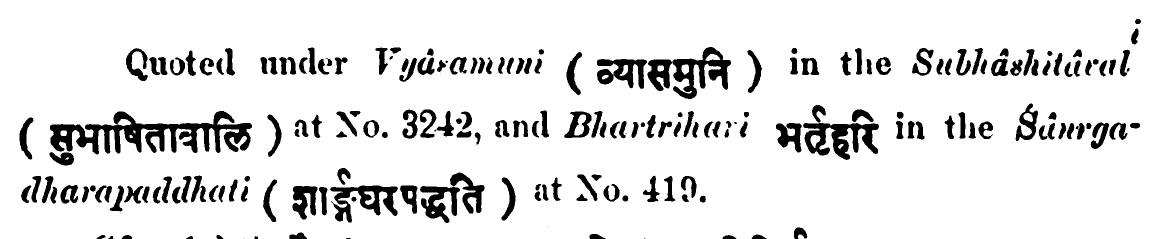
Quoted under Fyäramani ( व्यासमुनि ) in the Subhashitāral ( सुभाषितावालि ) at No. 3242, and Bhartrihari भर्तृहरि in the Sargadharapaddhati ( शार्ङ्गघर पद्धति ) at No. 419.
Cf. – (1) " यौवनं जरया ग्रस्त-मारोग्यं व्याधिभिर्हतम् ।
जीवितं मृत्यु रभ्येति, तृष्णैका निरुपद्रवा "

(b) अङ्गं गलितं पलितं मुण्डं, दशन विहीनं जातं तुण्डम् ।
करधृत कम्पित शोभित दण्डं तदपि न मुञ्चत्याशा पिण्डम् " १५

(c ) " जीर्यन्ते जीर्यतः केशा, दन्ता जीर्यन्ति जीर्यतः ।
चक्षुः श्रोत्रे च जीयेते, तृष्णैका तरुणायते "


Kosambi
all

Footnote
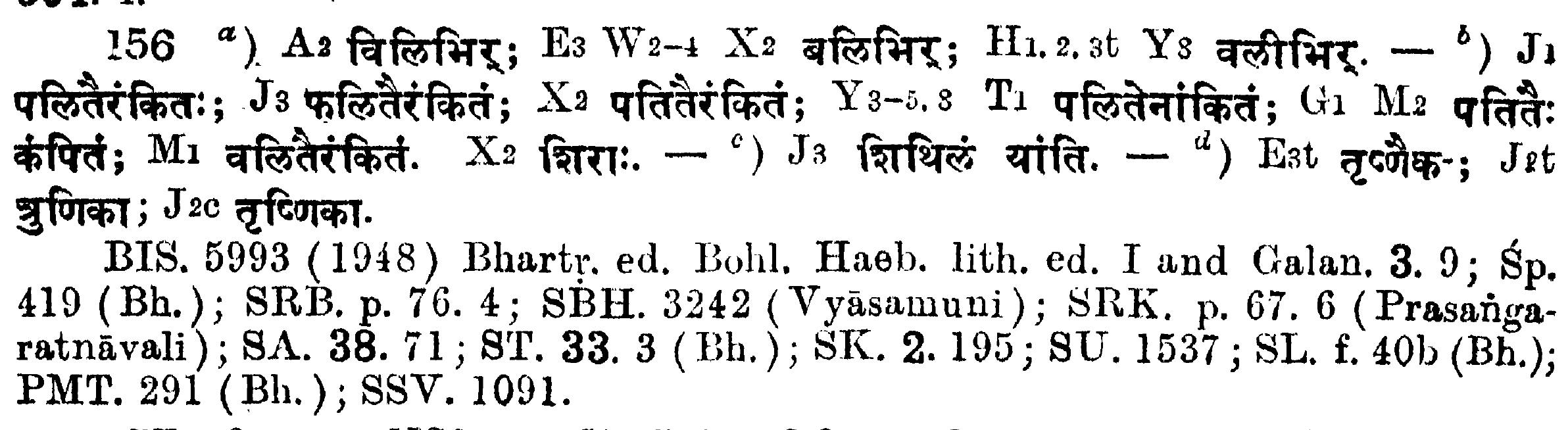
156 ) As विलिभिर् ; E3 W2-4 X 2 बलिभिर् ; H1 2 3t Ys वलीभिर् . b ) Ji
पलितैरं कितः ; Js फलितैरंकितं ; X 2 पतितैरंकितं ; X 3 - 3.8 T1 पलितेनांकितं ; G1 M2 पतितैः
कंपितं ; M1 वलितैरंकितं . X 2 शिरा :. c ) J3 शिथिलं यांति . “ ) Est तृष्णैक- ; Jat
त्रुणिका ; J20 तृष्णिका .
BIS . 5993 ( 1948 ) Bhartr . ed . Bohl . Haeb lith . ed . I and Galan . 3. 9 ; Śp .
419 ( Bh . ) ; SRB . p . 76.4 ; SBH . 3242 ( Vyāsamuni ) ; SRK . p . 67.6 ( Prasanga
ratnāvali ) ; SA 38. 71 ; ST . 33. 3 ( Bh . ) ; SK 2 195 ; SU . 1537 ; SL f . 40b ( Bh . ) ;
PMT . 291 ( Bh . ) ; SSV . 1091 .
Commentary