Tawney
I've wandered over many lands, and reaped withal no fruit,
I've laid my pride of rank aside, and pressed my baffled suit,
At stranger boards, like shameless crow, I've eaten bitter bread,
But fierce Desire, that raging fire, still clamours to be fed.
More
XLV
O'er perilous mountain roads with pain
I 've journeyed, yet acquired no gain;
The pride of birth I have forsworn
And toiled in service, yet no profit borne.
In strange homes where I blushed to go
My food I've taken, like the crow,
And eaten shame. — Oh lust of gold!
Oh Greed! that younger grow'st as I wax old!
Mādhavānanda
भ्रान्तं देशमनेकदुर्गविषमं प्राप्तं न किञ्चित् फलम्
त्यक्त्वा जातिकुलाभिमानमुचितं सेवा कृता निष्फला ।
भुक्तं मानविवजिर्तं परगृहेष्वाशङ्कया काकव-
त्तृृष्णे जृम्भसि पापकर्मपिशुने नाद्यापि सन्तुष्यसि ।।२।।
2. Many are the inaccessible and perilous places I have travelled and yet obtained no riches; sacrificing proper dignity of birth and social position, in vain have I served the rich; like the crows have I fed myself, devoid of self-respect, at the house of others in the expectation of gain; and yet, oh! Desire, thou prompter of evil deeds, thou art waxing lustier and art not still satisfied.
[अनेकदुर्गविषमं—rendered difficult of access by various obstacles. फलं—result (but here), wealth. आशङ्कया—hankering (after gain). पापकर्मपिशुने—indicative of evil deeds.]
Telang
all
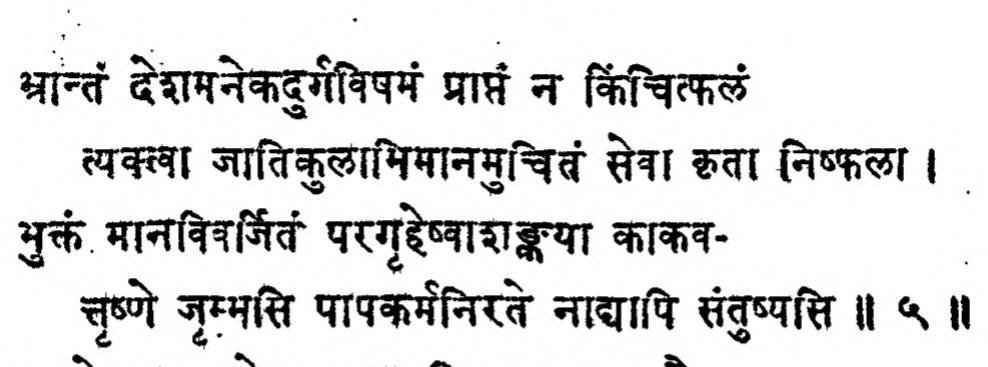
भ्रान्तं देशमनेकदुर्गविषमं प्राप्तं न किंचित्फलं
त्यक्त्वा जातिकुलाभिमानमुचितं सेवा कृता निष्फला ।
भुक्तं मानविवर्जितं परगृहेष्वाशङ्कया काकव-
त्तृष्णे जृम्भसि पापकर्मनिरते नाद्यापि संतुष्यसि ॥ ५ ॥
Notes
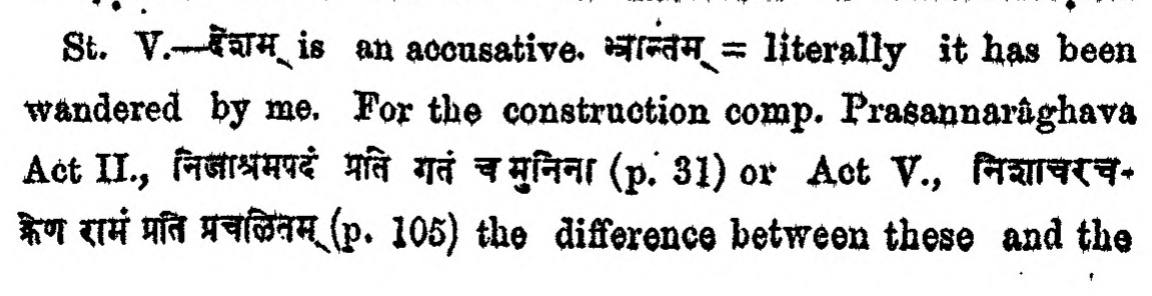
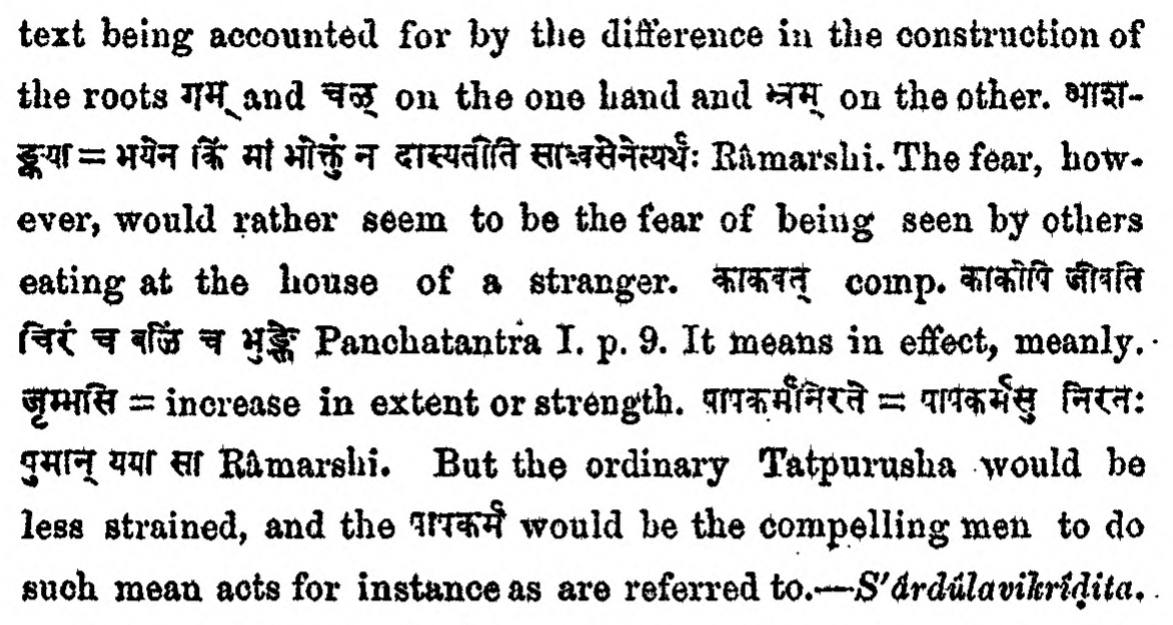
St. V.—देशम् is an accusative. भ्रान्तम् = literally it has been wandered by me. For the construction comp. Prasannarâghava Act II., निजाश्रमपदं प्रति गतं च मुनिना (p. 31) or Act V., निशाचरचक्रेण रामं प्रति प्रचलितम् (p. 105) the difference between these and the text being accounted for by the difference in the construction of the roots गम् and चल् on the one hand and भ्रम् on the other. आशङ्कया = भयेन किं मां भोक्तुं न दास्यतीति साध्वसेनेत्यर्थः Râmarshi. The fear, however, would rather seem to be the fear of being seen by others eating at the house of a stranger. काकवत् comp. काकोपि जीवति चिरं च बलिं च भुङ्क्ते Panchatantra I. p. 9. It means in effect, meanly. जृम्भसि = increase in extent or strength. पापकर्मनिरते = पापकर्मसु निरतः पुमान् यया सा Râmarshi. But the ordinary Tatpurusha would be less strained, and the पापकर्म would be the compelling men to do such mean acts for instance as are referred to.—S'ârdûlavikrîḍita.

Kale
all
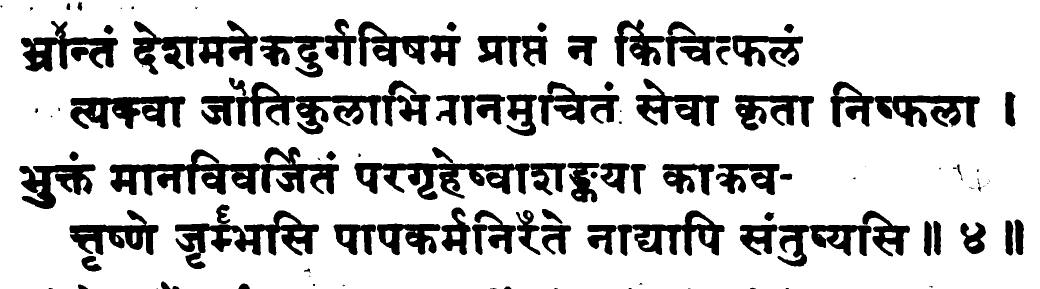
भ्रान्तं देशमनेकदुर्गविषमं प्राप्तं न किंचित्फलं
त्यक्त्वा जातिकुलाभिमानमुचितं सेवा कृता निष्फला ।
भुक्तं मानविवर्जितं परगृहेष्वाशङ्कया काकव-
त्तृष्णे जृम्भसि पापकर्मनिरते नाद्यापि संतुष्यसि ॥ ४ ॥
Translation
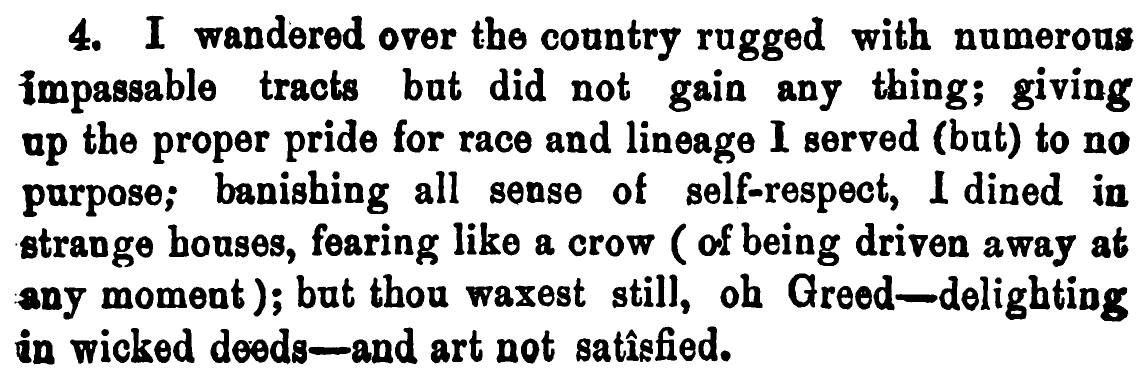
4. I wandered over the country rugged with numerous impassable tracts but did not gain any thing; giving up the proper pride for race and lineage I served (but) to no purpose; banishing all sense of self-respect, I dined in strange houses, fearing like a crow ( of being driven away at any moment ); but thou waxest still, oh Greed—delighting in wicked deeds—and art not satîsfied.
Notes
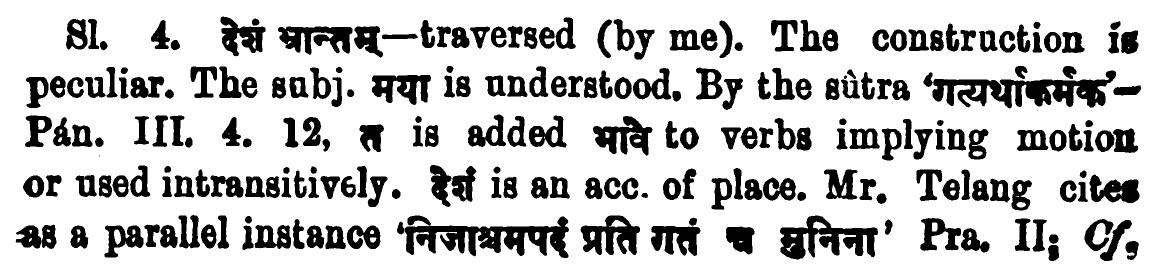
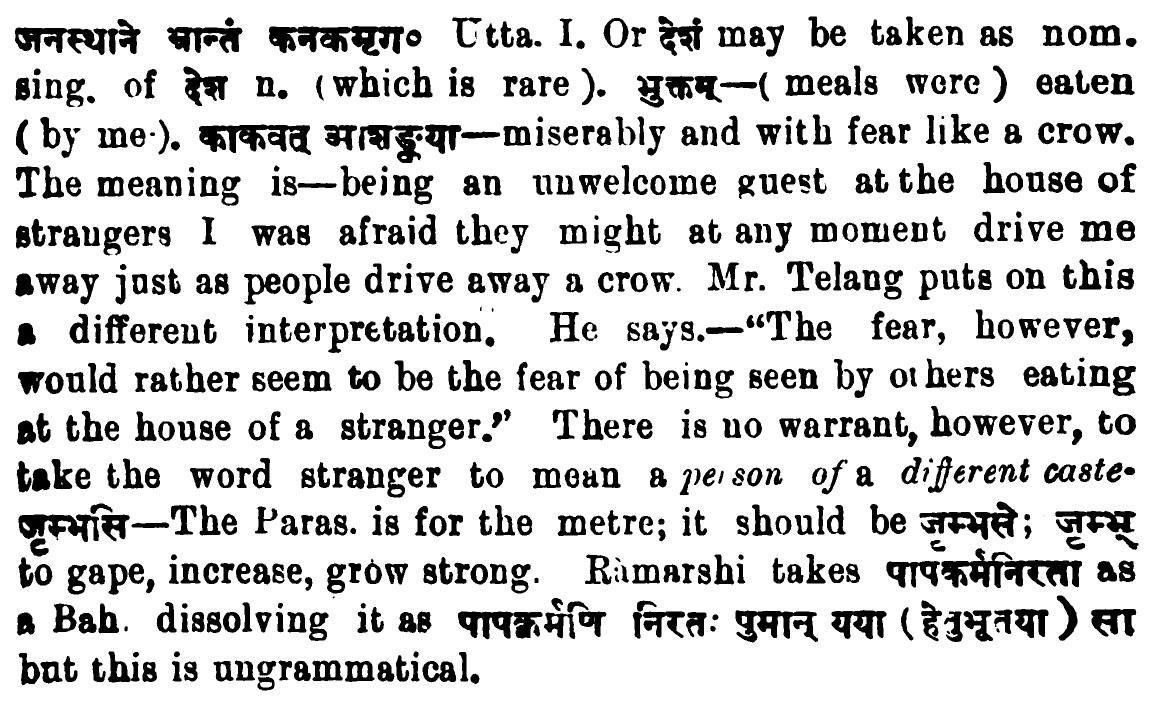
Sl. 4. देशं भ्रान्तम्—traversed (by me). The construction is peculiar. The subj. मया is understood. By the sûtra ‘गत्यर्थाकर्मक’— Pán. III. 4. 12, त is added भावे to verbs implying motion or used intransitively. देशं is an acc. of place. Mr. Telang cites as a parallel instance ‘निजाश्रमपदं प्रति गतं च मुनिना’ Pra. II; Cf, जनस्थाने भ्रान्तं कनकमृग० Utta. I. Or देशं may be taken as nom. sing. of देश n. ( which is rare ). भुक्तम्—( meals were ) eaten ( by me ). काकवत् आशङ्कया—miserably and with fear like a crow. The meaning is—being an unwelcome guest at the house of strangers I was afraid they might at any moment drive me away just as people drive away a crow. Mr. Telang puts on this a different interpretation. He says.—“The fear, however, would rather seem to be the fear of being seen by others eating at the house of a stranger.” There is no warrant, however, to take the word stranger to mean a person of a different caste. जृम्भसि—The Paras. is for the metre; it should be जृम्भसे; जृम्भ् to gape, increase, grow strong. Ràmarshi takes पापकर्मनिरता as a Bah. dissolving it as पापकर्मणि निरतः पुमान् यया ( हेतुभूतया ) सा but this is ungrammatical.


Gopinath1914
all
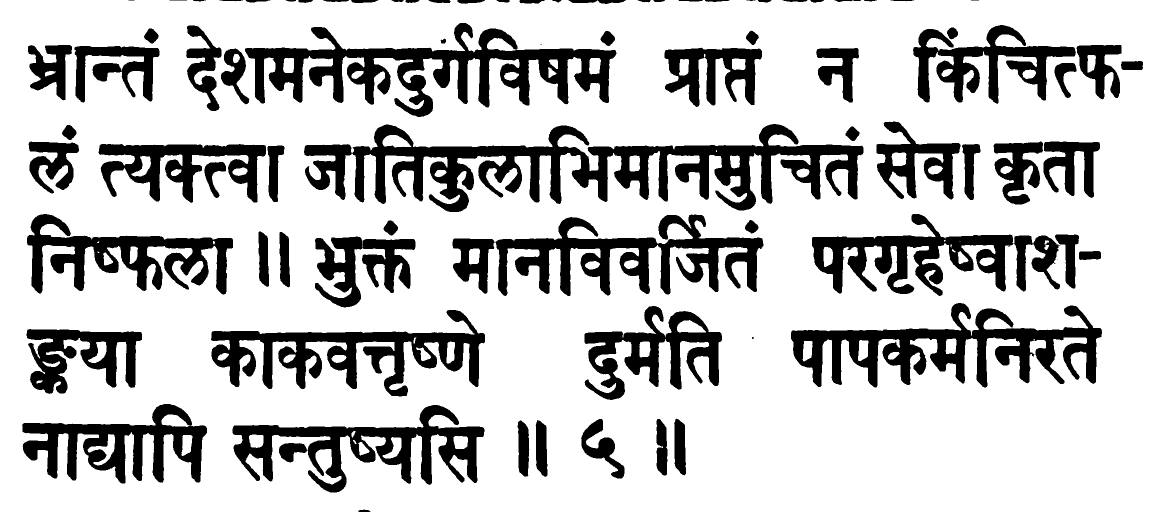
भ्रान्तं देशमनेकदुर्गविषमं प्राप्तं न किंचित्फ-
लं त्यक्त्वा जातिकुलाभिमानमुचितं सेवा कृता
निष्फला ॥ भुक्तं मानविवर्जितं परगृहेष्वाश-
ङ्कया काकवत्तृष्णे दुर्मति पापकर्मनिरते
नाद्यापि सन्तुष्यसि ॥ ५ ॥
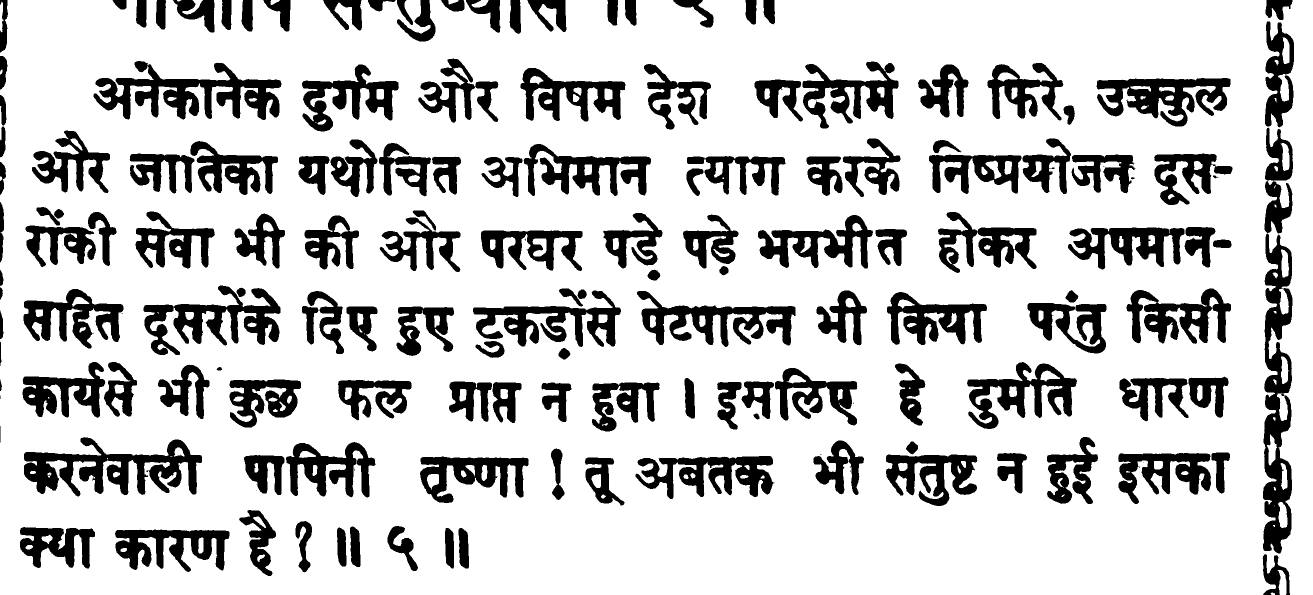
अनेकानेक दुर्गम और विषम देश परदेशमें भी फिरे, उच्चकुल किट और जातिका यथोचित अभिमान त्याग करके निष्प्रयोजन दूसकी सेवा भी की और परघर पड़े पड़े भयभीत होकर अपमानसहित दूसरोंके दिए हुए टुकड़ोंसे पेटपालन भी किया परंतु किसी कार्य से भी कुछ फल प्राप्त न हुवा । इसलिए हे दुर्मति धारण करनेवाली पापिनी तृष्णा ! तू अबतक भी संतुष्ट न हुई इसका क्या कारण है ? ॥ ५॥
I have travelled over many rough and impassable countriespride , of but my all in vaincaste . Having and familylaid , aside have the natu ral (high) I served (others), but with that too without crowany advantage have to dis- me. Trembling fear like a , I eaten honourable bread in another's house. But oh stupid and sinful Avarice! thou art not satisfied even now.
Footnote
Quoted anonymously in the Subhashitavali ( सुभाषितावलि) at No. 3262. Cf.—“ भ्रान्तं याचनतत्परेण मनसा देहीति वाक्प्रेरिता मुक्तं मानविवर्जितं परगृहे साशाङ्कितं काकवत् । साक्षेपं भृकुटीकटाक्षकुटिलं दृई खळानां मुखं तृष्णे देवि यदम्पदिच्छसि पुनस्तत्रापि सज्जा वयम् ॥ " 3rd of Note our that text. the 2nd line of this ( सुभाषितरत्नभाण्डागारः verse is almost the ११२।३८ same ). as the
Gopinath1896
all
भ्रान्तं देशमनेकदुर्गविषमं प्राप्तं न किंचित्फ-
लं, त्यक्त्वा जातिकुलाभिमानमुचितं सेवा कृता
निष्फला । भुक्तं मानविवर्जितं परगृहे ष्वाश-
या काकव तृष्णे दुर्मति पापकर्मनिरते
नाद्यापि सन्तुष्यसि ॥ ५॥
अनेकानेक दुर्गम और विषम देशपरदेशमें भी फिरे, उच्चकुल और जाति का यथोचित अभिमान त्याग करके निष्प्रयोजन दूसरों की सेवा भी की और परघर पड़े पड़े भयभीत होकर अपमानसहित दूसरों के दिएहुए टुकड़ों से पेटपालन भी किया, परंतु किसी कार्य से भी कुछ फल प्राप्त न हुवा । इसलिए हे दुर्मति धारण करनेवाली पापिनी तृष्णा ! तू अबतक भी संतुष्ट न हुई इसका क्या कारण है ? ॥ ५ ॥
I have travelled over many rough and impassable countries, but all in vain. Having laid aside the natural pride of my (high) caste and family, I have served (others), but that too without any advantage to me. Trembling with fear like a crow, I have eaten dishonourable bread in another's house. But oh stupid and sinful Avarice! thou art not satisfied even now.


Footnote
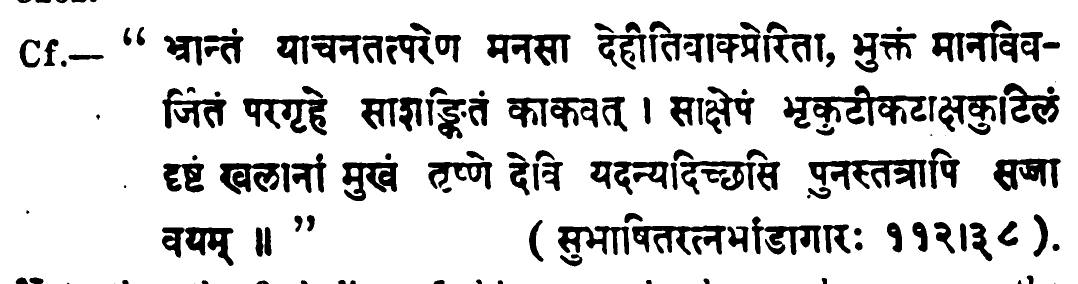
Cf. - " भ्रान्तं याचनतत्परेण मनसा देहीतिवाक्प्रेरिता, भुक्तं मानविवजितं परगृहे साशङ्कितं काकवत् । साक्षेपं भृकुटीकटाक्षकुटिलं दृष्टं खलानां मुखं तृष्णे देवि यदन्यदिच्छसि पुनस्तत्रापि सज्जा वयम् ॥ " ( सुभाषितरत्न भांडागारः ११२/३८ ).

Kosambi
all
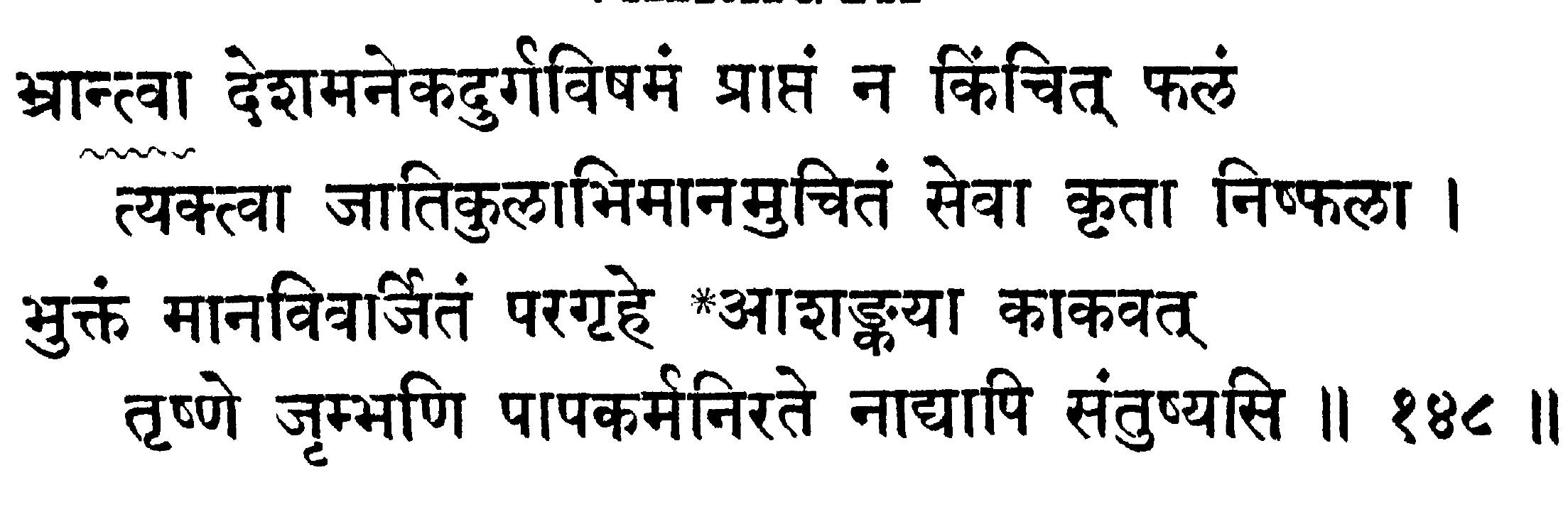
भ्रान्त्वा देशमनेकदुर्गविषमं प्राप्तं न किंचित् फलं
त्यक्त्वा जातिकुलाभिमानमुचितं सेवा कृता निष्फला ।
भुक्तं मानविवर्जितं परगृहे आशङ्कया काकवत्
तृष्णे जृम्भणि पापकर्मनिरते नाद्यापि संतुष्यसि ॥ १४८ ॥
Footnote
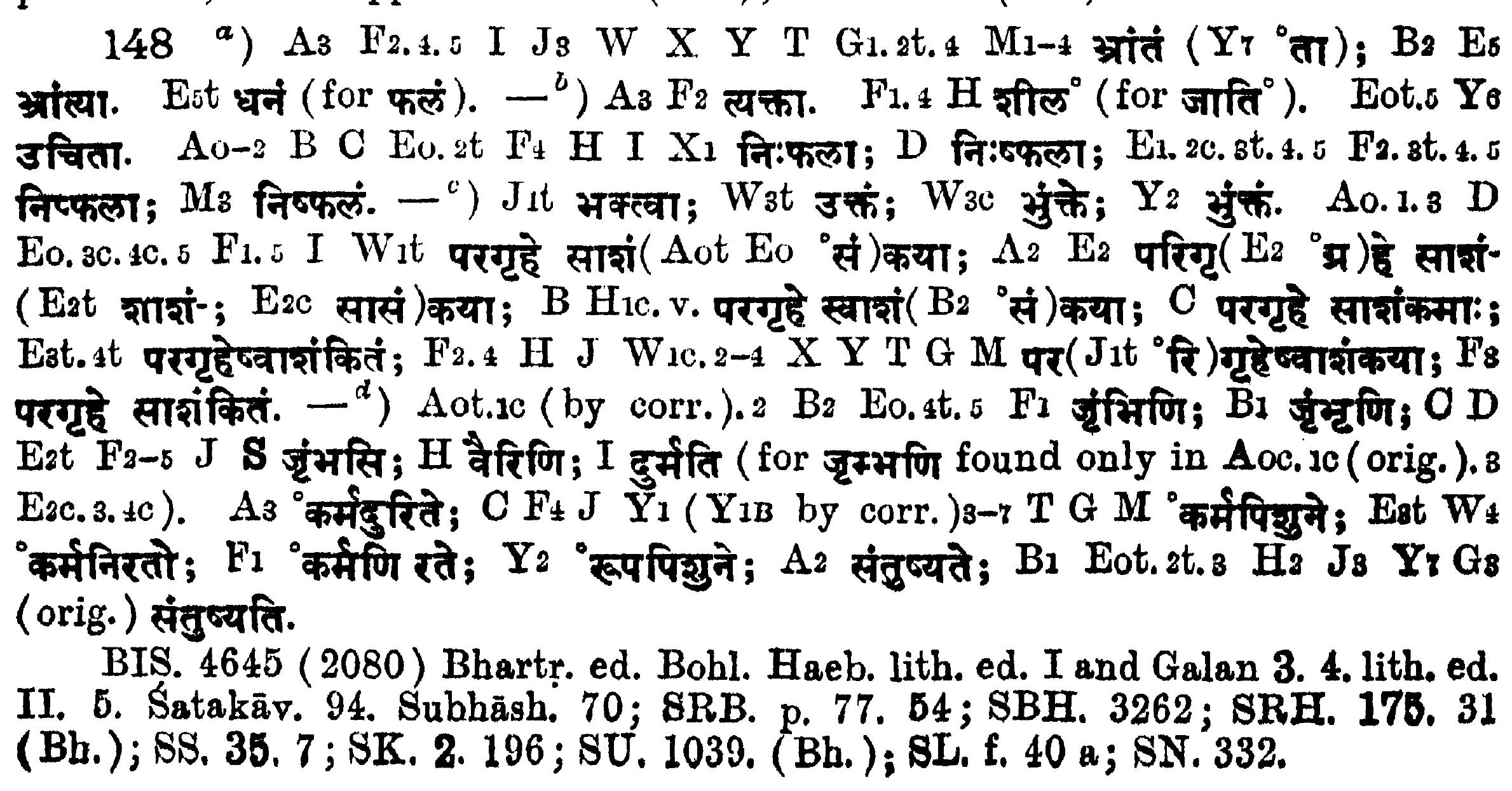
148 “ ) A3 F2 4 5 I J3 W X Y T G1.2t . 4 M1 - भ्रांतं ( Y1 ° ता ) ; B2E6
आंत्या . Est धनं ( for फलं ) . —5 ) A3 F2 त्यक्ता . F1 . 4 H शील ( for जाति ) . Eoto Ye
उचिता . A0-2 B C Eo.2t F4 H I X 1 निःफला ; D निःष्फला ; E1.2c . 3.45 Fast , 4. 5
निष्फला ; Ms Ms निष्फलं निष्फलं . . — ) Jit भक्त्वा ; W3t उक्तं ; We भुंक्ते ; Y2 भुंक्तं . Ao . 1.3 D
E0 . 3c . 4c . 5 F15_I_Wit परगृहे साशं ( Aot Eo ' सं ) कया ; 42 E2 परिगृ ( E2 ° म ) हे साशं
( Eat शाशं ; ; E20 सासं ) कया ; B Hic v . परगृहे स्वाशं ( Ba सं ) कया ; C परगृहे साशंकमाः ;
Eat at परगृहेष्वाशंकितं ; F2.4 4 H J W10.2-4 X Y TGM पर ( Jit ° रि ) गृहेष्वाशंकया ; F8
परगृहे साशंकितं . 4 ) Aot.ic ( by corr . ) . 2 B2 Eo . 46.6 F1 जूंभिणि ; B1 जृंभृणि ; OD
Eat_F2-5_ J_S जृंभसि ; H वैरिणि ; I दुर्मति ( for जृम्भणि found only in Aoc.ic ( orig . ) 4
Eac . 3. 10 ) . A3 कर्मदुरिते ; CF + J Y1 ( Y1 by corr . ) 3 - 7 T GM कर्मपिशुने ; Eat W4
' कर्मनिरतो ; F1 कर्मणि रते ; Y2 ' रूपपिशुने ; A2 संतुष्यते ; B1 Eot . 2t 3 H2 Js X1 G8
( orig . ) संतुष्यति .
BIS . 4645 ( 2080 ) Bhartṛ . ed . Bohl . Haeb . lith . ed . I and Galan 3. 4. lith . ed .
II . 6. Satakāv . 94. Subhāsh . 70 ; SRB . p . 77. 54 ; SBH . 3262 ; SRE . 175. 31
( Bh . ) ; ISS , 35 , 7 ; ISK . 2. 196 ; SU . 1039. ( Bh . ) ; SL . f . 40 ; SN . 332 .
Commentary