Tawney
A lion's whelp will boldly face th' earth-shaking monarch's rage,
For valour dwells in valourous kind, without regard of age.
Telang
all


Notes
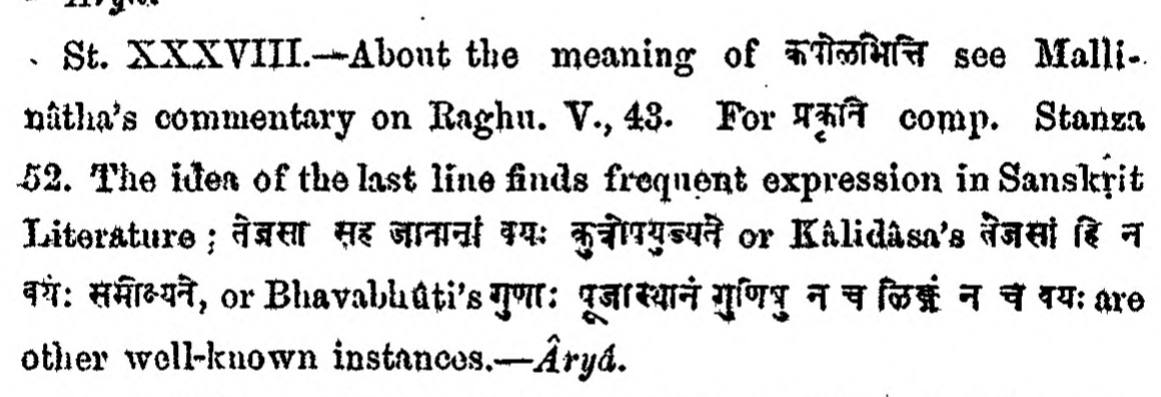
St. XXXVIII.—About the meaning of कपोलभित्ति see Mallinâtha's commentary on Raghu. V., 43. For प्रकृति comp. Stanza 52. The idea of the last line finds frequent expression in Sanskṛit Literature ; तेजसा सह जातानां वयः कुत्रोपयुज्यते or Kâlidâsa's तेजसां हि न वयः समीक्ष्यते, or Bhavabhûti's गुणाः पूजास्थानं गुणिषु न च लिङ्गं न च वयः are other well-known instances.—Âryâ.

Kale
all


Translation
38. A lion, though young, attacks elephants whose rampart-like temples are soiled with rut; this is the nature of the valiant; age, indeed, is not the cause of valour.

Notes
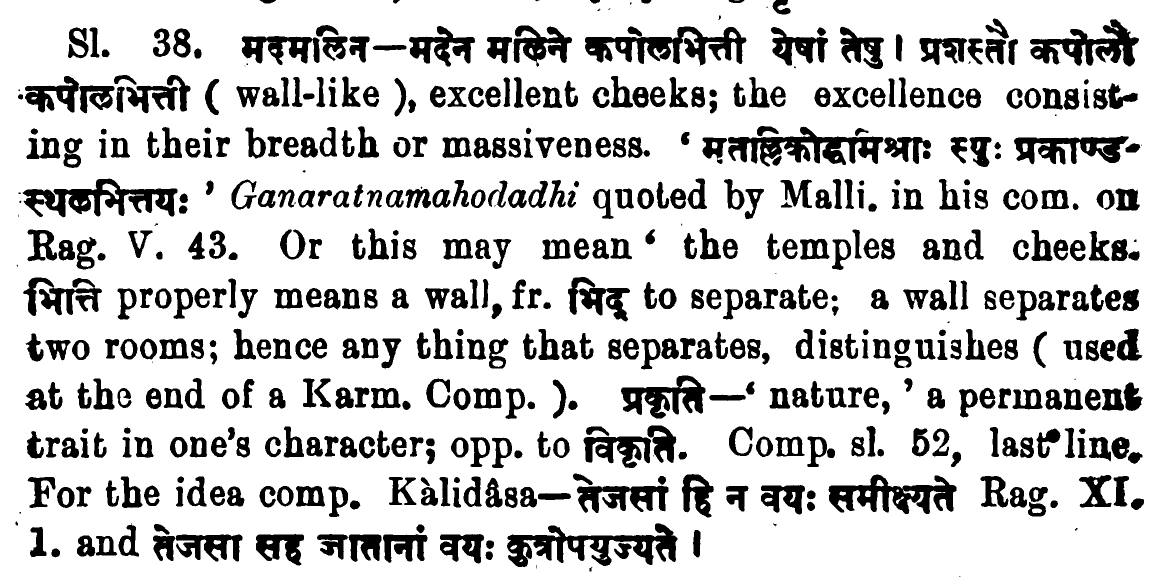
Sl. 38. मदमलिन—मदेन मलिने कपोलभित्ती येषां तेषु । प्रशस्तौ कपोलौ कपोलभित्ती ( wall-like ), excellent cheeks; the excellence consisting in their breadth or massiveness. ‘ मतल्लिकोद्धामिश्राः स्युः प्रकाण्डस्थलभित्तयः ’ Ganaratnamahodadhi quoted by Malli. in his com. on Rag. V. 43. Or this may mean ‘ the temples and cheeks. भित्ति properly means a wall, fr. भिद् to separate; a wall separates two rooms; hence any thing that separates, distinguishes ( used at the end of a Karm. Comp. ). प्रकृति—‘ nature, ’ a permanent trait in one’s character; opp. to विकृति. Comp. sl. 52, last line. For the idea comp. Kâlidâsa—तेजसां हि न वयः समीक्ष्यते Rag. XI. 1. and तेजसा सह जातानां वयः कुत्रोपयुज्यते ।
Gopinath1914
all
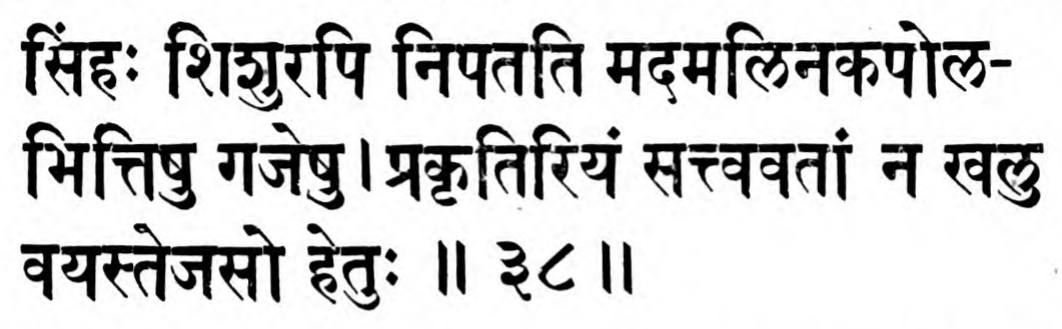
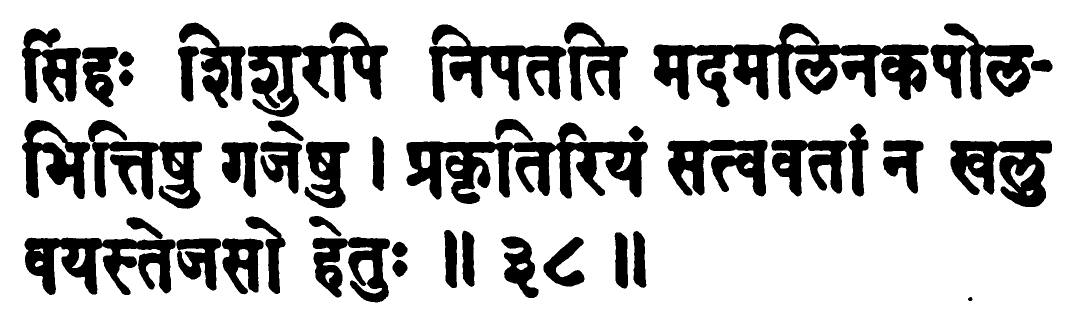
सिंहः शिशुरपि निपतति मदमलिनकपोल-
भित्तिषु गजेषु । प्रकृतिरियं सत्त्ववतां न खलु
वयस्तेजसो हेतुः ॥ ३८ ॥
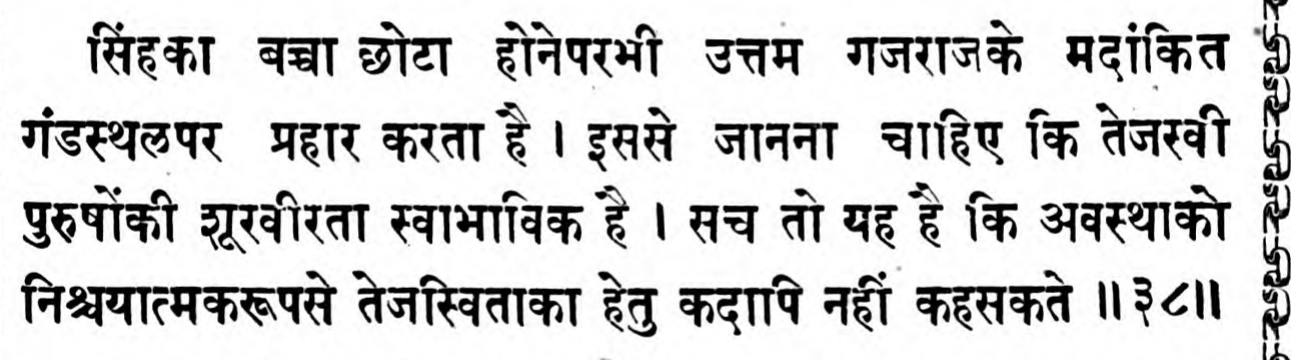
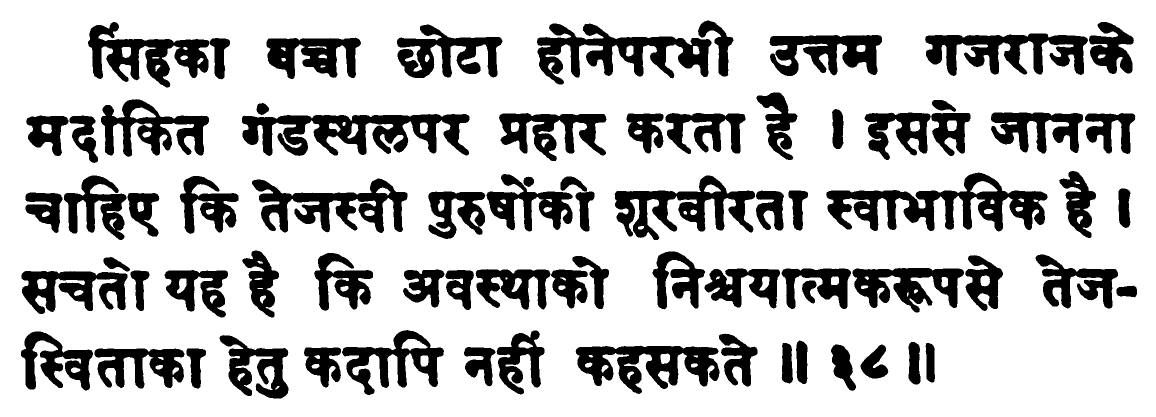
सिंहका बच्चा छोटा होनेपरभी उत्तम गजराजके मदांकित गंडस्थलपर प्रहार करता है। इससे जानना चाहिए कि तेजस्वी पुरुषोंकी शूरवीरता स्वाभाविक है। सच तो यह है कि अवस्थाको निश्चयात्मकरूपसे तेजस्विताका हेतु कदापि नहीं कहसकते ॥३८॥
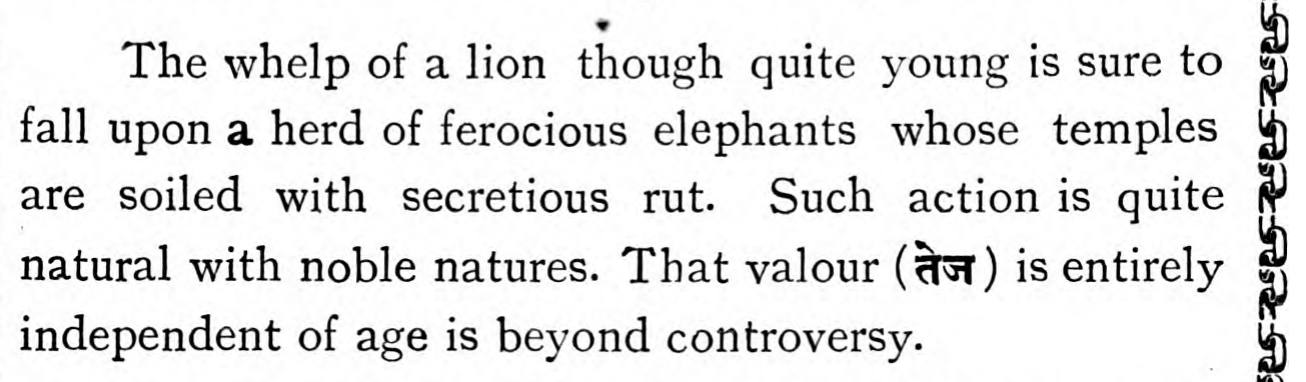
The whelp of a lion though quite young is sure to fall upon a herd of ferocious elephants whose temples are soiled with secretious rut. Such action is quite natural with noble natures. That valour (तेज) is entirely independent of age is beyond controversy.
Footnote
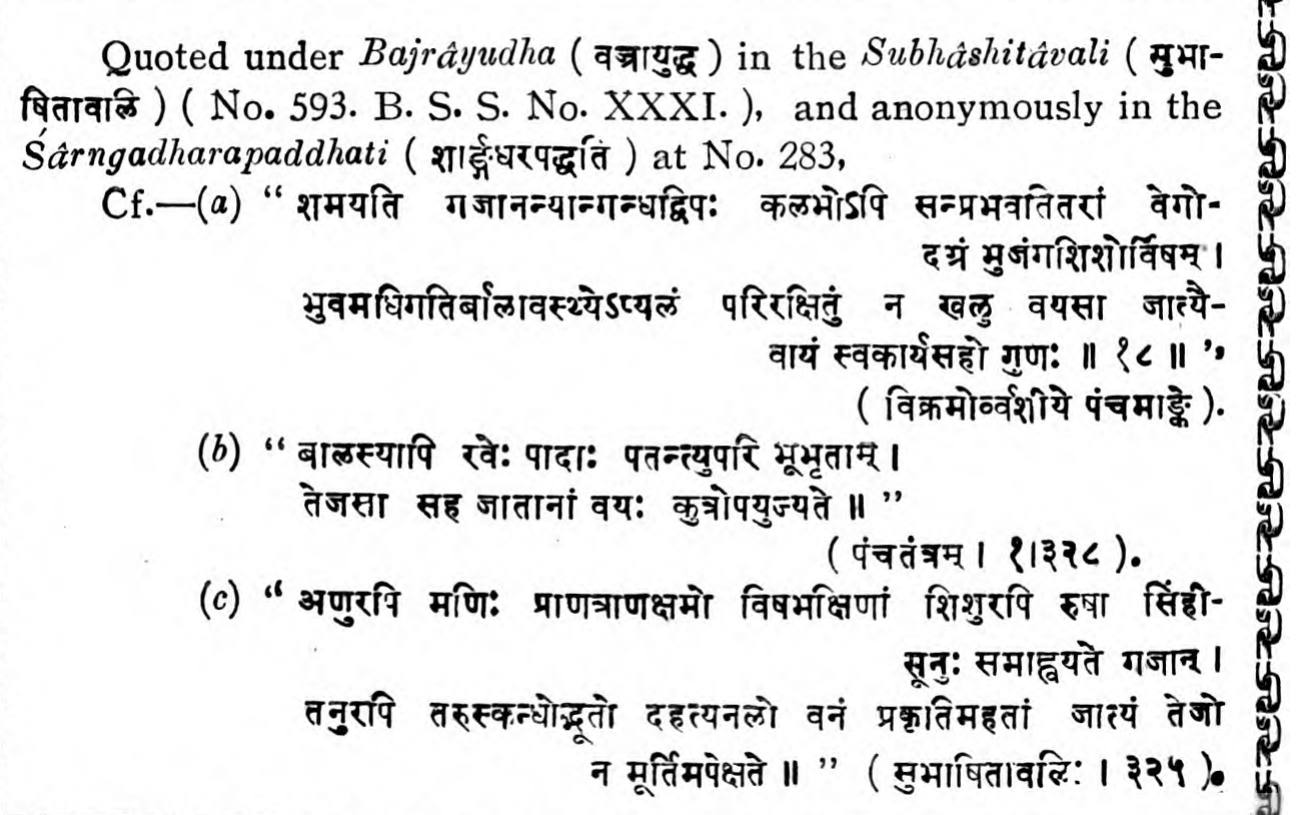
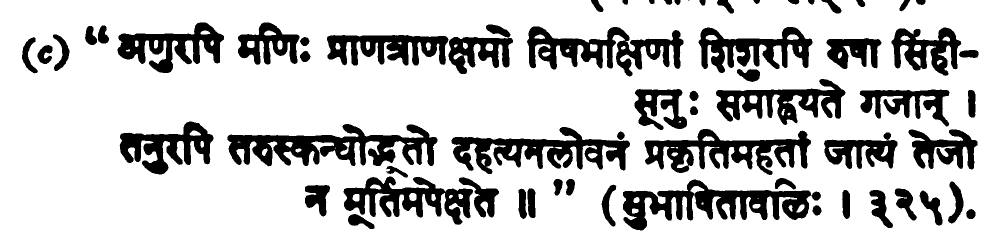
Quoted under Bajrâyudha (वज्रायुद्ध) in the Subhâshitâvali (सुभाषितावलि) (No. 593. B. S. S. No. XXXI.), and anonymously in the Sârngadharapaddhati (शार्ङ्गधरपद्धति) at No. 283, Cf.—(a) “शमयति गजानन्यान्गन्धद्विपः कलभोऽपि सन्प्रभवतितरां वेगोदग्रं भुजंगशिशोर्विषम् । भुवमधिगतिर्बालावस्थेऽप्यलं परिरक्षितुं न खलु वयसा जात्यैवायं स्वकार्यसहो गुणः ॥ १८ ॥ ” (विक्रमोर्व्वशीये पंचमाङ्के). (b) “बालस्यापि रवेः पादाः पतन्त्युपरि भूभृताम् । तेजसा सह जातानां वयः कुत्रोपयुज्यते ॥ ” (पंचतंत्रम् । १।३२८). (c) “अणुरपि मणिः प्राणत्राणक्षमो विषभक्षिणां शिशुरपि रुषा सिंहीसूनुः समाह्वयते गजान् । तनुरपि तरुस्कन्धोद्भूतो दहत्यनलो वनं प्रकृतिमहतां जात्यं तेजो न मूर्तिमपेक्षते ॥ ” (सुभाषितावलिः । ३२५).
Gopinath1896
all
सिंहका बच्चा छोटा होनेपरभी उत्तम गजराजके मदांकित गंडस्थलपर प्रहार करता है । इससे जानना चाहिए कि तेजस्वी पुरुषोंकी शूरवीरता स्वाभाविक है । सचतो यह है कि अवस्थाको निश्चयात्मकरूपसे तेजस्विताका हेतु कदापि नहीं कहसकते ॥ ३८ ॥
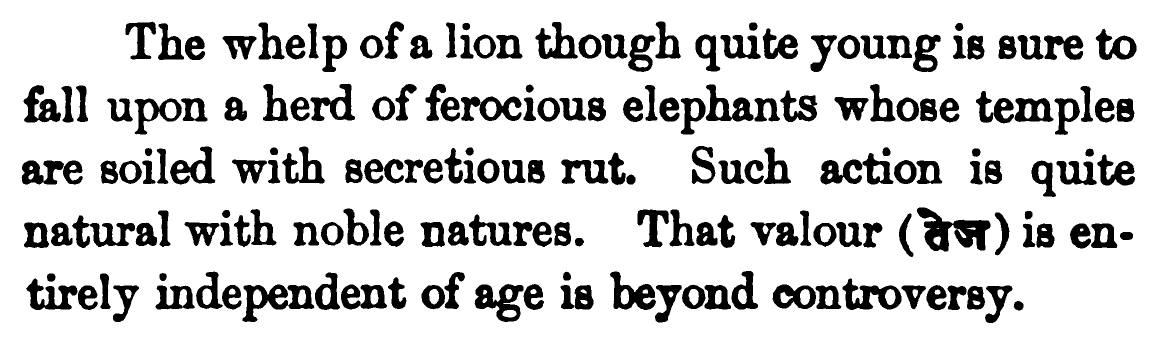
The whelp of a lion though quite young is sure to fall upon a herd of ferocious elephants whose temples are soiled with secretious rut. Such action is quite natural with noble natures. That valour (तेज) is entirely independent of age is beyond controversy.
Footnote
Quoted under Bajrâyudha (वज्रायुध) in the Subhâshitâvali (सुभाषितावलि) (No. 593. B. S. S. No. XXXI. ), and anonymously in the Śârngadharapaddhati (शार्ङ्गधरपद्धति) at No. 283.

Footnote
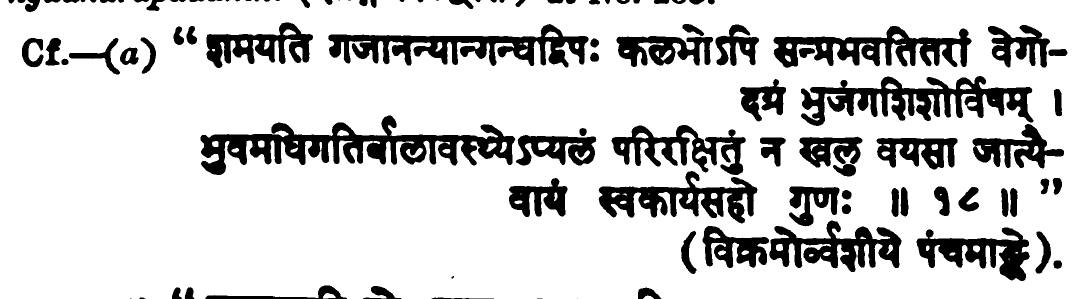
Cf.—(a) “शमयति गजानन्यान्गन्धद्विपः कलभोऽपि सन्नभवतितरां वेगोदग्रं भुजंगशिशोर्विषम् । भुवमधिगतिर्बालावस्थेऽप्यलं परिरक्षितुं न खलु वयसा जात्यैवायं स्वकार्यसहो गुणः ॥ १८ ॥ ” (विक्रमोर्वशीये पंचमाङ्के).
Footnote
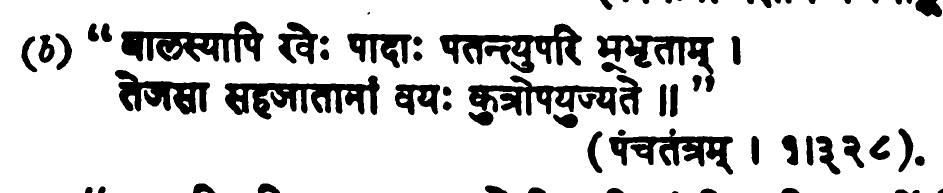
(b) “बालस्यापि रवेः पादाः पतन्त्युपरि भूभृताम् । तेजसा सहजातानां वयः कुत्रोपयुज्यते ॥” (पंचतंत्रम् । १।३२८).
Kosambi
all
सिंह : शिशुरपि निपतति मदमलिनकपोलभित्तिषु गजेषु ।
प्रकृतिरियं सत्त्ववतां न खलु वयस् तेजसो हेतुः ॥ ७५ ॥

Footnote
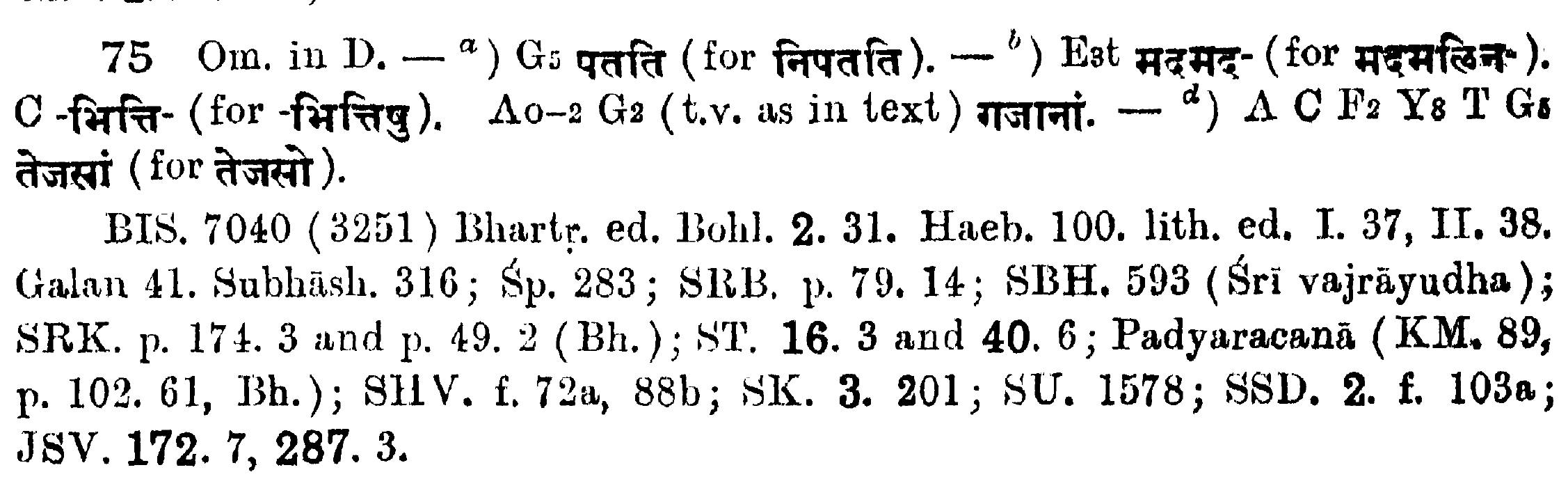
75 Om in D. a ) G5 पतति ( for निपतति ) . - ८ ) Est मदमद- ( for मदमलिन- ) .
C - भित्ति - ( for भित्तिषु ) , 40-2 G2 ( t.v. as in text ) गजानां - 4 ) ACF2 Y & T Go
तेजसां ( for तेजसो ) .
BIS . 7040 ( 3251 ) Bhartr ed . Bohl . 2. 31. Haeb . 100 lith ed . I. 37 , II . 38 .
Galan 41. Subhāsh . 316 ; Śp . 283 ; SRB p . 79 14 ; SBH 593 ( Śrī vajräyudha ) ;
SRK . P. 174. 3 and p . 49. 2 ( Bh . ) ; ST . 16. 3 and 40.6 ; Padyaracanā ( K.M. 89 ,
p . 102. 61 , Bh . ) ; SHV . f 72a , 88b ; SK . 3. 201 ; SU . 1578 ; SSD . 2. f . 103a ;
JSV . 172.7 , 287. 3 .
Commentary