Tawney
Knowledge is man's highest beauty, knowledge is his hidden treasure,
Chief of earthly blessings, bringing calm contentment, fame, and pleasure;
Friends in foreign lands procuring, love of mighty princes earning;
Man is but a beast without it: such a glorious god is Learning.
Telang
all
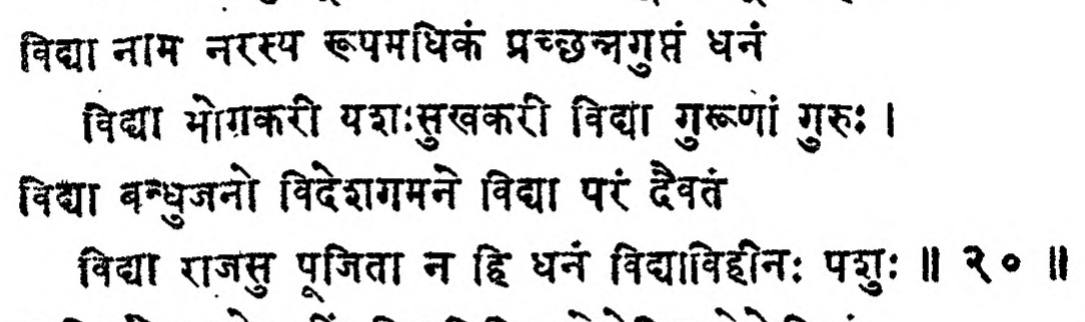
विद्या नाम नरस्य रूपमधिकं प्रच्छन्नगुप्तं धनं
विद्या भोगकरी यशःसुखकरी विद्या गुरूणां गुरुः ।
विद्या बन्धुजनो विदेशगमने विद्या परं दैवतं
विद्या राजसु पूजिता न हि धनं विद्याविहीनः पशुः ॥ २० ॥
Notes
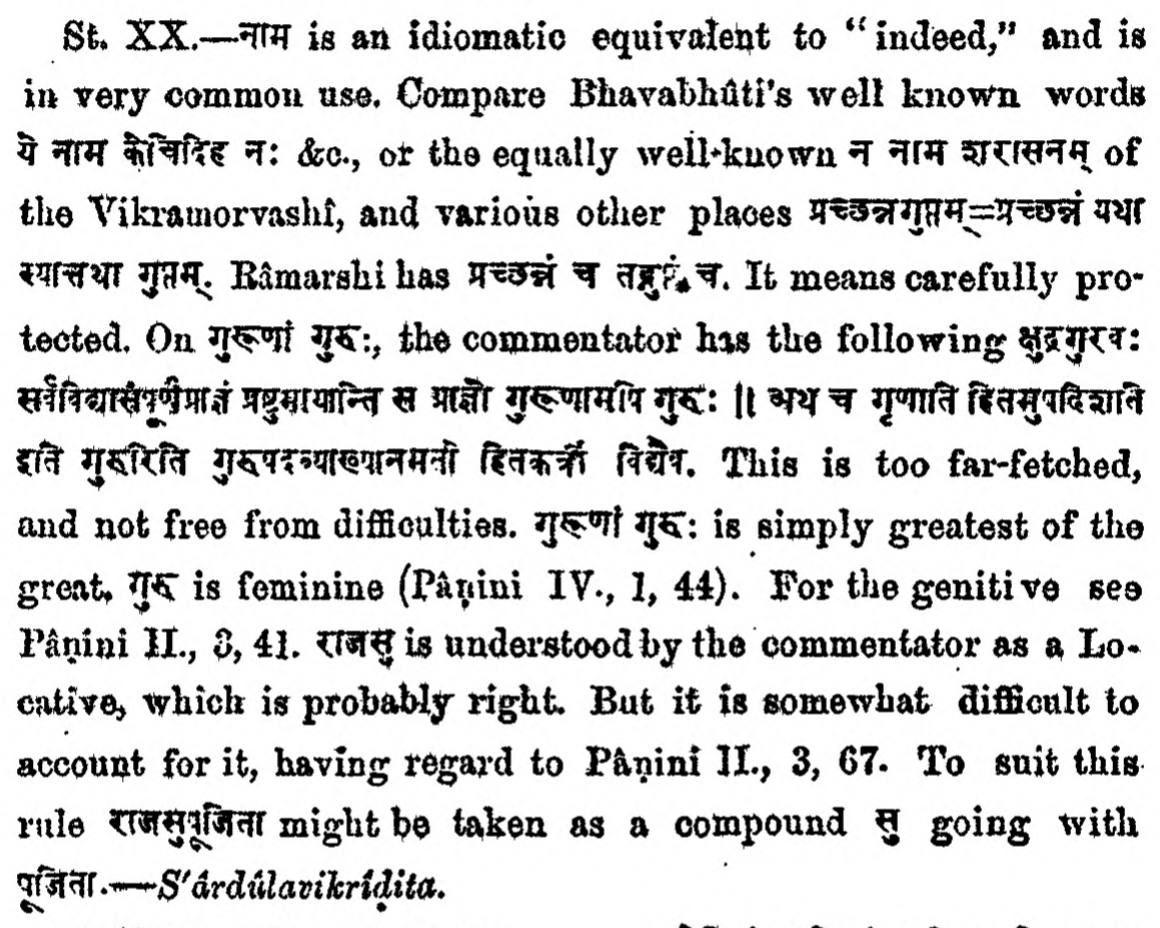
St. XX.—नाम is an idiomatic equivalent to “indeed,” and is in very common use. Compare Bhavabhûti's well known words ये नाम केचिदिह नः &c., or the equally well-known न नाम शरासनम् of the Vikramorvashî, and various other places प्रच्छन्नगुप्तम्=प्रच्छन्नं यथा स्यात्तथा गुप्तम्. Râmarshi has प्रच्छन्नं च तद्गुप्तं च. It means carefully protected. On गुरूणां गुरुः, the commentator has the following क्षुद्रगुरवः सर्वविद्यासंपूर्णप्राज्ञं प्रष्टुमायान्ति स प्राज्ञो गुरूणामपि गुरुः ॥ अथ च गृणाति हितमुपदिशति इति गुरुरिति गुरुपदव्याख्यानमतो हितकर्त्री विद्यैव. This is too far-fetched, and not free from difficulties. गुरूणां गुरुः is simply greatest of the great. गुरु is feminine (Pâṇini IV., 1, 44). For the genitive see Pâṇini II., 3, 41. राजसु is understood by the commentator as a Locative, which is probably right. But it is somewhat difficult to account for it, having regard to Pâṇini II., 3, 67. To suit this rule राजसुपूजिता might be taken as a compound सु going with पूजिता.—S'ârdûlavikrîḍita.

Kale
all
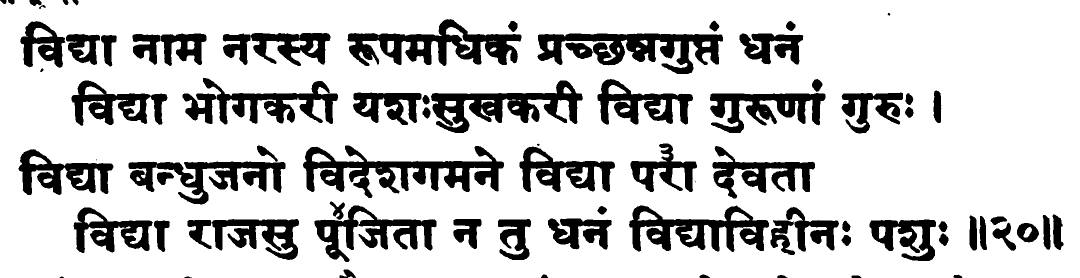
विद्या नाम नरस्य रूपमधिकं प्रच्छन्नगुप्तं धनं
विद्या भोगकरी यशःसुखकरी विद्या गुरूणां गुरुः ।
विद्या बन्धुजनो विदेशगमने विद्या परा देवता
विद्या राजसु पूजिता न तु धनं विद्याविहीनः पशुः ॥२०॥
Translation
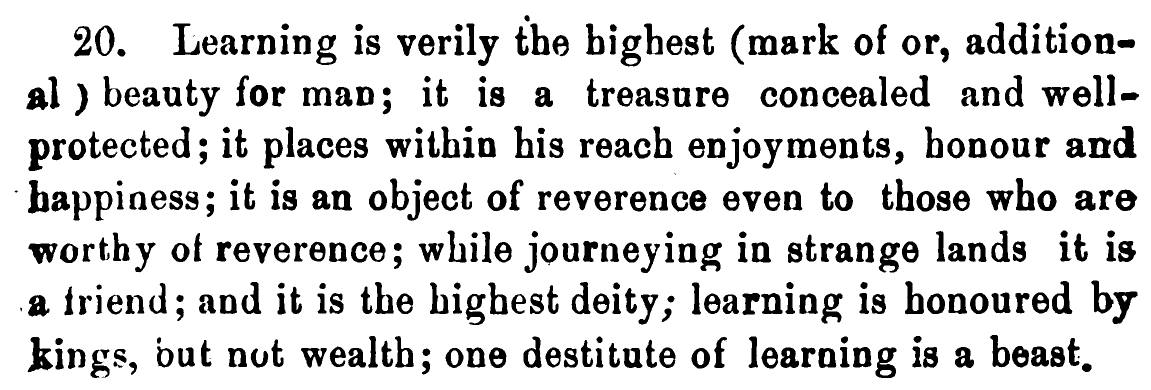
20. Learning is verily the highest (mark of or, additional ) beauty for man; it is a treasure concealed and wellprotected; it places within his reach enjoyments, honour and happiness; it is an object of reverence even to those who are worthy of reverence; while journeying in strange lands it is a friend; and it is the highest deity; learning is honoured by kings, but not wealth; one destitute of learning is a beast.
Notes
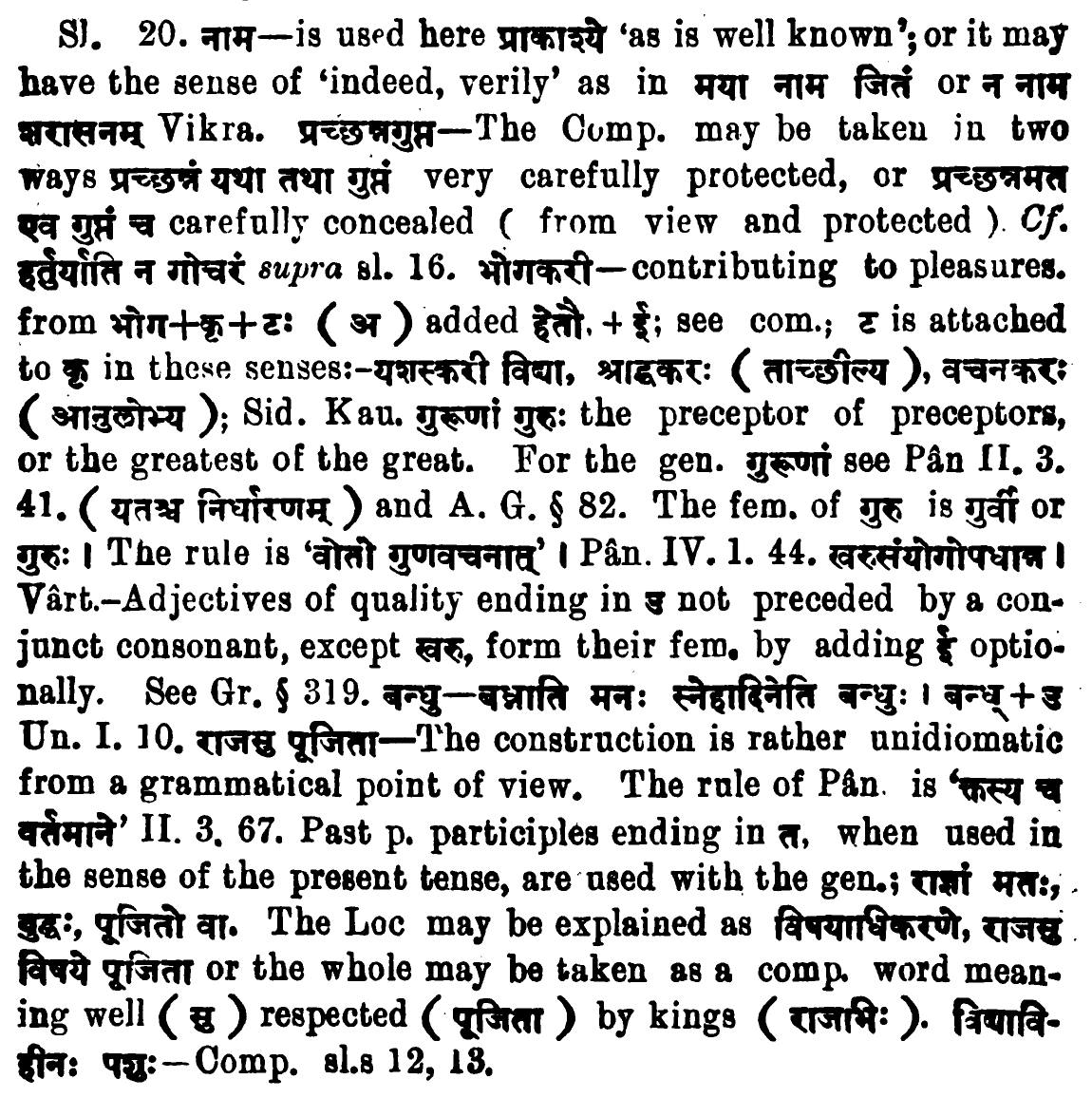
Sl. 20. नाम—is used here प्राकाश्ये ‘as is well known’; or it may have the sense of ‘indeed, verily’ as in मया नाम जितं or न नाम शरासनम् Vikra. प्रच्छन्नगुप्त—The Comp. may be taken in two ways प्रच्छन्नं यथा तथा गुप्तं very carefully protected, or प्रच्छन्नमत एव गुप्तं च carefully concealed ( from view and protected ). Cf. हर्तुर्याति न गोचरं supra sl. 16. भोगकरी—contributing to pleasures. from भोग+कृ+टः ( अ ) added हेतौ. + ई; see com.; ट is attached to कृ in these senses:–यशस्करी विद्या, श्राद्धकरः ( ताच्छील्य ), वचनकरः ( आनुलोम्य ); Sid. Kau. गुरूणां गुरुः the preceptor of preceptors, or the greatest of the great. For the gen. गुरूणां see Pân II. 3. 41. ( यतश्च निर्धारणम् ) and A. G. § 82. The fem. of गुरु is गुर्वी or गुरुः । The rule is ‘वोतो गुणवचनात्’ । Pân. IV. 1. 44. खरुसंयोगोपधान्न । Vârt.–Adjectives of quality ending in उ not preceded by a conjunct consonant, except खरु, form their fem. by adding ई optionally. See Gr. § 319. बन्धु—बध्नाति मनः स्नेहादिनेति बन्धुः । बन्ध् + उ Un. I. 10. राजसु पूजिता—The construction is rather unidiomatic from a grammatical point of view. The rule of Pân. is ‘क्तस्य च वर्तमाने’ II. 3. 67. Past p. participles ending in त, when used in the sense of the present tense, are used with the gen.; राज्ञां मतः, बुद्धः, पूजितो वा. The Loc may be explained as विषयाधिकरणे, राजसु विषये पूजिता or the whole may be taken as a comp. word meaning well ( सु ) respected ( पूजिता ) by kings ( राजभिः ). विद्याविहीनः पशुः—Comp. sl.s 12, 13. Fig.—As there are many rupakas in this sl. the figure of speech is Mâlâ—rûpaka. A रूपक is defined as तद्रूपकमभेदो य उपमानोपमेययोः—the identity of the उपमान and उपमेय is Rúpaka i. e. when two things known to be quite different from each other are identified together to show their great resemblance to each other the fig. is Rüpaka.




Gopinath1914
all
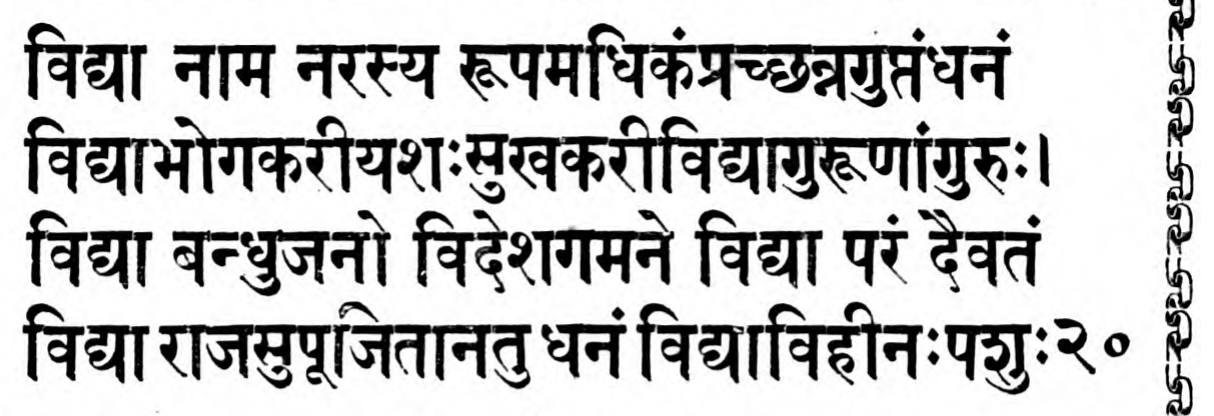
विद्या नाम नरस्य रूपमधिकं प्रच्छन्नगुप्तधनं
विद्याभोगकरीयशःसुखकरीविद्यागुरूणां गुरुः ।
विद्या बन्धुजनो विदेशगमने विद्या परं दैवतं
विद्या राजसुपूजितानतु धनं विद्याविहीनः पशुः २०
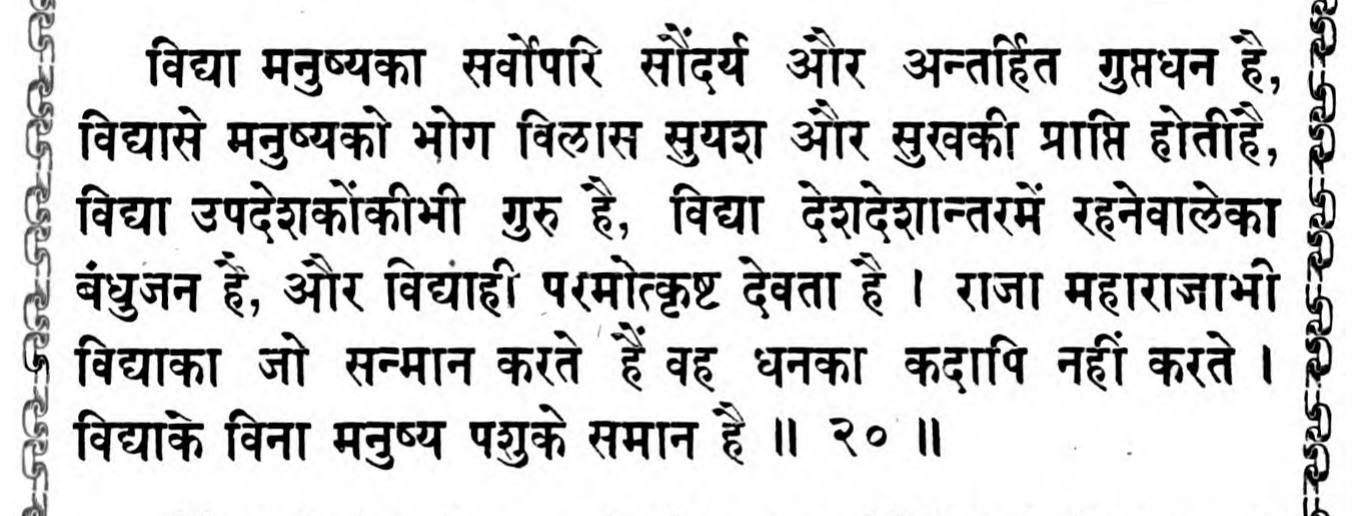
विद्या मनुष्यका सर्वोपरि सौंदर्य और अन्तर्हित गुप्तधन है, विद्यासे मनुष्यको भोग विलास सुयश और सुखकी प्राप्ति होती है, विद्या उपदेशकोंकीभी गुरु है, विद्या देशदेशान्तरमें रहनेवालेका बंधुजन हैं, और विद्याही परमोत्कृष्ट देवता है । राजा महाराजाभी विद्याका जो सन्मान करते हैं वह धनका कदापि नहीं करते । विद्या विना मनुष्य पशुके समान है ॥ २० ॥
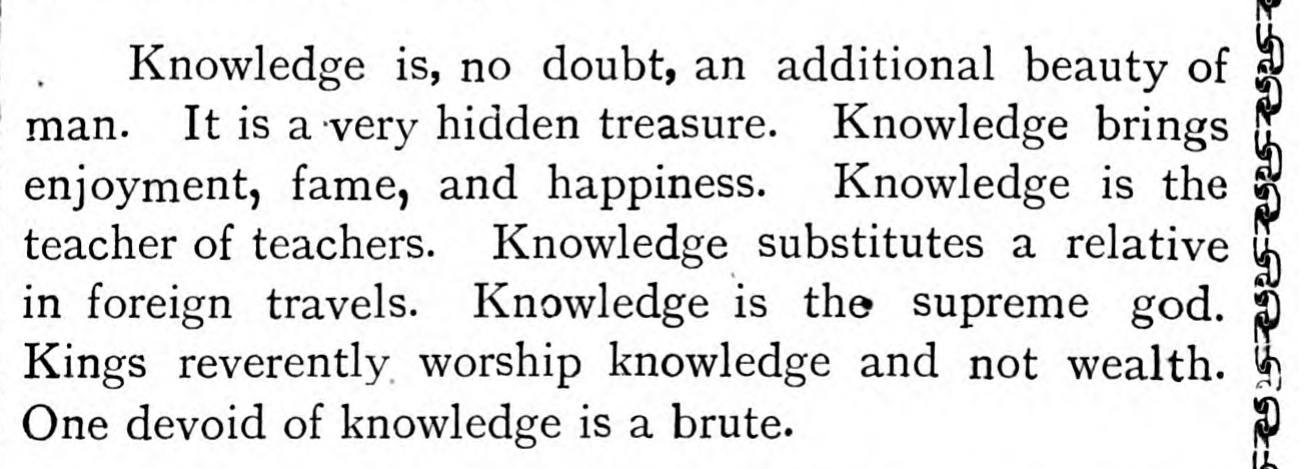
Knowledge is, no doubt, an additional beauty of It is a very hidden treasure. Knowledge brings enjoymentman. , fame, and happiness. Knowledge is the teacher of teachers. Knowledge substitutes a relative in foreign travels. Knowledge is the supreme god. Kings reverently worship knowledge and not wealth. One devoid of knowledge is a brute.
Footnote
This stanza is same as stanza 3 in Bhavabhuti's गुणरत्नम. It also stands in the Søktavali ( सूक्तावलिः । ४. )

Footnote
Cf.—(@) Without education man is but a splendid slave, a reasoning slave, vacillating between the dignity of an intelligence derived from God and the degradation of passions participated in by brutes. " (S. Coleridge ).

Gopinath1896
all
विद्या नाम नरस्य रूपमधिकं प्रच्छन्नगुप्तधनं
विद्याभोगकरीयशःसुखकरीविद्यागुरूणां गुरुः।
विद्या बन्धुजनो विदेशगमने विद्या परं दैवतं
विद्या राजसुपूजितानतु धनं विद्याविहीनः पशुः २०
विद्या मनुष्यका सर्वोपरि सौंदर्य और अन्तर्हित गुप्तधन है, विद्यासे मनुष्यको भोग विलास सुयश और सुखकी प्राप्ति होती है, विद्या उपदेशकों की भी गुरु है, विद्या देशदेशान्तर में रहनेवालेका बंधुजन है, और विद्याही परमोत्कृष्ट देवता है । राजा महाराजाभी विद्याका जो सन्मान करते हैं वह धनका कदापि नहीं करते । विद्या के विना मनुष्य पशुके समान है ॥ २० ॥
Knowledge is, no doubt, an additional beauty of man. It is a very hidden treasure. Knowledge brings enjoyment, fame, and happiness. Knowledge is the teacher of teachers. Knowledge substitutes a relative in foreign travels. Knowledge is the supreme god. Kings reverently worship knowledge and not wealth. One devoid of knowledge is a brute.
Footnote
This stanza is same as stanza 3 in Bhavabhuti's गुणरत्नम्. It also stands in the Saktavali ( सूक्तावलिः । ४).

Footnote
Cf. (a) Without education man is but a splendid slave, a reasoning slave, vacillating between the dignity of an intelligence derived from God and the degradation of passions participated in by brutes." (S. Coleridge).


Kosambi
all
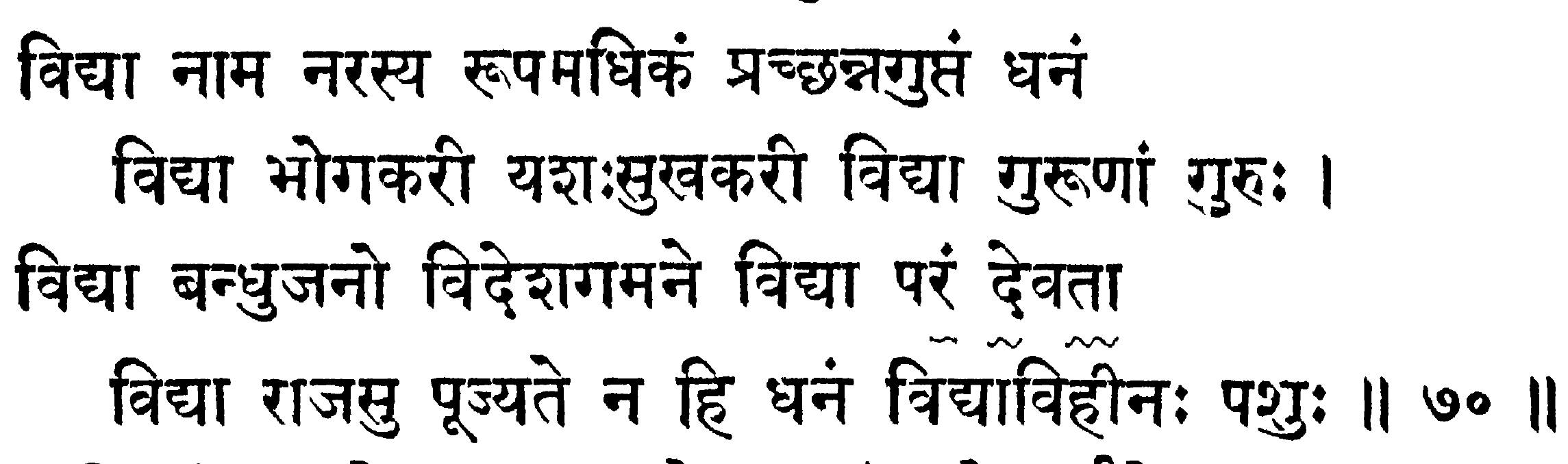
विद्या नाम नरस्य रूपमधिकं प्रच्छन्नगुप्तं धनं
विद्या भोगकरी यशः सुखकरी विद्या गुरूणां गुरुः ।
विद्या बन्धुजनो विदेशगमने विद्या परं देवता
विद्या राजसु पूज्यते न हि धनं विद्याविहीनः पशुः ॥ ७० ॥
Footnote
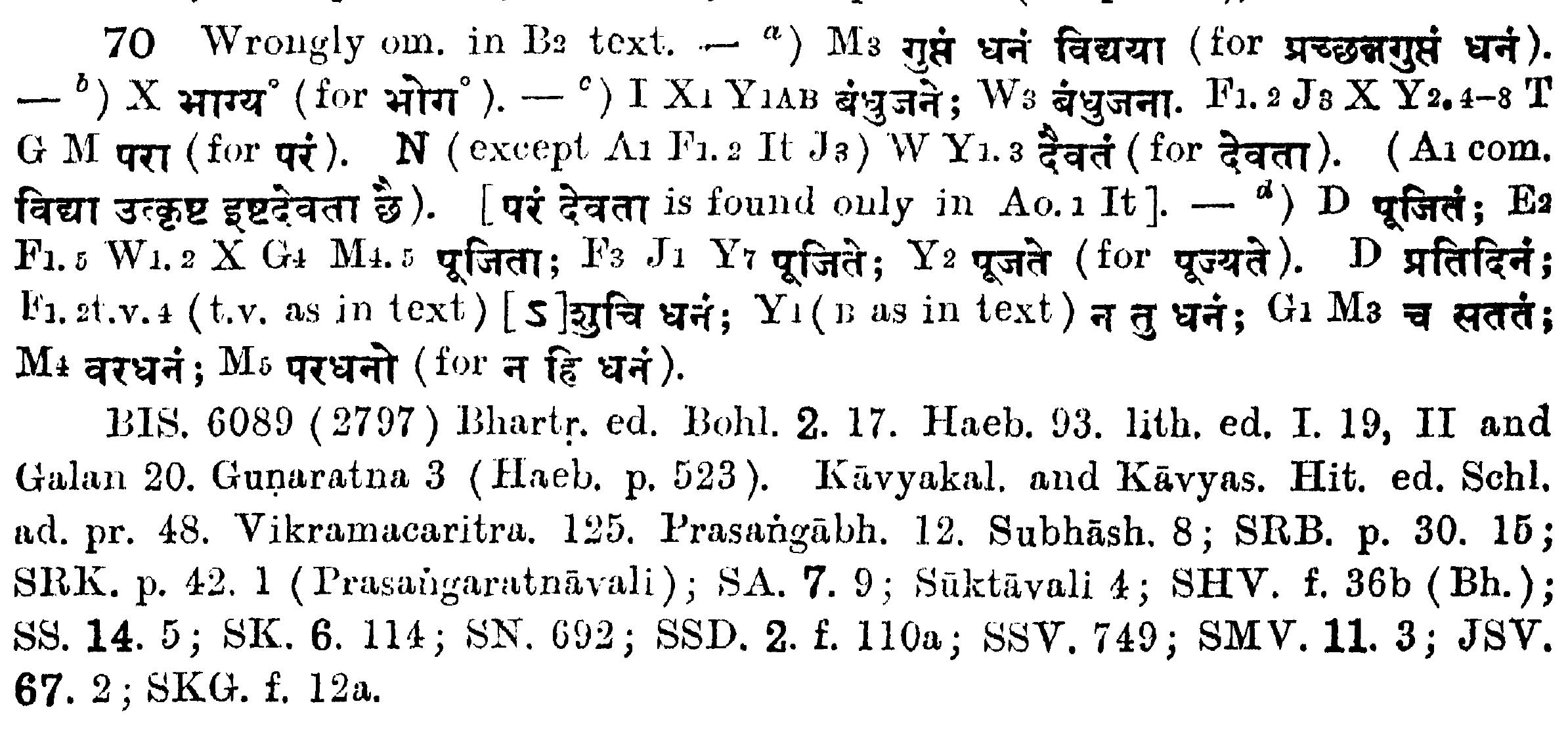
70 Wrongly om . in Ba text . a ) M3 गुप्तं धनं विद्यया ( for प्रच्छन्नगुप्तं धनं ) .
6 8 ) X भाग्य ' ( for भोग ं ) . – ° ) I X1 Y1AB बंधुजने ; W3 बंधुजना . F1 . 2 J3 X Y2.4 –8 T
GM परा ( for परं ) . N ( except A1 F1.2 It J3 ) W Y1.3 दैवतं ( for देवता ) . ( Ai com .
विद्या उत्कृष्ट इष्टदेवता छै ) . [ परं देवता is found ouly in Ao.1 It ] . ( a ) D पूजितं ; E2
F1.5_W1.2 X_G4_M4 . पूजिता ; 3 J1 Y 7 पूजिते ; ; Y2 पूजते ( for पूज्यते ) . D प्रतिदिनं ;
F1.2t.v. ± ( t.v. as in text ) [ 5 ] शुचि धनं ; Yi ( B as in text ) न तु धनं ; G1 M3 च सततं ;
M + वरधनं ; Ms परधनो ( for न हि धनं ) .
BIS . 6089 ( 2797 ) Bhartr . ed . Bohl . 2. 17. Haeb . 93. lith ed . I. 19 , II and
Galan 20. Gunaratna 3 ( Haeb . p . 523 ) . Kävyakal , and Kävyas . Hit . ed . Schl .
ad . pr . 48. Vikramacaritra . 125. Prasangābh . 12. Subhash , 8 ; SRB . p . 30. 15 ;
SRK . p . 42. 1 ( Prasaiigaratnāvali ) ; SA 7.9 ; Suktāvali & ; SHV . f . 36b ( Bh . ) ;
SS . 14. 5 ; SK 6 114 ; SN . 692 ; SSD . 2. f . 110a ; SSV 749 ; SMV . 11. 3 ; JSV .
67. 2 ; SKG f . 12a .
Commentary