Ryder
PREACHING
He longs, with twigs from lotus-bowers
To bind an elephant,
He strives, with softest siris-flowers
To sever adamant,
He yearns, with honey-drops alone
To sweeten ocean's taint,
Who hopes, with sugar-coated tone
To make a rogue a saint.
Tawney
As well attempt to pierce with flowers the diamond of the mine,
As well attempt with honey-drops to sweeten ocean's brine,
As well go bind with lotus-bands the lord of forest herds,
As strive to lead in wisdom's ways the bad with sugared words.
Telang
all
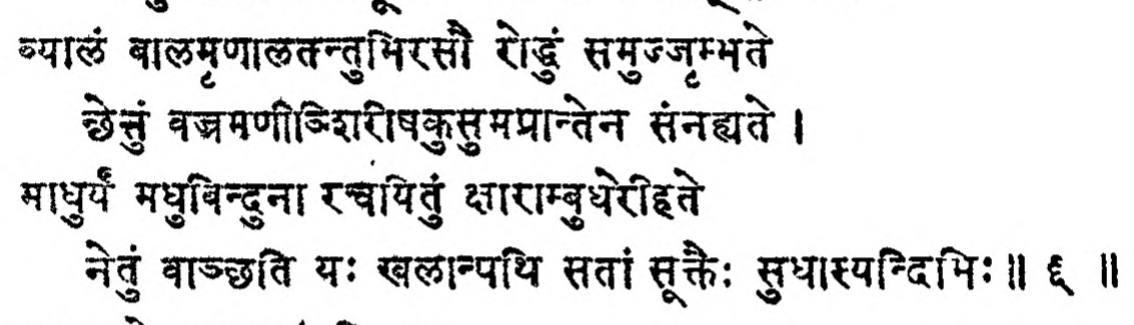
व्यालं बालमृणालतन्तुभिरसौ रोद्धुं समुज्जृम्भते
छेत्तुं वज्रमणीञ्शिरीषकुसुमप्रान्तेन संनह्यते ।
माधुर्यं मधुबिन्दुना रचयितुं क्षाराम्बुधेरीहते
नेतुं वाञ्छति यः खलान्पथि सतां सूक्तैः सुधास्यन्दिभिः ॥ ६ ॥
Notes
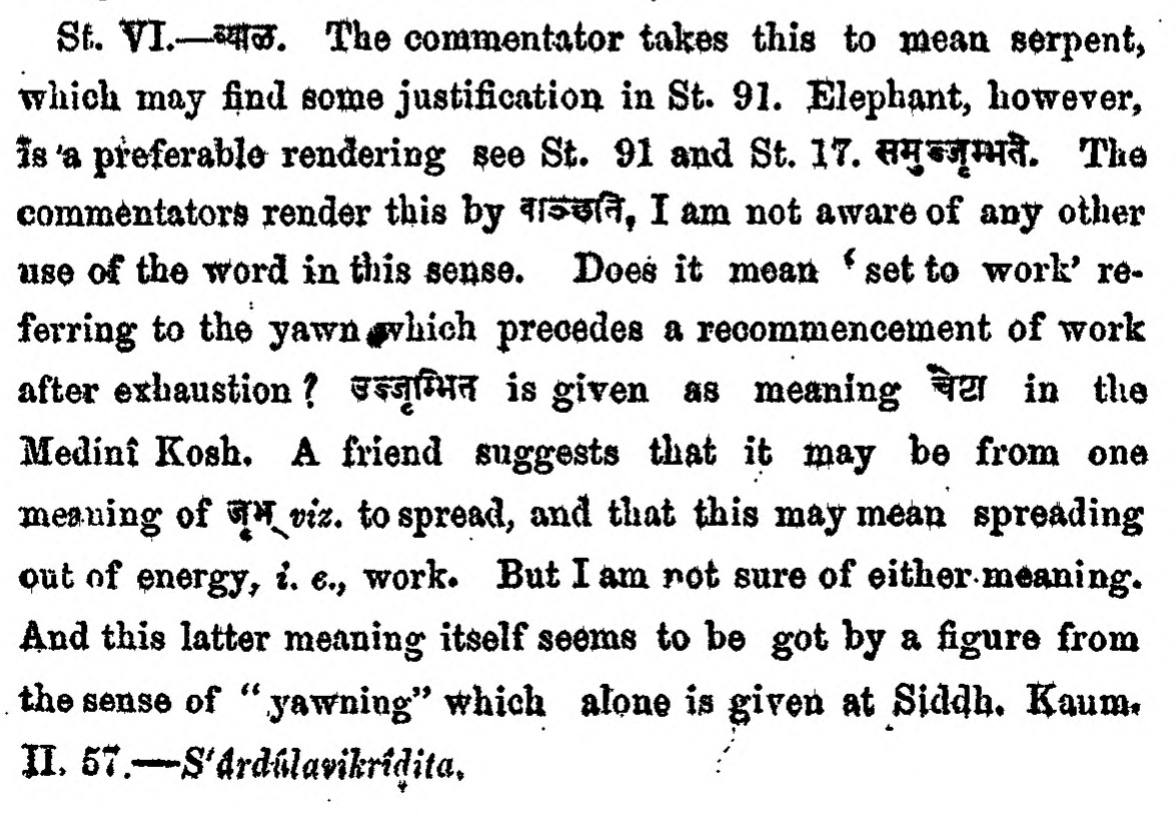
St. VI.—व्याल. The commentator takes this to mean serpent, which may find some justification in St. 91. Elephant, however, is a preferable rendering see St. 91 and St. 17. समुज्जृम्भते. The commentators render this by वाञ्छति, I am not aware of any other use of the word in this sense. Does it mean ‘set to work’ referring to the yawn which precedes a recommencement of work after exhaustion ? उज्जृम्भित is given as meaning चेष्टा in the Medinî Kosh. A friend suggests that it may be from one meaning of जृभ् viz. to spread, and that this may mean spreading out of energy, i. e., work. But I am not sure of either meaning. And this latter meaning itself seems to be got by a figure from the sense of “yawning” which alone is given at Siddh. Kaum. II. 57.—S'ârdûlavikrîḍita.

Kale
all

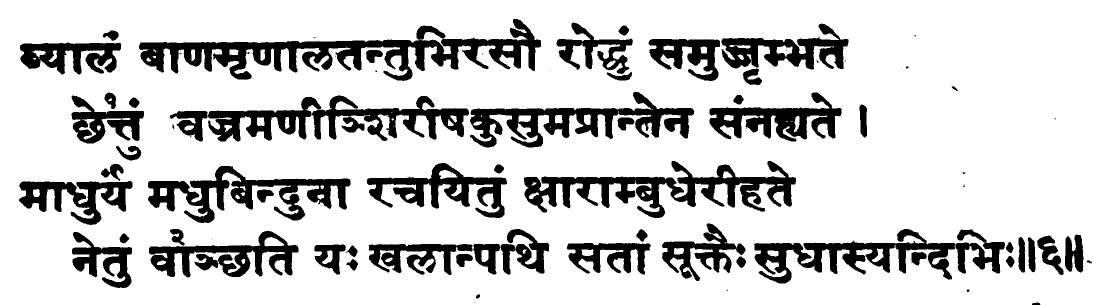
व्यालं बाणमृणालतन्तुभिरसौ रोद्धुं समुज्जृम्भते
छेत्तुं वज्रमणीञ्शिरीषकुसुमप्रान्तेन संनह्यते ।
माधुर्यं मधुबिन्दुना रचयितुं क्षाराम्बुधेरीहते
नेतुं वाञ्छति यः खलान्पथि सतां सूक्तैः सुधास्यन्दिभिः॥६॥
Translation
6. He who wishes to lead wicked men to the path of the good, with wise words that sprinkle nectar (as it were), tries to bind an elephant with a tender lotus-stalk, or attempts to cut a diamond with the edge of a S'irisha flower, or desires to impart sweetness to the salt ( waters of ) the ocean with one drop of honey.


Notes
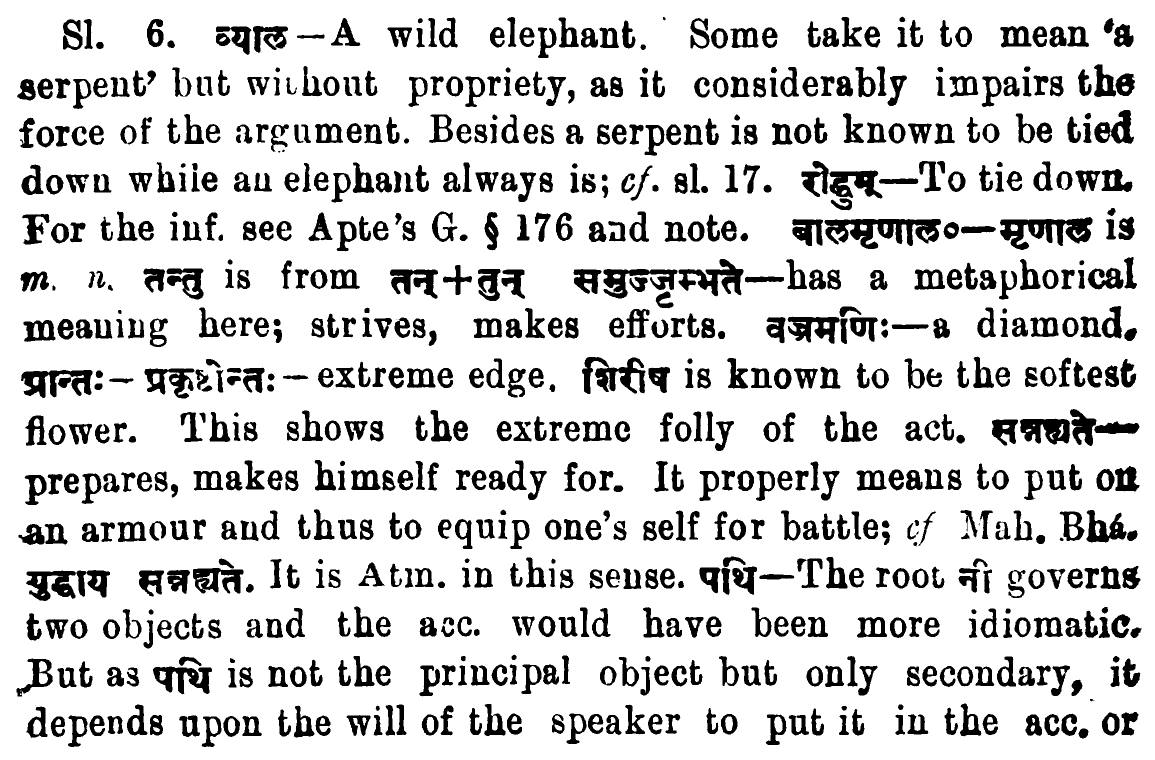
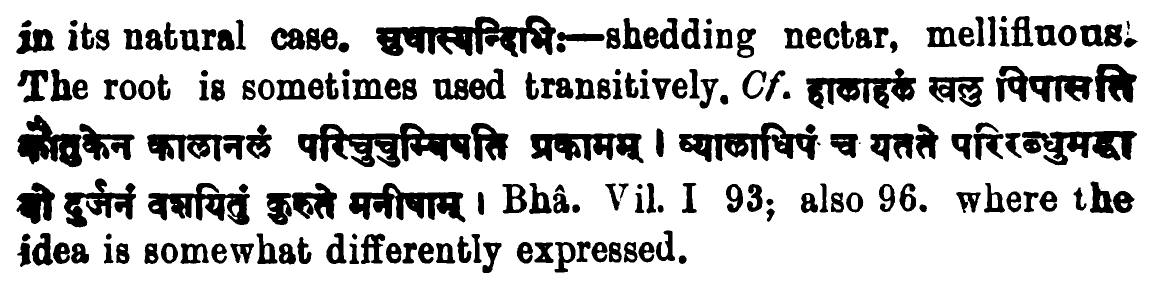
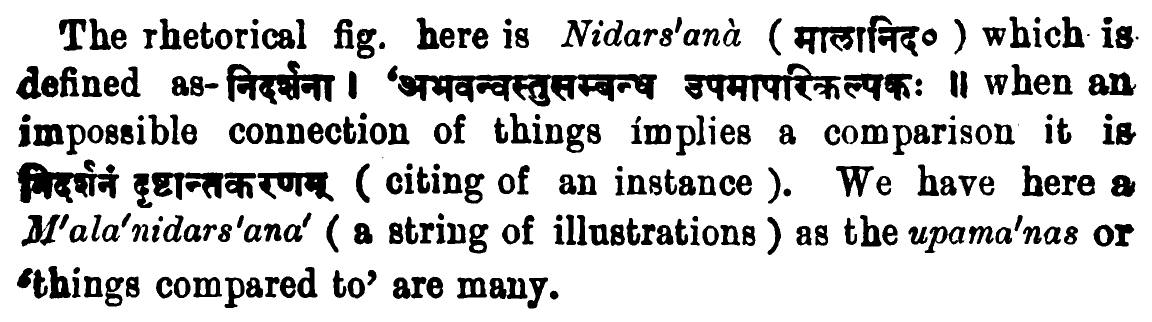
Sl. 6. व्याल—A wild elephant. Some take it to mean ‘a serpent’ but without propriety, as it considerably impairs the force of the argument. Besides a serpent is not known to be tied down while an elephant always is; cf. sl. 17. रोद्धुम्—To tie down. For the inf. see Apte’s G. § 176 and note. बालमृणाल०—मृणाल is m. n. तन्तु is from तन्+तुन् समुज्जृम्भते—has a metaphorical meaning here; strives, makes efforts. वज्रमणिः—a diamond. प्रान्तः–प्रकृष्टोन्तः–extreme edge. शिरीष is known to be the softest flower. This shows the extreme folly of the act. सन्नह्यते— prepares, makes himself ready for. It properly means to put on an armour and thus to equip one’s self for battle; cf Mah. Bhá. युद्धाय सन्नह्यते. It is Atm. in this sense. पथि—The root नी governs two objects and the acc. would have been more idiomatic. But as पथि is not the principal object but only secondary, it depends upon the will of the speaker to put it in the acc. or in its natural case. सुधास्यन्दिभिः—shedding nectar, mellifluous. The root is sometimes used transitively. Cf. हालाहलं खलु पिपासति कौतुकेन कालानलं परिचुचुम्बिषति प्रकामम् । व्यालाधिपं च यतते परिरब्धुमद्धा यो दुर्जनं वशयितुं कुरुते मनीषाम् । Bhâ. Vil. I 93; also 96. where the idea is somewhat differently expressed. The rhetorical fig. here is Nidars'anà ( मालानिद० ) which is defined as- निदर्शना । ‘अभवन्वस्तुसम्बन्ध उपमापरिकल्पकः ॥ when an impossible connection of things implies a comparison it is निदर्शनं दृष्टान्तकरणम् ( citing of an instance ). We have here a M'ala'nidars'ana' ( a string of illustrations ) as the upama'nas or ‘things compared to’ are many.

Gopinath1914
all
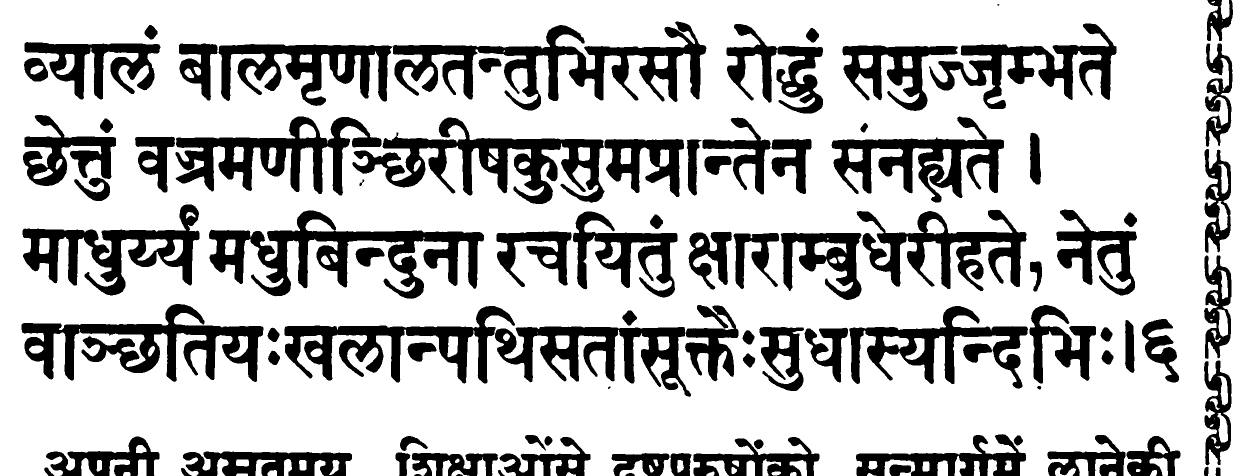
व्यालं बालमृणालतन्तुभिरसौ रोद्धुं समुज्जृम्भते
छेत्तुं वज्रमणीञ्छिरीषकुसुमप्रान्तेन संनह्यते ।
माधुय्र्यं मधुबिन्दुना रचयितुं क्षाराम्बुधेरीहते, नेतुं
वाञ्छतियःखलान्पथिसतांसूक्तैः सुधास्यन्दिभिः।६
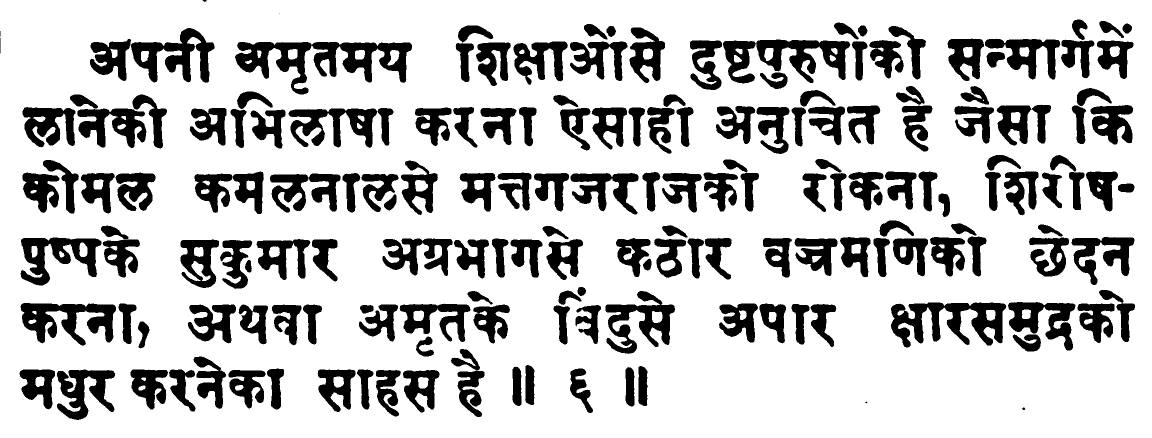
अपनी अमृतमय शिक्षाओंसे दुष्टपुरुषोंको सन्मार्गमें लानेकी अभिलाषा करना ऐसाही अनुचित है जैसा कि कोमल कमलनालसे मत्तगजराजको रोकना, शिरीषपुष्पके सुकुमार अग्रभागसे कठोर वज्रमणिको छेदन करना, अथवा अमृतके बिंदुसे अपार क्षारसमुद्रको मधुर करनेका साहस है ॥ ६ ॥
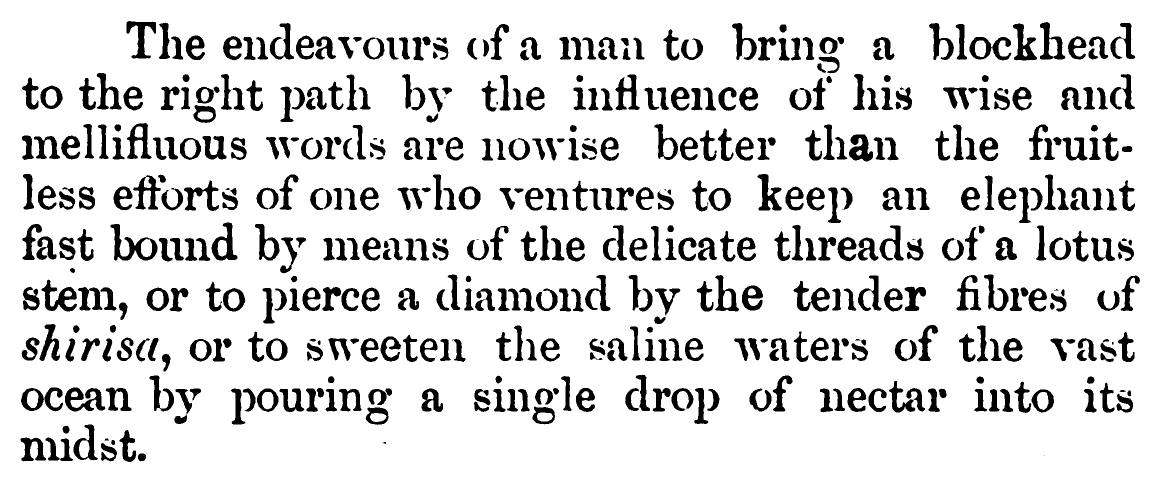
The endeavours of a man to bring a blockhead to the right path by the influence of his wise and mellifluous words are nowise better than the fruitless efforts of one who ventures to keep an elephant fast bound by means of the delicate threads of a lotus stem, or to pierce a diamond by the tender fibres of shirisa, or to sweeten the saline waters of the vast ocean by pouring a single drop of nectar into its midst.
Footnote
Also found in the Vairagya Sataka (वैराग्यशतक ) of Padmananda (पद्मानंद कवि) at No. 54. Cf._

Footnote
(a ) " दुर्जनःसन्ननीकर्तु यत्नेनाऽपि न शक्यते । संस्कारेणापि लघुनं कः सुगन्धी करिष्यति ॥ ( सुभाषितावलिः | ३८७ । B. S. S. No. XXXI,).

Gopinath1896
all
व्यालं बालमृणालतन्तुभिरसौ रोद्धुं समुज्जृम्भते
छेत्तुं वज्रमणीञ्छिरीषकुसुमप्रान्तेन संनह्यते । ।
माधुय्यै मधुविन्दुना रचयितुं क्षाराम्बुधेरीहते, नेतुं
वाञ्छति यः खलान्पथिसतां सूक्तैः सुधास्यन्दिभिः६
अपनी अमृतमय शिक्षाओंसे दुष्टपुरुषोंको सन्मार्ग में लानेकी अभिलाषा करना ऐसाही अनुचित है जैसा कि कोमल कमलनाल से मत्तगजराजको रोकना, शिरीषपुष्प के सुकुमार अग्रभागसे कठोर वज्रमणिको छेदन करना, अथवा अमृतके विंदुसे अपार क्षारसमुद्रको मधुर करने का साहस है ॥ ६ ॥
The endeavours of a man to bring a blockhead to the right path by the influence of his wise and mellifluous words are nowise better than the fruitless efforts of one who ventures to keep an elephant fast bound by means of the delicate threads of a lotus stem, or to pierce a diamond by the tender fibres of shirisa, or to sweeten the saline waters of the vast ocean by pouring a single drop of nectar into its midst.
Footnote
Also found in the Tairagya Sataka (वैराग्यशतक) of Padmdnanda (पद्मानंद कवि) at No. 54. Cf.—

Footnote
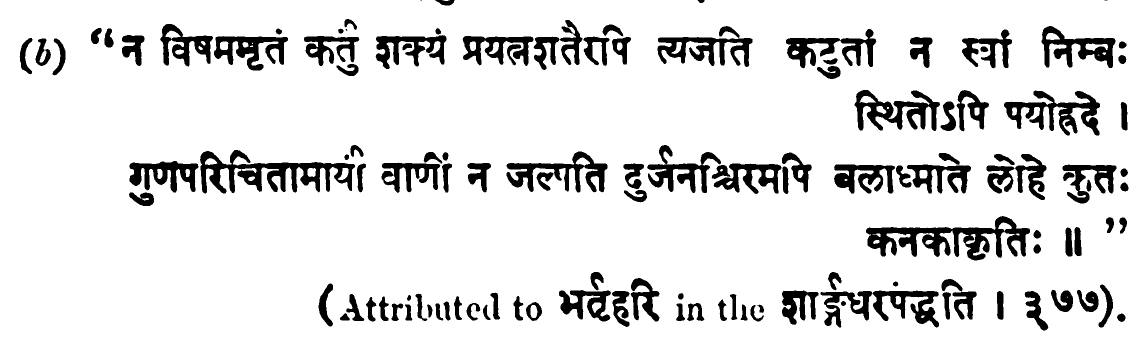
(a) " ं दुर्जनः सज्जनीकर्तुं यत्नेनाऽपि न शक्यते । संस्कारेणापि लशुनं कः सुगन्धीकरिष्यति” ॥ ( सुभाषितावलिः । ३८७ । B. S. S. No. XXXI.).

Kosambi
all
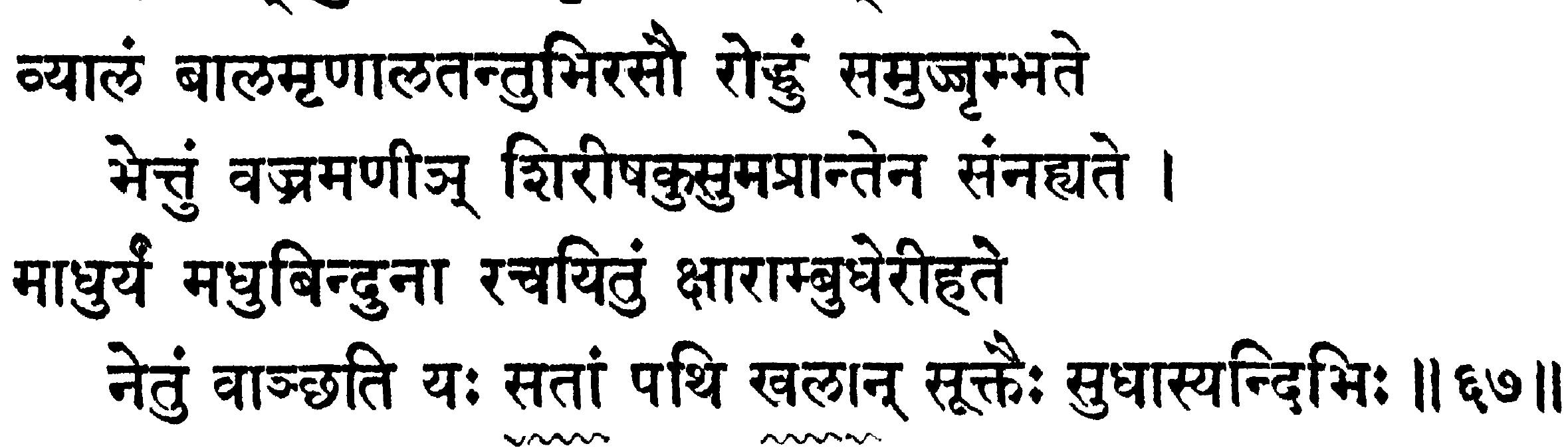
व्यालं बालमृणालतन्तुभिरसौ रोडुं समुज्जृम्भते
भेत्तुं वज्रमणीञ् शिरीषकुसुमप्रान्तेन संनह्यते ।
माधुर्यं मधुबिन्दुना रचयितुं क्षाराम्बुधेरीहते
नेतुं वाञ्छति यः सतां पथि खलान् सूक्तैः सुधास्यन्दिभिः ॥ ६७ ॥
Footnote
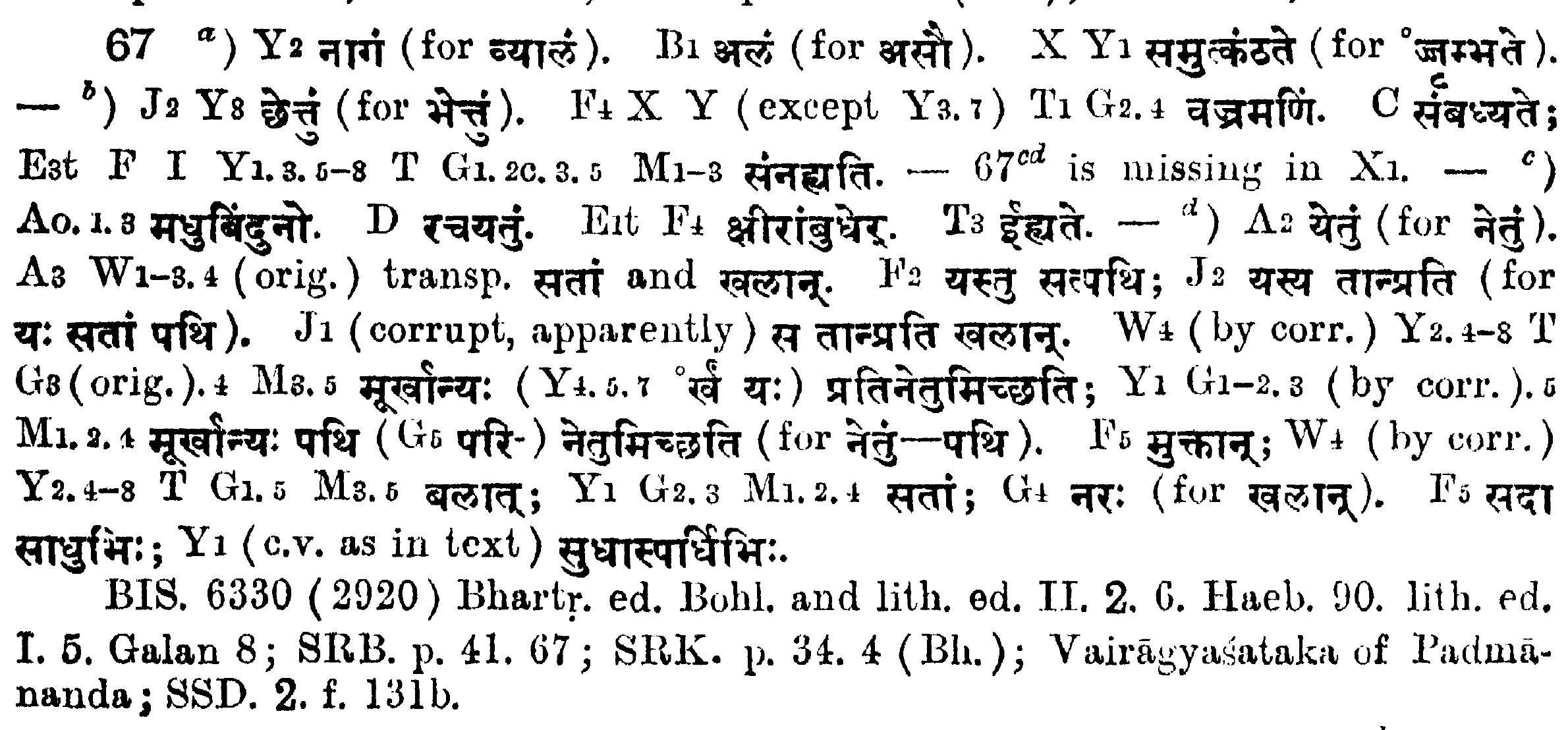
67 a 4 ) X2 नागं ( for व्यालं ) . B1 अलं ( for असौ ) . X Y1 समुत्कंठते ( for ' जम्भते ) .
6 ) J2 Y8 छेत्तं ( for भेत्तं ) . F4 X Y ( except Y3.7 ) T1 G2 . 4 वज्रमणिं . C संबध्यते ;
Est_F I Y1 . 36-8 T G1.20.35 M1 - 3 संनयति . 67ed is missing in X1 . www c )
A0 . 1. 8 मधुबिंदुनो . D रचयतुं . Eit F + क्षीरांबुधेर् . T3 ईह्यते - 4 ) A2 येतुं ( for नेतुं ) .
A3 W1-3 . 4 ( orig . ) transp . सतां and खलान् . 12 यस्तु सत्पथि ; J2 यस्य तान्प्रति ( for
यः सतां पथि ) . J1 ( corrupt , apparently ) स तान्प्रति खलान् . W ( by corr . ) Y2.4-4 ' T '
GB ( orig . ) . 4 M3.5 मूर्खान्यः ( Y4.5.7 ° खें यः ) प्रतिनेतुमिच्छति ; Y1 G1 2 3 ( by corr . ) ) . , 5
M1 . 2. 4 मूर्खान्यः पथि ( Go परि- ) नेतुमिच्छति ( for नेतुं – पथि ) . Fs मुक्तान् ; W + ( by corr . )
Y2.4 - 8 T G15 M3.5 बलात् ; Y1 G2.3 M1 . 2. 4 सतां ; G + नरः ( for खलानू ) . Is सदा
साधुभिः ; Y1 ( c.v. as in text ) सुधास्पर्धिभिः .
BIS . 6330 ( 2920 ) Bhartṛ . ed . Bohl , and lith . ed . II . 2. 6. Haeb . 90. lith . ed .
I. 5. Galan 8 ; SRB . p . 41. 67 ; SRK . p . 34. 4 ( Blı . ) ; Vairāgyaśataka of Padmā
nanda ; SS.D. 2. · f . 131b .
Commentary