Tawney
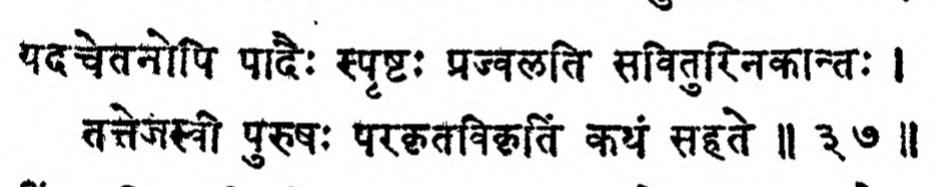
The sun-gem touched by Heaven's rays,
Though void of sense, is all ablaze;
How then can men of spirit brook
A fellow-mortal's scornful look?
Telang
all
Notes
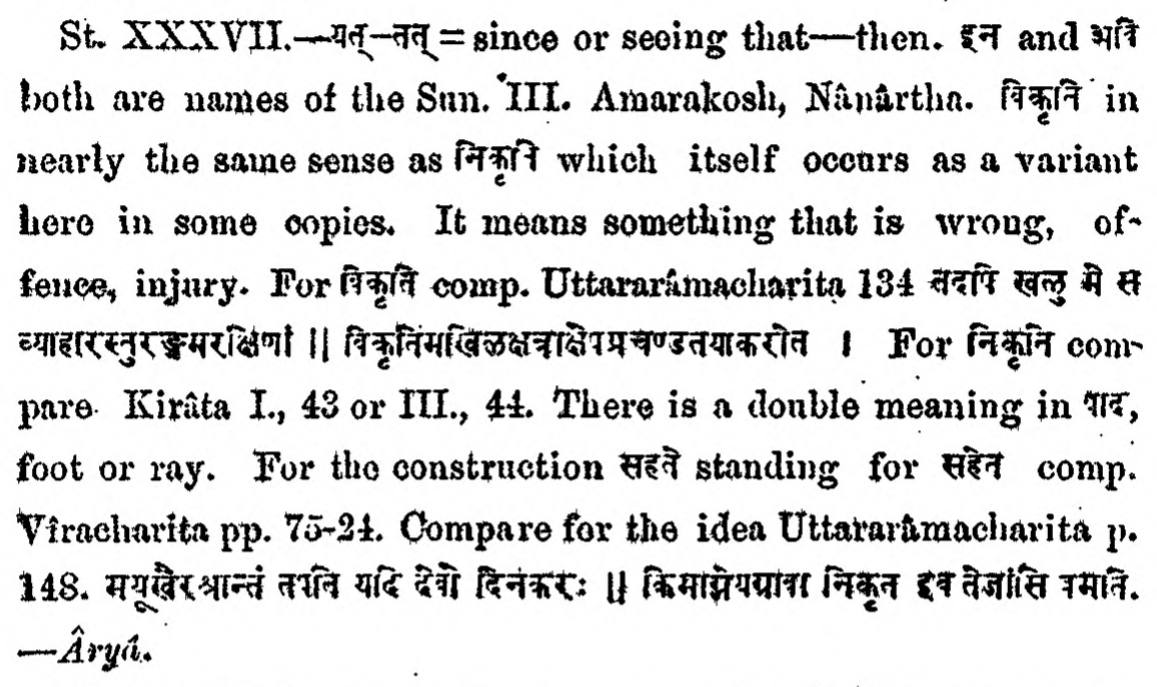
St. XXXVII.—यत्—तत् = since or seeing that—then. इन and भर्तृ both are names of the Sun. III. Amarakosh, Nânârtha. विकृति in nearly the same sense as निकृति which itself occurs as a variant here in some copies. It means something that is wrong, offence, injury. For विकृति comp. Uttararâmacharita 134 तदपि खलु मे स व्याहारस्तुरङ्गमराक्षिणां ॥ विकृतिमखिलक्षत्राक्षेपप्रचण्डतयाकरोत । For निकृति compare Kirâta I., 43 or III., 44. There is a double meaning in पाद, foot or ray. For the construction सहते standing for सहेत comp. Vîracharita pp. 75-24. Compare for the idea Uttararâmacharita p. 148. मयूखैरश्रान्तं तपति यदि देवो दिनकरः ॥ किमाग्नेयग्रावा निकृत इव तेजांसि वमति. —Âryâ.

Kale
all


Translation
37. Since even the insentient sun-jewel emits burning heat when touched by the pâdas ( feet–the rays ) of the sun, how can a man of mettle then brook an insult offered by others ?

Notes
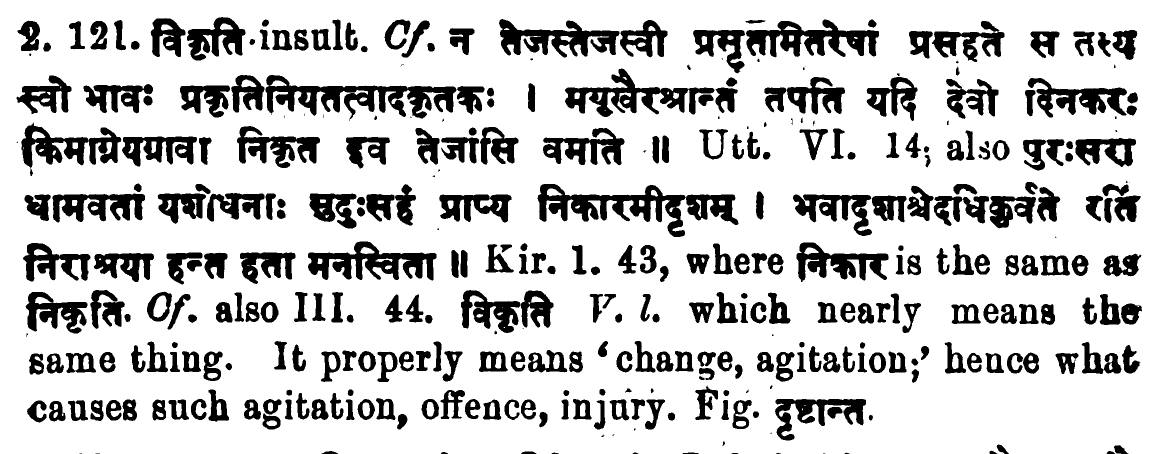
Sl. 37. यत्-तत्—since then; in as much as. पादैः स्पृष्टः- ( 1 ) touched with the rays; ( 2 ) with feet. तेजस्वी—of pre-eminent valour. विन् showing excess ( भूमन् ) 'अस्मायामेधास्रजो विनिः Pán V 2. 121. विकृति insult. Cf. न तेजस्तेजस्वी प्रसृतमितरेषां प्रसहते स तस्य स्वो भावः प्रकृतिनियतत्वादकृतकः । मयूखैरश्रान्तं तपति यदि देवो दिनकरः किमाग्नेयग्रावा निकृत इव तेजांसि वमति ॥ Utt. VI. 14; also पुरःसरा धामवतां यशोधनाः सुदुःसहं प्राप्य निकारमीदृशम् । भवादृशाश्चेदधिकुर्वते रतिं निराश्रया हन्त हता मनस्विता ॥ Kir. I. 43, where निकार is the same as निकृति. Cf. also III. 44. विकृति V. l. which nearly means the same thing. It properly means ‘change, agitation;’ hence what causes such agitation, offence, injury. Fig. दृष्टान्त.

Gopinath1914
all
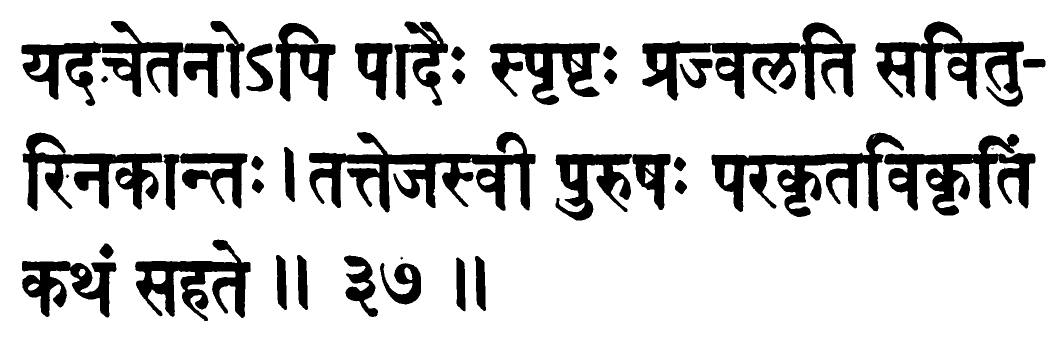
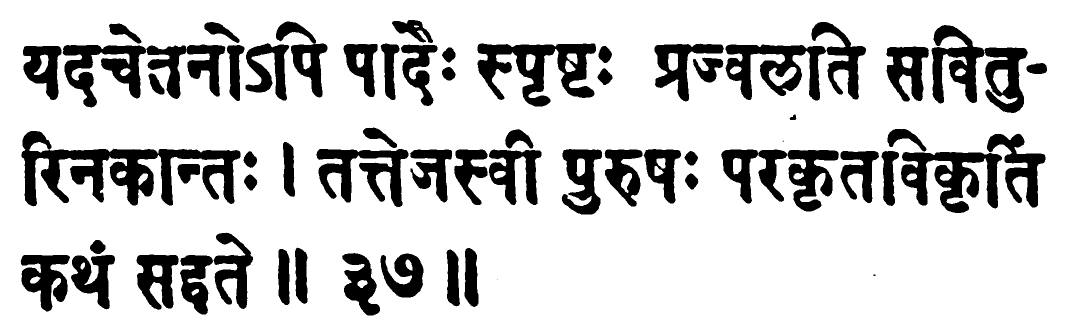
यदचेतनोऽपि पादैः स्पृष्टः प्रज्वलति सवितु-
रिनकान्तः । तत्तेजस्वी पुरुषः परकृतविकृतिं
कथं सहते ॥ ३७ ॥
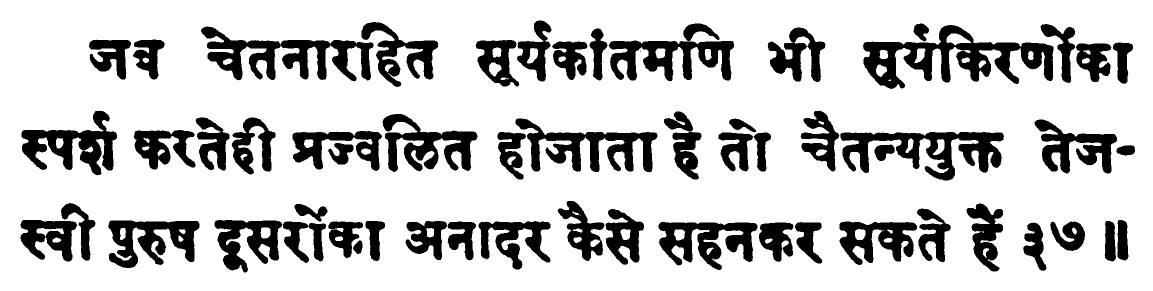
जब चेतनारहित सूर्यकांतमणि भी सूर्यकिरणोंका स्पर्श करतेही प्रज्वलित होजाता है तो चैतन्ययुक्त तेजस्वी पुरुष दूसरोंका अनादर कैसे सहन करसकते हैं ॥ ३७ ॥
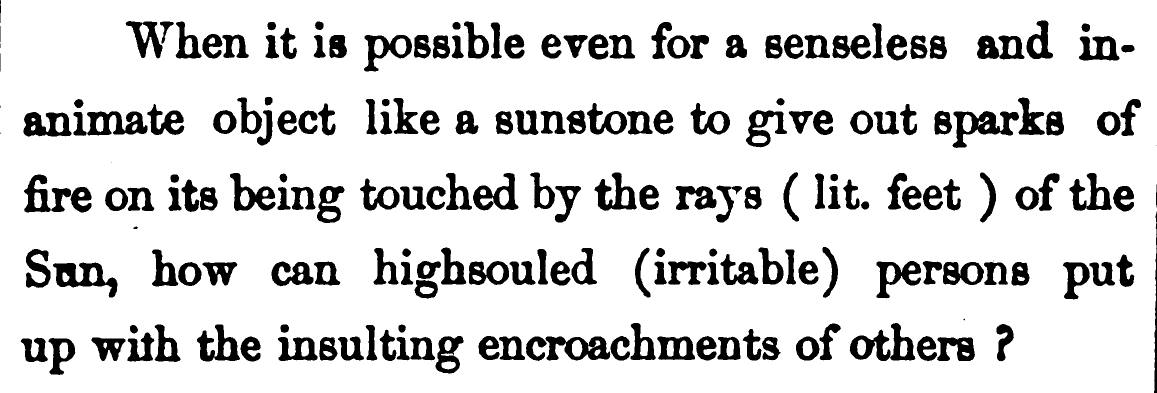
When it is possible even for a senseless and inanimate object like a sunstone to give out sparks of fire on its being touched by the rays ( lit. feet ) of the Sun, how can highsouled ( irritable ) persons put up with the insulting encroachments of others ?
Footnote
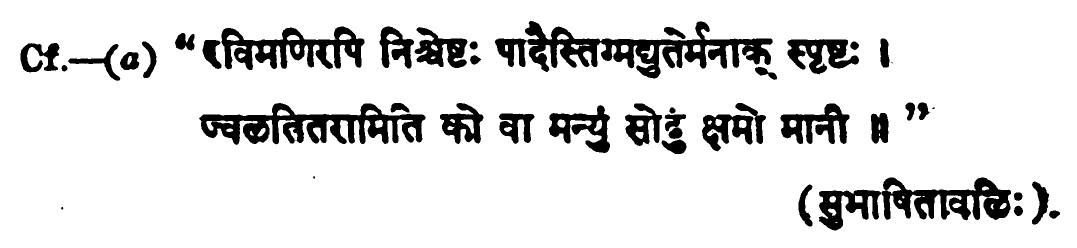
Cf.—(a) “ रविमणिरपि निश्चेष्टः पादैस्तिग्मद्युतेर्मनाक् स्पृष्टः । ज्वलतितरामिति को वा मन्युं सोढुं क्षमो मानी ॥ ” ( सुभाषितावलिः ).

Footnote
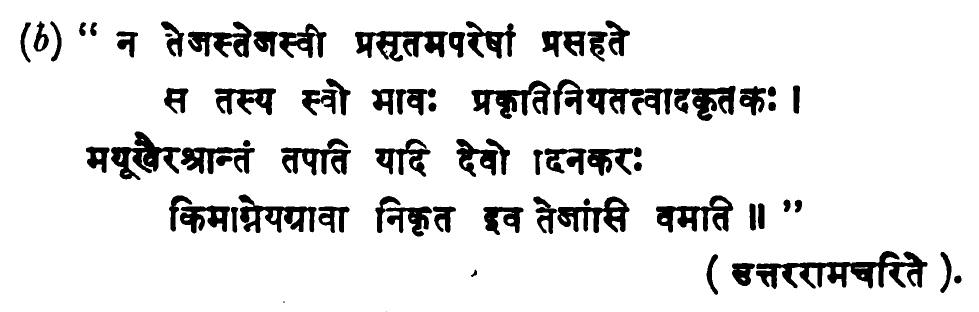
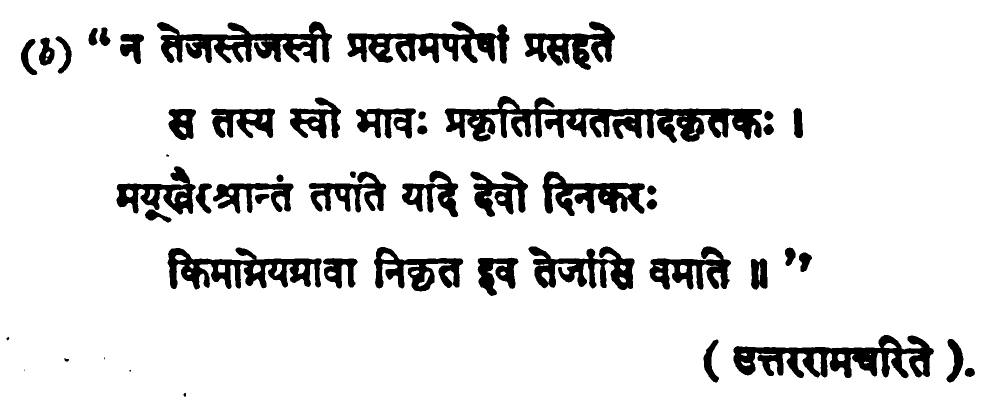
(b) “ न तेजस्तेजस्वी प्रसृतमपरेषां प्रसहते स तस्य स्वो भावः प्रकृतिनियतत्वादकृतकः । मयूखैरश्रान्तं तपति यदि देवो दिनकरः किमाग्नेयग्रावा निकृत इव तेजांसि वमति ॥ ” ( उत्तररामचरिते ).

Gopinath1896
all
यदचेतनोऽपि पादैः स्पृष्टः प्रज्वलति सवितु-
रिनकान्तः । तत्तेजस्वी पुरुषः परकृतविकृतिं
कथं सहते ॥ ३७ ॥
जब चेतनारहित सूर्यकांतमणि भी सूर्यकिरणोंका स्पर्श करतेही प्रज्वलित होजाता है तो चैतन्ययुक्त तेजस्वी पुरुष दूसरोंका अनादर कैसे सहनकर सकते हैं ३७ ॥
When it is possible even for a senseless and inanimate object like a sunstone to give out sparks of fire on its being touched by the rays ( lit. feet ) of the Sun, how can highsouled (irritable) persons put up with the insulting encroachments of others ?
The net point of the stanza seems to be this: a strong man of real worth cannot be expected to put up calmly with the insult of others.

Footnote
Cf.—(a) “रविमणिरपि निश्चेष्टः पादैस्तिग्मद्युतेर्मनाक् स्पृष्टः । ज्वलतितरामिति को वा मन्युं सोढुं क्षमो मानी ॥” ( सुभाषितावलिः ).
Kosambi
all


Footnote
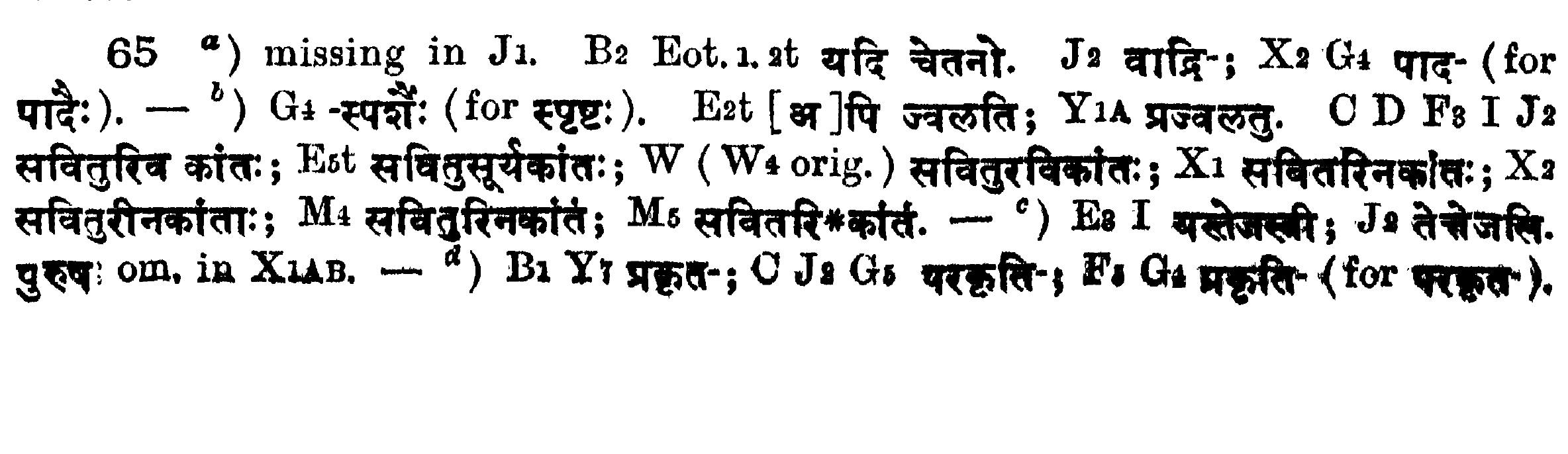
65 a ) missing in J1 . B2 Eot . 1. at यदि चेतनो . J2 वाद्रि ; X 2 G4 पाद- ( for
पादै : ) . - 0 ) G4 - स्पर्शै : ( for स्पृष्ट :) . E2t [ अ ] पि ज्वलति ; Y14 प्रज्वलतु . C CD D F3 I J2
सवितुरिव कांतः ; Est सवितुसूर्यकांत :; W ( Ws orig . ) सवितुरविकांतः ; X 1 सवितरिनकोतः ; X 2
सवितुरीनकांता ; M4 सवितुरिनकांतं ; Ms सवितरि * कांतं . - ° ) is I यस्तेजस्वी ; J2 ते तेजलि .
पुरुषः om . in XJAB . www.com ) Ba X1 प्रकृत- ; OJs Go परकृति - Fs Gs प्रकृति- ( for परकृत ) ,
Footnote
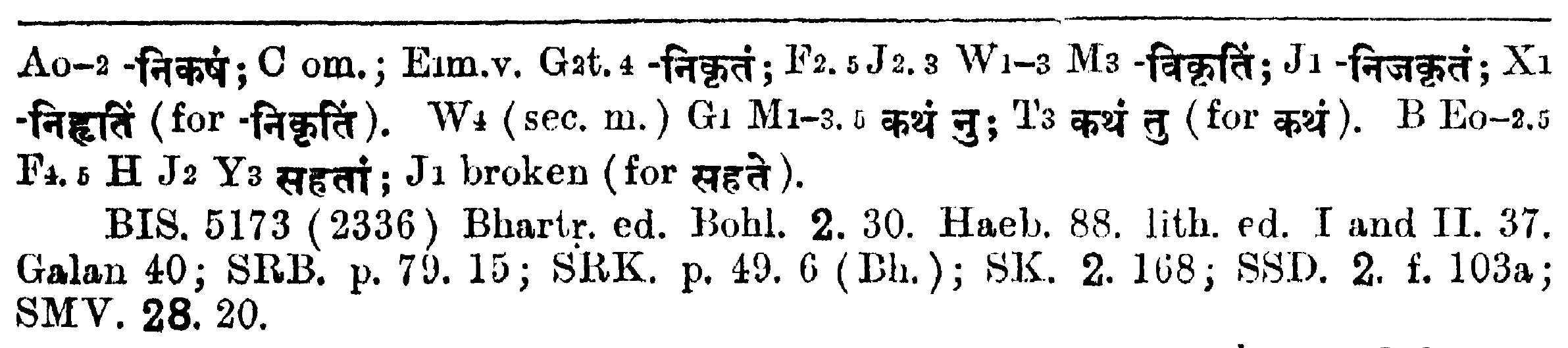
Ao - 2 - निकषं ; Com .; Eim.v. Gat . 4 -निकृतं ; 12.5J2.3 W1-3 M3 - विकृतिं ; J1 -निजकृतं ; X 1
- निहतिं ( for निकृतिं ) . W ½ ( sec . m . ) G1 M1 - 3.5 कथं नु ; 13 कथं तु ( for कथं ) . B Eo - 2.5
F1.6 H J2 Y 3 सहतां ; J1 broken ( for सहते ) .
BIS . 5173 ( 2336 ) Bhartr ed . Bohl . 2. 30. Haeb 88 lith ed . I and II . 37 .
Galan 40 ; SRB . p . 79.15 ; SRK . p . 49. 6 ( Bh . ) ; S.K. 2 . 108 ; SS.D. 2. f . 103a ;
SMV . 28.20 .
Commentary