Tawney
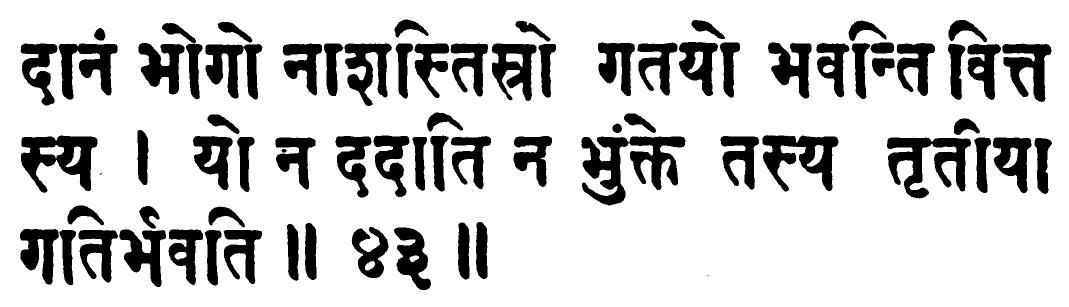
Three courses open lie to wealth, to give, enjoy, or lose,
Who shrinketh from the former two, perforce the third doth choose.
Telang
all
Notes
St. XLIII.—Here again the language is much condensed ; वित्तस्य must be supplied from the first line in the second, and तस्य must be taken to answer to यो and to mean ‘his.’—Âryâ.


Kale
all

Translation
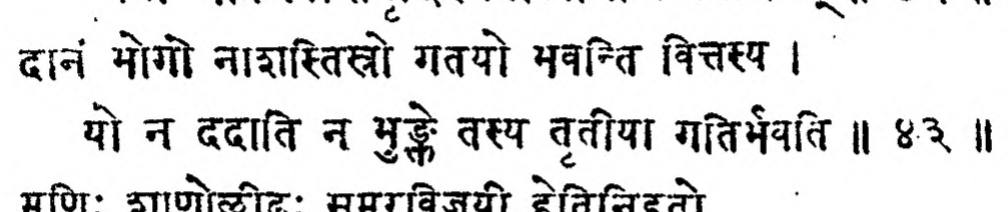
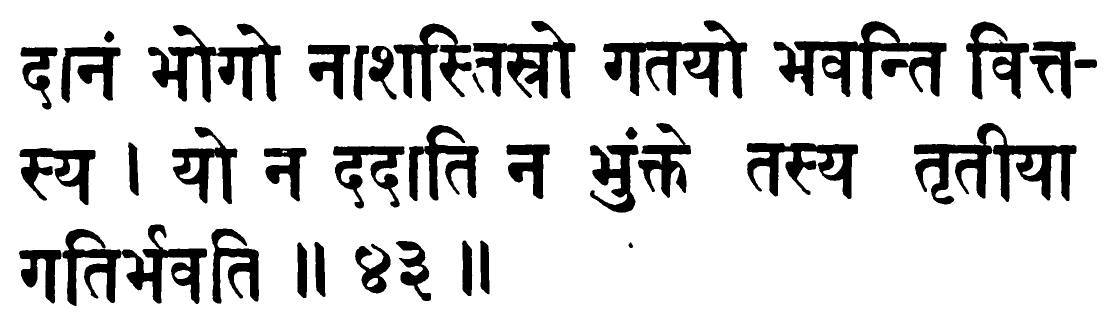
43. Charity, enjoyment, and destruction are the three courses by which wealth passes away. He who neither gives nor enjoys has the third course ( left for his wealth ).


Gopinath1914
all
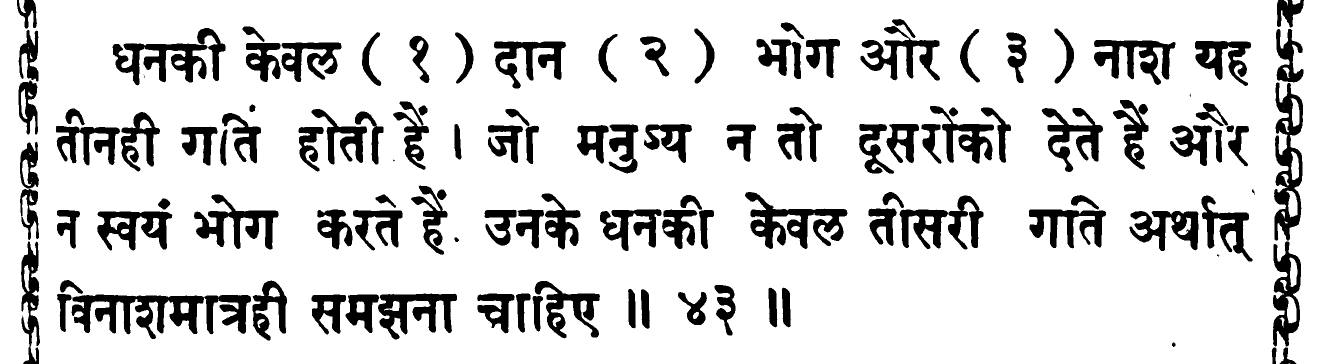
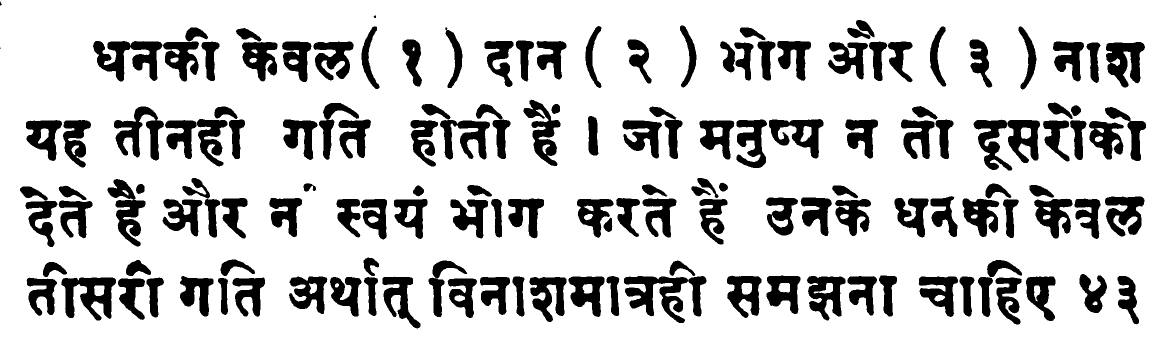
धनकी केवल ( १ ) दान ( २ ) भोग और ( ३ ) नाश यह तीनही गति होती हैं । जो मनुष्य न तो दूसरोंको देते हैं और न स्वयं भोग करते हैं. उनके धनकी केवल तीसरी गति अर्थात् विनाशमात्रही समझना चाहिए ॥ ४३ ॥
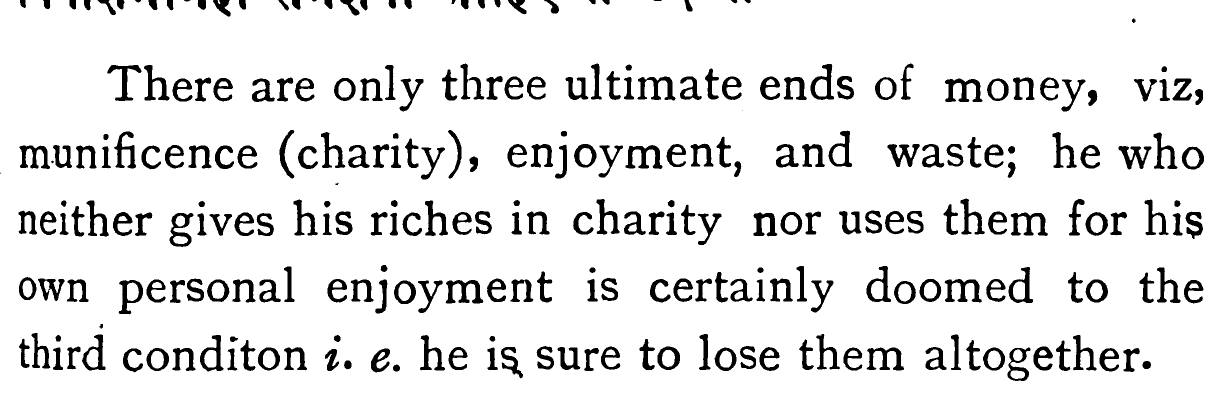
There are only three ultimate ends of money, viz, munificence (charity), enjoyment, and waste; he who neither gives his riches in charity nor uses them for his own personal enjoyment is certainly doomed to the third conditon i. e. he is sure to lose them altogether.
Footnote
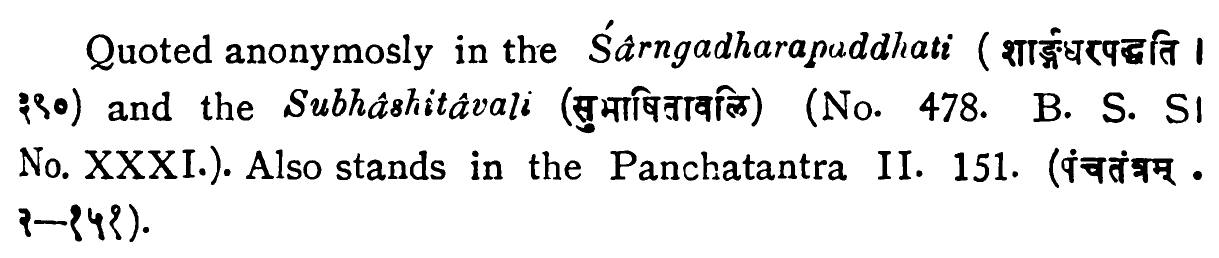
Quoted anonymosly in the Śârngadharapaddhati ( शार्ङ्गधरपद्धति । ३९०) and the Subhâshitâvali (सुभाषितावलि) (No. 478. B. S. S. No. XXXI.). Also stands in the Panchatantra II. 151. (पंचतंत्रम् . २—१५१).
Footnote
Cf.—(a) “ दातव्यं भोक्तव्यं सति विभवे संग्रहो न कर्तव्यः । पश्यामि मधुकरीणां संचितमर्थं हरंत्यन्य ॥ ” ( सुभाषितरत्नभाण्डागारे । १००।१७ ).

Footnote
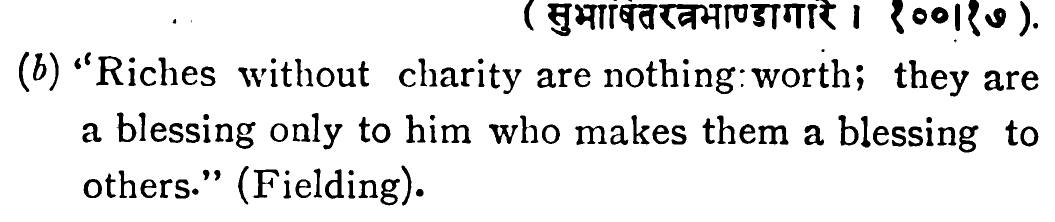
(b) “Riches without charity are nothing worth; they are a blessing only to him who makes them a blessing to others.” (Fielding).
Footnote
(c) “ अदानभोगोपहतं हि वित्तं पुंसां परत्रेह च दुर्निमित्तम् ॥ ११३ ॥ ” ( क्षेमेन्द्रस्य दर्पदलने २ विचारे ).


Gopinath1896
all
धनकी केवल ( १ ) दान ( २ ) भोग और ( ३ ) नाश यह तीनही गति होती हैं । जो मनुष्य न तो दूसरोंको देते हैं और न स्वयं भोग करते हैं उनके धनकी केवल तीसरी गति अर्थात् विनाशमात्रही समझना चाहिए ४३
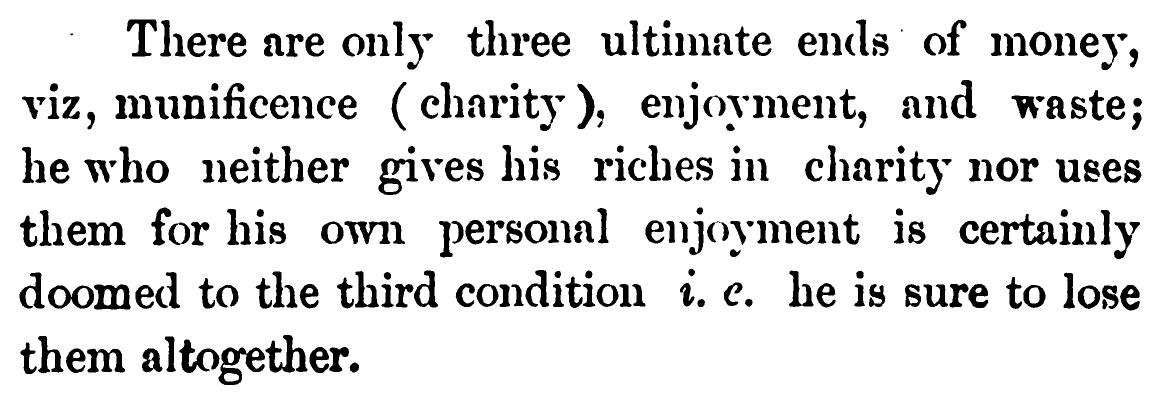
There are only three ultimate ends of money, viz, munificence ( charity), enjoyment, and waste; he who neither gives his riches in charity nor uses them for his own personal enjoyment is certainly doomed to the third condition i. c. he is sure to lose them altogether.
Footnote
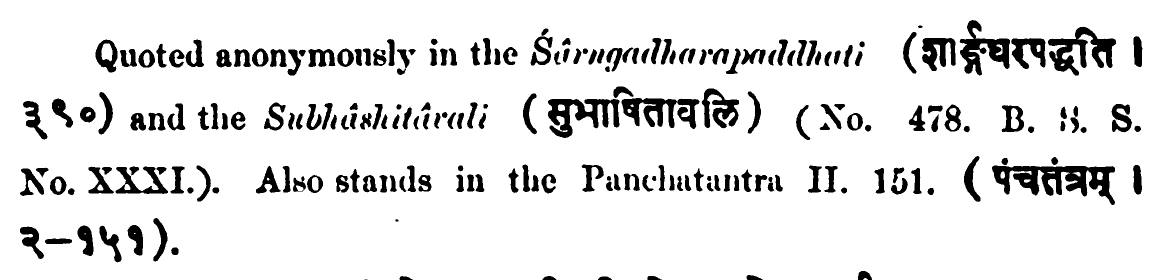
Quoted anonymously in the Särngadharapaddhati ( शार्ङ्गधरपद्धति । ३९०) and the Subhäshitiirali ( सुभाषितावलि ) ( No. 478. B. 3. s. No. XXXI.). Also stands in the Panchatantra II. 151. ( पंचतंत्रम् | २-१५१).
Footnote
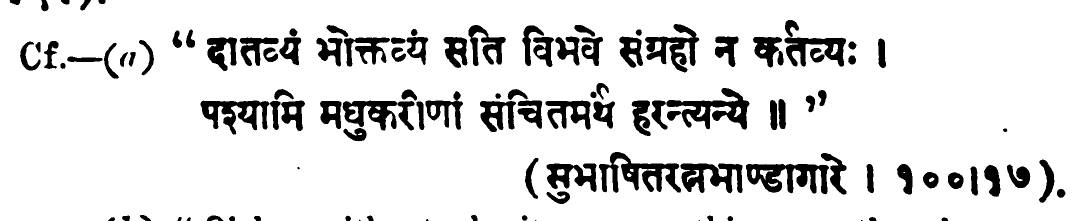
Cf. - (@) " दातव्यं भोक्तव्यं सति विभवे संग्रहो न कर्तव्यः । पश्यामि मधुकरीणां संचितमर्थं हरन्त्यन्ये ॥ " (सुभाषितरत्नभाण्डागारे । १००।१७ ).
Footnote
(b) “ Riches without charity are nothing worth; they are a blessing only to him who makes them a blessing to others.” (Fickling).

Footnote
() " अदानभोगोपहतं हि वित्तं पुंसां परत्रेह च दुर्निमित्तम् ॥ ११३ ॥ " ( क्षेमेन्द्रस्य दर्पदलने २ विचारे).


Kosambi
all

Footnote
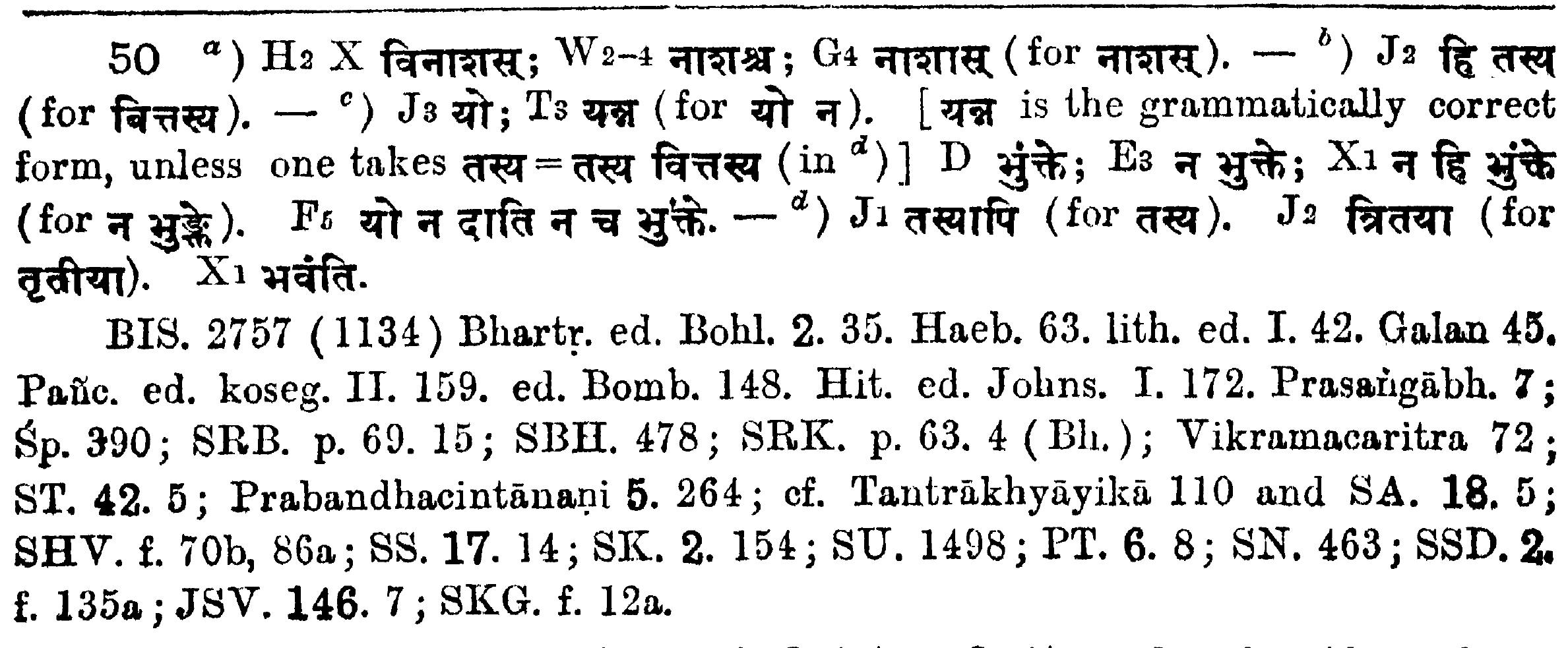
50 2 ) H2 X विनाशस् ; W2-4 नाशश्च ; G4 नाशास् ( for नाशस् ) . – 6 ) J2 हि तस्य
( for वित्तस्य ) . - c c ) ) J3 J3 यो यो ; ; Ts यन्न ( for यो न ) . [ यन्न is the grammatically correct
form , unless one takes तस्य तस्य वित्तस्य ( in a 4 ) ] D भुंक्ते ; E3 न भुक्ते ; X 1 न हि भुंके
( for न भुङ्क्ते ) . Fs यो न दाति न च भुक्ते . – - d ) J1 तस्यापि ( for तस्य ) . J2 त्रितया ( for
तृतीया ) . X 1 भवंति .
BIS . 2757 ( 1134 ) Bhartr ed . Bohl . 2. 35. Haeb . 63. lith ed . I. 42. Galan 45 .
Pañc . ed . koseg . II . 159. ed . Bomb 148. Hit . ed . Johns . I. 172. Prasaigābh . 7 ;
Śp . 390 ; SRB . p . 69. 15 ; SBH . 478 ; SRK . p . 63. 4 ( Bh . ) ; Vikramacaritra 72 ;
ST . 42. 5 ; Prabandhacintānani 5. 264 ; cf. Tantrākhyāyikā 110 and SA 18.5 ;
SHV . f . 70b , 86a ; SS . 17. 14 ; SK 2 • 154 ; SU . 1498 ; PT . 6. 8 ; SN . 463 ; SSD . 2 .
f . 135a ; JSV . 146 7 ; SKG f . 12a .
Commentary