Tawney
Under Vrihaspati's own eyes
Entrenched on heaven's height
Wielding th' artillery of the skies,
Followed by gods in fight,
Indra, in spite of all his skill,
Has seen his host give way;
Strength nought avails.—To whom she will
Fortune assigns the day.
Telang
all
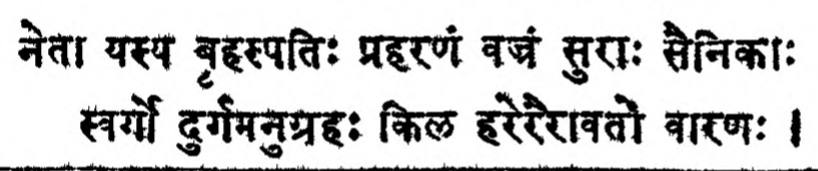
नेता यस्य बृहस्पतिः प्रहरणं वज्रं सुराः सैनिकाः
स्वर्गो दुर्गमनुग्रहः किल हरेरैरावतो वारणः ।
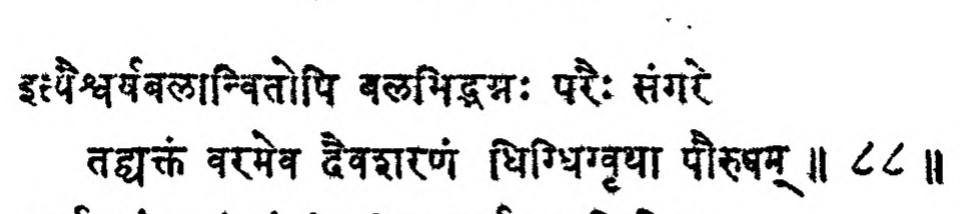
इत्थैश्वर्यबलान्वितोपि बलभिद्भग्नः परैः संगरे
तद्व्यक्तं वरमेव दैवशरणं धिग्धिग्वृथा पौरुषम् ॥ ८८ ॥
Notes
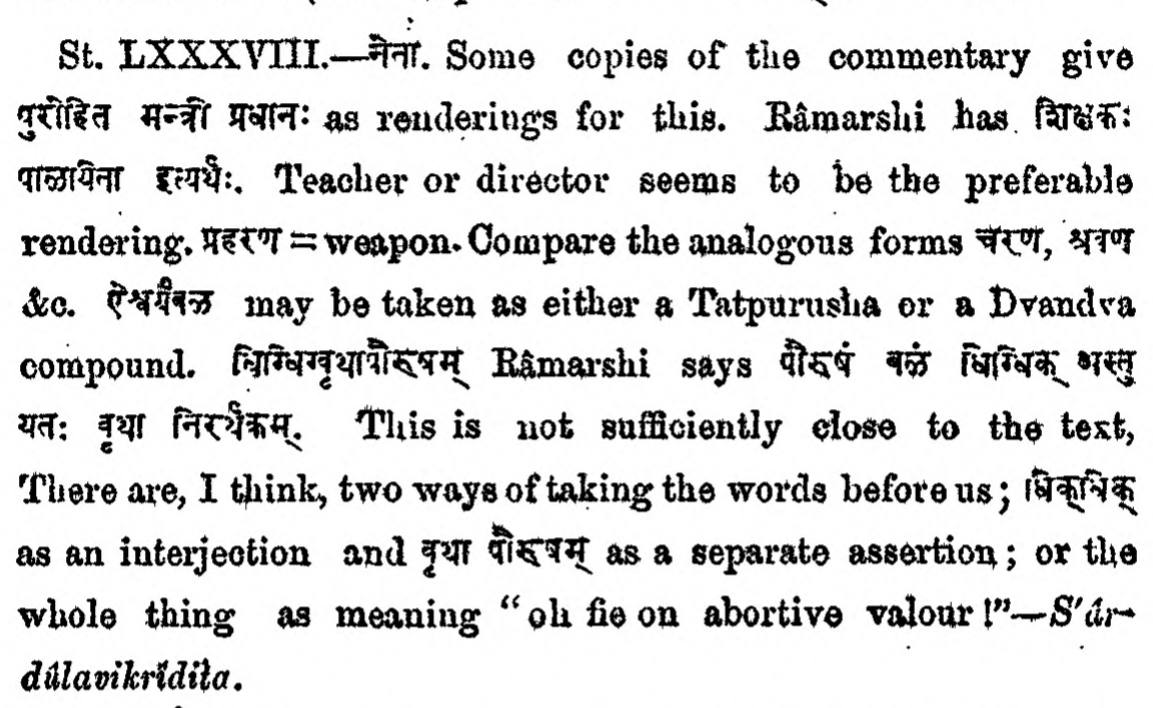
St. LXXXVIII.—नेता. Some copies of the commentary give पुरोहित मन्त्री प्रधानः as renderings for this. Râmarshi has शिक्षकः पालयिता इत्यर्थः. Teacher or director seems to be the preferable rendering. प्रहरण = weapon. Compare the analogous forms चरण, श्रवण &c. ऐश्वर्यबल may be taken as either a Tatpurusha or a Dvandva compound. धिग्धिग्वृथापौरुषम् Râmarshi says पौरुषं बलं धिग्धिक् अस्तु यतः वृथा निरर्थकम्. This is not sufficiently close to the text. There are, I think, two ways of taking the words before us; धिक्धिक् as an interjection and वृथा पौरुषम् as a separate assertion; or the whole thing as meaning “oh fie on abortive valour !”—S'ârdûlavikrîḍita.


Kale
all
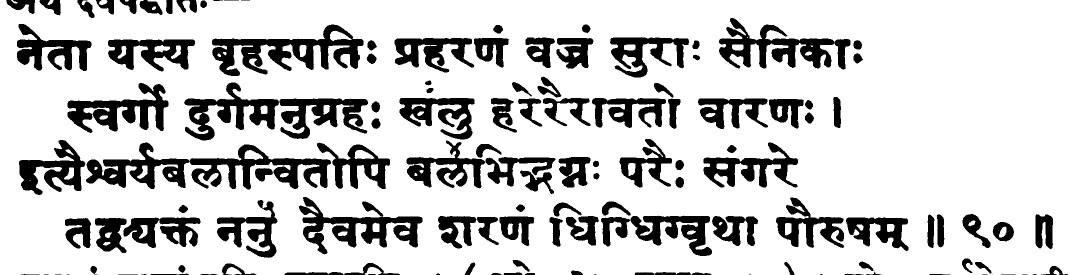
नेता यस्य बृहस्पतिः प्रहरणं वज्रं सुराः सैनिकाः
स्वर्गो दुर्गमनुग्रहः खलु हरेरैरावतो वारणः ।
इत्यैश्वर्यबलान्वितोपि बलभिद्भग्नः परैः संगरे
तद्व्यक्तं ननु दैवमेव शरणं धिग्धिग्वृथा पौरुषम् ॥ ९० ॥
Translation
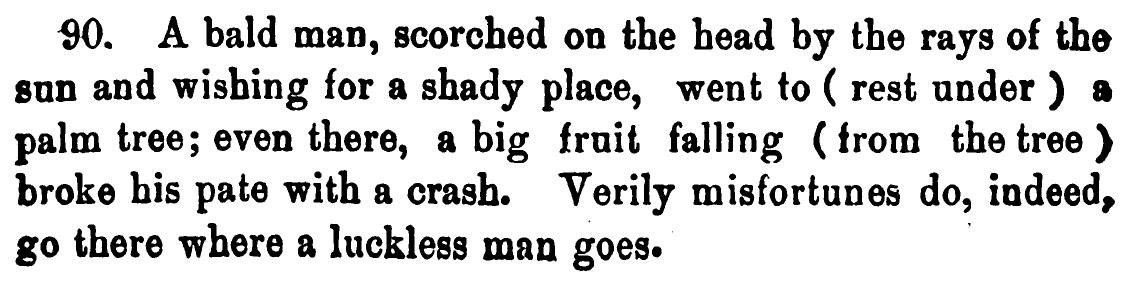
90. A bald man, scorched on the head by the rays of the sun and wishing for a shady place, went to ( rest under ) a palm tree; even there, a big fruit falling ( from the tree ) broke his pate with a crash. Verily misfortunes do, indeed, go there where a luckless man goes.
Notes
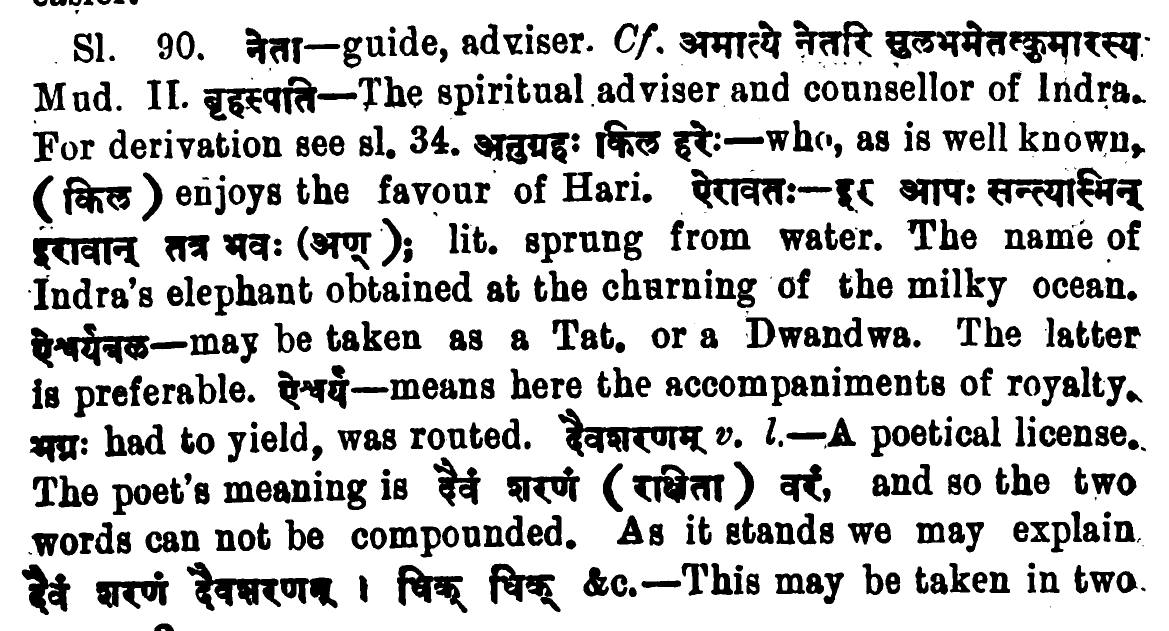
Sl. 90. नेता—guide, adviser. Cf. अमात्ये नेतरि सुलभमेतत्कुमारस्य Mud. II. बृहस्पति—The spiritual adviser and counsellor of Indra. For derivation see sl. 34. अनुग्रहः किल हरेः—who, as is well known, ( किल ) enjoys the favour of Hari. ऐरावतः—इरा आपः सन्त्यास्मिन् इरावान् तत्र भवः (अण् ); lit. sprung from water. The name of Indra’s elephant obtained at the churning of the milky ocean. ऐश्वर्यबल—may be taken as a Tat. or a Dwandwa. The latter is preferable. ऐश्वर्य—means here the accompaniments of royalty. भग्नः had to yield, was routed. दैवशरणम् v. l.—A poetical license. The poet’s meaning is दैवं शरणं ( रक्षिता ) वरं, and so the two words can not be compounded. As it stands we may explain दैवं शरणं दैवशरणम् । धिक् धिक् &c.—This may be taken in two ways:—धिग्धिक् as an interjection, and वृथा पौरुषं separately; or the whole together as meaning—‘Fie upon vain valour.

Gopinath1914
all
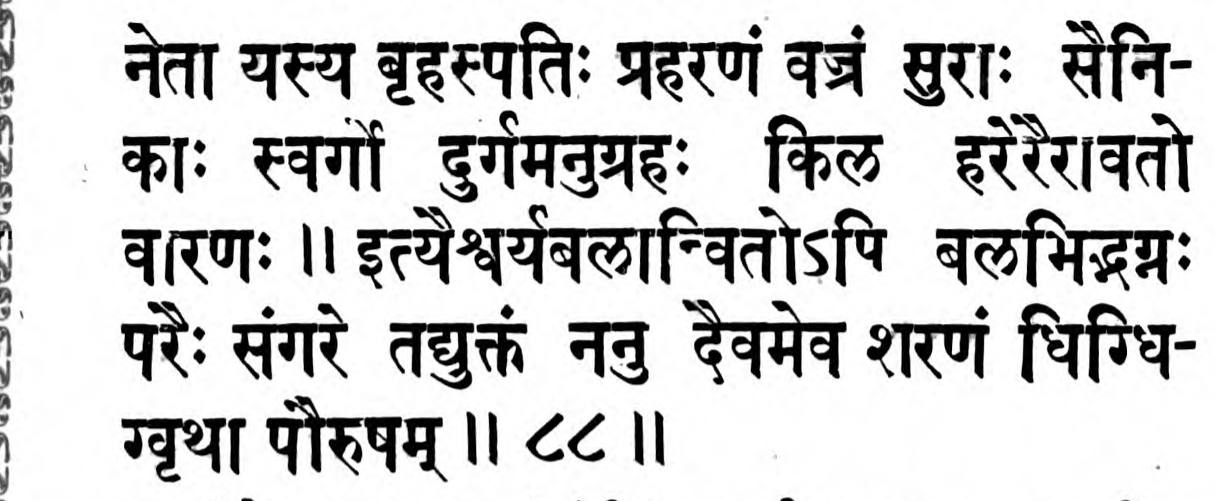
नेता यस्य बृहस्पतिः प्रहरणं वज्रं सुराः सैनि-
काः स्वर्गे दुर्गमनुग्रहः किल हरेरैरवतो
वारणः । इत्यैश्वर्यबलान्वितोऽपि बलभिद्भग्नः
परैः संगरे तद्युक्तं ननु दैवमेव शरणं धिग्धि-
ग्वृथा पौरुषम् ॥ ८८ ॥
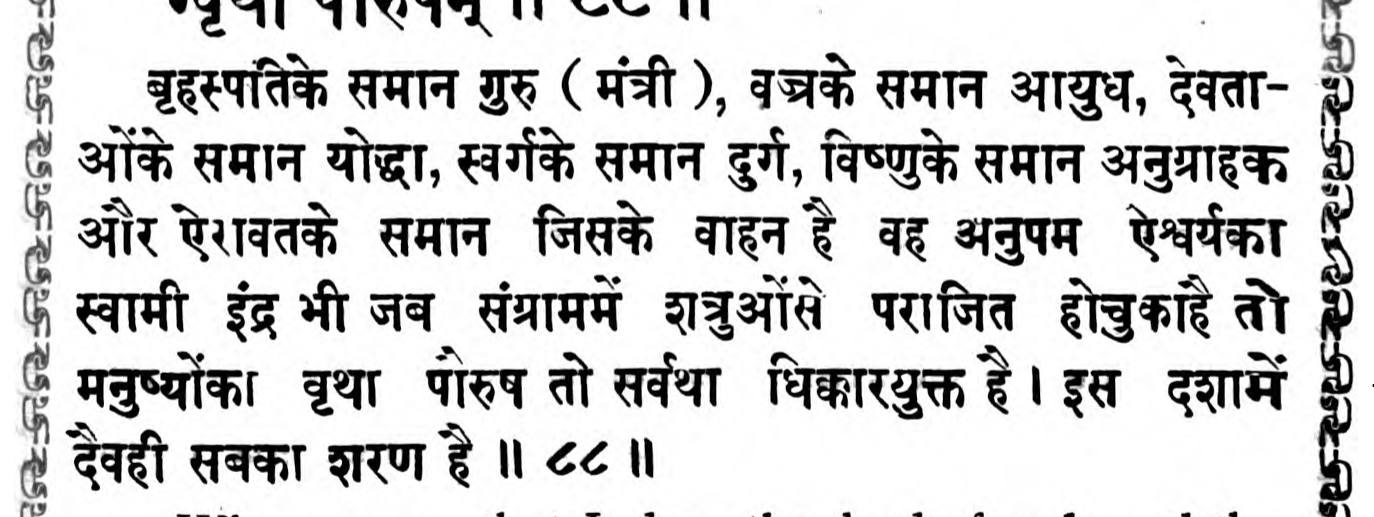
बृहस्पतिके समान गुरु (मंत्री), वज्र के समान आयुध, देवताओंके समान योद्धा, स्वर्गके समान दुर्ग, विष्णुके समान अनुग्राहक और ऐरावतके समान जिसके वाहन है वह अनुपम ऐश्वर्यका स्वामी इंद्र भी जब संग्राममें शत्रुओंसे पराजित होचुका है तो मनुष्योंका वृथा पौरुष तो सर्वथा धिक्कारयुक्त है । इस दशामें दैवही सबका शरण है ॥ ८८ ॥
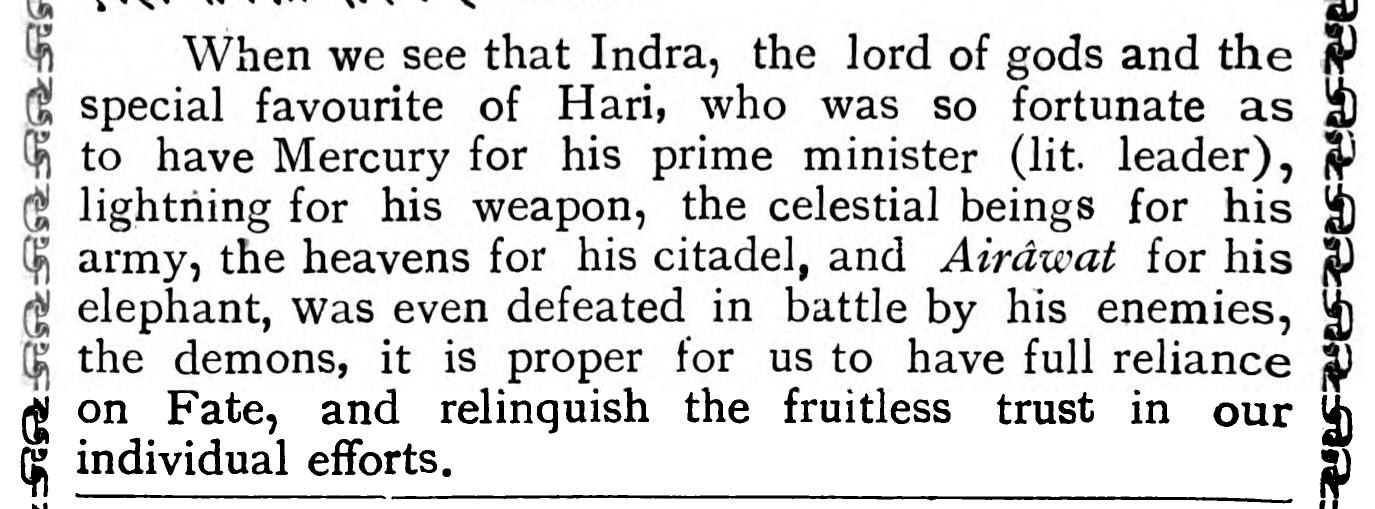
When we see that Indra, the lord of gods and the special favourite of Hari, who was so fortunate as to have Mercury for his prime minister (lit. leader), lightning for his weapon, the celestial beings for his army, the heavens for his citadel, and Airawat for his elephant, was even defeated in battle by his enemies, the demons, it is proper for us to have full reliance on Fate, and relinquish the fruitless trust in our individual efforts.
Footnote
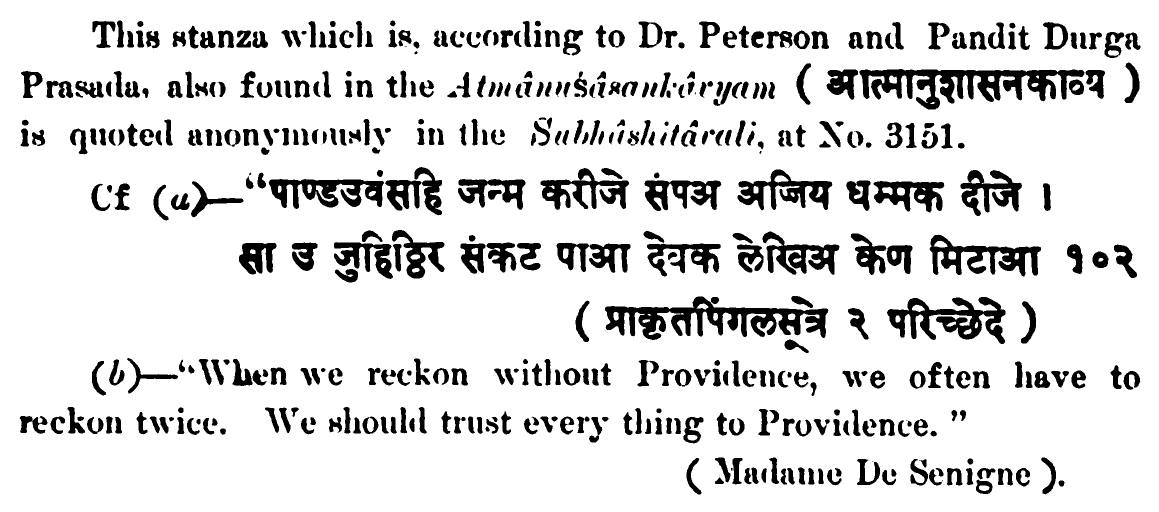
This stanza which is, according to Dr. Peterson and Pandit Durga Prasada, also found in the Atmanuśāsankavyam ( आत्मानुशासनकाव्य ) is quoted anonymously in the Subhashitavali, at Fo. 3151. Cf. ( a ) " पाण्डवंसहि जन्म करोजे संपअ अमिय धम्मक दीजे । साउ जुहिहिर संकट पाभा देवक लेखिभ केण मिटाओ १०२ ( प्राकृतपिंगलसूत्रे २ परिच्छेदे ) (b) “When we reckon without Providence, we often have to reckon twice. We should trust every ( Madame thing to ProvidenceDe Senigne . " ).
Gopinath1896
all
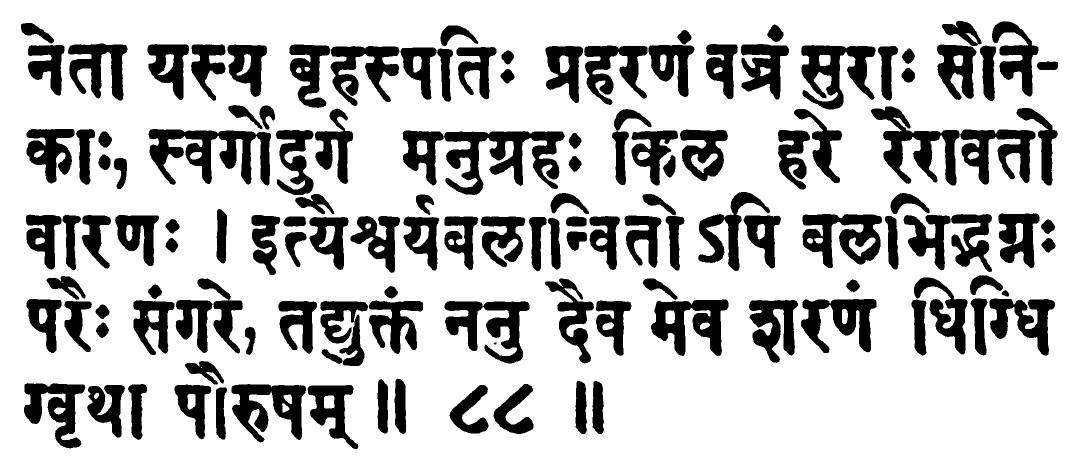
नेता यस्य बृहस्पतिः प्रहरणं वज्रं सुराः सैनि
काः, स्वर्गेदुर्ग मनुग्रहः किल हरे रैरावतो
वारणः । इत्यैश्वर्यबलान्वितोऽपि बलभिद्भग्नः
परैः संगरे, तद्युक्तं ननु दैव मेव शरणं धिग्धि
वृथा पौरुषम् ॥ ८८ ॥
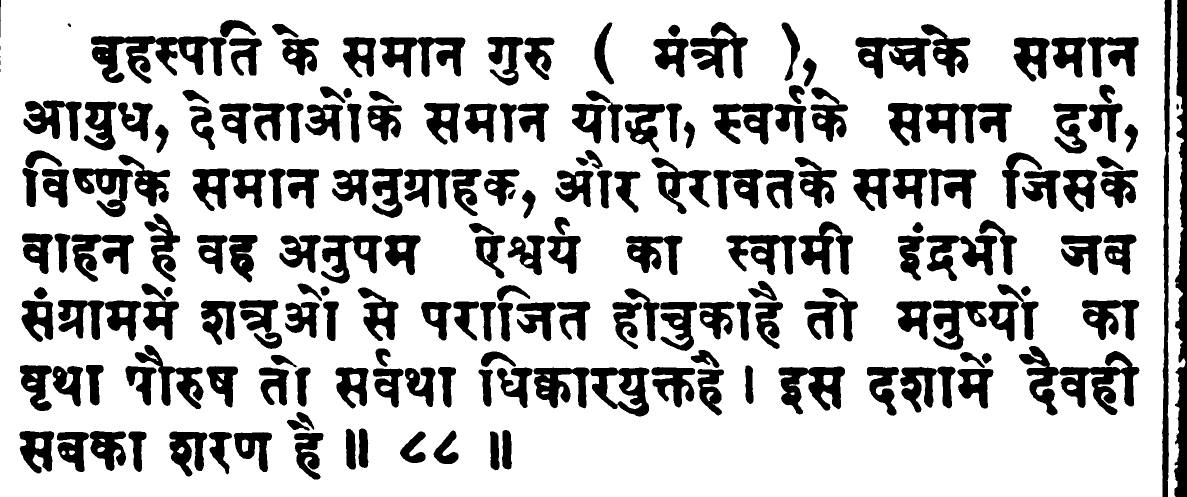
बृहस्पति के समान गुरु ( मंत्री ), वज्रके समान आयुध, देवताओंके समान योद्धा, स्वर्गके समान दुर्ग, विष्णु के समान अनुग्राहक, और ऐरावत के समान जिसके वाहन है वह अनुपम ऐश्वर्य का स्वामी इंद्रभी जब संग्राम में शत्रुओं से पराजित होचुका है तो मनुष्यों का वृथा पौरुष तो सर्वथा धिक्कारयुक्त है । इस दशा में दैवही सबका शरण है ॥ ८८ ॥
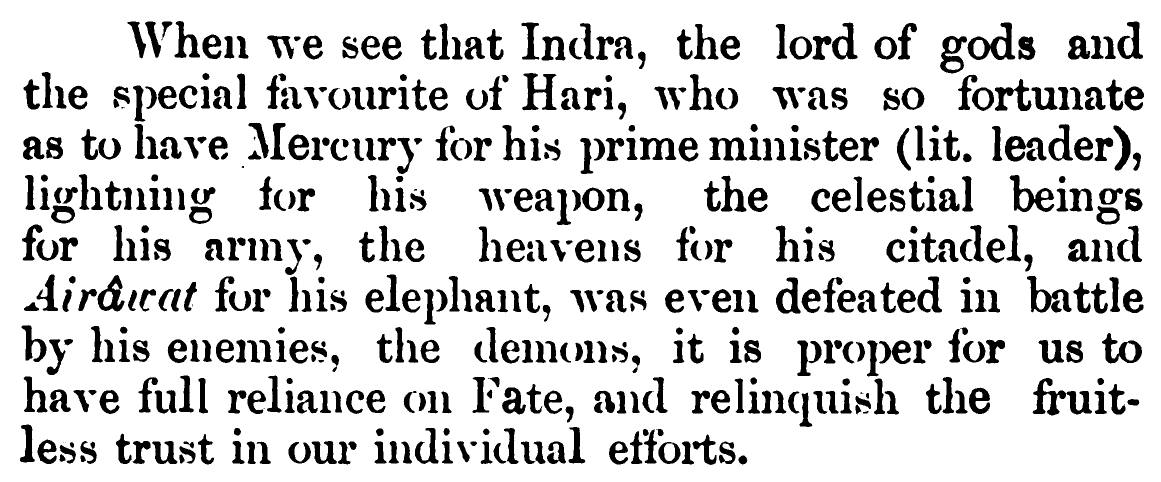
When we see that Indra, the lord of gods and the special favourite of Hari, who was so fortunate as to have Mercury for his prime minister (lit. leader), lightning for his weapon, the celestial beings for his army, the heavens for his citadel, and Airawat for his elephant, was even defeated in battle by his enemies, the demons, it is proper for us to have full reliance on Fate, and relinquish the fruitless trust in our individual efforts.
Footnote
This stanza which is, according to Dr. Peterson and Pandit Durga Prasula, also found in the Atmannstaankaryam ( आत्मानुशासनकाव्य ) is quoted anonymously in the Subhashitárali, at No. 3151. Cf (a) पाण्डवं सहि जन्म करीजे संपअ अज्जिय धम्मक दीजे । सा उ जुहिट्ठिर संकट पाआ देवक लेखिअ केण मिटाआ १०२ ( प्राकृतपिंगलसूत्रे २ परिच्छेदे ) (b)—“When we reckon without Providence, we often have to reckon twice. We should trust every thing to Providence. " (Madame De Senigne ).
Kosambi
all
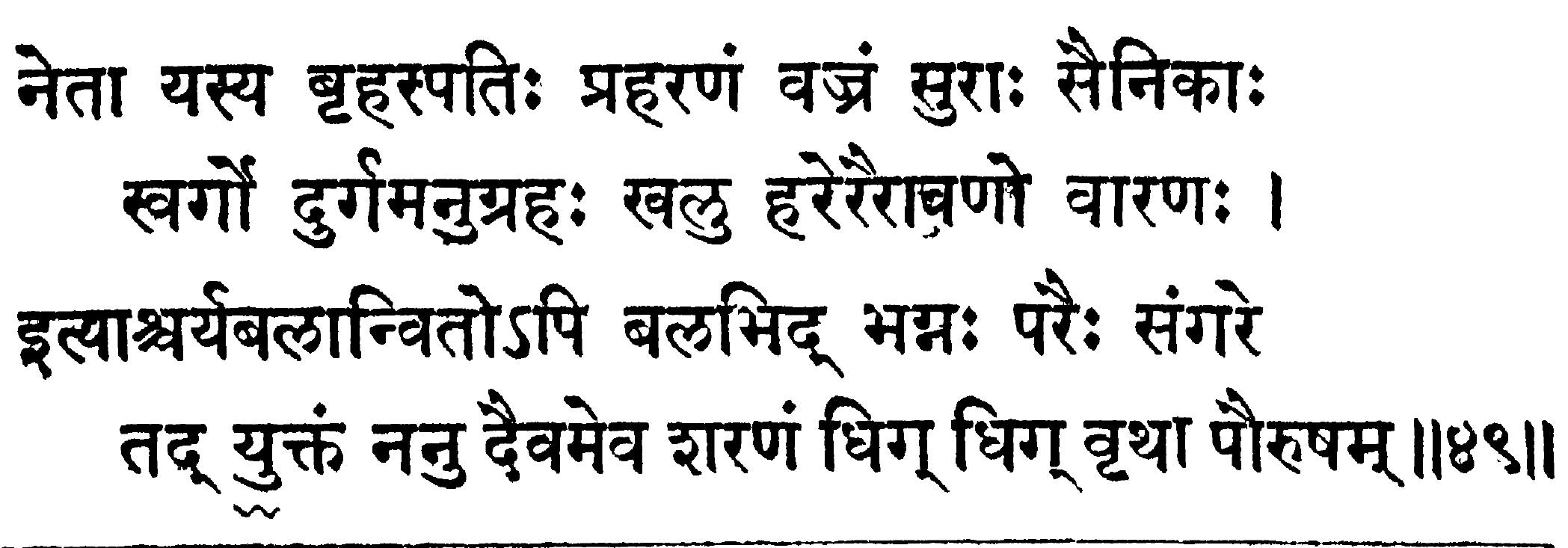
नेता यस्य बृहस्पतिः प्रहरणं वज्रं सुराः सैनिकाः
स्वर्गो दुर्गमनुग्रहः खलु हरेरैराचुणो वारणः ।
इत्याश्चर्यबलान्वितोऽपि बलभिद् भग्नः परैः संगरे
तद् युक्तं ननु दैवमेव शरणं धिग् धिग् वृथा पौरुषम् ॥४ ९ ॥
Footnote
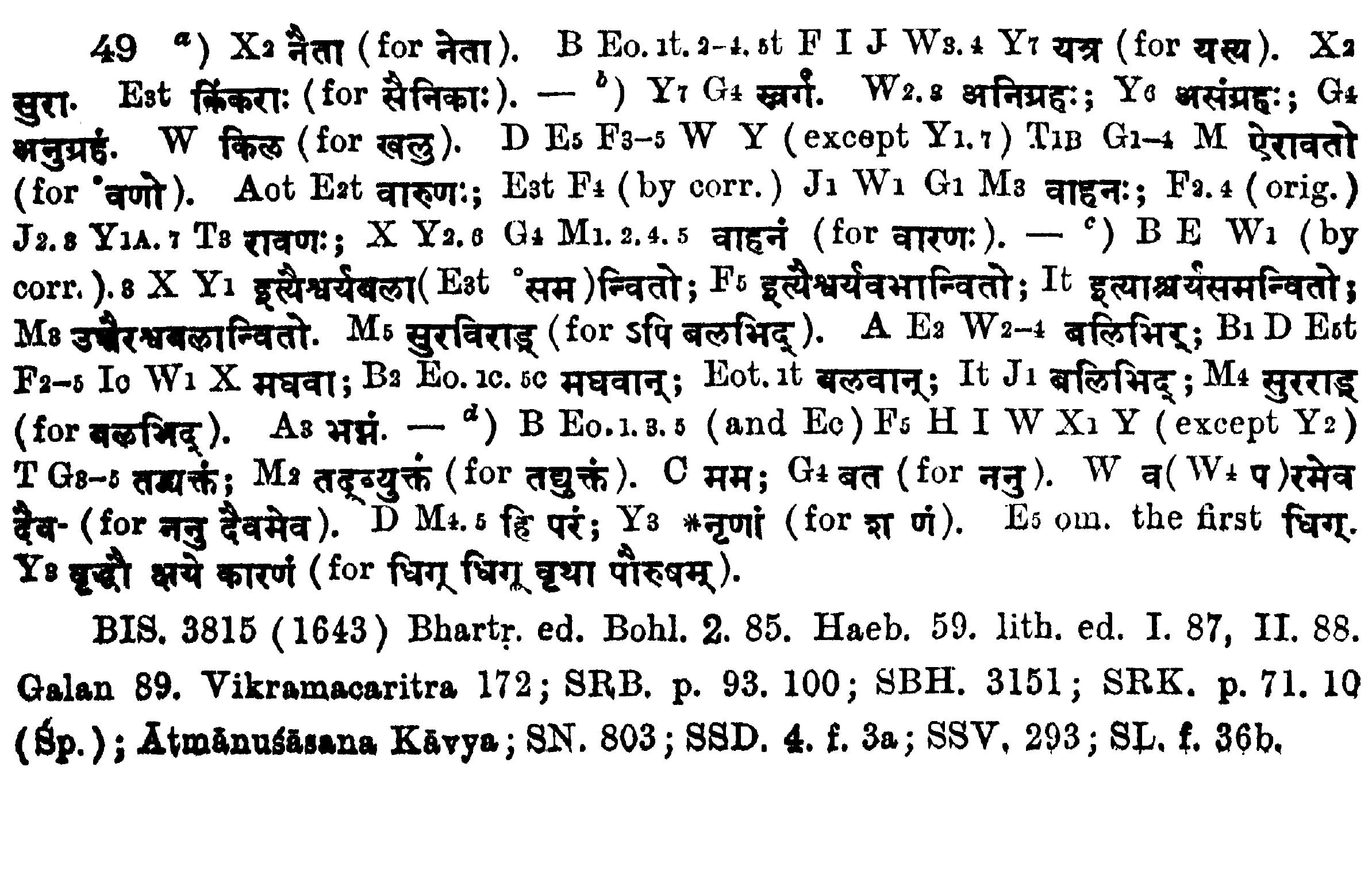
49 a ) X 2 नैता ( for नेता ) . BEo.at , 2–4 , st F F I J Ws . 4 Y1 Yr यत्र ( ( for यस्य ) . X2
Est किंकरा : ( for सैनिकाः ) . – . 6 1 ) ) Yr G + स्वर्ग . W 2.8 अनिग्रहः ; Yo असंग्रहः ; G4
सुरा .
अनुग्रई . W किल ( for खलु ) . D E F 3 - 5 W Y ( except Y1 7 ) T1B G1-4M ऐरावतो
( for ' वणो ) . Aot Eat वारुण : ; Est F1 ( by corr . ) J1W1G1M 3 वाहनः ; F2 . 4 ( orig . )
J2.8 Y1A.7 T3 रावण : ; X Y 2. 6 G1 M1.2.45 वाहनं ( for वारणः ) . c ) BE W1 ( by
corr . ) . 8 X Y1 इत्यैश्वर्यबला ( Est ° सम ) न्वितो ; F० इत्यैश्वर्यवभान्वितो ; It इत्याश्चर्यसमन्वितो ;
M8 उचैरश्वबलान्वितो . Ms सुरविराडू ( for ऽपि बलभिद् ) . A Ea W2-4 बलिभिर् ; Ba D Est
F2 - 6 Io W 1 X मघवा ; Ba Eo . 10. 50 मघवान् ; Eot . at बलवान् ; It Ji बलिभिदु ; M4 सुरराइ
( for बलभिदू ) . As भग्नं . W d ) B Eo.1.3.3 ( and Ec ) F5HIW X1 Y ( except Y2 )
T G8-8 तब्यक्तं ; Ma तद्ब्युक्तं ( for तधुक्तं ) . C मम ; G ± बत ( for ननु ) . W व ( W + प ) रमेव
दैव- ( for ननु दैवमेव ) . " D M4 . 5 हि परं ; X 3 * नृणां ( for श णं ) . Esom . the first धिग् .
Ys वृद्धौ क्षये कारणं ( for घिगू धिगू वृथा पौरुषम् ) .
BIS . 3815 ( 1643 ) Bhartr ed . Bohl . 2. 85. Haeb . 59. lith ed . I. 87 , II . 88 .
Galan 89 Vikramacaritra 172 ; SRB . p . 93. 100 ; SBH . 3151 ; SRK . p . 7110
( Śp . ) ; ātmānuśāsana Kāvya ; SN 803 ; SSD 4. f 3 & ; SSV 293 ; SL 4. 36b ,
Commentary