Tawney
Before he act, the man of sense
Looks forward to the consequence,
For heedless acts infix a dart,
That rankles in the tortured heart.
Telang
all
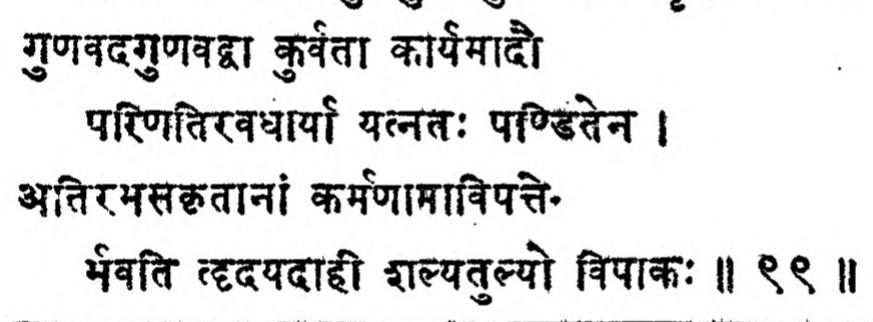
गुणवदगुणवद्वा कुर्वता कार्यमादौ
परिणतिरवधार्या यत्नतः पण्डितेन ।
अतिरभसकृतानां कर्मणामाविपत्ते-
र्भवति हृदयदाही शल्यतुल्यो विपाकः ॥ ९९ ॥
Notes
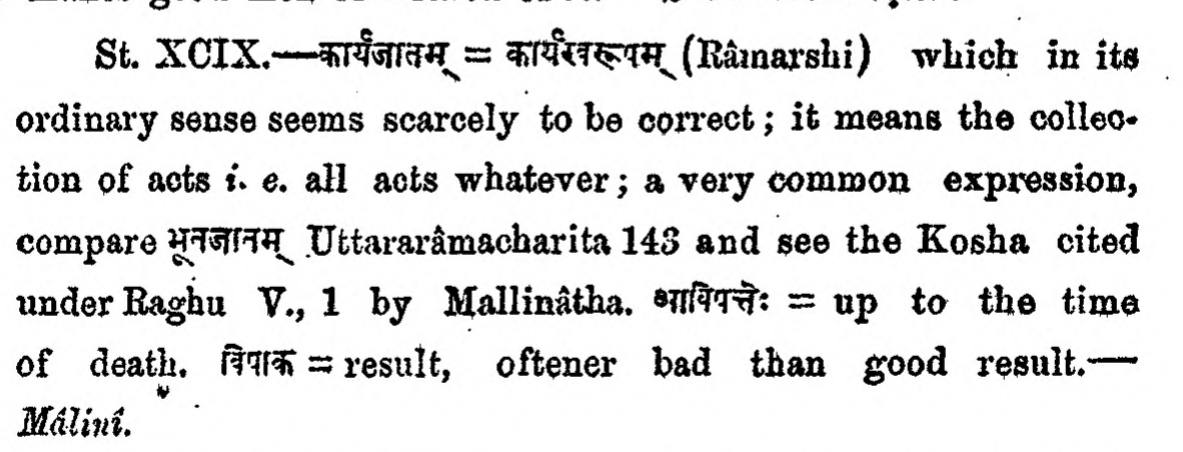
St. XCIX.—कार्यजातम् = कार्यस्वरूपम् (Râmarshi) which in its ordinary sense seems scarcely to be correct; it means the collection of acts i. e. all acts whatever; a very common expression, compare भूतजातम् Uttararâmacharita 143 and see the Kosha cited under Raghu V., 1 by Mallinâtha. आविपत्तेः = up to the time of death. विपाक = result, oftener bad than good result.— Mâlinî.

Kale
all

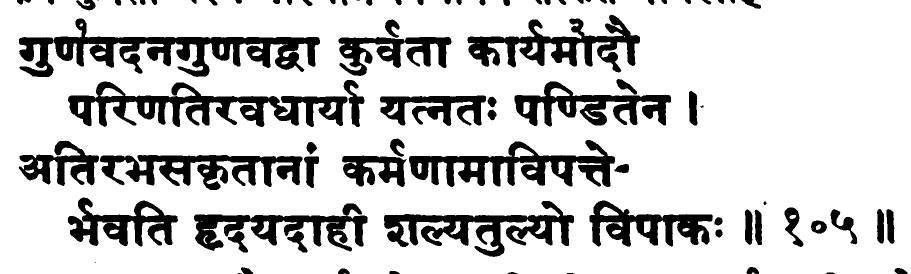
गुणवदनगुणवद्वा कुर्वता कार्यमादौ
परिणतिरवधार्या यत्नतः पण्डितेन ।
अतिरभसकृतानां कर्मणामाविपत्ते-
र्भवति हृदयदाही शल्यतुल्यो विपाकः ॥ १०५ ॥
Translation
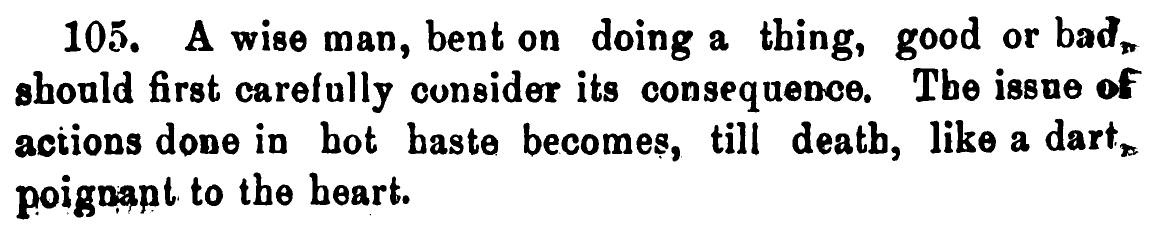
105. A wise man, bent on doing a thing, good or bad, should first carefully consider its consequence. The issue of actions done in hot haste becomes, till death, like a dart, poignant to the heart.
Notes
Sl. 105. गुणवत्—गुणा विद्यन्तेऽस्मिन्. अवधार्या—should be thought over or considered. आविपत्तेः—till death; cf. हिमसेकविपत्तिः, and ‘नरेन्द्रविपत्तिशोकात्’ Rag. VIII. 45, XIX. 56. also Veni. IV. 6. विपाकः—from वि + पच् + अ ( अच् or घञ् ) originally means cooking, and thence, ripeness, development, consequence. हृदयदाही— burning ( i. e. giving pain to ) the vitals of the heart like the barb of an arrow ( supposed to be poisoned that it should cause burning ); Cf. सविषमिव शल्यं दहति माम् । S'ak. VI. 9.
Gopinath1914
all
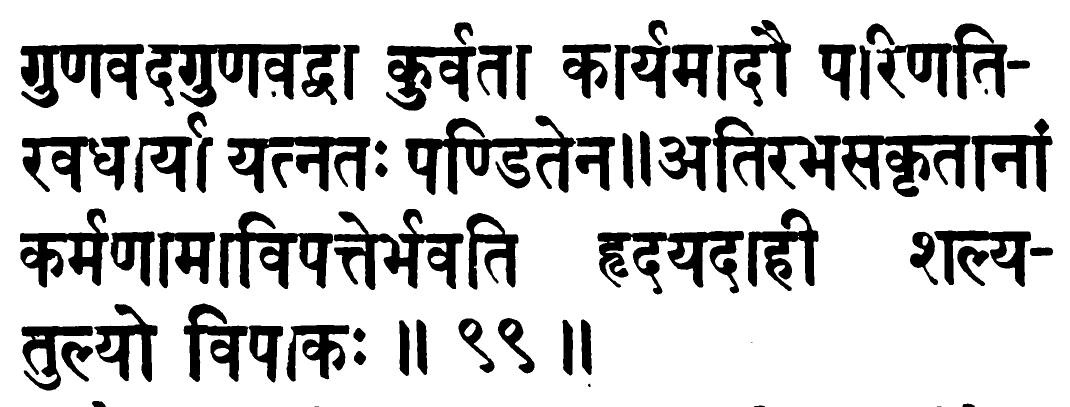
गुणवदगुणवद्धा कुर्वता कार्यमादौ परिणति-
वधार्या यत्नतः पण्डितेन ॥ अतिरभसकृतानां
कर्मणामाविपत्तेर्भवति हृदयदाही शल्य-
तुल्यो विपाकः ॥ ९९ ॥
कोई कैसाही कार्य क्यों न हो पंडितजनको प्रथमहीसे उसके गुण, दूषण और परिणामका विचार भली भांति करलेना चाहिए, क्योंकि बिना विचारे और शीघ्रतासे किए हुए कार्यका फल मरणपर्यंत मनुष्य के हृदयको संतप्त करता रहता है ॥ ९९ ॥
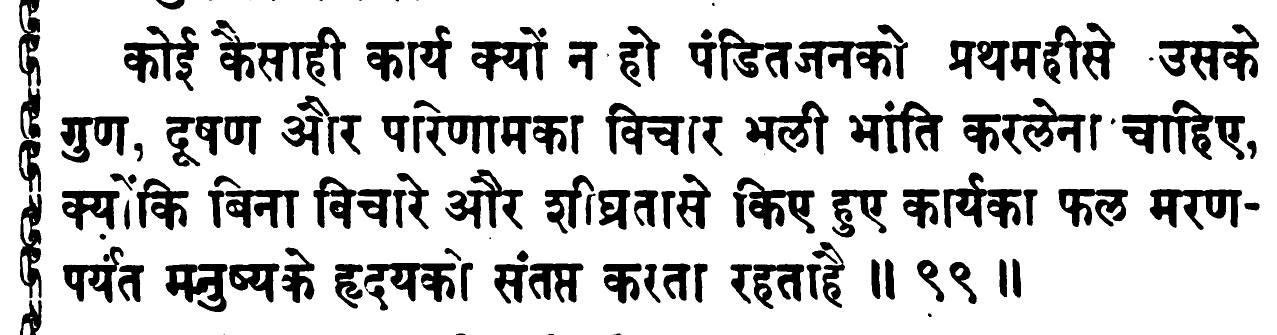
Whether good or bad, a wise man should carefully consider the end of the action he takes in hand; for the result of our precipitate and inconsiderate doings invaribly becomes the source of constant pain to the end of our heart-rending existence.
Footnote
This stanza is virtually the same as found in Vallala's Bhoja. prabandha (वल्लाल कृत भोजप्रबन्ध ). It is quoted anonymously in the Subhashitavali (सुभाषिनावलि) at No. 2934, and the Sarngdharpaddhati (शार्ङ्गवरपद्धति । १३९१ ).

Footnote
Cf (a ) " किं नु म स्थादिदं कृत्वा किं नु मे स्पादकुर्वतः । इति कर्माणि संचिन्त्य कुर्याद्वा पुरुषो न वा ” ( विदुरनीति: ).

Footnote
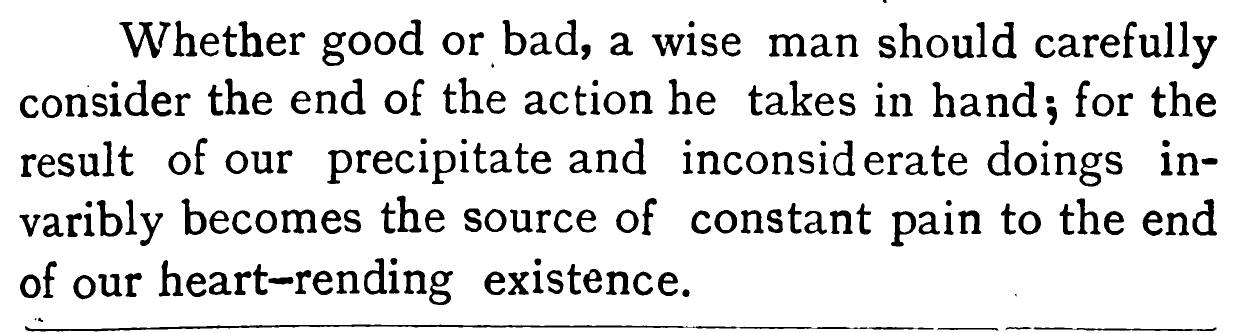
(b) '' Resolution without foresight, is but a temerarious folly; and the consequence " of things is the first point to be taken into consideration.

Footnote
(c) " सहसा विदधीत न क्रियामविवेकः परमापदां पदम् । वृणुते हि विमृश्यकारिणं गुणलुब्धाः स्वयमेव संपदः । ३० " किरातार्जुनीये २ सर्गे ).

Gopinath1896
all
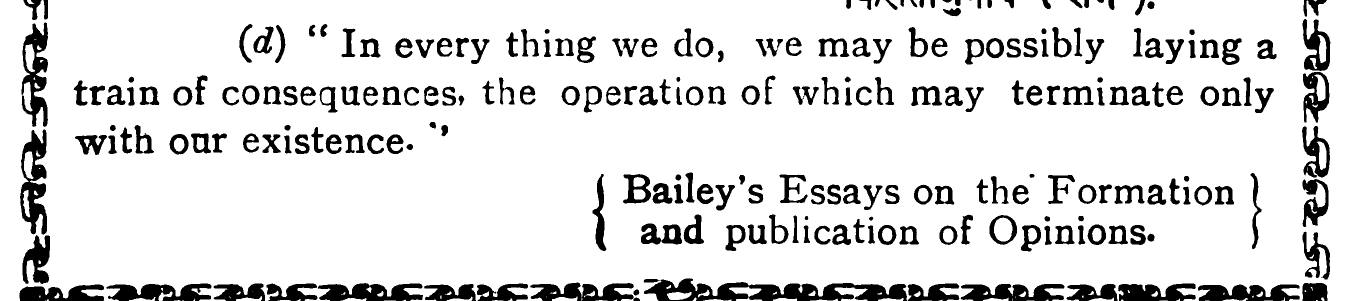
गुणवद्गुणवद्धा कुर्वता कार्यमादौ, परिणति
रवधार्थी यत्नतः पण्डितेन । अतिरभसकृतानां
कर्मणामाविपत्ते, र्भवति हृदयदाही शल्य-
तुल्यो विपाकः ॥ ९९ ॥
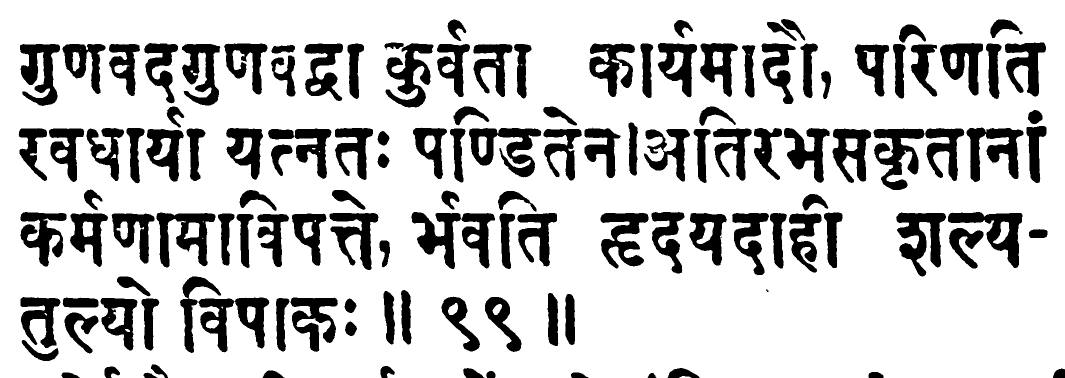
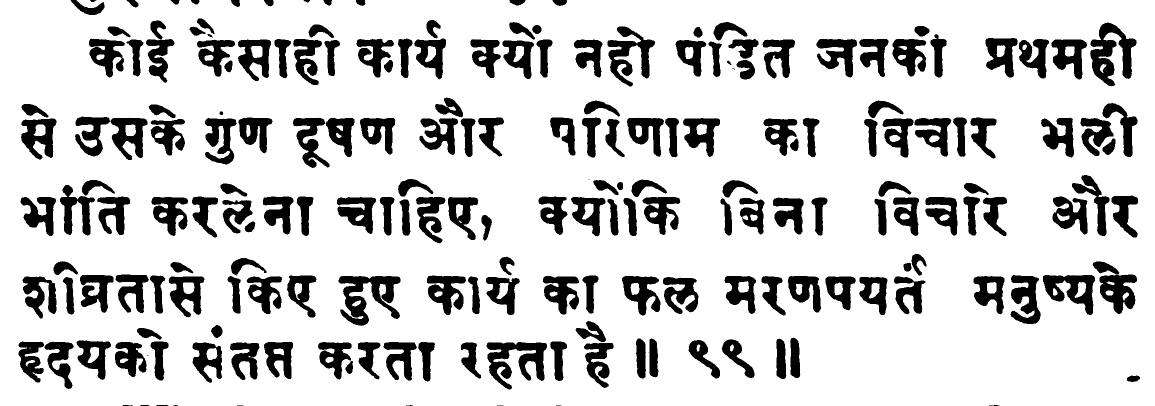
कोई कैसाही कार्य क्यों नही पंडित जनकी प्रथमही से उसके गुण दूषण और परिणाम का विचार भली भांति करलेना चाहिए, क्योंकि बिना विचारे और शीघ्रतासे किए हुए कार्य का फल मरणपयतें मनुष्य के हृदयको संतप्त करता रहता है ॥ ९९ ॥
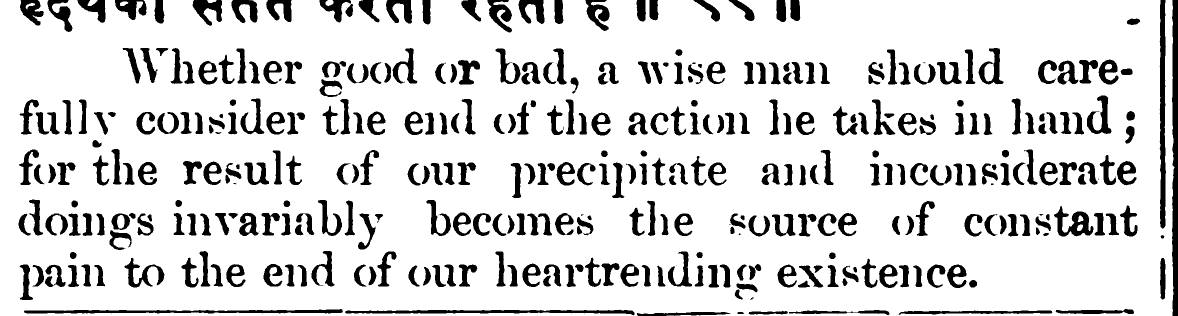
Whether good or bad, a wise man should carefully consider the end of the action he takes in hand ; for the result of our precipitate and inconsiderate doings invariably becomes the source of constant pain to the end of our heartrending existence.
Footnote
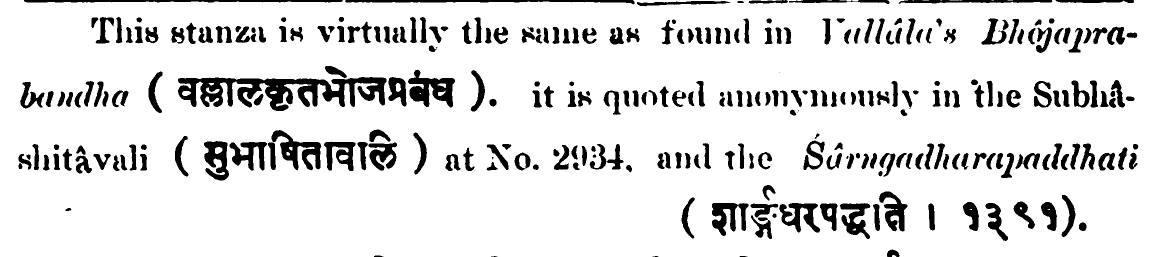
This stanza is virtually the same as found in Vallála's Bhójaprabarudha (वल्लालकृतभोजप्रबंध ) it is quoted anonymously in the Subhashitavali ( सुभाषितावाल ) at No. 2934, and the Sarngadharapaddhati ( शार्ङ्गधरपद्धति । १३९१).
Footnote
Cf. (") “किं नु मे स्या दिदं कृत्वा किं नु मे स्यादकुर्वतः । इति कर्मणि संचिन्त्य कुर्या द्वा पुरुषो न वा " (विदुरनीति: )

Footnote
(b) “Resolution without foresight, is but a temerarious folly; and the consequence " of things ir the first point to be taken into consideration.

Footnote
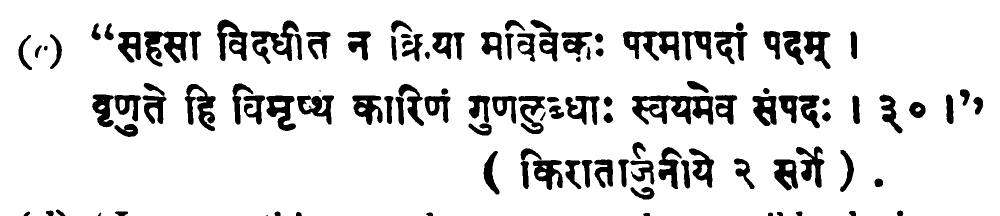
( ) " सहसा विदधीत न क्रिया मविवेकः परमापदां पदम् । वृणुते हि विमृष्य कारिणं गुणलुब्धाः स्वयमेव संपदः । ३० ।” ( किरातार्जुनीये २ सर्गे ) .
Kosambi
all
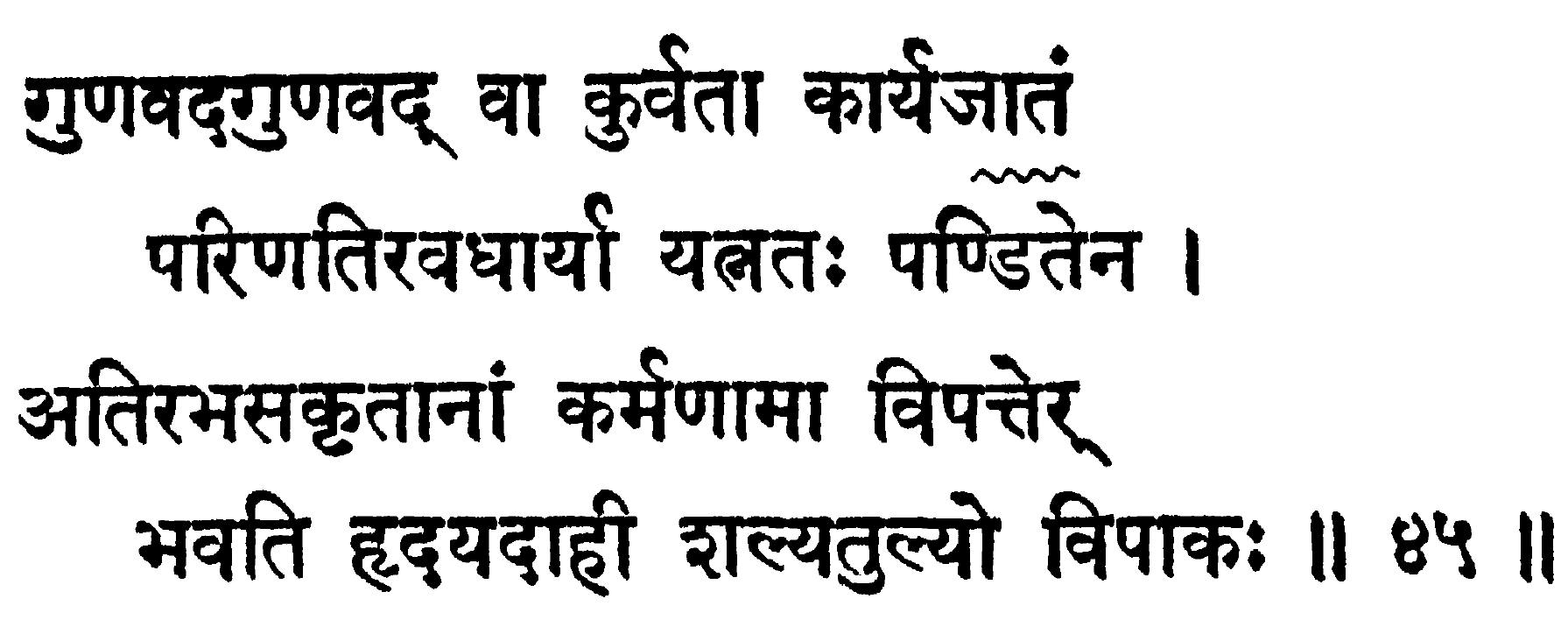
गुणवदगुणवद् वा कुर्वता कार्यजातं
परिणतिरवधार्या यत्नतः पण्डितेन ।
अतिरभसकृतानां कर्मणामा विपत्तेर्
भवति हृदयदाही शल्यतुल्यो विपाकः ॥ ४५ ॥
Footnote
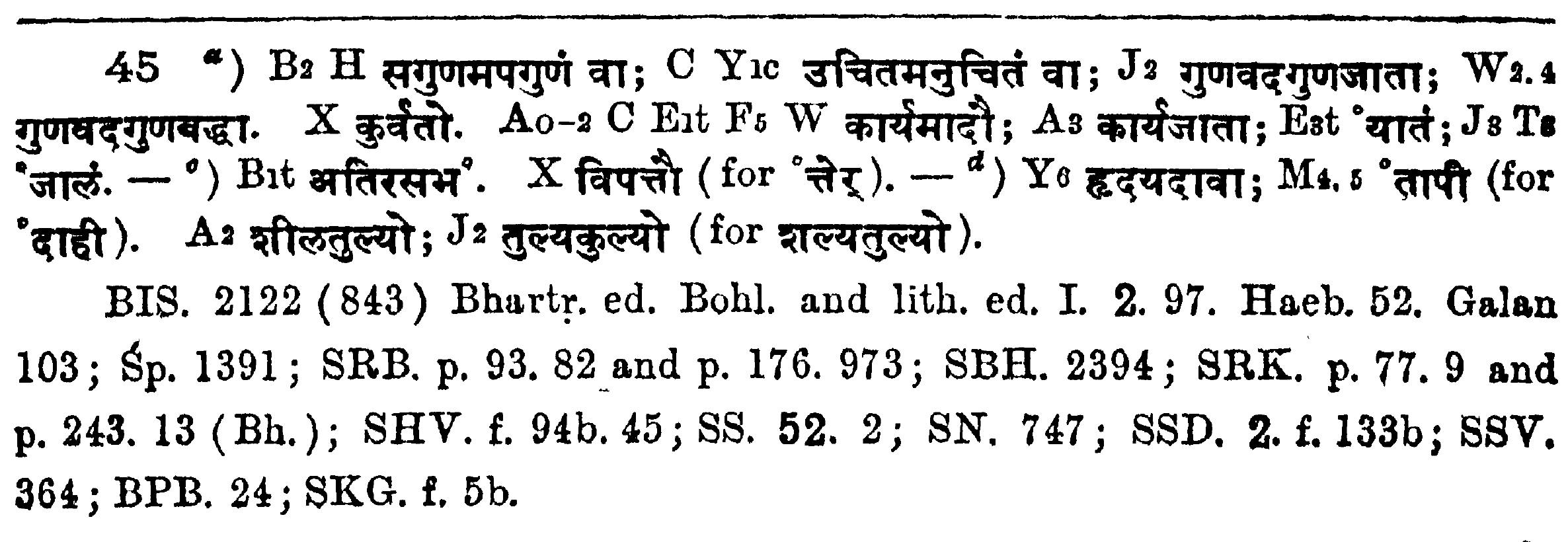
45 ) B2 H सगुणमपगुणं वा ; C Y10 उचितमनुचितं वा ; J 2 गुणवद गुणजाता ; W2 . 4
गुणवदगुणबद्धा . X कुर्वतो . A0 2 C Eat Fs W कार्यमादौ ; A3 कार्यजाता ; Est ' यातं ; J8 Js Te
जालं . ● ) Bit अतिरसभ . X विपत्तौ ( for ' तेर् ) . - 4 ) Yo हृदयदावा ; M4.5 ° तापी ( for
' दाही ) . A2 शीलतुल्यो ; J2 तुल्यकुल्यो ( for शल्यतुल्यो ) .
BIS . 2122 ( 843 ) Bhartṛ . ed . Bohl . and lith . ed . I. 2. 97. Haeb . 52. Galan
103 ; Śp . 1391 ; SRB . p . 93.82 and p . 176 973 ; SBH . 2394 ; SRK . p . 77.9 and
p . 243. 13 ( Bh . ) ; SHV . f . 94b 45 ; SS . 52. 2 ; SN . 747 ; SSD . 2. f . 133b ; SSV .
364 ; BPB . 24 ; SKGf 5b .
Commentary