Tawney
Subdue desire, and vanquish pride,
Bear scorn, in wrong take no delight,
Speak truth, for sages' wants provide,
And follow still the path of right,
Honour the worthy, love thy foes,
Hide thy own virtues, cheer the faint,
Pursue renown till life doth close,
Such conduct marks the perfect saint.
Telang
all
तृष्णां छिन्धि भज क्षमां जहि मदं पापे रतिं मा कृथाः
सत्यं ब्रूह्यनुयाहि साधुपदवीं सेवस्व विद्वज्जनम् ।
मान्यान्मानय विद्विषोप्यनुनय प्रच्छादय स्वान्गुणान्
कीर्तिं पालय दुःखिते कुरु दयामेतत्सतां चेष्टितम् ॥ ७७ ॥


Notes
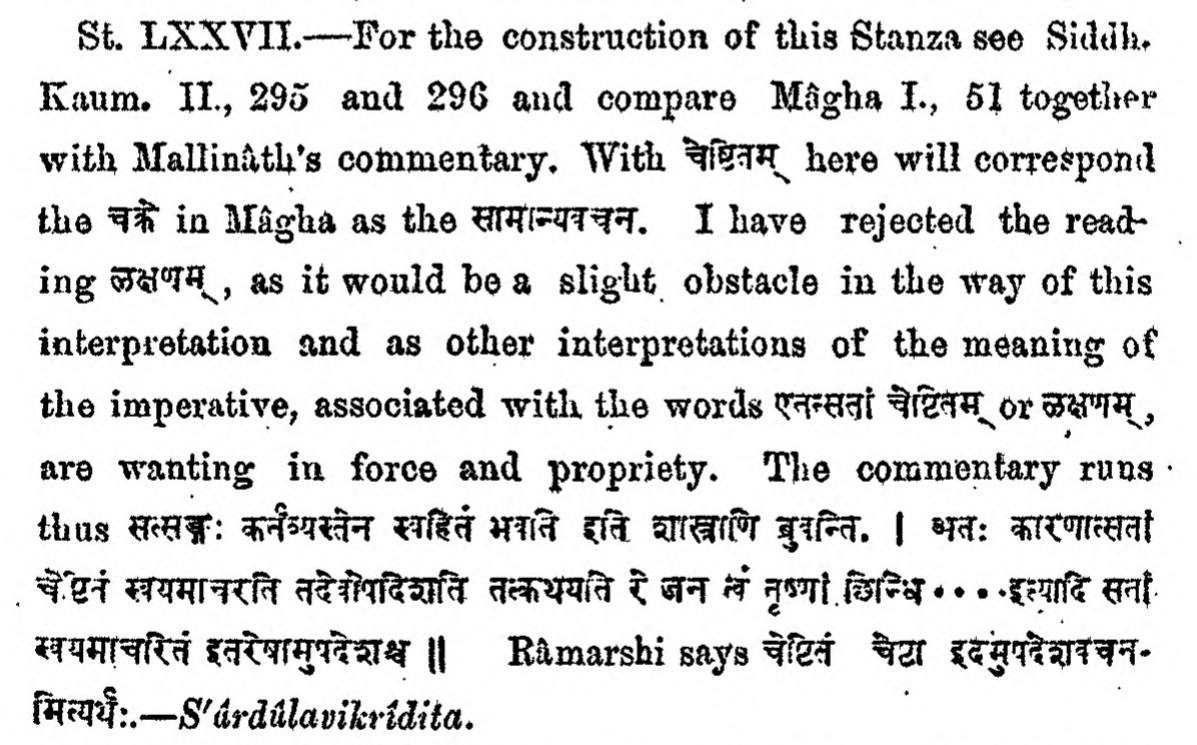
St. LXXVII.—For the construction of this Stanza see Siddh. Kaum. II., 295 and 296 and compare Mâgha I., 51 together with Mallinâth’s commentary. With चेष्टितम् here will correspond the चक्रे in Mâgha as the सामान्यवचन. I have rejected the reading लक्षणम्, as it would be a slight obstacle in the way of this interpretation and as other interpretations of the meaning of the imperative, associated with the words एतत्सतां चेष्टितम् or लक्षणम्, are wanting in force and propriety. The commentary runs thus सत्सङ्गः कर्तव्यस्तेन स्वहितं भवति इति शास्त्राणि ब्रुवन्ति. । अतः कारणात्सतां चेष्टितं स्वयमाचरति तदेवोपदिशति तत्कथयति रे जन त्वं तृष्णां छिन्धि....इत्यादि सतां स्वयमाचरितं इतरेषामुपदेशश्च ॥ Râmarshi says चेष्टितं चेष्टा इदमुपदेशवचनमित्यर्थः.—S'ârdûlavikrîḍita.


Kale
all

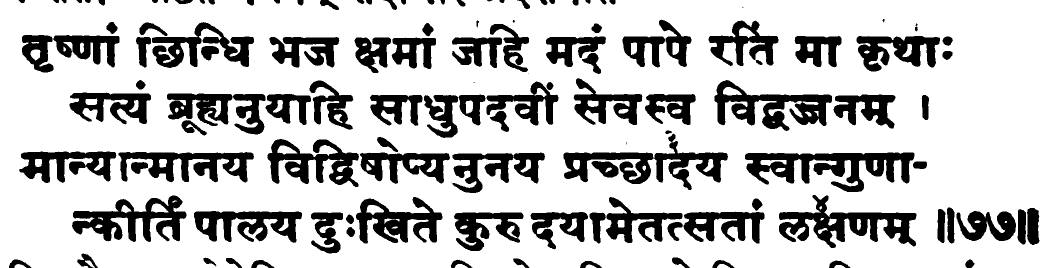
तृष्णां छिन्धि भज क्षमां जहि मदं पापे रतिं मा कृथाः
सत्यं ब्रूह्यनुयाहि साधुपदवीं सेवस्व विद्वज्जनम् ।
मान्यान्मानय विद्विषोप्यनुनय प्रच्छादय स्वान्गुणा-
न्कीर्तिं पालय दुःखिते कुरु दयामेतत्सतां लक्षणम् ॥७७॥
Translation
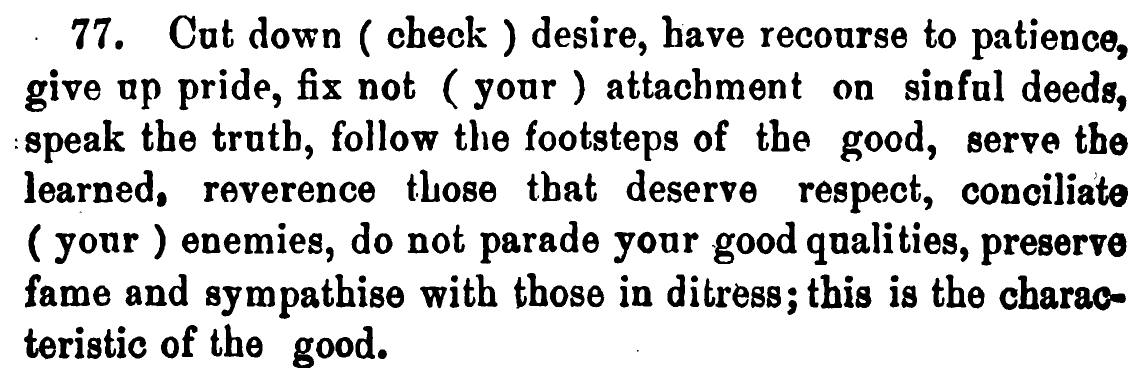
77. Cut down ( check ) desire, have recourse to patience, give up pride, fix not ( your ) attachment on sinful deeds, speak the truth, follow the footsteps of the good, serve the learned, reverence those that deserve respect, conciliate ( your ) enemies, do not parade your good qualities, preserve fame and sympathise with those in ditress; this is the characteristic of the good.
Notes
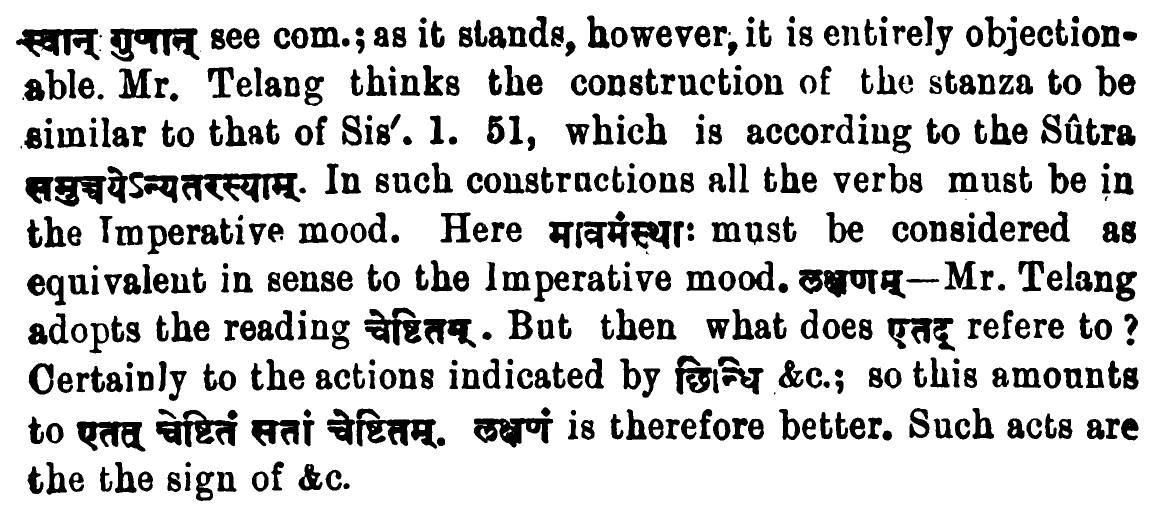
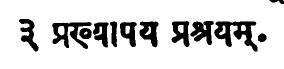
Sl. 77. In line 3 the Nirnayasâgar Edition reads प्रख्यापय for प्रच्छादय which will suit only with the reading प्रश्रयम् for स्वान् गुणान् see com.; as it stands, however, it is entirely objectionable. Mr. Telang thinks the construction of the stanza to be similar to that of Sis'. I. 51, which is according to the Sûtra समुच्चयेऽन्यतरस्याम्. In such constructions all the verbs must be in the Imperative mood. Here मावमंस्थाः must be considered as equivalent in sense to the Imperative mood. लक्षणम्—Mr. Telang adopts the reading चेष्टितम्. But then what does एतद् refere to ? Certainly to the actions indicated by छिन्धि &c.; so this amounts to एतत् चेष्टितं सतां चेष्टितम्. लक्षणं is therefore better. Such acts are the the sign of &c.


Gopinath1914
all
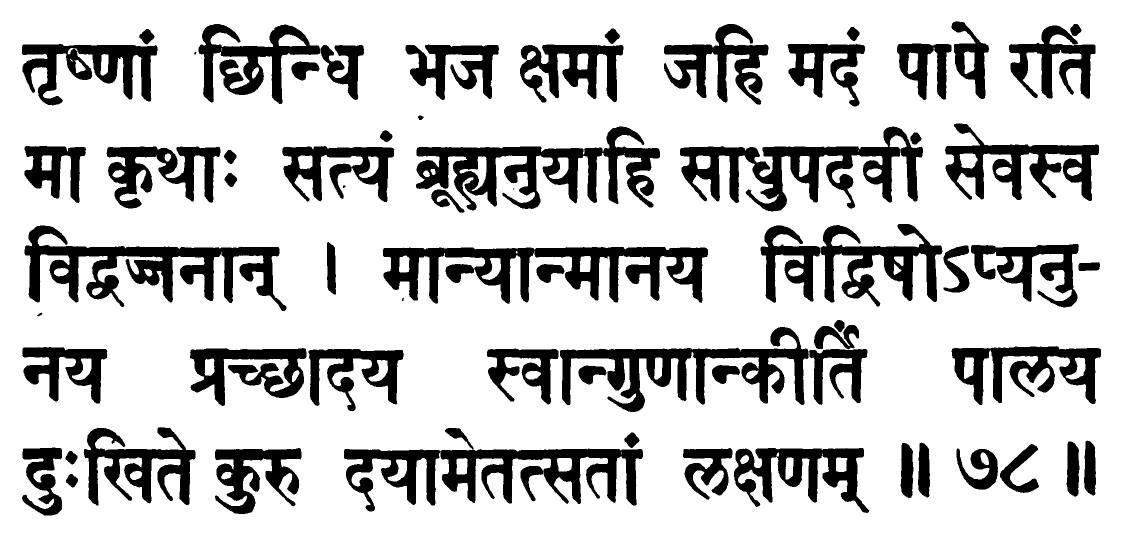
तृष्णां छिन्धि भज क्षमां जहि मदं पापे रतिं
मा कृथाः सत्यं ब्रूह्यनुयाहि साधुपदवीं सेवस्व
विद्वज्जनान् । मान्यान्मानय विद्विषोऽप्यनु-
नय प्रच्छादय स्वान्गुणान्कीर्ति पालय
दुःखिते कुरु दयामेतत्सतां लक्षणम् ॥ ७८ ॥
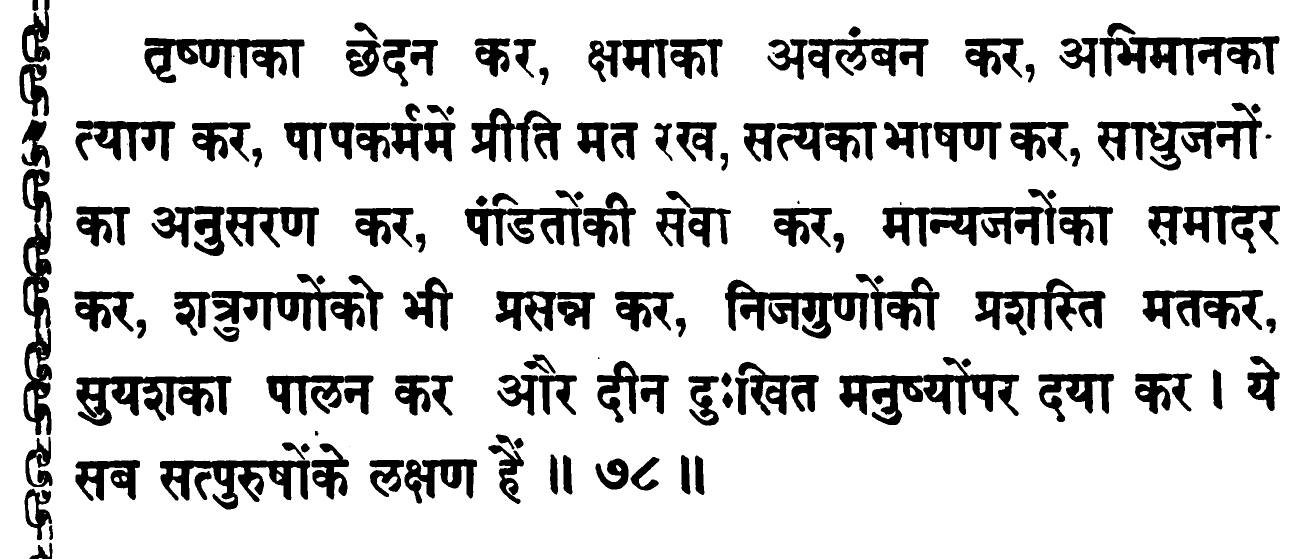
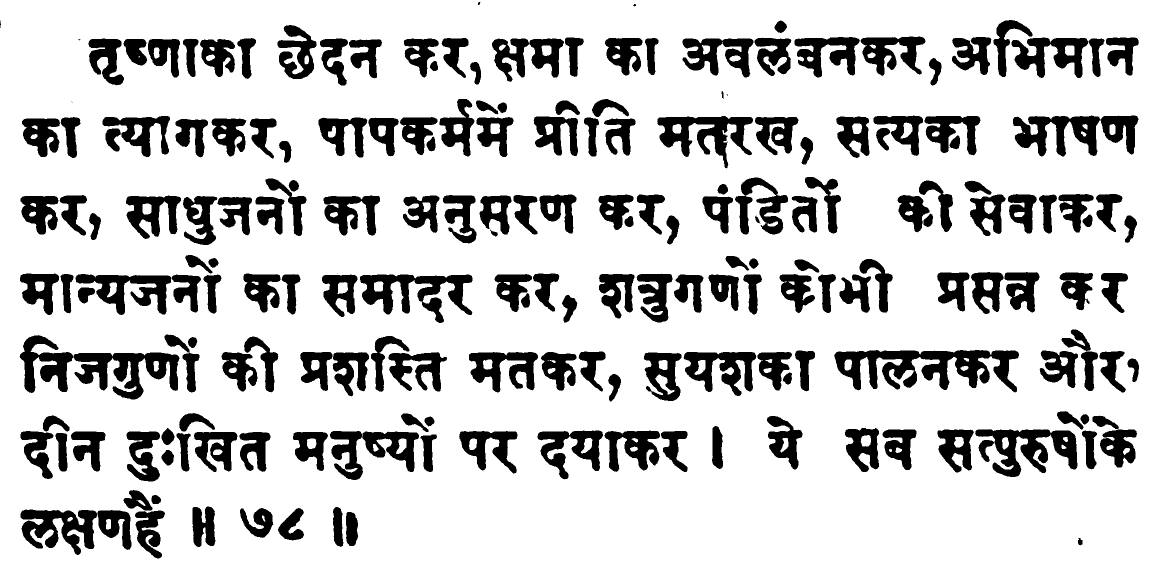
तृष्णाका छेदन कर, क्षमाका अवलंबन कर, अभिमानका त्याग कर, पापकर्ममें प्रीति मत रख, सत्यका भाषण कर, साधुजनों का अनुसरण कर, पंडितोंकी सेवा कर, मान्यजनोंका समादर कर, शत्रुगणोंको भी प्रसन्न कर, निजगुणोंकी प्रशस्ति मतकर, सुयशका पालन कर और दीन दुःखित मनुष्योंपर दया कर । ये सब सत्पुरुषोंके लक्षण हैं ॥ ७८ ॥
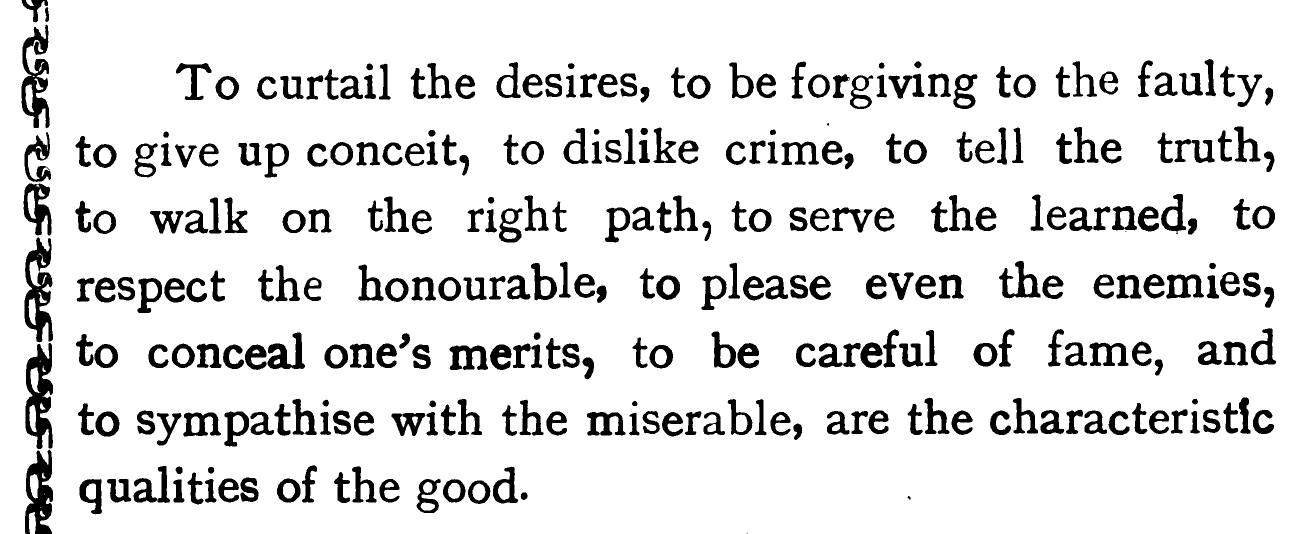
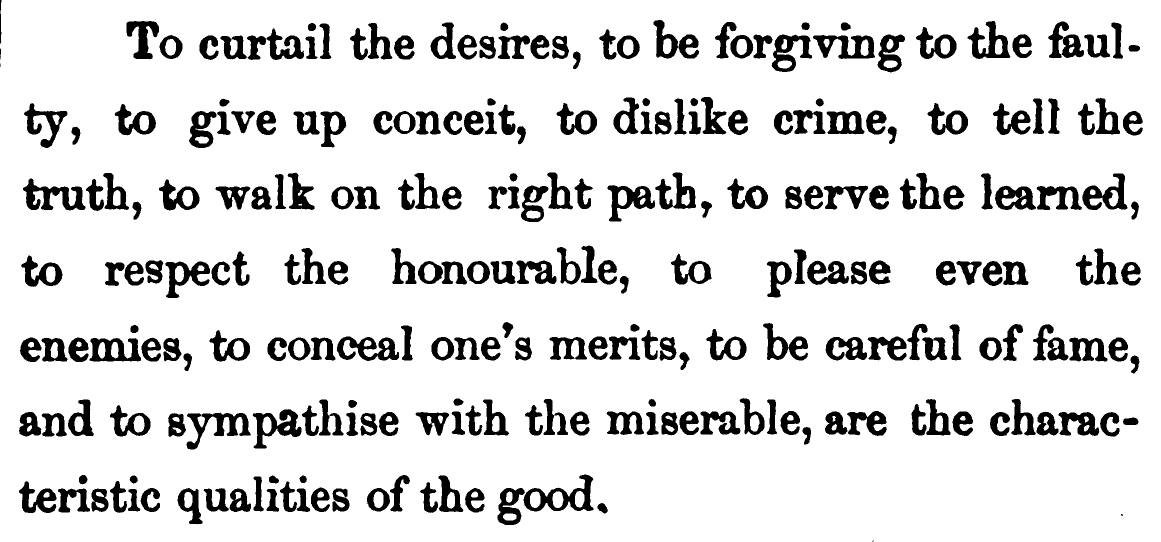
To curtail the desires, to be forgiving to the faulty, to give up conceit, to dislike crime, to tell the truth, to walk on the right path, to serve the learned, to respect the honourable, to please even the enemies, to conceal one's merits, to be careful of fame, and to sympathise with the miserable, are the characteristic qualities of the good.

Gopinath1896
all
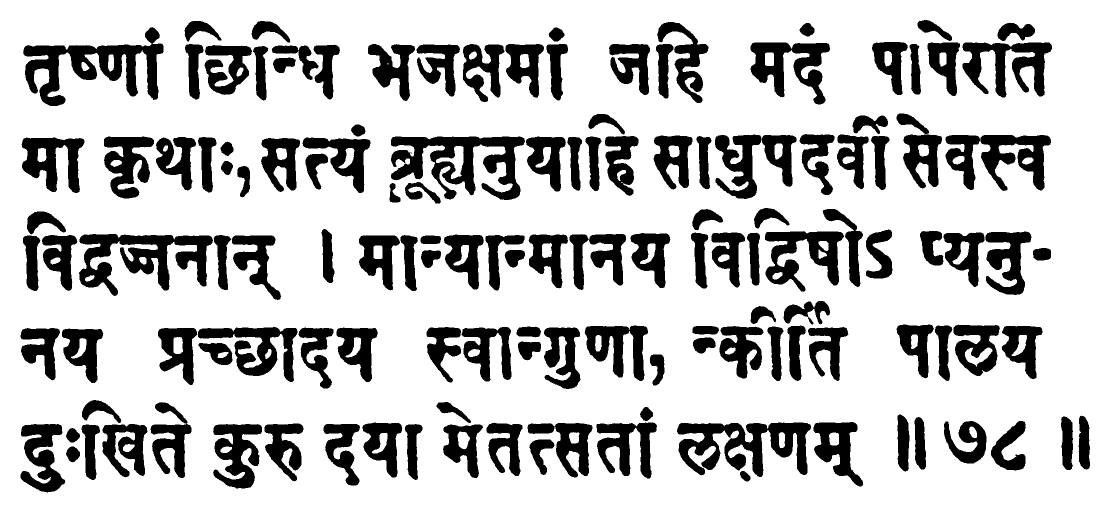
तृष्णां छिन्धि भजक्षमां जहि मदं पापेरति
मा कृथाः, सत्यं ब्रूह्यनुयाहि साधुपदवीं सेवस्व
विद्वज्जनान् । मान्यान्मानय विद्विषोऽ प्यनु-
नय प्रच्छादय स्वान्गुणा, कीर्ति पालय
दुःखिते कुरु दया मेतत्सतां लक्षणम् ॥ ७८ ॥
तृष्णाका छेदन कर, क्षमा का अवलंबनकर, अभिमान का त्यागकर, पापकर्म में प्रीति मतरख, सत्यका भाषण कर, साधुजनों का अनुसरण कर, पंडितों की सेवाकर, मान्यजनों का समादर कर, शत्रुगणों को भी प्रसन्न कर निजगुणों की प्रशस्ति मतकर, सुयशका पालनकर और) दीन दुःखित मनुष्यों पर दयाकर । ये सब सत्पुरुषों के लक्षण हैं ॥ ७८ ॥
To curtail the desires, to be forgiving to the faulty, to give up conceit, to dislike crime, to tell the truth, to walk on the right path, to serve the learned, to respect the honourable, to please even the enemies, to conceal one's merits, to be careful of fame, and to sympathise with the miserable, are the characteristic qualities of the good.
Kosambi
all
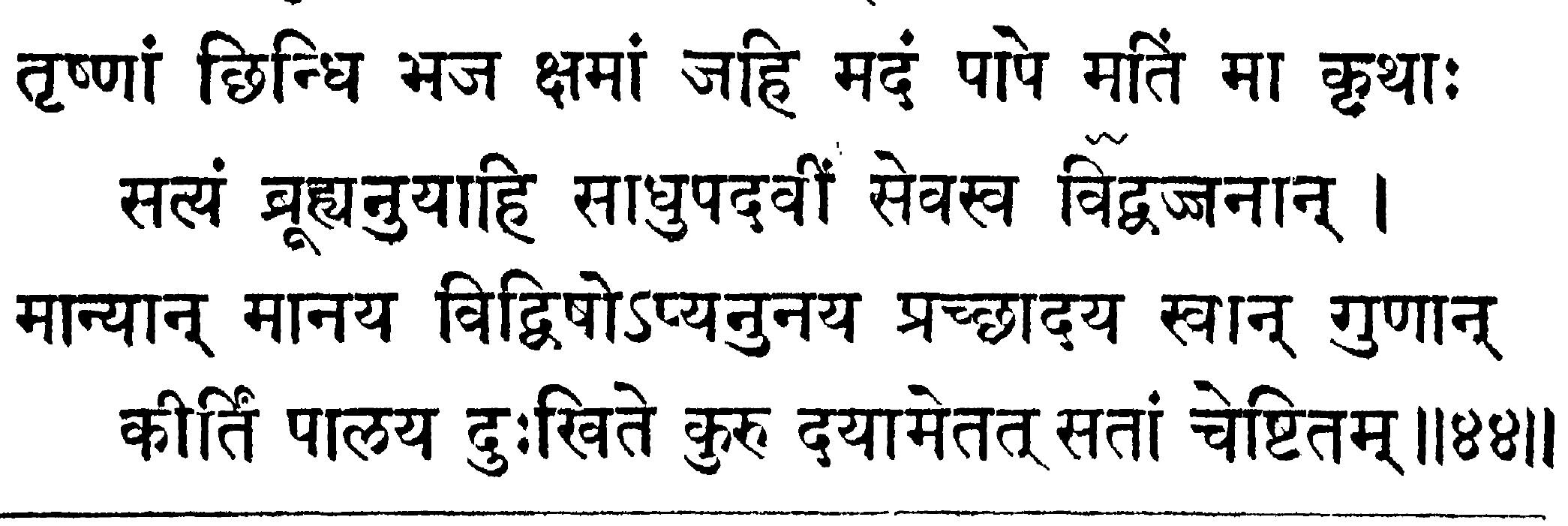
तृष्णां छिन्धि भज क्षमां जहि मदं पापे मतिं मा कृथाः
सत्यं ब्रूनुयाहि साधुपदवीं सेवस्व विद्वज्जनान् ।
मान्यान् मानय विद्विषोऽप्यनुनय प्रच्छादय खान् गुणान्
कीर्तिं पालय दुःखिते कुरु दयामेतत् सतां चेष्टितम् ॥४४ ॥
Footnote
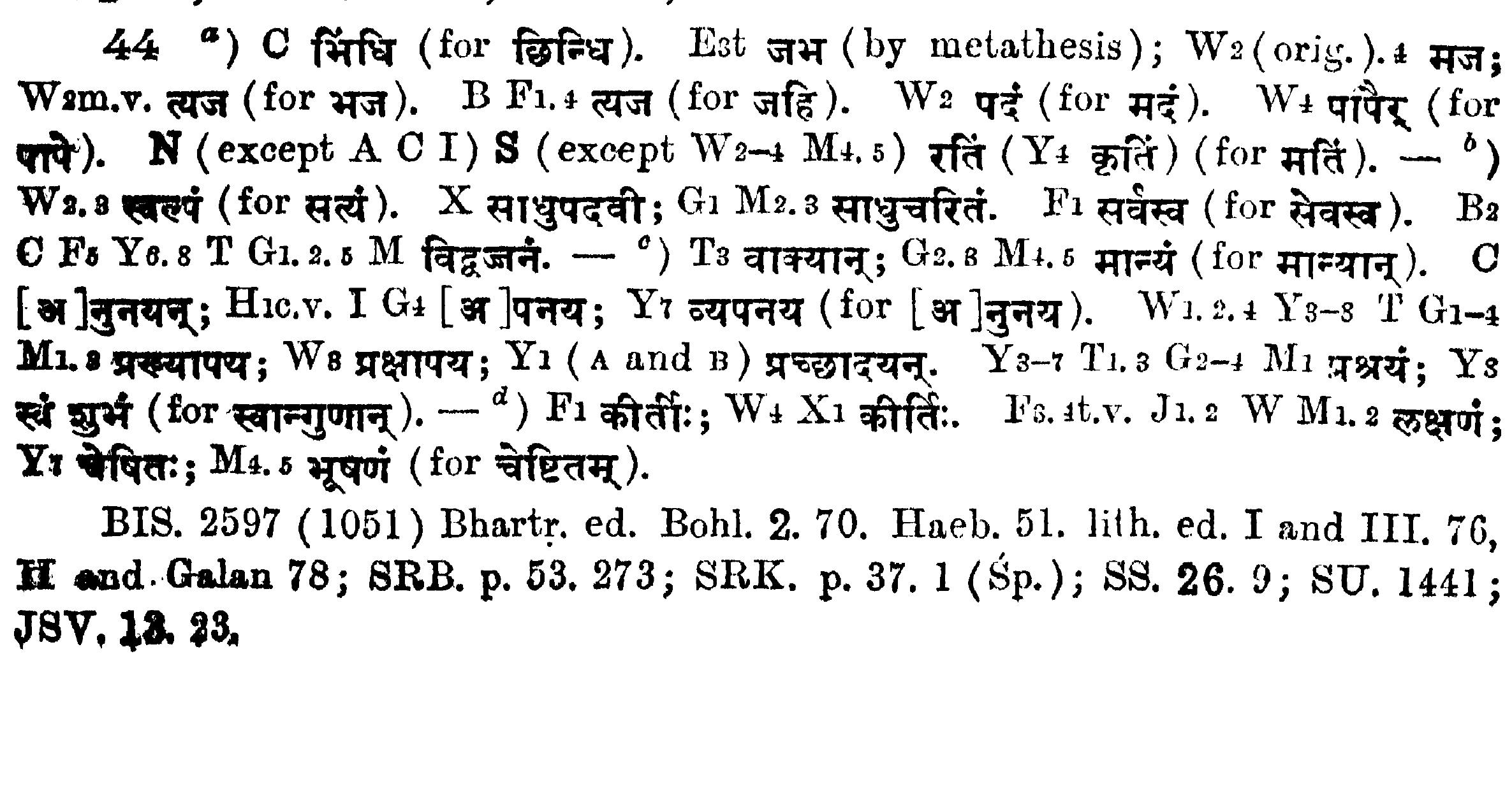
44 " ) C सिंधि ( for छिन्धि ) . Est जभ ( by metathesis ) ; W2 ( orig . ) 4 मज ;
Wam.v. त्यज ( for भज ) . B F14 त्यज ( for जहि ) . W2 पई ( for मदं ) . W + पॉपैर् ( for
पापे ) . N ( except A CI ) S ( except W2M + 5 ) रतिं ( Y1 कृतिं ) ( for मतिं ) . - 6 )
W2.8 स्वल्पं ( for सत्यं ) . X साधुपदवी ; G1 M2 . 3 साधुचरितं . F1 सर्वस्व ( for सेवस्त्र ) . Ba
CF5 Y6.8 T G1.2.6M विद्वजनं . ° ) T3 वाक्यान् ; G2 . BM + 5 मान्यं ( for मान्यान् ) . C
[ अ ] नुनयन् ; Hic.v. IG ½ [ अ ] पनय ; Y7 व्यपनय ( for [ अ ] नुनय ) . W 1 2 ● 4 Y3-3 T G1-4
M1.8 प्रख्यापथ ; W : प्रक्षापय ; Y1 ( A and B ) प्रच्छादयन् . Y3 - 7T1.3 G2 - 4 M1 प्रश्रयं ; Ys
स्वं शुभं ( for स्वान्गुणान् ) . – G 4 ) F1 कीर्ती :; W + X1 कीर्ति : Fs.1t.v. J12 WM1.2 लक्षणं ;
Y1 चेषितः ; M4.5 भूषणं ( for चेष्टितम् ) .
BIS . 2597 ( 1051 ) Bhartr ed . Bohl . 2.70 . Haeb . 51. lith ed . I and III . 76 ,
Hand . Galan 78 ; SRB . p . 53. 273 ; SRK . p . 37. 1 ( Sp . ) ; SS . 26.9 ; SU . 1441 ;
JSV . 18 23 ,
Commentary