Ryder
ONE FATE OF TWO
One fate of two for the jasmine flower,
The same for the wise and good;
To shine at the head of all the world,
Or to wither in the wood.
Tawney
Two paths are open to the proud,
As to the woodland flowers,
Which flourish high above the crowd,
Or wither in the bowers.
Telang
all
Notes
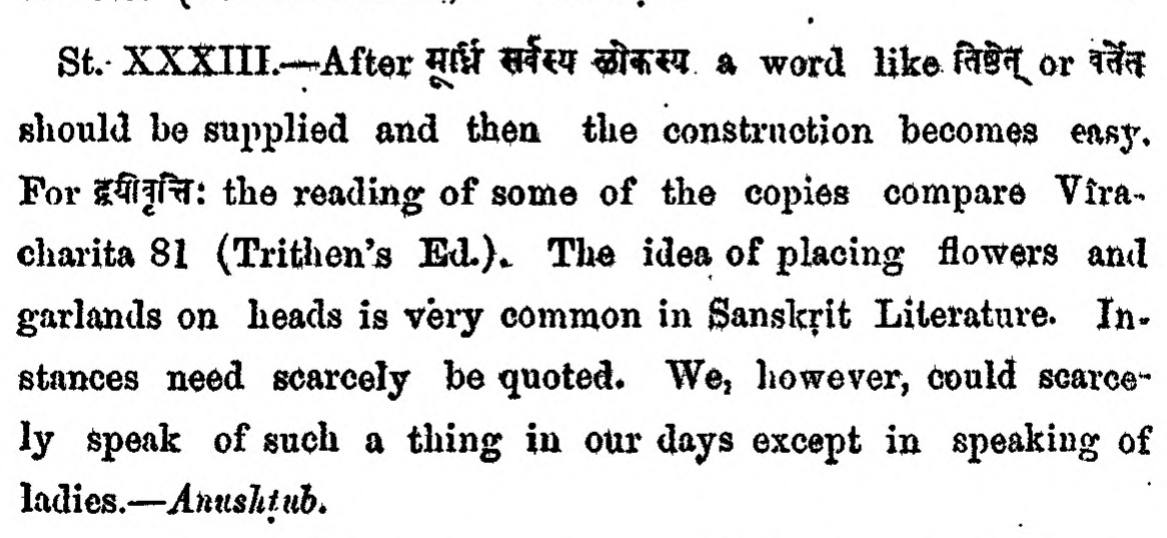
St. XXXIII.—After मूर्ध्नि सर्वस्य लोकस्य a word like तिष्ठेत् or वर्तेत should be supplied and then the construction becomes easy. For द्वयीवृत्तिः the reading of some of the copies compare Vîracharita 81 (Trithen’s Ed.). The idea of placing flowers and garlands on heads is very common in Sanskṛit Literature. Instances need scarcely be quoted. We, however, could scarcely speak of such a thing in our days except in speaking of ladies.—Anushṭub.

Telang
all

Notes
St. CIV.—The first line is ungrammatical, unless ह is taken as an expletive by itself. But ह is not used in the class of works to which these S'atakas belong. See St. 33.—Anushṭub.


Kale
all


Translation
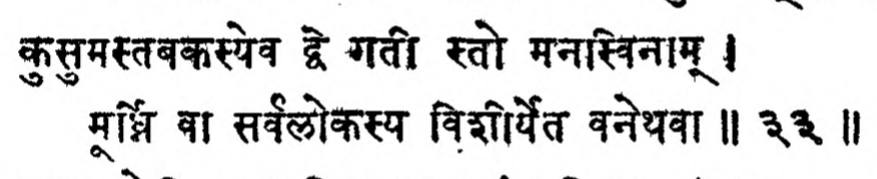
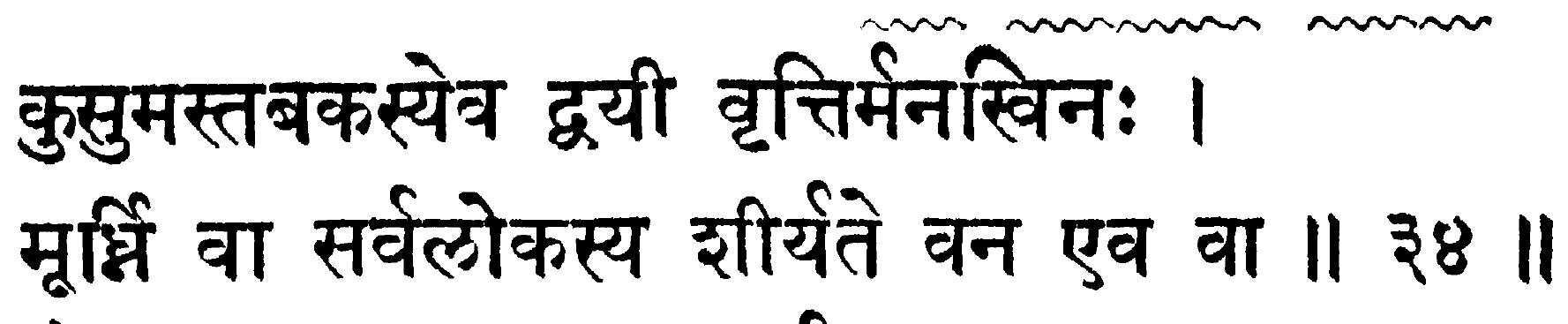
33. High-minded people have a two-fold course of action like a bunch of flowers. viz. to stand at the head ( in the case of flowers—on the heads, ) of all men, or to wither away in a forest.

Notes
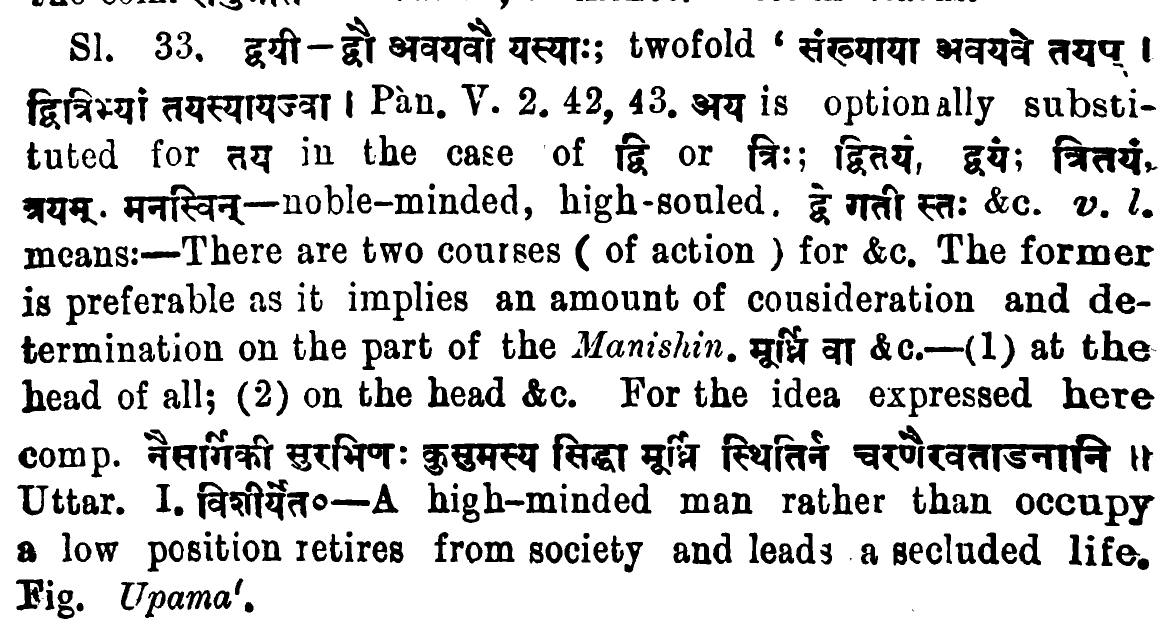
Sl. 33. द्वयी—द्वौ अवयवौ यस्याः; twofold ‘संख्याया अवयवे तयप् । द्वित्रिभ्यां तयस्यायज्वा । Pàn. V. 2. 42, 43. अय is optionally substituted for तय in the case of द्वि or त्रिः; द्वितयं, द्वयं; त्रितयं, त्रयम्. मनस्विन्—noble-minded, high-souled. द्वे गती स्तः &c. v. l. means:—There are two courses ( of action ) for &c. The former is preferable as it implies an amount of cousideration and determination on the part of the Manishin. मूर्ध्नि वा &c.—(1) at the head of all; (2) on the head &c. For the idea expressed here comp. नैसर्गिकी सुरभिणः कुसुमस्य सिद्धा मूर्ध्नि स्थितिर्न चरणैरवताडनानि ॥ Uttar. I. विशीर्येत०—A high-minded man rather than occupy a low position retires from society and leads a secluded life. Fig. Upama'.

Kale
all


Translation
3. High-souled persons have, like the mâlatí flower, two fates ( in store for them ), either to be at the head of all men, or to fade away in a forest.

Notes
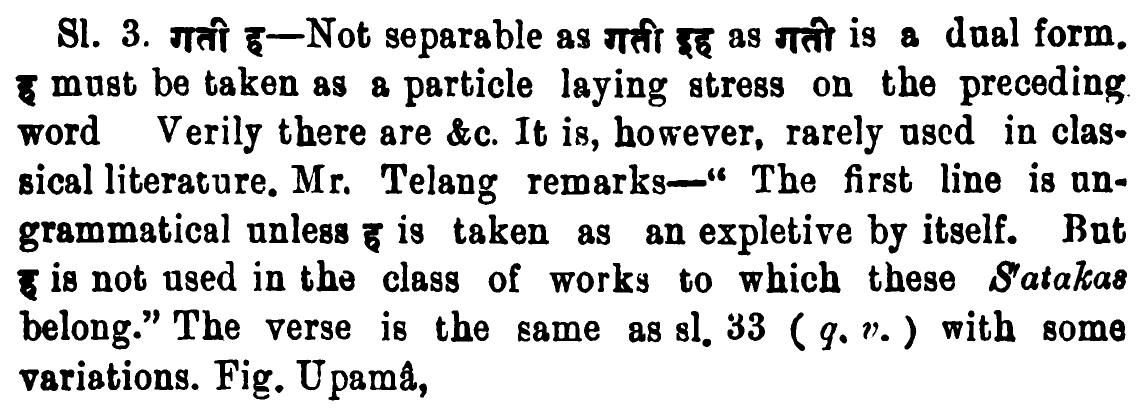
Sl. 3. गती ह—Not separable as गती इह as गती is a dual form. ह must be taken as a particle laying stress on the preceding word Verily there are &c. It is, however, rarely used in classical literature. Mr. Telang remarks—“ The first line is ungrammatical unless ह is taken as an expletive by itself. But ह is not used in the class of works to which these S'atakas belong.” The verse is the same as sl. 33 ( q. v. ) with some variations. Fig. Upamâ,
Gopinath1914
all
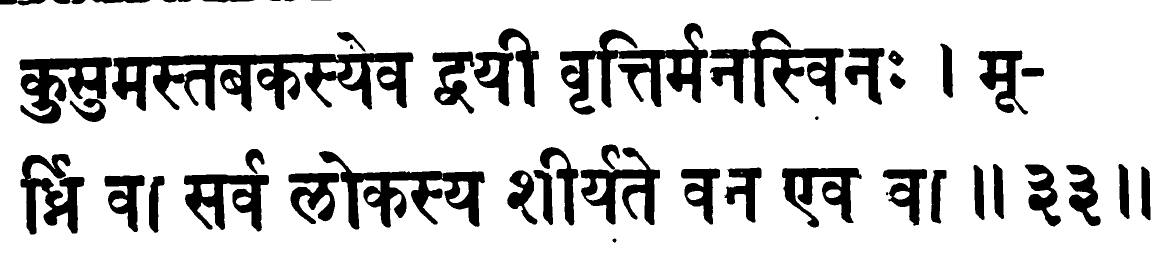
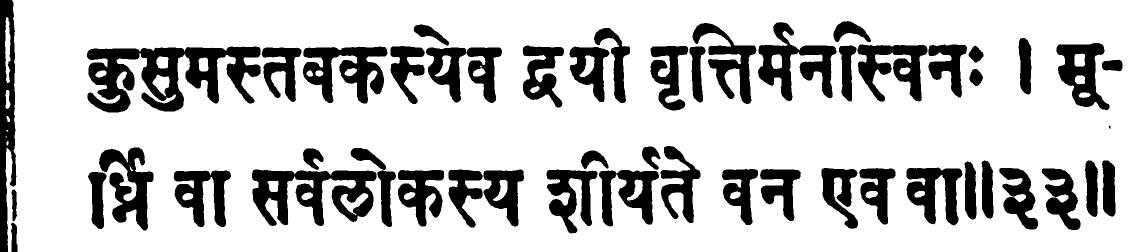
पुष्पके गुच्छेकी तरह विचारशील मनुष्योंकी स्थिति भी इस संसारमें केवल दोही प्रकारकी होती है अर्थात् या तो वे सर्वसाधारणके शिरोमणिही बनते हैं अथवा वनके वनहीमें अपना जीवन व्यतीत करदेते हैं ॥ ३३ ॥
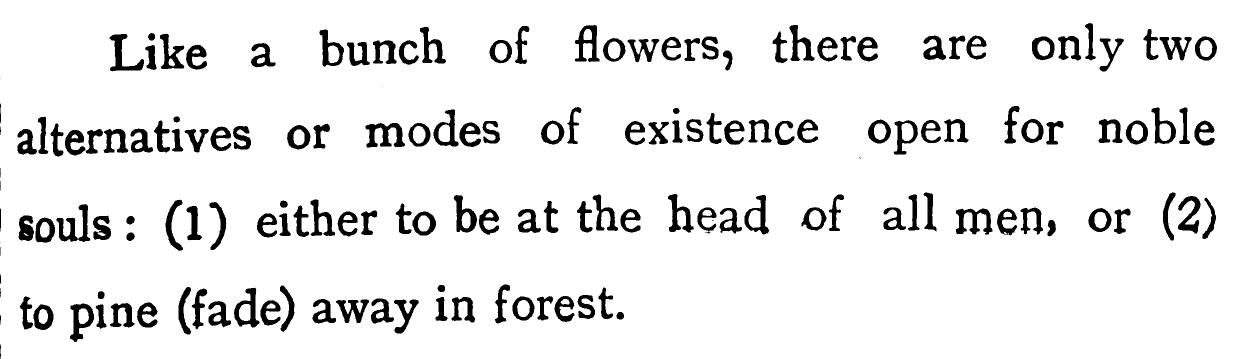
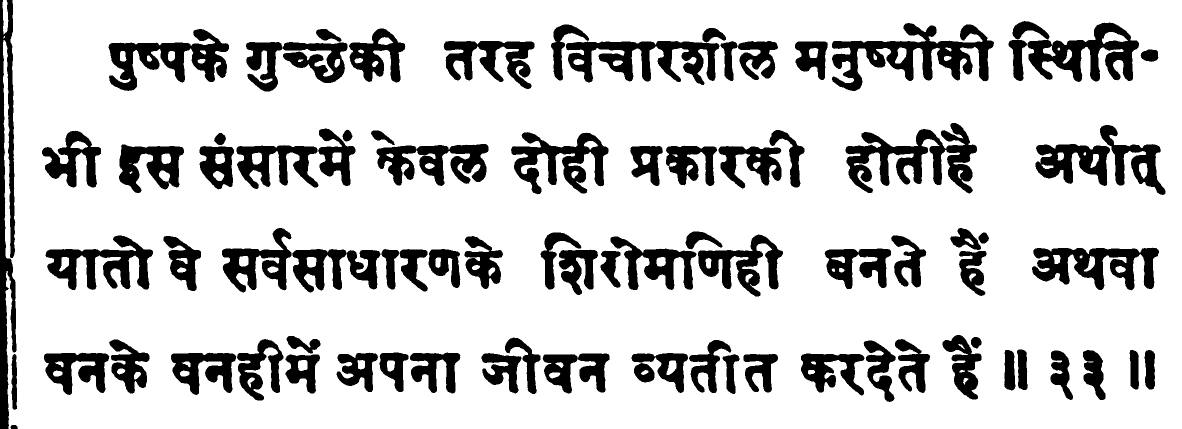
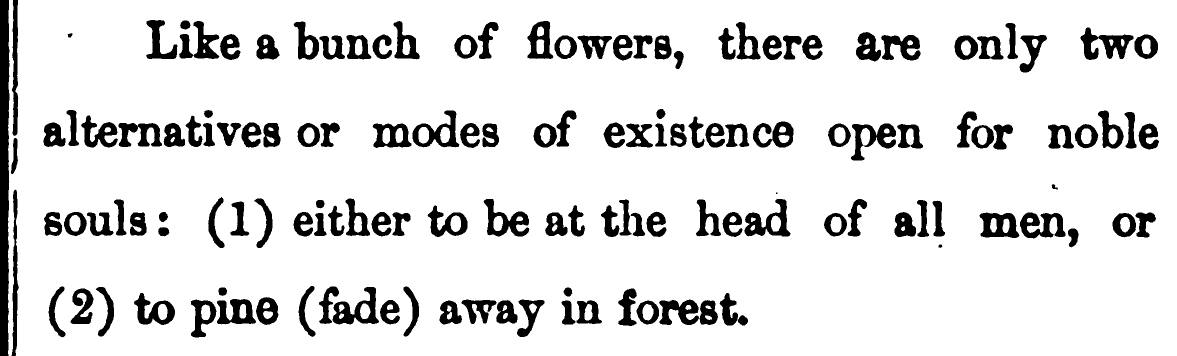
Like a bunch of flowers, there are only two alternatives or modes of existence open for noble souls : (1) either to be at the head of all men, or ( 2 ) to pine (fade) away in forest.
Cf. (a ) " पुंसामुन्मत्तचित्तानां द्वयमेव सुखावहम्
सर्व संगनिवृतिर्वा विभूतिर्वा सविस्तरा ॥" (सूक्तावलिः).


Footnote
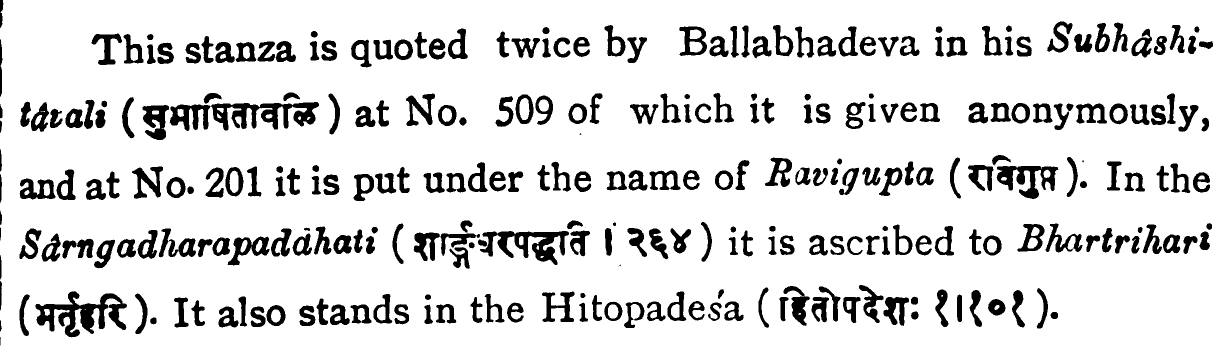
This stanza is quoted twice by Ballabhadeva in his Subhashithrali ( सुभाषितावळि) at No. 509 of which it is given anonymously, and at No. 201 it is put under the name of Ravigupta ( रविगुप्त ). In the Sarngadharapadāhati ( शार्ङ्गचरपद्धति | २६४) it is ascribed to Bhartrihari ( भर्तृहरि). It also stands in the Hitopadeśa (हितोपदेशः १।१०१ ).
Gopinath1896
all
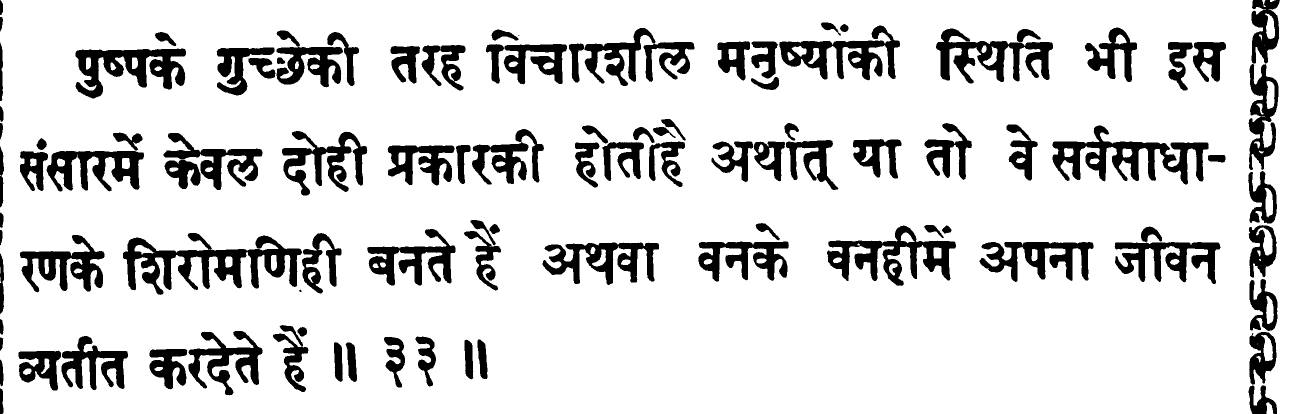
पुष्पके गुच्छेकी तरह विचारशील मनुष्योंकी स्थितिभी इस संसारमें केवल दोही प्रकारकी होतीहै अर्थात् यातो वे सर्वसाधारणके शिरोमणिही बनते हैं अथवा वनके वनहीमें अपना जीवन व्यतीत करदेते हैं ॥ ३३ ॥
Like a bunch of flowers, there are only two alternatives or modes of existence open for noble souls : (1) either to be at the head of all men, or (2) to pine (fade) away in forest.
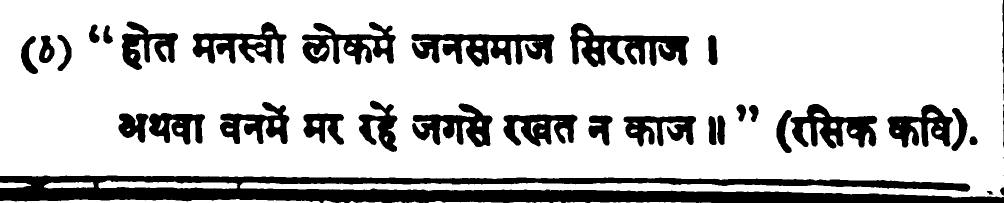
Cf.—(a) “पुंसामुन्मत्तचित्तानां द्वयमेव सुखावहम् ।
सर्वसंगनिवृत्तिर्वा विभूतिर्वासविस्तरा ॥ ” (मुक्तावलिः).

Footnote
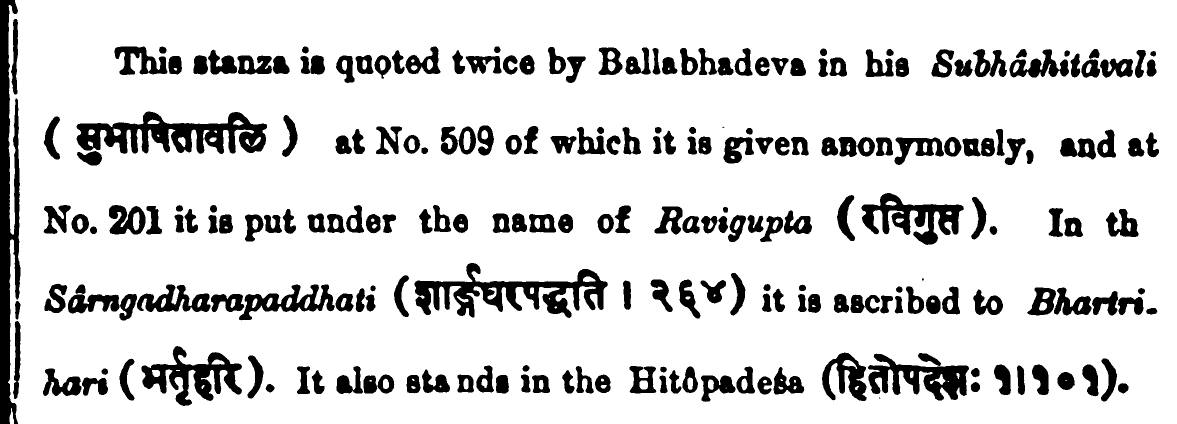
This stanza is quoted twice by Ballabhadeva in his Subhâshitâvali ( सुभाषितावलि ) at No. 509 of which it is given anonymously, and at No. 201 it is put under the name of Ravigupta (रविगुप्त). In th Sârngadharapaddhati (शार्ङ्गधरपद्धति । २६४) it is ascribed to Bhartrihari (भर्तृहरि). It also stands in the Hitôpadeśa (हितोपदेशः १।१०१).
Kosambi
all
Footnote
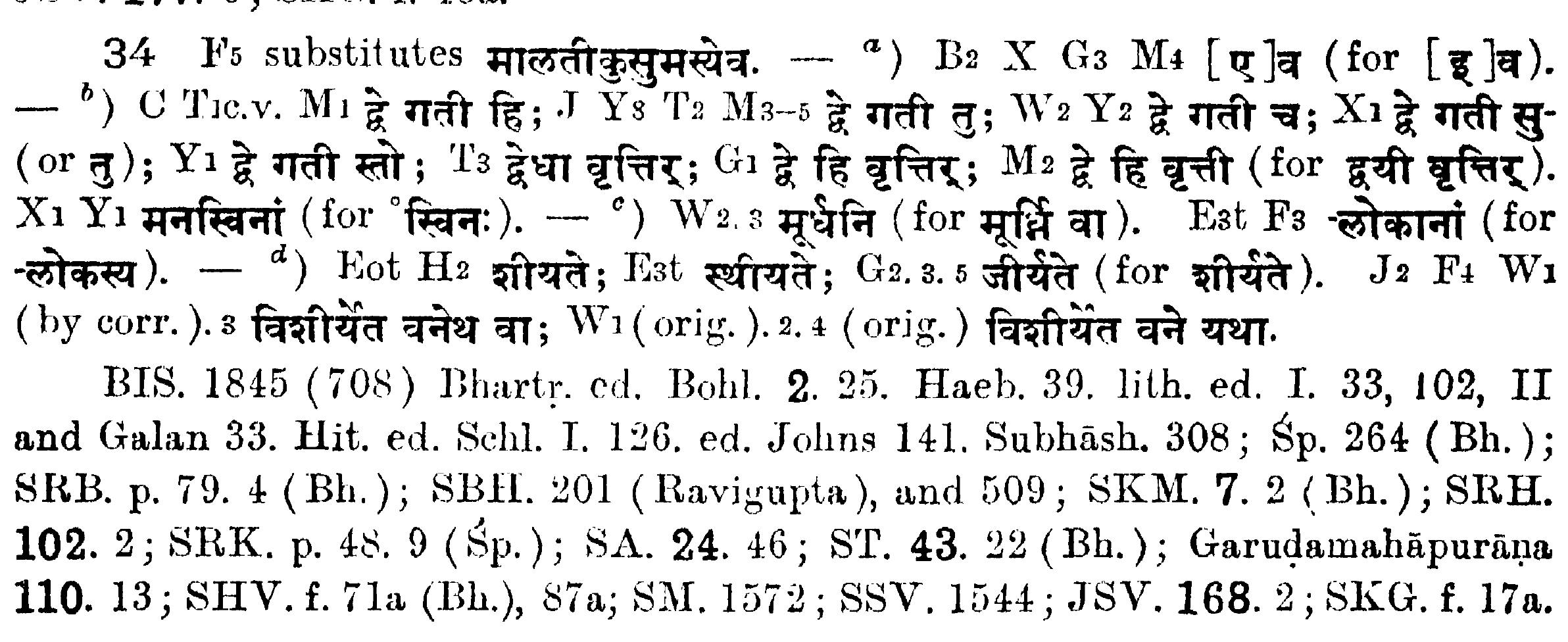
34 Fs substitutes मालती कुसुमस्येव . ± ) B2_X_G3 M + [ ए ] व ( for [ इ ] व ) .
- 6 ) C Tie.v. M 1 द्वे गती हि ; J Ys T2 M3 - 5 द्वे गती तु ; W2 Y2 द्वे द्वे गती च ; X 1 द्वे गती सु सु
( or तु ) ; Y 1 द्वे गती स्तो ; T3 द्वेधा वृत्तिर् ; G 1 द्वे हि वृत्तिर् ; M2 द्वे हि वृत्ती ( for द्वयी वृत्तिर् ) .
X 1 X 1 मनस्विनां ( for ' स्विनः ) . ● ) W2 . 3 मूर्धनि ( for मूर्ध्नि वा ) . Est F3 लोकानां ( for
-लोकस्य ) . d ) Hot H2 शीयते ; Est स्थीयते ; G2 . 3.5 जीयेते ( for शीर्यते ) . J2 F½ W1
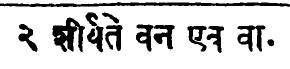
( by corr . ) . 3 विशीर्येत वनेथ वा ; W1 ( orig . ) . 2. 4 ( orig . ) विशीयेत वने यथा .
BIS . 1845 ( 708 ) Bhartr . cd . Bohl . 2 25. Haeb . 39. lith ed . I. 33 , 102 , II
and Galan 33. Hit ed . Sehl . I. 126 ed . Johns 141. Subhash 308 ; Sp . 264 ( Bh . ) ;
SRB . p . 79. 4 ( Bh . ) ; SBH . 201 ( Ravigupta ) , and 509 ; SKM . 7. 2 ( Bh . ) ; SRH .
102.2 ; SRK . p . 48. 9 ( Sp . ) ; SA . 24 46 ; ST . 43. 22 ( Bh . ) ; Garudamahāpuräņa
110. 13 ; SHV . f . 71a ( Bb . ) , 87a ; SM . 1572 ; SSV . 1544 ; JSV . 168 2 ; SKG . f . 17a .
Commentary