Tawney
Kindness can turn the bad man's heart, and fools convert to wise,
Make poison into nectar-juice, and friends of enemies,
Bring distant objects near: then strive that talisman to gain,
Nor set thy heart on glorious gifts acquired with endless pain.
Telang
all
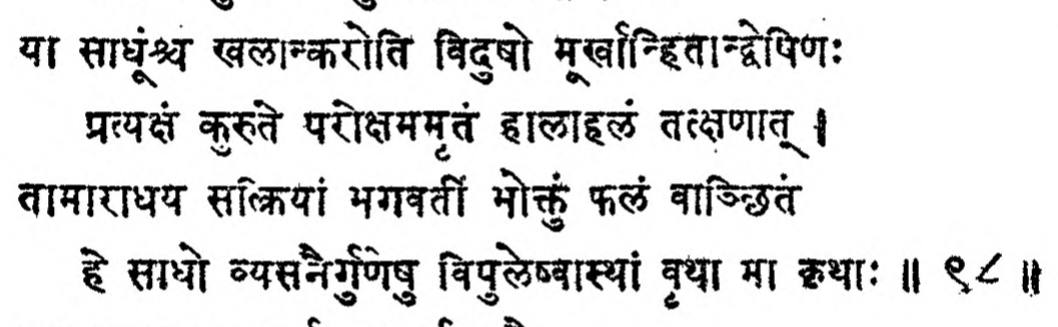
या साधूंश्च खलान्करोति विदुषो मूर्खान्हितान्द्वेषिणः
प्रत्यक्षं कुरुते परोक्षममृतं हालाहलं तत्क्षणात् ।
तामाराधय सत्क्रियां भगवतीं भोक्तुं फलं वाञ्छितं
हे साधो व्यसनैर्गुणेषु विपुलेष्वास्थां वृथा मा कृथाः ॥ ९८ ॥
Notes
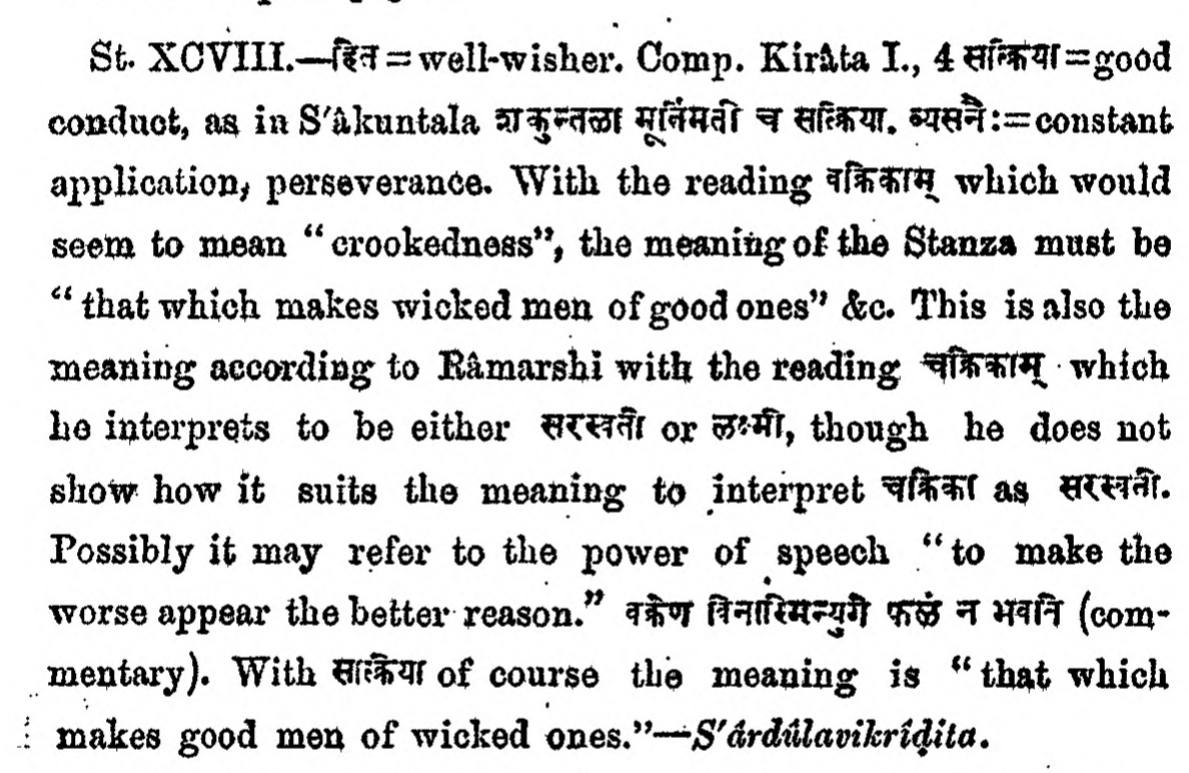
St. XCVIII.—हित = well-wisher. Comp. Kirâta I., 4 सत्क्रिया = good conduct, as in S'âkuntala शकुन्तला मूर्तिमती च सत्क्रिया. व्यसनैः = constant application, perseverance. With the reading वक्रिकाम् which would seem to mean “crookedness”, the meaning of the Stanza must be “that which makes wicked men of good ones” &c. This is also the meaning according to Râmarshi with the reading चक्रिकाम् which he interprets to be either सरस्वती or लक्ष्मी, though he does not show how it suits the meaning to interpret चक्रिका as सरस्वती. Possibly it may refer to the power of speech “to make the worse appear the better reason.” वक्रेण विनास्मिन्युगे फलं न भवति (commentary). With सत्क्रिया of course the meaning is “that which makes good men of wicked ones.”—S'ârdûlavikrîḍita.

Kale
all

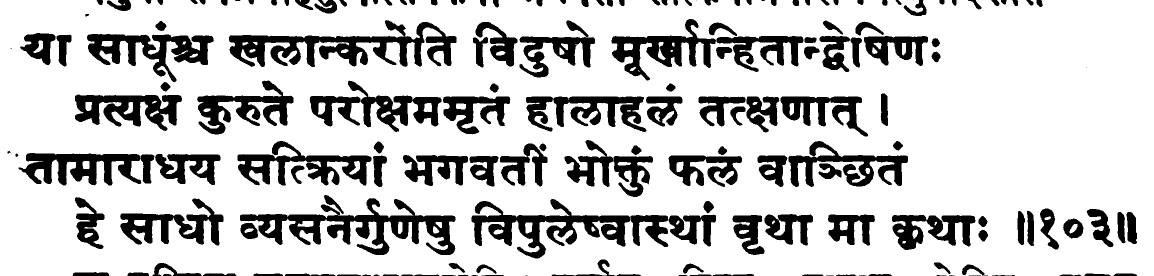
या साधूंश्च खलान्करोति विदुषो मूर्खान्हितान्द्वेषिणः
प्रत्यक्षं कुरुते परोक्षममृतं हालाहलं तत्क्षणात् ।
तामाराधय सत्क्रियां भगवतीं भोक्तुं फलं वाञ्छितं
हे साधो व्यसनैर्गुणेषु विपुलेष्वास्थां वृथा मा कृथाः ॥१०३॥
Translation
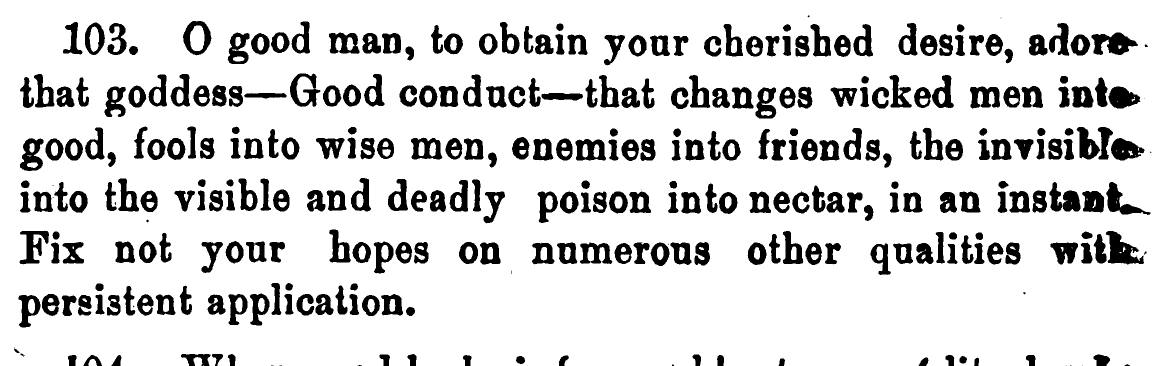
103. O good man, to obtain your cherished desire, adore that goddess—Good conduct—that changes wicked men into good, fools into wise men, enemies into friends, the invisible into the visible and deadly poison into nectar, in an instant. Fix not your hopes on numerous other qualities with persistent application.
Notes
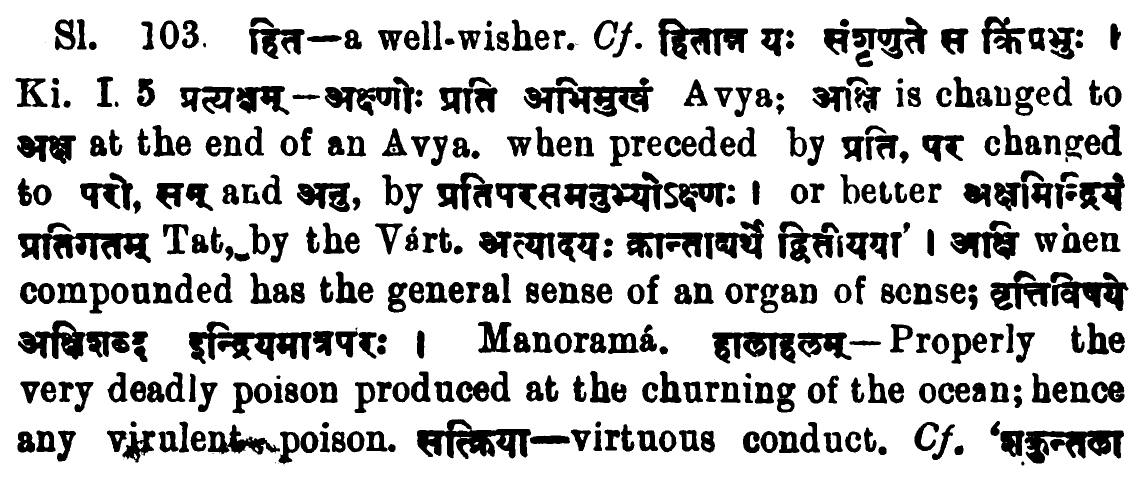
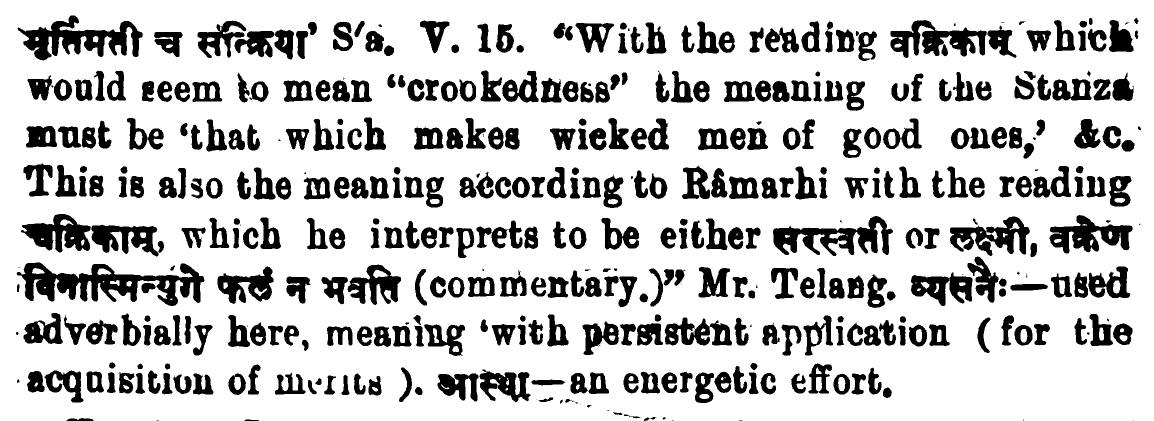
Sl. 103. हित—a well-wisher. Cf. हितान्न यः संशृणुते स किंप्रभुः । Ki. I. 5 प्रत्यक्षम्—अक्ष्णोः प्रति अभिमुखं Avya; अक्षि is changed to अक्ष at the end of an Avya. when preceded by प्रति, पर changed to परो, सम् and अनु, by प्रतिपरसमनुभ्योऽक्ष्णः । or better अक्षमिन्द्रियं प्रतिगतम् Tat, by the Várt. अत्यादयः क्रान्ताद्यर्थे द्वितीयया' । अक्षि when compounded has the general sense of an organ of sense; वृत्तिविषये अक्षिशब्द इन्द्रियमात्रपरः । Manoramá. हालाहलम्—Properly the very deadly poison produced at the churning of the ocean; hence any virulent poison. सत्क्रिया—virtuous conduct. Cf. 'शकुन्तला मूर्तिमती च सत्क्रिया' S'a. V. 15. “With the reading वक्रिकाम् which would seem to mean “crookedness” the meaning of the Stanza must be ‘that which makes wicked men of good ones,’ &c. This is also the meaning according to Râmarhi with the reading चक्रिकाम्, which he interprets to be either सरस्वती or लक्ष्मी, वक्रेण विनास्मिन्त्युगे फलं न भवति (commentary.)” Mr. Telang. व्यसनैः—used adverbially here, meaning ‘with persistent application ( for the acquisition of merits ). आस्था—an energetic effort.
Gopinath1914
all
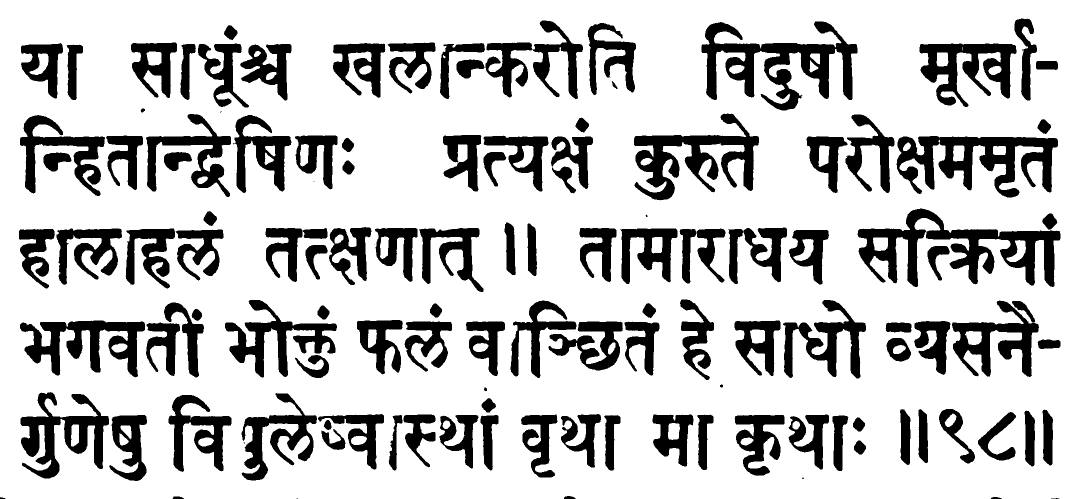
या साधूंश्व खलान्करोति विदुषो मूर्खा-
न्हितान्द्वेषिणः प्रत्यक्षं कुरुते परोक्षममृतं
हालाहलं तत्क्षणात् । तामाराधय सत्क्रियां
भगवतीं भोक्तुं फलं वाञ्छितं हे साधो व्यसनै-
र्गुणेषु विध्वास्थां वृथा मा कृथाः ॥ ९८ ॥
हे सांधुजनो ! यदि आप अपने मनोवांछित फल भोगनेकी इच्छा रखते हो तो अन्यान्य गुणसमूहमें वृथा आसक्त न होकर केवल सदाचारहीकी आराधना करो कि जो दुर्जनोंको सज्जन, मूर्खोको पंडित, शत्रुओंको मित्र, परोक्षको प्रत्यक्ष और हालाहलको अमृत बनानेकी तात्कालिक सामर्थ्य रखता है ॥ ९८ ॥
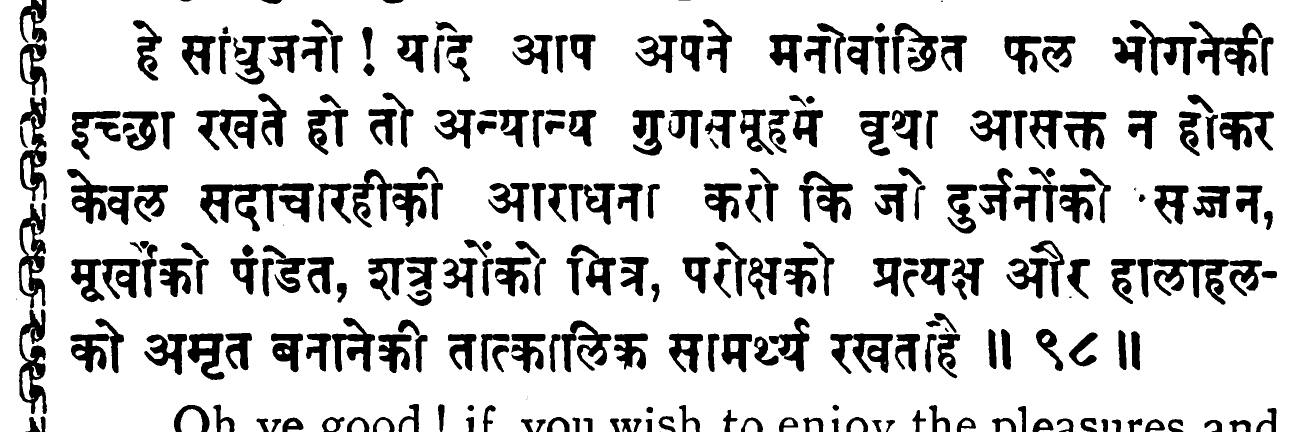
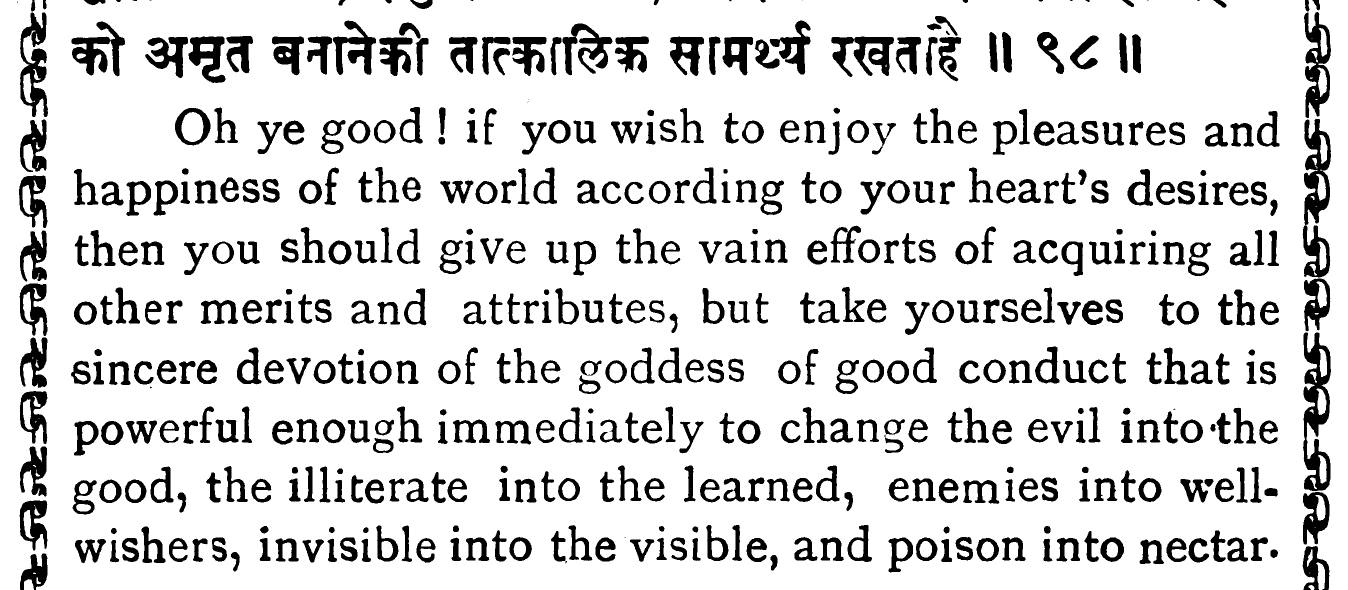
Oh ye good! if you wish to enjoy the pleasures and happiness of the world according to your heart's desires, then you should give up the vain efforts of acquiring all other merits and attributes, but take yourselves to the sincere devotion of the goddess of good conduct that is powerful enough immediately to change the evil into the good, the illiterate into the learned, enemies into wellwishers, invisible into the visible, and poison into nectar.
Footnote
Quoted under Srivar lhana ( श्रोवर्धन ) in the Subhashitavali ( सुभा षितावलि), at No. 3074.

Footnote
Cf. (a) The great high road of human welfare lies along the old pathway of steady welldoing; and those who are the most persistent, and work in the true spirit, will invariably be the most ; success treads on the heels of every right effort. (successfulSamuel Smiles ).


Gopinath1896
all
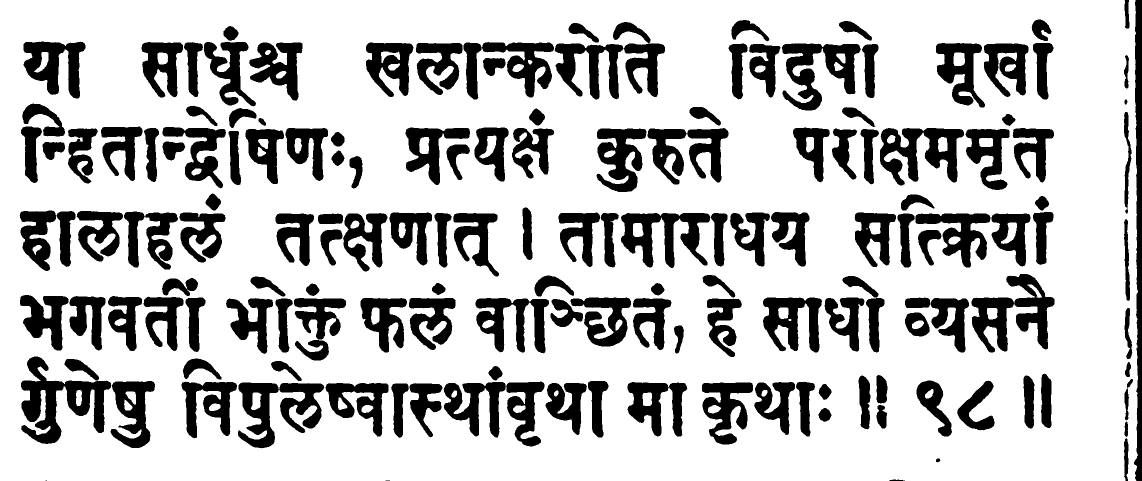
या साधूंश्च खलान्करोति विदुषो मूर्खा
निहतान्द्वेषिणः, प्रत्यक्षं कुरुते परोक्षममृत
हालाहलं तत्क्षणात् । तामाराधय सत्क्रियां
भगवतीं र्गुणेषु भोक्तुं फलं वाञ्छितं, हे साधो व्यसनै
विपुलेष्वास्थांवृथा मा कृथाः ॥ ९८ ॥
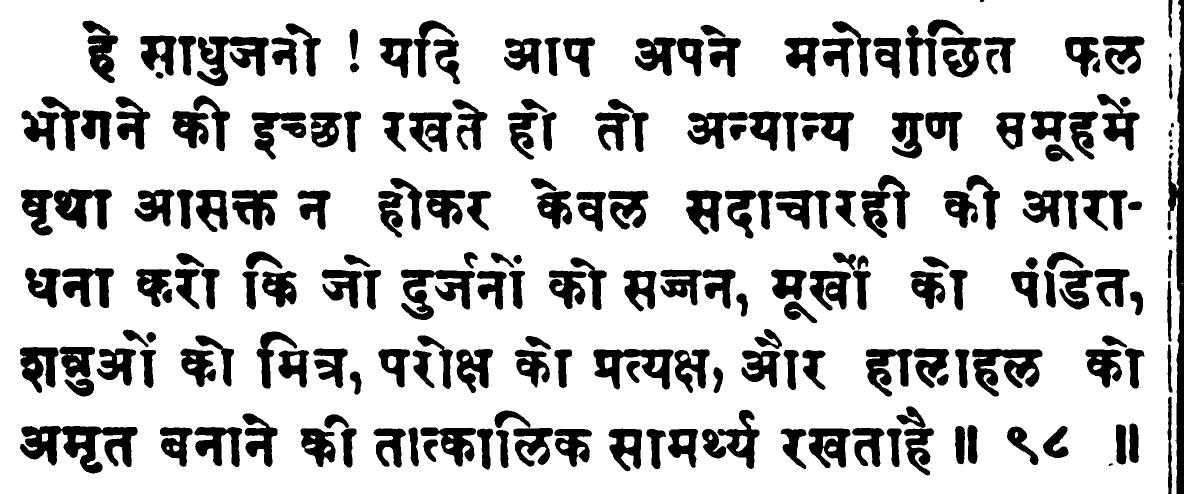
हे साधुजनो ! यदि आप अपने मनोवांछित फल भोगने की इच्छा रखते हो तो अन्यान्य गुण समूह में वृथा आसक्त न होकर केवल सदाचारही की आराधना करो कि जो दुर्जनों को सज्जन, मूर्खो को पंडित, शत्रुओं को मित्र, परोक्ष को प्रत्यक्ष, और हालाहल को अमृत बनाने की तात्कालिक सामर्थ्य रखता है ॥ ९८ ॥
Oh ye good! if you wish to enjoy the pleasures and happiness of the world according to your heart's desires, then you should give up the vain efforts of acquiring all other merits and attributes, but take yourselves to the sincere devotion of the goddess of good conduct that is powerful enough immediately to change the evil into the good, the illiterate into the learned, enemies into wellwishers, invisible into the visible, and poison into nectar.


Footnote
Cf—(@) “ The great high road of human welfare lies along the old pathway of steady welldoing: and those who are the most persistent, and work in the true spirit, will invariably be the most successful ; success treads on the heels of every right effort.” (Samnel Smiles)


Kosambi
all
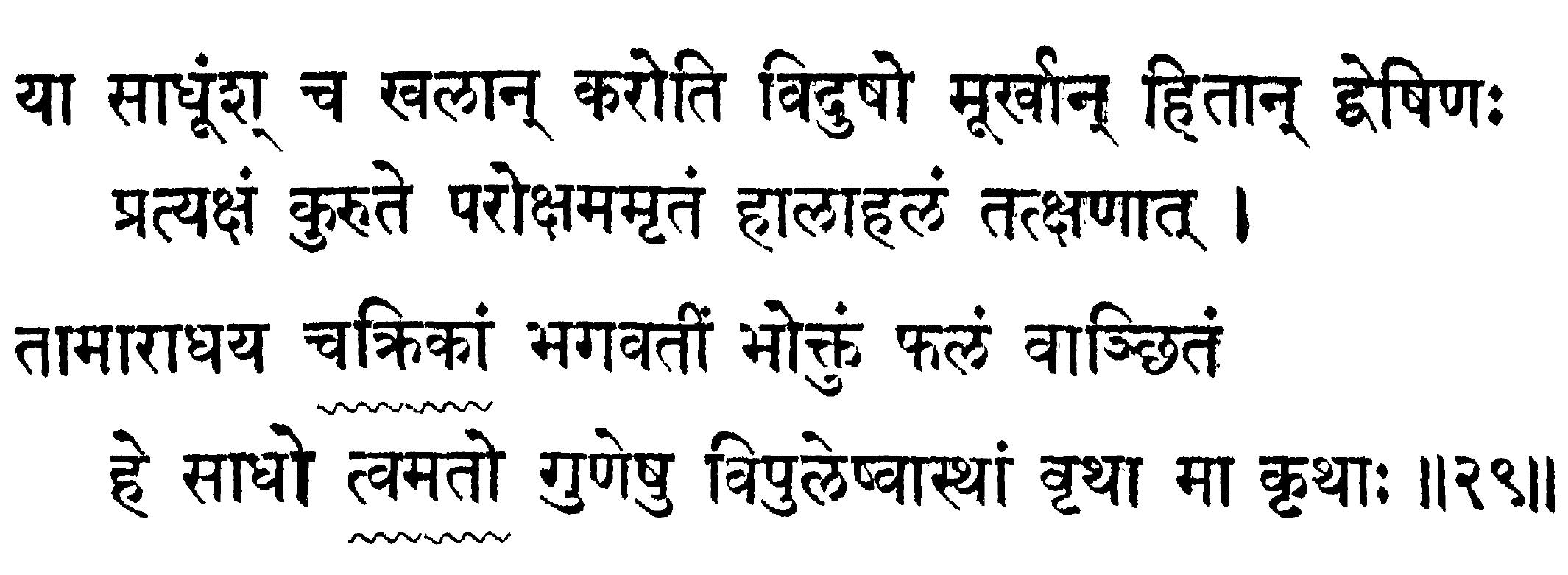
या साधूंश् च खलान् करोति विदुषो मूर्खान् हितान् द्वेषिणः
प्रत्यक्षं कुरुते परोक्षममृतं हालाहलं तत्क्षणात् ।
तामाराधय चक्रिकां भगवतीं भोक्तुं फलं वाञ्छितं
हे साधो त्वमतो गुणेषु विपुलेष्वास्थां वृथा मा कृथाः ॥२ ९ ॥
Footnote
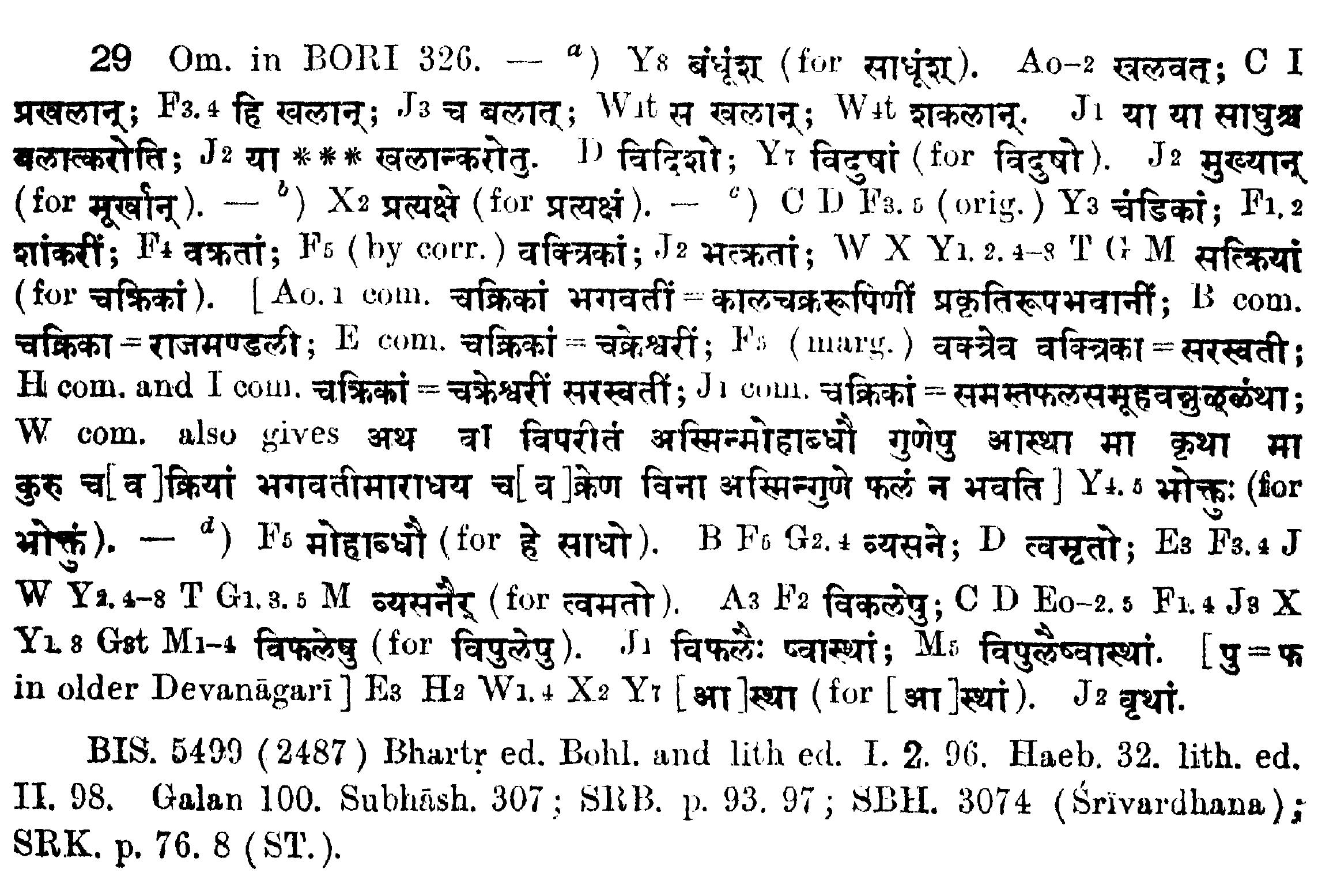
29 Om in BORI 326. a ) Ys बंधूंश् ( for साधूंश ) . Ao - 2 खलवत् ; C c I
प्रखलान् ; F3 . 4 हि खलान् ; J3 च बलात् ; Wit स खलान् ; Wit शकलान् . J1 या या साधुश्च
बलात्करोति ; J2 J2 या *** खलान्करोतु . 1 ) विदिशो ; Y : विदुषां ( for विदुषो ) . J2 मुख्यान्
( for मूर्खान् ) . – 4 ) X 2 प्रत्यक्षे ( for प्रत्यक्षं ) . “ ) C D F3 . 5 ( orig . ) Y3 चंडिकां ; F1 . 2
शांकरीं ; F + वक्रतां ; Ps ( by corr . ) चक्त्रिकां ; J2 भत्तां ; W X Y 1 , 2 , 4–4 T G M सकियां
( for चक्रिकां ) . [ Ao . 1 com . चक्रिकां भगवतीं - कालचक्ररूपिणीं प्रकृतिरूपभवानीं ; B com .
चक्रिका - राजमण्डली ; E com . चक्रिकां = चक्रेश्वरीं ; I ( marg . ) वक्त्रेव वत्रिका - - सरस्वती ;
Hcom . and I cou . चक्रिकां - चक्रेश्वरीं सरस्वतीं ; J1 . चक्रिकां - समस्तफलसमूहवनुलंथा ;
W com . also gives अथ वा विपरीतं अस्मिन्मोहाब्धौ गुणेषु आस्था मा कृथा मा
कुरु च [ व ] क्रियां भगवतीमाराधय च [ व ] क्रेण विना अस्मिन्गुणे फलं न भवति ] Y० 5 भोक्तु : ( for
भोक्तुं ) . ( d ) is मोहाब्धौ ( for हे साधो ) . BF6 G2 . व्यसने ; D त्वमृतो ; ; E3 F3 . 4 J
W_Y2.4–4 T G1.3 . 5 M व्यसनैर् ( for त्वमतो ) . A332 विकलषु ; C D Eo - - 2. 5 F1 . 4 J4 X
Y1 8 Gst M1-4 विफलेषु ( for विपुलेषु ) . J विफलैः प्वास्थां ; Ms विपुलैष्वास्थां . [ पु फ
in older Devanāgari ] E3 H2 W1 . + X 2 Y1 [ आ ] स्था ( for [ आ ] स्थां ) . J2 वृथां .
BIS . 5499 ( 2487 ) Bhartṛ ed . Bohl . and lith ed . I. 2. 96. Haeb . 32. lith . ed .
II . 98. Galan 100. Subhash 307 ; SRB . p . 93 97 ; SBH . 3074 ( Srivardhana ) ;
SRK . p . 76 8 ( ST . ) .
Commentary