Tawney
Milk to the water with it mixed its native virtues gave,
Which, pitying sore its tortured friend, rushed on a flaming grave;
The milk, unwilling to be left, must share its fellow's fate,—
True friendship envy cannot reach, nor fiery pains abate!
Telang
all
क्षीरेणात्मगतोदकाय हि गुणा दत्ताः पुरा तेखिलाः
क्षीरे तापमवेक्ष्य तेन पयसा ह्यात्मा कृशानौ हुतः ।
गन्तुं पावकमुन्मनस्तदभवद्दृष्ट्वा तु मित्रापदं
युक्तं तेन जलेन शाम्यति सतां मैत्री पुनस्त्वीदृशी ॥ ७५ ॥
Notes
St. LXXV.—उन्मनः = anxious, eager. The more common meaning is troubled with anxiety. युक्तम्—The commentator explains this by उचितम्; I think wrongly. It means ‘joined to’ पुनः does not make very good sense when taken with the words amongst which it stands, although it is not quite inexplicable there. It may be taken with युक्तंम् or शाम्यति. The Stanza it need scarcely be said gives a moral aspect to an actual physical phenomenon.—S'ârdûlavikrîdita

Kale
all

क्षीरेणात्मगतोदकाय हि गुणा दत्ताः पुरा तेऽखिलाः
क्षीरे तापमवेक्ष्य तेन पयसा स्वात्मा कृशानौ हुतः ।
गन्तुं पावकमुन्मनस्तदभवद् दृष्ट्वा तु मित्रापदं
युक्तं तेन जलेन शाम्यति सतां मैत्री पुनस्त्वीदृशी ॥७५॥


Translation
75. Milk, at first, imparted all (its) qualities to its constituent water; on seeing the distress of milk (i. e. when it was heated ) water sacrificed itself in the fire ( i. e. became evaporated ); seeing the distress of its friend ( i. e. water ), it ( viz. milk ) became very eager to throw itself into the fire ( lit. to go to the fire, i. e. began to boil over ); but it settled down when united with that water--such is the friendship of the good.
Notes
Sl. 75. पुरा—at first, i. e. before it was placed on fire. ताप— (1) heat; (2) trouble. हि—अवधारणे Mark !; or, surely, verily. उन्मनस्—eager. तेन जलेन युक्तम्—reunited with the same water. शाम्यति—becomes calm, settles down. The stanza draws a very nice moral lesson from a common occurrence in the kitchen. The milk on being well heated begins to boil over; but if water is added to it, it settles down. The fig.s are क्रियास्वरूपोत्प्रेक्षा supported by अर्थान्तरन्यास.

Gopinath1914
all
क्षीरेणात्मगतोदकाय हि गुणा दत्ताः पुरा ते
ऽखिलाः क्षीरे तापमदेक्ष्य तेन पयसा स्वात्मा
कृशानौ हुतः । गन्तुं पावकमुन्मनस्तदभव -
तु मित्रापदं युक्तं तेन जलेन शाम्यति
सतां मैत्री पुनस्त्वीदृशी ॥ ७६ ॥
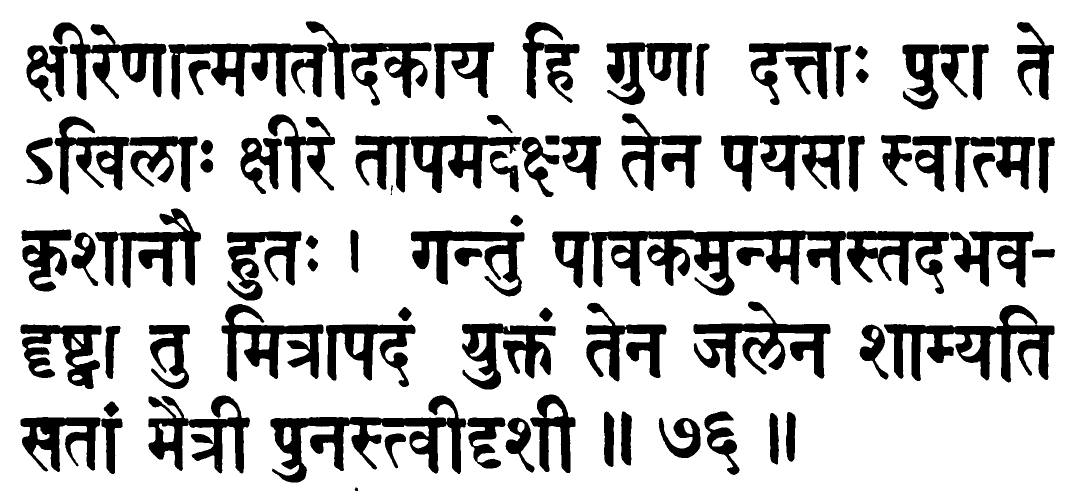
पानी के दुग्धमें मिलतेही दुग्धने अपने सब गुण पार्न को दे दिये । । इसही हेतु दुग्धका संताप देखकर पानी भी अपनी आत्माको अग्निमें हवन करने लगा । निज मित्र जलकी यह विपत्ति देख दुग्ध मनमलीन हुवा और अग्नि में पडकर आत्मनाश करने लगा । इस उफनते हुए दुग्धकी फिर उसही जलके प्रोक्षणसे शान्ति हुई । सत्पुरुषोंकी मित्रता ऐसीही होती है ॥ ७६ ॥
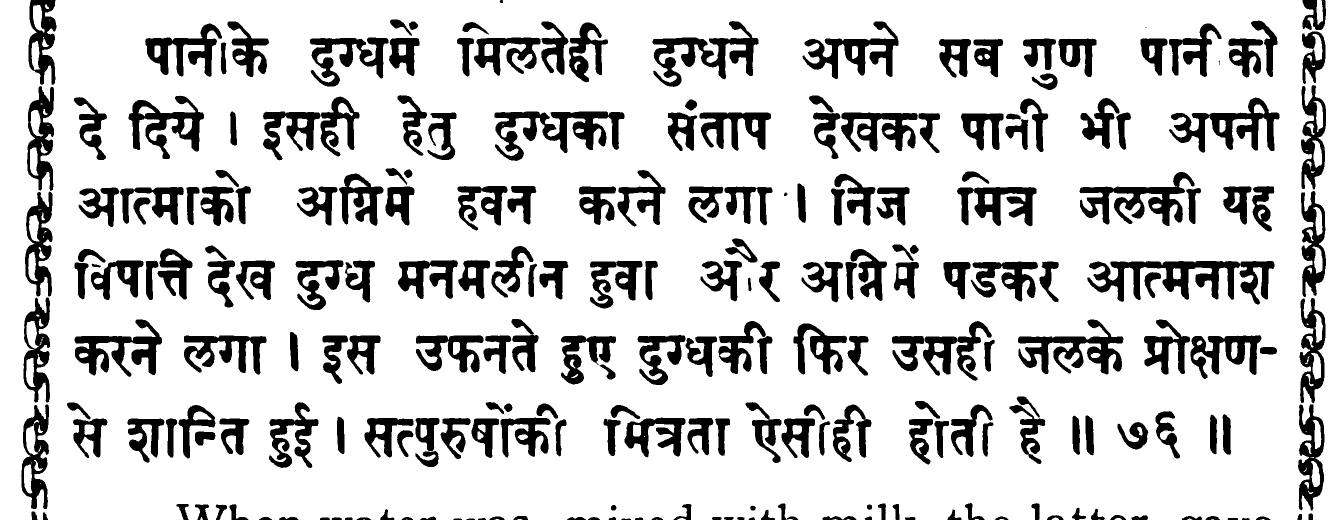
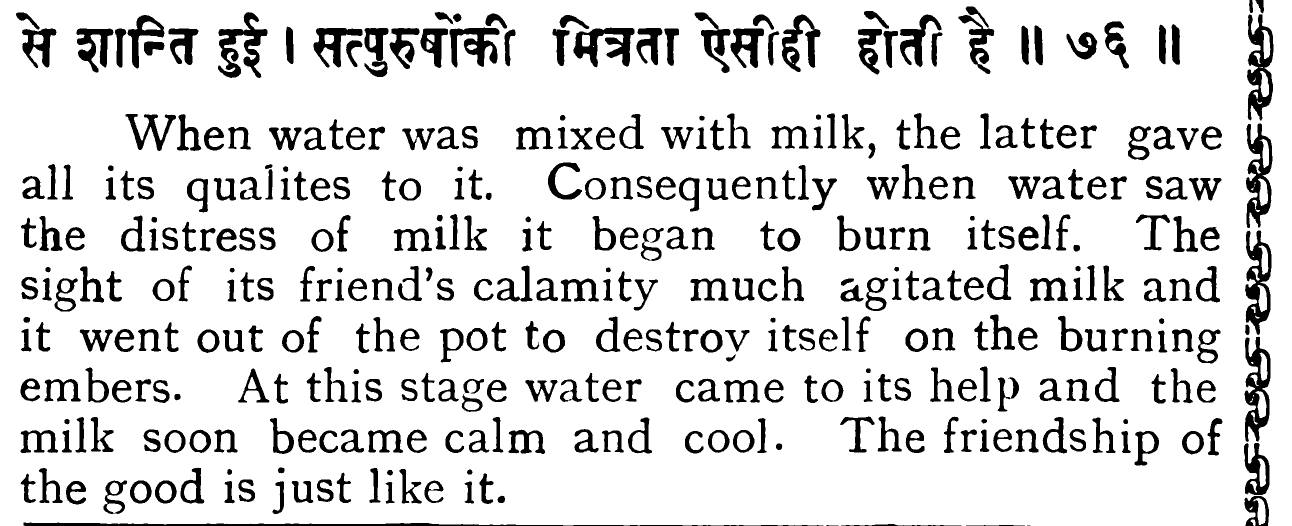
When water was mixed with milk, the latter gave all its qualites to it. Consequently when water saw the distress of milk it began to burn itself. The sight of its friend's calamity much agitated milk and it went out of the pot to destroy itself on the burning embers. At this stage water came to its help and the milk soon became calm and cool. The friendship of the good is just like it.
Footnote
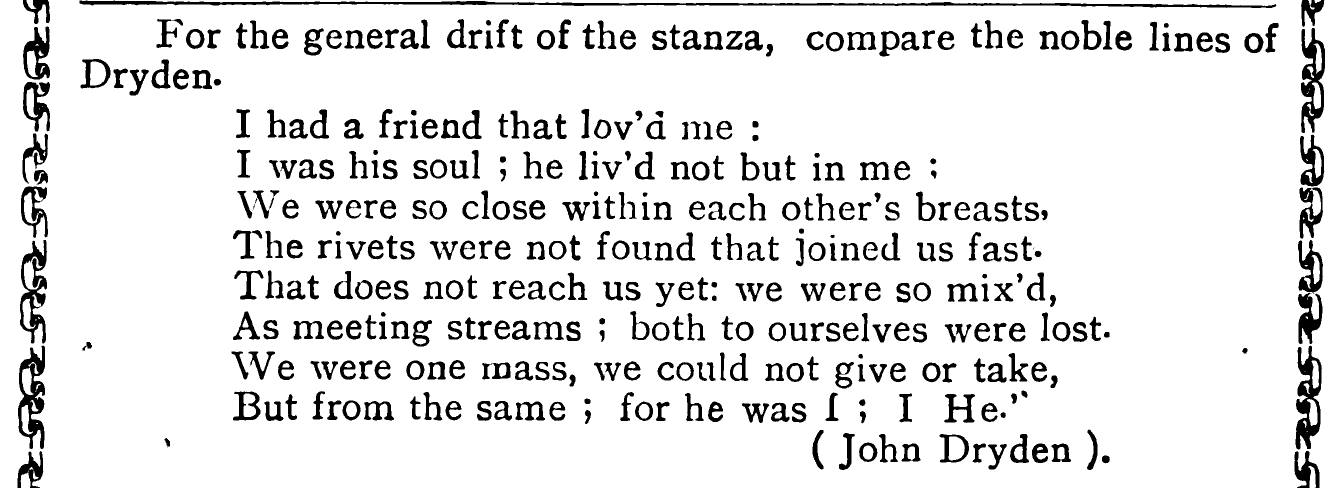
DrydenFor . the general drift of the stanza, compare the noble lines of I had a friend that lov'd me I was his soul ; he liv'd not but : in 5220252525 We were so close within each other's me breasts; , The rivets were not found that joined us fast. That does not reach us yet: we were so mix'd, As meeting streams; both to ourselves were lost. We were one mass, we could not give or take, But from the same ; for he was I ; I He." ( John Dryden ).
Gopinath1896
all
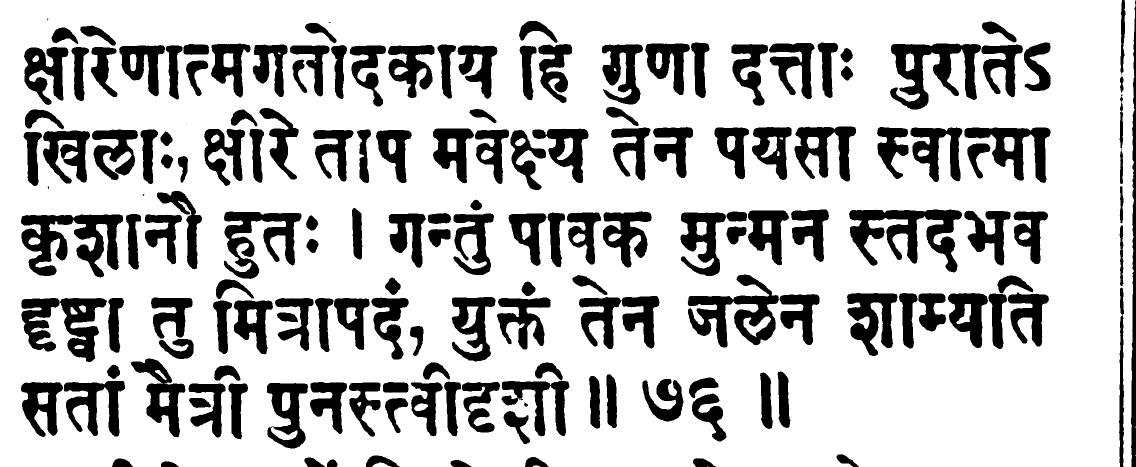
क्षीरेणात्मगतोदकाय हि गुणा दत्ताः पुरातेऽ
खिलाः, क्षीरे ताप मवेक्ष्य तेन पयसा स्वात्मा
कृशानौ हुतः । गन्तुं पावक मुन्मन स्तदभव
तु मित्रापदं युक्तं तेन जलेन शाम्यति
सतां मैत्री पुनस्त्वीदृशी ॥ ७६ ॥
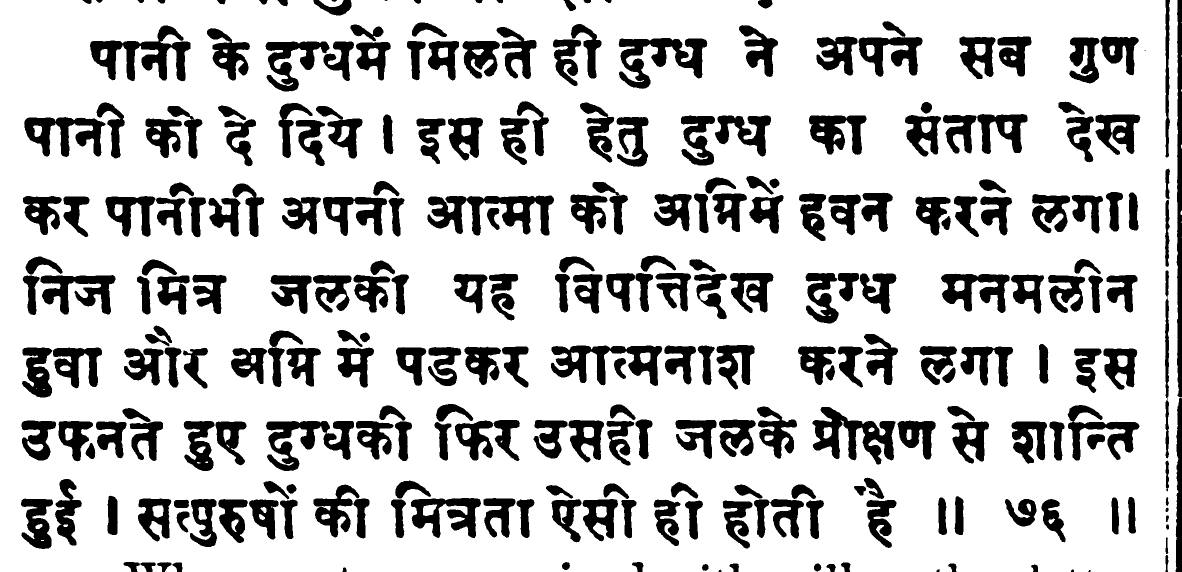
पानी के दुग्धमें मिलते ही दुग्ध ने अपने सब गुण पानी को दे दिये । इस ही हेतु दुग्ध का संताप देख कर पानी भी अपनी आत्मा को अभिमें हवन करने लगा। निज मित्र जलकी यह विपत्तिदेख दुग्ध मनमलीन हुवा और अभि में पडकर आत्मनाश करने लगा । इस उफनते हुए दुग्धकी फिर उसही जलके प्रोक्षण से शान्ति हुई । सत्पुरुषों की मित्रता ऐसी ही होती है ॥ ७६ ॥
When water was mixed with milk, the latter gave all its qualities to it. Consequently when water saw the distress of milk it began to burn itself. The sight of its friend's calamity much agitated milk and it went out of the pot to destroy itself on the burning embers. At this stage water came to its help and the milk soon became calm and cool. The friendship of the good is just like it.

I had was a friend soulthat ; lov'd me; ;
I his he liv'd not but in me
We were so close within each other's breasts,
The rivets were not found that joined us fast.
That does not reach us yet: we were so mix'd,
As meeting streams; both to ourselves were lost.
We were one mass, we could not give or take,
But from the same ; for he was I ; I He. "
Kosambi
all
क्षीरेणात्मगतोदकाय हि गुणा दत्ताः पुरा तेऽखिलाः
क्षीरे तापमवेक्ष्य तेन पयसा खात्मा कृशानौ हुतः ।
गन्तुं पावकमुन्मनस् तद्भवद् दृष्ट्वा तु मित्रापदं
युक्तं तेन जलेन शाम्यति सतां मैत्री पुनस् त्वीदृशी ॥ २८ ॥
Footnote
28 4 ) J1 क्षीरेणात्मगतो **** ; Y9-0 G2.3.6 -गतोदके ( Y8 ° को ) ननु ( for गतोदकाय
हि ) . C T2 हि पुरा ; E2 H सकला ( for हि गुणा ) . C T2 गुणास्तेखिला : ; Ea Hit ( com . as in
text ) . 2 निजा ये गुणाः ; J1 J 1 निजास्ते निजास्ते किल किल ; ; Y2 Y2 T3 T3 G5 G5 निजास्तेखिला निजास्तेखिलाः :; ; G1 M पुरा स्खे ( Ms. 5 ये ) .
खिला :. 4 ) C F5 J1.3 X 2 Y2.6 – 8 T1 G1 . 2. 4 M1-4 क्षीरो ( M4 ' रा ) तापम ; Esb शीरं तलम् ;
Y½ क्षारे तापम् . Eat अवेत्य ; X अवीक्ष्य ; T3 अपेक्ष्य ( for अवेक्ष्य ) . BEF4.5 H HJ J W
Y2.7 G2.8M1.5 ह्यात्मा ; CI [ अ ] प्यात्मा ( for स्वात्मा ) [ Original may have been * आत्मा
( with hiatus ) after cwesura ] . Y3 हतः ( for हुतः ) . www.g ● ) CYr Gst . v . उन्मुखं ; E2.8
Y Ye : Git . v . M3 - 5 उन्मनास ; G 1 उन्मुखास ; G + उन्मुनस् ( for उन्मनस् ) . Es समभक्द् ( for
तद ) . A Eot . 1.2 Fs G2t दृष्ट्वानु ; E3 दृष्ट्वात्म ; I 1 दृष्ट्वा स्व ( for दृष्ट्वा तु ) . d ) Xx मुर्ख ;
Ms यतं ( for युक्तं ) . X Y 1 तच्च ( for तेन ) . Ja ताम्यति ( for शाम्यति ) . B1 पुनर ; Ba
पयो ; Ec तमां ( for सतां ) . ACE2 W पुनस्तादृशी ; B B सतामीहशी ; D पुनस्स्वदशी ;
Fs Yo G2 . 3 गुणस्त्वीदृशः ; J1 * * * दृशी ; X Y 3 गुणास्त्वीदृशः ; Ya G1.4 M3 गुणास्त्वीदृशाः ;
Y4 पुनस्त्वीदृशः ; G5 पुरा त्वीदृशी ; M2 गुणस्त्वीदृशी .
BIS . 2026 ( 790 ) Bhartr . ed . Bobl . 2.67 . Haeb . 31. lith ed . I. 74 , II and
Galan 76. Subhash 306 ; SRB . p . 88.20 ; SRK . p . 55 11 ( Bh . ) ; SHV . f . 73 & .
810 ( Bh . ) ; SS.42 2 ; SSD . 2. f . 113 & ; SMV . 13 20 ; SKG f . 17 as
Commentary