Tawney
A snake lay helpless in the box pining for lack of meat,
A rat by night gnaws through the side, and yields his foe a treat,
With strength recruited then the snake by that same hole escapes,—
Behold how vain our efforts are! Fate all our fortune shapes.
More
XLVII
A captive snake half dead with fright
Starved in a basket; till one night
A silly mouse, who roamed abroad,
A hole straight through the wicker gnawed,
And in his very gullet jumped.
The serpent felt his thin sides plumped,
Took cheer, and wriggled out in turn. —
Who knows all lucky falls in Fortune's urn?
Telang
all
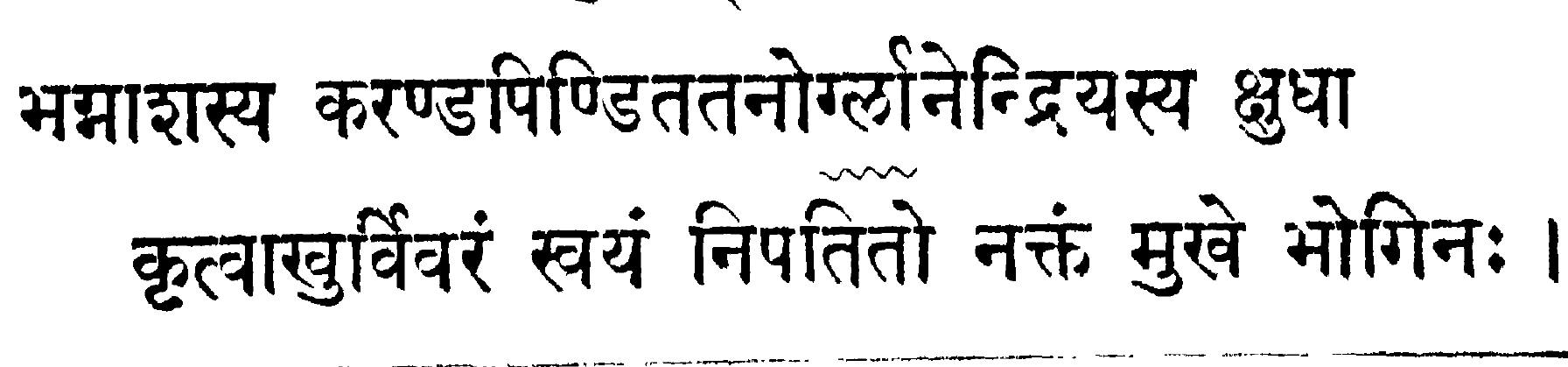
भग्नाशस्य करण्डपीडिततनोर्म्लानेन्द्रियस्य क्षुधा
कृत्वाखुर्विवरं स्वयं निपतितो नक्तं मुखे भोगिनः ।
तृप्तस्तत्पिशितेन सत्वरमसौ तेनैव यातः पथा
लोकाः पश्यत दैवमेव हि नृणां वृद्धौ क्षये कारणम् ॥ ८४ ॥


Notes
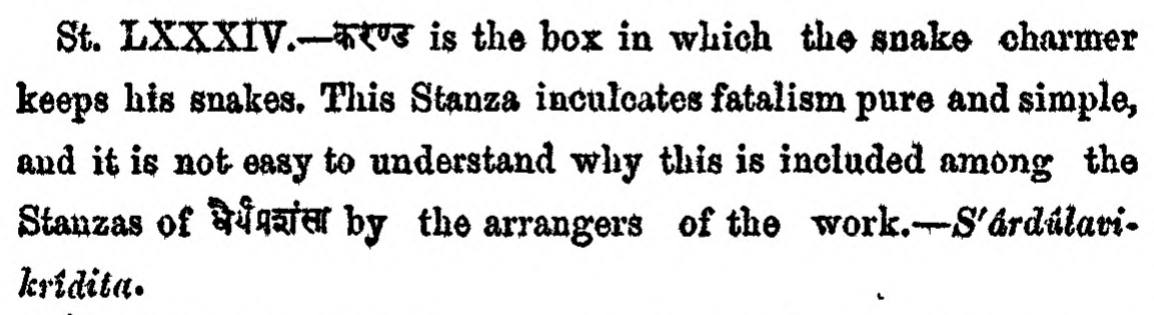
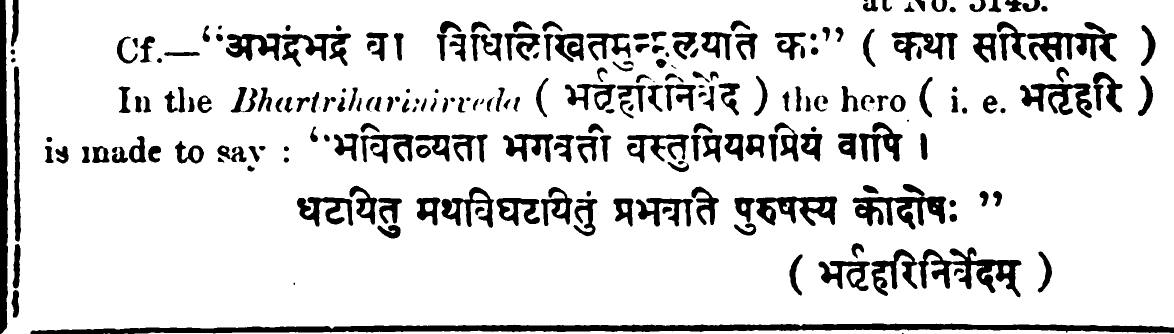
St. LXXXIV.—करण्ड is the box in which the snake charmer keeps his snakes. This Stanza inculcates fatalism pure and simple, and it is not easy to understand why this is included among the Stanzas of धैर्यप्रशंसा by the arrangers of the work.—S'ârdûlavikrîḍita.


Kale
all

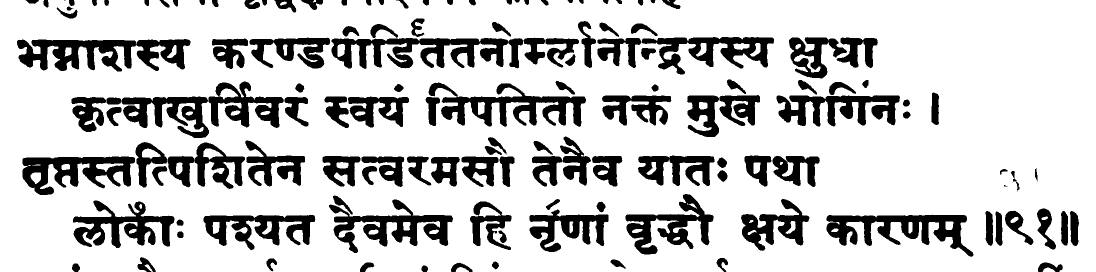
भग्नाशस्य करण्डपीडिततनोर्मूानेन्द्रियस्य क्षुधा
कृत्वाखुर्विवरं स्वयं निपतितो नक्तं मुखे भोगिनः ।
तृप्तस्तत्पिशितेन सत्वरमसौ तेनैव यातः पथा
लोकाः पश्यत दैवमेव हि नृणां वृद्धौ क्षये कारणम् ॥९१॥
Notes
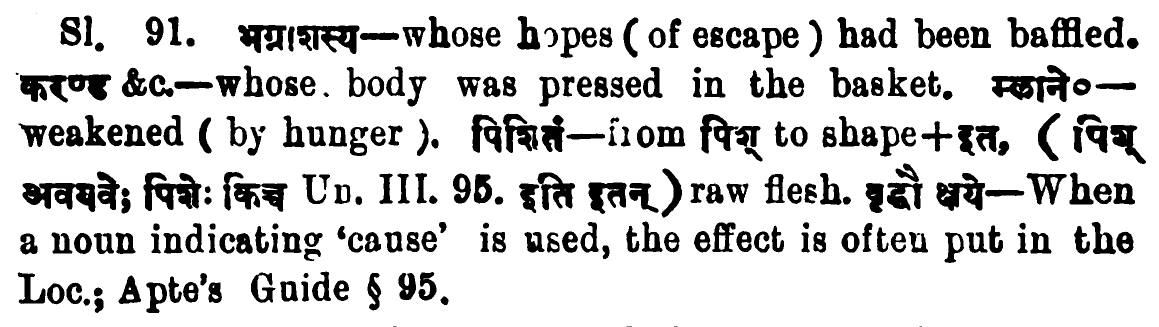
Sl. 91. भग्नाशस्य—whose hopes ( of escape ) had been baffled. करण्ड &c.—whose body was pressed in the basket. म्लाने०— weakened ( by hunger ). पिशितं—from पिशू to shape + इत, ( पिश् अवयवे; पिशेः किच्च Un. III. 95. इति इतन् ) raw flesh. वृद्धौ क्षये—When a noun indicating ‘cause’ is used, the effect is often put in the Loc.; Apte’s Guide § 95.
Gopinath1914
all
भग्नाशस्य करण्डपीडिततनोम्लानेन्द्रियस्य
क्षुधा कृत्वाऽखुर्विवरं स्वयं निपतितो नक्तं
मुखे भोगिनः ॥ तृप्तस्तत्पिशितेन सत्वरम-
सौ तेनैव यातः पथा लोकाः पश्यत दैवमेव हि
नृणां वृद्धौ क्षये कारणम् ॥ ८५ ॥
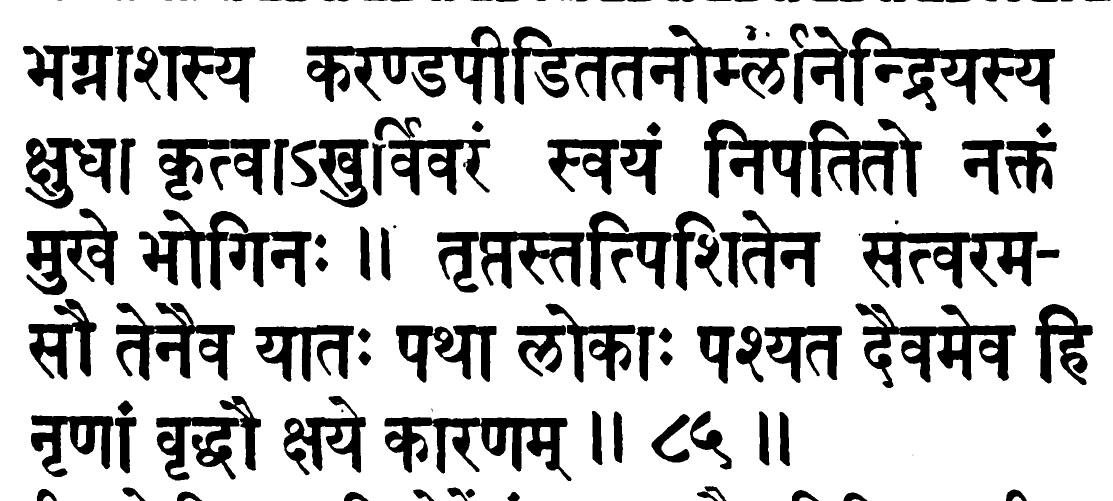
जीवनसे निराश, पिटारेमें बंद हुवा और शिथिल शरीरवाला सर्प जब क्षुधासे अत्यंत व्याकुल होरहाथा तब रात्रिके समय एक चूहा ( मूषक ) किसी खाद्यपदार्थकी आशंकासे पिटारी छेद करके उसके भीतर गया और जातेही उस सर्पका ग्रास बना कि जिसकी क्षुधा निवृत्त हुई और वह उसही मार्गसे शीघ्र बाहिर निकलकर स्वतंत्र भी होगया । इसलिए हे मनुष्यो ! तुमको उचित है कि अपनी वृद्धि और क्षयका कारण एकमात्र दैवहीको समझते रहो ॥ ८५ ॥
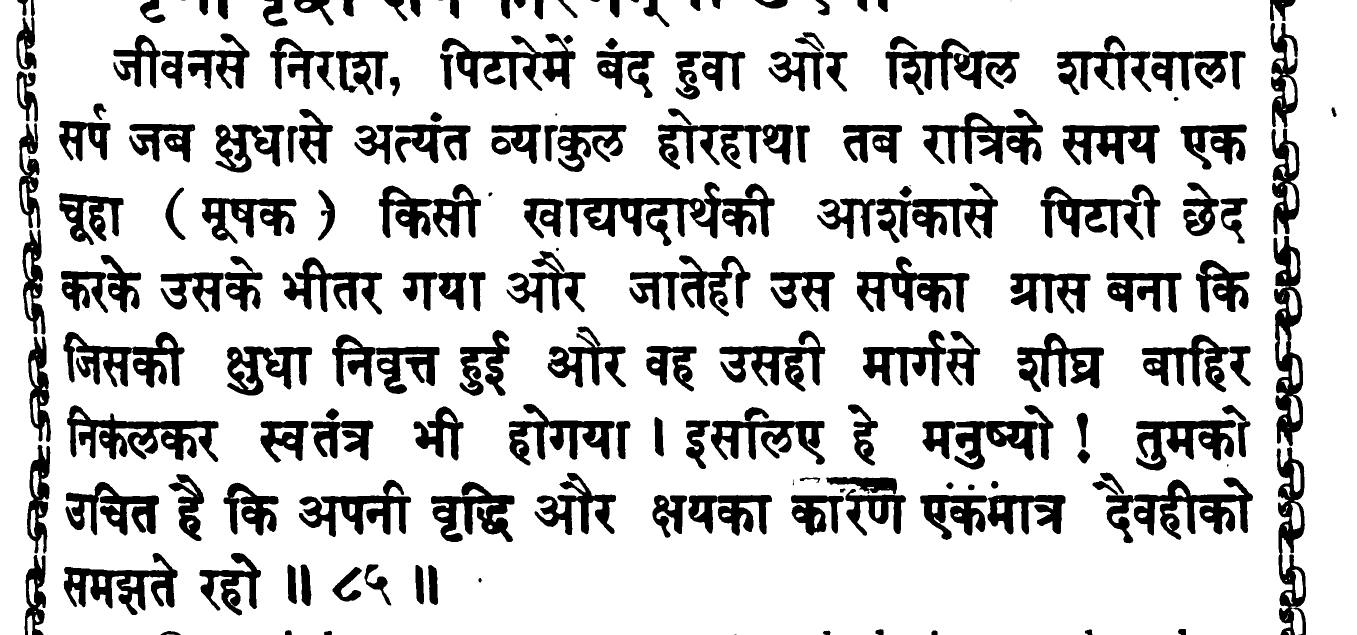
One night a mouse cut out a hole into a bamboo basketmorsel , and of thus a hungry entering into its interiorhad , longit became been the serpent that , imprisoned power and hope thereof , and consequently ; but having deprived appeased of all further lifeits hunger now by the flesh of the mouse God had sent it, it out of its prison by the same path and became came a free creature. Here you see that fate and fate alone is the real cause of good and evil to all men.



Gopinath1896
all
भग्नाशस्य करण्डपीडिततनोम्लीनेन्द्रियस्य
क्षुधा, कृत्वाऽखुर्विवरं स्वयं निपतितो नक्तं
मुखे भोगिनः । तृप्तस्तत्पिशितेन सत्वरम-
सौ तेनैव यातः पथा, लोकाः पश्यत देव मेवहि
नृणां वृद्धौ क्षये कारणम् ॥ ८५ ॥
जीवन से निराश, पिटारे में बंद हुवा और शिथिल शरीरवाला सर्प जब क्षुधास अत्यंत व्याकुलहो रहाथा तब रात्रिके समय एक चूहा ( मूषक ) किसी खाद्यपदार्थ की आशंका से पिटारी छेद करके उसके भीतर गया और जाते ही उस सर्पका ग्रास बना कि जिसकी क्षुधा निवृत्त हुई और वह उसही मार्गसे शीघ्र बाहिर निकल कर स्वतंत्र भी होगया । इसलिए हेमनुष्यो ! ! तुमको उचित है कि अपनी वृद्धि और क्षयका कारण एकमात्र दैवही को समझते रहो ॥ ८५ ॥
One night a mouse cut out a hole into a bamboo basket, and thus entering into its interior, it became the morsel of a hungry serpent that had long been imprisoned there, and consequently deprived of all power and hope of further life; but having appeased its hunger by the flesh of the mouse God had sent it, it now came out of its prison by the same path and became a free creature. Here you see that fate and fate alone is the real cause of good and evil to all men.

Kosambi
all
तृप्तस्तत्पिशितेन सत्वरमसौ तेनैव यातः पथा
स्वस्थास् तिष्ठत दैवमेव हि नृणां वृद्धौ क्षये चाकुलम् ॥२६ ॥

Footnote
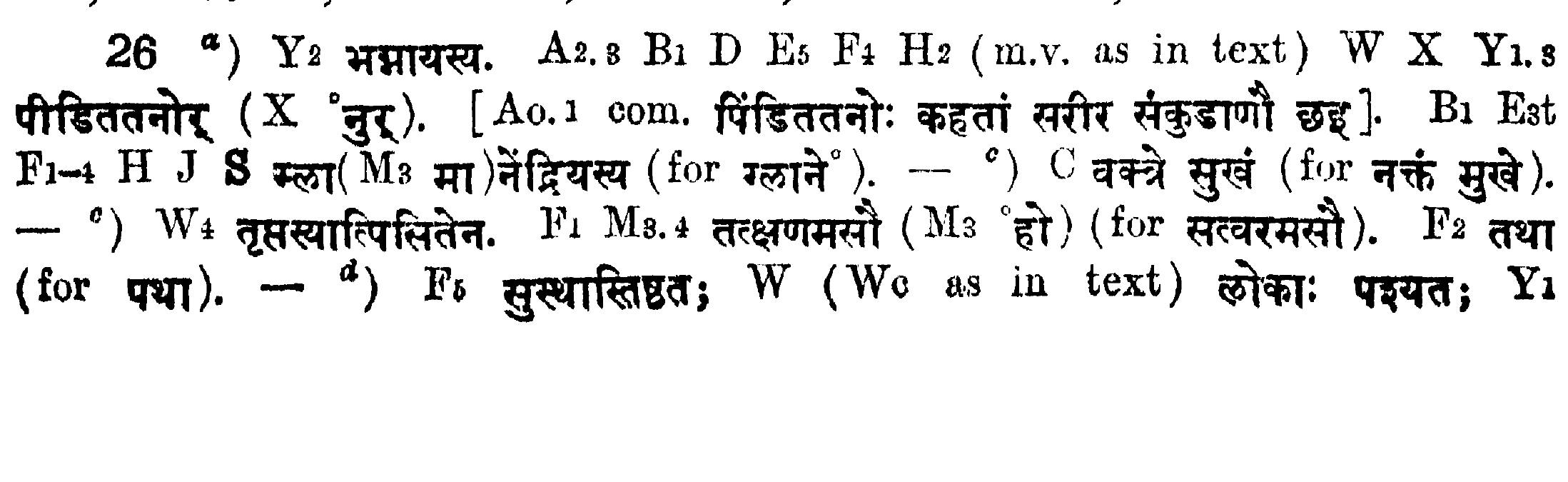
26 " ) Y2 भन्नायस्य . A2.8 B1 DE5 F1 H 2 ( m.v as in text ) W X Y1.3
पीडिततनोइ ( X नुइ ) . [ Ao . 1 com . पिंडिततनोः कहतां सरीर संकुडाणौ छइ ] . B1 Est
F1 ~ 4 H_J_S म्ला ( M3 मा ) नेंद्रियस्य ( for ग्लाने ) . H ● ) C वक्त्रे सुखं ( for नक्तं मुखे ) .
4 ) W + तृप्तस्यात्पिलितेन . F1 M3 . + तत्क्षणमसौ ( M 3 ' हो ) ( for सत्वरमसौ ) . F2 तथा
( for पथा ) . 4 ) Fs सुस्थास्तिष्ठत ; W ( We as in text ) लोकाः पश्यत ; Y1
Footnote
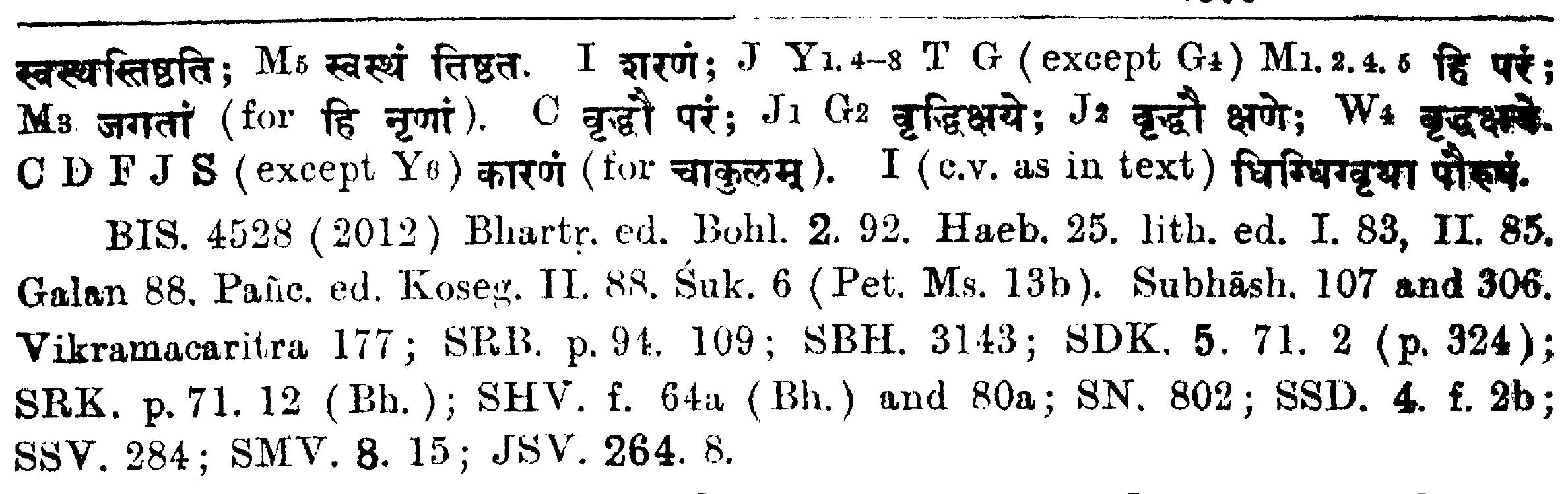
स्वस्थस्तिष्ठति ; Ms स्वस्थं तिष्ठत . I शरणं ; J Y1 . 4 - 8 T G ( except G + ) M1 . 2.4.6 हि परं ;
Ms. जगतां ( for हि नृणां ) . C वृद्धौ परं ; J1 G2 वृद्धिक्षये ; J2 वृद्धौ क्षणे ; W + बृद्धक्षके .
C D F J S ( except Yo ) कारणं ( for चाकुलम् ) . I ( c.v. as in text ) धिम्धिग्वृथा पौरुष .
BIS . 4528 ( 2012 ) Bhartr ed . Bohl . 2. 92. Haeb 25 lith ed . I. 83 , II . 85 .
Galan 88. Paiic . ed . Koseg . II . 88. Suk . 6 ( Pet Ms. 13b ) . Subhāsh . 107 and 306 .
Vikramacaritra 177 ; SRB p . 94 " 109 ; SBH . 3143 ; SDK 5.71 2 ( p . 324 ) ;
SRK . p . 71.12 ( Bh . ) ; SHV . f . 64a ( Bh . ) and 80 & ; SN . 802 ; SSD . 4. f . 2b ;
SSV . 284 ; SMV . 8. 15 ; JSV . 264. 8 .
Commentary